





Key takeaways:
- A successful Rehlat-like app needs reliable flight and hotel APIs, secure payments, scalable architecture, and a smooth booking experience.
- Building an app like Rehlat can cost $25,000–$90,000, depending on features, integrations, platforms, and complexity.
- Arabic RTL support, local currencies, regional payments, and personalized offers can help target UAE and GCC travelers effectively.
- AI recommendations, predictive fare intelligence, loyalty programs, and smart rebooking can differentiate the platform from traditional travel booking apps.
Travelers now expect to search, compare, book, and manage trips from a single mobile experience. This demand has created opportunities for businesses looking to build an app like Rehlat with integrated flight, hotel, payment, and travel management capabilities. However, developing a competitive platform requires more than replicating Rehlat’s interface or booking screens. A successful travel platform needs real-time inventory, reliable API integrations, secure payment processing, scalable booking architecture, and personalized user experiences. Businesses also need to consider localization, multilingual support, loyalty programs, and regional payment preferences when targeting the Middle East.
This guide explains how to develop an app like Rehlat, covering the development process, essential features, travel APIs, technology stack, security requirements, development cost, timeline, and monetization strategies needed to launch a scalable travel booking platform.
What is Rehlat and How Does It Work?
Rehlat is an online travel booking platform that brings flight and hotel reservations into one digital experience. Travelers can search, compare, book, pay, and manage trips from a single platform. Businesses planning an online travel agency app can use this model to connect multiple travel suppliers with a unified customer experience. A travel app development company can build similar functionality by combining travel APIs, booking engines, payment gateways, and scalable backend services.
How Does a Rehlat-Like Platform Work?
The core booking workflow typically follows these steps:
- 1. User searches for travel: The traveler enters the destination, dates, passenger details, cabin preferences, or hotel requirements.
- 2. APIs retrieve inventory: Flight and hotel APIs or GDS systems send available inventory, fares, room rates, and booking conditions to the platform.
- 3. Data is processed: The backend normalizes supplier responses and organizes prices, availability, baggage, cancellation policies, and other booking information.
- 4. User compares options: The platform displays relevant flights or accommodations with filters for price, duration, ratings, amenities, and other preferences.
- 5. Booking is initiated: After selecting an option, the booking engine validates availability and sends the reservation request to the appropriate supplier.
- 6. Payment is processed: The payment gateway securely authorizes the transaction and returns the payment status to the booking system.
- 7. Reservation is confirmed: The platform receives the booking reference, ticket, or hotel voucher and delivers confirmation through the app, email, or messaging channels.
- 8. Trip management continues: Users can access reservations, receive travel alerts, request cancellations, track refunds, and manage eligible booking changes.
Answer a few quick questions and our experts will share a tailored project estimate.
Why Invest in a Rehlat-Like Travel Booking App?
The Middle East is becoming an increasingly attractive market for digital travel businesses. According to the World Travel & Tourism Council (WTTC), Travel & Tourism in the Middle East grew 5.3% in 2025, exceeding the global growth rate of 4.1%. The sector contributed $385.8 billion to regional GDP and supported 7.1 million jobs.
This growth creates a strong opportunity to build an app like Rehlat that combines flights, hotels, payments, and travel services in one mobile experience. Businesses can generate revenue through flight and hotel commissions, convenience fees, insurance, premium memberships, and cross-selling.
A localized Rehlat-like travel booking app can also serve UAE and GCC travelers with Arabic interfaces, local currencies, flexible payment options, and personalized recommendations. Loyalty programs and targeted offers can further encourage repeat bookings, while integrated travel services can increase revenue per customer. For businesses entering this market, working with a specialized travel app development solution can help translate these requirements into a scalable product.
Industry Insight
According to Booking.com, 89% of consumers want to use AI in future travel planning, showing how AI-powered recommendations and itinerary planning are becoming important features for travel platforms.
Step-by-Step Process to Build an App Like Rehlat
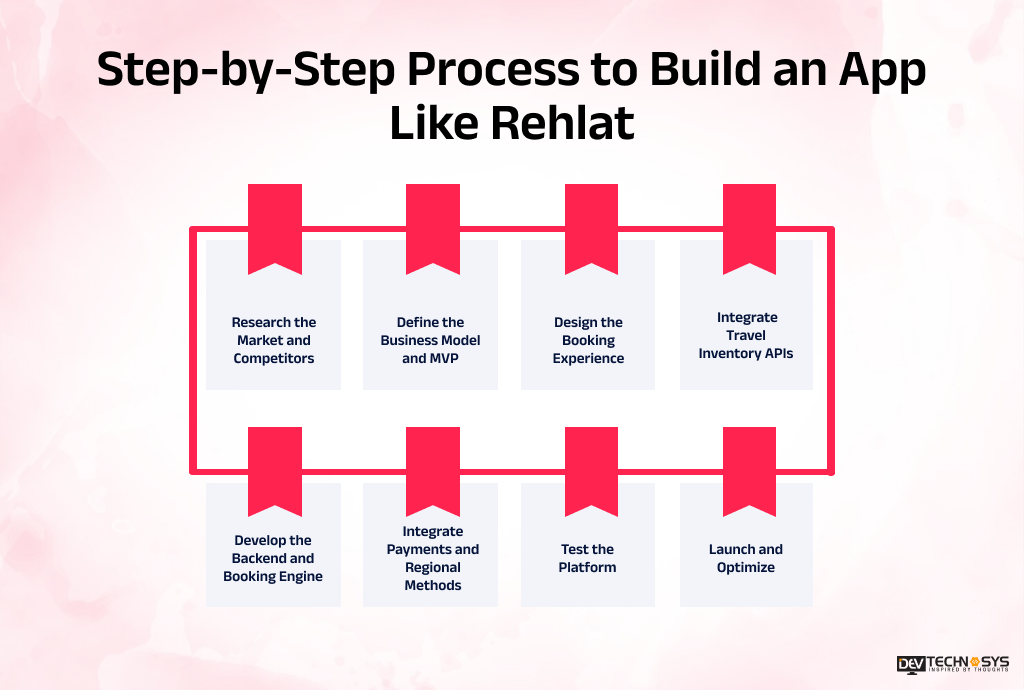
Building an app like Rehlat requires a structured product strategy before developers begin writing code. The process should connect business goals, travel inventory, booking workflows, payments, and user experience into one scalable system.
1. Research the Market and Competitors
Start by studying Rehlat and competing OTAs to understand their booking journeys, pricing models, loyalty programs, payment options, localization, and customer support. Rehlat’s own support resources show that its booking ecosystem covers flight searches, payment, cancellations, refunds, booking changes, rewards, and hotel reservations.
This research helps identify gaps that a new product can address instead of simply copying an existing interface.
2. Define the Business Model and MVP
Next, determine whether you want to create an app like Rehlat focused on flights, hotels, or both. Define the revenue model and prioritize the minimum viable product around high-value booking workflows. Businesses should also evaluate target users, markets, suppliers, and operational requirements before finalizing the scope. Following these things to consider, travel app development helps reduce unnecessary development work and keeps the MVP focused.
3. Design the Booking Experience
Create a search-first interface that makes travel discovery simple. The UX should support clear filters, fair comparison, transparent pricing, Arabic RTL layouts, and a streamlined checkout process. The objective is to reduce friction between search and confirmed booking.
4. Integrate Travel Inventory APIs
Connect the platform with flight and hotel suppliers through APIs and GDS providers. The integration layer should retrieve availability, fares, room rates, baggage information, and booking conditions. Supplier responses should then be normalized before being displayed to users.
5. Develop the Backend and Booking Engine
Build the core backend around authentication, search, inventory, booking, payment, loyalty, and notification services. Redis can support frequently accessed data, while the booking engine should use idempotency controls to prevent duplicate reservations or payment requests.
6. Integrate Payments and Regional Methods
Add secure card processing, digital wallets, currency handling, 3D Secure, and refund workflows. Payment status should remain synchronized with booking status so a successful transaction does not create an inconsistent reservation.
7. Test the Platform
Conduct functional, API, security, payment, load, localization, and cross-device testing. Test failure scenarios such as supplier timeouts, price changes, failed payments, and incomplete booking responses before production deployment.
8. Launch and Optimize
After launch, monitor crashes, API performance, booking conversions, checkout abandonment, and user behavior. Continuous testing and optimization can improve the platform as traffic, suppliers, and customer requirements grow. Businesses can also use specialized travel app development services to support ongoing technical improvements.
Essential Features to Build an App Like Rehlat
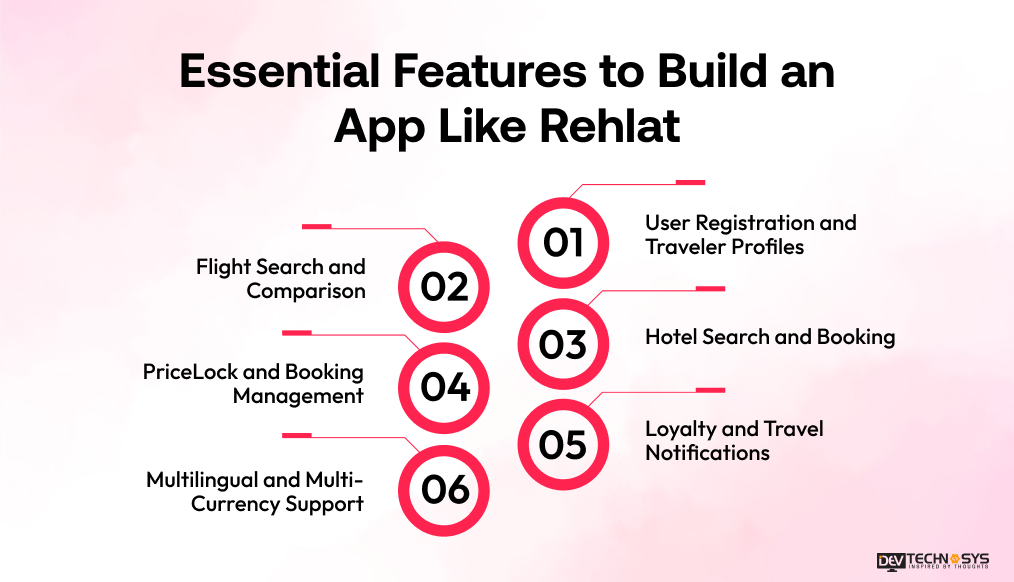
A competitive Rehlat-like platform needs features that simplify travel discovery, booking, and post-booking management. The priority should be a reliable booking journey rather than an overloaded interface.
User Registration and Traveler Profiles
Users should be able to register through mobile OTP or social login, create traveler profiles, save passenger details, manage preferences, and access previous bookings. This reduces repetitive data entry during checkout.
Flight Search and Comparison
A robust flight booking app should support one-way, round-trip, and multi-city searches with flexible dates and cabin selection. Comparison tools should organize fares by price, duration, stops, baggage allowance, refundability, and departure times, helping users make faster decisions.
Hotel Search and Booking
The hotel booking app should let travelers search destinations, dates, rooms, and guests while comparing properties by price, ratings, amenities, location, and cancellation policies. A streamlined accommodation booking flow should display important conditions before payment.
PriceLock and Booking Management
A Rehlat clone app can include fare-locking functionality that temporarily holds selected prices before payment. The booking dashboard should provide PNRs, tickets, hotel vouchers, cancellation options, modifications, and refund status in one place.
Loyalty and Travel Notifications
Rewards, cashback, referral benefits, and wallet credits can encourage repeat bookings. Real-time notifications should cover booking confirmations, flight changes, reminders, price alerts, and other important trip updates.
Multilingual and Multi-Currency Support
For a Middle East travel booking app, Arabic and English interfaces, RTL layouts, local currencies, localized pricing, and regional payment preferences are important. Businesses planning to develop a travel app like AlmoSafer can use similar regional localization strategies to make the booking experience more relevant to Middle Eastern travelers.
Advanced Features to Make Your App Better Than Rehlat
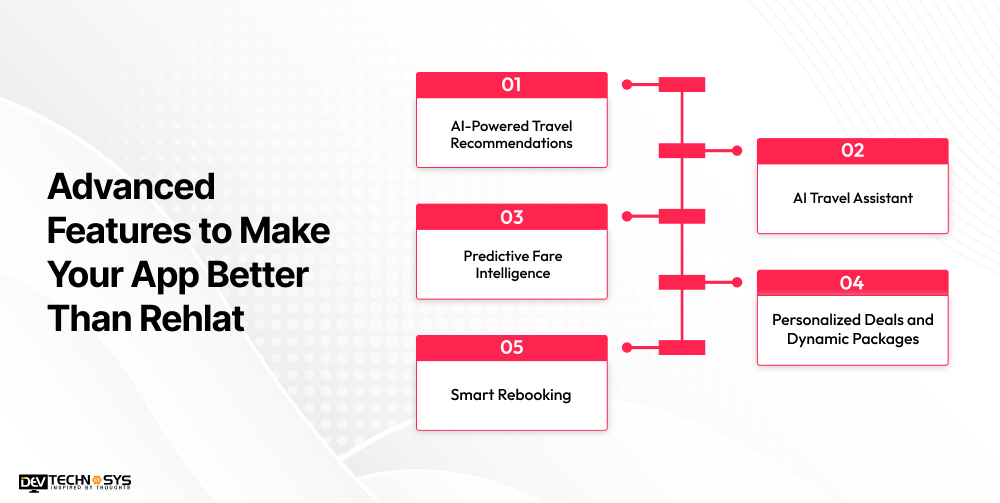
Basic booking functionality can help a new platform enter the market, but differentiation requires features that improve discovery, personalization, and booking confidence. These capabilities can help businesses create an app like Rehlat that delivers more value than a standard OTA interface.
AI-Powered Travel Recommendations
AI can analyze search behavior, previous bookings, preferred destinations, budgets, and travel dates to recommend relevant flights, hotels, and packages. This reduces search time while creating a more personalized discovery experience.
AI Travel Assistant
An AI assistant can help travelers plan trips through conversational interactions. It can suggest destinations, compare travel options, answer booking questions, and support itinerary planning without forcing users through multiple screens.
Predictive Fare Intelligence
A Rehlat alternative can use historical pricing patterns and real-time fare data to identify potential price movements. Users can receive fare alerts and recommendations about when to book, helping them make more informed purchasing decisions.
Personalized Deals and Dynamic Packages
Businesses can create an app like Rehlat with personalized offers based on traveler preferences and booking history. Dynamic flight and hotel bundles, loyalty-based discounts, and destination-specific packages can increase cross-selling opportunities.
Smart Rebooking
A similar app like Rehlat can monitor eligible disruptions and present alternative flights when schedules change. Automated recommendations can simplify rebooking while reducing customer-support workload.
Industry Insight
According to IATA, travelers are increasingly using smartphones to book flights, manage payments and loyalty programs, and handle check-in and other travel processes.
Third-Party APIs and Integrations Required to Develop an App Like Rehlat
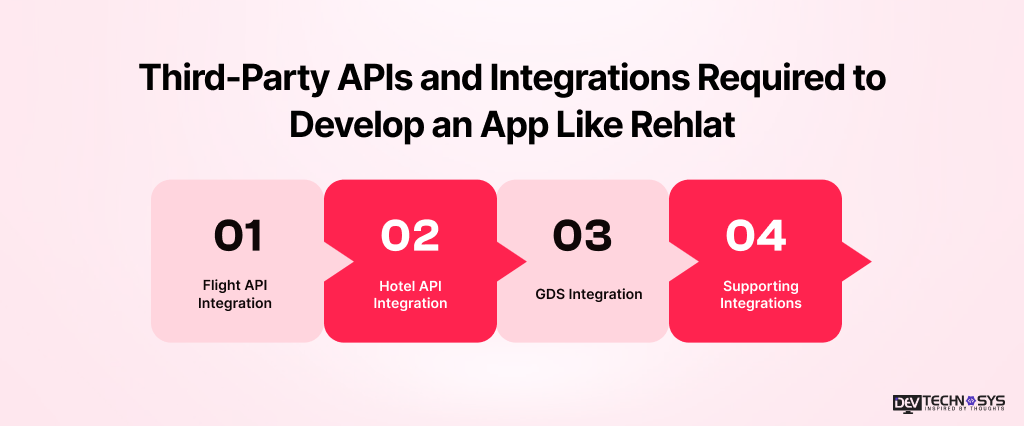
A Rehlat-like travel platform depends on third-party integrations to access real-time inventory and complete reservations. The integration layer should connect suppliers with the booking engine while normalizing different data formats and responses.
Flight API Integration
Flight API integration provides schedules, fares, seat availability, baggage information, and booking capabilities. The system should validate availability again before payment because airline fares and inventory can change rapidly.
Hotel API Integration
Hotel API integration connects the platform with property inventory, room rates, amenities, availability, and cancellation policies. Hotel data should be normalized so users can compare properties from multiple suppliers consistently.
GDS Integration
GDS integration provides broader airline inventory and supports search, fare availability, reservations, and ticketing. Depending on the target market and supplier strategy, businesses may also consider Amadeus API integration and Sabre API integration for additional travel inventory and booking connectivity.
Supporting Integrations
A complete platform may also require payment gateways, currency conversion, maps, communication services, analytics, and notification APIs. Businesses working with a specialized iOS app development company should also plan for API rate limits, timeout handling, retries, webhooks, supplier fallbacks, and response normalization.
The typical integration flow is:
User Request → API Gateway → Supplier API/GDS → Data Normalization → Availability Validation → Booking → Confirmation
This architecture helps maintain consistent booking workflows even when multiple travel suppliers use different API structures.
Technology Stack to Make an App Like Rehlat
The technology stack should support real-time travel searches, high-volume API requests, secure transactions, and scalable booking workflows. The right combination depends on platform requirements, expected traffic, integration complexity, and long-term maintenance needs. For businesses evaluating Android app development, Kotlin can provide a strong native foundation, while Flutter or React Native can reduce duplicated development across platforms.
Technology Layer |
Recommended Technology |
Role in the Travel Platform |
| iOS Application | Swift | Builds high-performance native iOS experiences with reliable access to device capabilities. |
| Android Application | Kotlin | Supports stable Android applications with strong performance and modern platform APIs. |
| Cross-Platform | Flutter / React Native | Enables shared codebases when faster multi-platform delivery is a priority. |
| Web Frontend | React.js | Powers responsive customer portals, supplier dashboards, and administrative interfaces. |
| Backend | Node.js / NestJS | Handles booking APIs, authentication, business logic, supplier communication, and transaction workflows. |
| Database | PostgreSQL / MongoDB | PostgreSQL manages structured booking data, while MongoDB can support flexible travel and content data. |
| Cache | Redis | Reduces response times for frequently accessed search, session, and temporary booking data. |
| Search Engine | Elasticsearch | Enables fast filtering and searching across flights, hotels, destinations, and travel inventory. |
| Cloud Infrastructure | AWS / Google Cloud | Provides scalable computing, storage, load balancing, monitoring, and disaster recovery capabilities. |
| Notifications | Firebase / SMS APIs | Delivers push notifications, booking alerts, reminders, and travel updates. |
| Monitoring | CloudWatch / Grafana | Tracks application health, API performance, errors, and infrastructure metrics. |
Scalable Architecture for a Rehlat-Like App
A scalable architecture allows a travel platform to handle concurrent searches, supplier requests, bookings, and payments without affecting user experience. A modular, API-first design also makes it easier to add new suppliers and services as the platform grows.
Architecture Flow
Mobile/Web Apps → API Gateway → Core Services → Travel Aggregation Layer → Airline APIs, Hotel APIs & GDS → Database, Cache & Message Queue
The API gateway acts as the central entry point for authentication, routing, rate limiting, and request validation. Behind it, separate services can manage search, inventory, booking, payments, loyalty, and notifications.
The travel aggregation layer normalizes responses from different suppliers so the application can present consistent fares, availability, room rates, and booking conditions. Redis can cache frequently requested search data, while message queues handle asynchronous tasks such as notifications and booking updates.
For businesses planning to develop an app like Rehlat, idempotent booking requests are important because they help prevent duplicate reservations when users retry failed transactions. Load balancing and horizontal scaling can then distribute traffic during peak travel periods. Working with a specialized mobile app development company can help align this architecture with expected traffic, platform requirements, and future integrations.
Security and Compliance Requirements for a Rehlat-Like App
A travel booking platform processes personal details, payment transactions, booking records, and supplier credentials, making security a core architectural requirement. Protection should be applied across the application, APIs, infrastructure, and administrative systems.
API Security and Access Control
Strong API security should include TLS encryption, OAuth 2.0, secure API-key storage, rate limiting, input validation, and monitoring of suspicious requests. Role-based access control should restrict customers, support agents, finance teams, suppliers, and administrators to only the data and functions they require.
Multi-Factor Authentication
Multi-factor authentication can protect administrator and staff accounts from credential-based attacks. Additional verification can also be required for sensitive actions such as changing payment details or accessing high-risk account functions.
Payment and Data Protection
PCI DSS compliance should guide secure payment processing, tokenization, and protection of cardholder data. GDPR compliance requires appropriate consent, data minimization, retention controls, and mechanisms for handling user data requests. The platform should also maintain encryption, audit logs, vulnerability monitoring, and controlled access to sensitive records.
For enterprise operations, SOC 2 compliance can strengthen controls around security, availability, and confidentiality. HIPAA compliance is only relevant if the platform handles protected health information, which is not a standard requirement for travel applications. Businesses evaluating mobile app development costs should include security engineering and compliance requirements in the initial budget rather than treating them as post-launch additions.
How Much Does It Cost to Build an App Like Rehlat?
The cost to build an app like Rehlat generally ranges from $25,000 to $90,000, depending on the platform scope, feature complexity, travel API integrations, design requirements, security controls, and development team location. A basic MVP needs fewer integrations and workflows, while an advanced platform requires sophisticated booking, personalization, payment, and supplier management capabilities.
App Type |
Estimated Cost |
Timeline |
| Basic Travel MVP | $25,000–$40,000 | 3–4 months |
| Mid-Level Travel Booking App | $40,000–$65,000 | 4–6 months |
| Advanced Rehlat-Like Platform | $65,000–$90,000 | 6–8 months |
What Affects Rehlat-Like App Development Cost?
- Feature complexity: Advanced search, loyalty programs, fare locking, AI recommendations, and automated rebooking increase development effort.
- API and GDS integrations: Flight, hotel, payment, and supplier integrations require additional development, testing, and ongoing maintenance.
- UI/UX design: Multilingual interfaces, Arabic RTL support, personalized dashboards, and optimized checkout flows require additional design work.
- Technology architecture: Scalable backend services, cloud infrastructure, databases, caching, and monitoring influence both development and infrastructure costs.
- Security requirements: Encryption, access controls, payment security, compliance, and vulnerability testing add specialized engineering work.
- Development team: Developer rates vary based on expertise, location, team structure, and engagement model.
For a more detailed pricing breakdown, businesses can review travel app development costs before finalizing their product scope and development budget.
How Long Does It Take to Build an App Like Rehlat?
The development timeline depends on the platform scope, number of integrations, booking complexity, testing requirements, and team size. A focused MVP can launch faster, while a feature-rich OTA requires more time for supplier integrations and quality assurance.
Development Stage |
What Happens in This Stage? |
Estimated Timeline |
| Market Research & Planning | Define target users, business model, MVP scope, competitors, travel suppliers, and technical requirements. | 2–3 weeks |
| UI/UX Design | Create user flows, wireframes, booking screens, navigation, responsive layouts, and Arabic RTL interfaces. | 3–4 weeks |
| Frontend Development | Build search, flight, and hotel listings, filters, booking screens, profiles, payments, and account interfaces. | 5–7 weeks |
| Backend & Booking Engine | Develop APIs, authentication, booking logic, inventory management, payment workflows, databases, and administrative services. | 6–8 weeks |
| API/GDS Integrations | Connect flight, hotel, GDS, payment, notification, and other third-party services and validate supplier responses. | 3–5 weeks |
| Testing & Security | Perform functional, API, performance, payment, security, compatibility, and user acceptance testing. | 3–4 weeks |
| Deployment | Configure production infrastructure, monitoring, app-store submissions, release processes, and post-launch tracking. | 1–2 weeks |
These activities can overlap when separate teams work on design, frontend, backend, and integrations simultaneously. Businesses choosing hybrid app development services can also reduce duplicated platform development when the product requirements suit a shared codebase. However, complex supplier approvals, API dependencies, payment certification, and extensive testing can extend the final launch timeline.
Industry Insight
According to Phocuswright, the travel industry is moving from AI systems that simply answer questions toward AI agents capable of taking actions across travel discovery, booking, payments, and trip management.
How Does a Rehlat-Like App Make Money?
A Rehlat-like travel platform can generate revenue through multiple streams instead of relying on booking volume alone. A diversified monetization model can improve margins while giving suppliers and travelers more ways to engage with the platform.
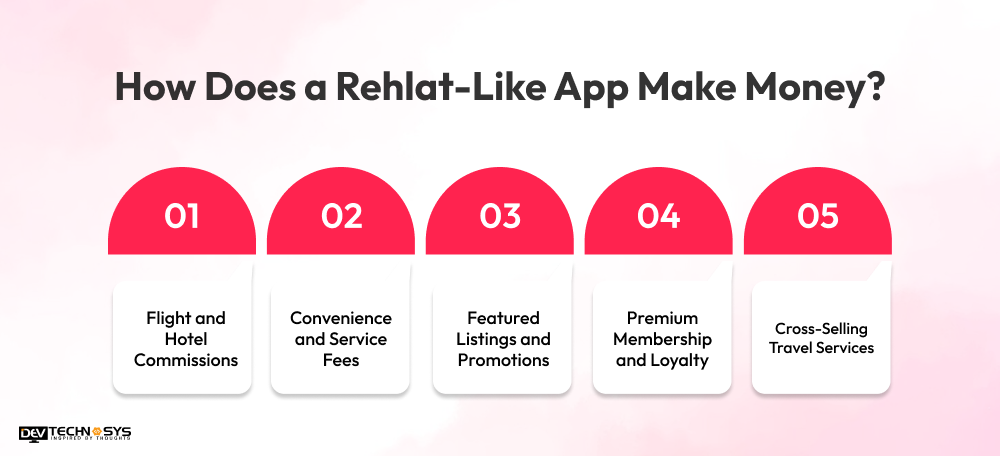
Flight and Hotel Commissions
The platform can earn commissions from airlines, hotels, and other travel suppliers for confirmed bookings. Commercial terms generally depend on supplier agreements, booking volume, destination, and product category.
Convenience and Service Fees
A hotel reservation platform can charge transparent booking or service fees for selected transactions. Additional charges may apply to eligible cancellations, modifications, premium assistance, or specialized booking services.
Featured Listings and Promotions
A travel marketplace app can generate advertising revenue by offering hotels and travel suppliers sponsored placements, promotional campaigns, and destination-specific visibility.

Premium Membership and Loyalty
Paid memberships can provide exclusive fares, cashback, priority support, or additional rewards. This approach can increase customer retention while creating recurring revenue.
Cross-Selling Travel Services
A holiday booking app can expand its average order value by offering travel insurance, airport transfers, car rentals, activities, and other complementary services. Businesses can also study platforms such as an app like Travelocity to evaluate additional monetization opportunities.
Rehlat Alternatives: Which Travel Apps Can You Consider?
Rehlat operates across flight and hotel bookings while also offering additional travel services in selected Middle Eastern markets. Its current app listing highlights flight comparison, hotel reservations, rewards, flexible payments, and other travel booking capabilities.
For businesses researching a Rehlat alternative, several established travel platforms provide useful models to study:
| Platform | Key Strength | Best For |
| Wego | Travel comparison and discovery | Comparing flight and hotel options |
| Booking.com | Extensive accommodation inventory | Hotel and property bookings |
| Expedia | Flights, hotels, and packages | Complete trip planning |
| Almosafer | Middle East-focused travel services | GCC travelers and regional bookings |
| Travelocity | Flights, hotels, and vacation products | Leisure travel planning |
The right benchmark depends on the product strategy. A business targeting GCC travelers may study regional localization from platforms such as Almosafer, while a broader, similar app like Rehlat may prioritize supplier connectivity and inventory depth.
Conclusion
To build an app like Rehlat successfully, businesses need more than a familiar booking interface. The platform should combine reliable flight and hotel inventory, secure payments, scalable architecture, personalized discovery, and efficient booking management. Development costs can range from $25,000 to $90,000, depending on features, integrations, platforms, security requirements, and project complexity.
Businesses planning to develop an app like Rehlat should prioritize a focused MVP before expanding into advanced capabilities such as AI recommendations, fare intelligence, and dynamic travel packages. Rather than treating a Rehlat clone app as a direct copy, define a differentiated value proposition and build around your target market. Businesses can also hire mobile app developers in Dubai to support product development, integrations, testing, and long-term scalability.
FAQs
1. How Much Does It Cost To Build An App Like Rehlat?
The cost to build an app like Rehlat typically ranges from $25,000 to $90,000. The final price depends on features, flight and hotel API integrations, platforms, UI/UX complexity, security requirements, and development team location.
2. How Long Does It Take To Develop An App Like Rehlat?
Developing an app like Rehlat can take approximately 3 to 8 months. An MVP requires less time, while advanced platforms with GDS integrations, loyalty programs, AI features, payment systems, and extensive testing require a longer development cycle.
3. What APIs Are Required For A Rehlat-Like Travel App?
A Rehlat-like travel platform may require flight APIs, hotel APIs, GDS integrations, payment gateways, currency conversion services, maps, notifications, and analytics APIs. Providers such as Amadeus and Sabre can provide travel inventory and booking connectivity.
4. What Features Should A Rehlat Clone App Include?
Essential features include traveler profiles, flight and hotel search, comparison, booking management, secure payments, fare locking, loyalty programs, notifications, multilingual support, and multi-currency functionality. Advanced platforms can add AI recommendations and smart rebooking.
5. How Can Businesses Build A Successful Rehlat Alternative?
Businesses should identify an underserved travel segment, define a focused MVP, establish reliable supplier integrations, simplify the booking journey, and prioritize security and scalability. Regional localization, personalized recommendations, competitive pricing, and strong post-booking support can further differentiate the platform.