





Key takeaways:
- A Wizz Air-like app should cover the complete passenger journey, from flight search and booking to check-in, boarding passes, and real-time updates.
- 52.36% of global online travel agency bookings were made through mobile devices in 2025, showing the growing importance of mobile travel platforms.
- The cost to develop an app like Wizz Air ranges from $30,000 to $90,000+, depending on features, integrations, platforms, and security requirements.
- GDS and airline API integrations, secure payments, cloud infrastructure, and data protection are critical for building a scalable airline booking platform.
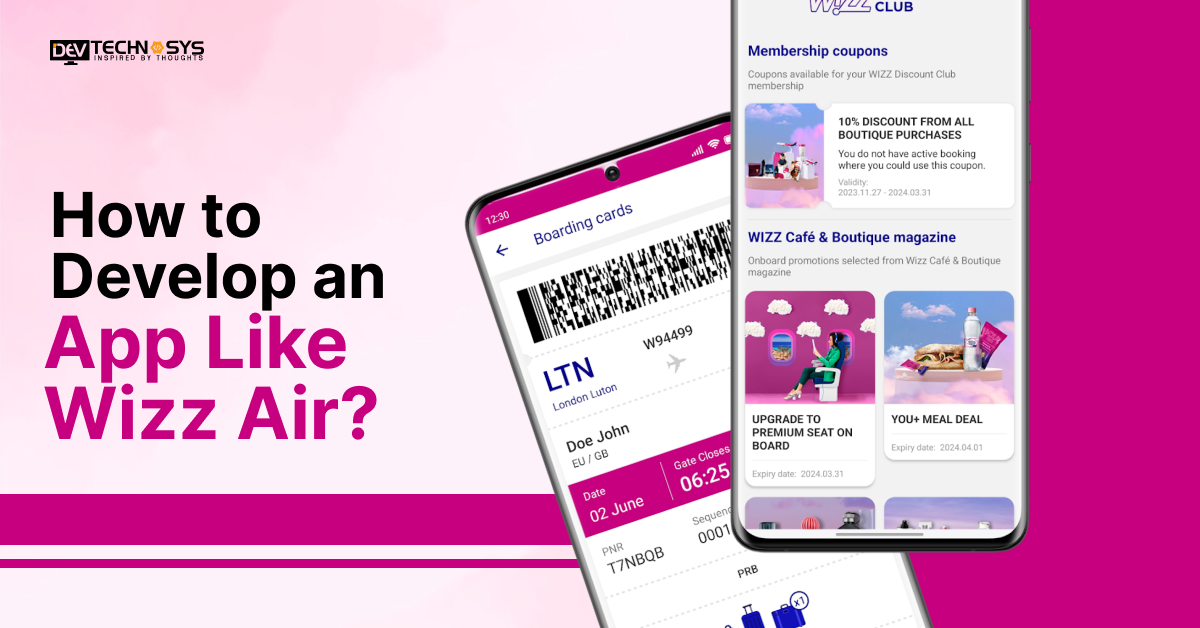
To develop an app like Wizz Air, it requires more than building a flight search and booking interface. A modern airline mobile app connects flight inventory, reservations, passenger profiles, digital check-in, boarding passes, real-time flight updates, payments, and travel add-ons through a reliable digital ecosystem. Wizz Air’s app also supports features such as document scanning, offline boarding passes, Fare Finder, booking management, and airport services.
Businesses planning to build an app like Wizz Air need to consider product strategy, airline and GDS API integrations, flight booking app architecture, cloud infrastructure, data security, and third-party services from the beginning. The development cost can range from $30,000 to $150,000+, depending on feature complexity, integrations, platforms, security requirements, and development resources.
This guide covers the essential features, development process, technology stack, architecture, security and compliance requirements, monetization strategies, timeline, and Wizz Air app development cost involved in creating a scalable airline booking platform.
Answer a few quick questions and our experts will share a tailored project estimate.
What is the Wizz Air App and How Does It Work?
The Wizz Air app is an airline mobile app that brings flight discovery, reservations, passenger services, check-in, boarding passes, booking management, and real-time travel information into one digital platform. Businesses looking to develop an app like Wizz Air need to combine a user-friendly interface with booking systems, airline or GDS APIs, secure payment processing, passenger data management, and scalable backend infrastructure. To use the Wizz Air app, follow the working mechanisms explained by a travel app development company.
How Does a Wizz Air-Like App Work?
- Flight Search: Users enter destinations, travel dates, and passenger details to find available flights and fares.
- Fare and Flight Selection: The app retrieves schedules, availability, and pricing through airline systems or GDS API integration.
- Booking: Travelers select flights, enter passenger information, choose seats or baggage, and confirm their reservation.
- Payment: A secure payment gateway processes the transaction while protecting sensitive financial information.
- Booking Management: Users can view reservations, modify eligible services, access travel details, and receive important updates.
- Check-In and Boarding: Passengers complete online check-in and access digital boarding passes through the app.
- Real-Time Updates: Backend services synchronize flight status, schedule changes, notifications, and other operational information.
Why Develop an App Like Wizz Air in 2026?
The shift toward mobile-first travel booking is creating new opportunities for businesses exploring travel app development solutions to make an app like Wizz Air. Travelers increasingly expect to search flights, compare fares, complete reservations, manage bookings, check in, and receive travel updates through their smartphones. For businesses, an airline mobile app can go beyond ticket sales by supporting seat selection, baggage purchases, priority services, memberships, transfers, and other ancillary offerings.
Latest Travel Booking Market Statistics
According to Grand View Research, mobile-based bookings accounted for 52.36% of global online travel agency bookings in 2025, demonstrating the growing importance of smartphones in digital travel transactions. The global online travel agencies market is also projected to continue expanding through 2033.
- 52.36%: Share of global online travel agency bookings made through mobile devices in 2025.
- $1.08 trillion: Estimated global online travel agencies market size in 2025.
- $1.24 trillion: Projected market size by 2026.
- 9.2%: Expected compound annual growth rate from 2026 to 2033.
- $2.08 trillion: Projected global market size by 2033.
These figures highlight why airline app development is becoming an important digital investment. A well-designed platform can reduce booking friction, centralize passenger services, improve engagement, and create additional revenue opportunities.
Step-by-Step Process to Develop an App Like Wizz Air in 2026
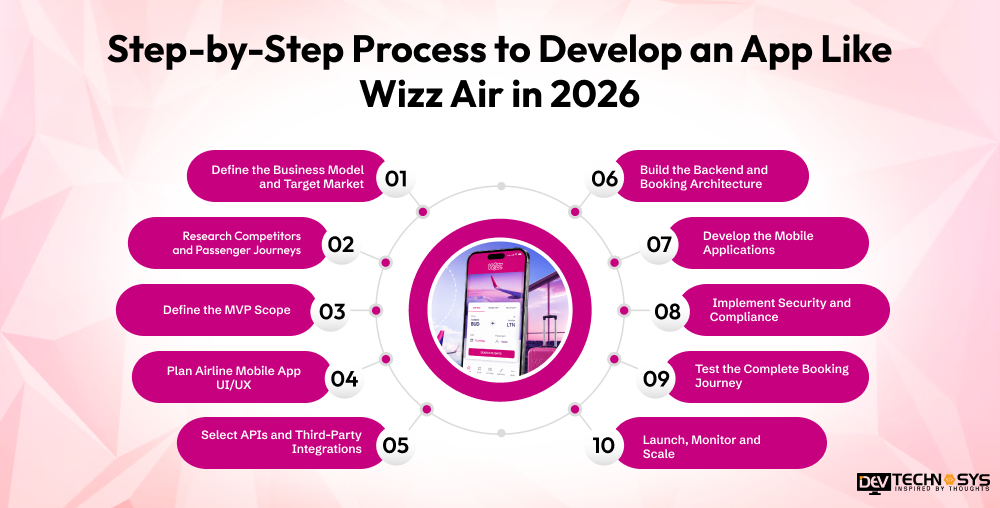
Developing an app like Wizz Air requires a structured approach that combines airline operations, flight inventory, passenger services, secure payments, and real-time data processing. The development process should begin with business validation and continue through architecture, API integration, application development, testing, deployment, and continuous optimization.
1. Define the Business Model and Target Market
Start by determining whether the platform will serve a single airline, operate as a flight marketplace, or combine airline and travel-booking services. Define target travelers, routes, pricing models, revenue channels, and required operational workflows. This stage determines the features, integrations, and infrastructure required later.
2. Research Competitors and Passenger Journeys
Analyze Wizz Air and other airline platforms to identify useful features, friction points, and opportunities for differentiation. Map the complete passenger journey from destination search and fare selection to payment, check-in, boarding, and post-booking support.
3. Define the MVP Scope
Prioritize the functionality required to launch a reliable flight reservation app. The initial MVP can include account creation, flight search, fare selection, booking, passenger profiles, payments, booking management, notifications, and digital travel documents. Advanced capabilities can be introduced after validating user demand.
4. Plan Airline Mobile App UI/UX
Design interfaces around the passenger journey rather than individual screens. Make flight comparison, fare details, seat selection, baggage options, checkout, check-in, and boarding passes easy to access. Responsive design, accessibility, localization, and clear error states are important for reducing booking friction.
5. Select APIs and Third-Party Integrations
Identify the external systems required for flight availability, schedules, fares, reservations, payments, and passenger services. GDS API integration can connect the platform with broader travel inventory, while airline APIs can provide carrier-specific capabilities. Payment gateways, notification services, maps, identity verification, and airline CRM integration may also be required. Businesses can work with experienced providers offering travel app development services to plan these integrations according to their target market and business model.
6. Build the Backend and Booking Architecture
Develop a scalable backend that separates authentication, flight search, booking, payment, passenger management, notifications, and other core services. API gateways, caching, queues, databases, and real-time synchronization help maintain reliable performance when booking demand increases.
7. Develop the Mobile Applications
Build iOS and Android applications using native or cross-platform technologies based on performance requirements, budget, and long-term maintenance needs. The application should communicate securely with backend services through authenticated APIs.
8. Implement Security and Compliance
Protect passenger, payment, and travel information using encryption, secure authentication, role-based access control, API security, and appropriate privacy controls. PCI DSS, GDPR, and regional data-protection requirements should be considered according to the markets and payment workflows involved.
9. Test the Complete Booking Journey
Test flight search, availability synchronization, booking confirmation, payment processing, cancellations, notifications, check-in, and digital boarding passes. Conduct API, security, performance, usability, compatibility, and failure-recovery testing before release.
10. Launch, Monitor and Scale
Deploy the platform on scalable cloud infrastructure and monitor application performance, API latency, booking failures, crashes, and user behavior. Continuous optimization allows the product team to introduce advanced features while maintaining reliability as passenger traffic grows.
Industry Insight
According to IATA’s 2025 Global Passenger Survey, 54% of travelers prefer dealing directly with airlines, increasingly through mobile apps, while 78% want a smartphone-based experience combining a digital wallet, digital passport, and loyalty cards for booking and airport processes.
Key Features to Develop an App Like Wizz Air
A successful app like Wizz Air should simplify the complete passenger journey, from discovering affordable flights to managing bookings and accessing boarding information. The feature set should combine essential booking capabilities with real-time airline services, secure payments, and personalized travel options.
Passenger Features
- Flight Search and Fare Finder: Let users search destinations, compare available flights, check fares, and identify suitable travel dates.
- Flight Booking: Allow passengers to select flights, enter traveler details, choose available services, and confirm reservations through a streamlined checkout.
- Seat and Baggage Management: Enable travelers to select seats, purchase additional baggage, and manage eligible services before departure.
- Online Check-In: Allow passengers to complete check-in digitally and access essential travel information without visiting a physical counter.
- Digital Boarding Pass: Generate mobile boarding passes that users can access easily and, where supported, store for offline use.
- Real-Time Flight Updates: Provide notifications about delays, cancellations, schedule changes, boarding information, and other important travel events.
- Booking Management: Give passengers access to reservations, passenger details, flight information, add-ons, and eligible booking modifications.
- Secure Payments: Support multiple payment methods while protecting financial and personal information throughout the transaction.
Business and Admin Features
- Booking Management Dashboard: Manage reservations, cancellations, refunds, passenger information, and booking status.
- Fare and Inventory Management: Monitor flight availability, pricing, seat inventory, baggage options, and other airline services.
- Loyalty Program: Manage memberships, rewards, discounts, promotional offers, and personalized benefits.
- Analytics and Reporting: Track bookings, revenue, conversion rates, customer behavior, popular routes, and ancillary purchases.
- Push Notifications: Deliver personalized booking confirmations, reminders, promotional messages, and operational alerts.
These features provide the foundation for Wizz Air app development, while advanced capabilities can be added according to the target market, airline partnerships, and business model.
General Architecture of Flight Booking Apps
A scalable flight booking app architecture should connect the passenger-facing mobile application with booking services, airline systems, payment gateways, and secure data infrastructure. The architecture should support real-time availability, reliable reservations, fast API responses, and secure passenger-data processing.
Mobile App → API Gateway → Booking Engine → GDS/Airline APIs → Payment Gateway → Database → Cloud Infrastructure
- Mobile App: Handles flight search, booking, check-in, boarding passes, and passenger services.
- API Gateway: Secures and routes requests between the application and backend services.
- Booking Engine: Processes flight availability, reservations, passenger details, fares, seats, and add-ons.
- Integration Layer: Supports GDS API integration, airline APIs, airline CRM integration, payment services, and other third-party systems.
- Data Layer: Stores booking, passenger, transaction, and operational data using secure databases and caching systems.
- Cloud Infrastructure: Provides scalability, load balancing, monitoring, backups, and CDN integration for reliable application performance.
Technology Stack for an App Like Wizz Air
Choosing the right technology stack is essential for scalable airline app development. A reliable mobile app development company can select technologies that support real-time flight data, secure transactions, third-party integrations, high availability, and consistent performance.
Layer |
Recommended Technology |
What It Does |
| iOS Development | Swift | Builds native iOS applications with reliable performance and access to Apple device capabilities. |
| Android Development | Kotlin | Develops secure, responsive Android applications with strong native platform support. |
| Cross-Platform | Flutter / React Native | Enables applications for multiple platforms while reducing duplicated development effort. |
| UI/UX | Figma | Designs booking flows, passenger dashboards, check-in screens, boarding passes, and responsive interfaces. |
| Backend | Node.js / Java / Python | Handles authentication, flight search, booking logic, passenger services, notifications, and business workflows. |
| Database | PostgreSQL / MongoDB | Stores booking information, passenger profiles, transactions, and operational application data. |
| Caching | Redis | Accelerates frequently requested flight, session, and availability data while reducing database load. |
| APIs | REST / GraphQL | Connects mobile applications with backend services and external airline or travel systems. |
| Cloud | AWS / Google Cloud / Azure | Provides scalable computing, storage, networking, backups, monitoring, and disaster recovery. |
| Payment | Stripe / PayPal | Processes online transactions and supports multiple payment methods where available. |
| Notifications | Firebase Cloud Messaging | Delivers booking confirmations, reminders, boarding alerts, promotions, and travel notifications. |
| Analytics | Firebase / Mixpanel | Tracks user journeys, booking behavior, conversions, feature usage, and application performance. |
| Monitoring | Datadog / New Relic | Monitors infrastructure, APIs, application performance, errors, and service availability. |
Industry Insight
According to SITA’s 2025 Passenger IT Insights, 79% of passengers are ready to use digital identities on their phones, highlighting the growing demand for mobile-based travel credentials and digital journeys.
Security and Compliance Considerations for a Wizz Air-Like App
Security should be built into every layer of Wizz Air app development, from mobile interfaces and APIs to cloud infrastructure and payment processing. A secure airline mobile app must protect passenger identities, travel documents, booking information, and payment data while meeting applicable privacy and payment requirements.
- Data Encryption: Use encryption at rest and in transit to protect passenger, booking, and transaction data. TLS/SSL encryption should secure communication between mobile applications, APIs, and backend services.
- PCI DSS Compliance: Payment workflows should follow PCI DSS compliance requirements and use tokenization where appropriate to reduce exposure to sensitive card information.
- Role-Based Access Control: Implement role-based access control (RBAC) to restrict administrative access according to responsibilities. Support separate permissions for administrators, customer-support teams, finance staff, and operational users.
- API Security: Secure GDS API integration, airline APIs, payment gateways, and CRM connections using authentication, authorization, rate limiting, secure credentials, and continuous monitoring.
- Data Privacy Compliance: Apply appropriate GDPR compliance and UK GDPR controls when processing personal data from users in relevant jurisdictions. Include consent management, data minimization, retention policies, and user data-access mechanisms.
- Mobile Application Security: Protect local storage, sessions, authentication tokens, and sensitive application data. Certificate pinning, biometric authentication, secure logging, and runtime protection can strengthen the mobile security layer.
- Cloud and Network Protection: Use secure cloud infrastructure, firewalls, Web Application Firewalls, monitoring, backups, and DDoS protection to maintain availability and reduce infrastructure-level threats.

How Much Does It Cost to Develop an App Like Wizz Air?
The Wizz Air app development cost typically ranges from $30,000 to $90,000+, depending on features, platforms, integrations, security requirements, and development complexity. Businesses can also compare broader market benchmarks through this guide to the travel app development cost when planning their investment.
App Development Level |
Estimated Cost |
Core Features |
| Basic Flight Booking MVP | $30,000 – $50,000 | Registration, flight search, fare selection, booking, payments, profiles |
| Mid-Level Airline App | $50,000 – $70,000 | Check-in, digital boarding pass, seat selection, baggage, notifications, booking management |
| Advanced Wizz Air-Like App | $70,000 – $90,000+ | GDS integration, real-time tracking, loyalty, personalized offers, CRM integration, analytics |
Factors That Affect Wizz Air App Development Cost
- Feature Complexity: Advanced booking workflows, real-time tracking, loyalty programs, personalized recommendations, and ancillary services require additional development effort.
- API and GDS Integrations: GDS API integration, airline APIs, payment gateways, CRM systems, maps, and other third-party services can significantly increase development and integration costs.
- Platforms: Building native iOS and Android applications separately generally requires more resources than using a cross-platform approach.
- UI/UX Complexity: Interactive fare comparison, seat maps, booking flows, check-in interfaces, and personalized dashboards require additional design and development effort.
- Backend Architecture: Real-time synchronization, booking engines, caching, databases, APIs, and scalable cloud infrastructure increase backend complexity.
- Security and Compliance: Encryption, RBAC, PCI DSS compliance, GDPR requirements, penetration testing, and security monitoring add to the overall investment.
- Development Team: Hiring mobile app developers in Dubai for low cost, expertise, team size, and engagement model directly influences hourly rates and project costs.
- Testing and Quality Assurance: Payment testing, API testing, security testing, device compatibility, performance testing, and failure-recovery testing require additional resources.
- Post-Launch Requirements: Cloud hosting, monitoring, bug fixes, API updates, security patches, and feature enhancements contribute to ongoing costs after launch.
How Long Does It Take to Develop an App Like Wizz Air?
The time required to develop an app like Wizz Air typically ranges from 2 to 9 months, depending on the feature scope, platform requirements, API integrations, design complexity, security standards, and testing depth.
Development Stage |
Timeline |
What Happens in This Stage |
| Discovery & Planning | 1–2 weeks | Define business requirements, target users, MVP scope, revenue model, technical requirements, and project roadmap. |
| UI/UX Design | 2–4 weeks | Design user journeys, flight search, booking, payment, check-in, boarding pass, dashboards, and responsive interfaces. |
| Backend Development | 4–8 weeks | Build authentication, flight search, booking logic, passenger management, payment workflows, APIs, databases, and backend services. |
| Mobile App Development | 4–8 weeks | Develop iOS and Android applications and connect the interfaces with backend services and booking workflows. |
| API & System Integration | 2–6 weeks | Integrate GDS APIs, airline systems, payment gateways, notifications, CRM platforms, maps, and other third-party services. |
| Testing & Security | 2–4 weeks | Perform functional, API, payment, performance, compatibility, security, and user acceptance testing. |
| Deployment | 1–2 weeks | Configure production infrastructure, complete app store requirements, deploy backend services, and release the applications. |
| Monitoring & Optimization | Ongoing | Monitor performance, crashes, booking failures, security events, and user behavior while continuously improving the platform, considering mobile app maintenance costs. |
How Does a Wizz Air-Like App Make Money?
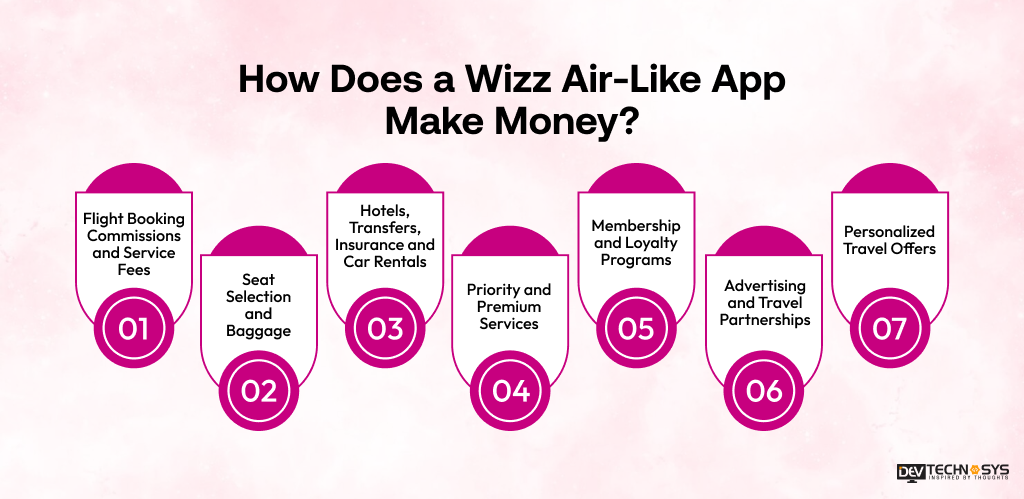
An app like Wizz Air can generate revenue through multiple channels beyond flight ticket sales. Businesses planning to develop an app like Wizz Air can combine booking fees, ancillary services, memberships, partnerships, and personalized offers to increase revenue per passenger.
Flight Booking Commissions and Service Fees
A flight reservation app can generate income through commissions, booking fees, or margins on reservations. The exact model depends on airline partnerships, inventory agreements, and the platform’s role in the booking process.
Seat Selection and Baggage
Passengers can pay for preferred seats, extra-legroom options, checked baggage, excess baggage, and other travel services. These ancillary purchases can increase the average booking value without requiring additional flight inventory.
Hotels, Transfers, Insurance and Car Rentals
Travel add-ons create opportunities to earn commissions from hotels, airport transfers, car rentals, travel insurance, and other third-party services. This approach is particularly valuable for businesses looking to develop a travel app like AlmoSafer and expand beyond flight reservations.
Priority and Premium Services
Businesses can offer paid priority boarding, fast-track services, flexible booking options, and other convenience-focused upgrades. These services provide additional revenue while allowing passengers to customize their journey.
Membership and Loyalty Programs
A paid membership model can provide discounted fares, exclusive offers, reward points, or priority benefits. Loyalty programs can also encourage repeat bookings and improve customer retention.
Advertising and Travel Partnerships
Hotels, tourism companies, airlines, car rental providers, and travel brands can pay for sponsored placements, promotional campaigns, or referral traffic. A broader b2c travel portal development strategy can create additional partnership opportunities across the travel ecosystem.
Personalized Travel Offers
An advanced Wizz Air alternative can analyze booking preferences and present relevant upgrades, packages, and ancillary services. Personalization can improve conversion rates while increasing revenue per passenger.
Industry Insight
According to Wizz Air, its mobile app is designed to support the passenger journey beyond flight booking, including booking management, boarding passes, price alerts, notifications, flight updates, and additional travel services.
How to Build a Better Alternative to Wizz Air?
Businesses looking to build an app like Wizz Air should avoid simply replicating an existing airline platform. The stronger approach is to identify passenger pain points and create a differentiated experience around convenience, personalization, pricing, and service quality. Understanding the things to consider in travel app development can help define the right product strategy before development begins.
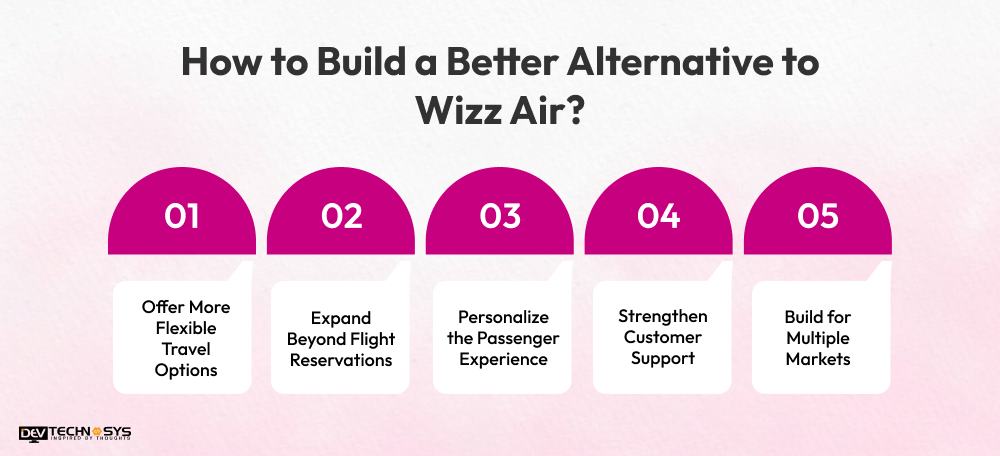
Offer More Flexible Travel Options
A similar app like Wizz Air can differentiate itself through flexible booking policies, multiple payment methods, bundled fares, dynamic add-ons, and transparent pricing. Giving travelers greater control can improve booking confidence and reduce abandonment.
Expand Beyond Flight Reservations
Businesses can create an app like Wizz Air with integrated hotels, airport transfers, car rentals, travel insurance, and local experiences. This creates a broader travel ecosystem while opening additional revenue opportunities.
Personalize the Passenger Experience
Use booking history, preferences, destinations, and traveler behavior to provide relevant fare recommendations, upgrades, loyalty rewards, and travel notifications. Personalization can improve engagement without complicating the core booking journey.
Strengthen Customer Support
Real-time chat, automated assistance, disruption alerts, self-service booking management, and faster refund workflows can create a better post-booking experience.
Build for Multiple Markets
Support multiple currencies, languages, regional payment methods, and market-specific travel requirements. This makes the platform more adaptable than a single-market airline application.
The objective is not to copy Wizz Air, but to build a differentiated airline platform that solves specific customer problems better and creates a stronger long-term competitive advantage.
Conclusion
To develop an app like Wizz Air successfully, businesses need more than flight search and booking functionality. A scalable airline platform requires intuitive UX, reliable GDS API integration, secure payment processing, real-time flight services, strong backend architecture, and robust data protection. The development investment can range from $30,000 to $150,000+, depending on features, integrations, platforms, and security requirements.
Businesses can also choose between native, cross-platform, or hybrid app development services based on their product requirements. With the right technology strategy, monetization model, and development approach, an app like Wizz Air can become a scalable digital travel platform that improves passenger experiences while creating multiple revenue opportunities.
FAQs About Developing an App Like Wizz Air
Q1. How Much Does It Cost to Develop an App Like Wizz Air?
The cost to build an app like Wizz Air generally ranges from $30,000 to $150,000+. The final investment depends on features, platforms, GDS and airline API integrations, UI/UX complexity, security requirements, development team, testing, and post-launch maintenance.
Q2. How Long Does It Take to Develop an App Like Wizz Air?
Developing an app like Wizz Air typically takes 2 to 9 months. A basic flight booking MVP may require around 2–4 months, while mid-level and advanced platforms can take 4–6 and 6–9 months, respectively, depending on integrations, features, testing, and deployment requirements.
Q3. What APIs Are Required for a Wizz Air-like App?
A Wizz Air-like platform may require GDS APIs, airline APIs, payment APIs, airport and flight-status APIs, maps, notification services, identity verification, and CRM integrations. The exact integration requirements depend on the business model, airline partnerships, target markets, and available flight inventory.
Q4. What Technology Stack is Suitable for Airline App Development?
A suitable stack can include Swift for iOS, Kotlin for Android, Flutter or React Native for cross-platform development, Node.js, Java, or Python for backend services, PostgreSQL or MongoDB for data management, Redis for caching, and AWS, Google Cloud, or Azure for infrastructure.
Q5. How Can an App Like Wizz Air Generate Revenue?
A Wizz Air-like app can generate revenue through booking commissions, service fees, seat selection, baggage, priority services, memberships, loyalty programs, travel insurance, hotels, airport transfers, car rentals, advertising, and partner commissions. A diversified model can increase revenue per passenger.
Q6. What Security Measures Are Required for an Airline Mobile App?
An airline mobile app should use TLS/SSL encryption, encryption at rest, secure authentication, role-based access control, API security, PCI DSS controls, DDoS protection, secure cloud infrastructure, vulnerability testing, and appropriate GDPR or UK GDPR privacy controls based on the markets served.
Q7. Can I create a Wizz Air Alternative Instead of a Direct Clone?
Yes, developing a Wizz Air alternative can be a stronger strategy than creating a direct clone. Businesses can differentiate through better personalization, flexible payments, broader travel services, improved customer support, loyalty programs, localized experiences, and more efficient booking workflows.
Q8. Is It Better to Build a Native or Cross-Platform Airline App?
The choice depends on project requirements, budget, performance expectations, and long-term maintenance. Native development provides deeper platform-specific capabilities, while Flutter or React Native can reduce duplicated development effort when launching iOS and Android applications together.