





Key Takeaways:
-
- The global online travel market was valued at approximately $613 billion in 2024.
- The cost to build a travel app like Almosafer ranges from $8,000 to $25,000, with the price increasing if you opt for an advanced and high-tech stack.
- Entrepreneurs can earn extra money from travel apps like Almosafer through strategies like in-app purchases and a subscription model.
Imagine planning your entire trip, from accommodations to flights, right from your phone. That’s the magic of a travel app. In today’s world, where travelers crave personalized experiences, speed, and simplicity, travel apps are becoming essential companions.
As an upcoming entrepreneur or start-up, are you curious to know what makes travel apps successful? Then you are in the right place.
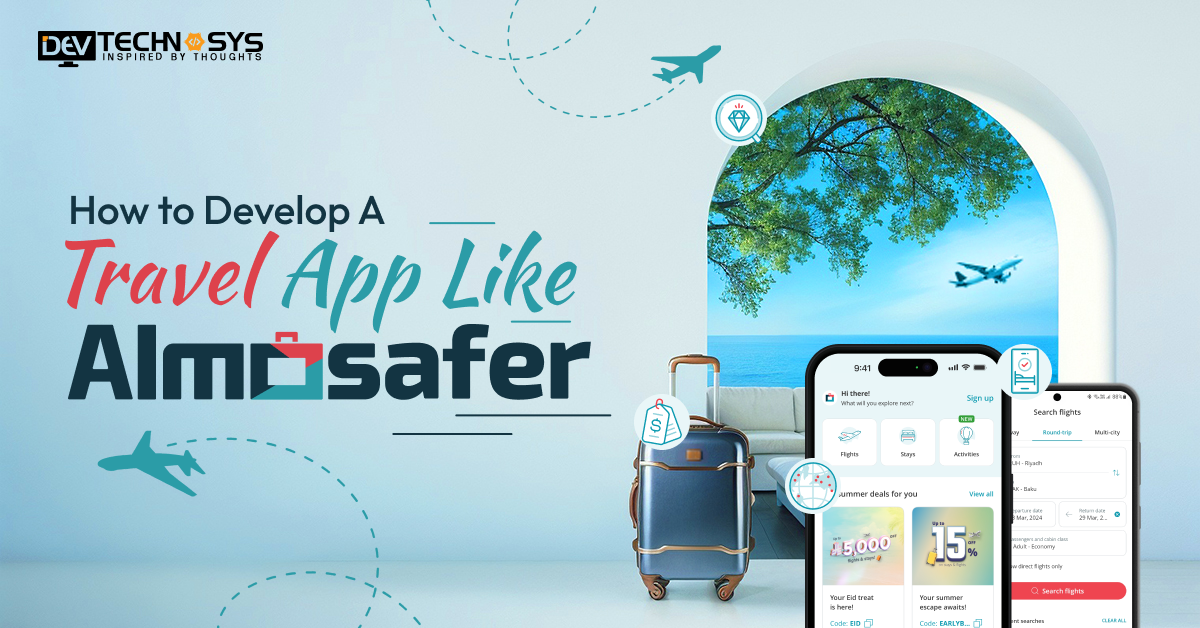
Here, in this blog, we have discussed what makes Almosafer, a travel app, a favorite among millions of travelers.
This blog reveals the steps, features, costs, and tech stack required to develop a travel app like Almosafer. So let’s get started.
What is Almosafer?
Almosafer is a leading online travel platform that is based in Saudi Arabia. This app offers a comprehensive range of travel services, including holiday packages, flight bookings, hotel reservations, and more. This travel application also supports English to serve consumers from different locations. Almosafer was launched in 2013 in Riyadh, Saudi Arabia, and in the first quarter of 2025, Almosafer helped increase total travel bookings by 8%, reaching SAR 1.73 billion.
Market Overview of Travel Apps
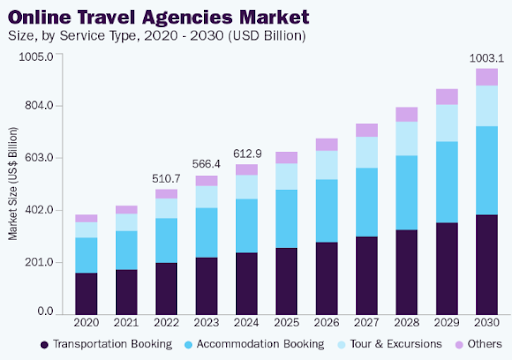
- Global market trends: The global online travel market was valued at approximately $613 billion in 2024 and is expected to continue growing at a rate of around 8.6% annually from 2025 to 2030.
- U.S. market trends: In 2024, the U.S. led the world in online travel bookings.
- By service type segment: Most of the bookings made through online travel platforms in 2024 were for transportation, making up 41% of the market.
- Booking platform segment: In 2024, using mobile apps to book travel was the most popular option, with over 52% of all bookings made through smartphones.
- AI in the Travel Industry Market Stats: Travel apps have become more engaging too—use of fun tech like AR and VR for virtual tours increased by 22% in 2023, making travel experiences feel more realistic from your phone.
What Makes Almosafer a Top Travel App?
Almosafer is a top travel app in the UAE that offers localised and seamless experiences to users. This user-friendly application offers a seamless booking experience for hotels, flights, and travel packages. With 24/7 multilingual consumer support, the Almosafer app offers multiple payment options for its consumers. With a strong regional focus, this application seamlessly provides international and local planning experiences to users.
Top Reasons Businesses Invest in Travel Apps
Find out why businesses around the globe are making investments in travel apps and what the main factors are that influence their attention.
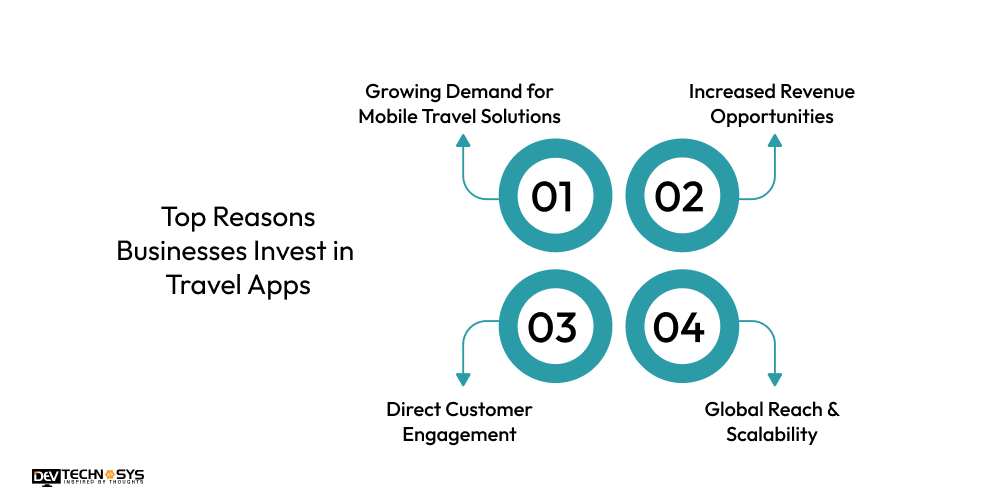
1. Growing Demand for Mobile Travel Solutions
The number of travelers who are making bookings via smartphones is increasing at a faster rate. This is attracting the attention of investors to invest in this industry. With real-time updates, convenience, and quick access to multiple travel-related services, businesses are experiencing high user engagement.
2. Increased Revenue Opportunities
Investors are tapping into this market to benefit from multiple revenue streams, including affiliate partnerships, in-app purchases, and advertising. This enables entrepreneurs to grow profits while delivering value-added services to users.
3. Direct Customer Engagement
Travel apps create direct communication with users via personalised offers, notifications, and 24/7 support. It helps increase the chances of repeat bookings and fosters users’ loyalty, thereby reducing dependence on third-party platforms. It offers excellent opportunities for businesses to build a stronger user base.
4. Global Reach & Scalability
Travel apps are globally demanded application that offers businesses an opportunity to target users on a global scale. By providing support to users in multiple languages, entrepreneurs are experiencing rapid expansion. This helps in increasing revenue generation opportunities for investors, which also opens the door to international markets.
The Role of Artificial Intelligence in Travel Apps
Here, we have discussed how AI is transforming the travel app industry to enhance user satisfaction and increase businesses’ potential for growth.
1. Personalized Recommendations
With AI, you can analyze users’ behavior preferences, browsing habits, and past search history. Through this, AI travel app solution like Almosafer offer personalised or tailor-made suggestions to users, which increases the chances of a booking rate.
2. Smart Itinerary Planning
The AI mechanism helps make trip planning effortless by organizing accommodation and flights. AI adapts according to users’ preferences and provides them with updates, including those related to local traffic conditions.
3. AI-Powered Chatbots
AI-powered chatbots offer 24/7 support to user, which helps in solving their queries instantly. An AI development company can help you integrate these chatbots, enabling you to provide multilingual support to users. This serves as a personal travel assistant that improves their satisfaction rate.
4. Visual Search & Recognition
AI offers users the facility to conduct visual search, where they can upload a snap or picture of a hotel, landmark, or destination to make smart bookings. This feature helps entrepreneurs attract on-the-go and curious travelers.

10 Popular Travel Apps
If you are looking to build a travel app, then you must know which are the leading travel apps in the UAE. So, let’s find out this with the help of the table below.
App Name |
Platforms |
Android Downloads |
Rating (Android) |
Key Highlight |
|
Careem |
Android, iOS |
50M+ |
4.3 |
UAE’s top super-app for rides, delivery, and more |
|
Uber UAE |
Android, iOS |
500M+ |
4.4 |
Global ride-hailing with regional reach |
|
Booking.com |
Android, iOS |
500M+ downloads |
4.1 |
Leading global booking platform |
|
Skyscanner |
Android, iOS |
50M+ downloads |
4.7 |
Flight/hotel/car search with smart filters |
|
KAYAK |
Android, iOS |
10M+ downloads |
4.6 |
All-in-one travel comparison tool |
|
Cleartrip |
Android, iOS |
10M+ downloads |
4.3 |
Booking flights, hotels, and activities |
|
Klook |
Android, iOS |
10M+ downloads |
4.1 |
Tours, activities, and local experiences |
|
Etihad Airways |
Android, iOS |
1M+ downloads |
4.7 |
National airline’s booking & management app |
|
Wego – Flights & Hotels |
Android, iOS |
10M+ downloads |
4.1 |
MENA-focused travel metasearch engine |
|
Trip.com |
Android, iOS |
10M+ downloads |
4.2 |
Global flight & hotel booking platform |
How to Develop Travel Apps: Step-by-Step Procedure
Now is the time to learn about developing a travel app like Almosafer. We have provided a step-by-step guide to help you understand every development stage in detail. So let’s get this segment started.
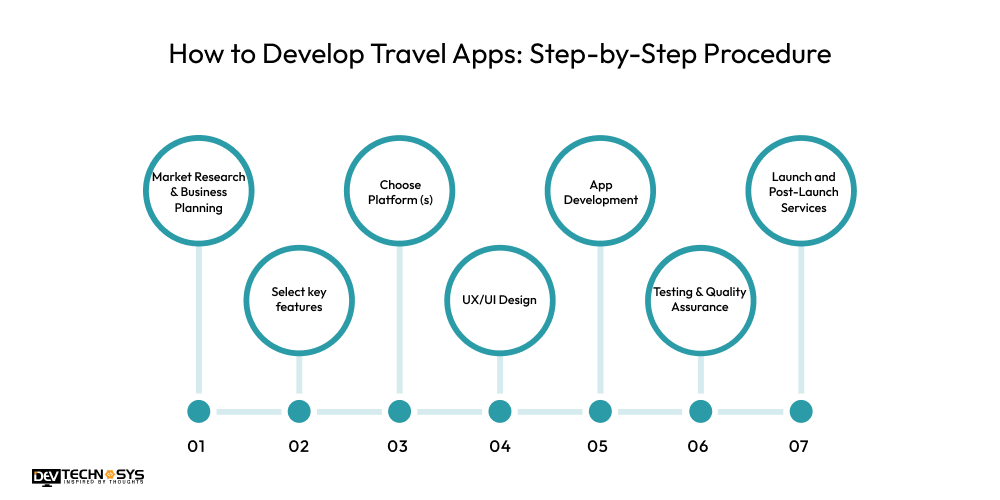
1. Market Research & Business Planning
Before building a travel app, conducting market research is crucial, as it enables the analysis of audience needs and market trends. In-depth market research allows entrepreneurs to analyze competitors’ strategies and identify gaps in their approach.
This research also helps define business goals, select a revenue model, and target users. A travel app development company enables you to create a business plan that sets the foundation for your travel app.
2. Select key features
After understanding the market, you must select the key features that make your travel app unique from its competitors. Include basic features like hotel booking, real-time notifications, flight booking, and GPS navigation. Later, entrepreneurs can add additional features, such as travel insurance, reviews, and language translators.
Other apps like Almosafer focus on integrating features that enhance the user experience and make it more competitive in the market. Selecting the right features allows you to increase app scalability and reach.
3. Choose Platform (s)
At this stage, you need to decide whether you want to develop your app for iOS, Android, or both platforms. This stage helps you select platforms based on your budget and target audience. An app like Klook uses a cross-platform approach to reach a global audience and reduce the timeline and maintenance cost of the application.
Entrepreneurs must ensure that their platform choice does not compromise the quality of the app. You must focus on compatibility and user behaviour before selecting the platform. This helps to ensure the performance of the travel app.
4. UX/UI Design
Design is a crucial stage that brings your app to life. With an attractive UX/UI interface, you can easily influence users. Must consider user-friendly screens, simple navigation, and clear icons. Entrepreneurs must ensure that their travel app appears well-designed on all devices.
App design plays a crucial role in creating a positive first impression among users, which is why start-ups should prioritize making travel apps like Almosafter fast, intuitive, and clean. With this, you can increase the reach and scalability of apps in the market.
5. App Development
This stage marks the beginning of the real game of travel app development. To build a travel app, developers help you turn features and designs into a working product. Entrepreneurs must ensure that they use secure technologies while focusing on stability. This stage also includes setting up authentication and APIs with both backend and frontend functionality.
Businesses need to ensure that the app development step is conducted in conjunction with a proper business plan. An airline app such as Almosafer in Saudi Arabia, with a systematic business plan, encompasses all essential stages without confusion or complexity.
6. Testing & Quality Assurance
Before launching your app, thoroughly test it to help identify bugs and crashes. Entrepreneurs must test travel apps on various devices, with different internet speeds, and across different screen sizes. This helps in offering smooth experiences to users, which increases app reach and visibility.
Start-ups with quality assurance can verify everything, from payment accuracy to maps. This helps identify issues at an early stage and launch the travel app glitch-free, ensuring user satisfaction.
7. Launch and Post-Launch Services
Once you have trust in everything, from feature selection to testing, it is time to launch your app on your selected platform. Entrepreneurs must promote the app through travel blogs and social media. You must keep track of user feedback to identify and resolve bugs, as well as implement changes as requested by users.
One thing to keep in mind is that adding new features is essential for increasing interest. Ensure to resolve issues and provide timely support to users. With regular post-launch services, you can develop users’ trust.
Must-Have Features for Travel Apps
To create a travel app like Almosafer, there are several must-have features that are essential for your app.
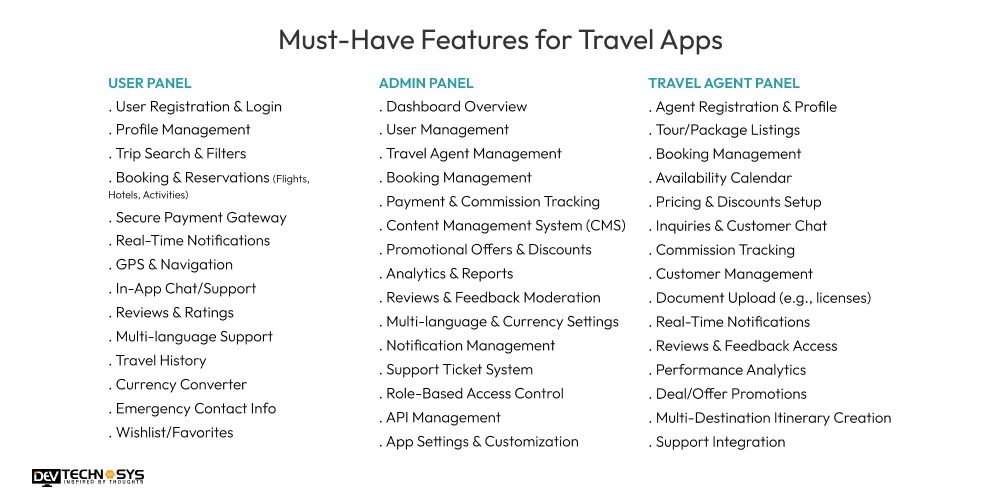
Panel |
Features |
|
User Panel |
User Registration & Login
Profile Management Trip Search & Filters Booking & Reservations (Flights, Hotels, Activities) Itinerary Planner Secure Payment Gateway Real-Time Notifications GPS & Navigation In-App Chat/Support Reviews & Ratings Multi-language Support Travel History Currency Converter Emergency Contact Info Wishlist/Favorites |
|
Admin Panel |
Dashboard Overview
User Management Travel Agent Management Booking Management Payment & Commission Tracking Content Management System (CMS) Promotional Offers & Discounts Analytics & Reports Reviews & Feedback Moderation Multi-language & Currency Settings Notification Management Support Ticket System Role-Based Access Control API Management App Settings & Customization |
|
Travel Agent Panel |
Agent Registration & Profile
Tour/Package Listings Booking Management Availability Calendar Pricing & Discounts Setup Inquiries & Customer Chat Commission Tracking Customer Management Document Upload (e.g., licenses) Real-Time Notifications Reviews & Feedback Access Performance Analytics Deal/Offer Promotions Multi-Destination Itinerary Creation Support Integration |
Advanced Features for Travel Apps
Here, we have discussed some amazing advanced features that make your ordinary travel app unique. So let’s find out how you can turn your travel app into an unforgettable digital travel companion.
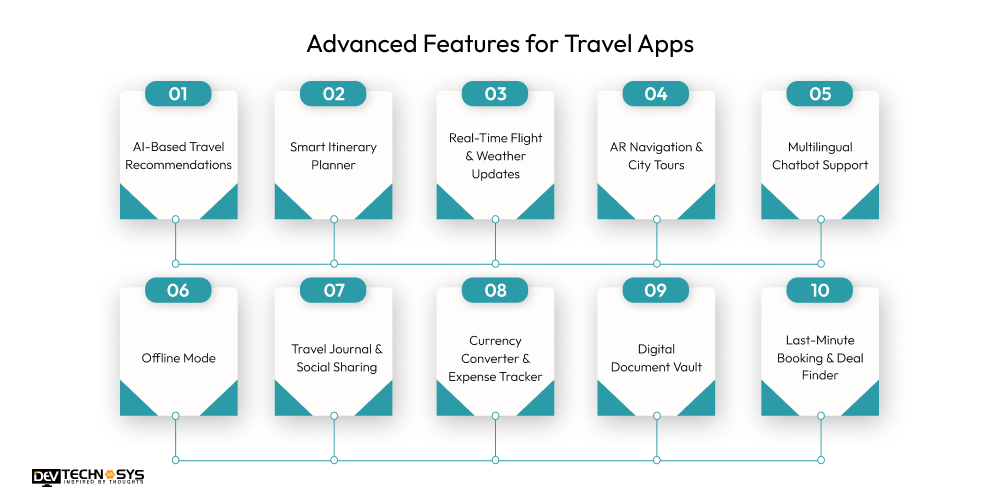
1. AI-Based Travel Recommendations
With AI-based travel recommendations, you can offer personalized activities and trip suggestions to users based on their past behavior and preferences. This helps increase bookings and engagement rates.
2. Smart Itinerary Planner
AI-powered tools, such as behavioral analytics, help you create a personalized itinerary plan for users. With automatic scheduling, you can easily enhance the user experience.
3. Real-Time Flight & Weather Updates
With real-time updates, you can keep your travels 24/7 updated about weather and flight changes. This helps in reducing their stress and increases their trust in the app.
4. AR Navigation & City Tours
AI tools help you to provide interactive and augmented reality guides to users. This feature is also helpful to provide travel-related services to physically disabled travelers.
5. Multilingual Chatbot Support
Offer all-time and instant consumer support to users in multiple languages. This helps you to improve overall satisfaction and retention rate.
6. Offline Mode
Offline mode is an advanced feature that allows users to access the app without an internet. This feature enhances the application’s usability.
7. Travel Journal & Social Sharing
With this feature, you can allow users to share their trips and documents with their friends, family, and colleagues. This is an attractive word-of-mouth promotion strategy that increases engagement rate.
8. Currency Converter & Expense Tracker
Businesses that provide users with easy access to a currency converter can help them manage their budgets. This helps in making the travel app a more practical travel companion.
9. Digital Document Vault
Offering secure storage in the form of a digital document vault helps users to access essential documents quickly. This allows you to attract users by offering them convenience and accessibility.
10. Last-Minute Booking & Deal Finder
By providing last-minute deals and booking facilities, you can attract spontaneous travelers. This helps you increase sales opportunities and expand your user base.
How Much Does it Cost to Create a Travel App?
The cost to develop a travel app like Almosafer is $8,000 to $25,000. This cost fluctuated based on platform selections, features, tech stack, and third-party integration. Entrepreneurs who select basic features and a simple tech stack will incur costs of $7,100 and $11,200. However, if you integrate advanced AI features and launch a travel app on multiple platforms, the cost will be $25,200 to $28,000. Find out the cost to develop a travel app like Almosafer from the table below.
App Type |
Estimated Cost |
Development Time |
|
Basic MVP App |
$7,100 – $11,200 |
2 – 3 Months |
|
Standard App |
$12,200 – $19,200 |
3 – 5 Months |
|
Feature-Rich App |
$18,500 – $23,200 |
5 – 6 Months |
|
Custom Enterprise-Grade App |
$25,200 – $28,000 |
6 – 8 Months |
Factors Affecting the Cost to Develop Travel Apps
Several factors influence the cost of developing travel apps. By analyzing these features, you can determine how features, platforms, UX design, and testing impact the cost of app development.
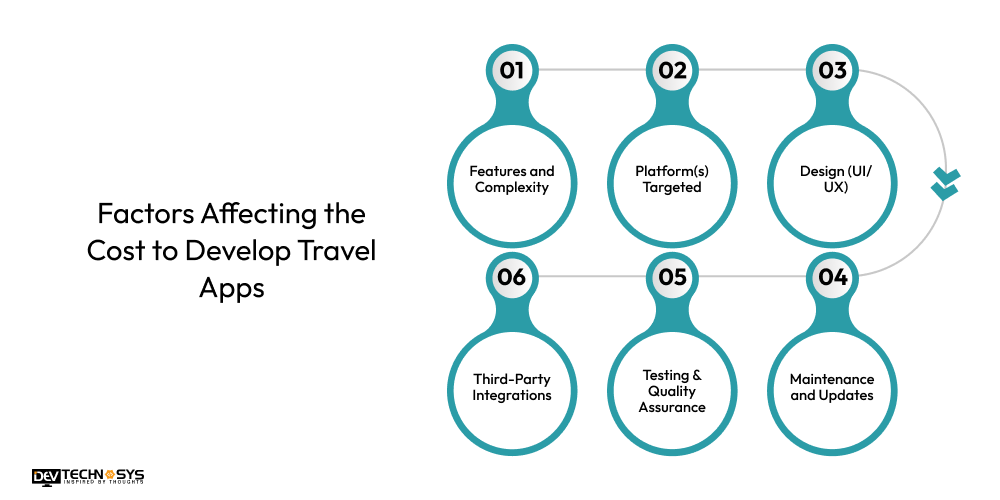
1. Features and Complexity
If you want to keep your app simple, it will require less cost and time. The more features businesses want to include in their travel app, such as chat support, GPS, and itinerary planning, the higher the development cost. Complex features require more time, testing, and advanced coding, which increases the cost.
Feature Complexity |
Cost |
Time |
|
Basic Listings & Search |
$2,200 – $4,200 |
1 – 1 Months |
|
Intermediate (Chat, Filters, Profile) |
$5,300 – $8,300 |
2 – 3 Months |
|
Advanced (AI, AR, Blockchain) |
$5,500 – $7,600 |
3 – 4 Months |
2. Platform(s) Targeted
The cost to develop a travel app like Almosafer, is highly influenced by platform selection. Building an app for Android, iOS, or both increases the cost as every platform has different coding and functionality stages. You can reduce the cost to develop an app by choosing cross-platform tools like Flutter, as it requires the same coding.
Platform Complexity |
Cost |
Time |
|
iOS, Android only, and Web |
$2,400 – $4,700 |
1 – 1 Months |
|
All (Native) |
$5,300 – $9,300 |
2 – 3 Months |
|
Cross-Platform |
$5,400 – $9,300 |
3 – 4 Months |
3. Design (UI/UX)
Creating a travel app that is visually appealing and has an intuitive design, however, enhances the user experience, but it comes at a price. Responsive layouts, custom animations, and interactive maps require UX/UI tools and additional development time, which increases the cost of creating a travel app like Almosafer.
UI/UX Complexity |
Cost |
Time |
|
Basic UI |
$1,500 – $2,400 |
2 – 3 Weeks |
|
Custom & Responsive UI/UX |
$2,500 – $4,800 |
1 – 1 Months |
|
High-End Interactive Design |
$5,300 – $7,300 |
2 Months |
4. Third-Party Integrations
Integrating services such as payment gateways, hotel booking systems, flight search engines, and APIs increases the overall cost to develop an app that requires API integration, like unique setup and testing. This is crucial to ensure the app’s smooth functionality. B2C travel portal development like Expedia also involves licensing fees in its app, which increases the overall development cost.
Third-party integration Complexity |
Cost |
Time |
|
Basic Backend (CRUD APIs) |
$2,300 – $3,300 |
2 – 3 Weeks |
|
Scalable Backend + DB |
$4,800 – $7,300 |
1 – 1 Months |
|
Third-party Integrations |
$3,600 – $6,300 |
1 – 2 Months |
5. Testing & Quality Assurance
Testing helps businesses ensure their travel app is bug-free, stable, and fast. Quality assurance helps you to check the security, performance, and compatibility of the application. To experience seamless travel app development services, you need to conduct various types of testing. This increases the overall cost of developing a travel app like Almosafer. However, this process helps you create a travel app that enhances user satisfaction.
Testing Complexity |
Cost |
Time |
|
Manual Testing Only |
$9,300 – $1,900 |
2 Weeks |
|
Manual + Automated Testing |
$1,600 – $3,800 |
3 – 4 Weeks |
|
Advanced Testing + Security Audits |
$3,900 – $5,800 |
1 Month |
6. Maintenance and Updates
Maintenance and post-launch updates are key to making your travel app attractive. Updating the app by adding new features, fixing bugs, and improving performance increases the ongoing cost of app development. Neglecting maintenance and updates increases the chances of security vulnerabilities and the cost to maintain an app.
Maintenance Complexity |
Cost |
Time |
|
Basic (Bug Fixes, Minor Updates) |
$1,800 – $2,700 |
Ongoing Monthly |
|
Standard (Feature Updates, Monitoring) |
$3,300 – $5,700 |
Ongoing Monthly |
|
Premium (24/7 Support) |
$6,800 – $8,300 |
Ongoing Monthly |
Important Tech Stack To Create Travel Apps
One can deny that behind every great travel app, there is a robust tech stack. Let’s find out which of the following tables to determine the essential technologies that make your app scalable, fast, and secure.
Category |
Technology / Tools |
Purpose |
|
Frontend (Mobile) |
React Native, Flutter, Swift (iOS), Kotlin (Android) |
For building user interfaces on iOS and Android platforms |
|
Backend |
Node.js, Django, Ruby on Rails, Laravel |
Manages app logic, server-side processing, and APIs |
|
Database |
PostgreSQL, MongoDB, MySQL, Firebase Realtime DB |
Stores user data, bookings, itineraries, and preferences |
|
APIs & Integrations |
Skyscanner, Amadeus, Booking.com, Google Maps API |
Flight/hotel data, bookings, navigation, and geolocation |
|
Authentication |
Firebase Auth, Auth0, OAuth 2.0 |
Secure user login and account management |
|
Payment Gateway |
Stripe, PayPal, Razorpay, Braintree |
Enables secure in-app payments and currency conversion |
|
Cloud & Hosting |
AWS, Google Cloud, Microsoft Azure |
Scalable hosting, storage, and server infrastructure |
|
Push Notifications |
Firebase Cloud Messaging (FCM), OneSignal |
Real-time alerts for bookings, promotions, and updates |
|
Analytics & Monitoring |
Google Analytics, Mixpanel, Sentry, Crashlytics |
Tracks user behavior and monitors app performance/errors |
|
Maps & Navigation |
Google Maps SDK, Mapbox |
Enables directions, location tracking, and nearby suggestions |
How to Make Money From Travel Apps?
Here, we have discussed strategies that help you turn your travel app into a money-making machine.
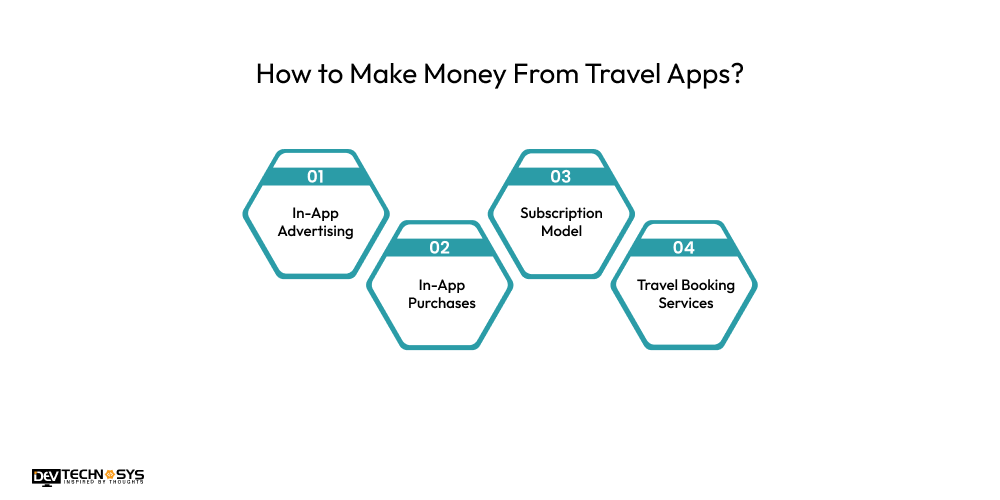
1. In-App Advertising
Entrepreneurs can earn income from in-app advertising, which helps them generate revenue by displaying ads from third-party networks, such as Google AdMob. These ads can take the form of video ads or banners. This monetization strategy enables businesses to generate revenue from clicks and impressions.
2. In-App Purchases
In-app purchases enable businesses to generate revenue from travel apps through features such as offline maps, premium content, and exclusive travel guides. In this, users need to pay extra for added-value services. This model helps increase user experience, which is also a significant source of revenue generation.
3. Subscription Model
You can earn from a subscription model where users pay for yearly or monthly services to access features like personalized travel recommendations, ad-free use, and offline access. An iOS app development company can help you incorporate this model into your app. This is a steady source of income that allows businesses to earn from a stable source of revenue.
4. Travel Booking Services
Entrepreneurs have the opportunity to earn money from travel apps by creating partnerships with tour companies, hotels, and car rental services. This helps you earn in the form of service fees and commissions. A travel booking service is a monetization strategy that helps increase user trust and confidence.

Conclusion
Based on the above discussion, we have reached the conclusion that the travel industry is evolving rapidly and becoming increasingly digital. Travelers in today’s period want multiple travel facilities in one app. So, if you want to create a travel app, now is the time to take action. With the right mobile app development company, you can incorporate smart technology, features, and a robust tech stack to offer a seamless user experience. With professional support and guidance, you can ensure that you have a travel app that fits your budget without compromising quality.
FAQ’s
1. What is the Average Cost to Develop a Travel App Like Almosafer?
The average cost to develop a travel app like Almosafer is $8,000 to $25,000. Based on your platform selection, features, and third-party integration choices, the price will increase.
2. How Much Time Does it Take to Develop a Travel App Like Almosafer?
The time required to develop a travel app like Almosafer is 3-6 months. Bug fixes, updates, and testing increase the overall time to make the travel app.
3. What Are the Must-Have and Advanced Features in Travel Apps?
Must-have and advanced features for travel apps are:
- User Registration & Login
- Profile Management
- Dashboard Overview
- User Management
- Agent Registration & Profile
- Tour/Package Listings
- AR Navigation & City Tours
- Digital Document Vault
4. How Does a Travel App Like Almosafer Make Money?
Travel apps like Almosafer earn money from monetisation strategies like
- In-App Advertising
- In-App Purchases
- Subscription Model
- Travel Booking Services
5. What is The Best Tech Stack For Building Travel Apps?
Best tech stack to build travel apps like Almosafer are:
- Frontend
- Backend
- Database
- APIs & Integrations
- Authentication
- Push Notifications