





Key takeaways:
-
- A successful Flyin-like app requires more than a booking interface. Businesses need a reliable hotel inventory and booking engine, GDS and aggregator integrations, secure payments, scalable architecture, and regional localization.
- The global hotel booking market is projected to grow from $22.40 billion in 2026 to $34.28 billion by 2035, at a 15.25% CAGR, creating opportunities for localized GCC hotel booking platforms.
- The estimated cost to develop a hotel booking app like Flyin ranges from $25,000 to $100,000+, depending on features, integrations, platforms, and customization.
- A competitive Middle East hotel booking platform should support Arabic and English, RTL design, local currencies, regional payment methods, and Muslim-friendly hotel discovery to better serve GCC travelers.
Most of the passengers are now finding, comparing, and booking hotels digitally, opening up new potential for online travel platforms. According to Global Market Statistics, the global hotel booking industry is anticipated to be worth $34.28 billion by 2035, growing at a CAGR of 15.25% during the forecast period from 2026 to 2035.
This growth provides an opportunity for businesses and startups that are interested in penetrating the Middle East market with a localized hotel reservation experience tailored to the needs of regional travelers. The Flyin-like platform could offer substantial hotel selection, immediate availability, payment options, an Arabic-language interface, and recommendation services.
When you build a hotel booking app like Flyin, it isn’t about copying its booking UI. This platform requires a robust hotel interface, safe payment systems, flexible architecture, and a smooth booking process. In this article, we will be exploring some key aspects of building an effective hotel booking platform in the GCC region, including features, development process, API integration, technologies used, costs, security requirements, AI usage potential, and monetization models.
What Is Flyin and How Does Its Hotel Booking Model Work?
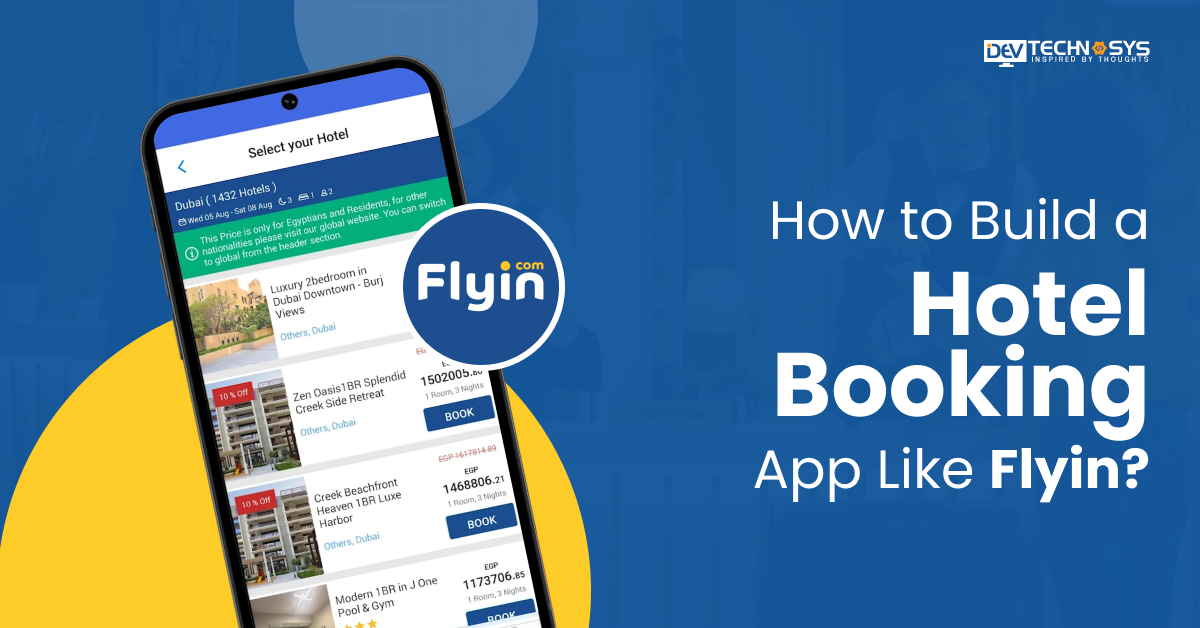
Flyin is a Saudi-origin online travel agency that serves travelers with flight and hotel booking services. Its current app listing highlights access to more than 600,000 hotels, resorts, villas, and apartments, along with Arabic and English support, local currency display, flexible payment options, and 24/7 customer assistance.
From a product perspective, Flyin follows the broader OTA model, where travelers can search, compare, and reserve travel inventory through a single digital platform. Its regional positioning makes it particularly relevant when studying hotel booking platform development for Middle Eastern audiences.
The Flyin business model can be viewed through multiple revenue opportunities common to OTAs, including hotel commissions, markups, promotional placements, and complementary travel services. Industry analysis also identifies commissions, advertising, subscriptions, and ancillary services as common OTA revenue streams.
For entrepreneurs planning OTA app development, the key lesson is that a Flyin-like product requires more than a booking interface. It needs connected hotel inventory, pricing and availability systems, secure transactions, customer support, and scalable hotel reservation software that can handle bookings reliably.
Why Build a Hotel Booking App Like Flyin for the GCC Market?
The GCC offers a strong environment for localized hotel booking platforms, particularly as travelers increasingly expect fast, mobile-first reservation experiences. Global Market Statistics estimates that the global hotel booking market will grow from $22.40 billion in 2026 to $34.28 billion by 2035, representing a 15.25% CAGR. The report also identifies the Middle East and Africa among the major regional segments of the market.
For GCC-focused businesses, the opportunity is not simply to launch another generic OTA. A Middle East hotel booking app can differentiate itself through Arabic and English interfaces, RTL support, local currencies, regional payment methods, and hotel discovery tailored to family, business, religious, and leisure travel.
A GCC hotel booking platform can also prioritize properties based on location, amenities, cancellation policies, and Muslim-friendly preferences. These localized capabilities can create a stronger experience than a one-size-fits-all booking service.
Businesses can also study regional platforms when planning their strategy. For example, entrepreneurs exploring to develop a travel app like Almosafer can identify useful approaches to localization and regional travel experiences.
This makes a localized Arabic hotel booking platform a practical direction for businesses seeking to build a scalable hotel booking solution for GCC travelers.
How to Develop a Hotel Booking App Like Flyin?
Building a competitive hotel booking platform requires more than replicating an existing OTA interface. The development process should connect business strategy, hotel inventory, booking workflows, regional payments, and scalable technology.
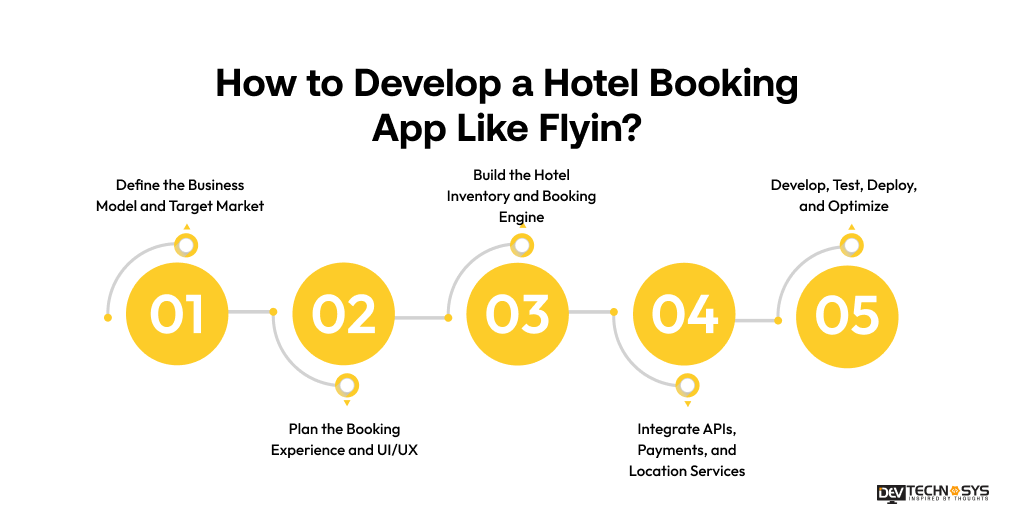
1. Define the Business Model and Target Market
Start by identifying the GCC markets and traveler segments you want to serve. Decide whether the platform will follow a B2C, B2B, or hybrid OTA model. Define hotel supply sources, commission structures, markups, cancellation policies, and localization requirements. Arabic and English support, regional currencies, and local payment preferences should be considered during planning.
2. Plan the Booking Experience and UI/UX
Map the complete customer journey from destination search to booking confirmation. The interface should make hotel discovery, filtering, room comparison, and checkout simple. Arabic RTL support should be planned from the beginning rather than added later. Booking, cancellation, refund, and notification workflows should also be clearly defined.
3. Build the Hotel Inventory and Booking Engine
The core of hotel booking application development is a reliable inventory and reservation engine. It should manage room availability, rates, restrictions, booking status, and supplier updates. Real-time synchronization helps reduce problems such as outdated prices or unavailable rooms during checkout.
A structured travel app development solution can also make the platform easier to scale as more hotels, destinations, and booking channels are added.
4. Integrate APIs, Payments, and Location Services
The next step is connecting hotel inventory and supporting services through GDS, hotel aggregator, payment, and location APIs. These integrations allow the platform to access broader inventory and provide accurate booking information.
5. Develop, Test, Deploy, and Optimize
Finally, developers build the mobile apps, backend, admin panel, and supporting services. Testing should cover booking flows, API reliability, security, payments, and performance. After deployment, analytics and customer feedback can guide continuous improvements to the platform.
What Features Should a Flyin-Like Hotel Booking App Have?
A successful hotel booking platform needs features that simplify discovery, comparison, reservation, and post-booking support. For a GCC-focused product, these capabilities should also reflect regional languages, payment preferences, and traveler expectations.
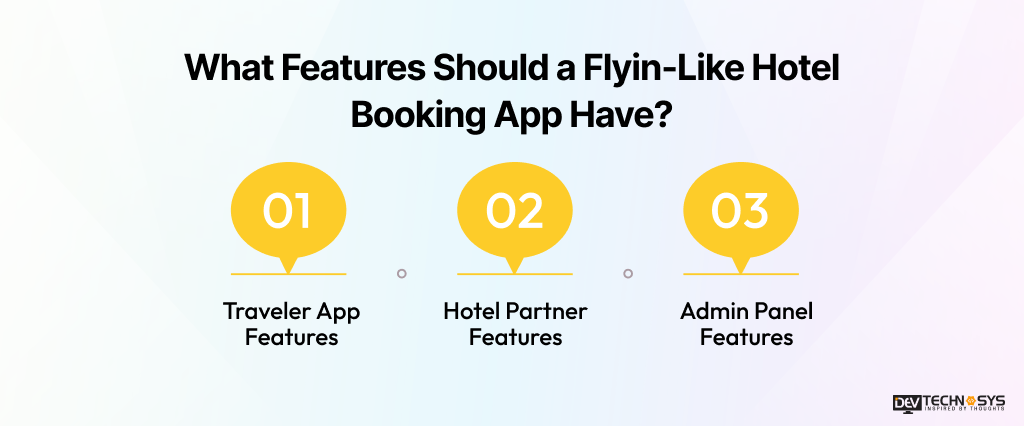
1. Traveler App Features
The traveler app should provide fast hotel search with filters for price, location, ratings, amenities, property type, and availability. Location-based discovery can help users find hotels near airports, attractions, business districts, or specific destinations.
Detailed hotel pages should include photos, room information, amenities, policies, ratings, and available rates. Real-time availability and room comparison can reduce booking friction. Secure checkout, multiple payment options, instant confirmation, cancellation management, and refund tracking should complete the reservation journey.
Arabic and English support, RTL design, localized currencies, wishlists, loyalty rewards, personalized offers, and push notifications can further improve the experience. These capabilities are particularly valuable when developing a Muslim-friendly hotel booking app for GCC travelers.
2. Hotel Partner Features
Hotel partners need a dedicated dashboard to manage property information, room types, rates, availability, promotions, and bookings. Inventory synchronization helps keep information accurate across the platform.
Revenue dashboards and performance analytics can help properties understand bookings, occupancy trends, and promotional performance.
3. Admin Panel Features
The admin panel should provide centralized control over users, hotels, suppliers, bookings, commissions, cancellations, refunds, and promotional content. Reporting tools can help monitor revenue and booking trends, while fraud and dispute management features can protect the platform.
Together, these Flyin app features create a custom hotel booking app that goes beyond basic search and reservation functionality. The goal is to build a reliable hotel booking solution that supports travelers, hotel partners, and administrators through one scalable platform.
Hotel API and GDS Integrations You Need
A hotel booking platform depends on reliable integrations to access inventory, pricing, availability, property information, and reservation services. Choosing the right integration strategy is essential for delivering accurate results and reducing booking failures.
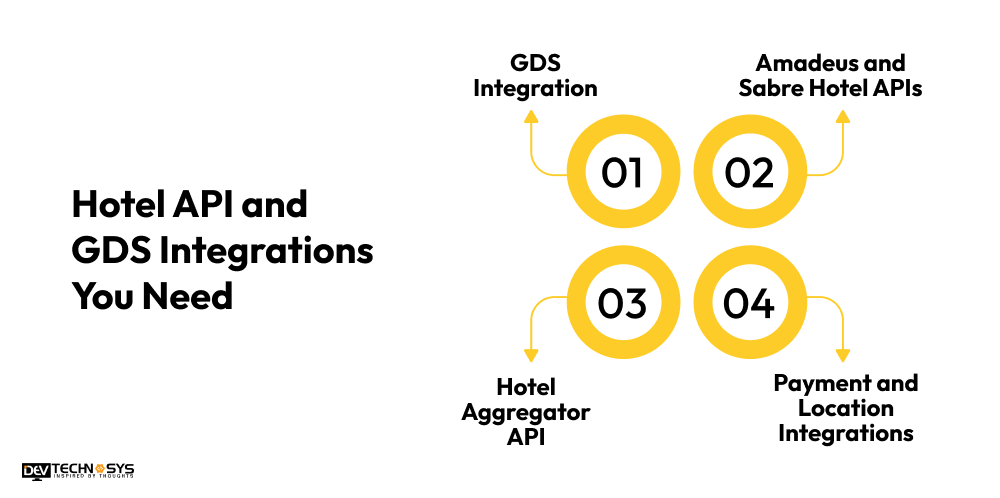
1. GDS Integration
GDS integration can connect the platform with broad travel inventory and provide access to hotel rates, availability, room details, and booking capabilities. It can be useful for OTAs that want wider inventory without building separate connections for every supplier.
2. Amadeus and Sabre Hotel APIs
An Amadeus hotel API can provide hotel content, availability, rates, and booking capabilities through its travel technology ecosystem. Similarly, the Sabre hotel API can support hotel search and reservation workflows. The right provider depends on your target markets, inventory requirements, commercial agreements, and technical architecture.
3. Hotel Aggregator API
A hotel aggregator API can provide access to multiple suppliers through a unified integration layer. This can simplify inventory management while helping the platform compare rates, availability, room types, and booking conditions across different sources.
4. Payment and Location Integrations
A reliable payment gateway integration is required to process hotel reservations securely and support the payment methods preferred by target customers. A geolocation API can power nearby-hotel searches, map-based discovery, and location-aware recommendations.
Finally, CDN integration can improve the delivery of hotel images and other static content. This is particularly useful for a platform handling large property catalogs and image-heavy hotel pages.
How Much Does It Cost to Build a Hotel Booking App Like Flyin?
The cost to build a hotel booking app like Flyin depends on the platform’s complexity, number of integrations, supported devices, and level of customization. A basic booking MVP requires fewer integrations, while an advanced OTA needs sophisticated inventory, payment, partner, and administration systems.
1. Estimated Hotel Booking App Development Cost
Development Level |
Estimated Cost |
Typical Scope |
| Basic MVP | $25,000–$40,000 | Core search, hotel listings, booking, payments, user accounts |
| Mid-Level Platform | $40,000–$65,000 | API integrations, advanced filters, notifications, loyalty, admin panel |
| Advanced Flyin-Like Platform | $65,000–$100,000+ | GDS, multiple suppliers, AI, partner portal, advanced analytics, GCC localization |
These figures are practical estimates for planning. The final hotel booking application development cost depends on the project scope and development team.
2. What Affects Hotel Booking App Development Cost?
Several factors influence the final budget. UI/UX complexity, Android and iOS development, backend architecture, booking-engine development, GDS integrations, hotel aggregator APIs, and payment systems can significantly affect development effort.
Arabic RTL support, regional payment methods, AI-powered recommendations, security controls, and compliance requirements can also increase the scope.
Businesses comparing the cost to develop a travel app should therefore evaluate the complete feature and integration requirements rather than comparing hourly development rates alone. Similarly, understanding mobile app development cost helps establish realistic budgets for multi-platform products.
For a GCC-focused OTA, investing in scalable infrastructure early can reduce expensive architectural changes as hotel inventory and booking volumes grow.
Technology Stack for a Flyin-Like Hotel Booking Platform
The technology stack should support fast hotel searches, reliable bookings, secure payments, and scalable supplier integrations. The right architecture also makes it easier to add new destinations, partners, and AI capabilities as the platform grows.
Technology Layer |
Recommended Technologies |
Purpose |
| Mobile App | Flutter / React Native | Cross-platform development |
| Backend | Node.js | APIs and booking logic |
| Database | PostgreSQL / MongoDB | User, hotel, and booking data |
| Cloud | AWS / Google Cloud | Scalable infrastructure |
| APIs | REST / GraphQL | Service communication |
| Maps | Google Maps / Mapbox | Hotel location and discovery |
| Payments | Regional Payment Gateways | Secure transactions |
| CDN | CloudFront / Cloudflare | Faster content delivery |
| Security | OAuth 2.0 / OpenID Connect | Authentication and access control |
For businesses planning Android app development, cross-platform frameworks can reduce duplicate development work while maintaining a consistent booking experience across devices. Companies looking for specialized iOS app development company support can also choose native iOS development when platform-specific performance or functionality is important.
The architecture should remain modular so APIs, payment services, hotel suppliers, and analytics tools can be upgraded independently. Cloud infrastructure and CDN integration can further support performance as hotel inventory, traffic, and booking volumes increase.
Security and Compliance for a Middle East Hotel Booking App
A hotel booking platform handles personal details, booking records, payment information, and sometimes identity documents. Strong security should therefore be built into the architecture from the beginning rather than added after development.
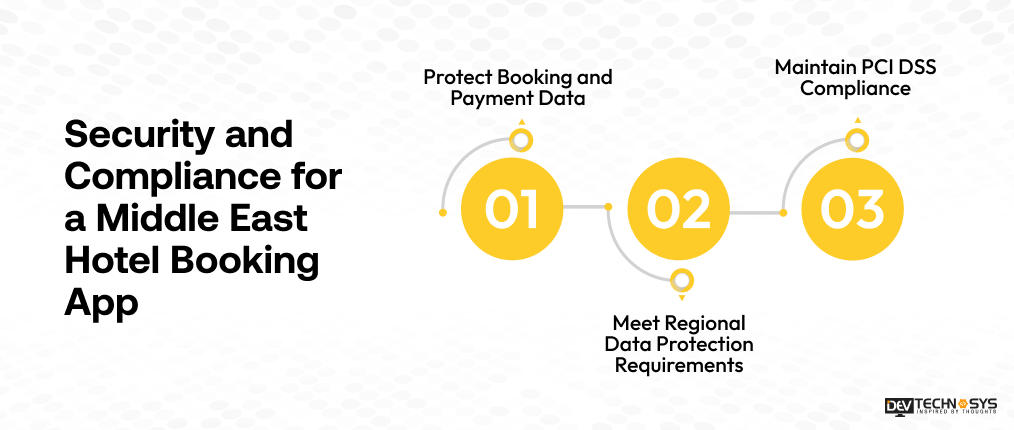
1. Protect Booking and Payment Data
API security should protect communication between the mobile application, backend, hotel suppliers, and payment services. API authentication can control access to protected services, while OAuth 2.0 and OpenID Connect can support secure authorization and identity management.
Sensitive information should be protected using AES-256 encryption for stored data and TLS/SSL encryption for data transmitted between systems. Role-based access controls, secure sessions, audit logs, vulnerability testing, and continuous monitoring can further reduce unauthorized access risks.
Payment workflows should minimize exposure to card information by using trusted payment infrastructure and appropriate tokenization mechanisms.
2. Meet Regional Data Protection Requirements
A GCC-focused platform should evaluate applicable UAE PDPL compliance and Saudi PDPL compliance requirements based on its operations, customers, and data flows. GDPR compliance may also apply when the platform processes personal data covered by European requirements.
Effective data privacy compliance should include consent management, data minimization, retention policies, access controls, deletion processes, and careful management of third-party suppliers. Businesses should also assess relevant GCC data protection regulations before launching across multiple markets.
3. Maintain PCI DSS Compliance
Payment processing should follow applicable PCI DSS compliance requirements. Sensitive card information should not be unnecessarily stored within the booking platform. Regular security assessments and vendor reviews can help maintain a safer reservation environment as transaction volumes increase.
How Can AI Improve a Flyin-Like Hotel Booking App?
AI can make a hotel booking platform more personalized by helping travelers discover relevant properties faster. Instead of presenting the same results to every user, AI can analyze search behavior, budgets, travel dates, preferred amenities, previous bookings, and destinations to generate more relevant recommendations.
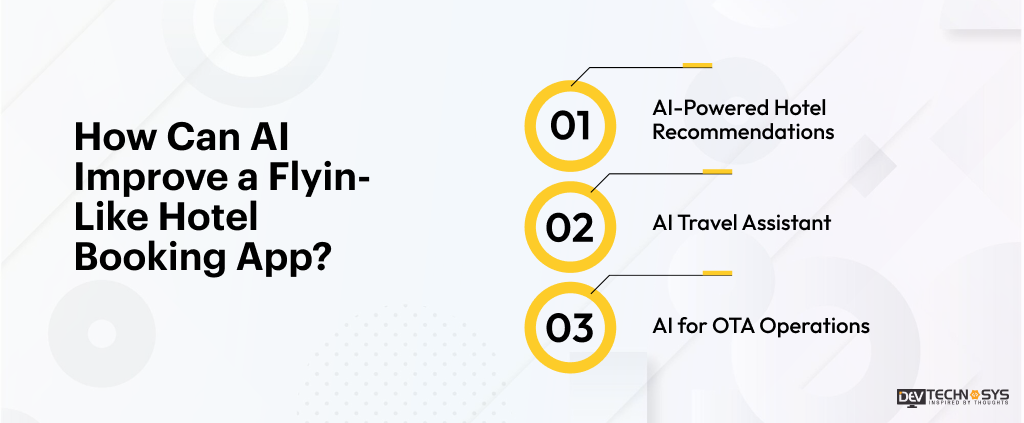
1. AI-Powered Hotel Recommendations
AI algorithms can rank hotels according to individual preferences and booking patterns. For example, a family traveler could receive recommendations emphasizing larger rooms, pools, breakfast, and nearby attractions. Business travelers could see properties closer to commercial districts with suitable work amenities.
2. AI Travel Assistant
A conversational assistant can simplify hotel discovery by understanding natural-language requests. A traveler might ask for a family-friendly hotel in Dubai near the beach within a specific budget. The assistant can interpret these requirements and surface suitable properties.
Businesses can also develop an ai powered travel assistant platform to extend this capability across hotel search, itinerary planning, and customer support.
3. AI for OTA Operations
AI can also support the business through automated customer assistance, review summarization, personalized offers, fraud detection, demand forecasting, and smarter hotel ranking. These capabilities can improve operational efficiency while creating a more relevant booking experience.
How Can a Flyin-Like Hotel Booking App Generate Revenue?
A hotel booking platform can combine multiple revenue streams instead of depending on a single commission model. A diversified approach can improve financial stability as the number of hotels and bookings grows.
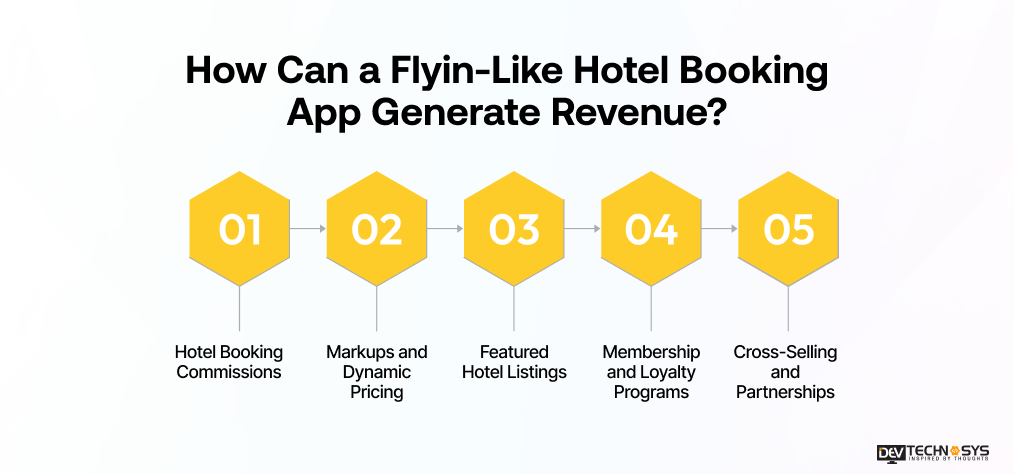
1. Hotel Booking Commissions
The primary revenue stream can come from commissions on completed reservations. The platform earns an agreed percentage from hotel partners or suppliers for bookings generated through its marketplace.
2. Markups and Dynamic Pricing
Where supplier agreements allow it, the platform can apply a margin to available rates. Dynamic pricing strategies can also help optimize offers based on demand, seasonality, destination, and inventory conditions.
3. Featured Hotel Listings
Hotels can pay for enhanced visibility through sponsored placements, featured listings, promotional campaigns, or preferred positions within relevant search results. This creates an additional B2B revenue channel.
4. Membership and Loyalty Programs
A premium membership can offer exclusive rates, loyalty rewards, promotional deals, or priority customer support. These programs can encourage repeat bookings and improve customer lifetime value.
5. Cross-Selling and Partnerships
The platform can generate additional revenue by offering airport transfers, activities, travel insurance, car rentals, and other complementary services. Affiliate partnerships can provide another revenue opportunity.
For businesses planning OTA app development, combining these models within a b2c travel portal development strategy can create multiple monetization opportunities while keeping the core hotel booking experience convenient.
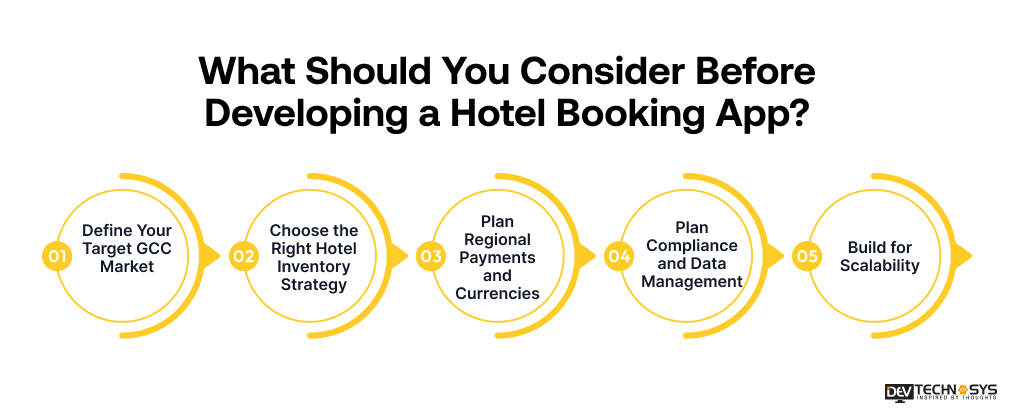
What Should You Consider Before Developing a Hotel Booking App?
Developing a hotel booking platform requires strategic decisions before writing the first line of code. These choices can influence the product scope, operating model, scalability, and long-term profitability.
1. Define Your Target GCC Market
Start by identifying whether you will target the UAE, Saudi Arabia, Qatar, Kuwait, Bahrain, Oman, or multiple markets. Define your primary traveler segments and decide between a B2C, B2B, or hybrid model. Arabic and English localization should also be planned early.
2. Choose the Right Hotel Inventory Strategy
Decide whether your inventory will come from direct hotel partnerships, GDS providers, hotel aggregators, or a hybrid approach. The right strategy depends on the destinations, property categories, and inventory volume you want to offer.
3. Plan Regional Payments and Currencies
Support relevant currencies such as AED and SAR while offering payment methods preferred by your target customers. Cancellation, refund, and failed-payment workflows should be designed alongside the checkout process.
4. Plan Compliance and Data Management
Data handling should account for applicable regional privacy requirements, third-party suppliers, retention policies, and user consent. Compliance requirements should be evaluated based on the countries and data flows involved.
Businesses can also review things to consider in travel app development before finalizing the product scope.
5. Build for Scalability
Cloud infrastructure, reliable APIs, monitoring, and modular architecture can help the platform handle growing hotel inventory and booking volumes without major architectural changes.
How Long Does It Take to Develop a Hotel Booking App Like Flyin?
The timeline to build a hotel booking app like Flyin depends on the number of platforms, integrations, features, and customization required. A typical project can follow this schedule:
Development Stage |
Estimated Time |
Key Activities |
| Research & Planning | 2–3 weeks | Requirements, market research, business model |
| UI/UX Design | 3–5 weeks | Wireframes, prototype, Arabic/RTL UX |
| Core Development | 10–14 weeks | Mobile apps, backend, booking engine |
| API & Payment Integration | 3–5 weeks | GDS, hotel APIs, payments, maps |
| Testing & QA | 3–4 weeks | Functional, security, API, performance testing |
| Deployment | 1–2 weeks | App stores, cloud setup, monitoring |
Businesses working with experienced travel app development services can streamline planning, integration, development, and testing. However, an advanced OTA may require additional time when it includes multiple hotel suppliers, complex booking workflows, AI features, Arabic localization, and extensive compliance requirements.
A focused MVP can launch sooner, while a full-scale GCC platform requires more development and testing before production deployment.
Why Choose a Custom Hotel Booking App Instead of a Basic Clone?
A basic clone can replicate familiar hotel search, filtering, property listings, and reservation workflows. However, copying an existing platform does not automatically create a competitive OTA. It may also limit customization as your business expands into new markets.
A custom hotel booking app allows businesses to design the experience around their target travelers, hotel partners, and revenue strategy. Features such as Arabic and RTL support, GCC payment methods, regional currencies, Muslim-friendly hotel discovery, custom loyalty programs, AI recommendations, and flexible supplier integrations can create stronger differentiation.
Businesses can study established travel platforms, such as those exploring how to build an app like Travelocity, while developing their own unique booking experience and commercial model.
A custom hotel booking solution also provides greater control over architecture, integrations, security, and future scalability. This makes it a more sustainable approach than building a simple Flyin clone app focused only on visual similarity.
Final Thoughts
A hotel booking app in the GCC does not mean copying an existing OTA or other ideas. If you want to build a successful platform, your app needs to be integrated with reliable hotel inventory, seamless reservations, regional payment options, Arabic UX, strong security, and scalable technology.
To build a hotel booking app like Flyin, businesses should focus on providing a unique and seamless experience to travelers and hotel partners. A custom hotel booking solution gives you more control over integrations, monetization, compliance, and future expansion. An expert travel app development company may partner with you to translate these needs into a scalable platform, built for GCC travelers and long-term growth.
Frequently Asked Questions
Q1. How Much Does It Cost to Build a Hotel Booking App Like Flyin?
The cost can range from $25,000 to $100,000+, depending on features, platforms, integrations, design complexity, and customization. A basic MVP costs less, while an advanced GCC-focused OTA requires GDS connections, supplier integrations, payment systems, AI, partner dashboards, and advanced security.
Q2. How Long Does It Take to Develop a Hotel Booking App Like Flyin?
A basic MVP can take several months, while a feature-rich OTA may require significantly more time. GDS integrations, multiple hotel suppliers, Arabic RTL support, complex booking workflows, AI capabilities, testing, and compliance requirements can extend the development timeline.
Q3. What APIs Are Required for Hotel Booking App Development?
A hotel booking platform may require GDS and hotel aggregator APIs for inventory, rates, and availability. Providers such as Amadeus and Sabre can support hotel services. Payment, geolocation, maps, notification, and other third-party APIs may also be integrated based on platform requirements.
Q4. Can I Build a GCC-Focused Hotel Booking Platform With Arabic Support?
Yes. A GCC-focused platform can support Arabic and English interfaces, RTL layouts, regional currencies, local payment preferences, and localized hotel discovery. Businesses can also include family-oriented and Muslim-friendly accommodation filters to create a more relevant experience for regional travelers.
Q5. What Is the Difference Between a Flyin Clone App and a Custom Hotel Booking Solution?
A Flyin clone app focuses on replicating familiar booking functionality, while a custom hotel booking solution is designed around your business model and target audience. Custom development provides greater control over branding, hotel inventory, integrations, monetization, localization, security, and future scalability.