





Key takeaways:
-
- React Native is a strong choice for teams familiar with JavaScript, React, and web development.
- Flutter offers a highly consistent UI and excellent control over cross-platform design.
- For MVPs and startups, both can deliver fast development, but the right choice depends on your team and product requirements.
- For enterprise apps, consider scalability, existing technology infrastructure, integrations, and long-term maintenance.
Cross-platform app development is gaining popularity in today’s time. React Native & Flutter – two popular programming languages are ruling in 2026. Choosing the right framework for mobile app development depends on multiple sets of features and functionalities, as mentioned by the mobile app development company professionals in this blog.
React Native Vs Flutter: Which one to choose? This is one of the most popular debates that has been going around for a while. So, if you also want to develop an app and are wondering which one to choose for mobile app development, continue reading.
Why Does Choosing the Right Cross-Platform Framework Matter?
When it comes to React Native Vs Flutter 2026, choosing the right cross-platform framework is important. impacts your app’s performance, development speed, scalability, and long-term success. Choosing the right framework is necessary because:
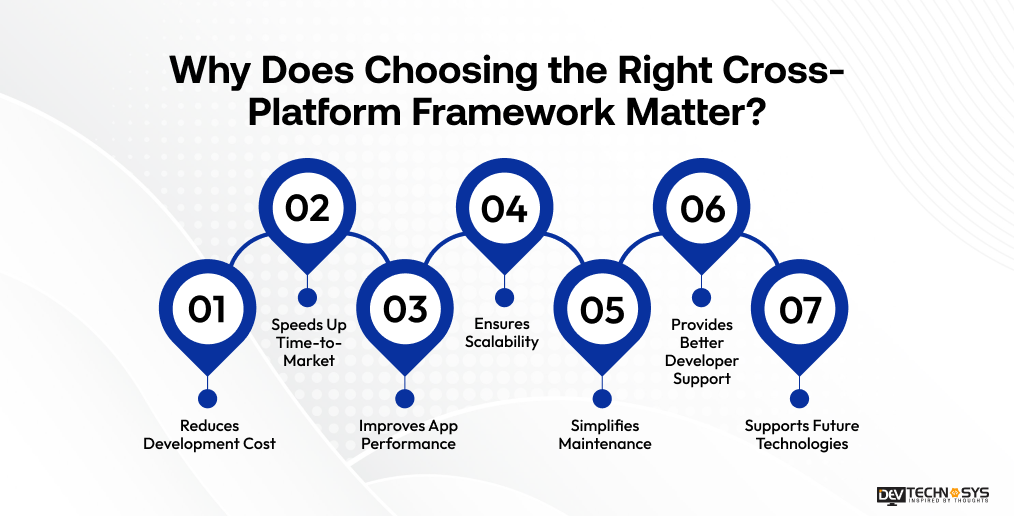
- Reduces Development Cost: A suitable framework allows developers to reuse code across platforms, lowering development efforts and overall project expenses.
- Speeds Up Time-to-Market: The right technology helps teams build, test, and launch applications faster, giving businesses a competitive advantage.
- Improves App Performance: Framework selection directly impacts app speed, responsiveness, animations, and overall user experience.
- Ensures Scalability: A future-ready framework supports growing users, advanced features, and business expansion without major technology changes.
- Simplifies Maintenance: A strong framework makes updates, bug fixes, and feature improvements easier and more cost-effective.
- Provides Better Developer Support: Popular frameworks offer large communities, ready-to-use libraries, tools, and skilled developers.
- Supports Future Technologies: The right framework makes it easier to integrate emerging technologies like AI, IoT, cloud services, and advanced APIs.
Since the framework becomes the foundation of your application, the wrong choice can lead to higher costs, performance limitations, and challenges during future upgrades. Flutter vs React Native for startups: whichever option you choose, the ideal framework should match your business goals, app complexity, performance requirements, target users, and future growth plans.
What Is React Native?
During the F8 conference of 2015, one of the most well-known frameworks of React was launched, and now it is known as React Native. It is one of the most well-known JavaScript libraries primarily concerned with front-end development. Being a subset of React, React Native allows native app development.
Just like React itself, the React Native framework is also maintained by Meta, formerly Facebook. Needless to say, React Native app development services are popular among clients. This is a relevant point in the React Native vs Flutter debate.
Where Is React Native Used?
Which is better Flutter or React Native? Well, as we read, React Native is a framework empowered by the JavaScript library. It is used for cross-platform app development that promises native-like app performance. It includes Android, iOS, macOS, Web, Desktop, etc.
Popular Apps Developed in React Native include:
- Facebook Ads
- Skype
- Tesla
What Is Flutter?
Flutter, by definition, is a UI toolkit that is portable and open-source. It is mainly used for designing and developing natively compiled applications. Flutter is compatible with different platforms, including mobile, web, and even desktop. The best part about Flutter is that the same code can be implemented across multiple platforms.
Flutter is a toolkit that was first introduced to developers back in 2018, making it young in the development world. It was developed by none other than the tech giant Google itself. It is popular among developers. It is a key reason a full-stack development company prefers Flutter for app development.
Where Is Flutter Used?
Flutter is a toolkit that enables code reusability across different platforms and operating systems. This includes mobile phones for different development platforms like iOS, Android, and cross-platform app development. In addition to this, Flutter also allows these apps to connect with the relevant platform service.
Popular Apps Developed in Flutter include:
- Xianyu app by Alibaba
- Hamilton app for Hamilton Musical
- Google Ads app
- Philips Hue
- My BMW

React Native vs Flutter at a Glance
Flutter vs React Native which is better? If you’re looking for a quick answer, here’s the short version: both React Native and Flutter are excellent cross-platform frameworks, but they excel in different areas. React Native is ideal for teams leveraging the JavaScript ecosystem and aiming to launch products quickly, while Flutter stands out for delivering highly customized, visually consistent, and performance-driven applications. The best choice ultimately depends on your business objectives, technical requirements, and long-term product strategy.
React Native vs Flutter for mobile app development: Quick Comparison:
Feature |
React Native |
Flutter |
| Developed By | Meta | |
| Programming Language | JavaScript / TypeScript | Dart |
| Rendering | Native UI Components | Own Rendering Engine (Skia/Impeller) |
| Performance | Excellent | Excellent (slightly better for graphics-heavy apps) |
| UI Consistency | Platform-specific look and feel | Consistent across all platforms |
| Hot Reload | Yes | Yes |
| Learning Curve | Easier for JavaScript developers | Moderate (requires Dart) |
| Development Speed | Fast | Fast |
| Third-Party Libraries | Extensive ecosystem | Growing ecosystem |
| App Size | Smaller | Slightly larger |
| Web Support | Available | Mature and actively improving |
| Desktop Support | Limited | Strong support |
| Community | Very Large | Large and rapidly growing |
| Best For | MVPs, startups, business apps | Enterprise apps, custom UI, animations |
React Native vs Flutter Architecture
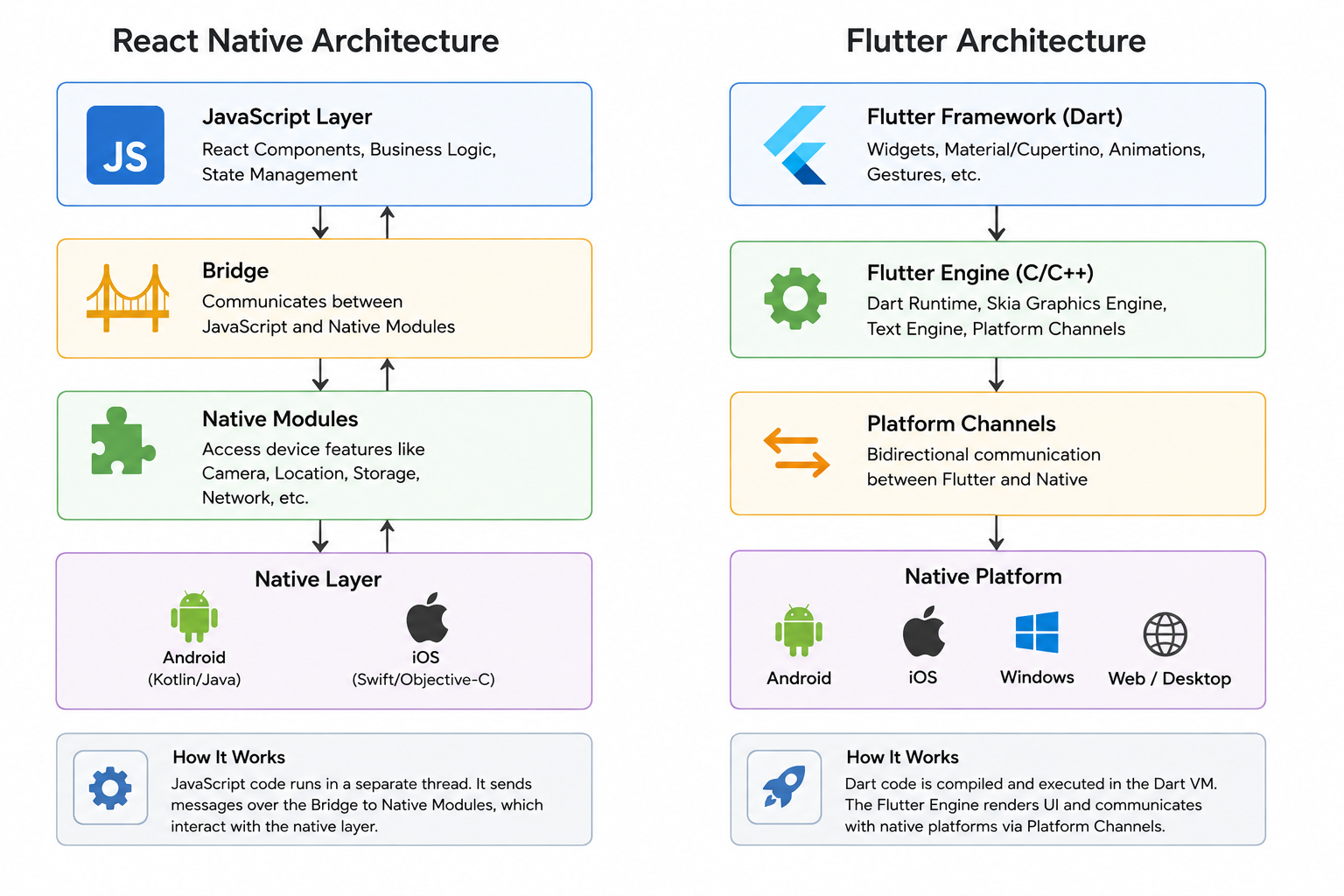
The biggest difference between React Native and Flutter isn’t visible in the user interface; it’s in how each framework communicates with the operating system. Understanding their architecture helps explain differences in performance, customization, and development complexity.
React Native New Architecture (Fabric, JSI, TurboModules)
React Native separates application logic from native functionality using JavaScript. When a user interacts with the app, requests are processed through JavaScript and then communicated to native APIs.
The latest React Native bridge architecture introduces:
- JavaScript Interface (JSI) for faster communication
- Fabric Renderer for improved UI rendering
- TurboModules for optimized native module loading
- Native Components for platform-specific functionality
This modernization significantly reduces bottlenecks and improves responsiveness compared to earlier versions.
Flutter Architecture
A layered Flutter widget-based architecture is designed for maximum rendering performance.
It consists of three primary layers:
- Framework Layer: The Flutter app development framework handles widgets, gestures, animations, themes, and application logic.
- Engine Layer: Responsible for graphics rendering, text layout, accessibility, and platform communication.
- Embedder Layer: Connects the Flutter engine with Android, iOS, Windows, macOS, Linux, and web environments.
Because Flutter controls its entire rendering pipeline, developers have greater flexibility to create highly customized interfaces without depending on platform-specific UI elements.
React Native vs Flutter Performance: Which Framework Is Faster?
Performance isn’t measured by a single benchmark. It’s the result of how efficiently a framework handles rendering, animations, memory management, and communication with the underlying operating system. Let’s examine where each framework shines.
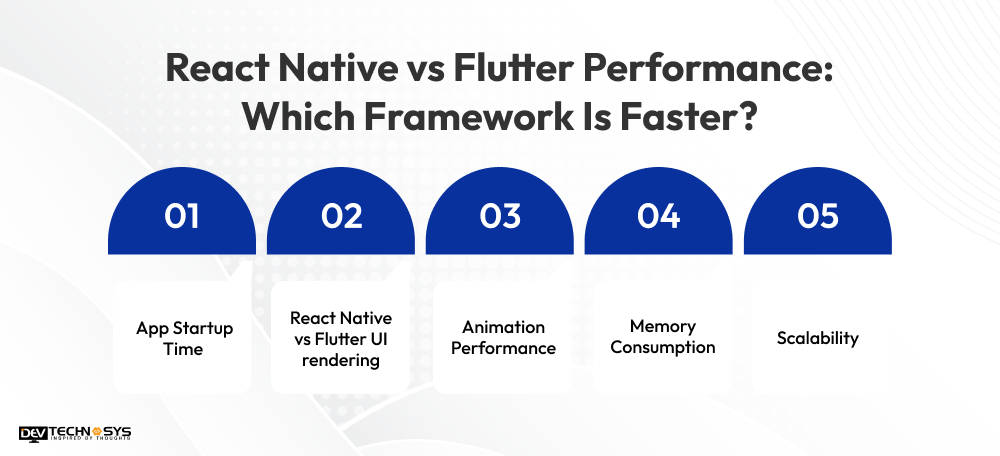
1. App Startup Time
The time it takes for an application to launch can significantly impact user satisfaction.
- React Native loads the JavaScript bundle before rendering the interface. While this process is generally quick, larger applications may experience a slight delay during startup.
- Flutter compiles directly into native machine code and renders the interface using its own engine. This often results in faster startup times, particularly for applications with complex user interfaces.
Winner: Flutter
2. React Native vs Flutter UI rendering
One of the biggest architectural differences between the two frameworks lies in how they render the user interface.
- React Native uses the platform’s native UI components. As a result, Android apps feel like Android apps, while iOS apps naturally follow Apple’s design guidelines. This creates a familiar user experience but can sometimes lead to slight inconsistencies between platforms.
- Flutter takes a different approach by rendering every UI element itself. Instead of relying on native controls, it paints each widget directly onto the screen. This allows developers to achieve identical layouts, animations, and transitions across Android, iOS, tablets, foldable devices, and even desktop applications.
If your product relies heavily on custom branding or unique interface designs, Flutter provides significantly more creative freedom.
Winner: Flutter
3. Animation Performance
Modern applications are expected to feel fluid. Smooth scrolling, responsive gestures, and interactive transitions all contribute to the overall user experience. Now let’s see the React Native vs Flutter performance comparison.
- Flutter consistently delivers high frame rates because animations are processed within its rendering engine rather than passing through a JavaScript bridge.
- React Native has improved dramatically with its New Architecture, including Fabric and JSI, which reduce communication overhead.
For most business applications, its animation performance is more than sufficient. However, graphics-intensive experiences may still require additional optimization.
Winner: Flutter
4. Memory Consumption
Memory efficiency becomes increasingly important as applications grow in size and complexity.
- React Native generally consumes less storage because it uses native UI components already available on the operating system.
- Flutter applications include their own rendering engine and framework, resulting in larger installation sizes.
For applications targeting users with limited device storage or slower internet connections, this difference may be worth considering.
Winner: React Native
5. Scalability
Scalability isn’t just about handling more users; it’s about supporting new features, integrations, and evolving business requirements without major redevelopment.
- According to a top Flutter app development company UAE, React Native integrates seamlessly with existing JavaScript ecosystems, making it a practical choice for organizations that already use React for web development.
- Flutter’s modular widget architecture enables developers to build reusable components and maintain consistent design systems across mobile, web, and desktop applications.
Winner: Tie (depends on your technical ecosystem)
React Native vs Flutter Development Cost Comparison
From a business perspective, React Native vs Flutter development cost is often just as important as technical capabilities. The total investment depends on several factors, including project complexity, feature requirements, developer expertise, integrations, testing, and ongoing maintenance. However, the choice of framework can also influence timelines and long-term expenses.
Cost Factor |
React Native |
Flutter |
| Initial Development Cost | Similar cost range due to reusable code across iOS and Android | Similar cost range with a single codebase approach |
| MVP Development Cost | Around $8,000–$30,000 depending on features and complexity | Around $8,000–$30,000 depending on features and complexity |
| Development Speed | Faster for teams familiar with JavaScript and React | Faster due to rich widget libraries and efficient UI development |
| Developer Availability | Lower hiring cost due to a large JavaScript talent pool | May have slightly higher costs due to a smaller Dart developer pool |
| UI Customization Cost | May require additional native modules for highly customized designs | Lower cost for custom interfaces due to built-in widget system |
| Maintenance Cost | Cost-effective with strong React ecosystem support | Cost-effective with a unified Dart codebase |
| Third-Party Integration Cost | Generally affordable with extensive libraries | Affordable but some integrations may require custom development |
| Long-Term Scalability Cost | Suitable for businesses already using React technologies | Suitable for businesses needing multi-platform expansion |
| Enterprise App Cost | Can range from $40,000–$150,000+ depending on complexity | Can range from $40,000–$150,000+ depending on complexity |
Future Outlook (2026 and Beyond): The Next Phase of Cross-Platform Development
Cross-platform development is moving toward AI-powered workflows, multi-device experiences, and enterprise-scale adoption. React Native and Flutter are expanding beyond mobile apps to support faster, smarter, and more connected digital products.
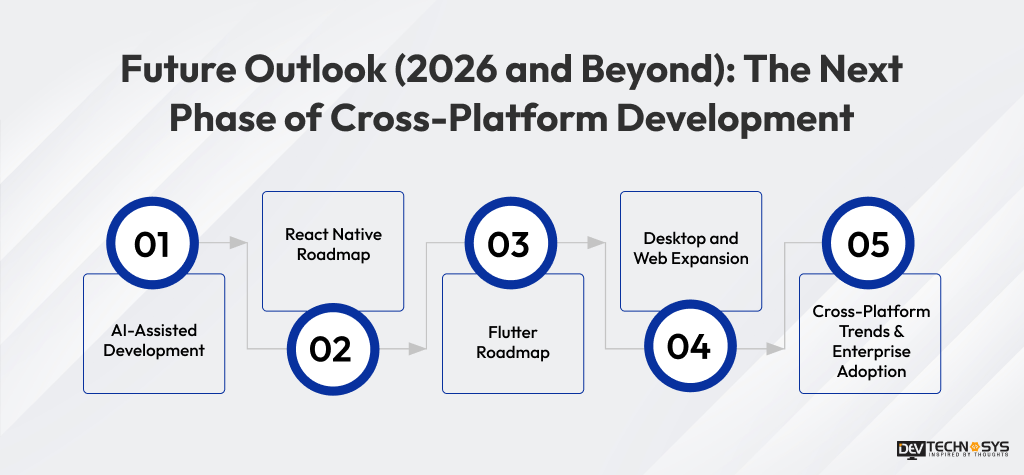
AI-Assisted Development
AI will become an essential part of app development by helping the React Native app development company UAE with:
- Automated code generation
- Faster debugging
- AI-powered testing
- Performance optimization
- UI component creation
This will help businesses reduce development time, lower costs, and launch products faster while developers focus more on architecture and innovation.
React Native Roadmap
React Native is expected to continue improving performance through its modern architecture, including Fabric and TurboModules.
Future developments will focus on:
- Faster rendering and smoother experiences
- Better native feature integration
- Improved scalability for enterprise apps
- Stronger support for web and desktop platforms
React Native will remain a preferred choice for businesses already using React and JavaScript ecosystems. It is best to hire React Native developers Dubai
Flutter Roadmap
Flutter is evolving into a complete multi-platform framework beyond mobile development.
Future improvements will include:
- Better performance optimization
- Stronger desktop and web capabilities
- Enhanced native integrations
- Wider enterprise adoption
Flutter’s single-codebase approach will continue attracting businesses looking for consistent experiences across multiple platforms.
Desktop and Web Expansion
The future of applications will go beyond smartphones. Businesses will increasingly build solutions that work across:
- Mobile devices
- Web browsers
- Desktop systems
- Smart devices
With improved web and desktop support, React Native and Flutter will help companies maintain one development ecosystem instead of managing separate platforms.
Cross-Platform Trends & Enterprise Adoption
Key trends shaping the future include:
- AI-driven development
- Single-codebase applications
- Cloud-native solutions
- Faster MVP development
- Multi-device user experiences
Enterprises across fintech, healthcare, retail, logistics, and SaaS are expected to increase adoption of cross-platform frameworks due to lower maintenance costs, faster releases, and easier scalability.
Conclusion!
As discussed about the React Native vs Flutter learning curve, both React Native & Flutter have their own advantages and disadvantages. It goes without saying that the debate of React Native vs Flutter can go on forever. However, it is often seen that react native app development services have the upper hand over Flutter for various reasons. Nevertheless, suppose you want to develop an app of your own. In that case, it is recommended that you consult a mobile app development company in Dubai or the UAE, as they can guide you better based on your needs and project requirements.
FAQs
- Which Is Better, React Native Or Flutter?
There is no single winner in React Native vs Flutter. The right choice depends on project requirements, team expertise, and business goals. React Native works well for businesses already using React and JavaScript, while Flutter is ideal for apps requiring highly consistent UI and smooth performance across platforms.
- Is Flutter Faster Than React Native?
Flutter can deliver slightly better performance in some scenarios because it uses its own rendering engine and compiles directly to native code. However, React Native has improved significantly with its New Architecture, making performance differences less noticeable for most business applications.
- Which Is Easier To Learn: React Native Or Flutter?
React Native is generally easier for developers familiar with JavaScript and React. Flutter requires learning Dart, but its structured framework and widget-based approach make it beginner-friendly for developers starting from scratch.
- Which Framework Is Better For Startups?
Both frameworks are suitable for startups. React Native can be a great choice for startups wanting faster development with existing JavaScript talent, while Flutter is beneficial for startups looking for a visually rich app with a consistent experience across platforms.
- Is Flutter Or React Native Better For Enterprise Applications?
Both React Native and Flutter support enterprise-level applications. React Native is commonly preferred by companies with existing React ecosystems, while Flutter is gaining adoption for large-scale applications requiring strong UI performance and a unified codebase.
- Can React Native and Flutter Build Apps for Both Android and iOS?
Yes. Both frameworks allow developers to create Android and iOS applications using a single codebase, reducing development time and maintenance costs compared to building separate native apps.