





As telematics systems, connected vehicles, and smart mobility solutions become increasingly driven by data, auto applications are becoming vital parts of the digital automotive ecosystem. The application process includes things like real-time vehicle diagnostics, remote control, electric vehicle (EV) charging, fleet management, and infotainment.
Thus, automotive applications handle large amounts of important user and vehicle data, which is why cybersecurity becomes crucial for this kind of technology.
If there is a security vulnerability, it might lead to the leakage of private data or malfunctions of a vehicle.
By introducing proper frameworks – ISO 27001 and OWASP Mobile Application Security Verification Standard (MASVS) software developers can set up secure information security controls and defend against mobile-specific threats.
The purpose of this guide is to explain how automotive app security compliance can help founders of auto applications build secure mobile software.
What Is ISO 27001 and Its Role in Automotive App Security UAE?
ISO 27001 is a globally recognized information security standard that assists organizations in developing, implementing, and maintaining an effective Information Security Management System (ISMS). It offers an organized approach to managing cybersecurity risks, safeguarding sensitive data, regulating access, and assuring continual security upgrades. ISO 27001 is designed to help automotive companies handle vehicle data, user information, and connected systems securely.
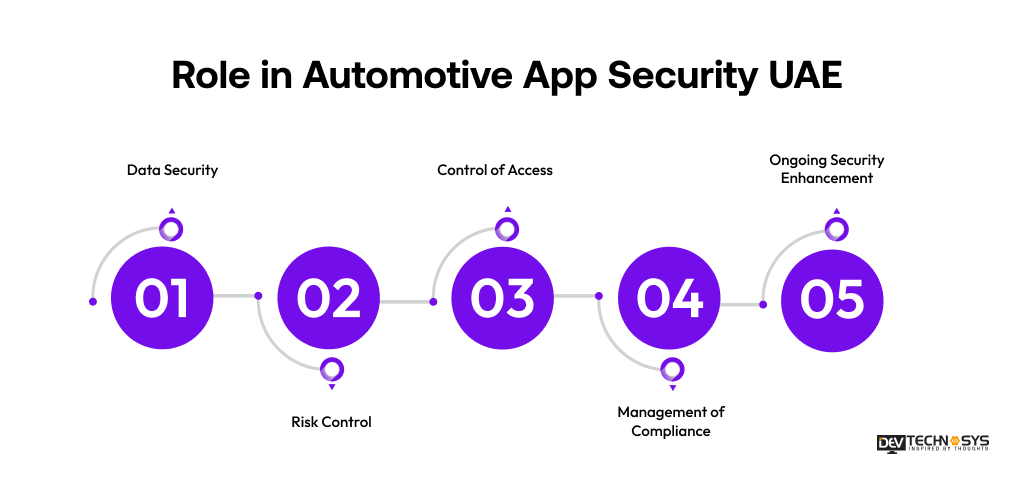
Role in Automotive App Security UAE:
1. Data Security
Through encryption, secure storage procedures, and limited access methods, ISO 27001 assists automotive applications in protecting sensitive data, such as vehicle data, customer information, and location records.
2. Risk Control
Automotive companies can use ISO 27001 to detect cybersecurity risks, assess possible effects, and put preventative measures in place to lower risks in connected cars, mobile apps, cloud platforms, and APIs.
3. Control of Access
By implementing appropriate access control policies and guaranteeing that only authorized users may access vehicle systems, application features, and sensitive data, ISO 27001 enhances automotive app security compliance.
4. Management of Compliance
In order to meet industry regulations and increase trust with automotive customers, partners, and stakeholders, ISO 27001 assists firms in maintaining security policies, conducting frequent audits, and adhering to organized processes.
5. Ongoing Security Enhancement
In order to assist automotive applications in adapting to changing cyber risks and retain dependable protection throughout their operational lifecycle, ISO 27001 promotes continuous monitoring, security reviews, and process enhancements.
OWASP Mobile Security Standards for Automobile Apps
Best practices for creating safe mobile applications are provided by the OWASP Mobile Security Guidelines. The OWASP Mobile Top 10 identifies common security threats, such as dangerous communication, shoddy authentication, and insecure data storage. While vulnerability testing finds flaws through security assessments, penetration testing, and ongoing monitoring to shield automotive mobile applications from cyberattacks.
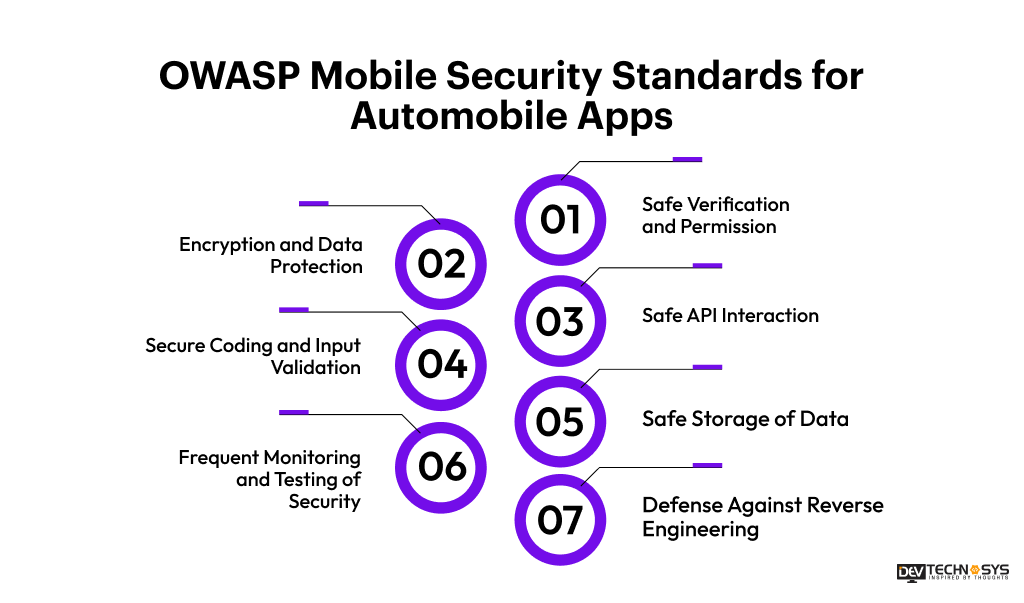
1. Safe Verification and Permission
Strong authentication and authorization procedures must be implemented by automotive apps in order to safeguard user accounts and linked vehicle systems. Using secure login techniques, role-based access control, token validation, and session management are all part of adhering to OWASP recommendations. These procedures guard against illegal access to vital automotive services, personal data, and car features.
2. Encryption and Data Protection
Sensitive data, such as payment information, driver information, and car position, are handled by automotive apps. OWASP advises utilizing industry-standard security techniques to encrypt data while it is being transmitted and stored. Appropriate encryption methods guarantee customers’ trust in connected car apps and services while guarding against data breaches, illegal access, and privacy violations.

3. Safe API Interaction
For connectivity between mobile devices, cars, cloud platforms, and third-party services, modern car apps mainly rely on APIs. OWASP places a strong emphasis on secure API development using input validation, encryption, authentication, and access controls. Attackers cannot alter vehicle orders, steal data, or interfere with connected automobile experiences when APIs are protected.
4. Secure Coding and Input Validation
To avoid vulnerabilities like injection attacks and malicious data processing, automotive applications should validate all user inputs and adhere to secure development guidelines. OWASP advises putting in place appropriate code reviews, error handling, and validation. Throughout the automobile app development services lifecycle, these steps assist developers in producing dependable applications that lower security threats.
5. Safe Storage of Data
Important data, including user profiles, vehicle settings, travel history, and authentication credentials, is stored by connected car apps. Developers are advised by OWASP to adopt encrypted storage solutions and steer clear of unsafe storage practices. Sensitive information is kept safe even in the event that a device is lost, stolen, or compromised thanks to proper data protection.
6. Frequent Monitoring and Testing of Security
Maintaining safe automotive applications requires ongoing security testing. To find such risks, OWASP suggests vulnerability assessments, penetration testing, code analysis, and continuous monitoring. Frequent security reviews assist developers in fixing vulnerabilities, strengthening defenses, upholding compliance, and providing users and car owners with safer digital experiences.
7. Defense Against Reverse Engineering
Automobile app development solutions need to have safeguards against unauthorized changes, code tampering, and reverse engineering. OWASP suggests methods including secure build procedures, code obfuscation, and application integrity checks. These security precautions assist in preventing hackers from finding weaknesses, protecting connected car features from abuse, and preserving unique technology.
ISO 27001 vs OWASP: How They Work Together for Automotive Security
ISO 27001 and OWASP collaborate to establish a more robust automotive security framework. OWASP enhances application-level protection by implementing secure coding and vulnerability prevention, whereas ISO 27001 offers risk management, governance, and compliance processes. Collectively, they assist automotive enterprises in safeguarding digital platforms, user data, and connected vehicles.
Aspect |
ISO 27001 |
OWASP |
How They Work Together |
| Security Framework | Provides an information security management structure. | Provides application security guidelines. | Combines strategy with technical protection. |
| Risk Assessment | Identifies business and security risks. | Detects software vulnerabilities and threats. | Covers organizational and application risks. |
| Data Protection | Protects sensitive information through security controls. | Secures data using encryption and safe practices. | Protects vehicle and user data effectively. |
| Access Control | Defines identity and permission policies. | Secures authentication and authorization systems. | Prevents unauthorized vehicle app access. |
| Secure Development | Establishes security processes for organizations. | Guides secure coding and testing methods. | Creates safer automotive applications. |
| Compliance Support | Helps meet regulatory and industry requirements. | Supports application security compliance. | Strengthens automotive cybersecurity compliance. |
| Testing & Monitoring | Requires audits and security reviews. | Uses penetration testing and vulnerability checks. | Enables continuous security improvement. |
| Incident Management | Provides response and recovery processes. | Helps prevent and address application attacks. | Improves resilience against cyber threats. |
Secure Automotive App Development Lifecycle
Cybersecurity is included throughout the whole process of developing a safe automobile app, from planning and architecture design to coding, testing, deployment, and monitoring. Automotive companies can defend connected cars, user data, and digital platforms from emerging cyberthreats by putting threat modeling, secure Android app development techniques, continuous testing, and proactive security policies into place.
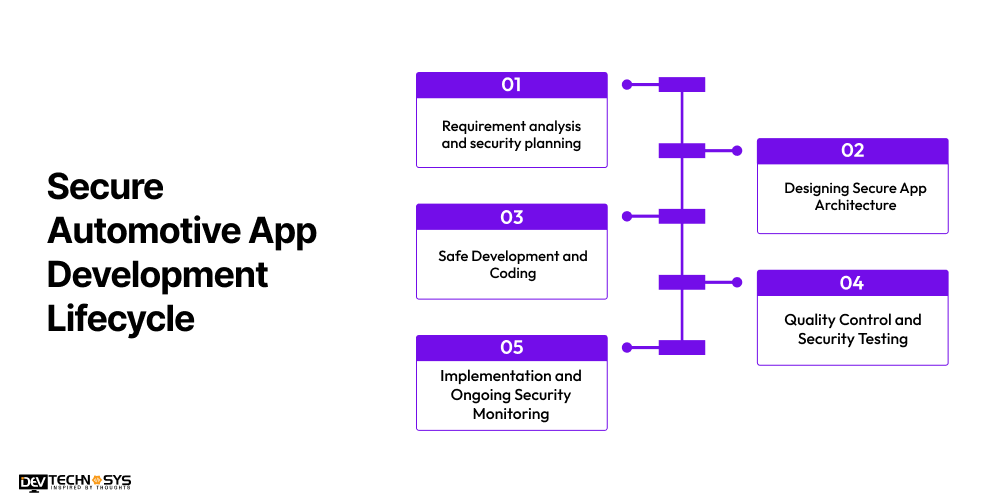
1. Requirement analysis and security planning
By establishing cybersecurity goals and protection requirements, security planning lays the groundwork for a safe automotive application lifecycle. Teams determine security needs based on user information, vehicle systems, and legal requirements. Automotive app security compliance adherence to automotive cybersecurity UAE frameworks, privacy laws, and industry security criteria, threat modeling aids in the analysis of probable attack vectors.

2. Designing Secure App Architecture
Building robust automotive applications with secure cloud architecture, encrypted communication channels, and scalable infrastructure is the main goal of secure architectural design. Planning for API security guarantees secure data transfer between backend systems, mobile apps, and automobiles. Hire dedicated developers to verify each user, device, and connection before allowing access, a zero trust security method lowers the chance of unwanted access.
3. Safe Development and Coding
By adhering to industry-accepted security standards and development guidelines, secure coding methods assist developers in producing dependable automotive applications. While dependency security checks find threats in third-party libraries and software components, regular code reviews find vulnerabilities during secure mobile app development UAE. These procedures augment application defense against cyberattacks, decrease security vulnerabilities, and enhance code quality.
4. Quality Control and Security Testing
Before being deployed, security testing makes sure automotive apps adhere to cybersecurity regulations. Vulnerability assessments examine system flaws, whereas penetration testing uses simulated attacks to find exploitable vulnerabilities. In order to guarantee secure communication between linked automotive platforms, mobile security testing assesses application protection measures, and API security testing confirms authentication, authorization, and data protection procedures.
5. Implementation and Ongoing Security Monitoring
By spotting new risks and preserving system resilience, continuous security monitoring safeguards automotive apps after they are deployed. Vulnerabilities are fixed by routine security upgrades, and suspicious activity across apps and related services is identified by threat monitoring. Hire a mobile app development company to handle security breaches, reduce downtime, and swiftly resume operations during cybersecurity incidents thanks to incident response planning.
10 Key Features of a Secure Automobile Application
Advanced cybersecurity elements are combined in a secure automotive application to safeguard users, vehicles, and associated services. These features, which range from robust authentication and data encryption to secure APIs, monitoring, and frequent updates, guarantee safer online experiences, stop cyberattacks, and boost confidence in connected car technology.
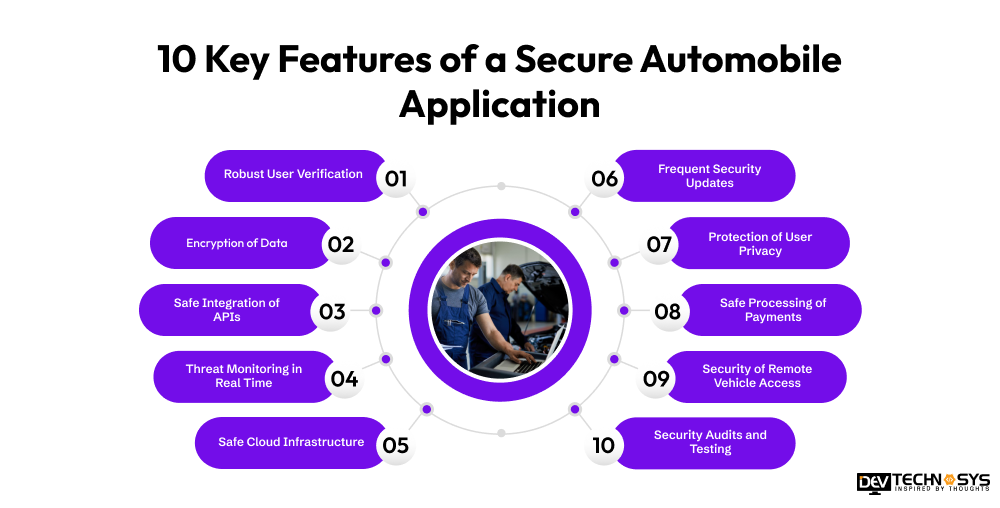
1. Robust User Verification
To stop unwanted access and safeguard user accounts, secure car apps include multi-factor authentication, biometric verification, and secure login procedures.
2. Encryption of Data
Sensitive data, such as user information, payment records, and car details, is protected during storage and transmission between linked systems using encryption.
3. Safe Integration of APIs
Through authentication and access controls, protected APIs guarantee secure communication between mobile apps, automobiles, cloud platforms, and third-party services.
4. Threat Monitoring in Real Time
Faster reactions to possible assaults or system compromises are made possible by continuous monitoring, which identifies suspicious activity, cybersecurity threats, and odd behaviors.
5. Safe Cloud Infrastructure
Through network security, encryption, access control, and dependable infrastructure configurations, a secure cloud environment safeguards automotive data.
6. Frequent Security Updates
Automotive app security compliance offers regular updates that fix security flaws, enhance security measures, and guarantee that automotive apps are shielded from new online dangers.
7. Protection of User Privacy
By restricting data access, guaranteeing compliance, and upholding user transparency, privacy controls properly manage personal information.
8. Safe Processing of Payments
To safeguard transactions, subscriptions, and digital services, automotive apps need secure payment gateways with encryption and authentication.
9. Security of Remote Vehicle Access
Robust security measures guard against illegal instructions and misuse of remote capabilities, including car monitoring, locking, and unlocking.
10. Security Audits and Testing
Frequent security audits, vulnerability assessments, and penetration testing aid in finding flaws and preserving the dependability and security of applications.
Technologies Used for Building Secure Automotive Apps
Building safe automotive apps needs modern technology in mobile, backend, cloud, and car ecosystems. Modern tech stacks enable the delivery of dependable, scalable, and secure connected vehicle experiences, featuring native platforms, cross-platform frameworks, secure APIs, microservices, IoT connection, telematics, and EV integrations.
Category |
Technology / Stack |
Purpose in Secure Automotive Apps |
| Mobile Development | Native Android (Kotlin/Java) | Secure, high-performance Android apps. |
| Mobile Development | Native iOS (Swift) | Secure iOS apps with platform protection. |
| Cross-Platform Development | Flutter | Faster development with secure cross-platform support. |
| Cross-Platform Development | React Native | Builds scalable cross-platform applications. |
| Cloud Platforms | AWS, Azure, Google Cloud | Secure hosting, storage, and scalability. |
| Backend Development | REST APIs, GraphQL | Enables secure system communication. |
| Backend Architecture | Microservices | Improves scalability and service security. |
| IoT Connectivity | MQTT, IoT Gateways | Enables secure vehicle connectivity. |
| Telematics Systems | Vehicle Telematics Platforms | Manages real-time vehicle data. |
| EV Charging Integration | OCPP, Charging APIs | Supports secure EV charging services. |
| Vehicle Data Platforms | Automotive Data Platforms | Processes and protects vehicle insights. |
Best Practices for Secure Automotive App Development
Robust hybrid app development services necessitate an all-encompassing cybersecurity strategy that incorporates industry benchmarks, secure coding methodologies, encryption, authentication, testing, and ongoing surveillance. Adhering to ISO 27001 standards, OWASP recommendations, routine assessments, and compliance protocols enables developers to create dependable, robust, and secure apps.
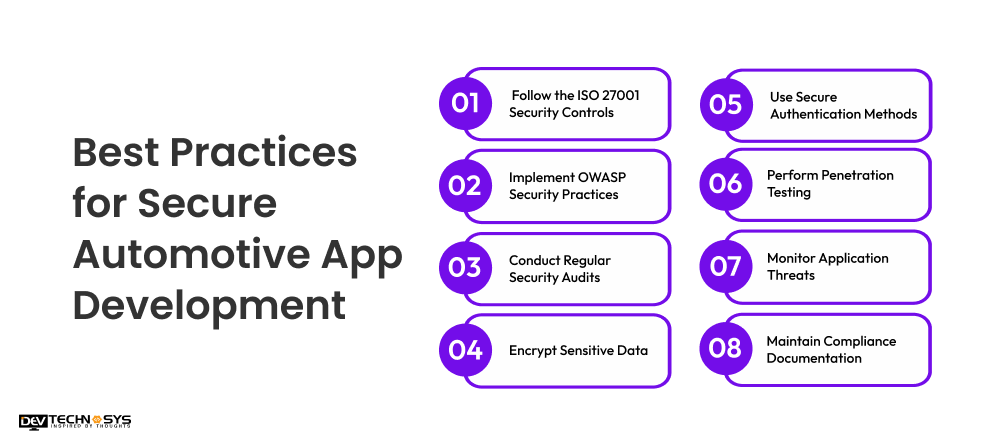
1. Follow the ISO 27001 Security Controls
Implement ISO 27001 security procedures to create a structured information security management system (ISMS). These controls assist in managing cybersecurity risks, protecting automotive application data, defining security rules, and ensuring compliance with industry security standards.
2. Implement OWASP Security Practices
Use OWASP security guidelines to detect and prevent application vulnerabilities. Follow secure coding rules, protect APIs, reinforce authentication procedures, and address common mobile security concerns to enhance the overall security of connected automobile applications and digital services.
3. Conduct Regular Security Audits
Conduct regular security audits to assess application security posture, detect flaws, and ensure compliance. Security reviews, vulnerability assessments, and control evaluations assist automotive organizations in ensuring consistent protection against evolving cyber threats and system weaknesses.
4. Encrypt Sensitive Data
Use modern encryption techniques to safeguard sensitive automotive data, such as user information, car specifications, and communication logs. To avoid unauthorized access and data breaches, use encryption technologies like TLS for data transport and secure storage.
5. Use Secure Authentication Methods
Use safe authentication mechanisms such as multi-factor authentication (MFA), biometric verification, and token-based access control. These measures secure user accounts, restrict unwanted vehicle entry, and ensure that only confirmed users have access to connected automobile features and services.
6. Perform Penetration Testing
Perform regular penetration tests to simulate cyberattacks and find exploitable weaknesses. Security testing evaluates application defenses, API protection, network security, and system resilience, allowing developers to remedy flaws before attackers exploit them.
7. Monitor Application Threats
Use continuous threat monitoring technologies to detect suspicious activity, security problems, and unusual application behavior. Implement SIEM solutions, real-time alerts, and analytics to enhance threat detection and response capabilities.
8. Maintain Compliance Documentation
Maintain extensive compliance documentation that includes security policies, risk assessments, audit reports, and development procedures. Proper documentation promotes regulatory compliance, improves security governance, and serves as evidence of cybersecurity measures implemented throughout the automotive application lifecycle.
Future Trends in Automotive Application Security
The security of future automotive applications will progress through the integration of sophisticated technologies including artificial intelligence, blockchain, edge computing, and systems for safeguarding autonomous vehicles. These automobile app trends in UAE will improve danger identification, bolster vehicle identity oversight, safeguard interconnected systems, and ensure safer digital interactions for contemporary intelligent transportation solutions.
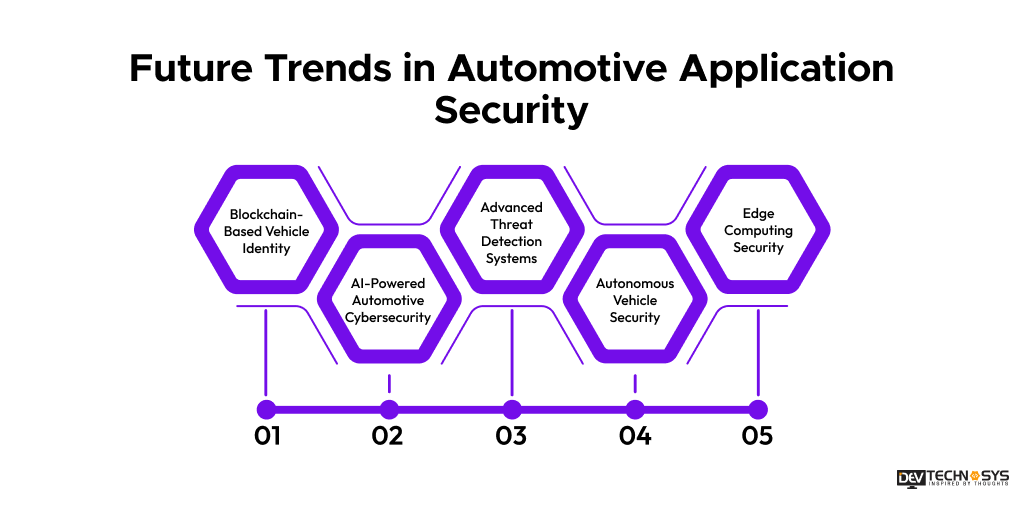
1. Blockchain-Based Vehicle Identity
Blockchain technology can establish secure digital identities for automobiles through the creation of immutable records of ownership, verification, and transactions. Decentralized identity management enhances confidence among cars, manufacturers, and service providers, simultaneously mitigating risks associated with identity theft, unauthorized access, and fraudulent manipulation of vehicle data.
2. AI-Powered Automotive Cybersecurity
AI in automobile app development is revolutionizing vehicle cybersecurity with real-time threat identification, predictive analytics, and automated interventions. AI algorithms are capable of recognizing atypical vehicular conduct, identifying cyber intrusions, and enhancing security measures. Machine learning algorithms assist automotive systems in responding to new threats and enhancing security for connected vehicles.
3. Advanced Threat Detection Systems
Sophisticated threat detection systems employ machine learning, behavioral analysis, and security surveillance techniques to swiftly recognize cyber threats. These systems scrutinize network traffic, application behaviors, and vehicular communications to identify irregularities, thwart attacks, and bolster the cybersecurity fortitude of contemporary connected car platforms.

4. Autonomous Vehicle Security
Self-driving cars necessitate sophisticated security protocols to safeguard sensors, AI algorithms, communication infrastructures, and control mechanisms. Future security measures will prioritize the prevention of illegal orders, safeguarding decision-making algorithms, and guaranteeing secure vehicle operations against advanced cyberattacks aimed at autonomous driving technology.
5. Edge Computing Security
Edge computing enhances automotive efficiency by analyzing vehicle data nearer to its origin. Future security approaches will emphasize safeguarding edge devices via encryption, secure communication protocols, device authentication, and ongoing surveillance. These strategies assist in preserving data confidentiality and dependability inside interconnected and intelligent vehicle systems.
Conclusion
As vehicle applications keep driving connected mobility, cybersecurity must always stay at the forefront of design. Organizations should leverage ISO 27001 and OWASP Mobile Security best practices to provide effective risk management, improve secure coding practices, secure vital automobile data, and minimize attack surfaces. Security-first development not only promotes automotive app security compliance and minimizes disruptions but also builds user confidence, protects ecosystems of connected vehicles, and offers foundations for innovations. Reach out to an experienced automobile app development company to integrate ISO 27001 and OWASP security standards in automobile applications for security measurements.
Frequently Asked Questions
1. Why Are ISO 27001 and OWASP Important For Automotive App Security Compliance?
While OWASP Mobile Standards concentrate on application-level protection, ISO 27001 offers an organized framework for security management. When combined, they assist automotive developers in managing cybersecurity risks, preventing vulnerabilities, safeguarding user data, securing connected car services, and creating dependable applications that adhere to industry security standards.
2. How Does ISO 27001 Improve Automotive App Security Compliance?
By implementing risk management procedures, security guidelines, access restrictions, and compliance procedures, ISO 27001 compliance UAE enhances the security of automotive apps. Throughout the development and operation of automotive applications, it assists enterprises in identifying threats, safeguarding sensitive data, keeping an eye on security performance, and maintaining a robust cybersecurity framework.
3. What OWASP Practices Should Automotive App Developers Follow?
OWASP guidelines, which include secure authentication, data encryption, API protection, secure code, input validation, vulnerability testing, and defense against reverse engineering, should be adhered to by automotive software developers. These procedures enhance the security of digital services and connected car applications by preventing common mobile application risks.
4. How do ISO 27001 and OWASP Work Together?
OWASP deals with technical application vulnerabilities, whereas ISO 27001 certification UAE concentrates on corporate security governance. By controlling cybersecurity risks, enhancing safe development procedures, fortifying application defenses, and shielding linked automotive platforms from changing cyberthreats, combining the two standards results in a comprehensive security strategy.
5. Why Is Encryption Necessary In Automotive Applications?
Sensitive automotive data, such as user credentials, car information, location information, and communication logs, is protected by encryption. Developers may avoid unwanted access, safeguard data integrity, uphold privacy compliance, and guarantee secure communication between mobile apps, automobiles, and cloud platforms by employing strong encryption protocols.