Key Takeaways:
-
- Custom CRM development cost in UAE approximately lies between AED 18,359–AED 330,521+.
- Basic CRM software UAE includes contact management, lead tracking, and sales pipelines
- Advanced CRM software Dubai requires additional investment in AI automation, ERP integrations, analytics, and multi-branch management.
- Arabic-English support, UAE-specific integrations, data migration, and security requirements can influence the cost to develop CRM system
Businesses across the UAE are investing in customer relationship management (CRM) software to streamline sales operations, manage customer interactions, automate follow-ups, and improve business performance. However, ready-made CRM platforms do not always accommodate specific workflows, industry requirements, or integration needs.
The custom CRM software development cost in the UAE typically ranges from AED 18,359 to AED 330,521+, which is around $4,999–$89,999. However, this is just an estimate; the actual investment depends on features, integrations, customization, security requirements, and development complexity. This guide explores CRM development costs, essential features, pricing factors, development timelines, and ways to manage your investment.
How Much Does a Custom CRM Cost to Build in the UAE?
The cost of developing custom CRM software in the UAE depends on the number of modules, user roles, integrations, automation requirements, and platform complexity.
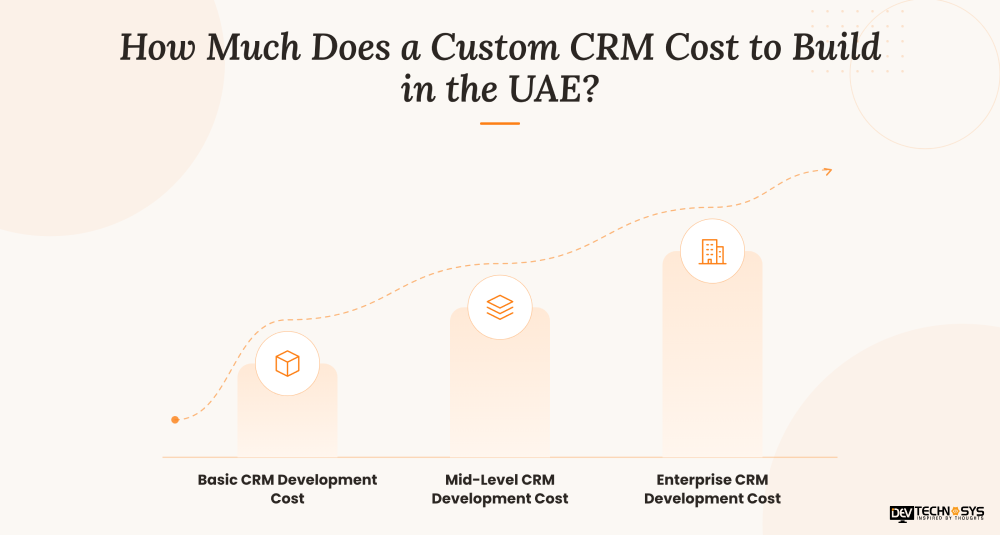
For budgeting purposes, businesses can consider three development levels:
CRM development level |
Estimated cost (AED) |
Typical timeline |
Best suited for |
| Basic CRM Software Development Cost in the UAE | AED 18,359–55,088 | 2–3 months | Startups and small businesses |
| Mid-level CRM Software Development Cost in the UAE | AED 55,088–146,900 | 3–5 months | Growing and mid-sized businesses |
| Enterprise CRM Software Development Cost in the UAE | AED 146,900–330,521+ | 5–9+ months | Large businesses and enterprises |
These are indicative development estimates converted from USD using the November 3, 2026 reference rate. According to the leading CRM software development company, the actual project quotations depend on scope, technical requirements, and the delivery model.
1. Basic CRM Development Cost
Custom CRM software development cost in UAE with basic features and functionalities ranges from AED 18,359–55,088. It is suitable for startups and small businesses that want to replace spreadsheets and disconnected customer records with a centralized system.
Typical features include:
- Customer and contact management
- Lead capture and assignment
- Basic sales pipeline management
- Task and follow-up reminders
- User login and role management
- Basic reports and dashboards
For example: A Dubai-based real estate agency could hire an MVP development company to build a basic CRM to capture property inquiries, assign leads to agents, track follow-ups, and monitor deal progress.
2. Mid-Level CRM Development Cost
A mid-level CRM Software Development Cost in the UAE typically ranges from AED 55,088 to AED 146,900. It supports businesses with more complex sales processes, multiple departments, and growing customer databases.
This development level may include:
- Custom sales pipelines and workflow automation
- Email and WhatsApp Business integration
- Marketing campaign management
- Advanced reporting and sales forecasting
- ERP and accounting software integration
- Customer segmentation and lead scoring
- Arabic and English interface support
For instance, a retail company operating across Dubai and Abu Dhabi may require CRM integration with its ecommerce platform, inventory system, and accounting software to maintain consistent customer records.
3. Enterprise CRM Development Cost
Enterprise CRM software development services in UAE can cost AED 146,900–330,521 or more, depending on the number of business units, integrations, security requirements, and customization depth.
Advanced enterprise solutions may include:
- AI-powered lead scoring and predictive analytics
- Arabic RTL support
- Multi-branch and multi-department management
- Complex approval workflows and automation
- ERP, finance, HRM, and marketing integrations
- Custom customer and partner portals
- Advanced access controls and audit logs
- Dedicated mobile applications
- Enterprise reporting and business intelligence
For example, a financial services company may require a CRM that connects customer onboarding, sales operations, service requests, internal approvals, and reporting across multiple departments.
Factors Affecting Custom CRM Software Development Cost in the UAE
Two businesses can request similar CRM platforms but receive different development quotations. The difference usually comes from the depth of customization, integrations, security requirements, and expected system performance.
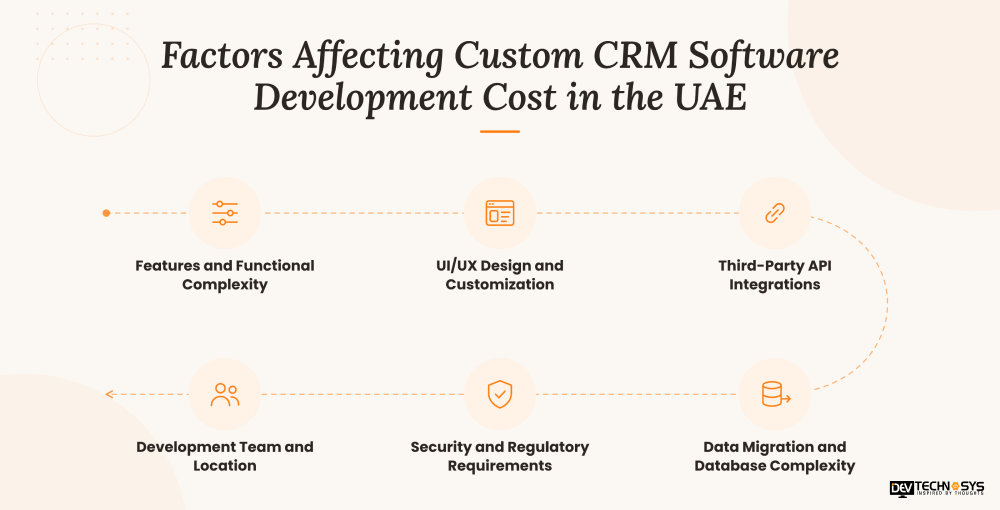
1. Features and Functional Complexity
The number and complexity of CRM features directly influence custom software development cost. A system with contact management and lead tracking requires fewer resources than one with automated sales workflows, AI recommendations, customer portals, and advanced analytics.
For example, adding a basic lead assignment rule is relatively straightforward. Building a lead distribution engine that considers location, agent availability, sales performance, and customer priority requires additional business logic and testing.
2. UI/UX Design and Customization
A CRM designed around specific business workflows requires more design and development effort than a standard dashboard-based application.
Cost to build a custom CRM system in the UAE may increase when businesses need:
- Custom dashboards for different departments
- Arabic and English interfaces
- Right-to-left (RTL) layouts
- Personalized reporting screens
- Separate interfaces for sales teams, managers, and customers
According to Mohit Nag, the CRM expert at Dev Technosys, for UAE businesses serving Arabic- and English-speaking customers, bilingual support should be considered during the initial design phase rather than added after development.
3. Third-Party API Integrations
Integrations allow Arabic CRM software to exchange information with other business applications, but they impact CRM software development cost in the UAE. However, every additional connection introduces development, authentication, synchronization, and testing requirements.
Common integrations include:
- Payment gateways and banking applications
- WhatsApp Business API and SMS services
- ERP and accounting platforms
- Ecommerce applications
- Email marketing tools
- Customer support systems
- Business intelligence platforms
For example, connecting a CRM with an accounting platform can automatically synchronize customer invoices and payment statuses. The ERP software development cost depends on API availability, data mapping, synchronization frequency, and error-handling requirements.
4. Data Migration and Database Complexity
Businesses moving from spreadsheets, legacy CRM platforms, or multiple databases need to consider data migration expenses.
The process involves reviewing existing records, removing duplicates, mapping fields, transferring customer histories, and validating migrated information.
Poor-quality customer data can increase real estate CRM migration time because developers must resolve inconsistent formats, missing fields, duplicate contacts, and outdated records before transferring information.
5. Security and Regulatory Requirements
CRM platforms often store personal information, customer communication records, financial details, and business documents. Protecting this information requires additional development and testing.
Businesses operating in the UAE should consider applicable requirements under the UAE Personal Data Protection Law (Federal Decree-Law No. 45 of 2021). It establishes requirements concerning personal data processing, confidentiality, data-subject rights, and cross-border data transfers. Certain financial and other regulated businesses may have additional sector-specific obligations.
Security-related development requirements may include:
- Role-based access control
- Data encryption
- UAE PDPL compliance, SSO authentication, GDPR compliance
- Multi-factor authentication
- Audit logs and activity monitoring
- Secure API authentication
- Backup and recovery mechanisms
6. Development Team and Location
The development team’s experience, location, AI chatbot development services expertise, and engagement model also influence the overall CRM budget.
A CRM development company in Dubai may offer local consultation and easier coordination but charge more than an offshore development team. Businesses should evaluate technical expertise, project management, security practices, and CRM maintenance cost rather than selecting a vendor solely on hourly rates.
Essential Features to Include in Custom CRM Software
The features you choose should reflect how your business attracts customers, manages sales, and handles ongoing relationships. The following capabilities are particularly useful for UAE businesses.
CRM feature |
Business purpose |
| Contact and lead management | Centralizes customer information and inquiries |
| Sales pipeline management | Tracks deals from initial contact to closure |
| Workflow automation | Automates follow-ups, assignments, and approvals |
| Customer segmentation | Groups customers based on behavior and business requirements |
| Marketing automation | Manages campaigns and customer engagement |
| Reporting and analytics | Measures sales performance and business outcomes |
| Mobile CRM access | Allows sales teams to manage customer activities remotely |
| Integration management | Connects CRM with existing business applications |
| Role-based access | Controls access to customer and business information |
Businesses should prioritize features based on actual operational requirements. Building every possible CRM module during the first release can increase costs without delivering immediate value.
UAE-Specific Requirements to Consider Before CRM Development
Besides knowing about the CRM development cost in Dubai, there are several requirements to be considered before developing CRM software. These include regional considerations that should be discussed during requirements analysis.
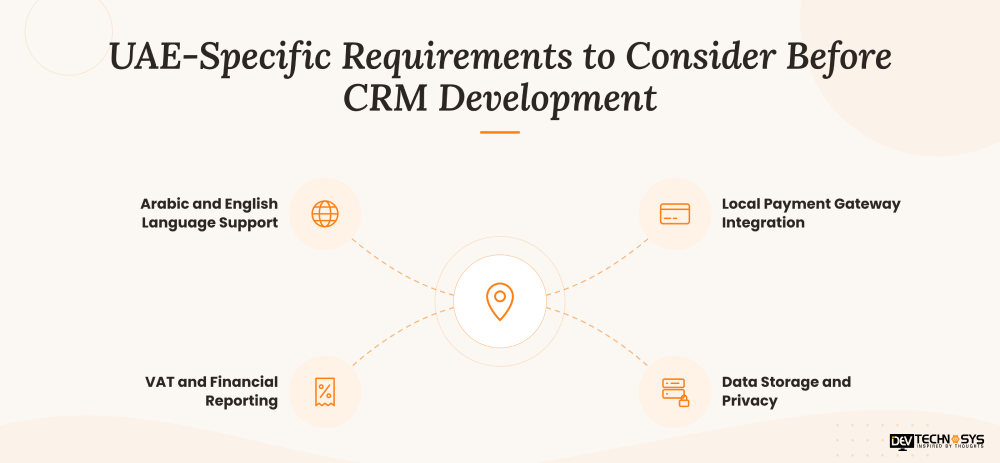
Arabic and English Language Support
If your business serves customers across different language groups, the CRM may need bilingual interfaces, multilingual communication templates, and Arabic RTL layouts. This affects interface design, database handling, document generation, and testing.
Local Payment Gateway Integration
Businesses collecting payments through their CRM may require integration with locally supported payment providers or banking services.
The Central Bank of the UAE operates the UAE Payment Gateway System (UAEPGS), which enables customers of connected merchants to pay bills online through participating banks. The appropriate integration depends on the business model and payment provider’s technical requirements.
VAT and Financial Reporting
Businesses should consider UAE VAT requirements when developing CRM modules that generate quotations, invoices, and payment records.
According to UAE Federal Tax Authority (FTA), the UAE’s standard VAT rate is 5%, subject to applicable zero-rated and exempt supplies. CRM invoicing requirements should be reviewed with the company’s finance team or tax adviser.
Data Storage and Privacy
Customer information should be collected, processed, stored, and shared according to applicable data protection requirements. Businesses should evaluate hosting arrangements, access permissions, retention policies, backups, and cross-border data transfers before selecting the CRM architecture.
Custom CRM vs. Ready-Made CRM: Which Is More Cost-Effective?
Before investing in custom development, businesses should compare it with existing CRM platforms such as Salesforce, HubSpot, and Zoho CRM.
Comparison factor |
Ready-made CRM |
Custom CRM |
| Initial investment | Generally lower | Higher |
| Customization | Limited by platform capabilities and plans | Built around specific requirements |
| Deployment | Faster | Requires development time |
| Integrations | Available connectors and APIs | Custom integration possibilities |
| Scalability | Depends on vendor plans and architecture | Designed around expected business growth |
| Ownership | Vendor-controlled platform | Greater control over custom application and code, subject to contract |
| Maintenance | Primarily vendor-managed platform updates | Requires an internal or external maintenance arrangement |
When should you choose ready-made CRM?
Choose an existing CRM when its features already support your sales processes, customer management requirements, and reporting needs. It can be a practical option for businesses that want faster implementation and predictable subscription plans.
When does custom CRM make more sense?
Custom development is worth evaluating when your business has complex workflows, industry-specific requirements, extensive integrations, or licensing expenses that increase significantly with user growth.
Note: A hybrid approach is another option. Businesses can use an existing CRM for core customer management and develop custom modules for specialized operations.
How to Reduce Custom CRM Software Development Costs
A well-defined development strategy can help control the initial investment without compromising essential functionality.
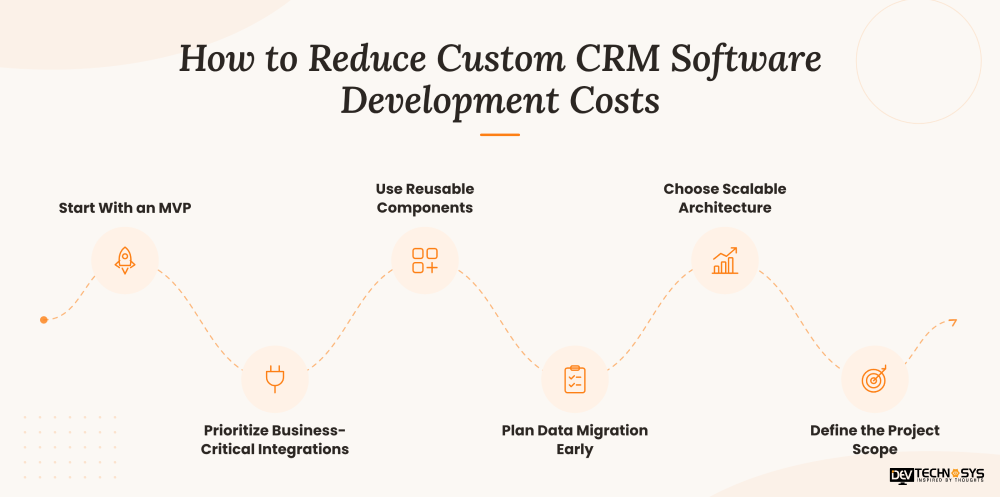
- Start With an MVP: To save on CRM implementation cost, build core modules such as contact management, lead tracking, and sales pipelines before introducing advanced features.
- Prioritize Business-Critical Integrations: Connect only the applications required for daily operations during the initial release.
- Use Reusable Components: Choose established frameworks and tested components where they meet project requirements.
- Plan Data Migration Early: Clean and organize customer records before development to avoid additional migration work.
- Choose Scalable Architecture: Build a foundation that allows new modules and users to be added without redesigning the entire application.
- Define the Project Scope: Document features, deliverables, integrations, and acceptance criteria before signing the development agreement.
Custom CRM Software Development Timeline in the UAE
Wondering how long does it take to build a custom CRM? The development timeline depends on the number of modules, integration complexity, testing requirements, and stakeholder availability.
Development stage |
Estimated timeline |
| Requirement analysis and planning | 1 weeks |
| UI/UX design and prototyping | 1–2 weeks |
| Architecture and database development | 2–3 weeks |
| Core CRM development | 2–3 weeks |
| API integrations and data migration | 3–4 weeks |
| Testing and quality assurance | 1–2 weeks |
| Deployment and training | 1–2 weeks |
These stages may overlap depending on the development methodology. A basic CRM can take approximately a month, while a mid-level solution may require 1–2 months. Enterprise app development with CRM software can extend to 2–3 months or longer.
Hidden Costs to Consider When Building a Custom CRM
The initial development quotation does not always represent the CRM total cost of ownership. Businesses should also account for recurring and additional expenses.
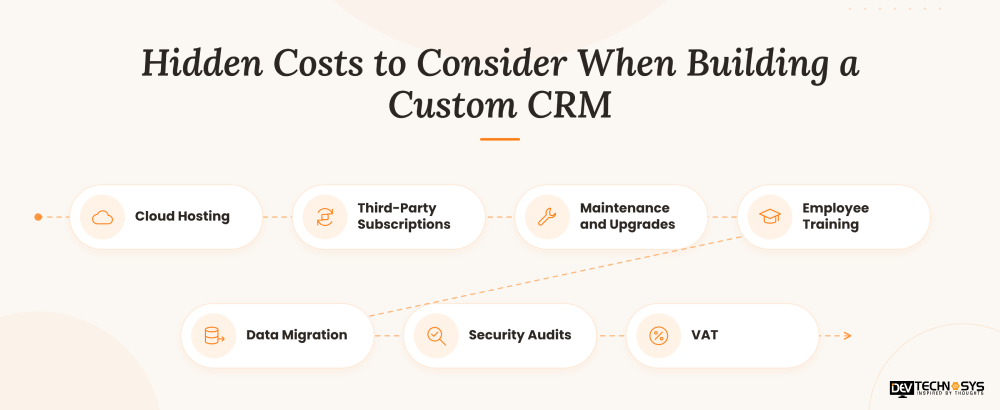
- Cloud hosting: Server, database, storage, and infrastructure expenses.
- Third-party subscriptions: Charges for messaging, email delivery, analytics, and external APIs.
- Maintenance and upgrades: Security patches, bug fixes, framework updates, and feature improvements.
- Employee training: Time and resources required to help teams adopt the new CRM.
- Data migration: Additional expenses for cleaning, restructuring, and validating legacy records.
- Security audits: Periodic vulnerability assessments and penetration testing.
- VAT: Applicable tax on software development services, depending on the supplier and transaction.
For annual maintenance, some software development budgets use approximately 15–25% of the initial MVP development cost as a planning benchmark. Actual support costs depend on the service-level agreement, system complexity, and expected response times.
How to Choose the Right CRM Development Company in the UAE
Selecting the right technology partner is as important as defining CRM requirements. A development company should understand your business workflows and translate them into a practical technical solution.
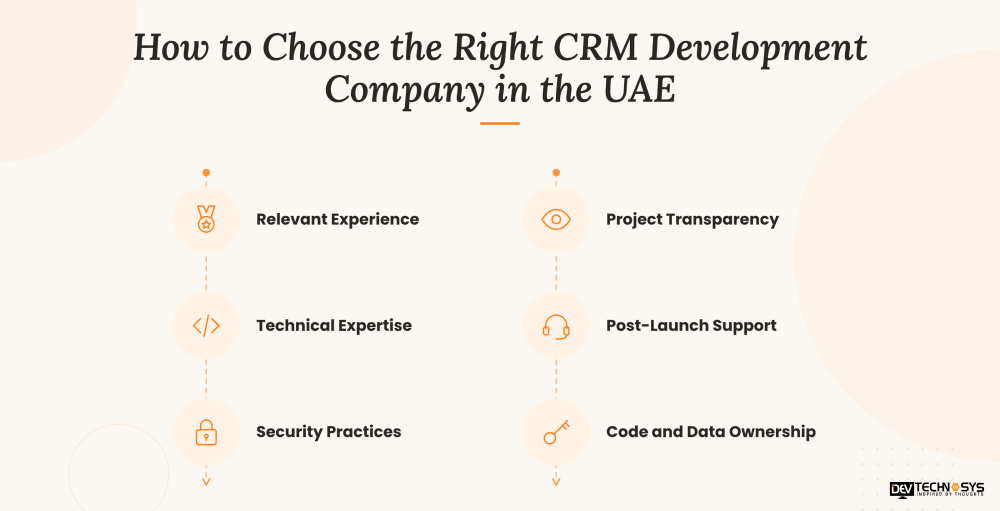
Consider these factors before making a decision:
- Relevant Experience: Make sure your AI development company reviews previous CRM projects, industry experience, and technical capabilities.
- Technical Expertise: Evaluate experience with APIs, cloud infrastructure, databases, automation, and mobile development.
- Security Practices: Ask how the company handles authentication, encryption, access control, and security testing.
- Project Transparency: Request a detailed proposal covering scope, milestones, deliverables, and payment terms.
- Post-Launch Support: Confirm maintenance coverage, bug-fixing commitments, and response times.
- Code and Data Ownership: Clarify intellectual property, source code access, documentation, and data ownership in the contract.
Hire dedicated developers who know and are ready to explain why a particular feature or integration is necessary rather than simply increasing the project scope.

Conclusion
Custom CRM software development costs in the UAE range from approximately AED 18,359 to AED 330,521+, depending on business requirements, integrations, security needs, and platform complexity. The right investment starts with understanding existing sales processes and identifying the operational gaps that a CRM should address.
Dev Technosys provides custom CRM software development to help businesses build solutions around their workflows. Discuss your CRM requirements with our team to explore the right development approach and estimated budget for your business.
FAQs
1. How Much Does It Cost to Build a Custom CRM in the UAE?
Custom CRM development in the UAE typically costs AED 18,359–AED 330,521+, depending on features, integrations, customization, and project complexity.
2. How Do You Build a Custom CRM?
The process includes requirement analysis, UI/UX design, technology selection, development, API integration, testing, deployment, and maintenance.
3. What Factors Affect CRM Development Cost?
Key factors include feature complexity, UI/UX design, third-party integrations, data migration, security requirements, and Arabic language support.
4. Is a Custom CRM Better Than Salesforce or HubSpot?
A custom CRM suits businesses with specialized workflows and integration needs. Salesforce or HubSpot may be better when their existing features meet business requirements.
5. What Is the Difference Between a Custom CRM vs SaaS CRM?
A custom CRM is developed around specific business workflows, while a SaaS CRM offers ready-made features through a subscription-based platform. A custom CRM provides greater flexibility, whereas SaaS CRM enables faster deployment.
6. What Is the Difference Between a Custom CRM vs Salesforce?
Salesforce is a ready-made CRM platform with configurable features and subscription plans. A custom CRM is built specifically for business requirements, offering greater control over workflows, integrations, and functionality.
7. Does Arabic Support Increase CRM Development Cost?
Yes. Arabic support may require RTL layouts, translated interfaces, bilingual templates, and additional localization testing, increasing development effort.