





To build an app like Dubai REST, it is important to understand the growing real estate market. According to a research report, the majority of new real estate buyers- that is, 58% of millennials and 46% of Generation X buyers- perform house hunting on mobile devices, compared to just 33% of baby boomers.
Mostly, mobile users spend their time on mobile apps as they offer a better user experience. Mobile apps are more adaptable to the device’s interface and can offer more personalized features such as push notifications, use of GPS for user location, etc.
Real estate mobile apps are also transforming the way the real estate industry operates now, adding more efficiency and accessibility for both buyers and sellers. Let’s see the guide to lunch on demand real estate app like Dubai REST.
What is a Real Estate App?
A real estate web application is a multi-page business card or even a landing page. It all depends on the size of the business. There are a large number of types of real estate apps. For example, it can be a real estate marketplace, a site with a list of brokers, investment sites, property management apps, etc.
A real estate app can be a simple or complex project that implements links between a database of houses, realtors and clients. There should be a real estate catalog with descriptions, terms of cooperation, services, prices, feedback form, and other types of contacts. Also, a blog will not hurt. It will help expand the base of key phrases and provide helpful information to those wishing to buy or rent housing.
Real Estate App Market Statistics and Growth Trends 2026–2027
According to our understanding from The Business Research Company, it is clear that UAE real estate businesses are rapidly adopting digital transformation. This means that businesses should choose an experienced real estate app development company or hire developers to build an effective solution.
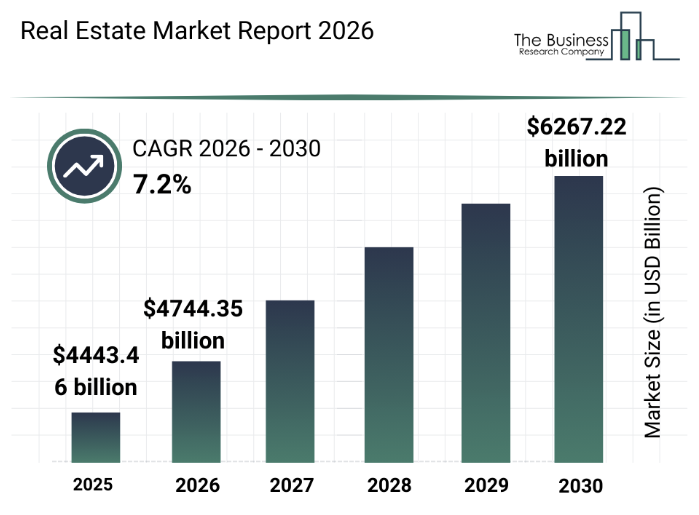
Some of our key findings include:
- The global real estate market size is expected to grow at a 7.2% CAGR by 2030, underscoring the importance of mobile-first experiences.
- The new trend is to integrate AI into existing systems to improve property search and increase user engagement.
- Major companies in the UAE are partnering with real estate app development firms to build secure and scalable solutions.
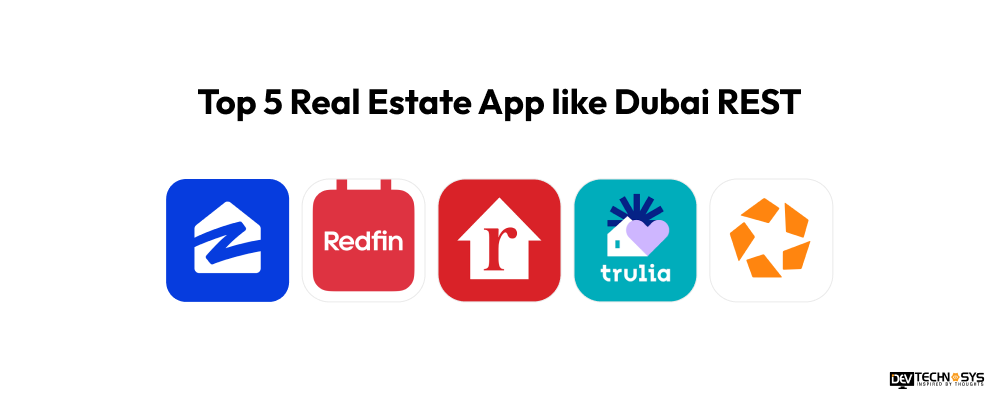
Top 5 Real Estate App like Dubai REST
Real estate apps have evolved beyond property discovery to include digital transactions, property management, market intelligence, mortgage tools, virtual tours, and personalized recommendations.
While Dubai REST is designed around Dubai’s real estate ecosystem and government-enabled property services, platforms such as Zillow, Redfin, Realtor.com, Trulia, and Homes.com focus primarily on property search and transaction support. Property listing platform development process becomes easier when comparing different applications.
Real Estate App |
Key Capabilities |
Dubai REST Comparison |
Best Takeaway for a New App |
| Zillow | Property search, buying, renting, home-value information, saved searches, alerts | Zillow is stronger in consumer property discovery, while Dubai REST provides a broader Dubai-specific digital real estate ecosystem. | Build AI-powered property discovery with personalized alerts and valuation tools. |
| Redfin | Property search, listings, agent services, home tours, market information | Redfin combines property discovery with brokerage services, whereas Dubai REST focuses more heavily on official real estate services and transactions. | Connect property search with agents, scheduling, and digital transaction workflows. |
| Realtor.com | Property listings, buying and renting tools, mortgage calculators, property information | Realtor.com emphasizes property discovery and home-buying support; Dubai REST offers services tailored to Dubai’s regulated real estate environment. | Add mortgage, affordability, property comparison, and transaction-support features. |
| Trulia | Property search, maps, neighborhood information, price insights, rental discovery | Trulia provides detailed consumer-oriented location and neighborhood insights, while Dubai REST serves a wider set of government and property-service use cases. | Use maps, neighborhood intelligence, and location-based recommendations to improve search. |
| Homes.com | Property search, buying and selling resources, agent connections, property information | Homes.com is primarily a property marketplace, whereas Dubai REST integrates property-related digital services within Dubai’s real estate ecosystem. | Combine marketplace functionality with agent communication and digital property services. |
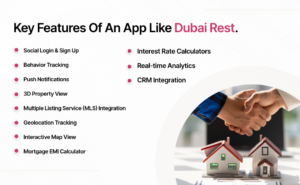
11 Essential Features of an App like Dubai REST
Features are the most essential part of every app development. So below are the essential features of an app like Dubai REST approved by hybrid app development services.
1. Sign up for Social Login and Sign In
Before registering with an app, all apps require some information from the user. Sign-up should be easy and associated with social media platforms to make it convenient and easy. Signing up via phone number and a verification code is an alternative. Users should be able to log in with their own accounts.
2. Behavior Tracking
This feature allows the app developer or on demand app development company to evaluate the behavior of the app user, and then provide him with leads that meet his search criteria. Users can set up parameters and filters to narrow down their search. This information is then sent to app developers.
3. Push Notifications
This is a technique of marketing that every real estate app like Dubai REST should have. This helps users to stay loyal and informed about all the properties in the app. These timely pop-ups on their device remind them of the app.
4. 3D Property View
Real estate apps offer a 3D view of the property, which allows a user to virtually visit the site.

5. Multiple Listing Service Integration
The app will display a variety of lists of properties in different categories. This feature allows users to better understand the properties that are available and displayed in a manner that best suits their needs.
6. Geolocation tracking
This tool was created to help customers get a better idea of the location of a property. If you want to integrate this feature in your app, you must hire mobile app developers.
7. Interactive Map View
This feature is essential for all real estate applications, since it helps newcomers to the city find their way around and evaluate the location. This feature can be integrated by a third-party.
8. Interactive Map View
The app can help users double-check a property by calculating how much EMI they will have to pay on a mortgage. This tool will give them an idea of how much they’ll have to pay to the bank each year.
9. Interest Rate Calculators
The interest rate calculator determines the rate of interest offered by different banks based on how much you borrowed. This is the same as the previous point.
10. Real-time analytics
This feature alerts the app’s real estate company whenever a buyer expresses interest in one of the listed properties.
11. CRM Integration
The questions and concerns of customers/users are very important. All real estate apps must have a Customer Service Management feature.
How to Build an App Like Dubai REST?
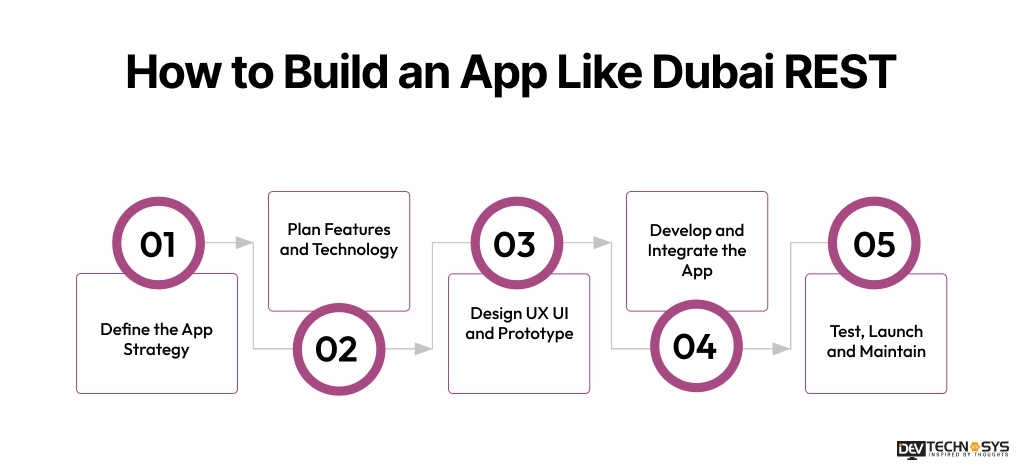
Building an app like Dubai REST requires more than creating a property-listing interface. The platform should combine property services, secure digital transactions, user-centric design, real-time data, and regulatory workflows. A structured development process helps reduce technical risks and ensures the application can scale as users, properties, and services grow.
Step 1. Define the App Strategy
Start by identifying the purpose, target users, and core value proposition of your Dubai REST-like app. Decide whether the platform will focus on property search, property ownership, rentals, transactions, property management, government-linked services, or a combination of these.
Define:
- Target users and their needs
- Core business objectives
- Revenue model
- Geographic market
- Key property services
- Competitor differentiators
- MVP features and future features
Step 2. Plan Features and Technology
Convert the business strategy into detailed functional and technical requirements. For property management software development, define separate workflows for property owners, buyers, tenants, agents, investors, and administrators based on your platform’s scope.
At this stage, determine the required technology architecture, APIs, databases, third-party integrations, payment gateways, maps, notifications, identity verification, and cloud infrastructure. For a Dubai-focused platform, also consider relevant UAE data protection, payment, authentication, and real estate regulatory requirements early in the planning process.
Step 3. Design UX UI and Prototype
Create the information architecture, user flows, wireframes, interactive prototypes, and final UI designs before full-scale development. The interface should make property discovery and digital services simple, even when the application contains complex workflows.
Focus on:
- Intuitive navigation
- Advanced property search
- Map-based discovery
- Personalized dashboards
- Clear property information
- Simple digital forms
- Multilingual support where required
- Accessible mobile-first design
Step 4. Develop and Integrate the App
Begin with front-end and real estate app database development using the approved architecture and product requirements. Build the core modules first, followed by integrations and advanced functionality.
A Dubai REST-like platform may require property databases, user authentication, payment processing, document management, location services, notifications, CRM or ERP integrations, analytics, and secure APIs. AI can also be incorporated for property recommendations, conversational search, lead qualification, document processing, and predictive insights.
Use a scalable cloud architecture so additional users, properties, services, and integrations can be added without redesigning the entire platform.
Step 5. Test, Launch and Maintain
Before launch, conduct functional, usability, performance, security, real estate app API integration, compatibility, and payment testing. Pay particular attention to authentication, personal information, property records, financial transactions, and role-based access.
After successful testing, release the MVP through the appropriate app stores and infrastructure. Post-launch maintenance should include security updates, performance monitoring, bug fixes, analytics, feature improvements, compliance reviews, and infrastructure scaling.
This continuous improvement cycle allows the app to adapt to changing user expectations, technology, and Dubai’s evolving digital real estate ecosystem.

Recommended Technology Stack to Build an App Like Dubai REST
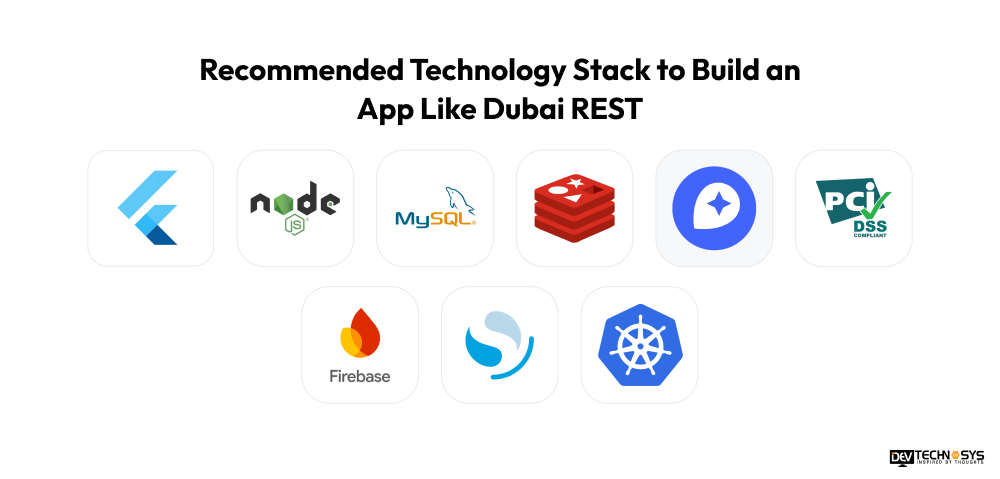
Building an app like Dubai REST requires a scalable, secure, API-first technology stack capable of supporting property data, user authentication, digital transactions, maps, document management, notifications, analytics, and third-party integrations.
The right stack should also support high availability and future integration of AI-powered property recommendations, conversational search, predictive analytics, and automation. The following technology stack is suitable for developing a modern UAE-focused real estate platform.
Technology Layer |
Recommended Technologies |
Purpose in a Dubai REST-Like App |
| Mobile App | Flutter / React Native | Build cross-platform iOS and Android applications with a shared codebase. |
| Web Application | React.js / Next.js | Develop responsive portals for property owners, agents, administrators, and other users. |
| Backend | Node.js / NestJS / Python / .NET | Manage business logic, authentication, property workflows, transactions, and integrations. |
| API Architecture | REST API / GraphQL | Enable secure communication between mobile apps, web portals, backend services, and third-party systems. |
| Database | PostgreSQL / MySQL | Store structured information such as users, properties, transactions, bookings, and ownership records. |
| Caching | Redis | Improve performance for frequently accessed property data, sessions, searches, and real-time operations. |
| Cloud Infrastructure | AWS / Microsoft Azure / Google Cloud | Provide scalable computing, storage, networking, monitoring, backup, and disaster-recovery capabilities. |
| Authentication | OAuth 2.0 / OpenID Connect / JWT | Secure user authentication, authorization, and session management. |
| Maps & Location | Google Maps Platform / Mapbox | Support property discovery, geolocation, directions, location-based searches, and map-based listings. |
| Payments | PCI DSS-compliant payment gateway | Enable secure rent, service, booking, or other supported property-related payments. |
| Real-Time Communication | WebSockets / Firebase | Support live notifications, chat, transaction updates, and real-time status changes. |
| AI & Machine Learning | Python / TensorFlow / PyTorch / LLM APIs | Power property recommendations, intelligent search, chatbots, document processing, and predictive insights. |
| Search Engine | Elasticsearch / OpenSearch | Provide fast property searches with filters, location queries, ranking, and personalized results. |
| Notifications | Firebase Cloud Messaging / Apple Push Notification Service | Deliver property alerts, payment reminders, booking updates, and transaction notifications. |
| Document Storage | Amazon S3 / Azure Blob Storage | Securely store contracts, property documents, identification files, and other digital records. |
| DevOps | Docker / Kubernetes / GitHub Actions | Automate deployment, scaling, testing, and infrastructure management. |
| Monitoring | AWS CloudWatch / Azure Monitor / Grafana | Monitor application performance, infrastructure health, errors, and security events. |
| Security | TLS, AES-256, RBAC, MFA, WAF | Protect user accounts, APIs, property data, documents, and financial information. |
How Much does it Cost to Develop an App like Dubai REST?
The cost to develop an app like Dubai REST depends on the feature set, platform, UI/UX complexity, backend architecture, third-party integrations, security requirements, and development team location. For a modern real estate platform targeting the UAE market, the estimated development cost typically ranges from AED 110,000 to AED 550,000+.
App Complexity |
Estimated Real Estate App Development Cost UAE |
Typical Scope |
| Basic Real Estate App | AED 110,000–185,000 | Property listings, user registration, search, filters, profiles, maps, notifications, and admin panel |
| Mid-Level App | AED 185,000–370,000 | Advanced search, property management, payment integration, agent dashboards, chat, document management, and API integrations |
| Advanced App Like Dubai REST | AED 370,000–550,000+ | AI features, real-time property data, digital transactions, advanced analytics, multiple integrations, strong security, scalable cloud infrastructure, and regulatory workflows |
Development Team Rates
The development team’s location also influences the overall budget. Typical hourly rates can vary significantly:
- UAE-based developers: AED 275–550+ per hour
- S.-based developers: AED 367–918+ per hour
- Indian developers: AED 55–73+ per hour
- Eastern European developers: AED 294–661+ per hour
Security and Compliance for a Real Estate App Like Dubai REST
A real estate app like Dubai REST handles sensitive information, including user identities, property ownership details, tenancy records, and more for AI in real estate. Security and compliance should therefore be incorporated into the architecture from the discovery stage rather than added after development.
For a UAE-focused application, the development team should also assess applicable UAE data protection, cybersecurity, electronic transaction, and real estate regulations based on the app’s exact services and integrations.
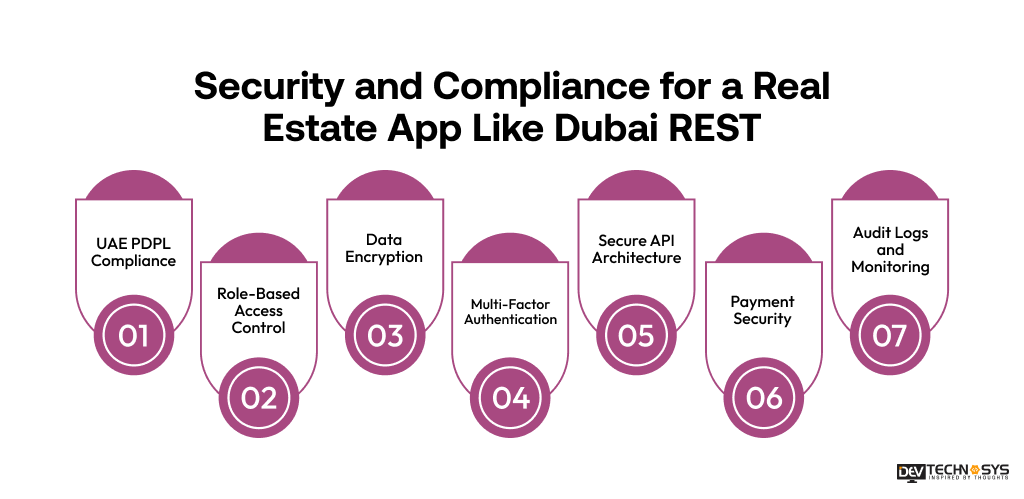
1. UAE PDPL Compliance
If the application processes personal data in the UAE, its data-processing practices should be designed in accordance with the applicable requirements of the UAE Personal Data Protection Law (PDPL). Implement appropriate consent and privacy mechanisms, data access controls, retention policies, and procedures for handling data subject requests.
2. Role-Based Access Control
Implement Role-Based Access Control (RBAC) to ensure that buyers, tenants, property owners, agents, administrators, and other authorized users can access only the information and functions required for their roles. Apply least-privilege permissions across both the mobile application and backend APIs.
3. Data Encryption
Protect sensitive information using encryption in transit and at rest. Use TLS for API communication and strong encryption mechanisms for databases, cloud storage, identity documents, contracts, and other confidential property-related records. Also, KYC and AML compliance is implemented for data security. This compliance might increase real estate app development cost because the integration requires extra effort.
4. Multi-Factor Authentication
Add Multi-Factor Authentication (MFA) for administrators, agents, property managers, and other high-privilege accounts. MFA can combine passwords with OTPs, authenticator applications, biometrics, or other supported authentication mechanisms to reduce account-takeover risks.
5. Secure API Architecture
A Dubai REST-like platform may depend on APIs for property data, maps, payments, identity verification, notifications, document services, and external real estate systems. Secure these APIs using strong authentication, authorization, token management, rate limiting, input validation, API gateways, and continuous monitoring.
6. Payment Security
If the application supports rent payments, property purchases, deposits, service charges, or other financial transactions, integrate PCI DSS-compliant payment providers rather than storing sensitive card information unnecessarily. Payment workflows should include transaction validation, fraud monitoring, secure callbacks, and detailed audit trails.
7. Audit Logs and Monitoring
Maintain tamper-resistant audit logs for key activities, including login attempts, profile changes, document access, property updates, payment events, administrative actions, and permission changes. Continuous monitoring can help identify suspicious activity and support incident investigation. UAE businesses can hire mobile developers or partner with a real estate app development company to build a secure solution.

Conclusion
Making a good property website needs a good plan and expertise. It is not as complicated as it seems. It won’t break your bank entirely if you know your core audience and have a clear idea of how to start building your online presence.
The websites of popular real estate companies highlight their corporate style and emphasize their brand image. The designs are attractive and neat.
If you are looking to hire a specialized real estate app development company or want to take a second opinion on whether to invest in it or not, now is the correct time. Just consult with them and build a robust real estate app like Dubai REST.
FAQ
Q1. How Much Does It Cost To Build A Real Estate App Like Dubai Rest?
The cost to build a real estate app like Dubai REST typically ranges from AED 110,000 to AED 550,000+, depending on the tech stack, security, design, and app complexity.
Q2. How Long Does It Take To Develop An App Like Dubai Rest?
A basic-to-advanced real estate app usually takes around 5 to 12 months. If a business requires advanced capabilities, then the development time might increase.
Q3. How Can A Real Estate App Like Dubai Rest Generate Revenue?
Businesses can use subscription strategies, in-app advertising, rewards, and loyalty programs to generate revenue from the real estate app.
Q4. Can I Build a Dubai Rest-Like App for Other Countries?
Yes, such applications can be built for other countries, but only if compliance requirements are included in the solution. Also, country-specific security protocols must be included.
Q5. Should I Build an MVP Before Developing the Complete Platform?
Yes, this is the best strategy that UAE businesses can implement. Building an MVP and later scaling it improves performance and saves maximum cost.