





Key takeaways:
- People are getting conscious about maintaining quality and nutritious eating habits. This has ignited the demand for diet and nutrition app development.
- The average cost to develop a diet and nutrition app can range somewhere between $30,000 and 1,50,000.
- According to Towards Healthcare, the diet and nutrition apps market size is expected to reach USD 27.73 billion by 2035.
- Freemium, subscription, B2B, affiliate marketing, etc., are some measures diet and nutrition apps use to make recurring revenues.
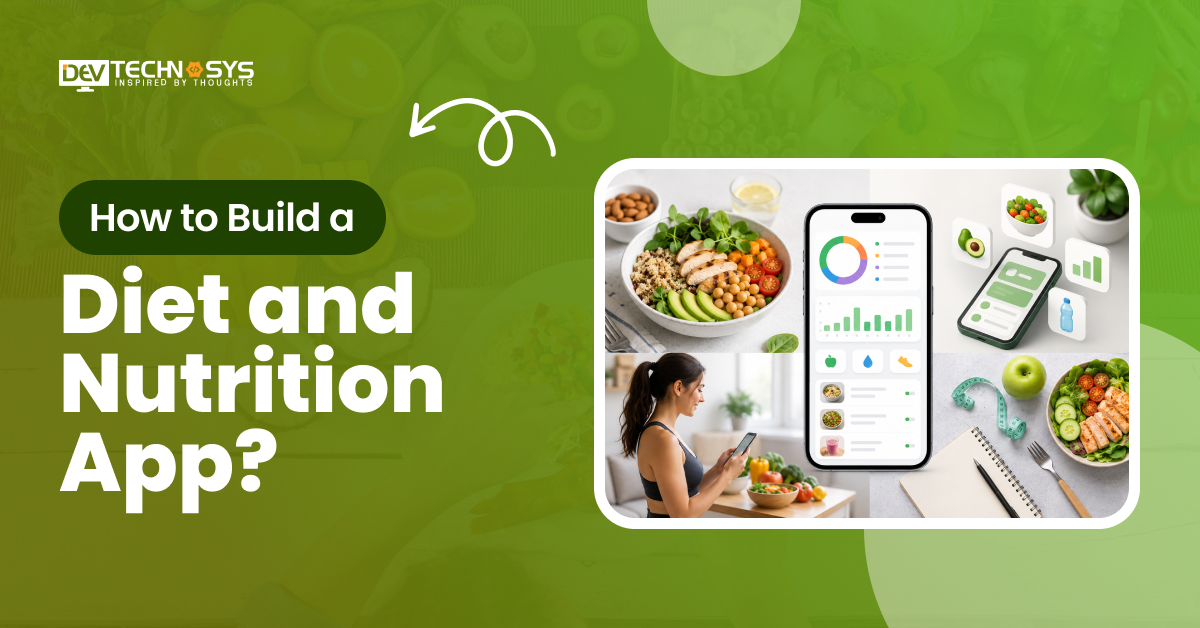
Every healthy habit needs a simple decision to get started. But following the right and proper diet is something people usually struggle with. That’s why diet and nutrition apps have become trusted companions for millions.
In 2026-2027, people are demanding a platform that helps them plan meals, monitor nutrition, and achieve fitness goals. Therefore, businesses and startups want to build a diet and nutrition app that offers:
- AI-powered nutrition recommendations
- Personalized diet plans
- Barcode scanning
- Fitness wearable integration
- Recipe suggestions
- Progress tracking
- Secure health data management
Are you a healthcare startup, fitness brand, nutritionist, or wellness business interested in nutrition and diet app development? All you require is careful planning, feature prioritization, technology selection, and compliance.
With this guide, we will understand the entire development process, essential features, estimated costs, and more. Get ready to build a scalable diet and nutrition app that stands out in the competitive digital health market.
Diet & Nutrition App Market Overview: Trends & Growth in 2026-2027
Today, people are searching for preventive healthcare, personalized nutrition, and digital wellness. This is driving the demand for diet and nutrition apps worldwide. Here are the key market highlights by Mordor Intelligence:
- The global diet and nutrition apps market reached USD 5.76 billion in 2025.
- The market is projected to reach USD 10.15 billion by 2030, showing strong long-term growth.
- The industry is expected to grow at a 11.97% CAGR between 2025 and 2030.
- Chronic disease patients represent the fastest-growing end-user segment across the global nutrition app market.
- This segment is forecast to expand at a 14.44% CAGR, outperforming the general population through 2030.
6 Essential Types of Diet and Nutrition Apps Explained
Diet and nutrition apps are designed to solve different health and wellness challenges. Before starting development, it’s important to identify the type of app you want to build. The hybrid app development services of each category include unique features, integrations, and user experiences. Here are the six most popular types of diet and nutrition apps in 2026–2027.
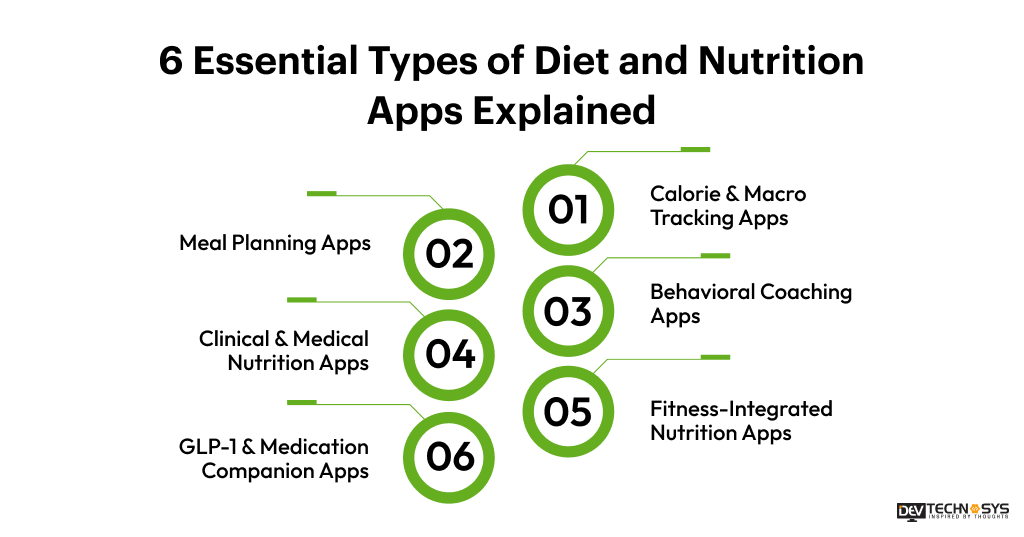
1. Calorie & Macro Tracking Apps
Calorie and macro tracking apps help users log meals and automatically track calories, protein, carbohydrates, fats, and other nutrients. They are ideal for people focused on weight management and healthy eating.
Real World Examples of Calorie & Macro Tracking Apps:
- MyFitnessPal
- Cronometer
- FatSecret
2. Meal Planning Apps
Meal planning apps are useful for creating personalized daily or weekly meal plans. They make plans according to the user’s dietary preferences, health goals, and allergies. These apps also include grocery lists and recipe recommendations.
Real World Examples of Meal Planning Apps:
- PlateJoy
- Eat This Much
- Mealime
3. Behavioral Coaching Apps
Behavioral coaching applications are highly recommended to combine nutrition tracking with AI. It also offers human coaching, habit-building techniques, and motivational content. Such apps help users develop healthier eating habits over time.
Real World Examples of Behavioral Coaching Apps:
- Noom
- Lark Health
- Second Nature
4. Clinical & Medical Nutrition Apps
Clinical and medical nutrition apps are especially designed for people managing chronic conditions such as diabetes, obesity, or heart disease. These apps usually require HIPAA-compliant data handling and healthcare integrations.
Real World Examples of Clinical & Medical Nutrition Apps:
- Foodsmart
- Nutrimedy
- Bant
5. Fitness-Integrated Nutrition Apps
Fitness-integrated nutrition apps synchronize nutrition tracking with fitness wearables and health platforms. These apps are created to provide a complete view of calorie intake, physical activity, and overall wellness.
Real World Examples of Fitness-Integrated Nutrition Apps:
- MyPlate Calorie Counter
- Lifesum
- YAZIO
6. GLP-1 & Medication Companion Apps
GLP-1 and medication companion apps are a rapidly growing category of diet planner apps. Such apps help users taking medications like Ozempic® or Zepbound®. They also monitor nutrition, hydration, meal timing, and appetite changes while supporting healthier lifestyle habits.
Real World Examples of GLP-1 & Medication Companion Apps:
- WeightWatchers GLP-1 Program
- LillyDirect
- Found
How to Build a Diet and Nutrition App: Step-by-Step Development Guide
To create a diet and nutrition app in 2026-2027, a structured developemnt approach is required. The approach should cover everything from market research to post-launch maintenance. Every stage in building an AI-powered fitness app plays a vital role in developing a secure, scalable food-tracking app. Below are the eight essential steps involved in developing a modern diet and nutrition app.
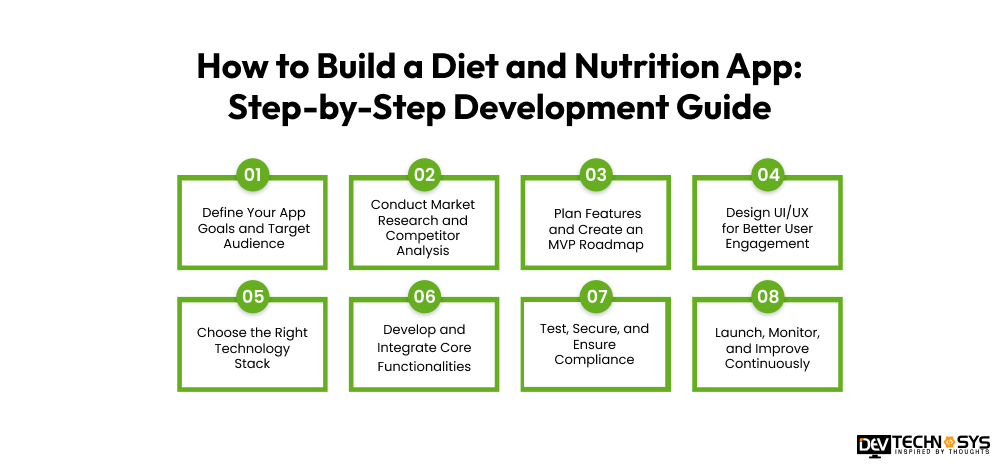
1. Define Your App Goals and Target Audience
The first step is to identify the app’s purpose, target users, and unique value proposition. It helps businesses decide whether to build a calorie tracker, meal-planning app, AI nutrition coach, or clinical wellness solution. This stage includes understanding user needs, business objectives, and market gaps. This is beneficial for defining the right features and development strategy.
2. Conduct Market Research and Competitor Analysis
An Android and iOS app development company focuses on analyzing leading diet and nutrition apps to understand:
- Feature set
- User expectations
- Market Trends
Studying competitors, pricing models, and reviews is necessary to find out the gaps that others fail to address. This research helps you identify opportunities and create a differentiated app experience that provides better value to users.
3. Plan Features and Create an MVP Roadmap
The next step is to define the essential features required for your first version. It includes core features such as user profiles, meal tracking, calorie monitoring, and progress analytics. Businesses should first prioritize features based on user value and business goals. Creating an MVP roadmap helps validate your idea faster while controlling development complexity and investment.
4. Design UI/UX for Better User Engagement
Hire mobile app developers in Middle East to create a simple, intuitive, and visually appealing interface. This type of interface can make nutrition tracking effortless for users. It should focus on smooth onboarding, easy meal logging, personalized dashboards, and clear progress visualization. A user-friendly design improves engagement, encourages daily usage, and helps users build healthier habits.
5. Choose the Right Technology Stack
Selecting technologies that support your app’s performance, security, and scalability requirements should never be missed at any cost. It includes the selection of suitable frameworks, databases, cloud platforms, APIs, and AI tools according to feature requirements. If the technology foundation is right, it enables smooth integrations with wearables, nutrition databases, and payment systems.
6. Develop and Integrate Core Functionalities
A fitness app development company then supports engineers to build the frontend, backend, database, and required integrations. Core functionalities such as nutrition tracking, meal recommendations, notifications, payment systems, and AI-powered features are implemented at this stage. Regular testing ensures the app performs smoothly across different devices and user scenarios.
7. Test, Secure, and Ensure Compliance
Before launch, the app undergoes detailed testing for performance, usability, security, and functionality. Developers implement data encryption, secure authentication, and compliance measures based on regulations like HIPAA and GDPR, and quality assurance. Here, a mobile app development company identifies issues early and ensures a reliable experience for users handling sensitive health data.
8. Launch, Monitor, and Improve Continuously
As the app is deployed, businesses should monitor user feedback, app performance, and engagement metrics. It helps identify opportunities for improvements in the future. It includes regular updates, feature enhancements, security patches, and AI improvements. This is necessary to keep the app competitive. Continuous optimization ensures better user retention, scalability, and long-term success in the evolving digital health market.
Essential Features Every Successful Diet & Nutrition App Needs
A successful and reliable healthcare software development solution comes with core features. This feature selection helps users make healthier choices every day. Whether an MVP or a full-scale wellness app development, these features are the foundation. Have a look at the features important for higher user retention and long-term business success.
Feature |
Business Value |
User Benefit |
| Personalized User Profile | Delivers tailored experiences that improve engagement and retention. | Receives diet plans based on age, weight, health goals, and preferences. |
| Smart Meal Planning | Increases app stickiness with personalized nutrition recommendations. | Gets customized daily and weekly meal plans. |
| Calorie & Nutrition Tracking | Makes the app a daily-use wellness companion. | Tracks calories, protein, carbs, fats, vitamins, and water intake. |
| Food Search & Barcode Scanner | Simplifies food logging and improves user satisfaction. | Logs meals instantly by searching foods or scanning packages. |
| Healthy Recipe Library | Boosts user engagement with fresh, valuable content. | Accesses nutritious recipes with ingredients and nutrition facts. |
| Progress Analytics Dashboard | Encourages long-term retention through measurable results. | Monitors weight, BMI, calorie trends, and nutrition progress. |
| Fitness & Wearable Integration | Expands ecosystem compatibility and user convenience. | Syncs workouts, steps, heart rate, and calories from wearables. |
| Smart Reminders & Notifications | Increases daily active users and reduces churn. | Never misses meals, hydration, workouts, or health goals. |
| AI Nutrition Coach | Creates a premium, competitive app experience. | Receives instant food suggestions, nutrition insights, and AI-powered guidance. |
| Premium Membership & Payments | Generates recurring revenue through subscriptions and premium services. | Unlocks advanced plans, expert consultations, and exclusive wellness content. |
AI-Powered Features That Make Diet Apps Smarter in 2026-2027
As Artificial Intelligence is transforming every industry, the diet and nutrition sector is no exception. AI-powered healthcare software development services transform simple calorie trackers into intelligent health companions. Here are the top AI features shaping the next generation of diet and nutrition platforms in 2026-2027.
AI Feature |
What It Does |
Why It Matters |
| AI Meal Recommendations | Suggests personalized meals based on health goals, preferences, and eating habits. | Improves user engagement through tailored nutrition plans. |
| Smart Calorie Recognition | Identifies food and estimates calories from meal photos using computer vision. | Makes food logging faster and more accurate. |
| AI Nutrition Coach | Delivers personalized diet advice, meal suggestions, and healthy eating tips. | Creates a virtual nutrition assistant available 24/7. |
| Predictive Health Insights | Analyzes user data to predict nutrition gaps and potential health risks. | Helps users make proactive lifestyle improvements. |
| Personalized Grocery Lists | Generates shopping lists based on meal plans and dietary preferences. | Simplifies meal preparation and healthy shopping. |
| Voice-Based Food Logging | Allows users to record meals using natural voice commands. | Improves accessibility and user convenience. |
| AI Recipe Generator | Creates healthy recipes using available ingredients and nutrition goals. | Encourages healthier eating while reducing food waste. |
| Behavior & Habit Analysis | Detects eating patterns and recommends healthier habits over time. | Supports long-term user retention and wellness. |
| Wearable Data Intelligence | Combines smartwatch and fitness tracker data to optimize nutrition plans. | Provides holistic health recommendations based on real-time activity. |
| Adaptive Goal Optimization | Continuously adjusts calorie targets and meal plans based on user progress. | Keeps recommendations accurate as fitness goals evolve. |
Industry Insight:
Leading nutrition platforms are no longer competing on calorie counting alone. Their competitive advantage comes from AI-powered personalization, including food recognition, intelligent meal planning, conversational nutrition coaching, and predictive health insights. Businesses entering the market in 2026–2027 should view these AI capabilities as core product features rather than optional enhancements. – Lifesum
Best Tech Stack for Diet & Nutrition App Development
To develop a diet and nutrition app, the selection of the right tech stack is mandatory. The right tech stack will make the application secure, scalable, and high-performing. From intuitive front-end frameworks to cloud infrastructure and AI technologies, every component plays a crucial role. The table below contains the highly recommended technologies to build a diet and nutrition app.
Technology Layer |
Recommended Technologies |
Purpose |
| Frontend (Android) | Kotlin | Builds high-performance native Android applications. |
| Frontend (iOS) | Swift | Develops fast and secure native iOS applications. |
| Cross-Platform | Flutter, React Native | Creates apps for Android and iOS using a single codebase. |
| Backend | Node.js, Django, Laravel | Manages APIs, authentication, business logic, and user data. |
| Database | PostgreSQL, MongoDB, Firebase | Stores user profiles, meal plans, nutrition data, and progress. |
| Cloud Platform | AWS, Google Cloud, Microsoft Azure | Provides secure hosting, storage, and application scalability. |
| AI & Machine Learning | OpenAI, TensorFlow, Google ML Kit | Powers meal recommendations, food recognition, and personalized coaching. |
| Third-Party APIs | Nutritionix, Edamam, Spoonacular, USDA FoodData Central | Supplies nutrition facts, recipes, barcode scanning, and food databases. |
| Wearable Integration | Apple HealthKit, Google Health Connect, Fitbit API | Synchronizes health metrics, workouts, and calorie burn. |
| Payment Gateway | Stripe, PayPal, Razorpay | Enables subscriptions, premium memberships, and secure payments. |
Build vs. Buy vs. Development Partner: Which Option Delivers Better ROI?
Picking the right development approach can significantly impact your budget, development & launch timeline, and long-term success. However, the best choice depends on your business goals, customization needs, and available resources. Here, we have a comparison table to help businesses make an informed decision.
Factor |
Build In-House |
Buy a Ready-Made Solution |
Partner with Dev Technosys |
| Development Cost | High upfront investment | Low initial cost | Cost-efficient with flexible engagement models |
| Time to Launch | 5–9+ months | 2–6 weeks | 4–7+ months with agile development |
| Customization | Complete control over every feature | Limited customization options | Fully customized to your business needs |
| AI Feature Integration | Requires in-house AI expertise | Limited AI capabilities | AI-powered features built by experienced specialists |
| Third-Party Integrations | Time-consuming implementation | Supports selected integrations only | Seamless integration with wearables, payment gateways, and nutrition APIs |
| Scalability | Depends on internal architecture | Limited by platform capabilities | Cloud-native architecture designed for future growth |
| Security & Compliance | Managed internally | Depends on the software vendor | Built following GDPR, HIPAA, and industry best practices |
| Source Code Ownership | Complete ownership | Usually vendor-controlled | 100% source code ownership upon project delivery |
| Maintenance & Updates | Internal development team | Vendor-managed with recurring fees | Dedicated post-launch support and continuous improvements |
| Best Fit | Large enterprises with dedicated tech teams | MVPs and businesses needing a quick launch | Startups, SMBs, and enterprises seeking a scalable custom solution |
How Much Does It Cost to Build a Diet and Nutrition App in 2026-2027?
The diet, nutrition, and fitness app development cost in 2026-2027 can be estimated at $30,000 to $1,50,000. The final development expenses depend on the platform’s complexity and several other factors. Let us understand it like this:
- A basic app, with an MVP strategy, is less complex to build. The cost to develop a basic diet and nutrition app ranges from $30,000 to $70,000.
- A mid-level diet and nutrition tracking app combines basic and advanced integrations, making it moderately complex for development. The price to create a moderate app can be between $70,000 and $1,10,000.
- A fully-featured application is developed with advanced integrations and modern technologies, making it complex to build. This makes the final cost range from $1,10,000 to $1,50,000.
As mentioned, multiple factors can influence the diet and nutrition mobile app development cost. These factors include backend infrastructure, security & compliance, platform choice, testing & QA, third-party APIs, and more. Now we will learn about these factors and how they impact the development expense.
1. Selection of Platform
The platform, either Android, iOS, or cross-platform, directly influences the cost to develop a nutrition app. Developing native apps separately demands more development time, resources, and codebases. Supporting web applications or wearable device integration further increases design, development, testing, and maintenance efforts.
Platform |
Estimated Cost |
| Android App | $10,000–$18,000 |
| iOS App | $10,000–$18,000 |
| Cross-Platform (Flutter/React Native) | $15,000–$25,000 |
| Android + iOS + Web Platform | $22,000–$30,000 |
2. Developer’s Location
The diet and nutrition app development cost varies based on the geographical location of the development team. If businesses hire dedicated developers from regions like North America, Western Europe, and Australia, they cost more. It is generally because developers in these regions charge higher hourly rates and increase the overall project budget.
Region |
Estimated Cost |
| India | $10,000–$14,000 |
| Eastern Europe | $12,000–$17,000 |
| Latin America | $13,000–$18,000 |
| UAE | $16,000–$21,000 |
| North America | $18,000–$23,000 |
3. Security & Data Compliance
Implementing security measures and complying with regulations such as GDPR, HIPAA, or regional data privacy laws raises development costs. It includes features like encrypted data storage, secure authentication, consent management, and regular security testing. All of these features require additional development expertise and time.
Security & Compliance Level |
Estimated Cost |
| Basic Authentication & Encryption | $5,000–$7,000 |
| GDPR Compliance | $6,000–$9,000 |
| HIPAA Compliance | $8,000–$12,000 |
| Advanced Security & Compliance (GDPR + HIPAA + Audits) | $12,000–$15,000 |
4. Development Team
The development model you choose has a major impact on overall mHealth app development costs.
- Freelancers are an affordable option but have less experience and expertise.
- In-house teams work professionally but at higher recruitment and operational expenses.
- Development companies offer comprehensive services at a structured project cost.
Development Model |
Estimated Cost |
| Freelancers | $12,000–$16,000 |
| Development Company | $15,000–$22,000 |
| In-House Team | $20,000–$25,000 |
5. Third-Party APIs
Integrating third-party APIs can significantly elevate the cost to build a diet and nutrition app. In such apps, API is used for nutrition databases, barcode scanning, payment gateways, wearable devices, maps, or AI services. Many APIs require paid subscriptions, custom integration work, ongoing maintenance, and updates to ensure compatibility and reliable performance.
API Integration |
Estimated Cost |
| Nutrition Database APIs | $4,000–$6,000 |
| Payment Gateway APIs | $4,500–$6,500 |
| Wearable Device Integration APIs | $6,000–$8,000 |
| AI & Food Recognition APIs | $7,000–$10,000 |
| Multiple API Integrations | $10,000–$12,000 |

Compliance & Data Security Requirements for Diet and Nutrition Apps
If you build a fitness app like Hevy, it collects sensitive user information. It requires information like:
- Health records
- Dietary habits
- Body measurements
- Wearable device data
Therefore, protecting this information is essential to build user trust and meet legal requirements. According to different target markets, the app needs to comply with multiple data privacy regulations. We have explained everything through a table, highlighting major compliance frameworks every diet and nutrition app should consider.
Regulation |
Applies To |
Key Compliance Requirements |
| HIPAA (United States) | Apps handling protected health information (PHI), medical records, or treatment-related data | Data encryption, audit logs, role-based access control, Business Associate Agreements (BAAs), breach notification |
| GDPR (European Union) | Apps collecting or processing data of EU users | Explicit consent, right to access/delete data, data minimization, privacy-by-design, lawful processing |
| DPDP Act (India) | Apps processing personal data of users in India | Consent-based processing, purpose limitation, secure data storage, breach reporting, user rights management |
| UAE Personal Data Protection Law (PDPL) | Apps operating in or serving users in the UAE | User consent, lawful processing, cross-border data transfer controls, security safeguards, breach notification |
| Saudi Personal Data Protection Law (PDPL) | Apps serving users in Saudi Arabia | Explicit consent, data localization where applicable, privacy impact assessments, secure data processing, breach reporting |
| Qatar Personal Data Privacy Protection Law (PDPPL) | Apps collecting personal data from users in Qatar | Transparent data collection, consent management, security controls, user access rights |
| PIPEDA (Canada) | Apps processing personal information of Canadian users | Meaningful consent, data safeguards, transparency, user access and correction rights |
| CCPA/CPRA (California, USA) | Apps collecting personal information from California residents | Data disclosure, opt-out options, deletion requests, privacy notices, consumer rights |
Expert Insight:
At Dev Technosys, compliance planning begins during the discovery phase. This ensures security, privacy, and regulatory requirements are integrated into the application’s architecture from day one rather than added later. – Narayan Das (Project Manager)
What are the Best Ways to Monetize a Diet & Nutrition App?
A well-designed calorie tracking app can generate recurring profits through multiple ways. It includes models such as subscriptions, in-app purchases, in-app advertising, B2B wellness strategies, affiliate marketing, and so on. We will now discuss some of the most common and widely used money-making strategies for a nutrition coach app.
1. Premium Subscriptions
In a subscription model, users get monthly or yearly subscription plans. These plans unlock personalized plans, AI nutrition coaching, advanced health insights, and ad-free access. This creates a steady recurring revenue stream.
2. In-App Purchases
Sell premium diet programs, recipe collections, fasting plans, fitness challenges, or personalized nutrition reports. Users only pay for the features they need, making this a flexible and profitable monetization strategy.
3. Online Nutrition Consultations
Allow users to book one-on-one sessions with certified dietitians, nutritionists, or wellness coaches directly through the app. You can earn revenue by charging consultation fees or taking a commission from each appointment.
4. Affiliate Marketing & Brand Partnerships
Partner with healthy food brands, meal delivery services, grocery platforms, or supplement companies. You earn a commission whenever users purchase products or services through referral links available within your app.
5. Corporate Wellness Programs
Offer customized diet and nutrition solutions to businesses looking to improve employee health and wellness. Companies pay for access to wellness challenges, nutrition tracking, and health reports, creating a reliable B2B revenue stream.
Why Do Most Diet and Nutrition Apps Fail and How to Avoid It?
Building a fitness and nutrition app usually struggles because they overlook user expectations, scalability, or data security. These are the reasons that make the app fail in the competitive digital health market. We will now understand these common pitfalls and how to avoid them to build a reliable, user-friendly nutrition app.
1. Lack of Personalization
Reason:
Many diet apps provide generic meal plans and nutrition advice that fail to meet individual user needs. Without personalized recommendations, users quickly lose interest and switch to apps that better align with their health goals.
How to Avoid It:
Use AI and user data to deliver personalized meal plans, calorie targets, recipe suggestions, and nutrition insights. These should be based on each user’s goals, dietary preferences, and activity levels.
2. Poor User Experience
Reason:
A complex interface, lengthy registration process, or difficult food logging makes users abandon the app. This way, users cannot experience the real value of the platform. So basically, convenience plays a major role in user retention.

How to Avoid It:
Businesses should design a simple and intuitive interface. It must include quick onboarding, easy meal tracking, barcode scanning, voice logging, and a clear progress dashboard. This can encourage users to use the app daily.
3. Weak Security and Scalability
Reason:
Diet and nutrition apps often store sensitive health information of users. If the app follows poor security practices, it cannot handle increasing users. This can easily damage user trust and limit business growth.
How to Avoid It:
Build the app with strong security measures, encrypted data storage, regulatory compliance, and a scalable cloud infrastructure. This supports future growth without performance issues.
Why Choose Dev Technosys for Top Diet and Nutrition App Development?
Dev Technosys has always been a reliable name when it comes to iOS and Android app development. Our 15+ years of experience and 95% client satisfaction reflect the trust businesses show in us. We have offered solutions for more than 35 industries worldwide and are ready to serve more. As a CMMI Level 3 certified company, we follow industry best practices to build secure, scalable, and future-ready applications. We also ensure complete confidentiality through NDA-backed engagements.
Final Words
Developing a custom nutrition app in 2026-2027 requires something beyond just calorie tracking. As this is a highly competitive market, the app needs to be more personalized. It must offer personalized user experiences, AI-powered capabilities, strong data security, and a scalable architecture.
The final development cost varies from basic MVP to advanced platforms with integrations, depending on your business requirements. A successful meal planning app is built with long-term scalability, regulatory compliance, and user engagement in mind.
Whether creating an app for nutritionists, healthcare providers, or wellness startups, investing in the right technology is important. It helps reduce future development costs and accelerates product growth. To build a diet and nutrition app, businesses must choose the right healthcare software development company and strategy.
People Mostly Ask
Q. 1 How Much Does It Actually Cost To Build A Diet And Nutrition App In 2026-2027?
The cost to make a diet and nutrition app in 2026-2027 can range from $30,000 to $1,50,000. The final development budget is determined by the platform’s complexity, feature set, backend, UI/UX, security, and several other factors. A simple MVP app development is less expensive than a fully-featured, advanced diet and nutrition application.
Q. 2 Can A Diet And Nutrition App Support GLP-1 (Ozempic/Zepbound) Users?
Yes, a diet and nutrition application strongly supports GLP-1 (Ozempic/Zepbound) users and will be a core differentiator in 2026-2027. It includes:
- Syncing dosage schedules with nutrition logging
- Adjusting calorie/protein targets for appetite suppression side effects
- Flagging nutrient deficiencies common in GLP-1 users
None of the major nutrition apps built this in from day one. Therefore, it is a real gap for new entrants to target.
Q. 3 Do I Need HIPAA Compliance To Build A Diet And Nutrition App?
If the app collects user data related to health conditions, medical history, or treatment, it needs HIPAA compliance. A basic app with food logging, calorie counting, and other simple features doesn’t require HIPAA compliance. The app with doctor-prescribed diet plans, clinical integrations, or GLP-1/medication tracking triggers HIPAA because it handles Protected Health Information.
Q. 4 What Makes A Diet And Nutrition App Profitable Beyond Subscriptions?
Subscriptions are the most common way to cover baseline revenue. Apart from this, several other monetization models include:
- B2B white-label licensing to gyms and dietitian clinics
- Affiliate partnerships with meal-kit or supplement brands
- Sponsored content and brand collaborations
- One-on-one nutrition consultations
Apps that rely on subscriptions alone tend to plateau faster than those with a diversified model.
Q. 5 How Long Will It Take To Create A Diet And Nutrition App?
Generally, it takes 4 to 7+ months to make a diet and nutrition app in 2026-2027. The overall development timeline is determined by the app’s complexity, integrations, and security requirements. A simple app, following MVP structures, gets developed within 4 to 6 months. While a fully advanced app with modern technologies takes 7+ months.