





Key Takeaways:
-
- Money Lending App development requires careful planning, integration with compliance, AI-powered risk assessment, cloud infrastructure, and security features.
- According to Precedence Research, the global fintech market size is expected to reach USD 1,825.64 billion by 2035. This has created opportunities for businesses to provide high-grade fintech solutions.
- UAE businesses must partner with an experienced mobile app development company to build a customized solution that complies with regulatory standards.
- Businesses must prioritize cross-platform app development with Flutter or React Native to accelerate time-to-market, reduce development costs, and deliver a consistent user experience across both Android and iOS devices.
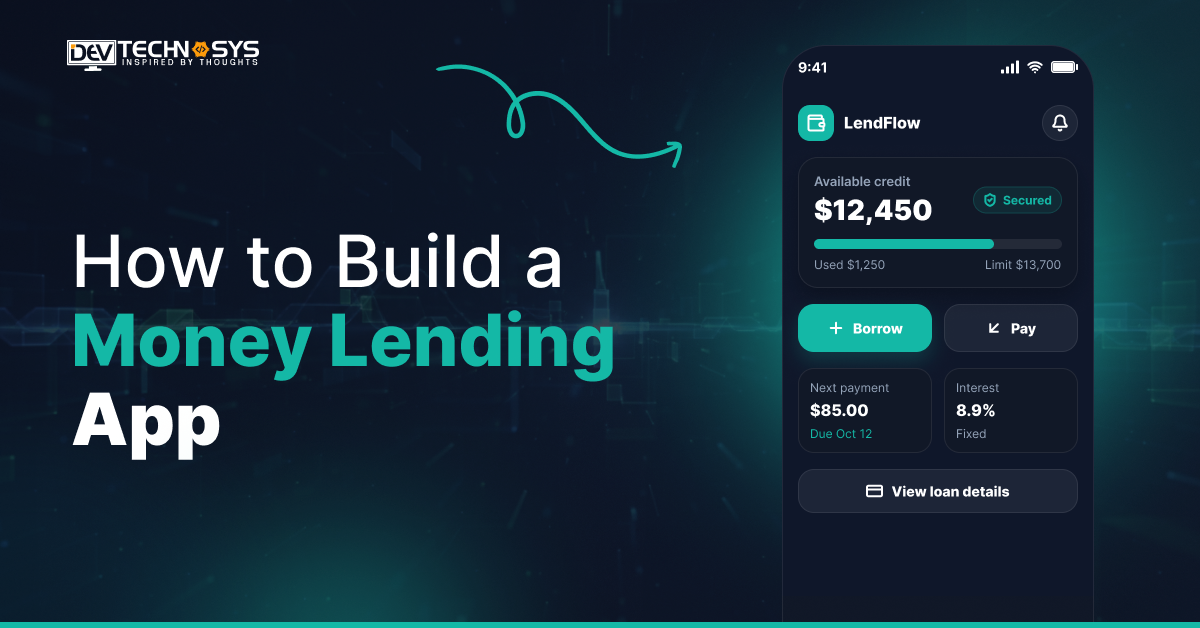
Loan app development is trending as users get instant access to credit without paperwork. Secure digital verification and repayment options allow users to manage finances more easily than traditional methods. UAE businesses are finding this an opportunity to build a money lending app with access to multiple loan products.
But building a digital loan platform means choosing the business model, compliance with financial regulations, security, and integrating payment gateways. This guide explains money lending app development, features, technology stack, compliance, and why it is important to partner with an experienced company.
UAE Digital Lending Market Statistics & Growth Trends
As per our research and findings from Precedence Research, a rapid growth in the fintech market indicates a strong business opportunity. Businesses are seeking long-term partnerships to build a money lending app with necessary features.
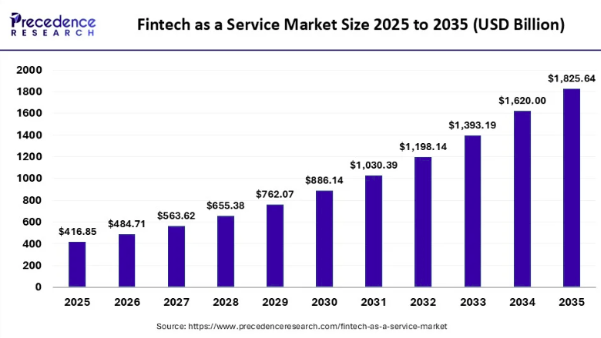
- AI is forecast to be the fastest-growing technology segment that is driving innovations such as digital onboarding, automated credit scoring, and real-time risk assessment for lending apps.
- Compliance and regulatory support are a critical requirement to ensure eKYC, AML, and fraud detection.
- Asia-Pacific is the fastest-growing regional market that presents opportunities for leaders to build mobile-first lending platforms.
- Changing consumer behavior is making businesses adopt cloud platforms to build scalable and interactive applications.
Top 5 Money Lending App Models in the UAE
Choosing an app model means a complete technology stack. Whether it is a peer-to-peer lending app, BNPL apps, B2B lending as a service, a clear requirement supports budget and informed decision-making. Collaborating with a mobile app development company ensures that a business creates the right application according to specific goals.
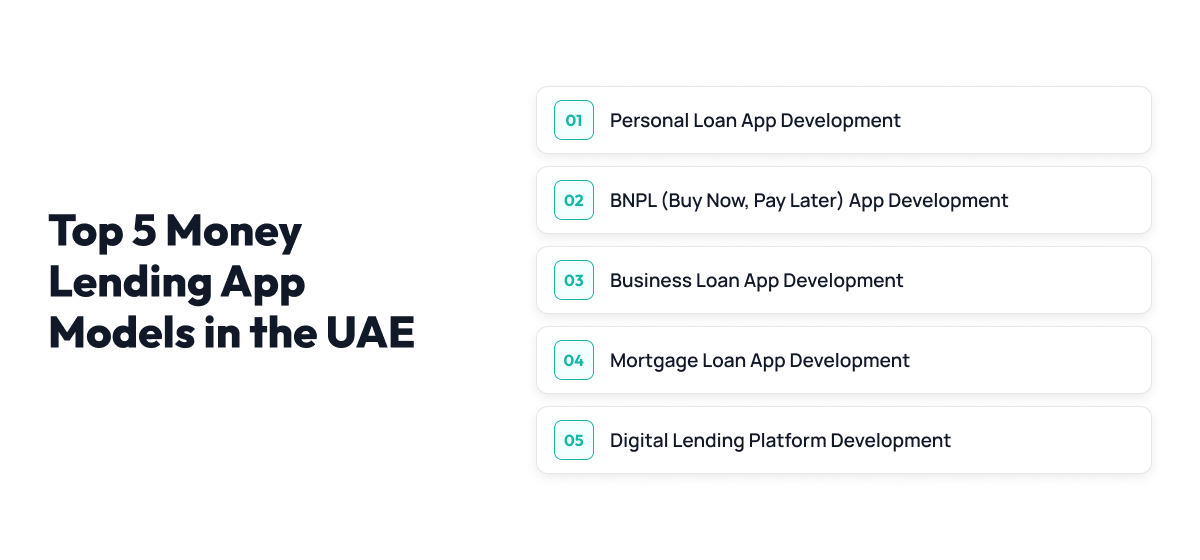
1. Personal Loan App Development
This is the most commonly used app that is used by Fintech startups, banks, and digital lenders. Users can apply for short- or long-term loans directly from their smartphones.
2. BNPL (Buy Now, Pay Later) App Development
This lending model has attracted most ecommerce stores to improve customer conversions. Gen Z finds this model to be perfect to meet their purchase needs.
3. Business Loan App Development
SME’s and growing enterprises often search for apps from where they can easily get a loan. Though development complexity is high because developers need to integrate security and compliance features, this app is good to monetize.
4. Mortgage Loan App Development
Businesses that are planning to hire mobile app developers in Dubai must focus on building a mortgage loan app. This solution is valuable in the future and beyond due to the growing demand in the real estate market. Users such as property investors and homebuyers are seeking loan apps.
5. Digital Lending Platform Development
Such a platform is an upgraded version of loan apps that are integrated with AI-powered credit scoring, repayment management, API integration, and analytics dashboards. This platform is usually developed by large financial institutions, digital banks, and enterprises.
Answer a few quick questions and our experts will share a tailored project estimate.
Essential Features Every Money Lending App Needs
A money lending app should have features that address complex business challenges. It should have essential features for admin, lender, and borrower. Compliance, KYC, onboarding, and audit are some of the core features. However, businesses should know that these factors also influence the mobile app development cost.
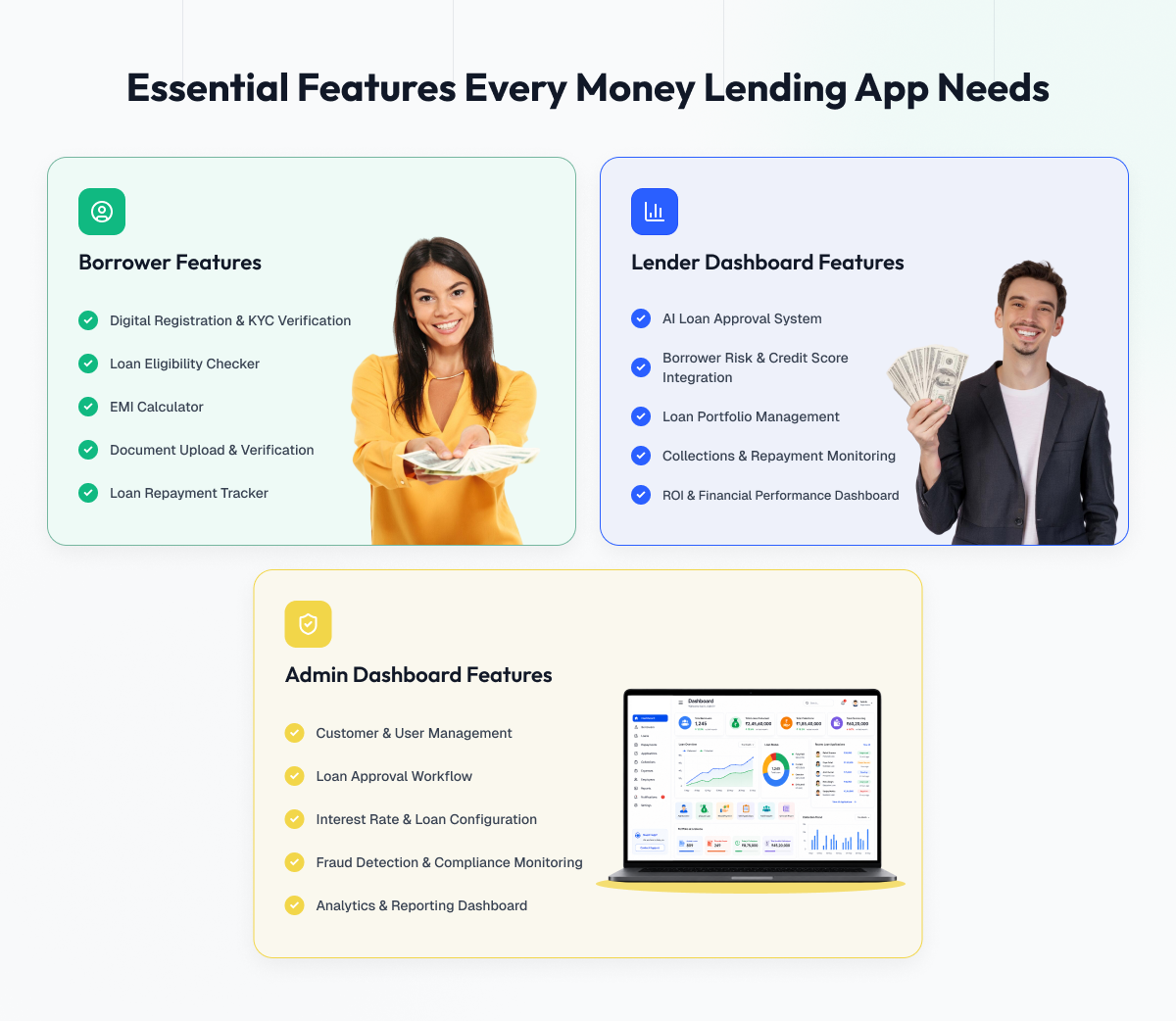
1. Borrower Features
BNPL app development services should be tailored to the specific requirements of a user. The features below help to get a hassle-free loan application process.
| Feature | Purpose |
| Digital Registration & KYC Verification | Users can securely create an account and verify their identity |
| Loan Eligibility Checker | Instantly evaluates loan eligibility based on user information |
| EMI Calculator | Gives accurate calculations for loan fees and repayments |
| Document Upload & Verification | Users can digitally upload necessary documents within a few steps |
| Loan Repayment Tracker | This dashboard helps borrowers to check upcoming EMIs, due dates, and other details |
Suitable For: Personal Loan Apps, Business Loan Apps, Mortgage Loan Apps, BNPL Apps, and Digital Lending Platforms.
2. Lender Dashboard Features
To develop a fintech app, developers need to design a lender dashboard. Lenders want to check detailed information about a borrower, which is possible with a feature-rich dashboard.
| Feature | Purpose |
| AI Loan Approval System | To review, approve, reject, or request additional information for loan applications |
| Borrower Risk & Credit Score Integration | Analyze credit scores, financial history, and AI-generated risk insights before approving loans |
| Loan Portfolio Management | Monitor active loans, repayment status, overdue accounts, and overall lending performance |
| Collections & Repayment Monitoring | Track missed payments, automate reminders, and manage loan recovery processes |
| ROI & Financial Performance Dashboard | Measure loan profitability, interest earnings, repayment trends, and portfolio growth |
Suitable For: Business Loan Apps, Peer-to-Peer Lending Apps, Mortgage Loan Apps, Enterprise Digital Lending Platforms, and FinTech Lending Apps.

3. Admin Dashboard Features
This gives the administrator complete control over legal policies, applications, and access control. AI in fintech app development supports integration of effective admin features.
| Feature | Purpose |
| Customer & User Management | Manage borrower and lender accounts, verify profiles, and control user access. |
| Loan Approval Workflow | Configure approval rules, assign applications to reviewers, and automate decision-making workflows. |
| Interest Rate & Loan Configuration | Set loan products, repayment terms, interest rates, and processing fees. |
| Fraud Detection & Compliance Monitoring | Detect suspicious activities, monitor transactions, and support KYC/AML compliance requirements. |
| Analytics & Reporting Dashboard | Make a Money Lending App with repayments, default rates, revenue, and user engagement |
Suitable For: Personal Loan Apps, BNPL Apps, Business Loan Apps, Mortgage Loan Apps, and Enterprise Digital Lending Platforms.
How to Develop a Money Lending App: Step-by-Step Development Process
Whether you are a startup or an established financial institution, following a structured development process is essential for building a secure, scalable, and compliant money-lending app. Businesses should be aware of the process for coordinating with the project managers at a loan app development company.
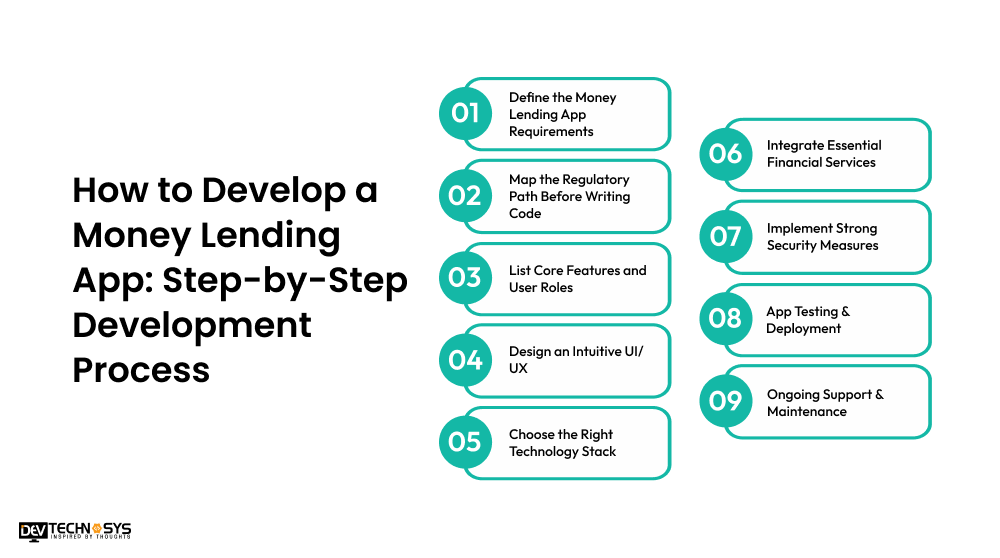
Step 1: Define the Money Lending App Requirements
Identifying the project’s scope is important for prioritizing development efforts. For example, some businesses may need a basic app while others want to add AI capabilities. An initial discussion to build a BNPL app like Tamara or a personal loan app helps developers to create the right app.
They need to add relevant features and functionality based on the type of mobile app required. This phase also includes cross-platform or Android/iOS app development.
Step 2: Map the Regulatory Path Before Writing Code
Licensing, capital requirements, and regulatory compliance needs to be followed. It is important to analyze competitors, potential user requirements, and privacy obligations. The dedicated app development company researches and implements the right compliance, security, and features to avoid legal or any other risks.
Step 3: List Core Features and User Roles
It is better to create a minimal viable product (MVP) with EMI calculators, document upload, repayment tracking, and other features so that borrowers can apply for a loan. Features should be prioritized separately for lenders, borrowers, and administrators to provide better user accessibility. Later, this MVP can be scaled according to the specific business requirements.
Step 4: Design an Intuitive UI/UX
Choose the segment for which the app has to be designed. For example, an enterprise, bank, or small businesses. Then, sketching a wireframe or creating a prototype will ensure the app’s layout, accessibility, responsiveness, and user-friendliness.
A clean interface with clear navigation improves usability and customer satisfaction in a money-lending app. This discussion should be done with proper communication to build an interactive UI/UX.
Step 5: Choose the Right Technology Stack
A better step will be to build a cross-platform mobile app with Flutter or React Native to save development costs. Node.js or .NET can be used for the backend. Also, a cloud infrastructure should be used to add a microservices architecture or handle user traffic.
This phase is important because choosing the wrong tech stack can directly affect app performance. Also, in the future, businesses might experience challenges integrating additional features or functionality.
Step 6: Integrate Essential Financial Services
Payment gateways, document verification, and accounting software must be linked with the lending app. A well-planned API integration improves the app performance. E-signature platforms, credit scoring services, and fraud detection tools improve operational efficiency.
These help users to take a loan without much effort. Businesses should be clear regarding the important financial services to avoid a last-minute upgrade. This might affect cost and overall app development time.
Step 7: Implement Strong Security Measures
Because a finance-related app transfers sensitive information, all the required security features need to be designed in the app. Encrypt customer data, implement multi-factor authentication, secure APIs, role-based access control, and audit logs.
Businesses must partner with a BNPL app development company to secure the apps. The dedicated team identifies potential security gaps and addresses them in advance to avoid deployment issues.
Step 8: App Testing & Deployment
Functional, UI/UX, security, and performance testing need to be conducted to ensure the app operates efficiently. The next step is to launch the app on Google Play or the App Store while following the specific guidelines. App testing needs to be done on multiple platforms and devices to ensure that it is working properly.
The required guidelines and practices must be followed to launch it without issues. A careful deployment means that the app is checked for features, functionality, responsiveness, and other important parameters.
Step 9: Ongoing Support & Maintenance
Collaborating with a company that frequently updates the money-lending app or improves its features as the business expands is beneficial. Businesses have to improve their apps based on consumer feedback to remain competitive.
If the app is not improved over time, it gets outdated, and competitors get a way to increase user engagement. Ongoing support for a money lending app is important to fix errors and provide a good user experience.
Money Lending App Development Timeline: How Long Does It Take to Launch?
While a basic MVP can take up to 5 – 8 months, an enterprise-grade app is built with 12+ months. Understanding the development timeline allows fintech app development companies and businesses to get an estimated project date.
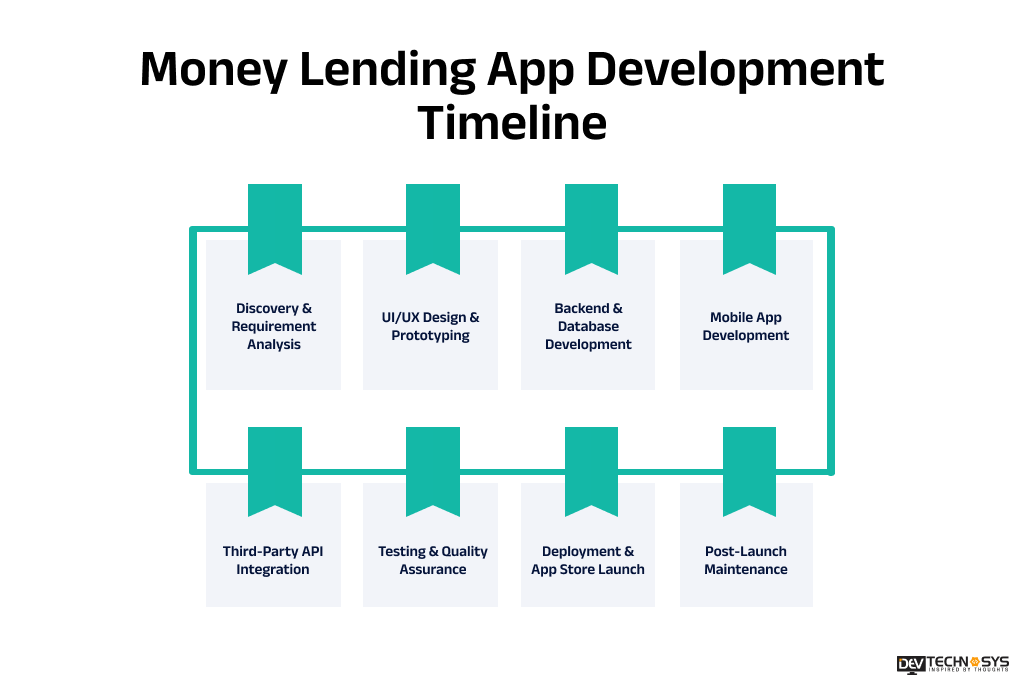
1. Discovery & Requirement Analysis
Businesses that want to develop a money lending app should be clear about the design and development requirements. Project managers gather essential requirements from the business to create a project roadmap. This usually takes up to 3 weeks, depending on the required app.
2. UI/UX Design & Prototyping
The dedicated team then begins work on responsive UI, wireframes, and user dashboards. A prototype is created within 5 weeks and is shared with the client to make suitable changes.
3. Backend & Database Development
This is a strong foundation development phase in which database architecture, microservices, API’s, security, and payment workflows are developed. This process takes up to 8 weeks to complete the entire iOS/android app development.
4. Mobile App Development
Though this phase works alongside the backend for 12 weeks, developers integrate essential features. These include an EMI calculator, notifications, a financial performance dashboard, and more as required.
5. Third-Party API Integration
To create a money lending app, it is essential to include third-party APIs. This phase takes almost 4 weeks to integrate regulatory compliance, KYC, payment gateways, and other fintech APIs.
6. Testing & Quality Assurance
Before the app is deployed, it needs to be tested for compatibility, usability, and functionality. The average time for these processes is around 4 weeks, during which bug fixes and app quality are ensured.

7. Deployment & App Store Launch
The digital lending app is deployed with cloud hosting and backend infrastructure. It is published on Google Play and the App Store within 2 weeks, ensuring security and compliance checks.
8. Post-Launch Maintenance
Many UAE businesses prefer to have post-launch support for bug fixes, app updates, or scaling the infrastructure. This is a continuous process that a dedicated team focuses on.
Technology Stack Behind a Modern Lending Platform
Selecting the right technology impacts security, scalability, and compliance of the money lending app. High-performing applications can be built using this tech stack. Businesses that hire dedicated developers ensure that the right technologies are used to build
| Recommended Technologies | Why It’s Used in a Money Lending App |
| Flutter, React Native | Develop a single codebase for Android and iOS, reducing development time and maintenance costs |
| Swift (iOS), Kotlin (Android) | Delivers high performance, platform-specific features, biometric authentication, and a better user experience |
| Node.js (Express.js), Java Spring Boot, .NET Core | Processes loan applications, user authentication, business logic, repayment workflows, and API requests securely |
| PostgreSQL, MongoDB, Redis | Stores customer profiles, loan records, repayment history, and transaction logs, and improves application performance through caching |
| AWS, Microsoft Azure, Google Cloud Platform (GCP) | Provides scalable hosting, automated backups, disaster recovery, load balancing, and high availability |
| REST APIs, GraphQL, OpenAPI | Connects payment gateways, credit bureaus, KYC providers, SMS services, and third-party financial systems |
| OAuth 2.0, JWT, Multi-Factor Authentication (MFA), Face ID, Touch ID | Protects user accounts, secures API access, and strengthens authentication for financial transactions |
| TensorFlow, Scikit-learn, OpenAI APIs | Enables AI-powered loan approval, credit risk assessment, fraud detection, OCR-based document verification, and customer support chatbots |
| Stripe, Checkout.com, PayTabs, Network International | Supports secure loan disbursement, EMI collection, recurring payments, and online transaction processing |
| Firebase Cloud Messaging (FCM), Twilio, SendGrid | Sends OTPs, repayment reminders, loan status updates, push notifications, SMS alerts, and email communications |
| Google Analytics 4, Power BI, Tableau | Tracks user behavior, loan performance, repayment trends, customer engagement, and business KPIs |
| Docker, Kubernetes, GitHub Actions, Jenkins | Automates application deployment, testing, scaling, monitoring, and continuous software delivery |
| Prometheus, Grafana, ELK Stack (Elasticsearch, Logstash, Kibana) | Monitors application health, detects failures, analyzes logs, and ensures system reliability and uptime |
Security & Compliance Checklist for UAE Money Lending App
According to Mordor Intelligence, the fintech market size is expected to reach USD 90.06 billion by 2031. This indicates that money-lending apps built with compliance in mind are more likely to be monetized. With the increased demand, businesses must incorporate specific standards to reduce risks.
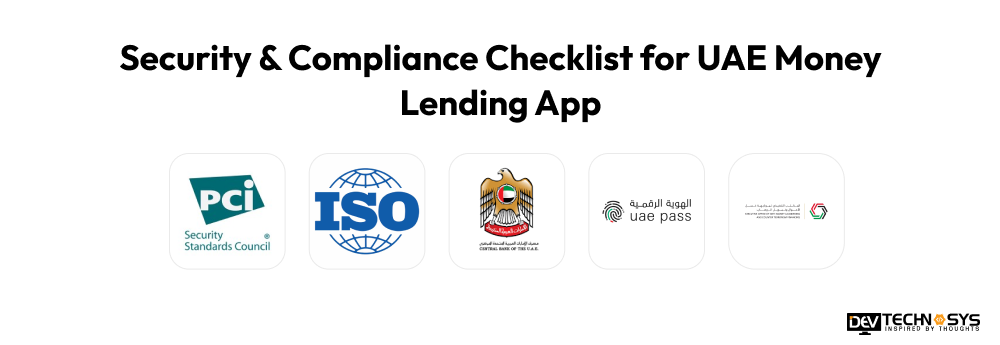
1. PCI DSS
The Payment Card Industry Data Security Standard reduces the risk of fraud. This compliance is vital for those businesses that accept loan repayments through credit or debit cards. The implementation of PCI DSS ensures that cardholder data is transmitted, stored, and processed securely.
2. ISO/IEC 27001
This standard needs to be followed if the lending app is created for international use. This demonstrates that the application follows all information security practices to secure banking and clients’ data. This standard builds trust among the financial institutions and lenders.
3. UAE Central Bank Regulations
The Central Bank has released certain regulations that need to be followed. These include risk management, licensing, and consumer protection requirements. Businesses need to follow this regulations to meet local financial practices. Apps built with this compliance are secured from legal risks.
4. UAE PASS
This standard is basically for user authentication and identity verification for lenders. Compliance follows KYC and onboarding while ensuring user trust. An iOS app development company follows this regulation while building an app. This regulation reduces the need for manual document verification and provides convenience.
5. UAE AML/CFT Framework
The framework supports financial institutions in monitoring suspicious activities, maintaining compliance, and verifying customer identities. A money lending app should include AML/CFT requirements to reduce financial crime risks.
Common Challenges When Developing a Lending App
Most UAE businesses often consider development cost but overlook technical, security, and compliance challenges involved. A lending platform gets access to sensitive information that might lead to security vulnerabilities. Poor user experience, speed, security, and compliance are some of the important factors that directly contribute to the challenges in developing an instant loan app and the mobile app maintenance cost.
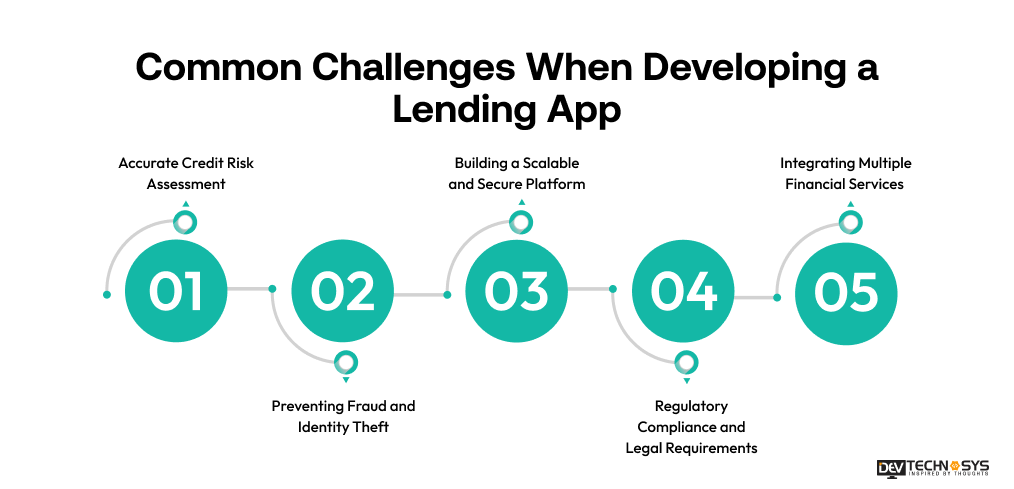
1. Accurate Credit Risk Assessment
One of the biggest challenges is to assess the eligibility of a lender. This involves integration of credit bureau APIs and AI-powered analytics to check income, credit history, and financial condition. For this accuracy, businesses need to hire a dedicated developer to include the necessary functionalities in the app.
2. Preventing Fraud and Identity Theft
Implementing fraud detection is a challenging task, and only experienced developers can handle it. Businesses that partner with a fintech app development company can ensure that their app is free from all risks. Building security mechanisms is technically challenging to prevent financial fraud.
3. Building a Scalable and Secure Platform
Developers need to build a scalable architecture during app development so that the app can handle traffic or load in the future. Usually, a microservices architecture, encrypted databases, and cloud infrastructure are used to support long-term growth. This is a budget challenge that can be solved by investing at once.
4. Regulatory Compliance and Legal Requirements
Modern money lending apps need to be integrated with credit bureau APIs, AI-powered analytics, and credit scoring models. Businesses often face the challenge of including risk assessment while building an app. KYC and AML are the two most important compliance modules to verify a user and ensure compliance.
5. Integrating Multiple Financial Services
A money lending app needs to be integrated with multiple features such as email, SMS, document verification, credit bureau, and more that require technical expertise. Poor integration of financial services can affect operational efficiency, which needs to be solved by collaborating with an experienced team.

Why Partner with a Mobile App Development Company?
Building a money lending app solution requires specialized expertise in fintech, compliance, security, and integrations. Partnering with an experienced mobile or specifically BNPL app development company allows businesses to minimize technical complexity.
Instead of hiring freelancers and taking a risk, businesses can avoid operational costs. Choosing a dedicated development team with CMMI Level 3 certification ensures they understand the specific requirements to build a Money Lending App.
Most importantly, the company ensures ongoing maintenance even after the app is deployed. This is the cost-effective solution for UAE businesses.
Monetization Options for a Money Lending App
Businesses that hire mobile app developers in the Dubai often generate sustainable revenue. This is because the experts build apps according to the business model and target audience.
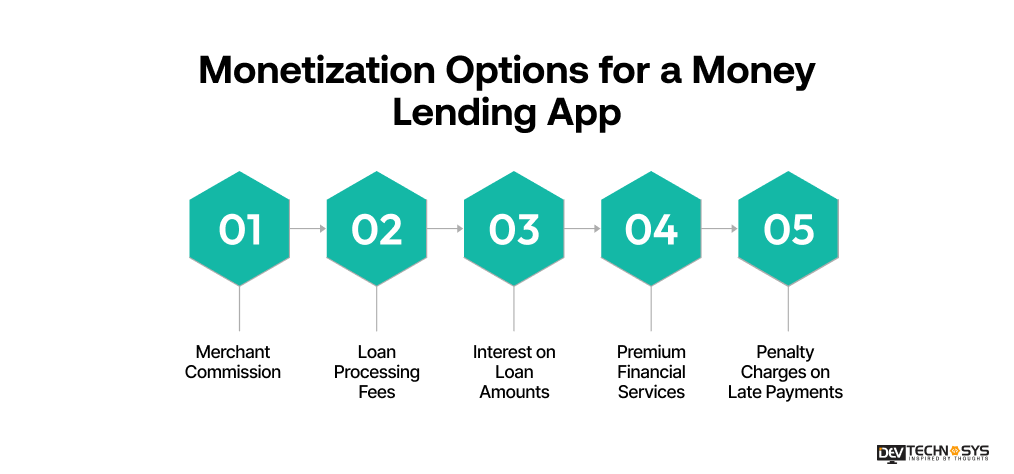
1. Merchant Commission
This is for BNPL providers who typically generate revenue by charging merchants a commission. Merchants usually earn from higher conversion rates. BNPL app development solution is one of the best monetization options for the business seeking to earn a good amount.
2. Loan Processing Fees
Money lenders from such apps usually charge a one-time processing fee that covers administrative costs and other applicable laws. This is an additional source of monetization in addition to interest income. Usually, borrowers pay on time, but if they forget, loan processing fees are accounted directly to money lenders.
3. Interest on Loan Amounts
This is the interest charged on a loan and is the primary source of income. The interest rate depends on the loan amount, tenure, loan type, and a borrower’s creditworthiness. A borrower can select the time to repay the loan amount while applying for a personal, vehicle, or any other type of loan.
4. Premium Financial Services
Most fintech companies offer services such as subscription-based membership plans, insurance partnerships, or credit monitoring. These value-added services create additional income while improving customer retention.
5. Penalty Charges on Late Payments
These payments are charged when borrowers fail to make a repayment. The penalty fees are according to the customer agreement. These payments encourage timely repayments while benefiting the loan providers.
Conclusion
Building a money lending app requires a strategic combination of technology, security, regulatory compliance, and user-centric design. Organizations must choose a fintech business model with a proper technology stack, implementation of compliance, and a scalable architecture.
By following a structured development approach and partnering with an experienced fintech app development company, businesses can accelerate time-to-market while delivering a secure, compliant, and feature-rich lending platform that meets evolving customer expectations and supports sustainable business growth.
Frequently Asked Questions
1. Which Technologies are Best for Developing a Money Lending App?
The superior technology stack used for developing a money lending app is Flutter or React Native, .NET Core, Node.js, and Java Spring Boot for backend development. Businesses often use PostgreSQL and MongoDB for databases that are often integrated with cloud services. These offer scalability and flexibility for fintech applications.
2. How Much Does it Cost to Build a Money Lending App?
If a business is planning to build a fintech lending app, then they must know the factors affecting cost. These are security, compliance, U/UX design, features, and third-party integrations. The average cost of developing a money lending app is $30000 to $150,000. However, an enterprise-grade application might cost more depending on the business model and capabilities required.
3. What APIs are Required for a Money Lending App?
APIs are important to manage the loan services. Notifications that are sent to users or integration with accounting software, third-party APIs automate lending operations while improving customer experience. APIs support automated lending operations while maintaining the responsiveness of the app.
4. How Can a Money Lending App Handle High User Traffic Securely?
With the advancement in technology, businesses can expect money lending apps to handle high user traffic. This feature is created by developers using microservices, encrypted databases, cloud infrastructure, caching mechanisms, and more as required. These ensure that the platform is secure to access even with high traffic.
5. Can a Money Lending App Support Multiple Loan Products?
With the growing fintech market, businesses are willing to build apps that can provide multiple functionalities. A modern money lending app supports multiple loan products such as BNPL, vehicle loans, education, or personal loans. Developers typically design a modular architecture that supports specific user requirements. They develop a scalable app to meet modern business requirements.