





Key takeaways:
- According to Business Fortune Insights, mobile applications dominate the Online Food Delivery Market Share with 74%, driven by smartphone dependence and app-based convenience
- The food delivery platform development cost ranges from $30,000 to $1,50,000. However, the total cost estimates depend on features, third-party APIs, AI features, and more.
- Developing a similar app like Herfy requires careful planning, scalable technology, and a user-centric approach.
- A food delivery app like Herfy can generate revenue through multiple monetization models, such as commissions on orders, delivery fees, premium memberships, and in-app advertisements.
With the growing need for quick and easy food delivery, applications like Herfy have set the standard for digital restaurant experiences in Saudi Arabia and worldwide. If you’re a restaurant chain, startup, or entrepreneur, restaurant delivery application development is an opportunity to increase your customer base, optimize business processes, and create recurring revenue.
But a scalable platform needs more than a pretty interface; it needs the correct features, technological stack, system architecture, and security measures. This informative guide will help you understand how to build an app like Herfy, its key features, development process, estimated cost, suggested tech stack, and best practices to start a successful food delivery business in 2026.
What is Herfy App?
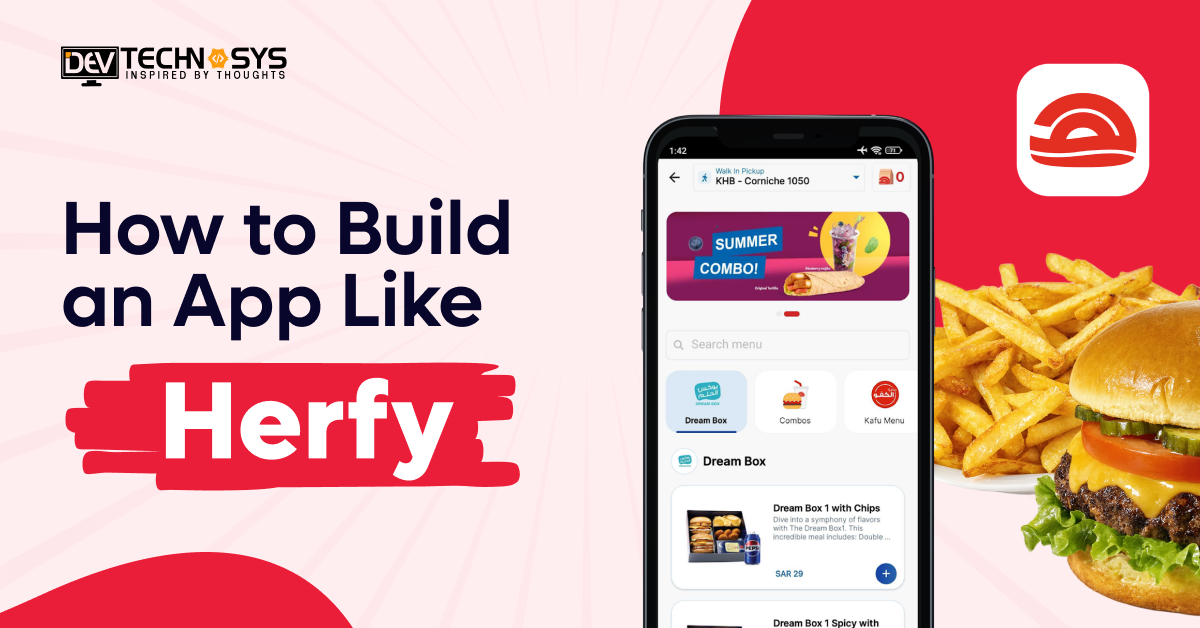
The Herfy app is the official food delivery and pickup service for HERFY, a major fast-food chain in Saudi Arabia. It lets you order burgers, sandwiches, and sides straight from your phone. You can track your food, check out special deals, and pay with cash or a card.
Key Features Include:
- Order Food: Get meals delivered to your door or ready for quick pickup.
- Track Orders: Watch your food get made and delivered in real-time.
- Find Stores: Use the built-in map to find the nearest HERFY location.
- Save Money: Access exclusive online discounts and offers.
Food Delivery Market Overview in 2026
- The online food delivery services market is set to reach USD 53.5 billion by the end of 2026 and grow at a CAGR of 9.9% between 2026 and 2036 to reach USD 137.4 billion by 2036.
- Restaurant to consumer will dominate with a 62.0% share, while mobile application will lead with a 71.0% share.
- Restaurant to consumer at 62.0% share is sustained by established buyer specifications, volume-based contract structures, and qualification incumbency.
- The USA market is set to grow at 9.5% through the forecast period. Consumer demand patterns and distribution channel evolution in the USA shape procurement of Restaurant to Consumer products
Answer a few quick questions and our experts will share a tailored project estimate.
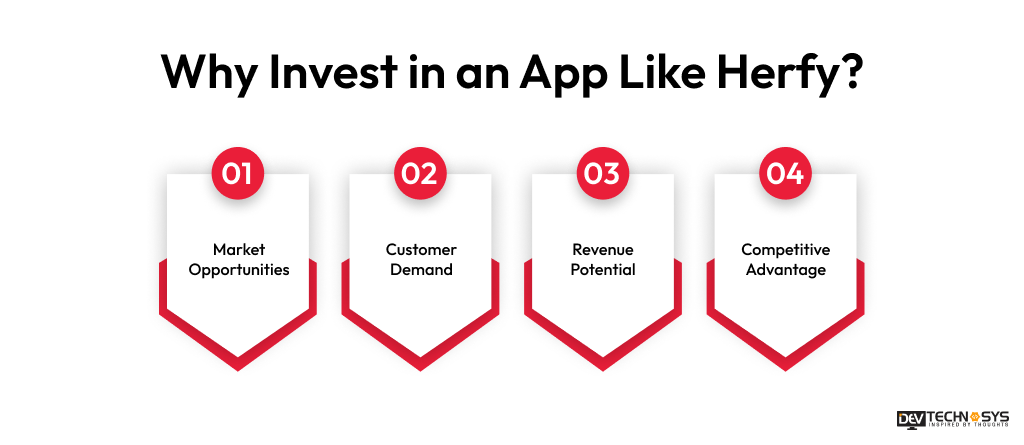
Why Invest in an App Like Herfy?
The food delivery industry continues to grow as consumers increasingly prefer the convenience of ordering meals through mobile apps. Investing in an app like Herfy enables businesses to expand their customer reach, streamline restaurant operations, and create multiple revenue streams.
1. Market Opportunities
The online food delivery market is expanding rapidly, particularly in the Middle East, where digital adoption and quick-commerce services continue to accelerate. Businesses that invest in scalable delivery platforms can tap into a growing customer base and capitalize on increasing demand for online ordering.
2. Customer Demand
Today’s customers expect a seamless ordering experience with real-time order tracking, secure payments, personalized recommendations, and fast delivery. By investing in a food delivery app development solution like Herfy, businesses can meet these expectations, improving customer satisfaction, loyalty, and repeat purchases.
3. Revenue Potential
Food delivery apps generate revenue through multiple channels, including delivery fees, restaurant commissions, subscription plans, featured listings, in-app advertising, and promotional partnerships. This diversified business model creates consistent income while supporting long-term scalability.
4. Competitive Advantage
A custom-built app allows businesses to differentiate themselves with unique features such as AI-powered recommendations, loyalty programs, online menu management, multilingual support, and efficient delivery management. Unlike generic solutions, a tailored platform provides greater flexibility, strengthens brand identity, and enables businesses to adapt quickly to changing market trends.
How Does an App Like Herfy Work?
An app like Herfy connects customers, restaurants, delivery partners, and administrators through a centralized platform. From placing an order to doorstep delivery, every step is synchronized in real time to ensure a seamless and efficient food ordering experience.
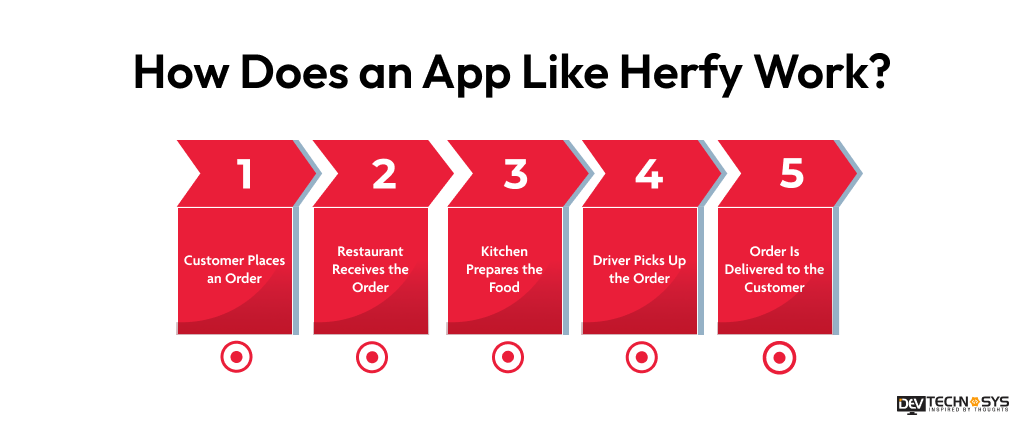
Step 1: Customer Places an Order
Customers browse nearby restaurants, select menu items, customize their meals, choose a payment method, and place an order through the mobile application.
Step 2: Restaurant Receives the Order
The restaurant instantly receives the order through its management panel. Staff members review the order, confirm availability, and send it to the kitchen for preparation.
Step 3: Kitchen Prepares the Food
The kitchen team prepares the order while updating its status in real time. Customers receive notifications about order confirmation and preparation progress.
Step 4: Driver Picks Up the Order
Once the food is ready, the platform automatically assigns the nearest available delivery partner. The driver accepts the request, collects the order, and begins the delivery.
Step 5: Order Is Delivered to the Customer
Customers can track the driver’s live location and estimated arrival time. After delivery, they can complete the payment, rate the service, and leave feedback, helping maintain service quality and customer satisfaction.
App Like Herfy System Architecture
Create a food delivery app architecture that ensures seamless communication between customers, restaurants, delivery partners, and backend services. Each component is responsible for a specific function, enabling the platform to deliver fast, secure, and scalable food delivery services.
1. Customer App
- User registration and authentication
- Restaurant and menu browsing
- Food ordering and online payments
- Real-time order tracking
- Ratings, reviews, and order history
2. Restaurant App
- Restaurant profile management
- Menu and pricing updates
- Order acceptance and processing
- Inventory management
- Sales and performance tracking
3. Driver App
- Delivery request management
- GPS navigation and route guidance
- Live order status updates
- In-app communication
- Earnings and delivery history
4. API Gateway
- Routes client requests to backend services
- Handles user authentication
- Performs request validation
- Manages API traffic and load balancing
- Improves application security
5. Backend Services
- User and restaurant management
- Order processing and tracking
- Driver assignment
- Payment processing
- Business logic and integrations
6. Database
- Stores user profiles and restaurant data
- Maintains menu and inventory records
- Saves order and payment history
- Manages delivery information
- Ensures secure data storage and retrieval
7. Notification Service
- Push notifications
- SMS and email alerts
- Order status updates
- Promotional campaigns
- Delivery reminders
8. Payment Gateway
- Secure online transactions
- Multiple payment methods
- Refund processing
- Fraud detection
- PCI DSS-compliant payment security
9. Maps API
- Live GPS tracking
- Route optimization
- ETA calculation
- Restaurant location search
- Distance and traffic analysis
10. Cloud Infrastructure
- Cloud hosting
- Auto scaling
- Load balancing
- Data backup and disaster recovery
- High availability and performance monitoring
11. Analytics
- Customer behavior analysis
- Sales and revenue reports
- Delivery performance metrics
- Marketing campaign insights
- Business intelligence dashboards
Industry Insights
According to a recent report by Mordor Intelligence, by service type, platform delivery is poised to expand at a 12.31% CAGR to 2031.
Step-by-Step Process to Build an App Like Herfy
Developing an app like Herfy requires careful planning, scalable technology, and a user-centric approach. From validating your business idea to post-launch optimization, each stage plays a critical role in building a reliable and successful food delivery platform.
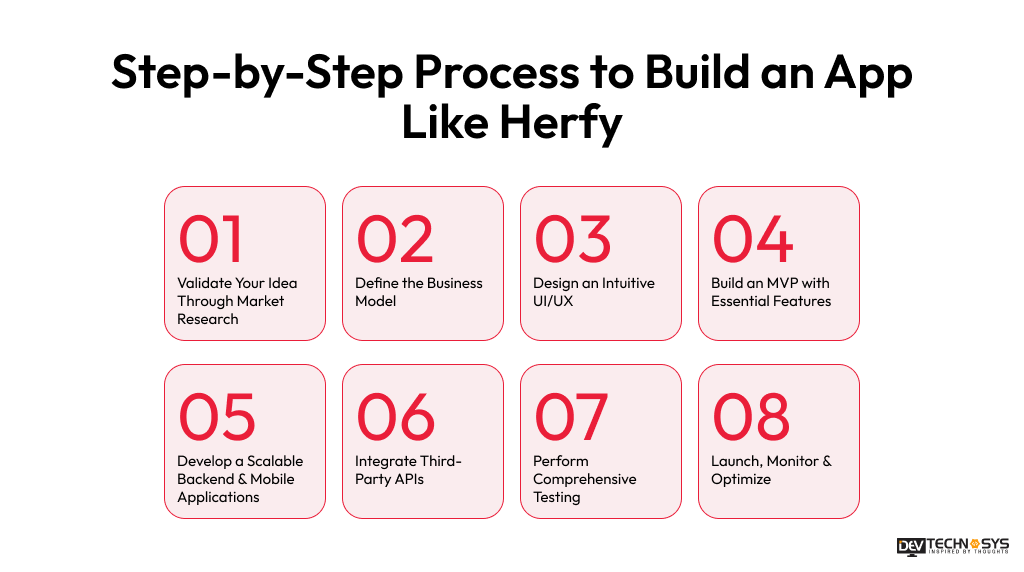
Step 1: Validate Your Idea Through Market Research
Begin the process to build app like Keeta or Herfy by researching your target audience, competitors, and regional food delivery trends. Analyze platforms like Herfy and other leading delivery apps to identify market gaps, customer pain points, and opportunities to differentiate your platform. This stage also helps define your target users, service areas, and long-term business objectives.
Key Deliverables:
- Market & competitor analysis
- User personas
- Feature prioritization
- Product Requirement Document (PRD)
Step 2: Define the Business Model & Core Requirements
Experts who offer food delivery app development services choose the business model that best fits your goals, whether it’s a single-brand restaurant app, multi-vendor marketplace, or cloud kitchen platform. Finalize your monetization strategy, user roles, core features, order workflow, and technical requirements before development begins to avoid costly revisions later.
Key Deliverables:
- Business model canvas
- Revenue strategy
- User flow diagrams
- Functional requirements document
Expert Insight:
“According to our skilled food delivery app development expert Mohit Nag, designing your order workflow at this stage prevents major backend changes later and ensures smoother integrations with payment and delivery systems.”
Step 3: Design an Intuitive UI/UX
To develop a halal food finder app, designers need to create user-centric interfaces for customers, restaurants, delivery partners, and administrators. Develop wireframes, interactive prototypes, and user journeys that simplify restaurant discovery, ordering, checkout, and delivery tracking while ensuring a consistent experience across Android, iOS, and web platforms.
Key Deliverables:
- Wireframes
- High-fidelity UI designs
- Interactive prototypes
- Design system
Step 4: Build an MVP with Essential Features
Develop a Minimum Viable Product (MVP) containing only the essential functionalities, including user registration, restaurant listings, menu management, online payments, order tracking, and an admin dashboard. Launching an MVP enables faster validation, reduces initial investment, and allows you to gather valuable user feedback before scaling.
Key Deliverables:
- Customer app MVP
- Restaurant dashboard
- Driver application
- Admin panel
Expert Insight:
“Focus on solving one core problem exceptionally well. Advanced capabilities like AI recommendations and loyalty programs can be introduced after validating product-market fit.”
Step 5: Develop a Scalable Backend & Mobile Applications
Build a secure, cloud-based backend that manages authentication, order processing, restaurant operations, driver allocation, notifications, and payment workflows. Simultaneously develop the best food delivery apps in Dubai for customers, restaurants, and delivery partners using a scalable architecture that supports future growth and high user traffic.
Key Deliverables:
- Backend APIs
- Database architecture
- Mobile applications
- Admin dashboard
Adopting a modular or microservices-based architecture makes it easier to scale individual services as your platform grows without affecting the entire application.
Step 6: Integrate Third-Party APIs & Essential Services
Enhance your application by integrating payment gateways, Maps APIs, push notifications, SMS and email services, analytics platforms, and customer support tools. These integrations enable secure payments, real-time tracking, seamless communication, and data-driven business decisions.
Key Deliverables
- Payment gateway integration
- Maps & GPS integration
- Push notification service
- Analytics dashboard
Step 7: Perform Comprehensive Testing & Security Validation
After you make an app like Herfy, conduct functional, usability, performance, compatibility, security, and load testing to ensure the application performs reliably under real-world conditions. Validate payment processing, GPS accuracy, API integrations, and data protection before releasing the platform to users.
Key Deliverables:
- QA reports
- Security audit
- Performance test results
- Bug resolution report
Step 8: Launch, Monitor & Optimize
Deploy the application to Android, iOS, and web platforms while configuring cloud hosting, monitoring tools, and analytics dashboards. After launch, continuously monitor user behavior, optimize performance, introduce AI-powered features, strengthen security, and release regular updates to keep your food delivery platform competitive and scalable.
Key Deliverables:
- Production deployment
- Monitoring dashboard
- User feedback reports
- Feature enhancement roadmap
See what experts at Dev Tech have to say
“Successful food delivery platforms continuously analyze customer behavior, delivery performance, and operational metrics to guide product improvements and maintain a competitive advantage.”
What are the Must-Have Features For Apps Like Herfy?
Building an app like Herfy requires more than just an attractive interface; it demands a feature-rich ecosystem that seamlessly connects customers, restaurants, delivery partners, and administrators. The following food delivery app features form the foundation of a scalable, secure, and high-performing food delivery platform.
Customer App Features |
Restaurant Panel Features |
Delivery Driver App Features |
Admin Dashboard Features |
| User Registration & Login | Restaurant Profile Management | Driver Registration | User Management |
| Restaurant Discovery | Menu Management | Order Assignment | Restaurant Management |
| Smart Search & Filters | Order Management | GPS Navigation | Driver Management |
| Menu Browsing | Inventory Management | Real-Time Delivery Tracking | Order Monitoring |
| Cart & Checkout | Pricing & Promotions | In-App Chat & Calling | Payment & Commission Management |
| Secure Payments | Sales Analytics | Earnings Dashboard | Reports & Analytics |
| Real-Time Order Tracking | Earnings Dashboard | Delivery History | Promotions & Coupon Management |
| Push Notifications | Order Status Updates | Availability Management | Customer Support Management |
| Ratings & Reviews | Customer Review Management | Route Optimization | Role-Based Access Control (RBAC) |
| Order History & Reordering | Delivery Radius Management | Proof of Delivery | Content Management |
| Favorite Restaurants | Restaurant Performance Reports | Delivery Performance Analytics | Dashboard Analytics |
| Multi-Language Support | Business Hours Management | Push Notifications | System Settings & Configuration |
Advanced Features That Differentiate Modern Food Delivery Apps
Herfy clone app development relies on AI, automation, and personalization to deliver exceptional customer experiences and improve operational efficiency. The following advanced features help businesses increase customer retention, optimize deliveries, and stay ahead of the competition.
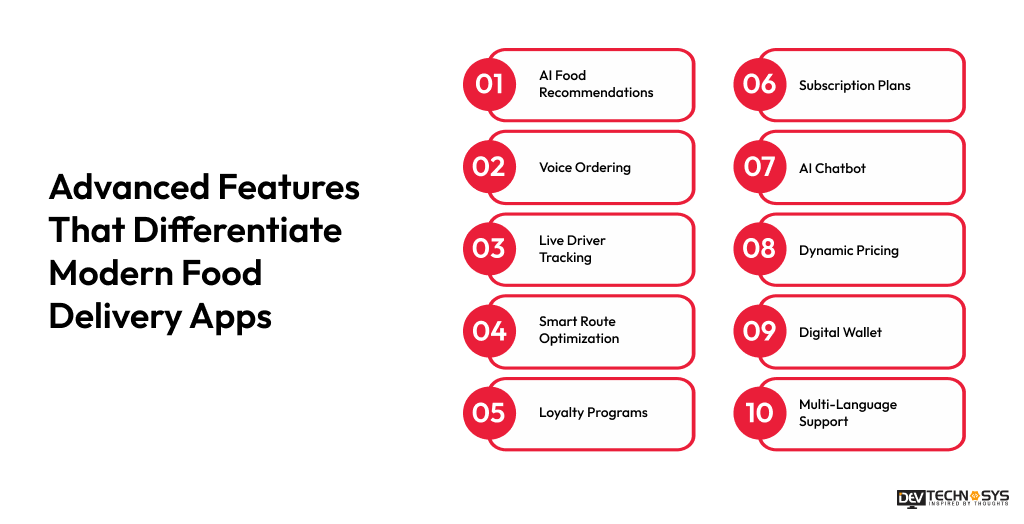
1. AI Food Recommendations
Build a food delivery app like PedidosYa with AI-powered recommendation engines to analyze user preferences, browsing history, and previous orders to suggest relevant meals and restaurants. Personalized recommendations improve customer engagement and encourage repeat purchases.
2. Voice Ordering
Voice ordering allows customers to search restaurants, browse menus, and place orders using simple voice commands. This hands-free feature enhances convenience, improves accessibility, and delivers a faster ordering experience across mobile devices.
3. Live Driver Tracking
Features of a Herfy-like app involve real-time GPS tracking, enabling customers to monitor their delivery from restaurant pickup to doorstep. Accurate ETAs, live location updates, and delivery notifications improve transparency, reduce support requests, and enhance customer satisfaction.
4. Smart Route Optimization
AI in food delivery app ensure route optimization, which helps identify the fastest and most efficient delivery routes by analyzing traffic, weather, and road conditions. This reduces delivery times, lowers fuel costs, and improves overall fleet productivity.
5. Loyalty Programs
Loyalty programs reward customers with points, cashback, exclusive discounts, and special offers for repeat purchases. These incentives strengthen customer relationships, improve retention rates, and encourage higher lifetime customer value.
6. Subscription Plans
Subscription plans provide premium benefits such as free deliveries, priority service, and exclusive discounts through monthly or annual memberships. This model generates recurring revenue while increasing customer loyalty and purchase frequency.
7. AI Chatbot
During Herfy Android app development, an AI chatbot provides instant assistance by answering customer queries, tracking orders, recommending meals, and resolving common issues around the clock. It enhances customer support while reducing operational workload and response times.
8. Dynamic Pricing
Dynamic pricing automatically adjusts delivery charges based on demand, traffic conditions, distance, and peak hours. This strategy maximizes revenue, balances delivery capacity, and ensures efficient resource allocation during busy periods.
9. Digital Wallet
A built-in digital wallet enables secure, one-click payments, quick refunds, cashback rewards, and seamless transactions. It simplifies the checkout process while improving payment convenience, customer trust, and overall user experience.
10. Multi-Language Support
Multi-language support allows users to access the application in their preferred language, creating a localized experience for diverse audiences. It expands market reach, improves accessibility, and boosts customer satisfaction across different regions.
What are the Types of Food Delivery Apps?
Food delivery apps can be categorized based on their business model and operational approach. Choosing the right type depends on your target audience, business goals, and revenue strategy. Below are the most common types of food delivery apps in the market.
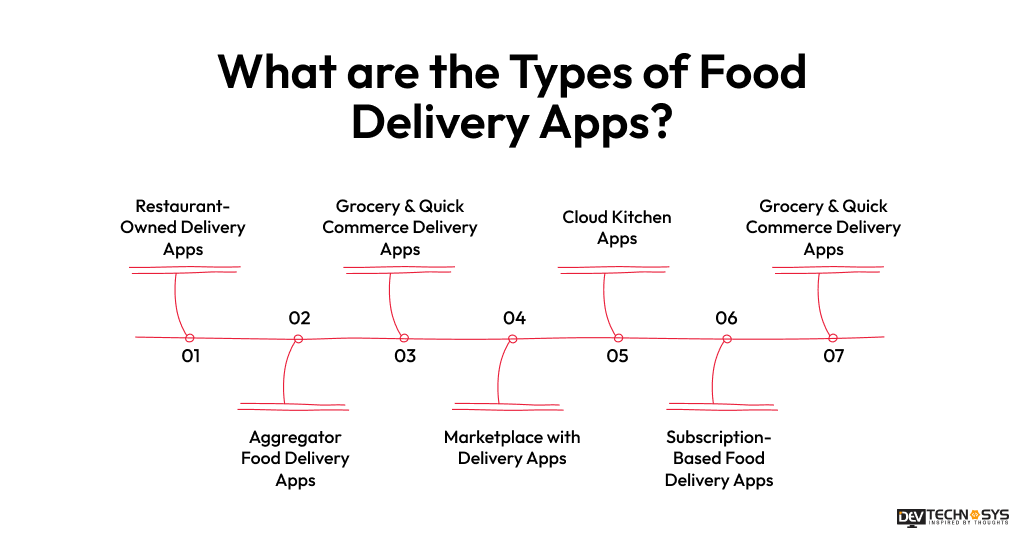
1. Restaurant-Owned Delivery Apps
These apps are developed for a single restaurant or restaurant chain, allowing customers to order directly without relying on third-party marketplaces. They offer complete control over branding, pricing, customer data, and delivery operations.
Examples: Herfy, Domino’s, McDonald’s
2. Aggregator Food Delivery Apps
Aggregator platforms partner with multiple restaurants, enabling customers to browse menus, compare options, and place orders from a single application. A food delivery app like Talabat earns revenue through commissions, delivery fees, and advertising.
Examples: Uber Eats, Talabat, Deliveroo
3. Grocery & Quick Commerce Delivery Apps
These platforms deliver groceries, beverages, medicines, and everyday essentials within minutes by leveraging dark stores, local retailers, and AI-powered logistics.
Examples: Instacart, Blinkit, Talabat Mart
4. Marketplace with Delivery Apps
In this model, the platform not only lists restaurants but also manages its own fleet of delivery drivers. It handles the complete order lifecycle, from order placement to doorstep delivery. To build a marketplace and delivery apps, contact a leading IOS app development company.
Examples: DoorDash, Jahez, HungerStation
5. Cloud Kitchen Apps
Cloud kitchen apps operate without physical dine-in locations. Orders are prepared in centralized kitchens and delivered directly to customers, reducing operational costs while maximizing delivery efficiency.
Examples: Rebel Foods, Kitopi
6. Subscription-Based Food Delivery Apps
An app like Bolt Food offers premium memberships that include free deliveries, exclusive discounts, cashback, and priority customer support. Subscription plans generate recurring revenue while improving customer loyalty.
Examples: Uber One, Deliveroo Plus
7. Grocery & Quick Commerce Delivery Apps
These platforms deliver groceries, beverages, medicines, and everyday essentials within minutes by leveraging dark stores, local retailers, and AI-powered logistics.
Examples: Instacart, Blinkit, Talabat Mart
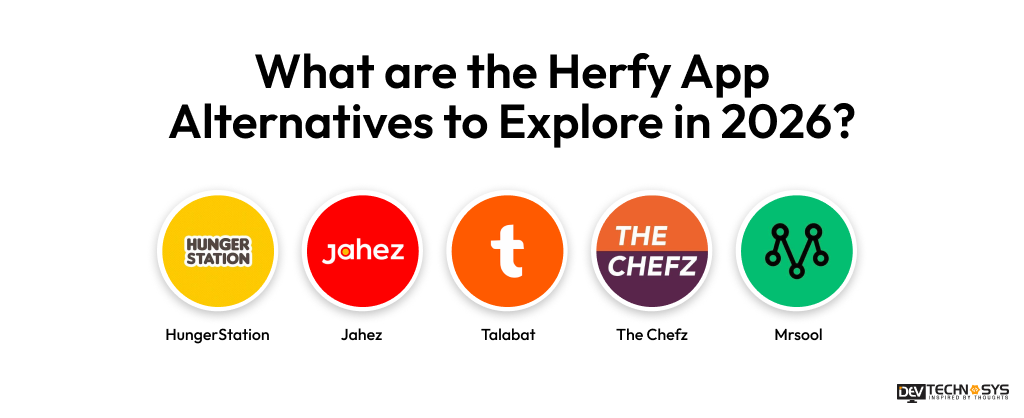
What are the Herfy App Alternatives to Explore in 2026?
Exploring successful food delivery apps can help you understand different business models, feature sets, and scalability requirements. Below are some of the leading Herfy alternatives, along with their estimated development cost and complexity level.
App |
Launch Year |
Development Complexity |
App Rating |
Platform Availability |
| HungerStation | 2012 | High | 4.4★ | Android, iOS, Web |
| Jahez | 2016 | High | 4.6★ | Android, iOS, Web |
| Talabat | 2004 | Very High | 4.5★ | Android, iOS, Web |
| The Chefz | 2016 | Medium–High | 4.6★ | Android, iOS, Web |
| Mrsool | 2017 | Very High | 4.2★ | Android, iOS, Web |
1. HungerStation
Best For: Multi-vendor food delivery marketplace
Estimated Development Cost: $80,000–$180,000
Complexity Level: High
HungerStation is one of Saudi Arabia’s leading food delivery platforms, offering food, grocery, and pharmacy delivery through a large merchant network. Its real-time tracking, multi-vendor architecture, and robust logistics system make it an excellent reference for businesses planning to build a scalable marketplace app. To build an app like HungerStation, contact a top mobile app development company in Dubai.
2. Jahez
Best For: Fast local food delivery
Estimated Development Cost: $70,000–$160,000
Complexity Level: High
Jahez focuses on delivering a seamless customer experience with fast deliveries, live order tracking, and an intuitive mobile interface. Its efficient delivery management and strong regional presence make it a popular benchmark for restaurant delivery applications.
3. Talabat
Best For: Enterprise multi-service marketplace
Estimated Development Cost: $120,000–$300,000+
Complexity Level: Very High
Talabat has evolved beyond food delivery by integrating grocery, pharmacy, and retail services into one platform. Its enterprise-scale architecture, AI-powered recommendations, and extensive partner ecosystem demonstrate how to build a highly scalable on-demand marketplace.
4. The Chefz
Best For: Premium restaurant delivery
Estimated Development Cost: $60,000–$140,000
Complexity Level: Medium–High
The Chefz specializes in premium dining by partnering with high-end restaurants and offering scheduled deliveries and gifting services. Its focus on personalized customer experiences makes it ideal for businesses targeting the luxury food delivery segment.
5. Mrsool
Best For: On-demand delivery services
Estimated Development Cost: $90,000–$220,000
Complexity Level: Very High
Mrsool enables customers to request deliveries from restaurants, supermarkets, pharmacies, and local stores through a flexible courier network. Its versatile delivery model and real-time communication features make it a strong example of a multi-purpose on-demand delivery platform.
Technology Stack Required to Build an App Like Herfy
Selecting the right technology stack is crucial for building a scalable, secure, and high-performance food delivery application. A modern tech stack enables seamless user experiences, real-time order tracking, secure payments, and efficient backend operations while ensuring the platform can scale as your business grows.
Technology Layer |
Recommended Technologies |
Frontend |
Flutter, React Native, Swift (iOS), Kotlin (Android) |
| Backend | Node.js, NestJS, Express.js, Java Spring Boot, Python Django |
| Database | PostgreSQL, MySQL, MongoDB, Redis (Caching) |
| Cloud Infrastructure | AWS, Google Cloud Platform (GCP), Microsoft Azure |
| Maps & Location | Google Maps Platform, Mapbox, HERE Maps |
| Payment Gateway | Stripe, PayPal, Razorpay, HyperPay (Saudi Arabia), Apple Pay, Google Pay |
| Notifications | Firebase Cloud Messaging (FCM), OneSignal, Twilio, SendGrid |
| Analytics | Google Analytics 4, Firebase Analytics, Mixpanel, Amplitude |
| DevOps & CI/CD | Docker, Kubernetes, Jenkins, GitHub Actions, GitLab CI/CD |
| Security | OAuth 2.0, JWT Authentication, SSL/TLS, AES-256 Encryption, PCI DSS Compliance |
| AI & Automation | OpenAI APIs, Google Vertex AI, TensorFlow, Dialogflow, Amazon Personalize |
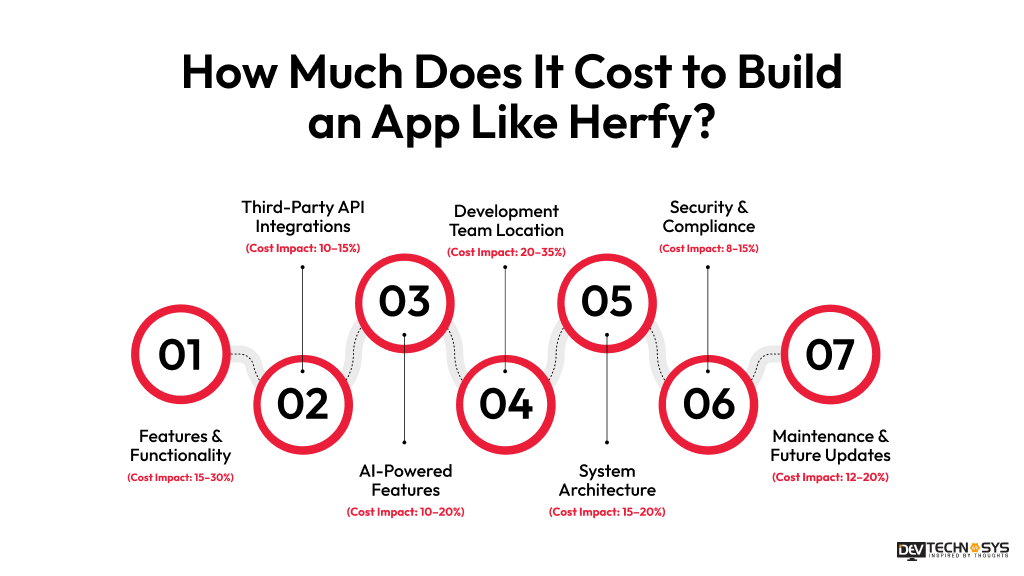
How Much Does It Cost to Build an App Like Herfy?
The cost to build an app like Herfy ranges from $30,000 to $1,50,000. However, the total cost estimates depend on features, third-party APIs, AI features, tech stack, architecture, team location, security features, and more. The food delivery app development cost with basic features like user registration & login, driver registration, order management, and pricing & promotions ranges between $30,000 and $65,000.
App Version |
Development Timeline |
Estimated Cost |
| Basic MVP | 3 to 4 Months | $30,000–$65,000 |
| Standard App | 5 to 7 Months | $65,000–$100,000 |
| Advanced App | 7 to 9 Months | $100,000–$150,000 |
The mid-level Herfy app development cost, with the addition of a few advanced features like live driver tracking and loyalty programs, ranges from $65,000 to $100,000.
However, the cost to build an app like Herfy with advanced features such as voice ordering, smart route optimization, and an AI chatbot can exceed $ 150,000. Now, let’s take a closer look at the factors that affect the total Herfy mobile app development cost.
1. Features & Functionality (Cost Impact: 15–30%)
Features are the biggest cost driver in any food delivery app. Basic functionalities such as user registration, menu browsing, cart management, and online payments require less development effort, while advanced capabilities like AI recommendations, loyalty programs, wallet integration, subscriptions, and multi-vendor management significantly increase the cost to develop an app like Herfy.
2. Third-Party API Integrations (Cost Impact: 10–15%)
Food delivery apps rely on third-party services for payments, maps, SMS, email, push notifications, analytics, and customer support. While these APIs accelerate development, premium providers often charge setup, licensing, or usage-based fees that add to the overall Herfy app development cost.
3. AI-Powered Features (Cost Impact: 10–20%)
Integrating AI features such as personalized food recommendations, intelligent chatbots, smart route optimization, dynamic pricing, and demand forecasting enhances user experience. However, the cost to develop an app like Herfy increases due to the need for additional development, AI model integration, and cloud computing resources.
Industry Insights:
According to McKinsey, AI-powered personalization can improve customer engagement by recommending products based on browsing behavior, order history, and preferences.
5. Development Team Location (Cost Impact: 20–35%)
The location of your development team directly influences your project budget. Herfy app development costs in North America and Western Europe are considerably higher than those in India, Eastern Europe, or Southeast Asia, even for projects with similar technical requirements. To cut costs, you need to hire dedicated developer from Southeast Asia.
System Architecture (Cost Impact: 15–20%)
The architecture of your application determines its scalability, security, and long-term performance. A monolithic architecture is suitable for MVPs, while microservices and cloud-native architectures require more engineering effort but support enterprise-level growth and higher traffic.
6. Security & Compliance (Cost Impact: 8–15%)
Hire mobile app developers in Middle East to implement enterprise-grade security measures. It includes data encryption, secure authentication, PCI DSS compliance, fraud detection, role-based access control (RBAC), and multi-factor authentication (MFA). It increases the cost to develop an app like Herfy but is essential for protecting customer and payment data.
7. Maintenance & Future Updates (Cost Impact: 12–20%)
Mobile app maintenance cost impacts the total development budget. Post-launch maintenance includes bug fixes, cloud hosting, server monitoring, operating system updates, performance optimization, feature enhancements, and security patches. Continuous maintenance ensures the application remains secure, stable, and competitive.
Cost Factor |
Estimated Cost Impact |
Estimated Cost Contribution |
| Features & Functionality | 15–30% | $4,500–$45,000 |
| Third-Party API Integrations | 10–15% | $3,000–$22,500 |
| AI-Powered Features | 10–20% | $3,000–$30,000 |
| System Architecture | 15–20% | $4,500–$30,000 |
| Development Team Location | 20–35% | $6,000–$52,500 |
| Security & Compliance | 8–15% | $2,400–$22,500 |
| Maintenance & Future Updates (Annual) | 12–20% | $3,600–$30,000/year |

What is the Estimated Herfy App Development Timeline?
Building an app like Herfy typically takes 4 to 12 months, depending on the project’s complexity, feature requirements, and development approach. To reduce time-to-market, many startups launch an MVP within 4 to 6 months with essential ordering and delivery features. The timeline below provides a typical breakdown of each development phase.
Development Phase |
Estimated Timeline |
| Planning & Discovery | 2–3 Weeks |
| UI/UX Design | 3–5 Weeks |
| Development | 12–20 Weeks |
| Testing & QA | 3–5 Weeks |
| Launch & Deployment | 1–2 Weeks |
| Maintenance & Updates | Ongoing |
Security & Compliance Standards for an App Like Herfy
Building a food delivery app like Herfy requires robust security measures to protect customer data, payment information, and business operations. Implementing industry-recognized security standards and compliance frameworks helps prevent cyber threats, ensures regulatory compliance, and builds user trust.
Security Standard |
Purpose |
| PCI DSS | Secures online payment transactions. |
| GDPR | Protects user privacy and personal data. |
| Saudi PDPL | Ensures compliance with Saudi data protection laws. |
| SSL/TLS | Encrypts data during transmission. |
| AES-256 Encryption | Secures sensitive customer and payment data. |
| MFA | Adds an extra layer of login security. |
| RBAC | Controls user access based on roles. |
| Payment Security | Prevents payment fraud and unauthorized transactions. |
| Automated Data Backup | Protects data and enables disaster recovery. |
| AI Fraud Detection | Detects suspicious activities and fraudulent orders. |
What are the Top Monetization Strategies For Apps Like Herfy?
A food delivery app like Herfy can generate revenue through multiple monetization models. Combining different income streams helps maximize profitability, improve customer retention, and create a sustainable business model.
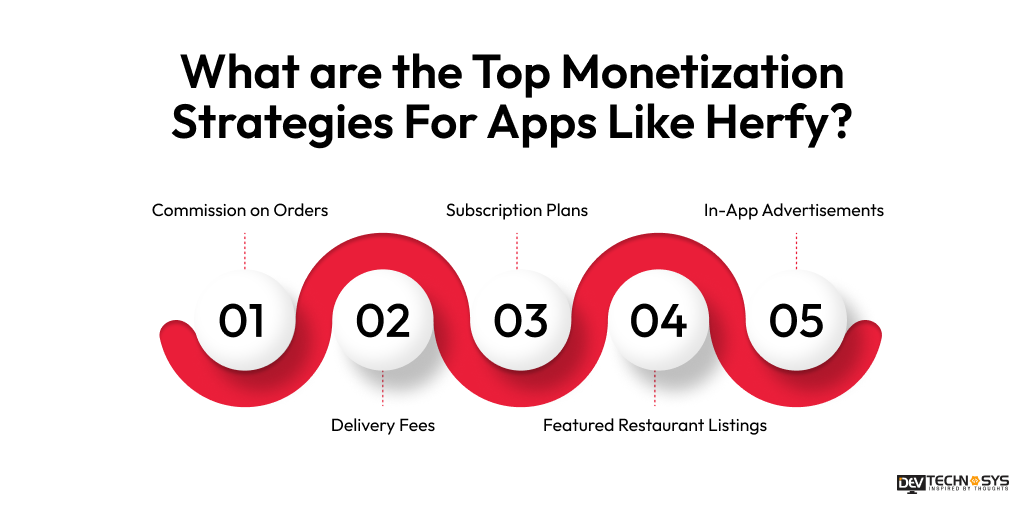
1. Commission on Orders
The platform earns a commission from every order placed through partnered restaurants, usually ranging from 15% to 30% of the order value. This remains the primary revenue source for most multi-vendor food delivery marketplaces.
2. Delivery Fees
Customers pay a delivery fee based on factors such as distance, delivery speed, location, or peak-hour demand. This revenue helps offset logistics expenses while ensuring timely deliveries and maintaining operational efficiency.
3. Subscription Plans
Offer premium memberships that provide benefits like unlimited free deliveries, exclusive discounts, cashback, priority support, and early access to promotions. Subscription plans generate predictable recurring revenue while increasing customer loyalty and order frequency.
4. Featured Restaurant Listings
Restaurants can pay for premium placement on the homepage, search results, or category pages to improve visibility and attract more customers. Sponsored listings create an additional advertising revenue stream for the platform.
5. In-App Advertisements
Display targeted advertisements, promotional banners, and sponsored campaigns from restaurants, beverage brands, or food partners within the app. Advertising generates passive revenue while helping businesses increase brand visibility and promote special offers.
Build vs Buy vs Development Partner: Which Option is Best For Herfy Cone App Development?
Choosing the right development approach depends on your budget, timeline, and long-term business goals. While ready-made solutions offer faster deployment, custom development provides greater flexibility and scalability for building a competitive food delivery platform.
Factor |
Build In-House |
Buy a Ready-Made Solution |
Hire a Development Partner |
| Estimated Cost | $100,000–$300,000+ | $10,000–$40,000 | $30,000–$150,000 |
| Time to Launch | 9 to 15 Months | 2 to 6 Weeks | 4 to 8 Months |
| Scalability | Excellent | Limited | Excellent |
| Customization | Full | Limited | High |
| Maintenance | Managed internally | Vendor-dependent | Supported by development partner |
| Technology Ownership | Full ownership | Limited ownership | Full ownership |
| Best For | Large enterprises | Startups with limited budgets | Startups, SMEs & enterprises |
Conclusion
Building an app like Herfy requires the right blend of scalable technology, user-centric features, secure infrastructure, and a sustainable monetization strategy. Starting with an MVP and partnering with an experienced food delivery app development company helps reduce costs, accelerate launch, and create a future-ready food delivery app. If you are a business wanting to build a Herfy clone app, contact Dev Technosys. With 15+ years of experience in building food pickup and delivery apps, we build apps that drive long-term business growth.
Frequently Asked Questions (FAQs)
Q1. How Much Does it Cost to Build an App Like Herfy?
The cost to build an app like Herfy typically ranges from $30,000 to $150,000. The final investment depends on factors such as feature complexity, AI capabilities, third-party integrations, supported platforms, security requirements, and the location of your development team.
Q2. How Long Does it Take to Develop a Herfy-Like Food Delivery App?
Developing a Herfy-like food delivery app generally takes 4 to 12 months. An MVP with core features can be launched within 4–6 months, while a fully featured enterprise solution requires additional time for testing, integrations, and optimization.
Q3. What Are The Essential Features of an App Like Herfy?
A Herfy-like app should include Features like:
- User Registration: Account creation and profile management.
- Restaurant Listings: Browse restaurants, menus, and offers.
- Menu Management: Update food items, prices, and availability.
- Online Ordering: Add items, customize orders, and check out.
- Payment Integration: Secure digital payment options.
- Live Order Tracking: Real-time delivery status updates.
- Push Notifications: Order alerts and promotional updates.
- Ratings & Reviews: Customer feedback and restaurant ratings.
- Driver Management: Manage deliveries and order assignments.
- Admin Dashboard: Manage users, restaurants, payments, and analytics.
Q4. Which Technology Stack is Best For Building a Herfy Clone App?
A scalable Herfy clone app can be built using Flutter or React Native for the frontend, Node.js or Laravel for the backend, PostgreSQL, cloud platforms like AWS, and APIs for maps, payments, notifications, and analytics.
Q5. Is it Better to Build a Custom App or Use a Herfy Clone?
A custom-built app offers greater scalability, branding, and flexibility, making it ideal for long-term growth. A clone solution is more affordable and faster to launch but often provides limited customization and scalability compared to custom development.
Q6. What Security Standards Should a Herfy-Like App Follow?
A Herfy-like app should implement PCI DSS, Saudi PDPL, SSL/TLS, AES-256 encryption, MFA, and RBAC to protect user data, secure payment transactions, prevent cyber threats, and comply with industry regulations.