





Key takeaways:
-
- Building a food delivery app requires careful planning of features, technology stack, and scalability from the start.
- Development cost and timeline depend on app complexity, platform choice, integrations, and business model selection.
- Launching an MVP first helps validate the idea, reduce risk, and optimize future feature investments.
Launching an MVP first helps validate the idea, reduce risk, and optimize future feature investments.
The food delivery industry has transformed how people discover, order, and enjoy meals, becoming a daily convenience rather than an occasional luxury. With smartphones at the center of modern lifestyles, food delivery apps now connect customers, restaurants, and delivery partners through a single digital ecosystem.
As we move into 2026, the demand for faster deliveries, personalized experiences, and seamless mobile interactions continues to grow rapidly. Entrepreneurs and businesses are increasingly viewing food delivery apps as scalable, technology-driven ventures with long-term revenue potential.
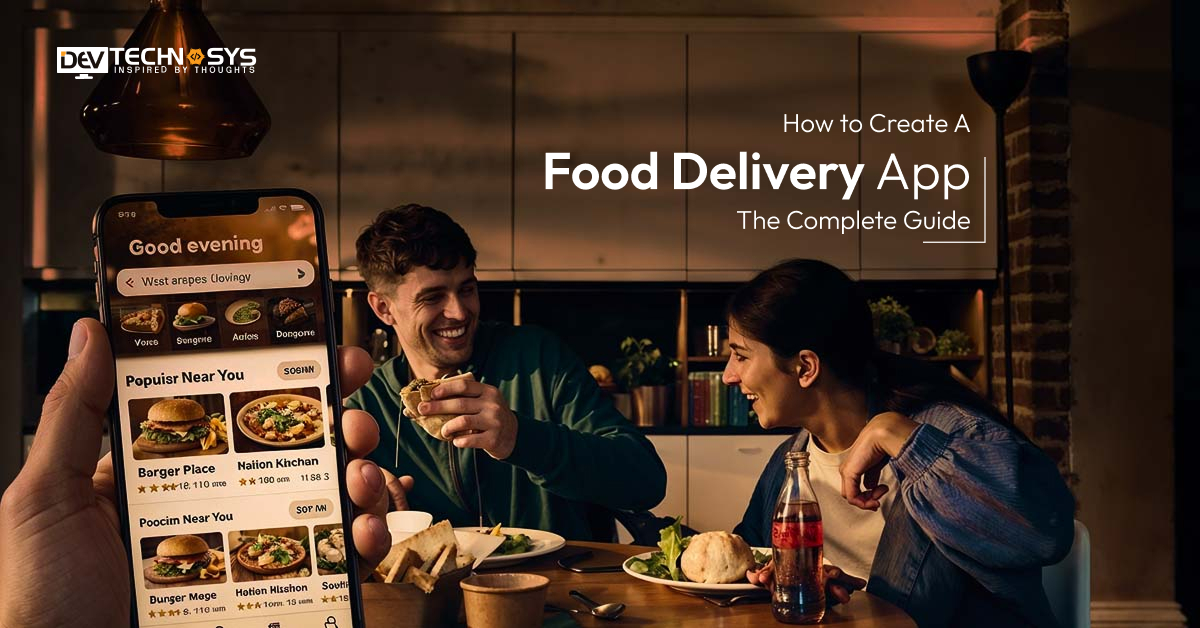
However, to build a food delivery app, strategic planning, user-centric design, reliable technology, and continuous optimization are required. This complete guide walks you through every essential aspect to create a food delivery app, from concept to launch and beyond, helping you understand the process, costs, features, and opportunities involved.
What Is a Food Delivery App?
A food delivery app is a digital platform that enables users to browse restaurants, explore menus, place food orders, and receive meals at their preferred location. These apps act as intermediaries between customers, restaurants, and delivery personnel, streamlining the entire ordering and delivery process.
Users can customize orders, make secure online payments, track deliveries in real time, and leave reviews after receiving their food. For restaurants, food delivery apps provide expanded reach, order management tools, and sales analytics.
Delivery partners benefit from flexible earning opportunities and route optimization. In 2026, online food delivery apps go beyond basic ordering. By incorporating AI-driven recommendations, smart logistics, and personalized user experiences, a food delivery app development company can help you create one.
How Does a Food Delivery App Work?
An on-demand food delivery app follows a structured workflow that ensures smooth interaction between users, restaurants, and delivery partners. This end-to-end process is designed to minimize friction, improve order accuracy, and deliver a fast, reliable, and convenient food ordering and delivery system for all stakeholders. Below are the key steps involved:
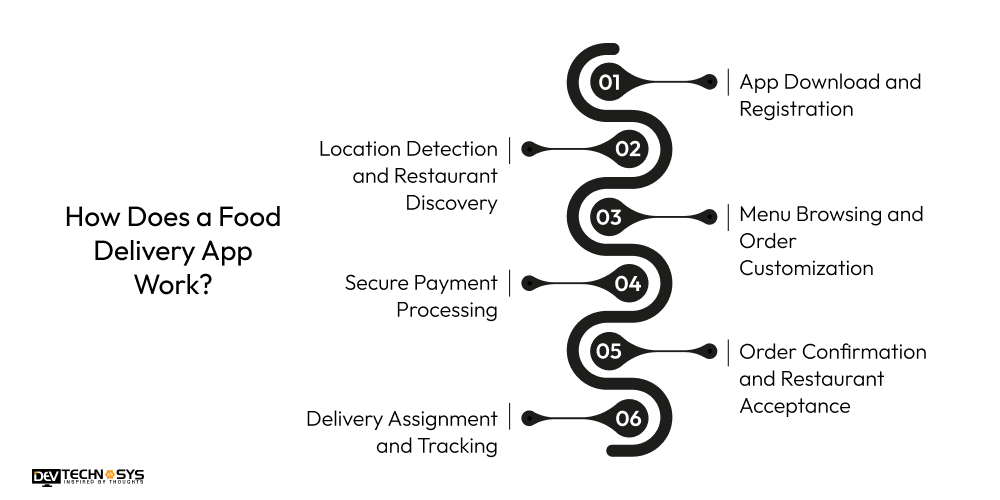
1. App Download and Registration
Users download the app from the app store and sign up using email, phone number, or social media accounts. Profiles store delivery addresses, payment methods, and preferences. This step enables personalization, faster checkout, order history access, and seamless communication throughout the ordering and delivery journey.
2. Location Detection and Restaurant Discovery
The app detects the user’s location and displays nearby restaurants available for delivery, along with menus, prices, ratings, and estimated delivery times. Advanced filters and sorting options help users quickly discover relevant restaurants based on cuisine type, budget, popularity, and delivery speed.
3. Menu Browsing and Order Customization
Users browse menus, add items to the cart, customize meals, apply promo codes, and review their order before checkout. This stage allows ingredient selection, portion adjustments, special instructions, and add-ons, ensuring users receive meals tailored exactly to their preferences and dietary needs.
4. Secure Payment Processing
The app like Bolt Food processes payments through multiple options such as digital wallets, cards, UPI, or cash on delivery, ensuring secure transactions. Encrypted payment gateways, fraud detection systems, and instant payment confirmation help build trust while enabling smooth, fast, and hassle-free checkout experiences.
5. Order Confirmation and Restaurant Acceptance
Restaurants receive the order, confirm availability, prepare the food, and update the order status in real time. This step ensures accurate order fulfillment, efficient kitchen workflow, preparation time estimation, and transparent communication between the restaurant, customer, and delivery partner.
6. Delivery Assignment and Tracking
A delivery partner is assigned, and users can track the order live until it reaches their doorstep. Real-time GPS tracking, route optimization, and delivery status updates enhance transparency, reduce delays, and ensure a reliable and satisfying last-mile delivery experience.
read also: Steps to Build Tea Delivery App in 2026
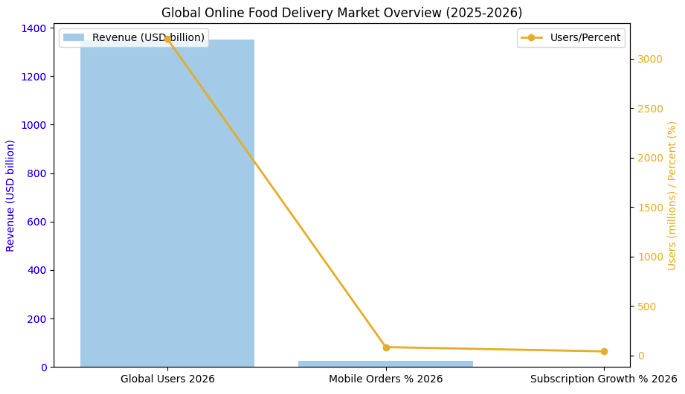
Current Market Statistics of the Online Food Delivery Business
As the digital economy continues its rapid expansion, online food delivery has emerged as one of the fastest-growing segments worldwide. Food ordering app development is reshaping consumer habits, boosting restaurant sales, and driving new technology adoption. With remarkable increases in users, revenue, and order frequency across regions, have looked at the market predictions.
- In 2025, the global online food delivery market surpassed USD 1.35 trillion in total transaction value.
- By 2026, over 3.2 billion users worldwide are expected to use food delivery apps at least once a month.
- The Middle East food delivery market crossed USD 25 billion in revenue in 2025, driven by urbanization and mobile-first consumers.
- In 2026, mobile-based food orders account for over 85% of all online food delivery transactions.
- Subscription-based food delivery programs saw a 42% growth rate globally between 2024 and 2026.
Which Steps to Follow to Create a Food Delivery App?
To develop a food delivery app, you require a systematic approach that balances business goals, technology, and user expectations. From idea validation to post-launch optimization, following the right steps ensures a seamless ordering experience for customers, restaurants, and delivery partners.
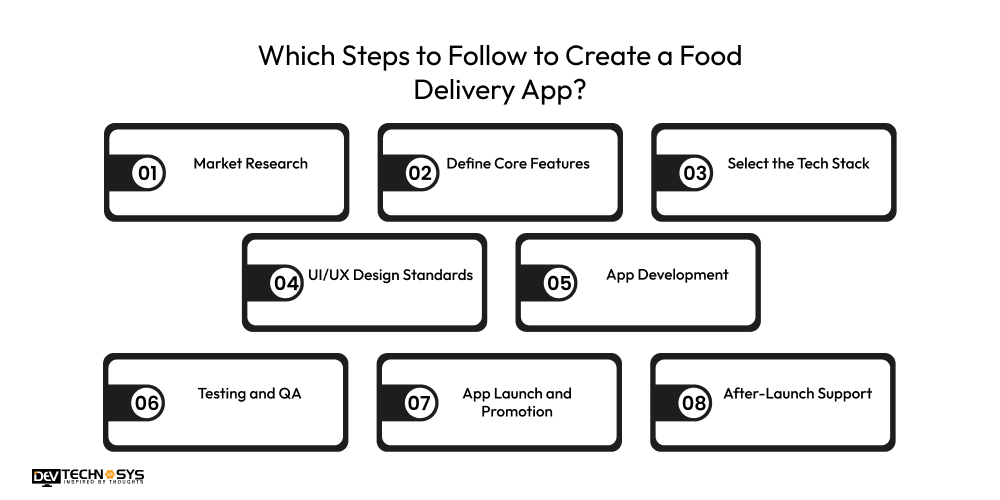
1. Market Research
When you make a food delivery app, market research helps identify target users, competitors, pricing models, etc. Understanding user behavior, peak order times, cuisine demand, and delivery challenges allows you to create a differentiated app concept. Analyze emerging food trends, ordering habits, and unmet gaps to validate demand before investing heavily. Study local regulations, delivery logistics constraints, and commission expectations to avoid operational surprises later on.
2. Define Core Features
To develop a food delivery app like DailyMealz, clearly outline essential features for customers, restaurants, and delivery partners. This prevents scope creep and ensures development focuses on high-value functionalities. Map must-have features versus nice-to-have features to control budgets and accelerate initial release timelines efficiently. Include features supporting scalability, such as multi-city support, flexible pricing rules, and a modular integrations architecture.
3. Select the Tech Stack
Choosing the right tech stack impacts the performance, scalability, and security of an on-demand app development. Decisions include frontend frameworks, backend architecture, cloud services, databases, and third-party integrations. Evaluate native, cross-platform, or hybrid frameworks based on budget, performance, and maintenance considerations, and long-term costs. Ensure the stack supports API integrations for payments, maps, notifications, analytics, and CRM systems smoothly.
4. UI/UX Design Standards
Building a delivery app requires a user-friendly interface with intuitive navigation, minimal steps, and a responsive design. Accessibility, readability, and visual consistency enhance user engagement and retention. Apply consistent branding, color psychology, and typography to build trust and a strong visual identity quickly. Optimize designs for multiple screen sizes, devices, and accessibility standards to develop an app like OpenTable.
5. App Development
Develop separate modules for customers, restaurants, and delivery partners. Agile development methodologies allow iterative improvements and faster time-to-market. Use agile sprints to release functional increments, gather feedback early, and refine features continuously faster. Implement strong security practices, including encryption, authentication, and role-based access controls, for user data protection compliance.
6. Testing and QA
Thorough testing ensures bug-free performance, secure payments, accurate order processing, and reliable app stability across devices and platforms. Test apps across different devices, operating systems, and network conditions for consistent performance globally today. Even to develop meat delivery app like Licious, validating payment flows, order accuracy, notifications, and tracking features through real-world scenarios with pilot users.
7. App Launch and Promotion
Launch the app strategically with marketing campaigns, influencer partnerships, discounts, and referral programs to attract early users. Leverage app store optimization, social media marketing, and partnerships to increase initial visibility quickly online. Offer introductory discounts, referral rewards, and loyalty incentives to drive rapid user adoption and retention.
8. After-Launch Support
Continuous monitoring, updates, customer support, feature enhancements, and performance optimization ensure long-term success and scalability. Release regular updates to fix bugs, enhance performance, and introduce features based on demand patterns. Scale infrastructure, support teams, and partner onboarding as order volumes and regions expand steadily worldwide.
What Features a Food Delivery App Must Incorporate?
The best food delivery app development companies in Riyadh combine convenience, speed, and reliability into the app. They are integrating user-focused, restaurant-friendly, and operations-driven features. They streamline ordering, payments, delivery, and support while ensuring scalability, security, and long-term customer satisfaction.
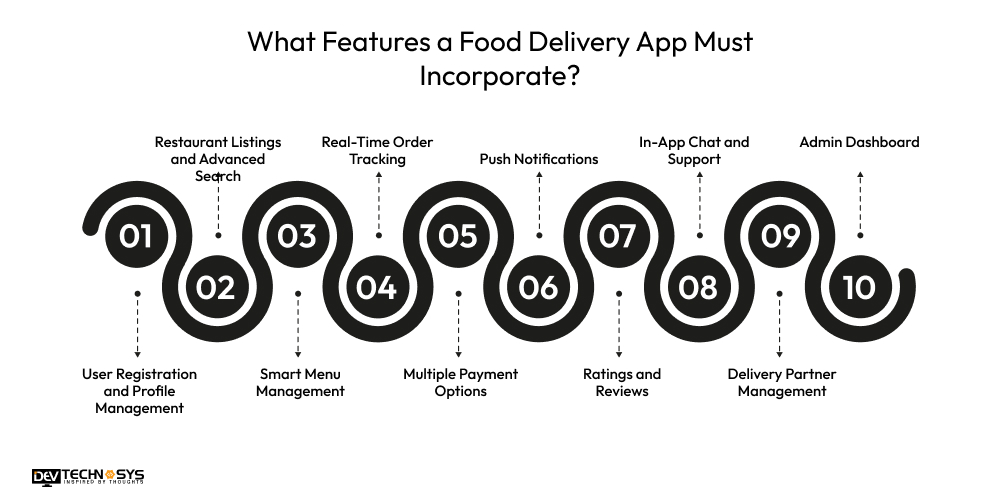
1. User Registration and Profile Management
Secure authentication, social logins, and profile personalization improve onboarding speed and encourage repeat usage consistently. Saved preferences and reorder options simplify checkout and reduce friction during frequent purchases for loyal customers.
2. Restaurant Listings and Advanced Search
Location-based discovery and AI-driven recommendations help users quickly find relevant dining options nearby based on context. Sorting by popularity, offers, and delivery speed improves decision-making and browsing efficiency for hungry users instantly.
3. Smart Menu Management
Automated menu updates prevent ordering unavailable items and reduce cancellations caused by stock mismatch errors. Add-ons, portion choices, and dietary tags enhance customization and improve overall ordering satisfaction for diverse users.
4. Real-Time Order Tracking
Accurate ETA updates increase transparency and build trust throughout the preparation and delivery process cycle. Map-based tracking reduces support queries by proactively answering common delivery status questions in real-time views.
5. Multiple Payment Options
Flexible payment methods increase conversion rates by accommodating diverse user preferences and financial behaviors securely. A food restaurant app development company helps with fraud detection and encryption protect transactions. They also ensure compliance with regional regulations and standards globally.
6. Push Notifications
Timely notifications keep users informed about order status changes without requiring constant app checking. Personalized promotional alerts drive repeat orders and strengthen customer engagement over time through smart targeting algorithms.
7. Ratings and Reviews
Verified reviews improve platform credibility and help restaurants maintain quality and service standards consistently across locations. User feedback highlights improvement areas and influences future feature and partner decisions through data-driven insights loops.
8. In-App Chat and Support
Real-time chat minimizes resolution time by enabling instant clarification of issues directly in iOS and Android app development. AI chatbots handle common queries efficiently, reducing support workload during peak hours without sacrificing response quality.
9. Delivery Partner Management
Smart dispatching balances workloads and improves delivery speed while reducing rider fatigue and churn rates significantly. Earnings transparency and performance metrics motivate partners and improve long-term retention across cities and service zones.
10. Admin Dashboard
Centralized dashboards enable real-time oversight of orders, partners, restaurants, and revenues across regions and categories instantly. Actionable analytics support data-driven decisions for growth optimization, fraud control, and profitability planning and forecasting accuracy.
Read More: Food Delivery App Features for 2026
Why Entrepreneurs Are Investing in Food Delivery App Development?
Entrepreneurs are increasingly investing in a food delivery app development solution as convenience-driven consumption reshapes the food industry. With scalable models, recurring revenues, and technology-led efficiencies, food delivery platforms present long-term growth. A food delivery app for startups also brings profitability and strong brand-building opportunities.
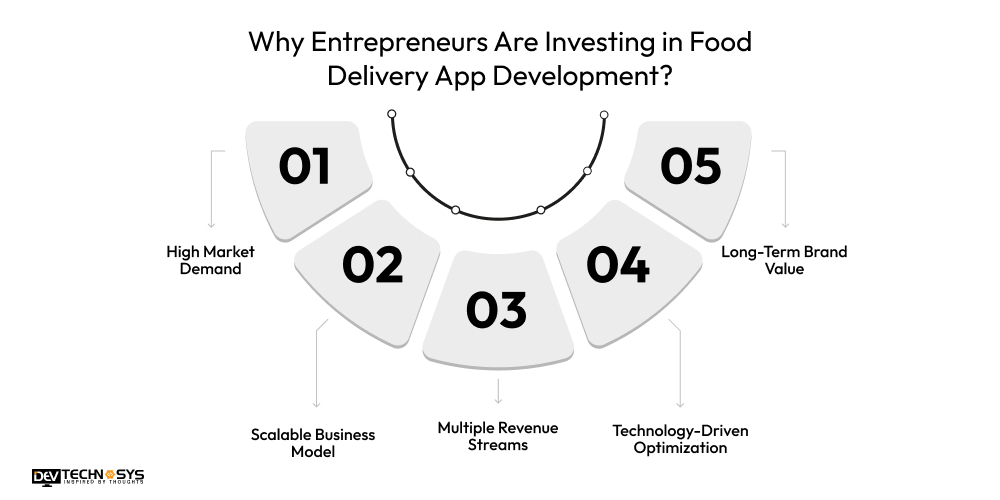
1. High Market Demand
- Rising smartphone usage and app-based ordering habits ensure consistent customer demand across urban and semi-urban markets.
- Work-from-home culture and time constraints increase reliance on convenient food delivery solutions daily.
- Expanding restaurant partnerships continuously broaden cuisine choices, attracting diverse user segments regularly worldwide.
2. Scalable Business Model
- Cloud-based infrastructure allows rapid geographic expansion without heavy physical or operational investments initially.
- Standardized onboarding processes simplify adding new restaurants, delivery partners, and service locations efficiently.
- Platform scalability supports fluctuating order volumes during peak hours, festivals, and promotional campaigns easily.
3. Multiple Revenue Streams
- Restaurant commissions provide predictable recurring income based on order volume and transaction value growth.
- In-app advertising placements help brands and restaurants gain visibility while generating additional platform revenue.
- Subscription programs encourage repeat usage and stabilize monthly earnings through loyalty-driven customer retention.
4. Technology-Driven Optimization
- AI-powered demand forecasting improves delivery planning, reducing delays and the operational cost to maintain an app significantly over time.
- Data analytics enable personalized recommendations, increasing average order value and customer satisfaction levels.
- Automation streamlines order processing, partner allocation, and support operations for higher efficiency.
5. Long-Term Brand Value
- Consistent service quality builds trust and emotional connection with users, strengthening brand recognition steadily.
- Expanding services like groceries and quick commerce transform platforms into everyday lifestyle ecosystems.
- Strong branding increases customer lifetime value and creates defensible market positioning against competitors.
How Much Is the Average Cost to Create a Food Delivery App?
The average food delivery app development cost in 2026 typically falls between $8,000 and $30,000, depending on app complexity, feature set, and development approach. A basic MVP with essential features like user login, restaurant listings, and payment integration stays on the lower end.
Mid-range food delivery app development cost applies when adding real-time tracking, push notifications, and admin dashboards. Development location, platform choice (Android, iOS, or cross-platform), UI/UX quality, and third-party integrations also influence pricing.
Opting for agile development, scalable architecture, and phased feature releases helps control costs while supporting future growth and performance optimization.
Here, we will discuss the factors that affect the final food delivery app development cost:
1. App Complexity and Features
More advanced features like live tracking, AI recommendations, and automation significantly increase development time and cost. Simple MVPs with essential functionalities require fewer resources and enable faster, budget-friendly app launches. Feature scalability planning ensures future upgrades without rebuilding the core architecture later.
| Feature Complexity | Estimated Cost | Description |
| Basic MVP Features | $1,500–$3,000 | Includes user registration, menu browsing, basic ordering, and payment integration. |
| Standard Features | $3,000–$5,500 | Adds real-time tracking, push notifications, ratings, and multiple payment options. |
| Advanced Features | $5,500–$8,000 | Includes AI recommendations, automation, custom filters, loyalty programs, and multi-city support. |
2. Platform Selection
Choosing Android, iOS, or cross-platform development directly affects development effort, timelines, and overall project budget. Cross-platform frameworks reduce the mobile app development cost by sharing codebases across platforms while maintaining consistent performance. Native apps offer superior performance but require separate development efforts for each platform.
| Platform Type | Estimated Cost | Description |
| Single Platform (iOS or Android) | $8,000–$12,000 | Development for one platform with essential app features and moderate design complexity. |
| Cross-Platform / Hybrid | $12,000–$20,000 | Shared codebase across Android and iOS, reduces cost while maintaining performance consistency. |
| Native Multi-Platform | $20,000–$30,000 | Separate native apps for Android and iOS with advanced features and high performance. |
3. UI/UX Design Quality
High-quality UI/UX improves user retention, satisfaction, and conversion rates but increases design investment. Custom animations, branding, and accessibility standards require additional design research and development effort. User-centric design minimizes friction, reducing support costs and abandonment rates significantly.
| Design Level | Estimated Cost | Description |
| Basic UI/UX | $2,000–$4,000 | Simple layouts, standard typography, and responsive design across basic screens. |
| Standard UI/UX | $4,000–$7,000 | Enhanced navigation, interactive elements, custom graphics, and multi-screen optimization. |
| Premium UI/UX | $7,000–$10,000 | High-end animations, accessibility standards, branding consistency, and advanced visual customizations. |
4. Backend Infrastructure
A mobile app development company build scalable backend architecture that supports real-time orders, tracking, and payments. Cloud hosting, APIs, and database optimization directly influence app reliability and operational costs. Secure infrastructure ensures data protection, compliance, and stable system performance under high traffic.
| Backend Type | Estimated Cost | Description |
| Basic Backend | $3,500–$6,000 | Simple database, order management, and basic server hosting for MVP apps. |
| Standard Backend | $6,000–$10,000 | Supports real-time tracking, notifications, APIs, analytics, and moderate scalability. |
| Advanced Backend | $10,000–$15,000 | High-performance servers, cloud hosting, multi-region support, security, and large-scale scalability. |
5. Maintenance and Updates
Ongoing maintenance includes bug fixes, security patches, and performance improvements after launch. Regular updates ensure compatibility with OS changes, devices, and evolving user expectations continuously. Feature enhancements and optimizations help maintain competitiveness and long-term user engagement.
| Maintenance Level | Estimated Cost | Description |
| Basic Support | $800–$1,500 | Bug fixes, minor updates, and occasional security patches for small apps. |
| Standard Support | $1,500–$3,000 | Regular updates, performance optimization, and new feature additions are periodically. |
| Premium Support | $3,000–$4,000 | Full-scale maintenance, continuous monitoring, priority support, and advanced feature rollouts. |
What Are the Top Food Delivery Apps?
Below is an extremely simple table highlighting the top food delivery apps, especially popular in the UAE and the Middle Eastern region:
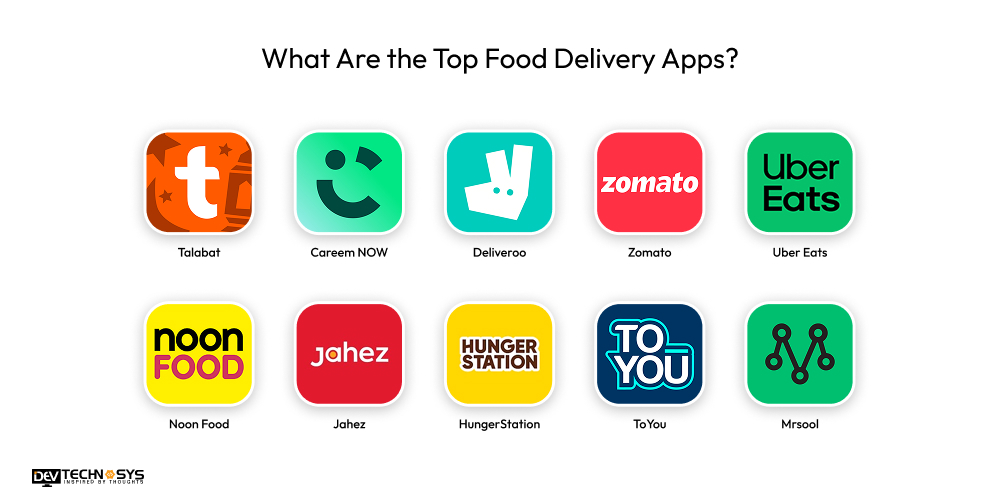
| App Name | Launch Year | Platform Availability | Ratings | Downloads |
| Talabat | 2004 | iOS, Android | 4.5 | 50M+ |
| Careem NOW | 2017 | iOS, Android | 4.6 | 100M+ |
| Deliveroo | 2013 | iOS, Android | 4.4 | 30M+ |
| Zomato | 2008 | iOS, Android | 4.3 | 500M+ |
| Uber Eats | 2014 | iOS, Android | 4.2 | 300M+ |
| Noon Food | 2021 | iOS, Android | 4.1 | 10M+ |
| Jahez | 2016 | iOS, Android | 4.4 | 20M+ |
| HungerStation | 2012 | iOS, Android | 4.3 | 25M+ |
| ToYou | 2019 | iOS, Android | 4.0 | 5M+ |
| Mrsool | 2017 | iOS, Android | 4.2 | 50M+ |
Now, we will learn about the top 5 widely used food delivery apps in UAE:
1. Talabat
Talabat is a leading Middle Eastern food delivery platform connecting users with thousands of restaurants. It offers groceries, quick commerce, real-time tracking, and multiple payment options across regions reliably today. Talabat focuses on fast deliveries, strong logistics partnerships, and localized experiences in MENA markets.
2. Deliveroo
Deliveroo is a UK-based food delivery app known for premium restaurants and fast delivery services. It partners with restaurants and grocery stores, offering scheduled deliveries and subscription benefits for loyal users. Deliveroo emphasizes rider efficiency, data-driven logistics, and high-quality customer experience across cities globally today consistently.
3. Uber Eats
Uber Eats is a global food delivery platform leveraging Uber’s logistics network and technology worldwide. It integrates seamlessly with Uber, offering real-time tracking, promotions, and diverse restaurant options for global users. Uber Eats benefits from strong brand recognition, scalable infrastructure, and multi-city operational expertise worldwide today.
4. Jahez
Jahez is a Saudi-based food delivery app serving local restaurants with region-focused services and fast logistics. The platform supports Arabic-first experiences, digital payments, and efficient last-mile delivery operations across Saudi cities. Jahez has gained popularity through reliability, competitive pricing, and a strong domestic market presence nationwide today.
5. ToYou
ToYou is a multi-service delivery app offering food, groceries, couriers, and on-demand services across Gulf markets. It combines super-app functionality with localized offerings tailored for Middle Eastern users and cities regionally. ToYou differentiates itself through convenience, bundled services, and broad daily-use customer appeal across demographics today.
How to Make Money With Food Delivery App Development?
Food delivery Android and iOS app development services enable diverse revenue models beyond orders, creating scalable and predictable income streams. Smart monetization strategies help platforms maximize profitability while balancing user experience and partner satisfaction levels.
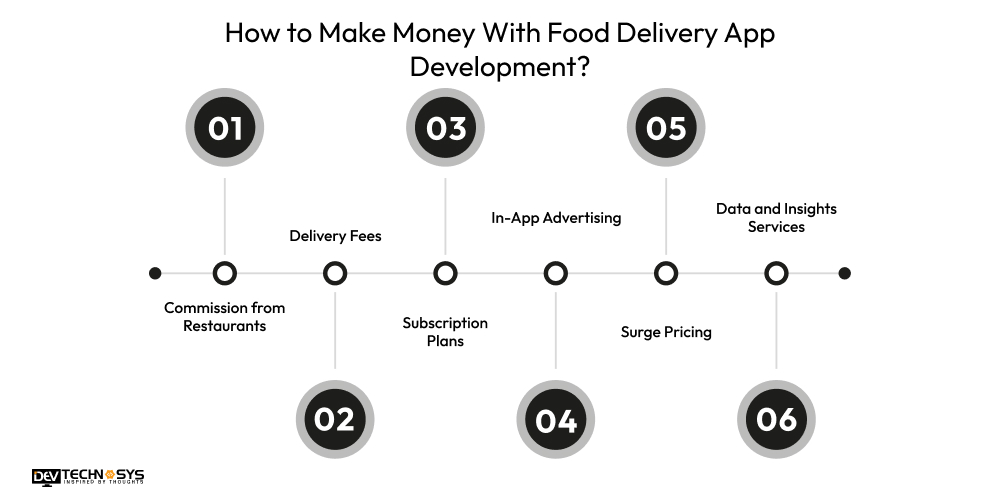
1. Commission from Restaurants
Platforms earn steady revenue by charging restaurants commissions for every successfully completed customer order transaction. Commission rates vary by restaurant type, order volume, and visibility options selected by partners regularly. This model scales naturally as platform order frequency and partner onboarding increase over time consistently.
2. Delivery Fees
Delivery fees are charged to users based on distance, delivery time, and real-time demand levels. Dynamic pricing helps balance supply and demand while improving courier availability daily during busy periods. This revenue stream directly offsets logistics costs and supports faster delivery service quality standards consistently.
3. Subscription Plans
Subscription plans provide users with free deliveries, discounts, and exclusive offers for recurring payments, monthly, and yearly. They improve customer retention and generate predictable revenue regardless of individual order frequency changes seasonally. Loyal subscribers tend to place more orders, increasing lifetime value significantly for platforms’ overall growth.
4. In-App Advertising
Restaurants pay for sponsored listings, banners, and promotions to gain higher visibility within the app. Advertising boosts restaurant discovery while generating high-margin revenue for the platform consistently across markets today. Targeted ads based on user behavior improve conversion rates and advertiser satisfaction measurably over time.
5. Surge Pricing
Higher delivery fees during peak hours increase revenue. Surge pricing increases delivery fees during peak hours, bad weather, or high-demand periods locally. It incentivizes more delivery partners to come online when demand spikes suddenly in cities quickly. This strategy maximizes revenue while maintaining service reliability during critical times for customers and platforms.

6. Data and Insights Services
Aggregated order data provides valuable insights into consumer behavior and market trends for partners globally. Platforms can sell analytics dashboards to restaurants for demand forecasting and menu optimization purposes commercially. Data-driven services unlock high-margin B2B revenue beyond traditional food delivery operations models and commissions alone.
Wrapping Up!
To create a food delivery app in 2026, both a strategic and technology-driven endeavor is required. It includes careful planning, execution, and long-term vision. From understanding market dynamics to selecting the right features, tech stack, and monetization strategies, every decision plays a crucial role in determining success.
As consumer expectations continue to evolve, food delivery apps must focus on speed, personalization, reliability, and seamless user experiences. Entrepreneurs who invest in scalable architecture, strong UI/UX design, and continuous innovation are better positioned to thrive in this competitive space.
With the right approach, food delivery mobile app development solutions can grow into a profitable digital ecosystem that delivers value to customers, restaurants, and delivery partners alike.
FAQs
Q1. How Long Does It Take To Develop A Food Delivery App?
On average, an MVP app takes 5-7 months, and an advaced takes 7+ months. Timeline varies based on third-party integrations, design iterations, testing depth, and team experience levels overall. Agile development and MVP-first approaches can shorten launch time while enabling faster market validation cycles.
Q2. Is It Better To Build A Native Or Cross-Platform App?
Cross-platform frameworks simplify maintenance and updates, making them ideal for startups with limited budgets initially. Native development suits complex apps requiring advanced animations, hardware access, and superior performance optimization levels.
Q3. Can Small Restaurants Benefit From Food Delivery Apps?
Yes, food delivery apps help small restaurants increase visibility, sales, and customer reach without heavy marketing investments. They gain access to new customers, delivery infrastructure, and digital ordering without upfront technology costs. Analytics and promotions help small restaurants understand demand patterns and compete with larger brands effectively.
Q4. What Is The Biggest Challenge In Food Delivery App Development?
Managing logistics, ensuring timely delivery, and maintaining consistent service quality are major challenges. Coordinating restaurants, delivery partners, and customers in real time requires robust systems and operations management. Scaling logistics while controlling costs and maintaining reliability becomes increasingly complex as demand grows rapidly.
Q5. How Can A New Food Delivery App Compete With Established Players?
Differentiation through faster delivery, unique cuisines, or hyperlocal focus helps attract loyal users consistently locally. Strong partnerships, targeted marketing, and customer-centric features build trust and sustainable growth over time.