





“Personalize, automate, and predict user behavior with AI in retail.”
Think of a situation where you are an entrepreneur, running a retail shop and expanding online through a website or a mobile app. Then, it is quite possible that your customers may face some issues like order delay, incorrect delivery, or payment issues. So, by using AI in E-commerce, you can resolve all these problems through automation, chatbot, and personalization.
Key Takeaways:
- The growth of the E-commerce sector before and after AI.
- Role of AI in the E-commerce industry.
- Major AI technologies and benefits of customer support for users.
- Top use cases and examples in the Retail market.
- Potential risks and future expectations from customer support in E-commerce.
- Implementation of AI in E-commerce customer support.
The major difference between traditional and modern AI E-commerce platforms is advanced customer support systems. According to a study, AI-powered apps and websites have seen an abrupt change in the growth rate and revenue generated.
So, it is necessary for a business investor to get familiar with all the concepts related to AI to enhance E-commerce user support.
Evolution of E-Commerce Industry
Strong government support, growing smartphone penetration, and digital innovation have all contributed to the e-commerce sector. It is expanding in the United Arab Emirates and the wider Middle East. Regional internet retail is currently dominated by major countries like the UAE, Saudi Arabia, and Egypt. This is because the use of mobile app development services is increasing rapidly.
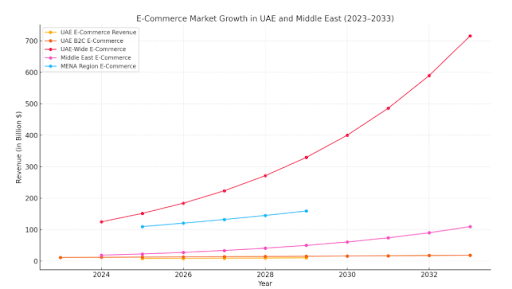
- UAE e‑commerce revenue is expected to reach $8.32 Billion in 2025, growing at a 6.02% CAGR rate between 2025 and 2029 and will hit $10.11 Billion by 2029.
- The UAE B2C e‑commerce segment recorded $11.9 Billion in 2023 and is projected to grow at 4.7% CAGR rate through 2030, reaching $16.3 Billion.
- UAE-wide e‑commerce reached an impressive $125 Billion in 2024, with expectations of $776 Billion by 2033, marking a 21.4% CAGR rate.
- The broader Middle East e‑commerce market was valued at about $18.88 Billion in 2024, forecasted to expand to $21.09 Billion by 2033, with a 21.6% CAGR rate.
- The MENA region is projected to generate $110 Billion in e‑commerce revenue by 2025, growing at roughly 9.7% CAGR rate between 2025 and 2029 and rising to $159.3 Billion.
What is the Need for Customer Support in E-Commerce?
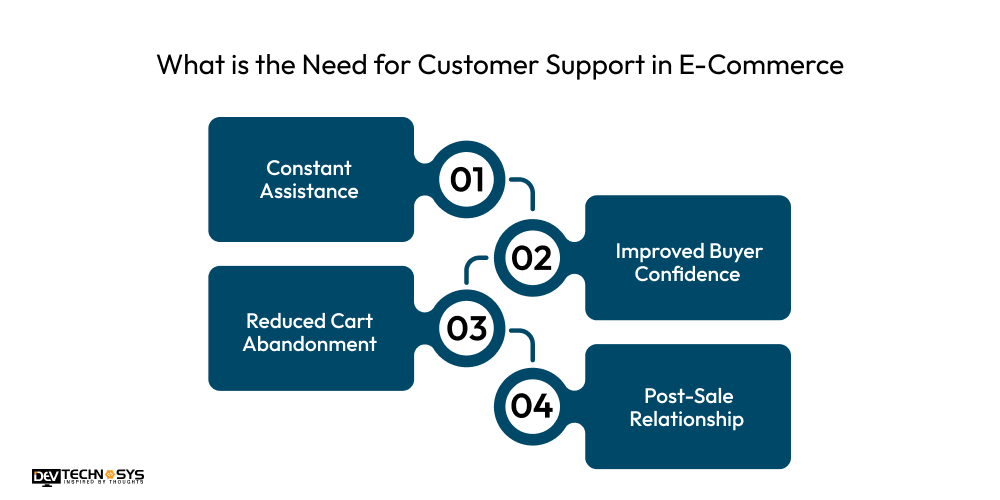
In e-commerce, customer service is crucial to ensure reliable and responsive buying experiences. From browsing to post-purchase care, it is essential in helping users at every point of their experience:
-
Constant Assistance
AI E-commerce UAE sites are open, and consumers anticipate prompt assistance whenever they need it. Real-time support increases customer happiness by providing prompt answers to questions, resolving problems, and guiding users.
-
Improved Buyer Confidence
Customers are reassured during the decision-making process by prompt and helpful support, particularly for complex or high-value purchases. It increases consumer confidence in the brand and support utilization. Businesses may approach a Magento development company to enhance buying experience.
-
Reduced Cart Abandonment
Confusion, unresolved queries, or technical difficulties cause many customers to abandon their carts. Support driven by AI may step in instantly to address issues or provide assistance, boosting conversion rates.
-
Post-Sale Relationship
Customer service guarantees seamless delivery, refunds, and feedback processing, so it doesn’t stop with a sale. Long-term client loyalty and repeat business are fostered by effective post-purchase assistance.
Role of AI in E-Commerce Customer Support
The use of Artificial Intelligence development services revolutionizes the e-commerce sector with quicker response times, personalizing user experiences, and automating conversations. It lowers operating costs while enabling companies to provide scalable, real-time support. AI improves customer pleasure, retention, and efficiency at every point of the customer experience using smart technologies like chatbots, natural language processing, and machine learning.
- Automates responses to common customer queries through chatbots and virtual assistants.
- Delivers personalized support by analyzing user behavior and purchase history.
- Enables 24/7 real-time assistance across multiple platforms and languages.
- Detects customer sentiment to prioritize and escalate critical issues.
- Reduces support costs by minimizing the need for large human support teams.

Necessary AI Tools & Technologies for E-Commerce Support
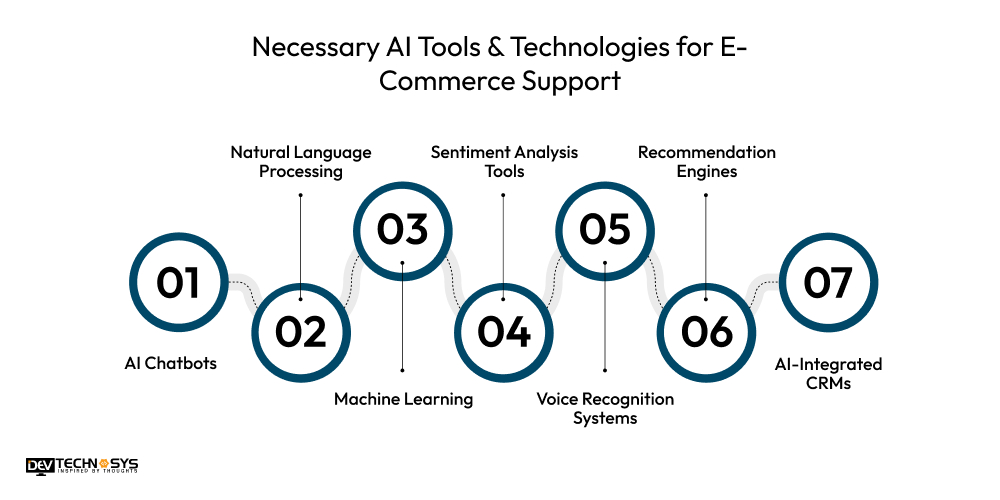
E-commerce systems use a set of advanced AI algorithms to provide smooth experiences. These tools let firms scale support effectively, automate communication, and personalize encounters:
-
AI Chatbots
An AI chatbot for E-commerce UAE responds to customer inquiries quickly, providing prompt responses and automating tedious chores. They are able to oversee thousands of conversations at once on various messaging apps, websites, and apps. This increases productivity and guarantees round-the-clock assistance without overburdening human workers.
-
Natural Language Processing
NLP makes it possible for machines to precisely understand, interpret, and react to human language. It enables virtual assistants and chatbots that increases the overall development rate. So, you must avail MVP development services for affordable AI model and architecture.
-
Machine Learning
AI systems can learn from historical data, human interactions, and trends thanks to machine learning. Over time, it anticipates customer needs and keeps improving support responses. With each customer engagement, this guarantees more intelligent and contextually aware help.
-
Sentiment Analysis Tools
These technologies instantly identify the mood, tone, and emotions in user texts. In order to initiate the appropriate support actions, AI sales tools Middle East assist in categorizing user preferences. Businesses can utilize this information to quickly escalate delicate matters to human agents.
-
Voice Recognition Systems
Voice AI solutions allow users to communicate with apps or smart devices using spoken language. They provide hands-free, real-time assistance by translating and interpreting speech into text. This is particularly useful in voice-activated shopping and mobile commerce settings.
-
Recommendation Engines
These AI programs make recommendations for pertinent goods and services based on user interests and behavior. To provide precise recommendations, they examine browser history, buying trends, and real-time inputs. This increases the cost to develop an app while improving user pleasure.
-
AI-Integrated CRMs
AI-powered CRM systems, such as Salesforce Einstein, provide more intelligent insights. They anticipate client needs, automate ticket routing, and customize follow-ups. In addition to improving overall service quality and client retention, this guarantees effective case management.
User Benefits of AI-Powered Customer Support System
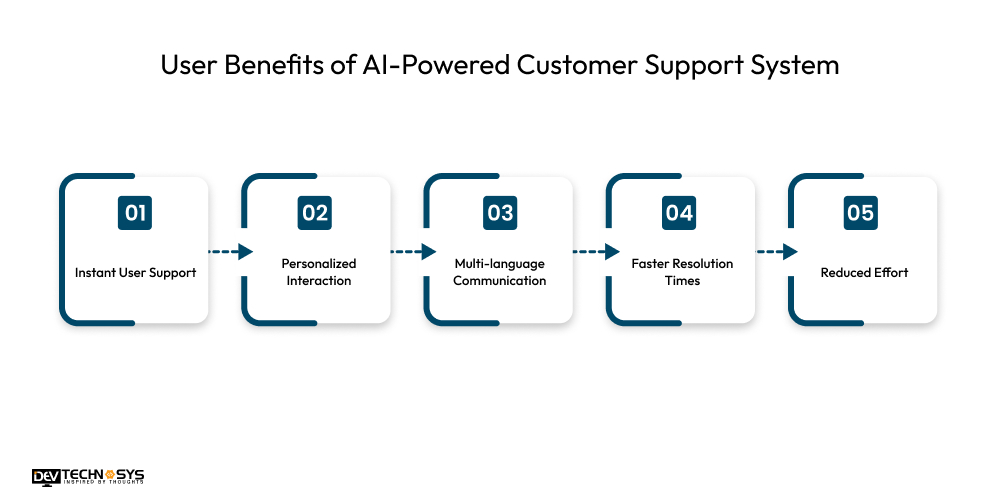
AI in E-commerce is enhancing user engagement by providing quicker and intelligent support. The following are the main advantages that improve user happiness and expedite the assistance process:
-
Instant User Support
AI chatbots and virtual assistants respond instantly, saving consumers from having to wait. Even after business hours, customers can receive prompt responses to frequently asked questions, such as order tracking or product details.
-
Personalized Interaction
To customize discussions, AI systems examine user behavior, previous exchanges, and preferences. Based on each customer’s demands, they recommend products and provide support. You may enhance customers’ overall buying experience by contacting an Android app development company in UAE.
-
Multi-language Communication
Language barriers are eliminated for users worldwide thanks to AI products’ multilingual communication capabilities. They recognize the preferred language of the user and react instantly. This feature may be found in smart shopping apps in Saudi Arabia that make customer service accessible.
-
Faster Resolution Times
AI efficiently automates routine questions and problem-solving procedures. Without human assistance, it can process return requests, payment problems, or frequently asked questions rapidly. You can hire an iOS app developer to implement models that enhance user satisfaction.
-
Reduced Effort
AI remembers context across conversations, so users don’t need to repeat their queries or problems. Smart systems require less input and walk users through each process. This smooth support experience improves user engagement and convenience.
Major Applications & Use Cases of AI-Powered Customer Support
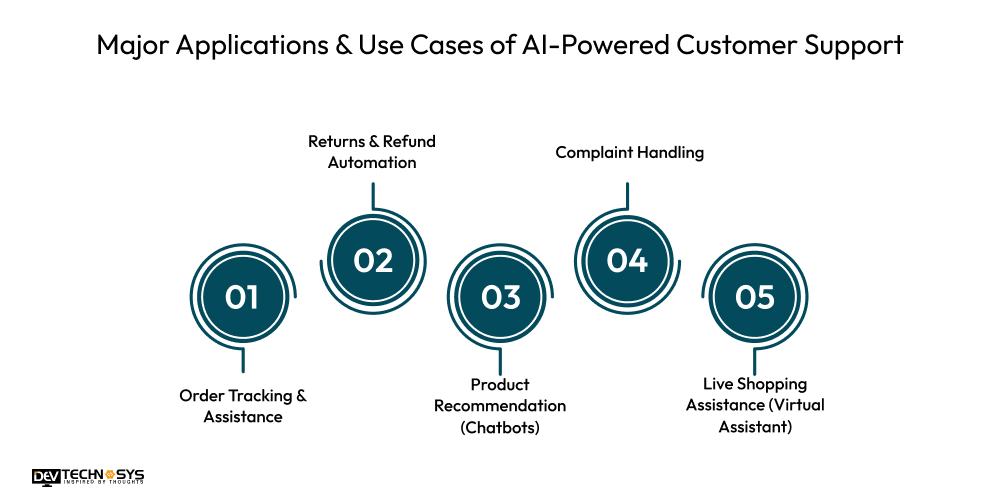
By automating processes and generating faster user experiences, AI in E-commerce is transforming customer services. Key real-world applications of AI providing intelligent support are listed below:
-
Order Tracking & Assistance
AI chatbots offer real-time information about shipment problems, delivery schedules, and order status. Consumers only need to type their question, and the AI will immediately return pertinent tracking data. The use of AI in Middle East retail guarantees quicker service to customers.
-
Returns & Refund Automation
By directing users via automated steps, AI technologies expedite the return and refund procedures. An app like ZOOD uses this model to initiate refunds and confirm eligibility with order details. This lowers support expenses, speeds up processing, and increases customer happiness.
-
Product Recommendation (Chatbots)
In order to recommend pertinent products, top AI retail solutions Dubai examine user behavior, preferences, and inquiries. Real-time delivery of these suggestions during discussions boosts participation. In addition to improving the user experience, this raises average cart value and conversions.
-
Complaint Handling
Sentiment analysis is used by AI technologies to identify discontent and direct complaints to the appropriate agent. An app like Mylo automatically provides solutions based on user issues. This enhances brand perception, reduces escalation, and facilitates speedier resolution.
-
Live Shopping Assistance (Virtual Assistant)
AI virtual assistants respond instantly to inquiries about products, much like in-store aides. While the customer is shopping, they can offer sizing charts, compatibility information, and even demonstration movies. The gap between online and physical shops is filled by this interactive experience.
Top Examples of AI-Enabled Customer Support
Leading e-commerce companies are using AI to provide quick, individualized, and perceptive customer service. Here are a few notable instances that show how AI is instantly changing the user experience:
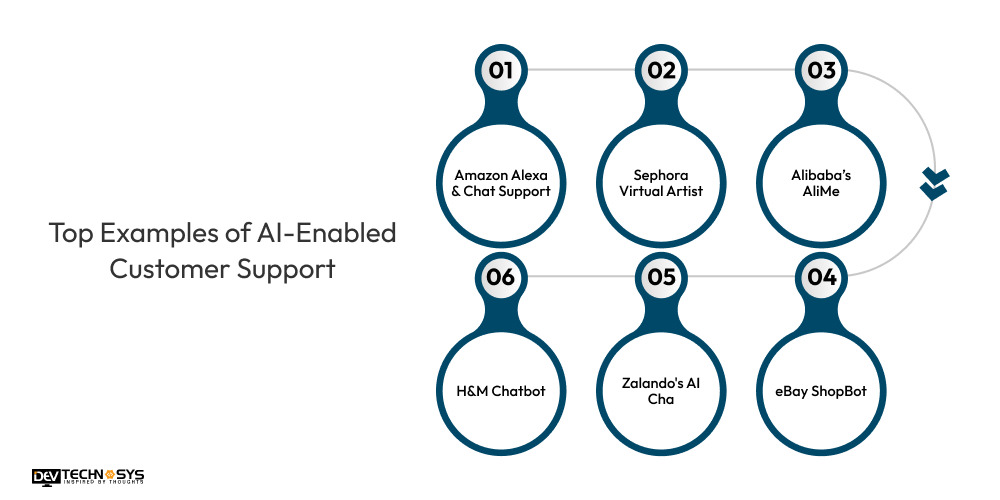
1. Amazon Alexa & Chat Support
Alexa and AI-powered chat platforms are used by Amazon to manage returns, track orders, and check delivery status. Voice-based help for hands-free shopping and answering questions is made possible by Alexa. You may approach a shopping app development company for personalized and smooth user experiences.
- Voice-Based Query Handling: Users can track orders, ask questions, and manage returns using simple voice commands via Alexa.
- Personalized Interaction: Alexa accesses account history to offer tailored responses and reminders based on user preferences.
2. Sephora Virtual Artist
The AI-powered Virtual Artist from Sephora provides individualized beauty advice and guidance. It enables users to virtually try on makeup and receive real-time guidance through a chatbot. In addition to providing on-demand, visual product support, this improves consumer engagement.
- Virtual Try-On: Uses augmented reality and AI to let users try makeup products digitally in real time.
- Personalized Recommendations: Suggests beauty products based on facial features, skin tone, and user preferences.
3. Alibaba’s AliMe
Alibaba’s AI assistant, AliMe, manages millions of consumer interactions every day. It uses AI in online shopping KSA that offers cross-platform product queries, order updates, and multilingual support in Saudi Arabia. AliMe consistently enhances its accuracy and communication skills through deep learning.
- Multilingual Support: Handles real-time chats in multiple languages, making it accessible to global users.
- Smart Escalation: Uses AI to detect complex issues and seamlessly route them to human agents when needed.
4. H&M Chatbot
Customers can use H&M’s chatbot on messaging apps to find products and get outfit recommendations. It improves the buying experience by providing real-time size, style, and availability information. You may avail Ecommerce development services for basic queries like order tracking and store locations.
- Fashion Recommendations: Offers outfit suggestions based on user input, style preferences, and trends.
- Store & Product Search: Helps customers find nearby stores or locate products online by category or size.
5. Zalando’s AI Cha
Zalando’s AI chatbot offers automated, multilingual assistance with refunds, exchanges, and frequently asked questions. NLP is used to comprehend user inquiries and provide accurate, instantaneous answers. The chatbot speeds up resolution while drastically lowering the workload for human operators.
- Automated Returns Handling: Guides users through the return process with real-time assistance.
- Multilingual Customer Support: Supports customers across different countries with localized language support.
6. eBay ShopBot
eBay’s ShopBot uses voice or text input to assist users in finding products. To filter search results according to preferences, an E-commerce AI Qatar platform analyzes customized queries. The AI assistant provides a conversational shopping layer and expedites product discovery.
- Conversational Product Search: Allows users to find products by chatting with the bot using text or voice.
- Preference-Based Filtering: Asks follow-up questions to refine search results based on budget, style, or category.

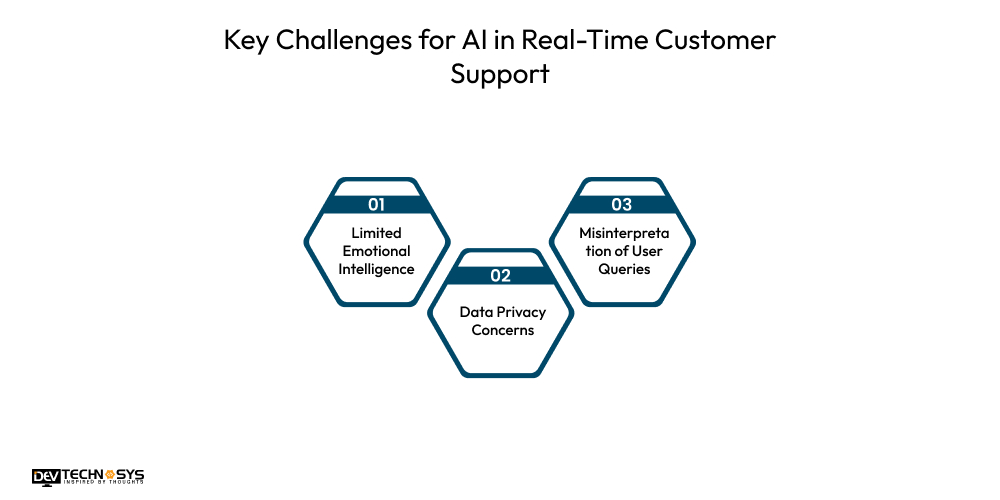
Key Challenges for AI in Real-Time Customer Support
AI increases speed and efficiency, but it is hard to handle complex situations and understand human behavior. The main real-time customer service challenges are listed below, along with workable solutions:
-
Limited Emotional Intelligence
AI is unable to empathize during delicate conversations or fully comprehend human emotions. In emotionally sensitive settings, this may result in impersonal or annoying robotic reactions.
Solution: Put in place a hybrid support system where AI responds to simple inquiries and refers sensitive or complicated problems to human representatives. Sentiment analysis techniques can also be integrated to identify discomfort and direct users appropriately.
-
Data Privacy Concerns
Large amounts of personal data are processed by AI systems, which raises security and the cost to develop an Ecommerce mobile app. Inadequate management may increase legal problems and a decline in client confidence.
Solution: Make use of AI technologies that provide end-to-end encryption and adhere to international privacy requirements like GDPR. Role-based access controls and routine audits can improve data security even more.
-
Misinterpretation of User Queries
Slang, ambiguous phrasing, and context-specific language might be misinterpreted by AI, resulting in inaccurate answers. Customer satisfaction suffers as a result, and human intervention might be necessary.
Solution: To enhance natural language comprehension, AI models should be continuously trained using real-world conversation data. To seamlessly escalate unclear questions to live agents, combine natural language processing (NLP) with fallback logic.
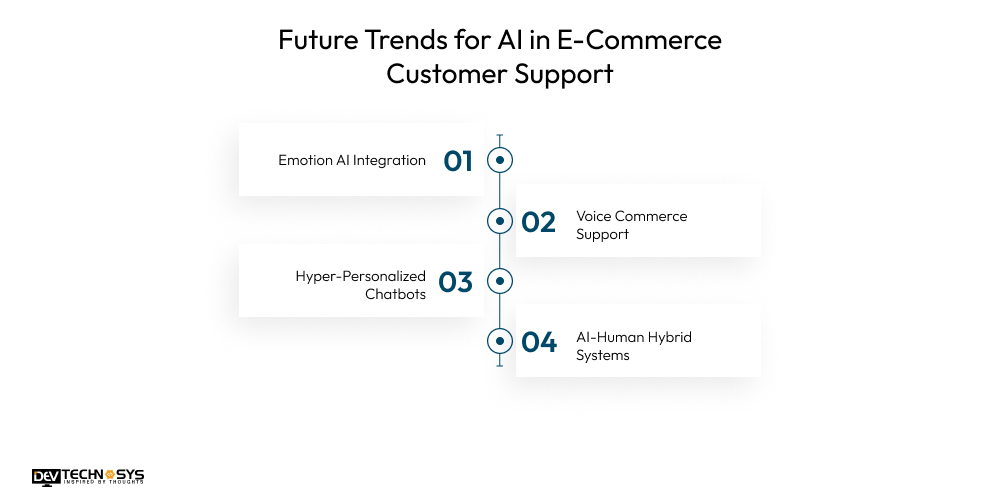
Future Trends for AI in E-Commerce Customer Support
The development of AI technology is opening up new opportunities for businesses in the retail industry. The following are the latest trends that will influence customer service in the e-commerce industry:
-
Emotion AI Integration
Affective computing, another name for emotion AI, uses facial expressions, language, and tone to determine user sentiment. It enables AI systems to modify their reactions according to emotional context, providing reassurance, urgency, or empathy as required. These AI shopping trends in MENA region improve human support.
-
Voice Commerce Support
Hands-free shopping and assistance are being made possible by voice assistants such as Google Assistant and Alexa. With voice commands, AI will increasingly manage product searches, order tracking, and problem solving. This trend increases the cost to maintain an app but simplifies support access for users.
-
Hyper-Personalized Chatbots
Beyond simple customisation, next-generation chatbots will have dynamic, context-aware dialogues. They will provide incredibly relevant answers based on browsing habits, past purchases, and in-the-moment activities. This leads to a more effective and personalized support experience for every user.
-
AI-Human Hybrid Systems
For best outcomes, future support models will integrate human empathy with AI efficiency. While humans will take over for difficult or delicate issues, AI-driven E-commerce apps will handle repetitive questions. This guarantees scalability without sacrificing quality or customer satisfaction.
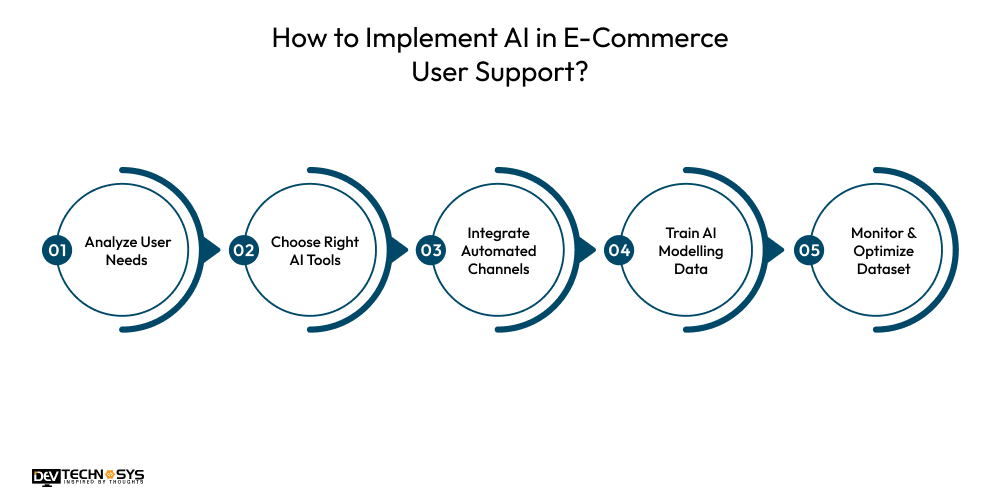
How to Implement AI in E-Commerce User Support?
AI in E-commerce support requires a strategy that matches customer expectations with technology. In this section, we will study the implementation of AI-powered customer service solutions:
-
Analyze User Needs
Start by determining the typical problems that customers have, the types of questions they ask, and the support gaps. Examine information from reviews, help desk tickets, and chat logs by hiring an Artificial Intelligence development company. This guarantees AI meets actual customer needs and aids in defining the extent of automation.
-
Choose Right AI Tools
Choose AI solutions according to your company’s size, financial constraints, and support objectives. NLP engines, voice bots, AI chatbots, and sentiment analysis tools are among the available options. Make sure the tools have analytical capabilities, are scalable, and connect seamlessly with your current IT stack.
-
Integrate Automated Channels
Use AI on all consumer touchpoints, including social media, mobile apps, and websites. To keep the conversation flowing, make sure the channel changes smoothly. You may hire Ecommerce app developers in Middle East for this omnichannel setup that ensures consistent and real-time services.
-
Train AI Modelling Data
Give your AI access to real-world support data, such as previous inquiries, product details, and interaction logs. Over time, increase response relevance and accuracy by utilizing supervised learning models. You may build a successful Ecommerce website with AI support and get smarter through better training data.
-
Monitor & Optimize Dataset
Monitor AI performance indicators including escalation frequency, satisfaction rating, and resolution rate continuously. Regularly update your training data to take into account new policies, products, or consumer trends. Your AI system will adapt to user expectations thanks to this continuous tuning.

In a Nutshell!!
There are a lot of other technologies like Blockchain and AR/VR also used to enhance the user experience and improve the buying process of retail products, but they are expensive. So, businesses must approach Ecommerce development companies in UAE like Dev Technosys to get better results through AI at affordable rates.
They use AI in E-commerce and other retail features to guide users with recommendation and personalization. A business investor needs intelligent and smart AI engineers to create automated E-commerce apps that Dev Technosys provides at reasonable costs. So, you must start investing in this technology to improve business growth and market revenue.
FAQs
1. How Does AI in E-Commerce Improve Real-Time Customer Support?
AI-powered customer support provide the following:
- Enables instant responses.
- Personalizes interactions.
- Reduces operational costs.
2. What Types of AI Tools are Used in E-Commerce Support Systems?
These are as follows:
- AI Chatbots for handling FAQs.
- NLP to understand & respond to user queries.
- Voice Assistants to detect emotions.
3. Is AI-Based Customer Support Suitable for Small E-Commerce Businesses?
Yes, small e-commerce enterprises can now more easily and affordably receive AI-based support. By automating frequently asked questions, it lessens the need for sizable support staff. Numerous platforms provide plug-and-play, scalable solutions designed for SMEs and startups.
4. Do AI-Driven Customer Support Ensure User Data Security?
AI-driven support systems employ encryption mechanisms and adhere to stringent data protection regulations such as GDPR. Reputable platforms use anonymization and access controls to guarantee the safe management of private client information.
5. How to Measure the Success of AI in Customer Support?
Some points are listed below:
- Response Time – Track AI’s issue resolving power.
- Customer Satisfaction Scores – Gauge user satisfaction.
- Chatbot Containment Rate – Measure the percentage of queries resolved.