





The SaaS landscape in 2026 is more competitive than ever. Customers expect smarter, faster, and more personalized experiences while businesses face relentless pressure to improve efficiency, reduce operational costs, and scale without friction. To stay ahead, SaaS companies are aggressively investing in emerging technologies that promise to transform how products are built and delivered. According to Fortune Business Insights, the SaaS market is expected to grow to USD 1482.44 billion by 2034. This highlights the rise in adoption of public and hybrid cloud.
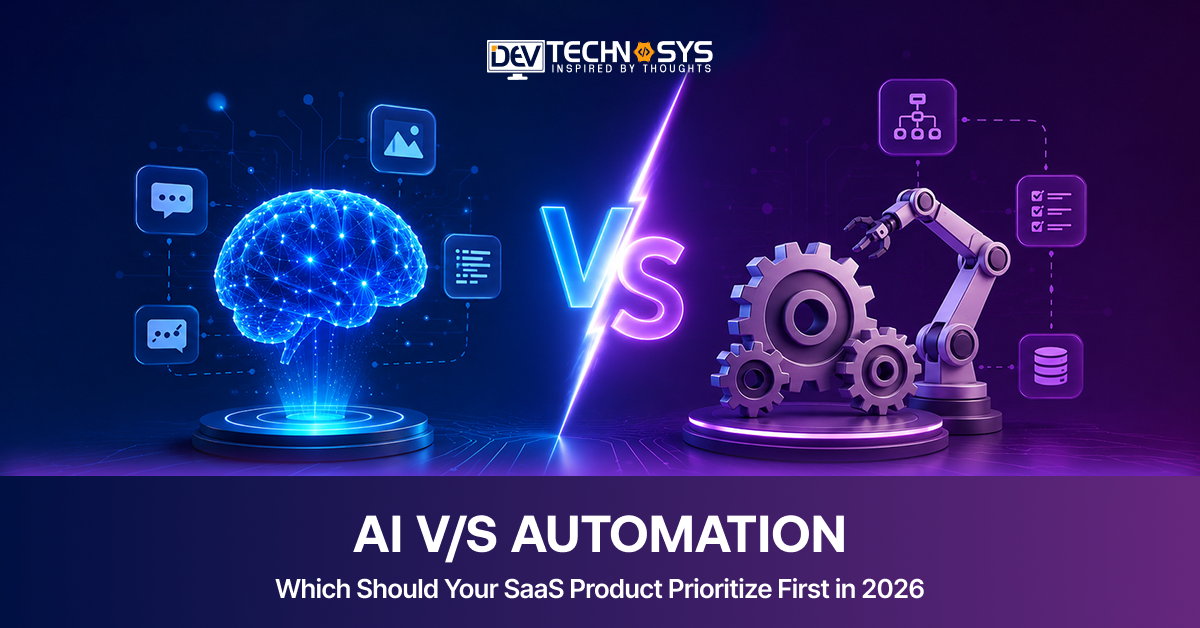
Yet one critical question continues to divide product teams and founders: should you invest in AI or automation first? Many organizations use these terms interchangeably, but they solve fundamentally different business problems. Confusing the two or choosing the wrong priority can inflate your budget, delay ROI, and slow your product roadmap. Understanding the AI vs automation in SaaS debate is no longer optional; it is a strategic necessity.
This guide breaks down the key differences, core benefits, real-world use cases, and a clear framework to help you make the right technology investment decision in 2026.
Understanding AI and Automation in SaaS Products
Before comparing the two technologies, it is important to understand what each one actually does inside a SaaS environment. While both improve how products operate, they serve fundamentally different purposes.
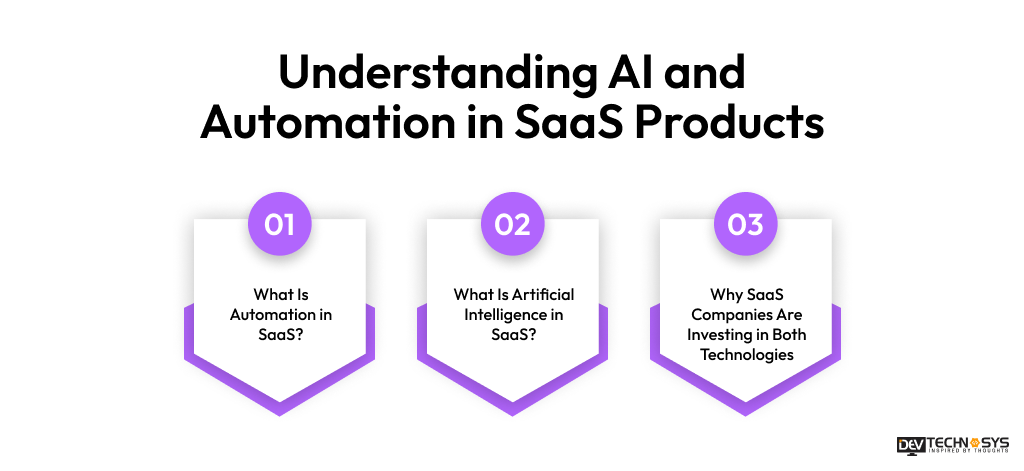
1. What Is Automation in SaaS?
Automation executes repetitive tasks based on predefined rules and workflows, without continuous human intervention. It improves consistency, speed, and operational efficiency but it does not learn or adapt on its own. Common SaaS automation solutions include automated email sequences, customer onboarding workflows, billing generation, ticket routing, and CRM updates. Each eliminates friction and frees teams for higher-value work through reliable SaaS process automation.
2. What Is Artificial Intelligence in SaaS?
Artificial intelligence in SaaS goes further by analyzing data, identifying patterns, and improving outputs over time. Rather than following fixed rules, AI enables software to make intelligent recommendations and predictions. Therefore, businesses choose AI agent development services for personalized recommendations, fraud detection, predictive forecasting, and customer behavior analysis.
3. Why SaaS Companies Are Investing in Both Technologies
Automation drives operational efficiency. AI enables AI-powered decision making that adapts to complexity. Together, they allow SaaS businesses to operate leaner while delivering smarter user experiences. Understanding these distinctions is essential when evaluating AI vs automation in SaaS and deciding which your product should prioritize first.
AI vs Automation in SaaS: Key Differences Explained
Although both technologies improve how SaaS products operate, they work in fundamentally different ways. A clear AI and automation comparison helps product teams and founders understand the AI vs automation in SaaS debate before committing to an investment strategy.
Factor |
Automation |
AI |
| Primary Goal | Execute predefined tasks | Make intelligent decisions |
| Working Method | Rule-based workflows | Data-driven learning |
| Adaptability | Fixed rules | Continuously improves |
| Human Involvement | Setup and monitoring | Training, monitoring, optimization |
| Data Requirement | Minimal | High |
| Learning Capability | No | Yes |
| Decision Making | Predefined | Dynamic |
| Personalization | Limited | Advanced |
| Scalability | Process scalability | Intelligence scalability |
| Customer Experience | Faster workflows | Personalized experiences |
| Implementation Cost | Lower | Higher |
| Maintenance | Relatively simple | Requires continuous refinement |
| Typical SaaS Use Cases | Billing, onboarding, notifications | Recommendations, forecasting, assistants |
| Best For | Operational efficiency | Competitive differentiation |
| ROI Timeline | Faster short-term ROI | Stronger long-term ROI |
The table above makes the automation vs AI technology distinction immediately clear. Automation delivers speed and consistency by following rules it has already been given. AI delivers intelligence and adaptability by learning from data it continuously processes. Neither approach is universally superior the right choice depends entirely on your product stage, data maturity, and business goals.
For AI-powered decision making, sufficient data volume and quality are prerequisites. Without them, AI investments underperform. Automation, by contrast, delivers measurable results from day one, making it a practical starting point for many SaaS teams evaluating AI vs automation for business efficiency. Businesses planning more advanced AI capabilities often partner with providers offering artificial intelligence development services to accelerate implementation and reduce deployment risks.

AI vs Automation in SaaS: Cost, Complexity, and Implementation Differences
AI vs Automation in SaaS differ significantly across cost, technical complexity, and implementation timelines. Understanding these differences helps SaaS companies identify the right starting point based on budget, data availability, and product maturity.
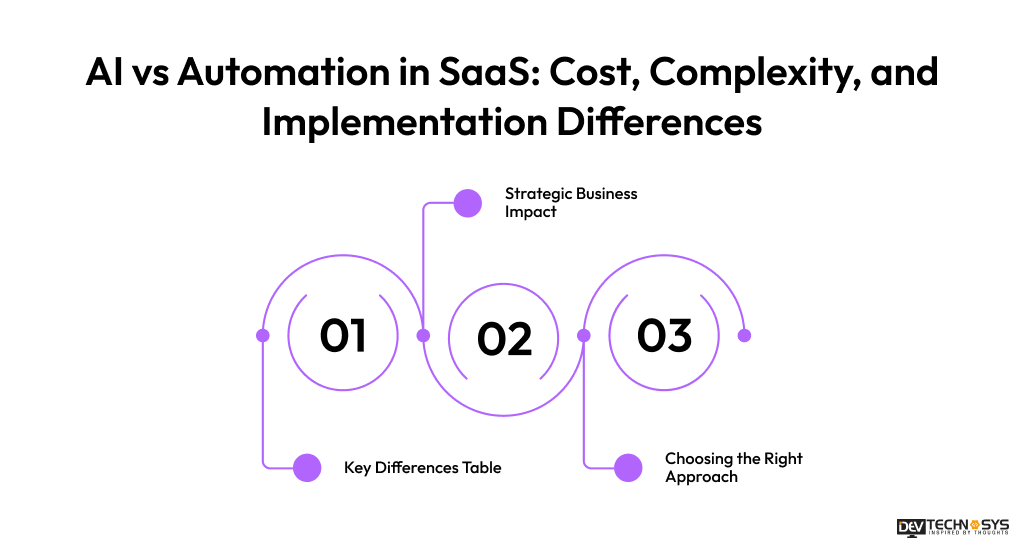
1. Key Differences Table
Factor |
Automation |
AI |
| Development Cost | Low to moderate | High |
| Technical Complexity | Simple rule-based logic | Advanced ML models |
| Data Requirement | Minimal | Large datasets required |
| Time to Build | Fast | Slower due to training |
| Maintenance | Low effort | Continuous optimization |
| ROI Timeline | Short-term gains | Long-term value |
| Scalability | Process-based scaling | Intelligence-based scaling |
| Use Case Focus | Repetitive tasks | Predictions and insights |
2. Strategic Business Impact
When evaluating automation vs AI technology, the investment profile differs considerably. Automation delivers cost-effective efficiency improvements with minimal technical overhead and faster deployment cycles.
AI requires higher upfront investment but creates stronger long-term product differentiation and competitive positioning. AI-powered SaaS platforms that eventually combine both consistently achieve a better balance between immediate ROI and sustained innovation than products relying on either technology alone.
3. Choosing the Right Approach
Start with automation when speed, operational efficiency, and budget constraints are the primary concerns. Prioritize AI when your product depends on intelligence, personalization, and data-driven experiences. For most SaaS companies, the strongest long-term strategy combines both technologies progressively, scaling automation first and introducing AI capabilities as data maturity and product complexity grow.
Benefits of Prioritizing SaaS Automation Solutions First
For many SaaS businesses, automation is the logical first investment. It delivers faster operational improvements at a fraction of the cost, making it a practical starting point in the broader AI vs automation in SaaS decision. Well-implemented SaaS automation solutions create immediate value while laying the groundwork for more advanced capabilities later.
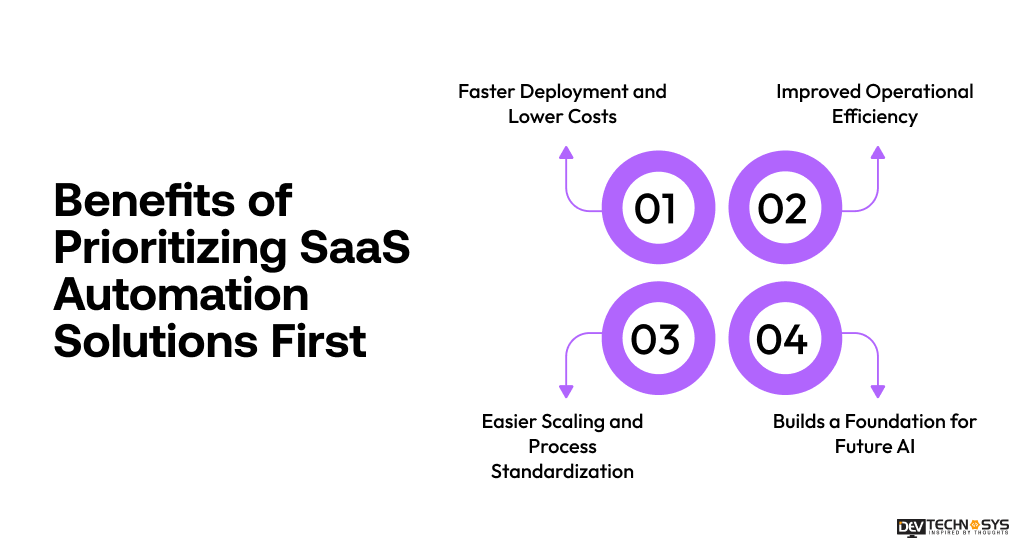
1. Faster Deployment and Lower Costs
SaaS process automation follows predefined rules, which means implementation is straightforward, and launch cycles are significantly shorter. Development costs stay lower compared to AI projects, and teams can deploy working solutions quickly. This makes automation particularly attractive for startups building MVPs and early-stage products where speed and budget efficiency are critical priorities. Thus, UAE businesses should understand the chatbot development cost before starting the project.
2. Improved Operational Efficiency
Automation eliminates repetitive manual work that consumes team time and introduces human error. Billing runs on schedule. Support tickets route instantly. Onboarding steps trigger automatically. The result is consistent workflow execution across the entire product, reduced operational overhead, and teams that are free to focus on higher-value strategic work instead of routine processes.
3. Easier Scaling and Process Standardization
As SaaS products grow, intelligent automation in SaaS ensures that workflows scale predictably without proportional increases in headcount. Standardized processes improve compliance, reduce onboarding friction for new team members, and create a consistent experience for customers regardless of how rapidly the business expands.
4. Builds a Foundation for Future AI
Automation also prepares SaaS products for AI adoption. Structured, automated processes generate the clean and organized data that AI models require to perform effectively. Companies that automate first reduce the data quality issues that often delay AI projects. Businesses ready to take that next step can work with an artificial intelligence development solution to build on their existing automation infrastructure confidently.
Benefits of Prioritizing Artificial Intelligence in SaaS First
Some SaaS products compete on intelligence, personalization, and data-driven experiences rather than operational efficiency alone. For these products, investing in artificial intelligence in SaaS from the start can build a stronger and more defensible competitive advantage.
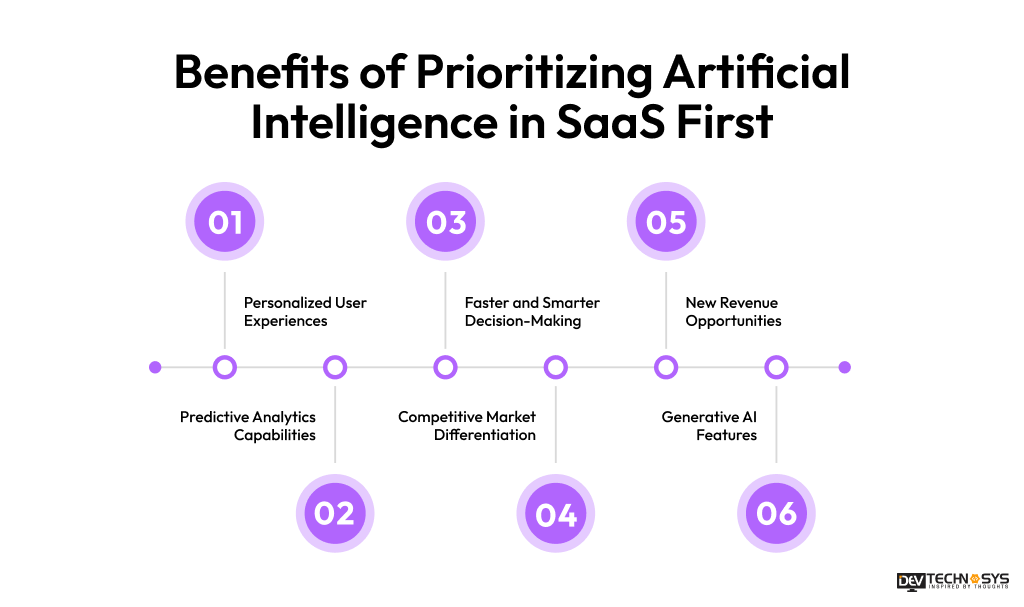
1. Personalized User Experiences
AI-powered SaaS platforms analyze individual user behavior to deliver personalized recommendations, customized content, and adaptive product experiences. Personalization increases engagement, reduces churn, and creates a product that feels uniquely valuable to every user, making it significantly harder for competitors to replicate.
2. Predictive Analytics Capabilities
Predictive analytics in SaaS enables products to anticipate what happens next rather than simply reacting to what has already occurred. AI models can forecast revenue, predict customer churn before it happens, and model demand patterns, giving businesses a meaningful advantage in planning, retention, and resource allocation.
3. Faster and Smarter Decision-Making
AI-powered decision-making transforms how chatbot Saas software for enterprises, SaaS teams, and their customers act on data. Real-time insights, intelligent recommendations, and automated business intelligence reduce the time between identifying an opportunity and acting on it, improving outcomes across sales, product, and customer success functions.
4. Competitive Market Differentiation
AI capabilities create product differentiation that is genuinely difficult to copy. Unique features powered by proprietary data and trained models strengthen your value proposition, improve customer retention, and support premium pricing strategies that rule-based automation alone cannot justify.
5. New Revenue Opportunities
AI-driven SaaS applications open monetization pathways that traditional products cannot access. AI copilots, smart assistants, and advanced analytics tiers attract enterprise buyers and support premium subscription models, directly expanding revenue potential beyond the core product offering.
6. Generative AI Features
Generative AI for SaaS is rapidly becoming a baseline expectation among business users. Content generation, automated summaries, intelligent workflow suggestions, and AI writing assistants add immediate perceived value and accelerate user adoption. Partnering with an experienced artificial intelligence development company helps SaaS teams build and deploy these features without the overhead of building foundational models from scratch.
When Should Your SaaS Product Prioritize Automation?
Automation is often the smarter first investment when a SaaS business is focused on operational efficiency, process consistency, and rapid growth. Before adding intelligence, many companies benefit from optimizing how work gets done. Knowing where you stand in the AI vs automation in SaaS journey makes this decision significantly clearer.
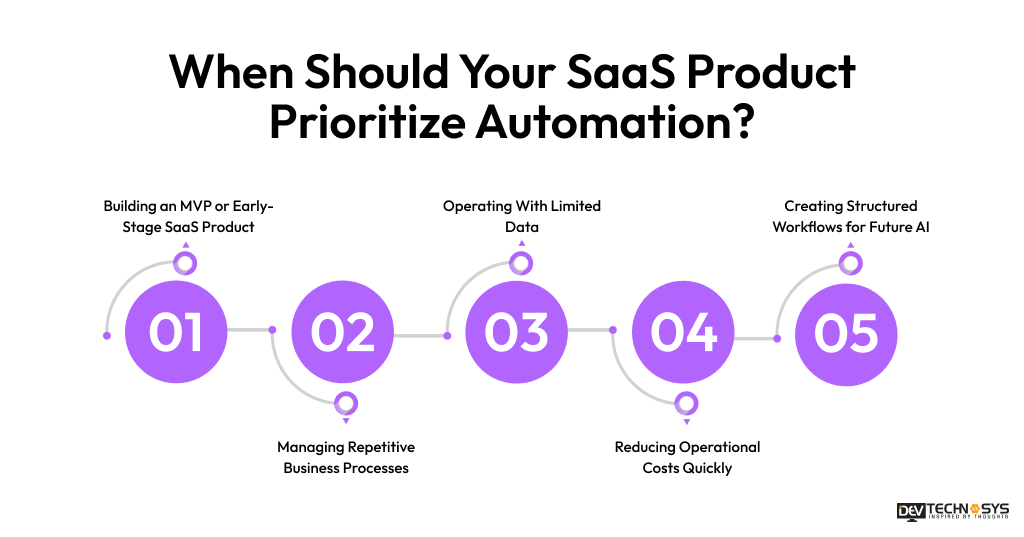
1. Building an MVP or Early-Stage SaaS Product
Early-stage SaaS products operate under tighter budgets and more aggressive launch timelines than to build a chatbot from scratch. SaaS automation solutions deliver immediate operational value without the complexity or cost of AI development. Automating core workflows from day one allows teams to validate product-market fit faster while keeping infrastructure lean and maintainable.
2. Managing Repetitive Business Processes
When your product relies heavily on recurring processes, automation is the natural solution. SaaS process automation handles customer onboarding sequences, email workflows, invoice generation, CRM updates, and support ticket routing consistently and reliably, eliminating manual effort and reducing the risk of human error across high-volume operations.
3. Operating With Limited Data
AI models require substantial volumes of quality historical data to perform effectively. New SaaS products rarely have this available at launch. Automation delivers consistent operational value without requiring extensive datasets, making it the practical choice when your data infrastructure is still maturing.
4. Reducing Operational Costs Quickly
Automation offers a lower implementation cost and a faster path to measurable ROI compared to AI. Repetitive manual workloads are eliminated quickly, productivity improves from the first week of deployment, and operational savings compound over time without requiring ongoing model training or data science resources.
5. Creating Structured Workflows for Future AI
Automation also builds the foundation that future AI depends on. Standardized workflows generate cleaner, more consistent datasets. Repeatable processes create the structure that machine learning models require to identify meaningful patterns. SaaS companies that automate first consistently find that their subsequent AI implementations perform better, deploy faster, and require less corrective work after launch.
When Should Your SaaS Product Prioritize AI?
While automation improves operational efficiency, some SaaS products generate value through intelligence and data insights. In these cases, AI becomes a core product capability rather than an optional enhancement.
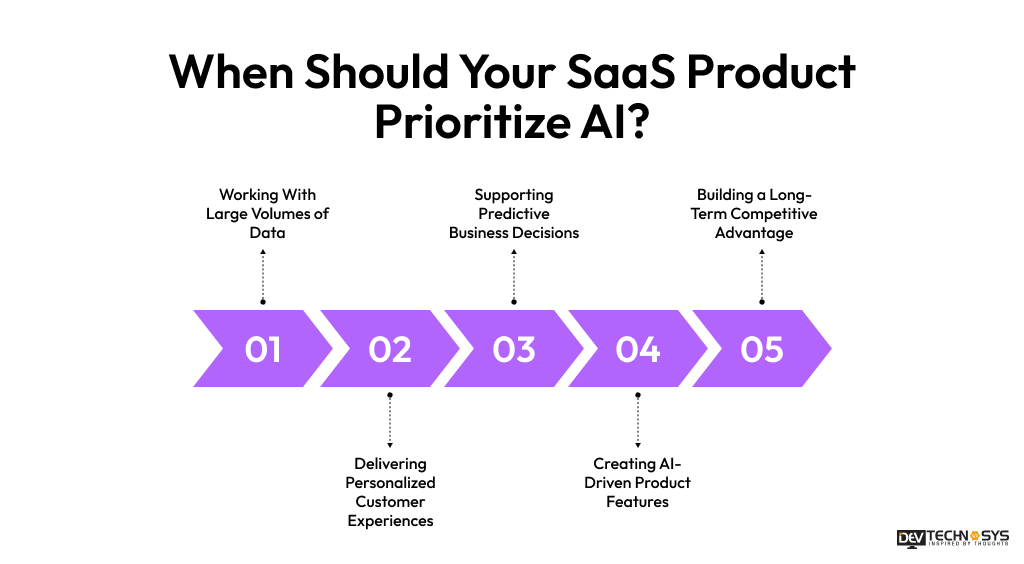
1. Working With Large Volumes of Data
Data-rich SaaS platforms have the most to gain from AI investment. Machine learning in SaaS turns raw behavioral, transactional, and operational data into actionable business insights. When your product already captures significant user activity, AI can identify patterns, forecast outcomes, and surface opportunities that no rule-based system could detect.
2. Delivering Personalized Customer Experiences
When personalization is central to your product’s value proposition, AI becomes essential rather than optional. Adaptive user journeys, smart content delivery, and personalized recommendations increase customer engagement and retention in ways that static, predefined workflows simply cannot replicate at scale.
3. Supporting Predictive Business Decisions
SaaS products built around forecasting, risk assessment, or revenue intelligence require AI from the ground up. Predictive analytics in SaaS enables churn prediction, demand forecasting, and financial modeling that gives customers measurable decision-making advantages. Combined with AI-powered decision making capabilities, these features become core reasons customers choose and stay with your product.
4. Creating AI-Driven Product Features
Products competing on feature depth and innovation need AI to stay relevant. AI-driven SaaS applications built around copilots, smart assistants, recommendation engines, automated insights, and conversational interfaces deliver differentiated experiences that rule-based automation cannot produce. These features also create stickiness that significantly raises switching costs for existing customers.
5. Building a Long-Term Competitive Advantage
In crowded SaaS markets, AI creates a sustainable moat. Premium positioning, higher perceived customer value, and continuous model improvement compound over time in ways that purely automated products cannot match. Businesses looking to deliver autonomous assistance, intelligent workflows, and advanced user experiences often invest in an AI agent development solution as part of their long-term product strategy.
Real-World AI and Automation Use Cases in SaaS
The AI vs automation in SaaS debate becomes far clearer when examined through real-world applications. Leading SaaS companies rarely rely on one technology alone. They combine both to improve efficiency, customer experiences, and business outcomes simultaneously.
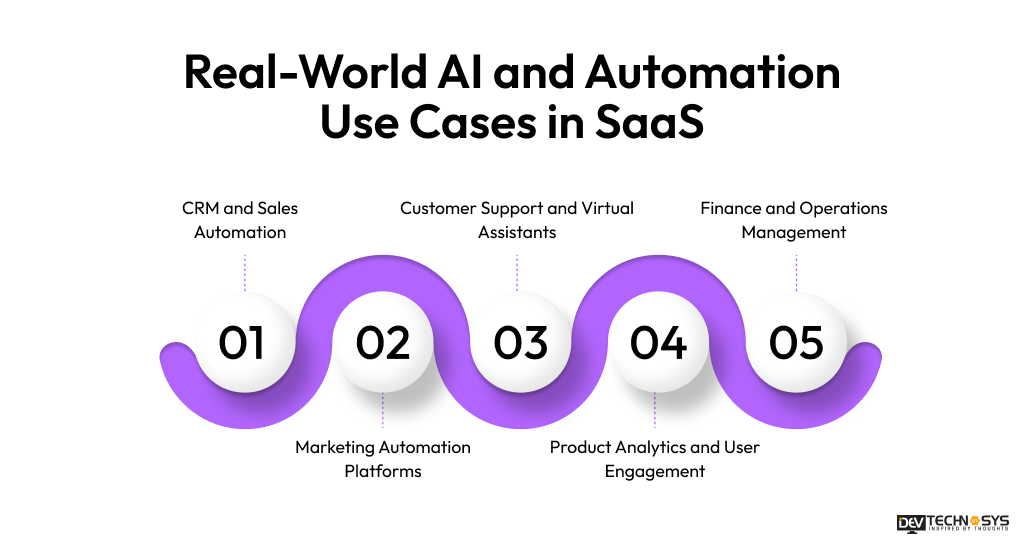
1. CRM and Sales Automation
Sales teams use automation for lead scoring, follow-up sequences, and opportunity tracking, while AI layers on top to deliver revenue forecasting and intelligent customer segmentation. Together, they reduce manual CRM workload while improving the quality of every sales interaction.
2. Marketing Automation Platforms
AI-powered SaaS platforms in marketing combine automated email campaigns with AI-driven audience targeting, content recommendations, and customer journey optimization. The result is personalized communication delivered at scale without proportional increases in marketing team headcount.
3. Customer Support and Virtual Assistants
AI automation software powers some of the most visible SaaS innovations in customer support. Automated ticket routing directs queries to the right team instantly, while AI-powered virtual assistants handle complex questions with increasing accuracy over time. Businesses building conversational support experiences often partner with a chatbot development company to deploy solutions that reduce response times and support costs significantly.
4. Product Analytics and User Engagement
SaaS products use AI to track user behavior, predict churn, and surface feature recommendations that improve engagement. Automated alerts then trigger retention workflows the moment a disengagement signal is detected, turning insight into action without manual intervention.

5. Finance and Operations Management
Among the most impactful AI and automation use cases in SaaS are finance operations. Invoice processing, expense management, and workflow approvals run automatically while AI handles fraud detection and financial forecasting, reducing risk and improving operational accuracy across the business.
The Hybrid Approach: Combining AI and Automation for Maximum ROI
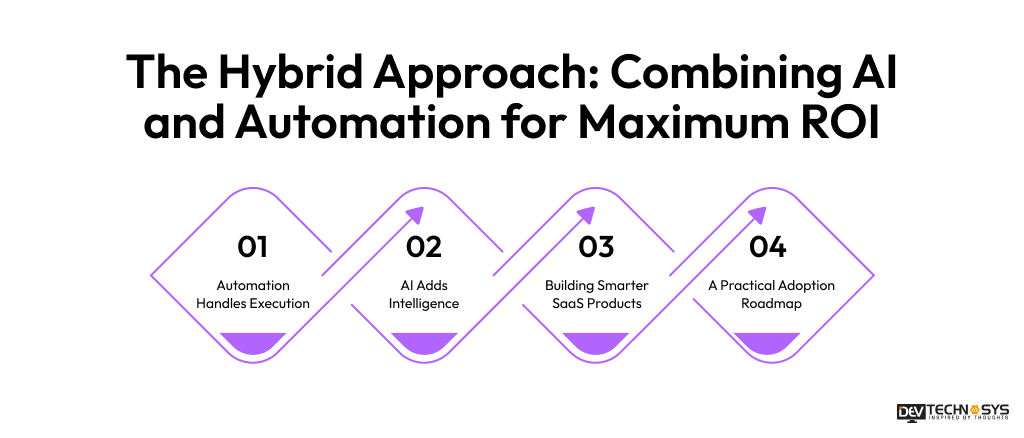
For most SaaS businesses, the goal is not choosing one technology permanently. The real opportunity in the AI vs automation in SaaS platform lies in combining both, using automation for execution and AI for intelligence to maximize AI vs automation for business efficiency across the entire product.
1. Automation Handles Execution
Automation ensures that repetitive tasks, workflow management, notifications, data entry, and operational processes run consistently at scale. Once configured, these processes require minimal oversight and deliver reliable results regardless of team size or product complexity. Execution efficiency becomes a baseline rather than a daily operational concern.
2. AI Adds Intelligence
Where automation executes, AI interprets. Intelligent automation in SaaS brings predictions, personalized recommendations, adaptive decision-making, and actionable business insights into products that would otherwise rely entirely on static logic. AI transforms operational data into strategic advantage, identifying opportunities and risks that no rule-based system could surface independently.
3. Building Smarter SaaS Products
The most powerful SaaS products combine both layers. AI automation software enables automated workflows triggered by AI-generated insights, predictive customer support that resolves issues before they escalate, smart lead management that prioritizes opportunities in real time, and personalized onboarding journeys that adapt to individual user behavior from the first login.
4. A Practical Adoption Roadmap
A phased approach reduces risk while maximizing long-term ROI. Start by automating repetitive processes. Collect and structure the business data those workflows generate. Introduce AI-powered features once sufficient data exists. Then scale intelligent capabilities progressively as model performance improves and user adoption grows. This roadmap is proven across successful SaaS companies of every size and stage.
AI vs Automation: Which Costs More?
Understanding the cost difference is beyond getting the answer to: what is chatbot development? Automation generally costs less than AI because it follows predefined rules and workflows. AI development can require additional investment in model integration, data preparation, AI infrastructure, training or fine-tuning, testing, and ongoing optimization.
For UAE businesses, automation projects can start from around AED 110,000, while sophisticated AI implementations can reach AED 551,000+. However, the final cost depends on the number of workflows, integrations, AI capabilities, security requirements, and scalability needs.
Solution |
Estimated Cost |
Cost Definition |
| Basic Automation | AED 110,000–AED 180,000 | Rule-based workflows, task automation, notifications, basic API integrations, and admin dashboards. |
| Advanced Automation | AED 180,000–AED 300,000 | Multi-step workflows, CRM/ERP integrations, RPA, approval processes, reporting and business process automation. |
| Basic AI | AED 150,000–AED 250,000 | AI chatbots, recommendation engines, intelligent search, NLP and AI-powered data processing. |
| Advanced AI | AED 250,000–AED 400,000 | Generative AI, predictive analytics, RAG, multiple AI integrations and intelligent decision-support features. |
| Enterprise AI | AED 400,000–AED 551,000+ | AI agents, custom AI workflows, complex data pipelines, advanced security, multiple system integrations and enterprise scalability. |
AI and Automation Security Considerations in UAE
AI and automation systems can process customer information, business records, payment data, and operational workflows. UAE businesses should therefore build security and compliance into the architecture from the beginning rather than treating them as post-development requirements.
1. UAE PDPL Compliance
AI and automation platforms should apply appropriate data protection controls when collecting, processing, or storing personal information. Data access, retention, consent, and transfer practices should be defined according to the UAE Personal Data Protection Law.
2. ISO 27001 and SOC 2 Controls
ISO 27001 and SOC 2 help establish structured information-security and operational controls. Implementing policies for access management, risk assessment, monitoring, and incident response can help businesses protect AI models, automation workflows, and sensitive business data.
3. PCI DSS for Payment Workflows
If an AI or automation platform processes payment-related information, PCI DSS requirements should be considered during architecture and integration planning. Tokenization, restricted access, secure payment gateways, and transaction monitoring can reduce exposure to sensitive payment data.
4. Encryption and Access Controls
Sensitive data should be protected using encryption in transit and at rest, while RBAC, MFA, and data-access controls should restrict systems according to user roles. Audit logs can also provide visibility into who accessed or modified sensitive information.
5. AI Monitoring and Threat Protection
AI-enabled workflows require continuous monitoring for abnormal behavior, model manipulation, data leakage, and prompt-injection attacks. Businesses should combine model monitoring, input validation, logging, and security testing to identify and respond to emerging AI-specific threats.
Conclusion
The AI vs automation in SaaS decision does not have a universal answer. The right choice depends on your business goals, data availability, product maturity, and customer expectations. Some products benefit most from automation first. Others require AI capabilities from the start. Understanding which technology solves your specific challenges is what ultimately drives the right investment decision.
Automation builds the operational efficiency and structured data foundation that sustainable SaaS growth requires. AI drives the intelligence, personalization, and predictive capabilities that create long-term competitive advantage. Businesses that have already established efficient workflows are often better positioned to build an artificial intelligence app that delivers measurable value. The most successful SaaS companies treat artificial intelligence in SaaS not as an either-or decision, but as a strategic progression.
Frequently Asked Questions
Q1. What is the Difference Between AI and Automation in SaaS?
The core AI vs Automation in SaaS distinction is straightforward. Automation follows predefined rules to execute repetitive tasks consistently. AI learns from data, adapts over time, and supports intelligent decision-making and personalization. Automation improves operational efficiency while AI enhances product intelligence and customer experience.
Q2. Should Startups Prioritize Automation Before AI?
Most startups benefit from automation first. It costs less, deploys faster, and delivers immediate operational improvements. Establishing structured workflows and collecting quality business data also makes future AI implementation significantly more effective. AI becomes a stronger investment once your processes and data foundation are in place.
Q3. How Does Machine Learning Improve SaaS Products?
Machine learning in SaaS identifies meaningful patterns within large volumes of user and business data. It powers personalized recommendations, accurate demand forecasting, churn prediction, and smarter customer experiences. Over time, models improve continuously, making SaaS products more valuable and more responsive to individual user needs.
Q4. Can AI and Automation Work Together in One SaaS Platform?
Absolutely. Some of the most impactful AI and automation use cases involve both technologies working in tandem. Automation handles workflow execution and operational consistency while AI contributes predictions, recommendations, and adaptive intelligence. Together they create SaaS platforms that are both efficient and genuinely intelligent.
Q5. What Should SaaS Companies Prioritize First in 2026?
It depends on your product goals. Automation delivers faster results for AI vs automation for business efficiency improvements, making it ideal for operations and scalability. AI suits products competing on personalization, analytics, and innovation. Most successful SaaS companies automate core processes first, then expand strategically into AI-powered capabilities.