





The trade of securities and the digitization of assets are at their height. Every business investor is interested in using blockchain in financial industry which is becoming more popular on a daily basis. These tangible resources are encouraging the growth and innovation of traditionally used finance systems.
A business professional must first understand the use of the blockchain finance industry in order to begin developing various platforms. There are numerous other factors that are important to consider when starting a blockchain and online trading business.
A company should concentrate its investments on the advancement of blockchain in banking through asset formation. To begin the development process, it is crucial to recognize the costs and other factors.
This blog discusses important terminologies of blockchain, benefits, and challenges of integrating it with finance systems. So, let us begin.
Why Is Blockchain Important for the Financial Industry?
In the financial industry, blockchain plays a critical role in enhancing transaction security, improving transparency, driving down costs, and ensuring faster provision of financial services. Its decentralized nature ensures that fraud is eliminated. On top of that, smart contracts make it possible to automate complex procedures and minimize the need for intermediaries.
Moreover, blockchain facilitates faster cross-border payments, digital asset management, and data sharing among financial institutions. In such a manner, blockchain provides banks and fintech companies with the possibility to become more efficient and more trustworthy.
Traditional v/s Modern Financial Systems
Businesses in the financial industry were prone to the ordinary systems. Additionally, every task was conducted at a lower accomplishment rate. But, after the introduction of the blockchain finance industry, this issue got resolved and changed the scenario for business investors.
They have now started using custom blockchain development services to create new use cases. Additionally, pre-defined components have also boosted the development of blockchain in banking and trading industries.
So, it is important to understand differences between the traditional and modern financing systems to know the need for this change. They are depicted with the below table:
Feature |
Traditional Financial Systems |
Modern Blockchain Financial Systems |
|
Centralization |
Centralized systems controlled by banks and other financial institutions. |
Decentralized services which are distributed over ledger technology |
|
Intermediaries |
Rely on intermediaries like banks and brokers for transactions | Eliminate intermediaries, allowing peer-to-peer transactions |
| Transparency | Limited transparency, information controlled by institutions |
Transparent and auditable, all transactions recorded on a public ledger |
|
Security |
Vulnerable to hacking and fraud | These systems are protected due to various encrypted algorithms and decentralized services |
| Speed | Slow transaction processing times |
Faster transaction processing times |
|
Costs |
High transaction fees due to intermediaries | Less transaction processing fees because of decreased featured price |
| Accessibility | Limited access for some individuals and regions |
Increased accessibility, available to anyone with internet access |
|
Innovation |
Slow innovation due to regulations and bureaucracy |
Faster innovation due to open-source nature and community development |
|
Regulation |
Heavily regulated by governments and financial authorities | Emerging regulatory frameworks, still under development |
| Privacy | Personal information may be shared with third parties |
Enhanced privacy with features like private transactions and zero-knowledge proofs |
Answer a few quick questions and our experts will share a tailored project estimate.
Fascinating Stats of Blockchain and Finance Industry
- By 2025, the United Arab Emirates’ cryptocurrency business is expected to generate $254.3 Million in revenue.
- It is anticipated to expand at a 52% CAGR annual rate between 2025 and 2029, reaching a total estimated value of $254.3 Million by 2025.
- In 2025, the cryptocurrency sector is expected to generate an average revenue per user of $67.3.
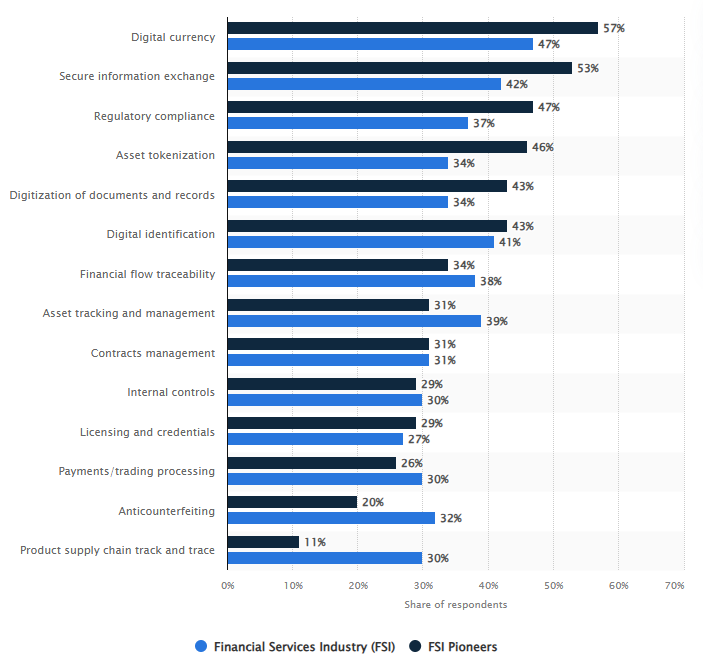
- With $9,423 Million in 2025, the US has the largest cryptocurrency market income when compared to other countries.
- By 2025, it is anticipated that there will be 78 Million users in the United Arab Emirates’ cryptocurrency sector.
- By 2025, it is anticipated that the user penetration rate will have increased to 13%.
- As more companies and individuals use digital currencies for transactions and investments, the United Arab Emirates is witnessing a boom in the use of cryptocurrencies.
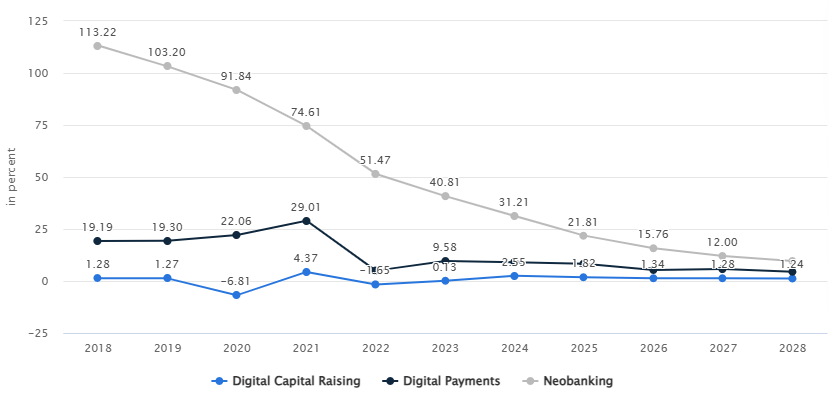
- With an AUM of $520.60 Million in 2025, digital assets will be the largest market.
- In the Digital Assets industry, the average AUM per user is expected to reach $175.90 by 2025.
- In 2026, the market for digital assets is anticipated to expand by 98%.
- By 2028, it is anticipated that there will be 9,194 K users in the digital payments market.
- In 2025, the market for financial equities is expected to reach $341.94 Million in total assets under management.
- The unique features of KPIs in the FinTech space make it impossible to combine and display them as a single figure that accurately reflects the whole FinTech sector.
What are the Significant Attributes of Blockchain
Before using blockchain in banking sector, knowing major attributes is quite important for businesses which are discussed in this section. There are multiple other components available that assist in the development process. But they are not suitable for the blockchain finance industry due to their applicability in other domains. So, let us understand them:
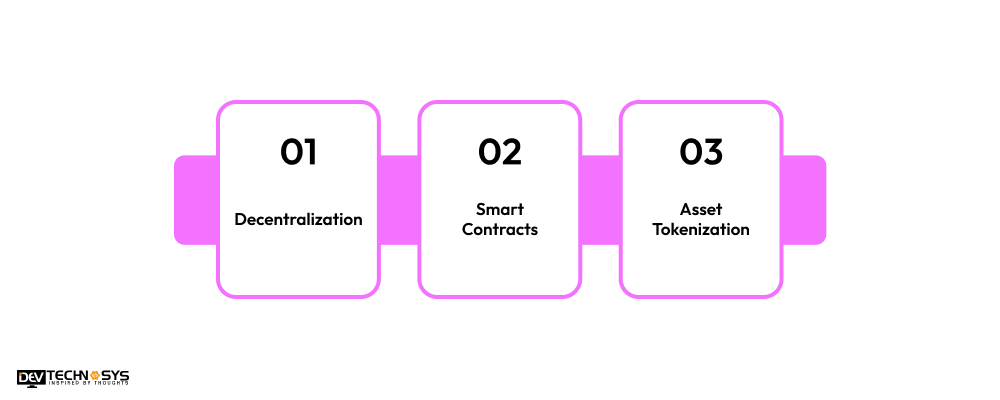
1. Decentralization
To keep the resources distributed and easily accessible, decentralized services are used. So, it is highly beneficial to invest in blockchain app development to use blockchain in finance industry with this component.
Additionally, there is another component as well which is centralization that is mainly applicable in the healthcare sector. With decentralization, you can convert your old payment systems to new financial methods.

2. Smart Contracts
Using smart contracts for enhancing the finance industry is a vary new concept in the blockchain domain. This component can be implemented with other entities of blockchain in financial industries. Its primary motive is to ensure synchronization between transactions and acknowledgement.
If the link is broken, then it automatically establishes the connection and again start the process. So, there is no loss of assets and other financial equities.
3. Asset Tokenization
Different online payment and trading platforms use tokenization of real world assets to digitize traditional money. Businesses use blockchain for financial services to keep this money alive in a convertible format through asset tokenization.
Additionally, you can also invest your resources to build an ICO that uses same component of blockchain to represent money in the form of coins and tokens.
Important Use Cases of Blockchain in Finance Industry
Various use cases of blockchain finance industry can be observed by researching multiple resources. Most of them are derived from the major ones. Additionally, these models are highly effective to handle different financial models with the integration of blockchain in banking and accounting sector. So, we are only going to discuss the major use cases in this section. They are as follows:
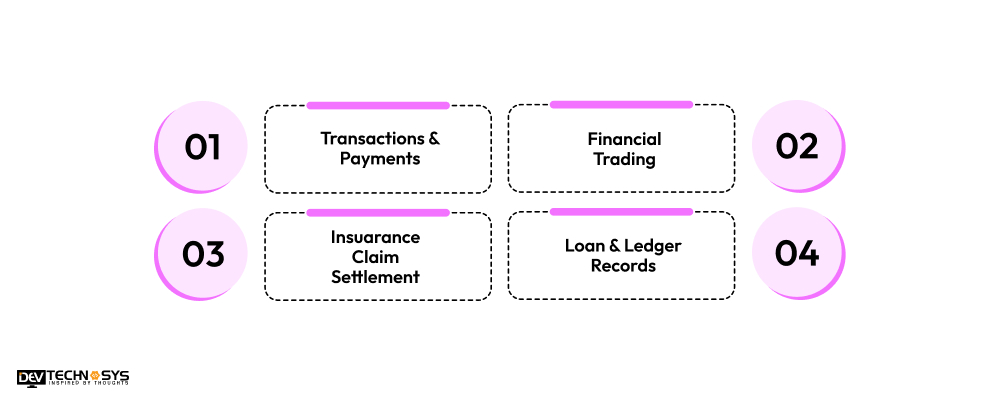
1. Transactions & Payments
Digitization of traditional payment services took place quite a long time before. Additionally, exchange of money and other financial assets can be easily conducted through this method. But, the implementation of blockchain technology in finance industry has transformed transactional services.
By taking these services online, businesses have justified their investment of resources in OTC crypto exchange development. Because, money can be liquified in tokens and coins very easily for cryptocurrency exchange.
2. Financial Trading
Trading systems are the primary source to generate profitable revenue. But, it has less impact on the society due to the limited circulation of money in the market. Through the development of blockchain applications in financial services, this problem gets solved quite easily.
So, in place of money different blockchain digital assets like tokens, coins, and cryptocurrencies are used for online financial trading. Additionally, they are not being completely accepted by everyone which paves a way for other assets as well.
3. Insurance Claim Settlement
By creating a blockchain app business investors can also enter in the insurance sector where they have to deal with multiple loan and policy related topics. So, you need to hire dedicated mobile app developers to collect all the necessary resources and discuss the cost of the development.
After getting a well-efficient blockchain platform, you can deliver unique insurance claim settlement solutions to your users. Additionally, services like auto-generated policy distribution can also be offered to multiple user benefits.
4. Loan & Ledger Records
Big data storage is a major application of blockchain in financial services. This is used in multiple domains like healthcare, finance, logistics, and real estate. So, businesses must appoint a custom blockchain app development company to use this use case for blockchain app development.
Consumers can easily maintain long financial records and keep their ledgers for a long time. Additionally, there is a facility to expand the memory of the blockchain platform to allow more data storage. As all the information gets redistributed on the server.
5 Advantages of Integrating Blockchain in Financial Systems
Advantages of implementing blockchain in banking industry are in good numbers. But, it is quite difficult to understand them all at once. So, the top 5 benefits of developing the blockchain finance industry are discussed in detail. Let us dive into this section to know more about them:
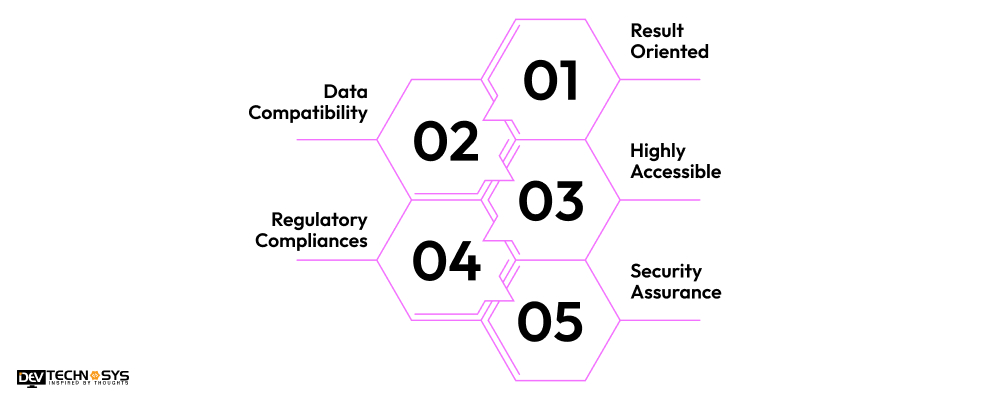
1. Result Oriented
You can generate accurate results and outcomes through blockchain technology applications by utilizing sophisticated financial and banking app development services. Additionally, you can take help of risk management software to offer equity solutions.
So, along with blockchain you may require Artificial Intelligence to predict the future model. In this case, an Android app development company will provide you with the desired resources to implement recommendation algorithms with decentralized services.
2. Data Compatibility
The best idea for developing software for the finance and management business is to use hybrid crypto exchange development at a large scale. Additionally, you can access a wide range of technology to make your financial business powerful and successful.
With the incorporation of blockchain in banking industry, you can construct big data services for users. So, they are able to fill as much information as they want. But, it is your responsibility that your system does not crashes.
3. Highly Accessible
To help your loan and insurance business, you can add highly legalized and accessible services by investing mony in the mobile app development solutions. So, getting in touch with a specialized blockchain application development company is advantageous.
There are a lot of things that you can do to make your services compatible with the modern infrastructure. Commonly, you can implement dynamic databases to store large amount of data from where users can take the required information.
4. Regulatory Compliances
By developing blockchain apps for Android systems, you can generate profitable revenue through regulatory and governance support. Additionally, you can also hire token developers in the UAE to create various financial models for users.
For business investors, this can make the process of developing banking software very simple and efficient. It legalize your services and builds an ethical trust in people’s mind. So, you can ensure that no one can break your services.
5. Security Assurance
Security is a well-known benefit that can solve business concerns. Additionally, the finance industry has a direct relationship with this factor. So, to create world-class financial systems, you can approach a software development company that should work well for people.
This is one of the most widely accepted benefits of blockchain in financial services that can help investors to capture the market. So, you must understand the function of various financial model to get completely identical and protected systems.
Major Applications of Blockchain in Financial Services
Blockchain technology is revolutionizing the financial sector through fast transactions, secure operations, clear transactions, and optimized business processes. Blockchain in finance is being introduced in the fields of cross-border transactions, smart contracts, digital identity verification, trade finance, and digital tokenized assets to get rid of outdated technology.
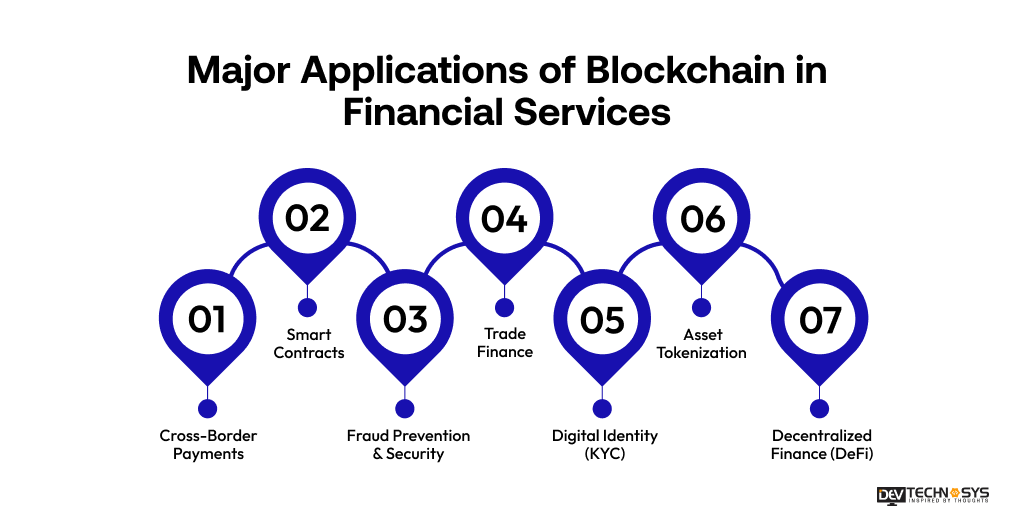
1. Cross-Border Payments
Thanks to blockchain development solutions, cross-border payments have become noticeably more efficient through near-instant settlement, removing the need for middlemen and reducing fees. Wherever traditional banks take days to complete a process, blockchain technology works around the clock. Companies such as Ripple and JPMorgan Kinexys demonstrate how banks can complete payment transactions much faster and with better clarity.
2. Smart Contracts
A smart contract is an automatic digital contract that executes itself, enforcing the agreed conditions without involving any third parties. Due to the use of smart contracts, financial companies reduce paperwork, speed up the processes, and cut costs. For instance, businesses in such financial sectors as insurance, lending, and trade finance use smart contracts to speed up claims processing.
3. Fraud Prevention & Security
Blockchain in financial industry provides great security for financial organizations through the irreversible transactions made on the blockchain platform. It guarantees strong identity verification, reduces opportunities for changing data, and creates visible transaction trails for audits; in other words, when combined with encryption support and decentralized platforms, blockchain technology allows financial organizations to detect fraud more effectively.
4. Trade Finance
The advancement of the financial industry through the utilization of blockchain technology allows the processes of trade finance and documents to be digitized, as well as the workflows automated, and the exchanges of information between banks, sellers, and buyers to become secure. As a result, trading organizations can enjoy less paperwork, shorter approval times, reduced fraud probabilities, and transparency of transactions at every stage of the process.
5. Digital Identity (KYC)
The implementation of digital identity systems that operate on blockchain technology allows conducting a KYC process in a simpler way due to reusable client credentials. In the course of this technology, banks will enhance their efficiency in identity validation processes while eliminating unnecessary duplication of efforts in every aspect of compliance and strengthening the fight against money laundering.
6. Asset Tokenization
Tokenization refers to the process of transforming physical or financial assets into digital tokens that operate using blockchain technology. Thus, tokenization provides fractional ownership and improves liquidity, which gives people more opportunities to invest.
7. Decentralized Finance (DeFi)
The term Decentralized Finance (DeFi) means the use of blockchain in the financial industry to offer services such as lending, borrowing, and generating profits without using traditional intermediaries. DeFi applications provide an opportunity for more people to access financial services and make innovations in this field, Decentralized Finance brings a number of challenges, including the risks connected with smart contracts.
Real-World Examples of Blockchain Adoption in Finance
The process of transitioning blockchain technology in financial services from experimentation into practice is underway. Major banks, financial intermediaries, and investment firms are starting to adopt blockchain finance applications to gain greater efficiency, digital securities, and transparency.
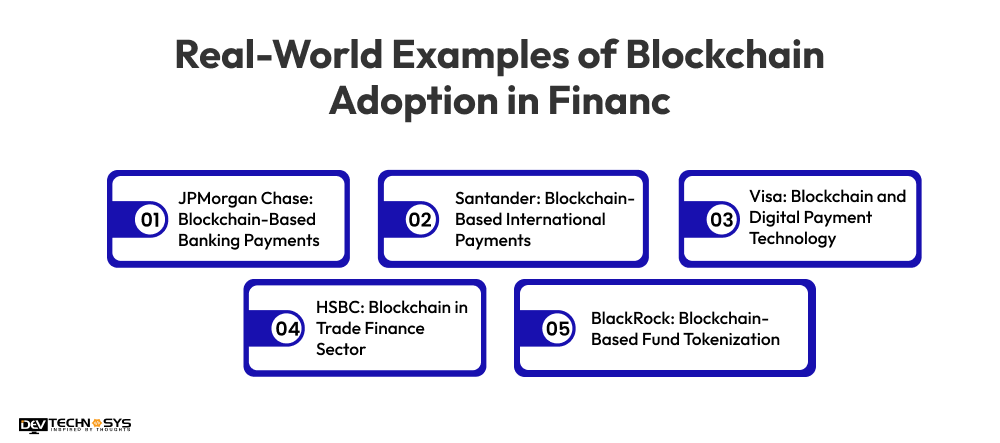
1. JPMorgan Chase: Blockchain-Based Banking Payments
With the help of the Onyx platform, JPMorgan Chase utilizes blockchain technology to facilitate faster institutional payments. The service allows companies to securely transfer value, enhance the efficiency of their transactions, and minimize delays in settling the payments. It shows how large financial institutions are taking advantage of blockchain technology to modernize payment systems.
2. Santander: Blockchain-Based International Payments
Santander Group has developed blockchain-based payment systems to facilitate payment processing in international money transfers. The use of the blockchain platform allowed the company’s clients to conduct international payments more quickly while providing them with more transparency and less complexity in processing.
3. Visa: Blockchain and Digital Payment Technology
Visa Inc. has adopted blockchain technology to enhance its digital payment infrastructure and facilitate the use of stablecoins in transactions. Visa’s blockchain solutions are focused on fast, secure, and smooth fund movements while integrating traditional banks and modern platforms involved in peer-to-peer payments.
4. HSBC: Blockchain in Trade Finance Sector
HSBC Holdings has utilized blockchain fintech solutions in the field of trade finance and digital assets management. The bank relies on blockchain platforms to facilitate the process of document verification in international trade and enhance transparency by improving the speed of secure financial transactions.
5. BlackRock: Blockchain-Based Fund Tokenization
BlackRock has implemented blockchain asset tokenization via smart banking solutions. This technology allows for financial assets to be represented digitally on blockchain networks, making access easier and more efficient. It indicates that investment managers are now looking into blockchain technology in investment markets.
5 Major Challenges of Implementing Blockchain with Finanace Industry
Business investors may face different challenges while using blockchain in financial industry. Additionally, it will get quite impossible for them to overcome this issue if they are not aware of the solutions. So, in this section, we have come up with major challenges and their solutions with detailed insights:
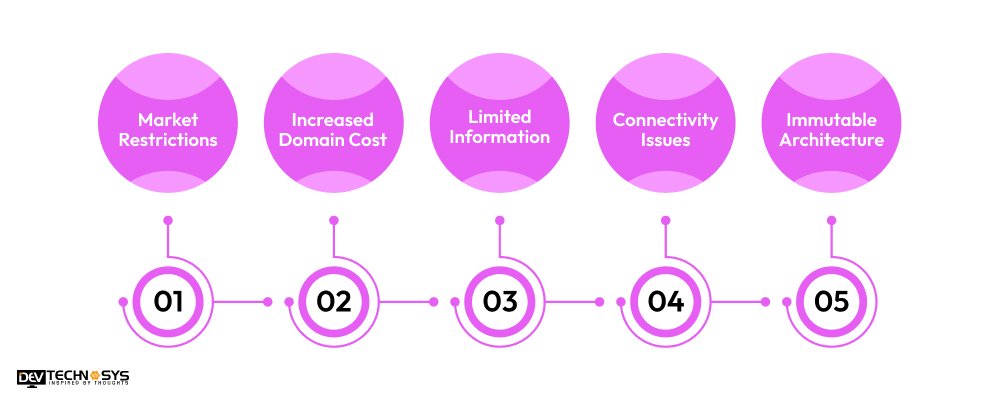
1. Market Restrictions
Numerous data sets are collected all at once and kept on the cloud in the finance and accounting systems. But, because the blockchain development for finance industry is not accepted worldwide it is quite difficult to safeguard.
Additionally, business investors can hire a mobile app development company to find the best solutions for this problem. The inability of various blockchain components and entities to connect with one another due to a lack of interoperability provokes the earlier issue.
2. Increased Domain Cost
As a professional working in the banking and financial sector, investing in the creation of accounting management software would be quite expensive. Additionally, it is essential to understand the cost to build a banking app in the UAE in the present industry as well as how to follow trends. Making the conversion to blockchain in the financial industry can be costly and time-consuming, particularly given the lack of qualified blockchain developers.
3. Limited Information
It is critical to modify the supply of financial assets in accordance with the needs and requirements of consumers. Additionally, using information from the digital system becomes difficult and calls for specialized facilities like implementing blockchain technology in financial services. To solve this issue more effectively, you can create banking asset management software. Regulators are still lagging behind because of the high software development cost due to which blockchain technology is still new and.

4. Connectivity Issues
To meet the finanacial requirements, the resources in the accounting and banking sector are crucial. To solve this problem, you can start integrating blockchain applications in iOS systems by putting up a strategy to offer limitless resources via software or any other platform.
Additionally, blockchain technology must be widely used for the best outcomes. This is particularly true if you are using iOS app development services in the financial sector, where a large number of businesses collaborate and discuss a common transaction handling approach.
5. Immutable Architecture
In the finance and risk management industry, developing sophisticated blockchain solutions for financial services is a highly difficult task. Additionally, a lot of software developers charge a lot of money to create different platforms for the finance sector.
So, connecting with a blockchain development company for making equity support system involves a number of phases that may take a long time. But, data on a blockchain platform cannot be changed. Despite this challenge, blockchain technology help investors to create dynamic systems.
Future Trends of Blockchain in Financial Industry
The future of blockchain technology in finance is driven by innovation, automation, and new security measures. Invest in blockchain app development offers new trends like cryptocurrencies, AI integration, asset tokenization, decentralized finance, and sustainable blockchain financial solutions, which will change how the financial industry operates through increased efficiency, transparency, and accessibility.
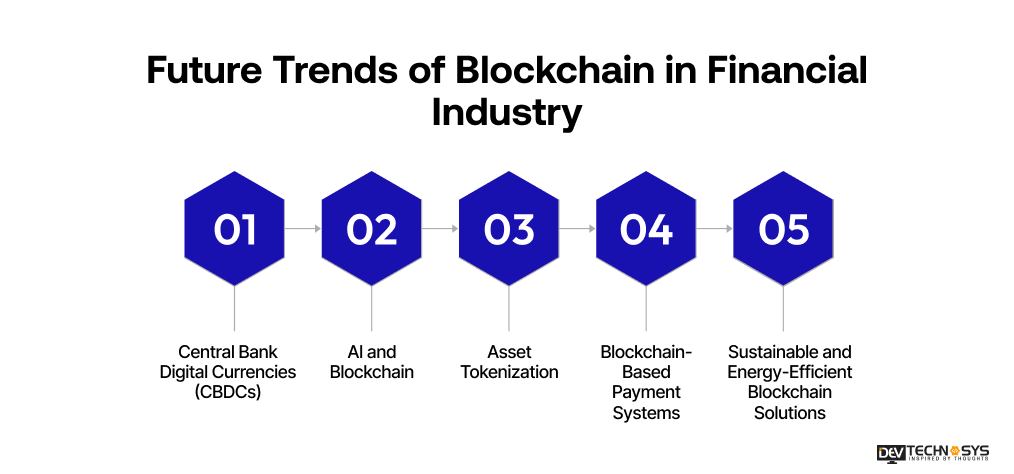
1. Central Bank Digital Currencies (CBDCs)
It is anticipated that Central Bank Digital Currencies will be an important trend in blockchain technology in the financial sector. Central Banks and governments are looking into digital currencies in order to make it easier to undertake payments, improve financial accessibility, and reduce the costs of transactions while keeping the regulatory structure.
2. AI and Blockchain
The merger of AI and blockchain in financial industry will push the importance of fintech services to a new level. The technologies help to introduce much more efficient automated operations, increase the accuracy of fraud prevention, and enhance the quality of analytics and information security.
3. Asset Tokenization
Tokenization of assets has the potential to change the way financial processes involving the assets (stocks, bonds, real estate) occur. With the help of blockchain technology, ownership of shared assets will become much more liquid and accessible to customers, thus bringing the development of financial blockchain platforms to a new level.
4. Blockchain-Based Payment Systems
The way financial operations happen in the near future will rely on the use of payment systems based on blockchain technology, bringing speed and transparency to the financial world. Platforms utilizing that digital banking technology will allow businesses and individuals to transfer money internationally at low costs thanks to quick settlements offered by using blockchain.
5. Sustainable and Energy-Efficient Blockchain Solutions
Financial service providers are interested in blockchain systems that are friendly to the environment. Innovations implemented into blockchain technology will enable institutions to operate in an eco-friendly manner while ensuring high blockchain security, scalability, and efficiency of operations.
In a Nutshell!!
In order to stay creative in the blockchain and cryptocurrency exchange industries, business owners are increasingly turning to the creation of the DeFi staking platform. Operating this network without adopting blockchain in financial industry is highly challenging. So, you must first understand how payment accounting, and trading system works are developed and invested in in the actual world. From the research to the deployment, using blockchain in banking can help you navigate the process.
So, now it is the ideal moment to hire a blockchain development company in Dubai to advance your business. Blockchain technology and cryptocurrency’s real-world assets are just waiting for you to have an influence on the present investment industry. What are you waiting for, then? Use our services to get your cryptocurrency token firm off to a strong start.
FAQs
1. What is Blockchain?
Blockchain is a modern technology that is applicable in different domains like, healthcare, finance, logistics, and entertainment. It has multiple components that assist business investors to deploy this technology in their online platforms.
2. Why Blockchain is Most Widely Used in the Finance Industry?
Presently, Blockchain is the second most popular technology after Artificial Intelligence. It is used much because of:
- Futuristic domain approach.
- Technical and managerial access.
- Continuous growing market.
3. Which Components of Blockchain are Used in the Finance Industry?
There are numerous components of Blockchain available to support different industries. But, there are only three of them are used in the finance industry:
- Decentralization of funds and quities.
- Using smart contracts for transactions.
- Tokenization of real entities and assets.
4. How Blockchain Services are Integrated With Financial Models?
Integrating of Blockchain services with financial infrastructure is quite a complex process due to its uniqueness and complexity. It goes like this:
- Identification of resources.
- Link financial models.
- Perform testing of blockchain components.
- Start service integration.
- Initiate promotion of digital platforms.
5. What are the Major Benefits of Blockchain in Financial Industry?
Using Blockchian with financial services can provide various advantages to business investors. So, let us look at them:
- This system delivers constant data-oriented results.
- Security of the system is always assured.
- Modern financial services can be easily accessed from anywhere.
6. What are the Challenges of Implementing Blockchain With Finance and Accounting?
Because of the newness of the Blockchain technology, there are several challenges for business investors to combine it with ordinary financial systems. These are as follows:
- The implementation cost is quite high.
- Development architecture cannot be changed.
- Less information is available on this industry.