





Key takeaways:
-
- The cost to build a taxi booking app like Taxif typically ranges between $30,000 and $1,50,000+, depending on complexity.
- A successful taxi booking app requires three major modules: Rider App, Driver App, and Admin Panel.
- Features like real-time tracking, automated dispatching, secure payments, and AI-powered route optimization technology impact development costs.
- The average time to develop a taxi booking app like Taxif in 2026 ranges from 3 to 7+ months.
- Revenue can be generated through ride commissions, surge pricing, subscriptions, and advertising.
The transportation industry has undergone a massive transformation over the past decade. Traditional taxi services were once dependent on street hailing and manual dispatch systems. These have now shifted toward fully automated, app-based ride-hailing platforms.
Taxi booking applications like Taxif have become central to urban mobility. It offers a seamless connection between riders and drivers in real time. These platforms eliminate inefficiencies in traditional systems and attract businesses to build a taxi booking app like Taxif.
Building a taxi booking app for entrepreneurs and startups is no longer a digital innovation. It is a scalable business opportunity capable of generating recurring revenue through commission-based transactions and value-added services.
The demand for on-demand taxi app development continues to rise globally. It is due to increasing urban populations, smartphone penetration, and consumer preference for convenience-driven services.
What Exactly Is Taxif and Why Is It Gaining Popularity in Ride-Hailing?
Taxif is a ride-hailing platform designed to connect passengers with nearby drivers through a mobile application ecosystem. It operates as a three-sided marketplace consisting of riders, drivers, and administrators.
The platform enables users to book rides instantly, track driver locations in real time, and make cashless payments. At the same time, drivers receive ride requests based on proximity and availability, allowing for optimized trip allocation and reduced waiting times.
The system is built around automation and real-time decision-making, ensuring efficient ride dispatch and smooth transportation experiences for users.
How Taxif Works:
The working model of Taxif is built on a structured workflow:
- A user opens the application and enters pickup and destination details.
- The system identifies nearby available drivers with GPS navigation integration
- A ride request is sent to the most suitable driver.
- Once accepted, both parties are connected through real-time tracking.
- The ride is completed, and the fare is automatically calculated.
- Payment is processed digitally or through cash, depending on availability.
- Both rider and driver provide ratings to maintain service quality.
This entire process of TaxiF app development is automated and completed within seconds, making the system highly efficient.
Taxi App Market Size in 2026: Global Trends You Need to Know
The global ride-hailing industry has experienced significant growth due to changing consumer behavior and advancements in mobile technology. The demand for convenient and cost-effective transportation continues to rise in both developed and emerging markets. Here, we will understand the data analyzed by Fortune Business Insight.
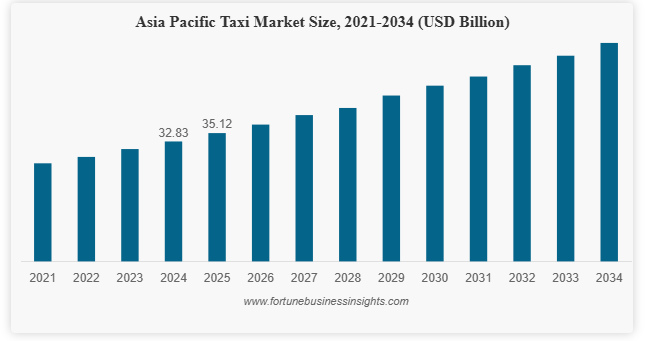
- The taxi market is valued at USD 96.31 billion in 2025, showing strong global industry demand growth.
- Market projected to reach USD 102.77 billion in 2026, indicating steady short-term expansion worldwide.
- The forecast suggests growth to USD 166.43 billion by 2034, highlighting long-term industry scalability.
- Industry expected to grow at 6.2% CAGR during the forecast period, ensuring consistent market momentum.
- Asia Pacific leads the taxi market with 36.47% share in 2025, dominating the global regional landscape.
Why Taxi Booking Apps Are a High-Growth Digital Business Opportunity?
Building a similar app like TaxiF provides multiple advantages from both a business and operational perspective. Scalability is the primary benefit to make a taxi booking app like Taxif. Once developed, the platform can be expanded to multiple cities or regions without significant changes to its core architecture.
Another advantage of making a TaxiF clone app is recurring revenue generation. Taxi booking app development services earn continuous income through ride commissions, surge pricing, and subscription models. Additionally, these platforms create a three-way ecosystem that benefits all participants:
- Riders receive convenient and fast transportation.
- Drivers gain access to consistent earning opportunities.
- Businesses generate scalable digital revenue.
The combination of automation and high transaction volume makes this model highly profitable when executed correctly.
Must-Have Features of a High-Performance Taxi Booking App
High-performance taxi booking TaxiF alternatives must deliver speed, reliability, and seamless user experience across all three modules: rider, driver, and admin panel. The success of platforms like Taxif depends heavily on feature engineering that ensures real-time responsiveness and operational efficiency.
1. Rider-Side Features
If businesses build a car rental app like Ekar, the rider panel focuses on convenience and transparency. Essential features include user registration, instant ride booking, fare estimation, live GPS tracking, multiple payment options, ride scheduling feature, and ride history. Emergency SOS integration and in-app notifications improve safety and engagement.
Feature |
Purpose |
| User Registration & Login | Enables secure onboarding and personalized user access |
| Profile Management | Allows users to update personal details and preferences |
| Ride Booking | Let users instantly request a taxi with pickup/drop location |
| Fare Estimation Calculator | Provides upfront cost transparency before ride confirmation |
| Live GPS Tracking | Enables real-time tracking of driver location and ride progress |
| Multiple Payment Options | Supports cards, wallets, UPI, and cash payments |
| Ride Scheduling | Allows users to book rides in advance for future trips |
| Ride History | Maintains records of all past rides for reference |
| Ratings & Reviews | Helps improve service quality through a feedback system |
| SOS Emergency Button | Provides instant emergency assistance during rides |
2. Driver-Side Features
Driver apps require tools for efficiency and earnings optimization. Key features include driver onboarding, document verification, availability toggle, ride request acceptance, navigation support, earnings dashboard, trip history, and rating systems. These features help optimize driver productivity and retention.
Feature |
Purpose |
| Driver Registration | Enables drivers to sign up and join the platform |
| Document Verification (KYC) | Ensures safety through identity and license validation |
| Availability Toggle | Allows drivers to set an active or inactive status |
| Ride Request Notifications | Alerts drivers about nearby ride requests instantly |
| Ride Acceptance/Decline | Gives drivers control over accepting trips |
| GPS Navigation | Provides optimized routes for efficient trip completion |
| Earnings Dashboard | Displays daily, weekly, and monthly earnings overview |
| Trip History | Tracks all completed rides for performance monitoring |
| Driver Ratings | Helps maintain service quality and accountability |
| In-App Communication | Enables chat or call between the driver and the rider |
3. Admin Panel Features
The admin dashboard acts as the control center. It includes user management, driver management, ride monitoring, commission tracking, dynamic pricing control, analytics dashboards, dispute resolution, and promotional management.
Feature |
Purpose |
| Admin Dashboard | Provides a centralized system overview and control |
| User Management | Manages rider accounts and user activities |
| Driver Management | Monitors driver onboarding and performance |
| Ride Monitoring | Tracks ongoing and completed rides in real-time |
| Commission Management | Controls platform earnings per ride |
| Dynamic Pricing Control | Adjusts fares based on demand and supply |
| Analytics & Reporting | Provides business insights and performance data |
| Dispute Resolution | Handles payment or ride-related conflicts |
| Promotions & Discounts | Manages coupons, offers, and campaigns |
| System Configuration | Controls platform settings and operational rules |
How to Develop a Scalable Taxi Booking App Like Taxif from Scratch?
To create a taxi booking app like Taxif, a structured, engineering-driven development lifecycle is needed. The cycle should be focused on performance, scalability, real-time coordination, and seamless user experience across rider, driver, and admin systems. Each stage ensures stability, security, and long-term platform growth.
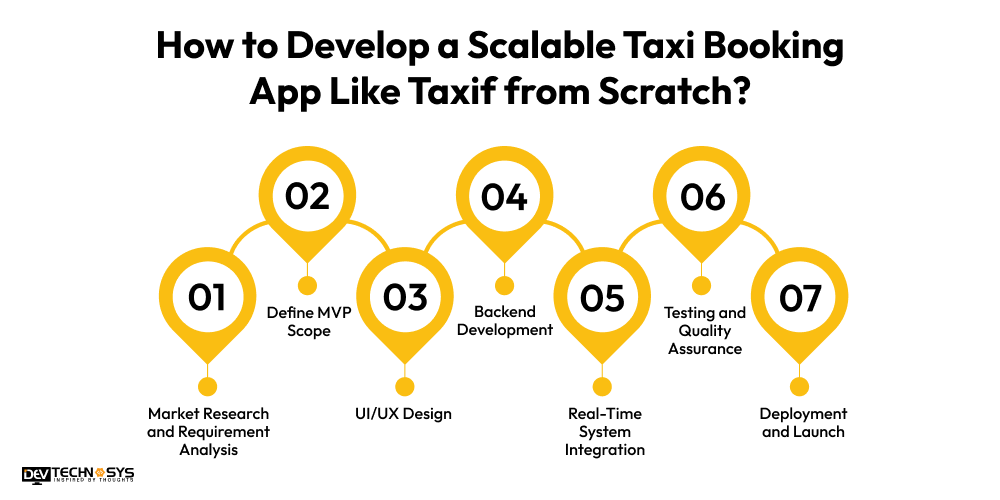
Step 1: Market Research and Requirement Analysis
This stage defines the foundation of the entire product by analyzing user behavior, competitor platforms, and market demand patterns. It helps identify feature gaps, target audience needs, and monetization opportunities. Technical feasibility, regional compliance, and scalability expectations are also evaluated to ensure the product aligns with business goals and industry standards.
Step 2: Define MVP Scope
In this stage, the minimum viable product is structured by selecting only essential features such as user registration, ride booking, driver matching, GPS tracking, and payments. This reduces mobile app development cost and time while validating the business idea quickly. The MVP approach ensures faster market entry and early user feedback collection for improvements.
Step 3: UI/UX Design
UI/UX design focuses on creating intuitive and user-friendly interfaces for both riders and drivers. The goal is to minimize friction in booking rides and accepting requests. Designers create wireframes, prototypes, and user flows that ensure smooth navigation, fast interactions, and a consistent experience across mobile platforms, improving engagement and retention significantly.
Step 4: Backend Development
Backend development involves building secure and scalable APIs that handle ride requests, user authentication, payment processing, and data storage. This layer manages business logic and ensures system stability under high traffic. Developers use frameworks like Node.js or Java to create a modular, efficient taxi booking app development solution.
Step 5: Real-Time System Integration
This stage enables instant communication between riders, drivers, and the system using technologies like WebSockets, Firebase, or MQTT. It supports live tracking, driver allocation, and real-time notifications. Efficient synchronization ensures accurate location updates and reduces delays, which is critical for maintaining reliability and user trust in ride-hailing applications.
Step 6: Testing and Quality Assurance
Testing ensures the application performs reliably under different conditions. Functional testing validates features, performance testing checks scalability under heavy traffic, and security testing identifies vulnerabilities. QA teams simulate real-world scenarios to detect bugs and ensure a smooth user experience across devices before deployment, reducing post-launch failures and operational risks significantly.
Step 7: Deployment and Launch
Deployment involves releasing the application on platforms like Google Play Store, Apple App Store, and web servers. A mobile app development company configures cloud infrastructure for scalability and uptime. Post-launch monitoring tracks performance, crashes, and user behavior. Continuous updates, bug fixes, and feature enhancements ensure long-term stability and platform growth in competitive markets.
Development Timeline for Building a Taxi Booking App Like Taxif
The development timeline of a taxi booking app depends on feature complexity, technology stack, and scalability requirements. A standard MVP can be delivered faster, while an advanced AI-powered ride-hailing platform requires additional time for backend architecture, real-time systems, security integration, and rigorous testing before launch.
Stage |
Duration |
What Happens |
| Market Research & Requirement Analysis | 2–3 Weeks | Defines features, business model, target audience, and technical scope |
| UI/UX Design | 3–5 Weeks | Creates rider, driver, and admin interfaces with a smooth user experience |
| Backend Development | 5–7 Weeks | Builds APIs, database structure, authentication, and core logic |
| Frontend Development | 6–8 Weeks | Develops rider and driver mobile apps (Flutter/React Native/native) |
| Real-Time Integration | 3–4 Weeks | Adds live tracking, GPS updates, and instant notifications |
| Payment & Third-Party Integration | 2–3 Weeks | Integrates payment gateways, maps, SMS, and analytics tools |
| Testing & QA | 3–5 Weeks | Performs functional, performance, and security testing |
| Deployment & Launch | 1–2 Weeks | App store release, cloud setup, and production deployment |
| Post-Launch Optimization | Ongoing | Bug fixes, scaling, performance monitoring, and updates |
Scalable Architecture of a Modern Taxi Booking App
A scalable taxi booking app architecture is designed to handle real-time ride tracking, high user traffic, and seamless coordination between riders, drivers, and admins. It uses distributed systems, microservices, and cloud infrastructure to ensure reliability, speed, and future scalability.
Layer |
Purpose |
| Client Layer (Rider & Driver Apps) | Handles user interaction and provides intuitive mobile interfaces for booking and accepting rides |
| API Gateway | Acts as a single entry point managing authentication, routing, and request handling |
| Microservices Layer | Breaks the system into independent services like booking, payments, and user management |
| Ride Matching Engine | Matches riders with nearby drivers using location-based algorithms |
| Real-Time Communication Layer | Enables live tracking, notifications, and instant updates using WebSockets or MQTT |
| Database Layer | Stores structured and unstructured data such as user profiles, rides, and payments |
| Cache Layer (Redis) | Improves system speed by storing frequently accessed data in memory |
| Cloud Infrastructure | Ensures scalability, uptime, and load balancing using AWS, Azure, or GCP |
| Payment Gateway Integration | Handles secure transactions and fare processing in real time |
| Monitoring & Logging System | Tracks system performance, errors, and ensures operational stability |
Best Technology Stack for Taxi Booking App Development in 2026-2027
Choosing the right technology stack is critical for building a fast, scalable, and secure taxi booking app. The stack must support real-time operations, high traffic loads, and seamless integration across rider, driver, and admin systems.
Layer |
Technologies |
Purpose |
| Mobile App Development | Flutter / React Native | Builds cross-platform rider and driver applications efficiently |
| iOS Development | Swift | Creates high-performance native iOS applications |
| Android Development | Kotlin | Builds optimized native Android applications |
| Backend Development | Node.js / Java / Python | Handles core business logic and scalable server-side operations |
| Database Management | PostgreSQL / MongoDB | Stores structured and flexible ride, user, and payment data |
| Real-Time Communication | WebSockets / Firebase | Enables live tracking, chat, and instant updates |
| Cloud Infrastructure | AWS / Google Cloud / Azure | Provides scalable hosting, storage, and deployment services |
| Caching System | Redis | Improves speed by storing frequently used data in memory |
| Payment Integration | Stripe / PayPal / Razorpay | Ensures secure and seamless digital transactions |
| Mapping & Navigation | Google Maps API / Mapbox | Provides route optimization and real-time location tracking |
How Taxi Apps Ensure Data Protection and Payment Security?
To build a taxi booking app like Taxif that handles user data, location tracking, and payments, security is a priority. To build trust and ensure regulatory compliance, platforms like Taxif implement multi-layered security frameworks. It covers data protection, payment safety, identity verification, and fraud prevention systems.
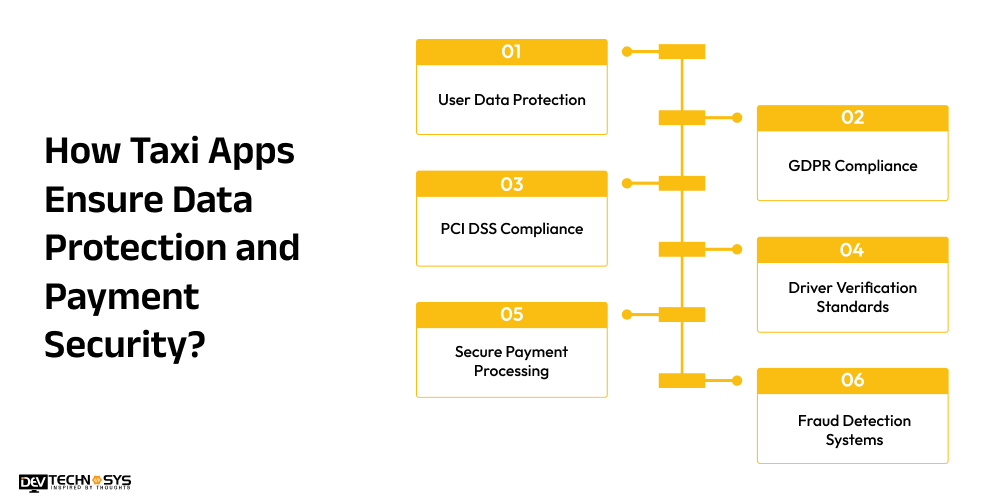
1. User Data Protection
Taxi apps protect user data through encryption, secure APIs, and restricted access control systems. Personal information such as names, phone numbers, and location history is stored in encrypted databases. Role-based access ensures only authorized systems and personnel can access sensitive data securely and efficiently.
2. GDPR Compliance
GDPR compliance ensures that taxi apps follow strict European data privacy regulations regarding user consent, data storage, and transparency. Users have the right to access, modify, or delete their data. Apps implement consent management systems and data minimization practices to meet legal requirements and avoid regulatory penalties.
3. PCI DSS Compliance
PCI DSS compliance ensures secure handling of card payment information within taxi apps. It enforces encryption, tokenization, and secure payment gateway integration to prevent card data breaches. Compliance with these standards reduces fraud risk and ensures that all financial transactions are processed in a secure, regulated environment.

4. Driver Verification Standards
Driver verification standards ensure that only legitimate and qualified drivers operate on the platform. This includes identity verification, driving license validation, background checks, and vehicle documentation. These checks reduce risks, enhance passenger safety, and maintain trust in the ride-hailing ecosystem by preventing unauthorized driver access.
5. Secure Payment Processing
Secure payment processing in taxi apps is enabled through encrypted payment gateways, multi-factor authentication, and token-based transactions. Platforms integrate trusted providers like Stripe or Razorpay to ensure safe digital payments. This minimizes risks of fraud, ensures transaction integrity, and provides seamless cashless payment experiences for users.
6. Fraud Detection Systems
Fraud detection systems use AI and machine learning to identify suspicious activities such as fake rides, location spoofing, or payment manipulation. Real-time monitoring and anomaly detection help prevent financial losses. These systems continuously analyze user behavior patterns to ensure platform integrity and maintain secure operational environments.
Complete Cost Guide to Build a Taxi Booking App Like Taxif in 2026-2027
The cost to make a taxi booking app like Taxif in 2026 primarily depends on the level of complexity, features, and scalability requirements.
- A basic MVP version typically costs between $30,000–$55,000, including essential features like user registration, ride booking, GPS tracking, and simple payment integration.
- A mid-level taxi app with advanced functionalities such as real-time tracking, multiple payment gateways, in-app chat, and analytics can range from $55,000–$100,000.
- For an advanced, AI-powered, highly scalable ride-hailing platform with dynamic pricing, predictive analytics, and microservices architecture, the cost can go up to $100,000–$150,000.
Additional factors like UI/UX, third-party integrations, and security also influence the cost to build a taxi app like Lyft.
Key Factors That Influence the Cost to Develop a Taxi Booking App Like Taxif
The cost to create a taxi booking app like Taxif depends on multiple technical and design-related factors. These directly influence development time, complexity, and infrastructure needs. Each factor plays a crucial role in determining overall budget, performance quality, and long-term scalability of the platform.
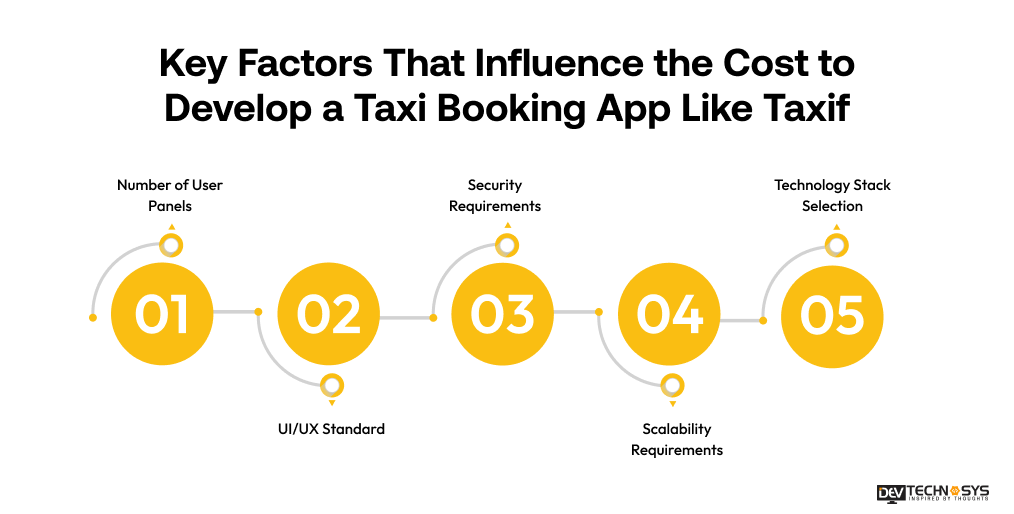
1. Number of User Panels
The number of user panels significantly impacts TaxiF app development cost. It is because each panel requires a separate design, backend logic, and testing. A taxi app typically includes rider, driver, and admin panels. More panels increase development time, API complexity, and integration efforts, ultimately. It is raising the overall project cost and maintenance requirements.
User Panel Type |
Cost Impact |
Explanation |
| Rider App Panel | $1,500 – $2,500 | Includes booking, tracking, payments, and user profile features |
| Driver App Panel | $1,500 – $2,500 | Covers ride acceptance, navigation, earnings, and availability management |
| Admin Panel | $2,000 – $5,000 | Handles operations, analytics, pricing control, and user management |
2. UI/UX Standard
UI/UX design standards directly influence taxi booking app development cost. It requires highly intuitive and visually appealing interfaces for extensive research, prototyping, and user testing. Advanced animations, seamless navigation, and micro-interactions increase design complexity. A premium UI/UX enhances demands for more design hours and skilled expertise, increasing overall project investment.
UI/UX Level |
Cost Impact |
Explanation |
| Basic UI Design | $5,000 – $8,000 | Simple interfaces with standard navigation and layouts |
| Mid-Level UI/UX | $8,000 – $15,000 | Improved user flow, branding, and responsive design |
| Premium UI/UX | $15,000 – $20,000 | Advanced animations, micro-interactions, and high-end user experience |
3. Security Requirements
Security requirements add to development cost because taxi apps handle sensitive user data, location tracking, and digital payments. Implementing encryption, authentication systems, fraud detection, and compliance standards like GDPR and PCI DSS requires advanced engineering. Strong security frameworks significantly increase both development effort and ongoing maintenance expenses.
Security Level |
Cost Impact |
Explanation |
| Basic Security | $5,000 – $8,000 | SSL encryption, secure login, and basic authentication |
| Standard Security | $8,000 – $15,000 | Role-based access, encrypted APIs, and secure payments |
| Advanced Security | $15,000 – $20,000 | Fraud detection, AI monitoring, GDPR & PCI DSS compliance |
4. Scalability Requirements
Scalability requirements impact the cost to develop a Turo car rental marketplace app. The system must handle growing users, rides, and real-time requests efficiently. Building scalable architecture using microservices, cloud infrastructure, load balancing, and caching systems requires advanced planning and resources. Higher scalability ensures long-term performance but increases initial development and infrastructure investment significantly.
Scalability Level |
Cost Impact |
Explanation |
| Basic Scalability | $3,000 – $5,000 | Handles a small user base with limited traffic |
| Medium Scalability | $5,000 – $8,000 | Supports multiple cities and moderate traffic load |
| High Scalability | $8,000 – $10,000 | Microservices, cloud scaling, and high-traffic readiness |
5. Technology Stack Selection
Technology stack selection affects cost based on complexity, performance needs, and developer availability. Choosing modern frameworks like Flutter, Node.js, or cloud-native tools can reduce or increase development time. Advanced stacks supporting real-time features, AI integration, and high scalability require experienced developers, increasing overall project cost and execution complexity.
Tech Stack Level |
Cost Impact |
Explanation |
| Standard Stack | $5,000 – $8,000 | Basic frameworks like Flutter + Node.js setup |
| Advanced Stack | $8,000 – $12,000 | Real-time APIs, caching, and optimized backend architecture |
| Enterprise Stack | $12,000 – $15,000 | AI integration, microservices, and cloud-native deployment |
How Taxi Apps Like Taxif Generate Multi-Stream Income?
Taxi booking apps like Taxif operate on diversified revenue models that ensure consistent profitability beyond just ride bookings. They combine dynamic pricing strategies, commissions, subscriptions, and enterprise solutions. These platforms create multiple income streams that support long-term scalability and sustainable business growth in the competitive ride-hailing market.
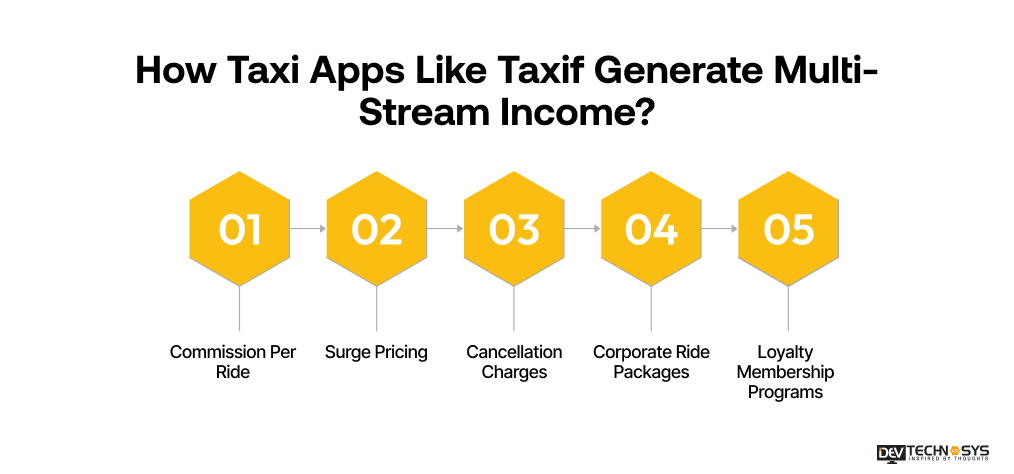
1. Commission Per Ride
Commission per ride is the primary revenue source for taxi apps, where the platform earns a fixed percentage from every completed trip. This fee is automatically deducted from the driver’s earnings. It ensures consistent income for the platform while enabling drivers to access a large customer base without marketing costs.
2. Surge Pricing
Surge pricing allows taxi apps to increase fares dynamically during high-demand periods such as rush hours, holidays, or bad weather. This model balances supply and demand while maximizing revenue per trip. It also encourages more drivers to become available during peak times, improving overall platform efficiency and service availability.
3. Cancellation Charges
Cancellation charges are applied when riders or drivers cancel a confirmed trip after a certain time limit. These fees compensate the other party for lost time and opportunity. For the platform, it becomes an additional revenue stream. It also discourages unnecessary cancellations, ensuring smoother ride operations and better service reliability.
4. Corporate Ride Packages
Corporate ride packages target businesses that require regular transportation for employees or clients. Companies subscribe to customized plans with fixed billing cycles and centralized dashboards. This generates high-value recurring revenue for the platform. It offers businesses mobile app maintenance cost control, reporting features, and streamlined employee travel management solutions.
5. Loyalty Membership Programs
Loyalty membership programs encourage frequent usage by offering riders benefits such as discounts, priority bookings, and cashback rewards. Users pay subscription fees or engage more frequently to access perks. This model increases customer retention, enhances engagement, and creates a predictable recurring revenue stream for the taxi booking platform.
Common Problems in Ride-Hailing App Development and Solutions
Building a ride-hailing app like Taxif comes with operational and technical challenges that directly impact user experience, driver satisfaction, and platform scalability. To build a ride-sharing app like Uber, addressing these issues effectively is important. It ensures smooth performance, safety, and long-term business sustainability in a highly competitive market.
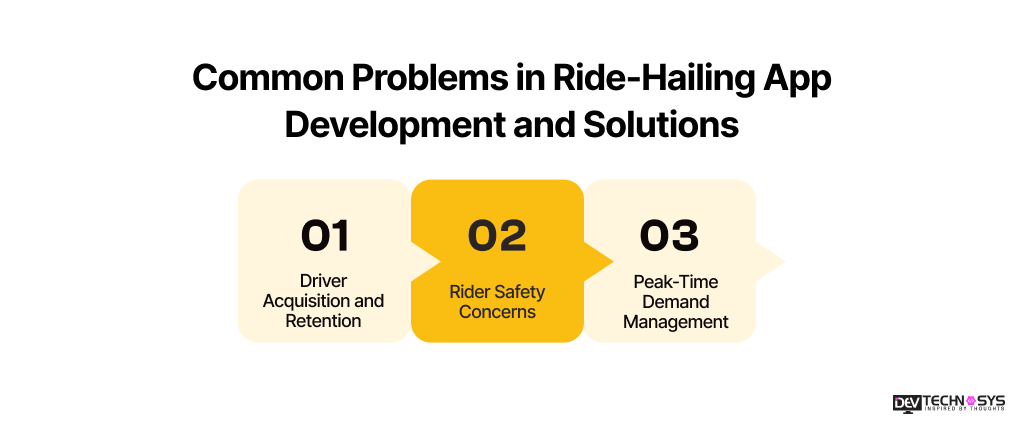
1. Driver Acquisition and Retention
One of the biggest challenges is attracting and retaining reliable drivers on the platform. High competition, inconsistent earnings, and a lack of incentives often lead to driver drop-offs. Without enough drivers, ride availability decreases, affecting user experience and platform credibility.
Solution:
To solve this, apps implement structured onboarding incentives, flexible earnings models, and performance-based bonuses. Providing transparent earnings dashboards, low commission structures, and fuel rewards improves retention. Additionally, continuous engagement programs and driver support systems help build long-term trust and platform loyalty.
2. Rider Safety Concerns
Rider safety is a critical concern in ride-hailing platforms, especially during late-night rides or in unfamiliar areas. Issues like driver misconduct, route deviation, or lack of emergency support can negatively impact user trust and platform reputation.
Solution:
Apps address this through multi-layer safety systems including driver verification (KYC), real-time GPS tracking, SOS emergency buttons, trip sharing features, and in-app emergency support. AI-based behavior monitoring also helps detect unusual activity, ensuring proactive safety management and building user confidence.
3. Peak-Time Demand Management
During peak hours such as rush periods, holidays, or bad weather, ride demand often exceeds driver availability. This leads to longer wait times, surge pricing dissatisfaction, and reduced user retention.
Solution:
Taxi apps solve this using dynamic pricing algorithms, predictive demand forecasting, and real-time driver incentives. AI systems predict high-demand zones and encourage driver repositioning. Additionally, queue management and ride pooling options help balance supply-demand gaps efficiently while maintaining service quality.
How AI Is Transforming Taxi Booking Apps?
AI-powered taxi app development is significantly reshaping taxi booking by making it smarter, faster, and more efficient. AI-powered algorithms improve ride matching by instantly connecting riders with the nearest and most suitable drivers. It reduces the wait times and increases trip efficiency.
Predictive analytics helps platforms forecast demand patterns, allowing better driver allocation during peak hours. Dynamic pricing models powered by AI adjust fares in real time based on demand, traffic, and availability.
An AI-powered taxi booking app also enhances route optimization by analyzing traffic conditions and suggesting the fastest routes for drivers. Additionally, fraud detection systems use machine learning to identify suspicious activities such as fake rides or payment anomalies.

Conclusion
Taxi booking apps like Taxif represent a powerful blend of mobility, technology, and data-driven innovation. From real-time ride matching and scalable architecture to AI-powered optimization and secure payment systems, these platforms are redefining urban transportation.
The development process requires careful planning, strong technical expertise, and a reliable taxi booking app development company. Cost varies based on complexity, but investing in advanced features like AI, security, and scalability ensures long-term profitability.
As demand for on-demand transportation continues to grow, businesses build a taxi booking app like Taxif. It will gain a strong competitive advantage in the evolving digital mobility ecosystem.
FAQs
Q1. Why Do Most Taxi Apps Fail In The First Year After Launch?
Most taxi apps fail due to poor driver acquisition strategy, weak demand-supply balance, and lack of scalability planning. Technical issues like slow ride matching and payment failures also contribute. Without strong backend architecture and market strategy, apps cannot sustain operations or compete with established ride-hailing platforms.
Q2. How Important Is Real-Time Architecture In A Taxi Booking App?
Real-time architecture is critical because taxi apps depend on instant ride matching, live GPS tracking, and dynamic pricing updates. Without WebSockets or event-driven systems, delays occur in communication between riders and drivers, leading to poor user experience, lost bookings, and reduced platform trust and engagement.
Q3. What Makes A Taxi Booking App Scalable For Millions Of Users?
Scalability depends on microservices architecture, cloud infrastructure, load balancing, and optimized databases. These systems ensure the app can handle high concurrent ride requests without crashes. Caching systems like Redis and distributed servers also help maintain speed and stability during peak traffic conditions across multiple cities.
Q4. How Do AI Algorithms Improve Taxi Dispatch Efficiency?
AI improves taxi dispatch app development efficiency by analyzing rider location, driver availability, and traffic conditions in real time. It reduces waiting time, increases ride completion rates, and optimizes fuel usage. Machine learning models continuously improve matching accuracy, making the entire ride-hailing system more efficient and cost-effective.
Q5. What Is The Biggest Technical Challenge In Building A Taxi Booking Platform?
The biggest challenge is building a real-time, low-latency system that handles millions of concurrent users. This includes instant ride matching, live tracking, and secure payment processing. Ensuring system stability, scalability, and synchronization across rider and driver apps is the most complex engineering requirement.