





Key Takeaways
Quick Summary:
Taxi apps like Lyft generate revenue through ride commissions, surge pricing, subscriptions, and partnerships. Overall, the taxi app development cost in 2026 typically ranges from $8,000 to $15,000+ for MVP solutions, $15,000 to $22,000+ for mid-level apps. The budget to create a ride-hailing mobile app with advanced features and functionalities can exceed $30,000+, depending on complexity and scalability.
Key Cost Drivers
- Real-Time GPS & Dispatch System: Implementing accurate location tracking, route optimization, and driver-passenger matching significantly increases complexity and cost to create a taxi app like Lyft due to real-time processing requirements.
- Third-Party Integrations: Integration of maps (Google Maps), payment gateways, SMS services, and analytics tools adds both operational and upfront taxi app development cost in UAE and recurring.
- Feature Complexity: On-demand taxi app development includes features like surge pricing, ride scheduling, in-app chat, ratings, and admin dashboards, which increase development time, technical effort, and overall MVP cost for taxi booking app.
- Scalability Needs: Apps designed for large user bases require cloud infrastructure, load balancing, and high-performance backend systems, leading to a higher long-term budget to create a ride-hailing mobile app.
Cost Based on Countries
- USA & Canada: $60 to $100/hour
- Western Europe: $45 to $85/hour
- Eastern Europe: $35 to $70/hour
- India & Southeast Asia: $15 to $25/hour
Development Timeline
- MVP Taxi App: 2 to 4+ months
- Mid-Level App: 4 to 7+ months
- Advanced Lyft-like Platform: 7 to 12+ months or more
- Asia (India, Southeast Asia): $15 – $25+ per hour
Building a taxi app like Lyft isn’t just about launching a ride-booking platform; it’s about creating a seamless, real-time mobility experience that users can rely on daily. With the global success of platforms like Lyft and Uber, the demand for smart transportation solutions continues to rise rapidly.
But how much does it actually cost to develop such an app in 2026? The answer depends on several factors, including features, technology stack, app complexity, and scalability requirements. From basic MVPs to fully advanced, AI-powered taxi platforms, the cost to build a taxi app like Lyft can vary significantly.
This informative guide will break down the key cost components, essential features, and development stages to help you understand what it takes, financially and technically, to build a successful taxi app like Lyft.
Taxi App Market Insights
- The Taxi Market Size is estimated to grow from USD 254.36 billion in 2026 to reach USD 366.91 billion by 2031, at a CAGR of 7.62% during the forecast period (2026-2031)
- By booking type, online channels captured 63.78% of taxi market share in 2026 and are forecast to grow at an 7.92% CAGR through 2031.
- By service type, pooled ride-sharing is advancing at an 7.78% CAGR through 2031.
- By vehicle type, passenger cars held 60.58% of taxi market share in 2026, whereas two-wheeler formats are forecast to grow at an 7.71% CAGR over the same period.
What is the Average Cost to Build Taxi App Like Lyft?
The average cost to build a taxi app like Lyft in 2026 typically ranges from $8,000 to $12,000+ for a basic MVP version, while mid-level car rental app development solutions can go up to $15,000 to $22,000+. Advanced, fully scalable ride-hailing platforms with real-time tracking, AI dispatch systems, and multi-city support can cost $30,000+ or more, depending on complexity, features, and infrastructure requirements.
| App Type | Estimated Cost (USD) | Development Timeline |
| Basic MVP Taxi App | $8,000 – $15,000+ | 2 – 4 months |
| Mid-Level Taxi App | $15,000 – $22,000+ | 4 – 8 months |
| Advanced Lyft-like App | $22,000 – $30,000+ | 8 – 12+ months |
The final cab booking app cost largely depends on feature set, technology stack, platform choice, and third-party integrations. Additionally, ongoing expenses like maintenance, cloud hosting, and marketing also contribute to the total investment required for long-term success.
Industry Insights: According to Statista, the global ride-hailing market reached ~$154 billion and continues to grow steadily. It is projected to serve 2.3 billion users by 2029.
What are the Factors Affecting the Cost to Build a Taxi App Like Lyft?
The cost to build a taxi app like Lyft depends on several technical and business factors that influence development complexity, scalability, and overall investment. Each element, from features to infrastructure, directly impacts the final budget and timeline of the project.
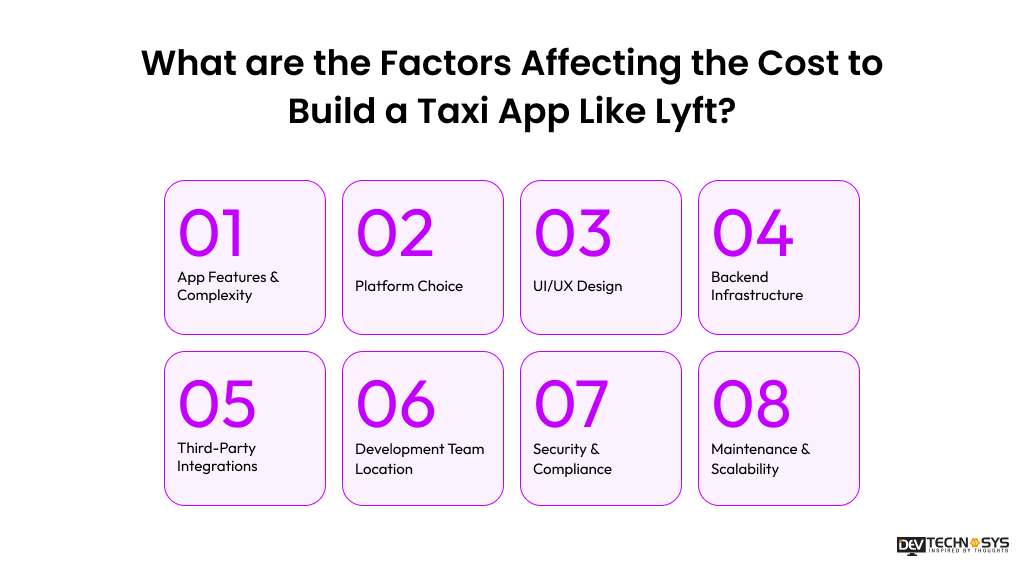
1. App Features & Complexity
The cost to develop a taxi booking app depends heavily on the number and complexity of features. Basic apps with ride booking and GPS tracking are more affordable, while advanced Ride-sharing app features like surge pricing, AI-based dispatch, WebSockets (real-time updates), Google Maps API / Mapbox, in-app chat, real-time tracking, and multi-city operations significantly increase development effort, time, and overall cost to develop a taxi app like Lyft.
| Complexity Level | Development Timeline | Estimated Cost Impact |
| Basic | 2 – 3 months | $3,000 – $7,000 |
| Medium | 3 – 6 months | $6,000 – $8,000+ |
| Advanced | 6 – 12+ months | $8,000 – 11,000+ |
2. Platform Choice
Your choice of iOS, Android or cross-platform directly affects Lyft app development cost. Building native apps for each platform is expensive, while cross-platform mobile app development using frameworks like Flutter or React Native reduces development time, resource needs, and overall cost to produce a cab service like Lyft.
| Approach | Development Timeline | Estimated Cost Impact |
| Single Platform | 2 – 3 months | $8,000 – $12,000 |
| Cross-Platform | 3 – 5 months | $12,000 – $17,000 |
| Native iOS + Android | 4 – 8 months | $18,000 – $23,000+ |
3. UI/UX Design
A good UI/UX design promotes the usability and consumer happiness of the app, but also increases the mobile app development cost. Design is an important aspect of developing taxi apps since it impacts the development cost. It involves designing easy-to-understand interfaces for both riders and drivers, coming up with unique navigation patterns, and facilitating seamless interaction between the two entities. The following table shows the cost of UI/UX design for ride-hailing apps, dependent on the level of complexity of design.
| Level | Development Timeline | Estimated Cost Impact |
| Basic UI | 2 – 3 weeks | $2,000 – $5,000 |
| Custom UI/UX | 3 – 6 weeks | $5,000 – $10,000 |
| Premium UI/UX | 6 – 10 weeks | $10,000 – $15,000+ |

4. Backend Infrastructure
A robust backend is necessary to manage ride bookings, user data, payments, and real-time operations. The scalable cloud infrastructure, secure databases, and API development will increase both the initial setup costs and the continuing maintenance costs as the user base expands.
| Level | Development Timeline | Estimated Cost Impact |
| Basic Backend | 2 – 4 weeks | $5,000 – $8,000 |
| Scalable Backend | 4 – 8 weeks | $8,000 – $12,000 |
| Enterprise Backend | 8 – 16+ weeks | $12,000 – $16,000+ |
5. Third-Party Integrations
Utilizing additional services like Google Maps, payment gateways, SMS notifications, and analytics tools might boost app functionality, but they can also cost you extra. Every integration involves setup, testing, licensing fees, and maintenance. It makes development more complex and operations more costly. For a better understanding of the cost of API integration, see the table.
| Level | Development Timeline | Estimated Cost Impact |
| Basic APIs | 1 – 2 weeks | $2,000 – $5,700 |
| Standard Integrations | 2 – 4 weeks | $5,800 – $11,000 |
| Advanced Integrations | 4 – 8 weeks | $10,000 – $16,000+ |
6. Development Team Location
The cost of on-demand app development services varies greatly by region. Teams in the USA and Western Europe charge higher hourly fees, whereas developers in India and Southeast Asia provide a more affordable alternative without sacrificing quality to maximize the entire cost of creating a taxi app like Lyft.
| Region | Development Timeline | Estimated Cost Impact |
| USA / Canada | 4 – 10 months | $50,000 – $150,000+ |
| Europe | 4 – 9 months | $30,000 – $100,000+ |
| India / SE Asia | 3 – 8 months | $8,000 – $50,000 |
7. Security & Compliance
Top taxi app development companies in UAE provide post-launch maintenance services, including bug repairing, upgrading, performance optimization, and scaling infrastructure. These recurrent fees are typically 15-25% of the initial development price every year, ensuring that your software remains stable, secure, and equipped to handle increasing user demand.
| Level | Development Timeline | Estimated Cost Impact |
| Basic Security | 1 – 2 weeks | $2,000 – $5,000 |
| Standard Security | 2 – 4 weeks | $5,000 – $8,000 |
| Advanced Compliance | 4 – 8 weeks | $8,000 – $13,000+ |
8. Maintenance & Scalability
Top taxi booking app development companies in UAE provide post-launch maintenance, including bug fixes, updates, performance optimization, and infrastructure scaling. These ongoing expenses typically account for 15% to 25% of the initial development cost annually, ensuring the app remains stable, secure, and capable of handling growing user demand.
| Stage | Development Timeline | Annual Cost Impact |
| Basic Maintenance | Ongoing | 12% of total cost |
| Growth Scaling | Ongoing | 15% of total cost |
| Enterprise Scaling | Ongoing | 18%+ of total cost |
Why Should Businesses Invest in Taxi App Development?
Investing in taxi booking app development services helps businesses tap into the rapidly growing on-demand mobility market. With increasing demand for convenient, digital-first transportation services, taxi apps provide strong revenue potential, operational efficiency, and long-term scalability for both startups and established transport companies.
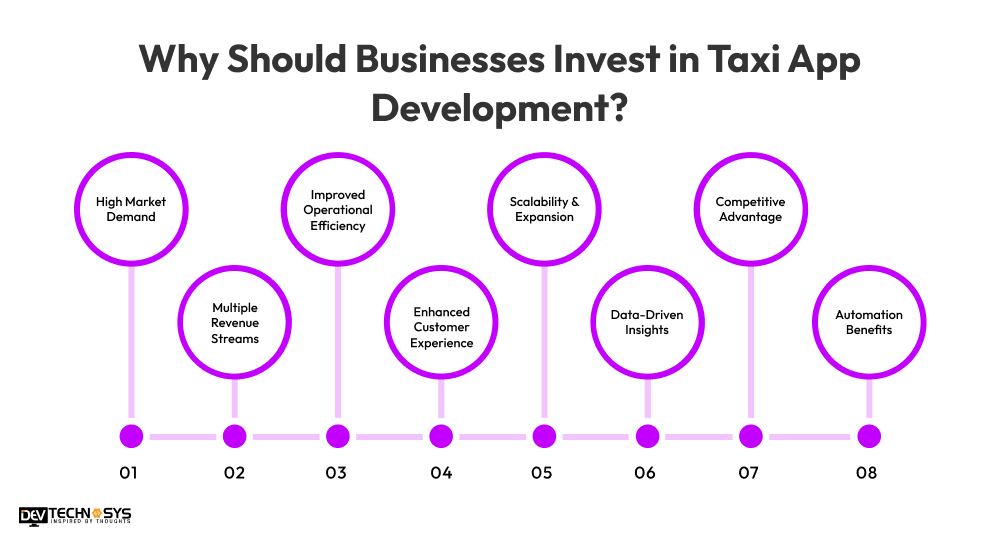
- High Market Demand: Growing urbanization and smartphone usage are increasing demand for on-demand taxi services globally.
- Multiple Revenue Streams: Businesses can earn through ride commissions, surge pricing, subscriptions, ads, and partnerships.
- Improved Operational Efficiency: AI-powered taxi app development with real-time tracking, automated dispatch, and route optimization reduces delays and operational costs.
- Enhanced Customer Experience: Features like instant booking, live tracking, and digital payments improve user satisfaction and retention.
- Scalability & Expansion: Cloud-based taxi apps allow easy expansion into new cities and markets without major infrastructure changes.
- Data-Driven Insights: User and ride data help optimize pricing, performance, and business strategies.
- Competitive Advantage: A dedicated taxi app helps businesses compete with major players like Uber and Lyft.
- Automation Benefits: Booking, payments, and driver allocation are automated, reducing manual effort and errors.
Why is Budgeting Essential for Developing a Taxi App Like Lyft?
Budgeting is a critical part of developing a taxi app like Lyft as it ensures proper allocation of resources across design, development, and deployment. Smart budgeting helps businesses control Cost to build app like Uber/Lyft, avoid unexpected expenses, and build a scalable, feature-rich application within budget.
| Budget Area | Why It Matters | Impact on Project |
| Core Features | Focus on essential functions like booking & tracking | Ensures MVP is delivered within budget |
| Advanced Features | AI dispatch, Taxi app development pricing, analytics | Added only after validating MVP success |
| Payment Gateway Integration Cost | Maps, payments, SMS APIs | Prevents unexpected recurring costs |
| Infrastructure & Backend | Cloud hosting, databases (PostgreSQL / MongoDB, Redis (for caching), scalability | Ensures smooth performance under load |
| UI/UX Design | User experience and interface quality | Balances cost vs usability |
| Testing & QA | Bug fixing and performance optimization | Avoids post-launch failures |
| Maintenance | Updates, fixes, scalability upgrades | Ensures long-term app stability |
Top 5 Lyft Alternatives with Development Cost Insights
The ride-hailing market is highly competitive, with several strong alternatives to Lyft offering unique features and regional dominance. Understanding their development cost insights helps businesses evaluate budget requirements and build an app like Tirhal tailored to different markets and service models.
1. Careem
Careem is a leading ride-hailing platform in the Middle East, offering services like ride booking, digital payments, and loyalty programs. Developing a similar app with core ride-hailing and payment features requires scalable infrastructure and regional customization. To built a similar app like Careem, contact a top taxi booking app development solution provider in Middle East
| App Level | Development Timeline | Estimated Cost |
| Basic (Ride Booking + Payments) | 2 – 4 months | $15,000 – $22,000 |
| Mid-Level (Wallet, Loyalty, Tracking) | 4 – 7 months | $22,000 – $30,000+ |
| Advanced (Super App Features, Multi-services) | 7 – 12+ months | $30,000+ |
2. Uber
Uber is a global ride-hailing giant offering multiple services like UberX, Pool, and Eats. According to experts who provide android application development services, building a similar app involves complex features such as real-time tracking, dynamic pricing, and multi-service integration, increasing development effort and scalability requirements.
| App Level | Development Timeline | Estimated Cost |
| Basic MVP | 2 – 4 months | $20,000 – $25,000 |
| Mid-Level App | 4 – 8 months | $25,000 – $30,000+ |
| Advanced Platform (Multi-services) | 8 – 12+ months | $30,000+ |
3. Bolt
Bolt is a cost-effective ride-hailing platform popular in Europe and Africa, known for lower commission rates. Developing a similar app focuses on efficient ride matching, payments, and lightweight infrastructure, making it slightly more budget-friendly than global competitors.
| App Level | Development Timeline | Estimated Cost |
| Basic App | 2 – 3 months | $12,000 – $18,000 |
| Mid-Level App | 3 – 6 months | $18,000 – $25,000+ |
| Advanced Platform | 6 – 10+ months | $25,000 – $30,000+ |
4. Ola
Ola is a dominant player in India, offering diverse transport options such as autos, bikes, and cars. Building a similar app requires multi-vehicle support, regional adaptability, and scalable backend systems, which increases iOS and Android app development complexity and cost.
| App Level | Development Timeline | Estimated Cost |
| Basic App (Single Ride Type) | 2 – 4 months | $15,000 – $20,000 |
| Mid-Level (Multi-Vehicle Support) | 4 – 7 months | $20,000 – $30,000+ |
| Advanced (Regional Scaling + AI) | 7 – 12+ months | $30,000+ |
5. Gett
Gett focuses on corporate transportation and professional cab services. Developing a similar app involves features like scheduled bookings, enterprise dashboards, and premium service management, requiring a reliable backend and secure payment integration. Need to build an amazing on-demand app like Gett, contact a top mobile app development company in UAE.
| App Level | Development Timeline | Estimated Cost |
| Basic (Ride Booking) | 2 – 4 months | $18,000 – $22,000 |
| Mid-Level (Corporate Features) | 4 – 7 months | $22,000 – $30,000+ |
| Advanced (Enterprise Solutions) | 7 – 12+ months | $30,000+ |
Industry Insights: According to Grand View Research, the forecast estimates that the global ride-hailing taxi market will reach $181.5 billion by 2033, growing at a CAGR of 18.6%.
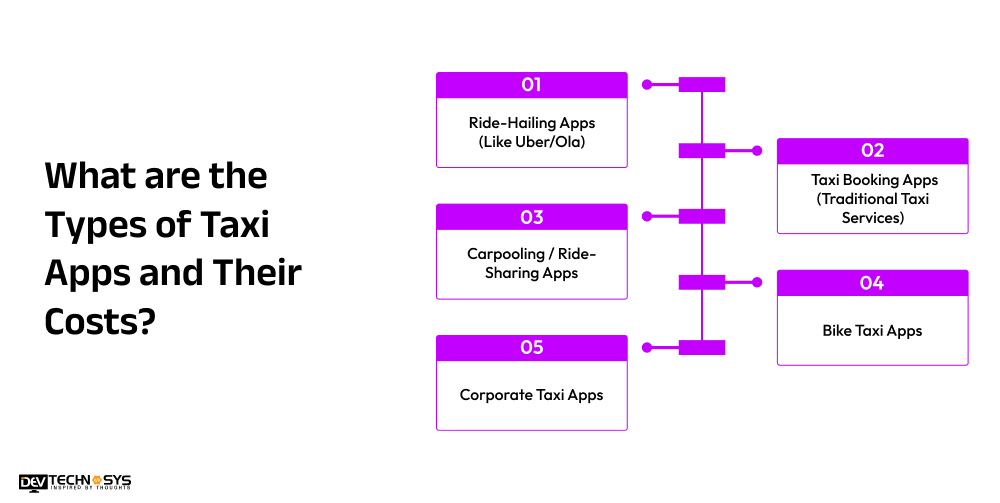
What are the Types of Taxi Apps and Their Costs?
Taxi apps come in various types based on business models, target users, and service offerings, each with different development requirements. Understanding these types helps businesses estimate costs and choose the right solution based on features, scalability, and market demand.
1. Ride-Hailing Apps (Like Uber/Ola)
Ride-hailing apps connect passengers with nearby drivers using real-time GPS tracking and smart matching algorithms. They include features like fare estimation, ride scheduling, and digital payments. These apps require scalable backend systems and strong infrastructure for handling high user demand.
| Component | Cost Range (USD) | Description |
| User App | $4,000 – $8,000 | Booking, tracking, and payments |
| Driver App | $3,000 – $6,000 | Ride handling |
| Admin Panel | $2,000 – $5,000 | Dashboard & analytics |
| Backend | $3,000 – $8,000 | Server & APIs |
| Total Estimate | $12,000 – $27,000+ | Scalable ride-hailing MVP |
2. Taxi Booking Apps (Traditional Taxi Services)
Taxi booking apps help traditional taxi businesses digitize operations by enabling online ride booking, driver assignment, and payment processing. These apps focus on simplicity, reliability, and operational efficiency, making them suitable for local taxi companies transitioning to digital platforms. The cost of developing a taxi booking app will be around $10,000 – $30,000+
| Component | Cost Range (USD) | Description |
| User App | $2,500 – $6,000 | Booking interface |
| Driver App | $2,000 – $5,000 | Trip handling |
| Admin Panel | $2,000 – $4,000 | Dispatch control |
| Backend | $2,000 – $5,000 | Basic setup |
| Total Estimate | $8,000 – $20,000+ | Entry-level solution |

3. Carpooling / Ride-Sharing Apps
Carpooling apps allow multiple passengers to share rides, reducing travel costs and fuel consumption. They require advanced route-matching algorithms, scheduling features, and split payment systems. These apps are ideal for eco-conscious users and businesses promoting shared mobility solutions.
| Component | Cost Range (USD) | Description |
| User App | $4,000 – $8,000 | Ride sharing UI |
| Driver App | $3,000 – $6,000 | Route handling |
| Admin Panel | $3,000 – $6,000 | Monitoring system |
| Matching Algorithm | $3,000 – $8,000 | Route optimization |
| Total Estimate | $15,000 – $28,000+ | Shared mobility app |
4. Bike Taxi Apps
Bike taxi apps offer quick and affordable rides for short distances, especially in traffic-heavy urban areas. They include essential features like real-time tracking, instant booking, and fare calculation, making them ideal for cost-sensitive users and densely populated cities.
| Component | Cost Range (USD) | Description |
| User App | $2,500 – $6,000 | Booking interface |
| Rider App | $2,000 – $5,000 | Trip handling |
| Admin Panel | $2,000 – $4,000 | Operations |
| Backend | $2,000 – $5,000 | Server setup |
| Total Estimate | $8,000 – $20,000+ | Budget-friendly solution |
5. Corporate Taxi Apps
Corporate taxi apps are designed for businesses to manage employee transportation efficiently. They include features like scheduled rides, centralized billing, reporting dashboards, and admin controls. These apps improve operational transparency, reduce travel costs, and ensure safe employee commuting. The estimated cost to develop a corporate taxi apps will be around $15,000 – $30,000+
| Component | Cost Range (USD) | Description |
| User App | $3,000 – $7,000 | Employee booking |
| Driver App | $3,000 – $6,000 | Ride execution |
| Admin Panel | $3,000 – $7,000 | Reports & billing |
| Backend | $3,000 – $7,000 | Secure system |
| Total Estimate | $12,000 – $27,000+ | Business transport solution |
6. Luxury / Limousine Booking Apps
Luxury taxi apps cater to premium users seeking high-end vehicles and personalized services. They focus on elegant UI/UX, chauffeur profiles, and flexible pricing models. These apps require advanced design and feature integration to deliver a seamless and upscale customer experience.
| Component | Cost Range (USD) | Description |
| User App | $5,000 – $9,000 | Premium interface |
| Driver App | $3,000 – $6,000 | Chauffeur tools |
| Admin Panel | $3,000 – $6,000 | Fleet control |
| Backend | $3,000 – $8,000 | High-end system |
| Total Estimate | $15,000 – $30,000+ | Premium taxi solution |
7. Airport Taxi Apps
Airport taxi apps specialize in scheduled rides to and from airports, offering features like fixed pricing, flight tracking integration, and advance booking. They are ideal for travelers who need reliable and timely transportation services with minimal delays.
| Component | Cost Range (USD) | Description |
| User App | $3,000 – $7,000 | Booking system |
| Driver App | $2,500 – $6,000 | Trip handling |
| Admin Panel | $2,500 – $5,000 | Scheduling |
| Backend | $3,000 – $7,000 | Integration |
| Total Estimate | $12,000 – $25,000+ | Airport transfer solution |
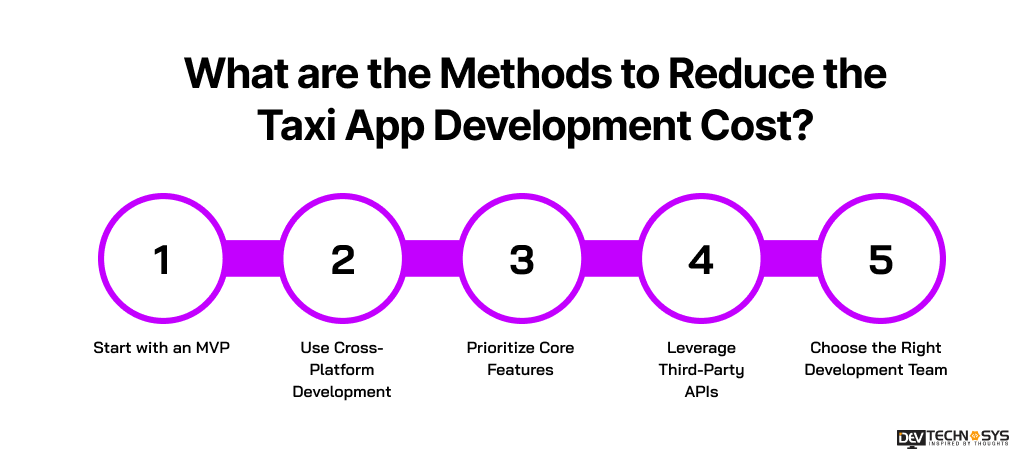
What are the Methods to Reduce the Taxi App Development Cost?
Reducing taxi app development cost requires strategic planning, smart technology choices, and prioritizing essential features. By optimizing resources, using scalable solutions, and adopting cost-effective development approaches, businesses can build high-quality apps while staying within budget.
1. Start with an MVP
If you are someone wondering how to start a taxi booking business in UAE but don’t want to spend excessively, then starting with a basic MVP version would be best. Begin with a Minimum Viable Product (MVP) that includes only essential features like ride booking, GPS tracking, and payments. This approach reduces initial investment, speeds up launch, and allows you to validate your idea before investing in advanced functionalities.
2. Use Cross-Platform Development
Opt for cross-platform frameworks like Flutter or React Native instead of building separate native apps. It reduces development time, resource requirements, and overall cost while still delivering a consistent user experience across both iOS and Android platforms.
3. Prioritize Core Features
Focus on must-have features first and avoid adding complex functionalities during the initial phase. Advanced features like AI dispatch or surge pricing can be added later based on user demand, helping control development costs effectively.
4. Leverage Third-Party APIs
Instead of building everything from scratch, use third-party APIs for maps, payments, and notifications. It reduces development time and cost, though it is important to plan for ongoing subscription or usage-based expenses.
5. Choose the Right Development Team
Hiring developers that provide custom app development services from cost-effective regions like India or Southeast Asia can significantly reduce development costs without compromising quality. Proper evaluation of expertise and experience ensures better results within budget.
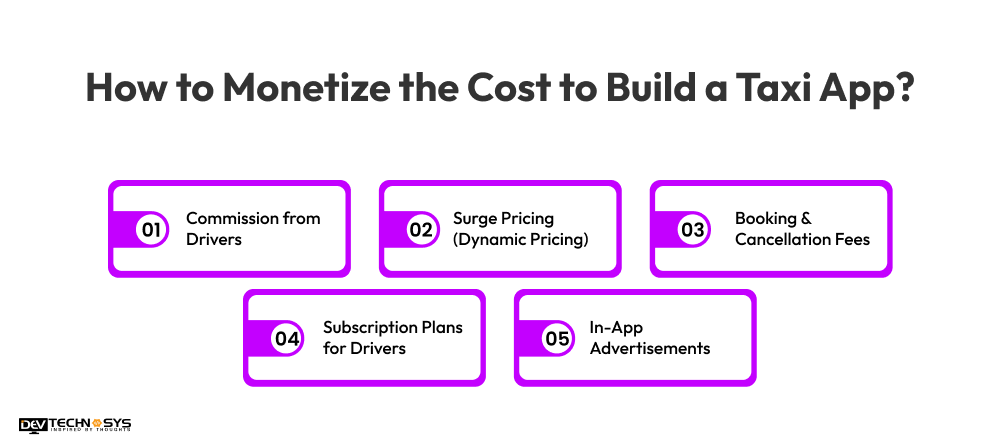
How to Monetize the Cost to Build a Taxi App?
Recovering the cost of building a taxi app requires a strategic mix of revenue models and scalable monetization techniques. By leveraging multiple income streams, businesses can accelerate ROI while ensuring long-term profitability and sustainable growth.
1. Commission from Drivers
Taxi apps earn revenue by charging drivers a commission on every completed ride, typically between 15% and 30%. This scalable model ensures consistent income as ride volume increases and remains the primary monetization strategy for most ride-hailing platforms.
2. Surge Pricing (Dynamic Pricing)
Surge pricing increases fares during peak hours, high demand, or unfavorable conditions like bad weather. This strategy helps balance rider demand and driver availability while maximizing revenue during busy periods and improving overall platform efficiency.
3. Booking & Cancellation Fees
Apps charge small booking or cancellation fees to generate additional revenue and reduce last-minute cancellations. These fees encourage users to confirm rides responsibly while ensuring drivers are compensated for lost time or sudden schedule changes.
4. Subscription Plans for Drivers
Taxi apps can offer subscription-based models where drivers pay a fixed weekly or monthly fee instead of per-ride commissions. This ensures predictable revenue for the platform and attracts frequent drivers seeking higher earnings without commission deductions.
5. In-App Advertisements
Displaying targeted advertisements within the app, such as local business promotions or sponsored listings, creates an additional revenue stream. This model becomes more profitable as the app gains a larger user base and higher engagement rates.

White-Label Taxi App vs Custom Development: Which One is More Better?
Choosing between a white-label taxi app and custom taxi app development is a crucial decision that impacts cost, speed, and long-term scalability. While white-label solutions offer faster deployment at a lower cost, custom development provides complete flexibility and control over features, design, and business growth. The mobile app maintenance cost for both white label and custom development will be around 12% to 20% of the total development cost.
| Factor | White-Label Taxi App | Custom Taxi App Development |
| Cost | $8,000 to $22,000 (lower upfront cost, ready-made solution) | $15,000 to $30,000+ (higher investment due to full customization) |
| Development Speed | 1 to 4 weeks (fast deployment with pre-built modules) | 3 to 12+ months (built from scratch based on requirements) |
| Flexibility | Limited customization; restricted to existing features and design | Fully flexible; features, UI/UX, and workflows can be customized |
| Scalability | Moderate scalability; depends on vendor architecture | High scalability; built to handle long-term business growth |
| Ownership | Often license-based; limited code ownership | Full ownership of code and product |
| Maintenance | Handled mostly by the vendor with fixed updates | Requires dedicated team for updates and support |
| Best For | Startups testing market or MVP launch | Businesses planning long-term, scalable ride-hailing platforms |
Conclusion
The cost to build a taxi app like Lyft typically ranges from $8,000 to $15,000+ for an MVP, while advanced, scalable platforms can exceed $30,000+. The final investment depends on features, technology stack, integrations, and long-term scalability requirements. Businesses should focus on MVP development first, then gradually scale with advanced features such as AI dispatch, real-time tracking, and dynamic pricing to optimize costs and performance.
If you need professional assistance regarding budget planning and development of your taxi app, like Lyft, then contact Dev Technosys, a leading taxi booking app development company. With 10+ years of expertise and over 2900 online solutions served, we create scalable, high-performance taxi apps that ensure seamless user experience, advanced features, and long-term business growth.
FAQs
Q1. How Much Does It Cost To Build A Taxi App Like Lyft?
The cost to build a taxi app like Lyft generally ranges from $8,000 to $15,000+ for basic to mid-level apps. Advanced platforms with real-time tracking, AI features, and scalability can exceed $30,000 depending on complexity and business requirements.
Q2. What Factors Affect Taxi App Development Cost?
Taxi app development cost depends on features, UI/UX design, platform choice, backend infrastructure, third-party integrations, security requirements, and development team location. Each factor adds to complexity, influencing overall budget, timeline, and long-term maintenance expenses.
Q3. How Long Does It Take To Build A Taxi App Like Lyft?
Developing a taxi app like Lyft usually takes 2 to 4 months for MVP, 4–8 months for mid-level apps, and 8 to 12+ months for advanced platforms. The timeline depends on features, integrations, scalability, and development approach.
Q4. What Are The Key Features Of A Taxi App?
Key features include ride booking, GPS tracking, driver-rider matching, fare estimation, in-app payments, ratings, and notifications. Advanced apps may include AI dispatch systems, surge pricing, route optimization, and real-time analytics dashboards.
Q5. Which Technology Is Used To Build a Taxi App Like Lyft?
Taxi apps are built using technologies like Flutter, React Native, Node.js, and Firebase. APIs for maps, payments, and messaging are integrated with cloud platforms such as AWS / Google Cloud / Azure for scalability and real-time performance.