





Guided meditation audio sessions User onboarding & profiles Daily reminders & notifications Basic progress tracking Secure user authentication" } }, { "@type": "Question", "name": "How Do Meditation Apps Make Money?", "acceptedAnswer": { "@type": "Answer", "text": "Meditation apps monetize using multiple strategies:
Subscription plans (monthly/annual) Freemium model with premium content One-time in-app purchases Corporate wellness programs Sleep programs or expert-led sessions for premium users" } }, { "@type": "Question", "name": "Is AI Necessary For A Meditation App?", "acceptedAnswer": { "@type": "Answer", "text": "AI is not mandatory for MVP launch, but is highly valuable for scaling. It helps with:
Personalized meditation recommendations Mood-based content suggestions Adaptive user progress tracking" } } ] }
Meditation apps are a necessity for today’s youth and working professionals wanting to stay in touch with their inner selves. Meditation helps users with stress and anxiety management in their fast-paced lifestyles. Although there are various meditation apps on the market, Simple Habit stood out the most. It is one of the best meditation apps in Middle East that offers short, guided meditations that fit easily into busy daily routines.
If you’re looking forward to develop a meditation app like Simple Habit, here’s a clear, step-by-step development guide. This guide will give you insights about the meditation app industry, meditation app development process, benefits, features, and cost requirements required to build a similar app like Simple Habit.
What is a Simple Habit App?
A Simple Habit app, most notably the popular Simple Habit meditation app, provides guided mindfulness and meditation sessions, often in short, 5-minute formats, for busy people to manage stress, improve sleep, and build wellness habits through expert-led audio content for various life situations like work breaks, commuting, or falling asleep. It’s designed to make mindfulness accessible, offering tools for focus, anxiety reduction, and general well-being.
Meditation App Market Stats
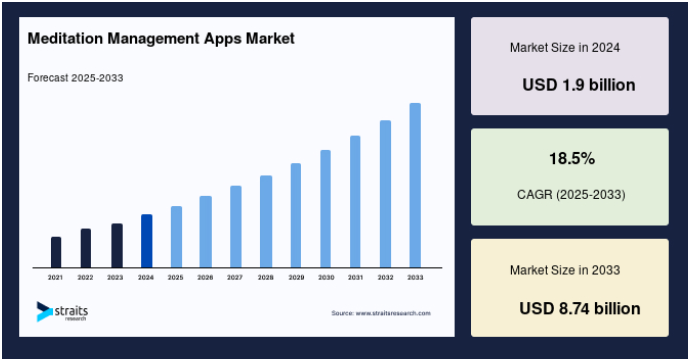
- The global meditation management apps market size was valued at USD 1.6 billion in 2024 and is projected to reach from USD 2.25 billion in 2025 to USD 7.6 billion by 2033.
- The global meditation management apps market is expected to reach a CAGR of 18.5% during the forecast period (2025–2033).
- North America is the largest global market shareholder and is estimated to grow at a CAGR of 18.2% over the forecast period.
- Asia-Pacific is anticipated to exhibit a CAGR of 18.8% over the forecast period.
What are The Business Benefits of Investing in Meditation App Development?
The growing awareness around mental wellness, stress management, and work–life balance has made meditation apps a high-potential digital business. Investing in meditation Android app development offers long-term revenue opportunities while addressing a real and rising global need.
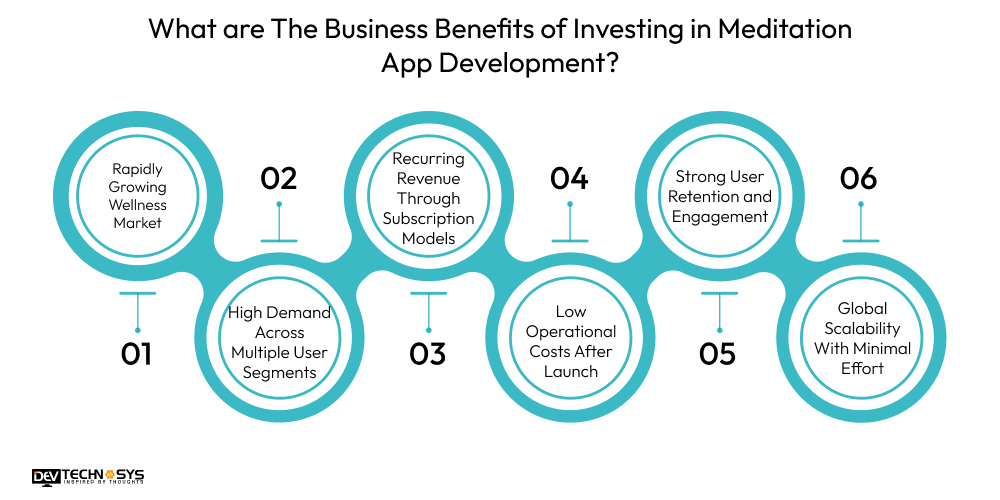
1. Rapidly Growing Wellness Market
The digital mental health and wellness market is expanding at a remarkable pace due to increasing stress levels, remote work culture, and lifestyle disorders. Businesses should develop a meditation app like Simple Habit to benefit from its sustained demand, ensuring strong market longevity.
2. High Demand Across Multiple User Segments
Build a meditation app like Simple Habit that attracts a wide audience, including students, working professionals, entrepreneurs, parents, and senior citizens. This broad appeal allows businesses to design multiple use cases and expand into diverse demographic and geographic markets.
3. Recurring Revenue Through Subscription Models
The best meditation apps in UAE primarily rely on monthly or annual subscriptions. Deciding to develop a meditation app like Simple Habit is great for businesses because it creates predictable and recurring revenue streams. Freemium access encourages onboarding, while premium features drive long-term customer value and revenue stability.
4. Low Operational Costs After Launch
Once the hybrid app development company completes the development and content is created, operational expenses remain relatively low. Digital content delivery eliminates physical inventory, and automation reduces ongoing staffing and infrastructure costs.
5. Strong User Retention and Engagement
Daily reminders, streak tracking, personalized meditation plans, and progress analytics encourage habitual usage. High engagement levels translate into better retention rates and increased lifetime value per user.
6. Global Scalability With Minimal Effort
Build a meditation app like calm that is not restricted by location. With multi-language support and cloud-based infrastructure, businesses can easily scale globally without significant additional investment in logistics or physical expansion.
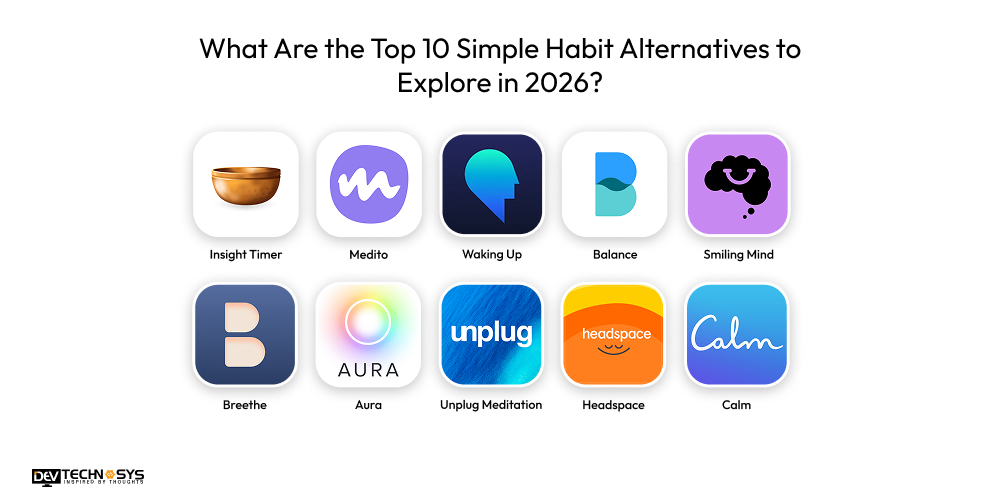
What Are the Top 10 Simple Habit Alternatives to Explore in 2026?
Before diving into the Simple Habit app development, let’s take a look at some top Simple Habit alternatives. All the apps mentioned in this list are some of the best meditation apps in UAE that provide features like mood tracking, multi-language support, and wearable integration to enhance user experience.
| App Name | Launch Year | Avg. Rating* | Platform Availability |
| Insight Timer | 2010 | 4.8 | iOS, Android, Web |
| Medito | 2019 | 4.9 | iOS, Android |
| Waking Up | 2018 | 4.7 | iOS, Android, Web |
| Balance | 2019 | 4.8 | iOS, Android |
| Smiling Mind | 2012 | 4.5 | iOS, Android |
| Breethe | 2016 | 4.6 | iOS, Android |
| Aura | 2017 | 4.6 | iOS, Android |
| Unplug Meditation | 2019 | 4.7 | iOS, Android |
| Headspace | 2012 | 4.9 | iOS, Android, Web |
| Calm | 2012 | 4.8 | iOS, Android, Web |

What are the Steps To Develop a Meditation app like Simple Habit?
Whether you want to develop a fitness and healthcare app like Garmin Connect or a meditation app like Simple Habit, the development requires a blend of wellness insight, user-centric design, and scalable technology. Below are the clear, step-by-step stages to develop a successful meditation app.
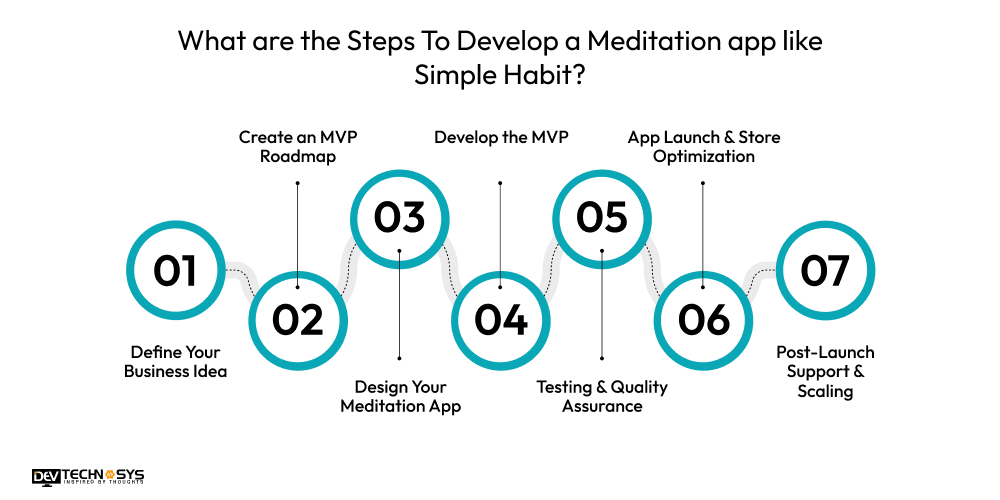
Step 1. Define Your Business Idea
Before starting the process to design and develop a meditation app like Simple Habit, it is crucial to clearly define the concept of your meditation app. Your business idea outlines the purpose, vision, and long-term direction of the product.
It helps identify the target audience, core problems you aim to solve, and the unique value your app will offer compared to competitors. Defining goals in advance, such as improving sleep quality, reducing stress, or boosting productivity, ensures that every development decision aligns with your success strategy.
Step 2. Create an MVP Roadmap
Experts who offer meditation app development services suggest creating an MVP roadmap first. Planning a Minimum Viable Product (MVP) allows you to focus on essential features that deliver immediate value to users. An MVP roadmap helps prioritize functionalities like guided meditations, reminders, and basic progress tracking. This approach to develop a meditation app like Simple Habit enables faster market entry, reduces initial development costs, and allows you to validate your idea using real user feedback before investing in advanced features or large-scale expansion.
Step 3. Design Your Meditation App
Since your app aims to help users manage stress, anxiety, and overall mental well-being, the UI/UX design must feel calm, simple, and welcoming. Hire an expert to provide full-stack development services to create an interface design. A user-friendly interface with intuitive navigation improves engagement and retention.
Successful meditation apps like Headspace and Calm use minimalistic layouts and pastel color palettes to create a soothing experience. Colors such as pastel pink, soft violet, light green, and muted blue are commonly used to evoke relaxation and emotional balance.
Step 4. Develop the MVP
In this step to build a meditation app like Simple Habit, you need to choose the development platform: iOS, Android, or cross-platform. If your budget permits, developing native apps for both platforms ensures better performance and wider reach.
However, if you want to optimize costs and speed, develop a meditation app like Simple Habit with cross-platform using frameworks like React Native or Flutter is an effective solution.
MVP development allows you to test the core concept, validate usability, and understand user behavior before adding complex features. If you are wondering what technology stack is best for building a scalable meditation app like Simple Habit, take a look at the table below:
| Layer | Technology | Purpose |
| Frontend | Flutter / React Native | Cross-platform mobile app |
| Backend | Node.js / Django | Content & user management |
| Database | PostgreSQL / MongoDB | User data & session tracking |
| Cloud | AWS / Google Cloud | Audio storage & streaming |
| Auth | Firebase Auth / JWT | Secure login & data protection |
| Notifications | FCM / OneSignal | Reminders & alerts |
| AI | Python (TensorFlow) | Personalized recommendations |
| Analytics | Firebase / Mixpanel | User insights & tracking |
Step 5. Testing & Quality Assurance
After the process to build a meditation app like Simple Habit is done, move on to testing. Thorough testing is essential to ensure a smooth and reliable user experience.
This includes functional testing to verify features, usability testing to check ease of navigation, security testing to protect sensitive user data, and performance testing for seamless audio playback. Proper QA ensures your app is stable, secure, and free from bugs before it reaches end users.
Step 6. App Launch & Store Optimization
Once testing is complete, your mobile app development company will publish your app on the Apple App Store and Google Play Store. Optimize your app listing with compelling descriptions, relevant keywords, screenshots, and preview videos to improve visibility.
App Store optimization (ASO) strategies help attract organic downloads, improve search rankings, and increase conversion rates during launch.
Step 7. Post-Launch Support & Scaling
After launch, continuous monitoring and improvement are vital for long-term success. Analyze user behavior, collect feedback, and release regular updates to fix issues and enhance performance. Add new meditation programs, sleep content, and guided sessions over time. As your user base grows, gradually introduce advanced features such as AI-based personalization, wearable device integration, multilingual support, and global market expansion.
What Features to Incorporate in an App Like Simple Habit?
What core features make Simple Habit successful, and which ones are essential for a new meditation app? Well, to build a successful meditation app like Simple Habit, it’s important to go beyond basic audio sessions and create a calming, supportive wellness ecosystem. The right combination of features improves user engagement and ensures long-term business growth.
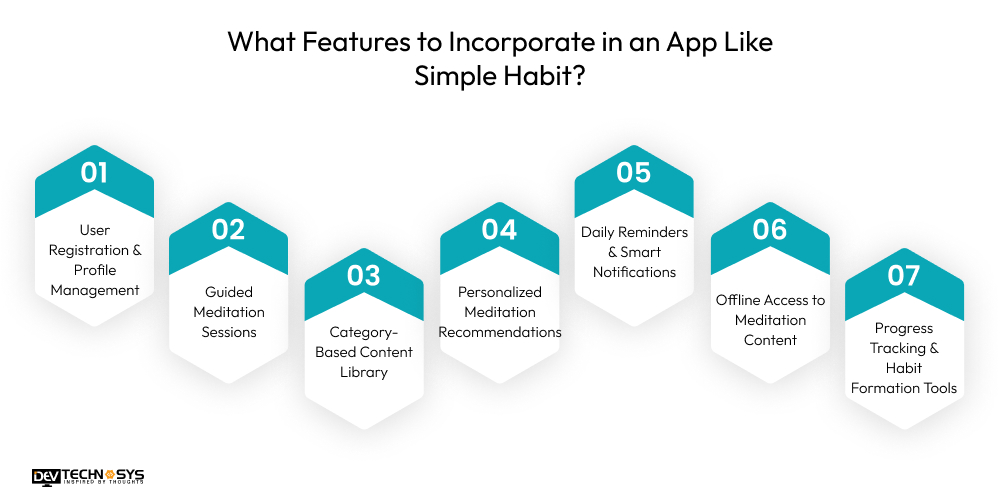
1. User Registration & Profile Management
A smooth onboarding and registration process allows users to sign up using email, mobile numbers, or social media accounts. User profiles store meditation history, preferences, goals, and progress data, enabling seamless synchronization across devices and a highly personalized experience.
2. Guided Meditation Sessions
Guided meditation sessions form the foundation of the app. These professionally recorded audio sessions should cater to different experience levels, ranging from beginners to advanced practitioners. Offering short, focused sessions (5–10 minutes) along with longer deep-relaxation programs helps users integrate meditation into busy daily schedules.
3. Category-Based Content Library
Organizing meditation content into clear categories such as stress relief, anxiety management, focus improvement, emotional wellness, and self-confidence makes navigation effortless. A well-structured library ensures users quickly find content aligned with their mood or current mental state.
4. Personalized Meditation Recommendations
Personalization is crucial if you want to develop a wellness app like Breethe. By analyzing user behavior, meditation frequency, session completion, and preferences, the app can recommend suitable sessions. Tailored recommendations make users feel understood and supported throughout their wellness journey.

5. Daily Reminders & Smart Notifications
Customizable reminders encourage users to meditate consistently without being intrusive. Notifications can include motivational quotes, session suggestions, or gentle nudges to maintain streaks, helping users build long-term mindfulness habits.
6. Offline Access to Meditation Content
Best meditation apps in Middle East include offline functionality that allows users to download meditation sessions and listen without internet connectivity. Hire on-demand app developers to add the feature that enhances usability during travel, commutes, or quiet offline moments, improving overall user satisfaction.
7. Progress Tracking & Habit Formation Tools
Visual progress tracking displays total meditation time, session completion, streaks, and milestones. These tools motivate users, reinforce consistency, and create a sense of accomplishment that encourages continued engagement.
What is the Cost to Develop an app like Simple Habit?
The cost to develop an app like Simple Habit ranges between $8,000 to $25,000, depending on factors like features, design, platform, cost, and more. The cost to build an app like Simple Habit with basic features and functionality can range from $8,000 to $15,000.
The cost to build an app like Meditopia with advanced features like AI-Based recommendations and breathing exercises & timers can exceed $25,000. The table below highlights the cost to create an app like Simple Habit based on app type.
| App Type | Total Estimated Cost | Total Timeline |
| Basic MVP | $8,000 – $12,000 | 8–10 weeks |
| Mid-Level App | $12,000 – $18,000 | 10–14 weeks |
| Advanced App | $18,000 – $25,000 | 14–18 weeks |
What Factors Can affect the Cost to Develop an App like Simple Habit?
The overall mobile app development cost of a meditation app like Simple Habit depends on feature depth, platform choice, design quality, team expertise, and long-term scalability needs. Below are the factors that affect the cost to create a meditation app like Simple Habit with estimated development timelines for each key factor.
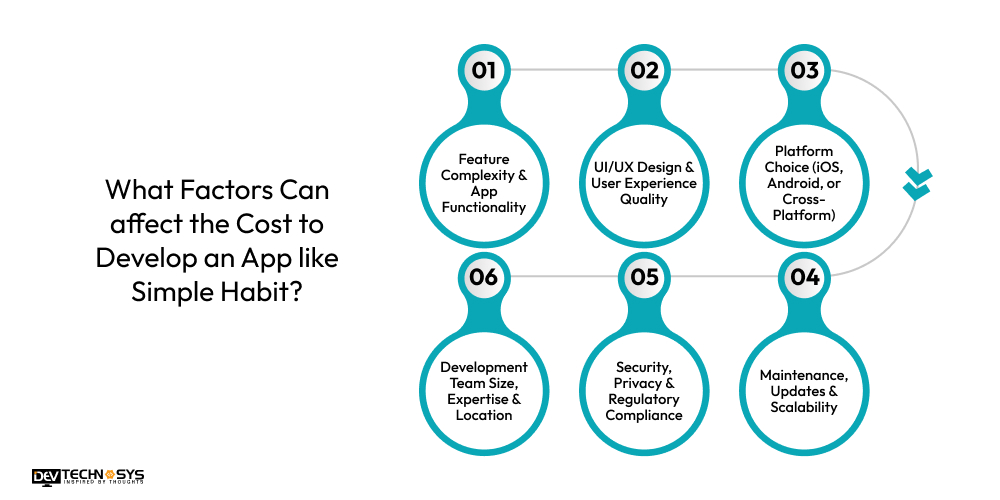
1. Feature Complexity & App Functionality
Feature selection is the most influential cost driver. The cost to create a meditation app like Simple Habit depends on feature complexity. App include guided audio sessions, reminders, and progress tracking, while a more advanced solution can offer AI-powered recommendations, sleep programs, and wearable device integration. The more sophisticated and interactive the features are, the higher the development effort and cost.
| Feature Level | Estimated Cost | Timeline |
| Basic (MVP) | $2,000 – $4,000 | 2–3 weeks |
| Medium | $4,000 – $7,000 | 3–5 weeks |
| Advanced | $7,000 – $10,000 | 5–7 weeks |
2. UI/UX Design & User Experience Quality
Meditation apps require a calming, intuitive, and visually appealing interface. experts in iOS app development services should offer custom illustrations, animations, micro-interactions, dark mode, accessibility options, and personalized user flows. It significantly enhances user experience but also increases the cost to create a meditation app like Simple Habit. A well-crafted design directly affects user retention.
| Design Level | Estimated Cost | Timeline |
| Basic UI | $800 – $1,500 | 1–2 weeks |
| Custom UI | $1,500 – $3,000 | 2–3 weeks |
| Premium UX | $3,000 – $4,500 | 3–4 weeks |
3. Platform Choice (iOS, Android, or Cross-Platform)
Developing an app for a single platform is more cost-effective, whereas building for both iOS and Android increases development hours and resources. Cross-platform frameworks such as Flutter or React Native can reduce costs by using a shared codebase, while native development provides better performance at a higher price.
| Platform Type | Estimated Cost | Timeline |
| Single Platform | $1,500 – $3,000 | 2–3 weeks |
| Cross-Platform | $2,500 – $4,500 | 3–4 weeks |
| Native (Both) | $4,500 – $6,000 | 4–6 weeks |
4. Development Team Size, Expertise & Location
Creating robust mobile app development solutions requires great skills. The cost to make a meditation app like Simple Habit differs depending on whether you hire freelancers, an in-house team, or an experienced app development company. Rates differ significantly across regions, teams in North America and Western Europe charge more than developers in Asia or Eastern Europe, directly affecting the overall budget.
| Team Type | Estimated Cost | Timeline |
| Freelancers | $2,000 – $4,000 | 4–6 weeks |
| Small Agency | $4,000 – $7,000 | 6–8 weeks |
| Experienced Agency | $6,000 – $9,000 | 8–10 weeks |
5. Security, Privacy & Regulatory Compliance
Meditation apps often handle sensitive personal and mental health-related data. Implementing strong encryption, secure authentication, data storage protocols, and compliance with regulations such as GDPR or HIPAA (where applicable) increases both development and legal consultation costs.
| Security Level | Estimated Cost | Timeline |
| Basic Security | $800 – $1,500 | 1 week |
| Enhanced Security | $1,500 – $2,500 | 1–2 weeks |
| Compliance-Ready | $2,500 – $4,000 | 2–3 weeks |
6. Maintenance, Updates & Scalability
The cost to maintain an app is usually between 12% to 18% of the total cost. Post-launch expenses include bug fixes, server costs, content updates, feature enhancements, and performance optimization. As the user base grows, scaling infrastructure and adding new functionality can account for 15% to 25% of the original annual cost to make a meditation app like Simple Habit.
| Support Type | Estimated Cost | Timeline |
| Basic Maintenance | $800 – $1,500 / year | Ongoing |
| Growth Support | $1,500 – $3,000 / year | Ongoing |
| Advanced Scaling | $3,000 – $5,000 / year | Ongoing |

What Are the Monetization Strategies for Meditation App Like Simple Habit?
What monetization models work best for meditation apps (subscriptions, freemium, in-app purchases)? Well, it depends. The goal is to maintain a calm, supportive experience while encouraging users to upgrade naturally. Below are the most effective monetization strategies, explained in greater detail.
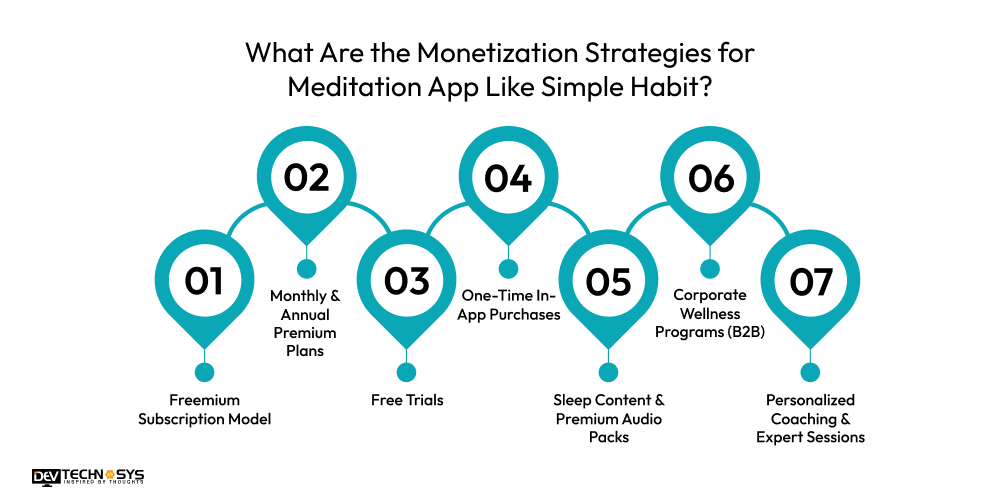
1. Freemium Subscription Model
The freemium model allows users to access a limited set of meditation sessions at no cost, helping them build a daily habit and experience the app’s value. Premium subscriptions unlock the full content library, offline access, personalized plans, and advanced features, encouraging users to upgrade once trust is established.
- Revenue Impact: High
- Best For: Building a large user base and long-term monetization
2. Monthly & Annual Premium Plans
Offering multiple subscription durations provides flexibility and improves conversion rates. Monthly plans attract short-term users, while annual plans, often discounted, boost customer lifetime value and reduce churn. Auto-renewal ensures predictable and consistent revenue growth.
- Revenue Impact: Very High
- Best For: Stable and recurring income
3. Free Trials
Free trials give users full access to premium features for a limited period, such as 7 or 14 days. This hands-on experience increases user confidence, showcases content quality, and significantly improves paid conversion rates once the trial ends.
- Revenue Impact: Medium–High
- Best For: Increasing subscription conversions
4. One-Time In-App Purchases
One-time purchases allow users to buy specific meditation programs, such as stress relief courses, productivity challenges, or beginner meditation packs. This strategy appeals to users who dislike recurring payments but are willing to pay for targeted, high-value content.
- Revenue Impact: Medium
- Best For: Monetizing non-subscribers
5. Sleep Content & Premium Audio Packs
Sleep-focused content such as bedtime stories, calming soundscapes, white noise, and deep-sleep meditations is highly popular. Placing this content behind a premium paywall increases engagement during nighttime hours and drives subscription upgrades.
- Revenue Impact: High
- Best For: Upselling premium memberships
6. Corporate Wellness Programs (B2B)
Businesses increasingly invest in employee mental health solutions. Meditation apps can offer corporate subscriptions, customized dashboards, and branded wellness plans for organizations, generating high-value, long-term contracts with minimal marketing costs.
- Revenue Impact: Very High
- Best For: Enterprise-level revenue growth
7. Personalized Coaching & Expert Sessions
Premium users may pay extra for live group sessions or one-on-one coaching with mindfulness experts. These sessions provide personalized guidance and accountability, allowing the app to charge higher prices for exclusive, human-led experiences.
- Revenue Impact: Medium–High
- Best For: Premium user segments
Conclusion
Developing a meditation app like Simple Habit requires a balanced approach that combines a clear wellness-focused vision, thoughtful design, and scalable technology. With the right development strategy, monetization model, and commitment to user mental well-being, you can successfully build a meditation app that delivers real value while standing strong in a competitive wellness market. If you are looking to develop a successful meditation app like Simple Habit, then contact a top meditation app development company like Dev Technosys.
FAQs
Q1. How Long Does It Take To Develop A Meditation App Like Simple Habit?
Developing a basic MVP meditation app usually takes 8 to 12 weeks. A full-featured app with advanced AI personalization, sleep content, wearable integration, and analytics can take 4–6 months, depending on complexity and team size.
Q2. What Is The Average Cost to Build an App Like Simple Habit Like Simple Habit?
The cost to build an app like Simple Habit typically ranges between $8,000 and $25,000 for an MVP. Full-featured apps with advanced AI, analytics, premium content, and multi-platform support can exceed this range, depending on features, design, and team location.
Q3. What Features Are Essential For A Meditation App MVP?
Essential features help validate the concept with real users efficiently. The core features for MVP include:
- Guided meditation audio sessions
- User onboarding & profiles
- Daily reminders & notifications
- Basic progress tracking
- Secure user authentication
Q4. How Do Meditation Apps Make Money?
Meditation apps monetize using multiple strategies:
- Subscription plans (monthly/annual)
- Freemium model with premium content
- One-time in-app purchases
- Corporate wellness programs
- Sleep programs or expert-led sessions for premium users
Q5. Is AI Necessary For A Meditation App?
AI is not mandatory for MVP launch, but is highly valuable for scaling. It helps with:
- Personalized meditation recommendations
- Mood-based content suggestions
- Adaptive user progress tracking