





The cost of supply chain management software in UAE can be in the range of AED 110,000 to AED 550,000+ depending on the complexity of workflow, integrations, automation, security, and scalability.
A basic-level SCM would help with procurement and inventory, order processing, and reporting, while a moderate-level SCM can connect warehouses, suppliers, transportation, ERP systems, and real-time analytics.
An enterprise-level SCM would need higher capabilities such as AI for demand forecasting, IoT for visibility, control towers, predictive analytics, multi-entity operations, and high-end integration.
Therefore, UAE companies may require specific customization of workflows for VAT operations, Arabic-English compatibility, logistics, and compliance requirements.
The cost guide covers different aspects of supply chain software development cost, major elements of pricing structure, key features of software, technology aspects of the development process, software security considerations, timelines, and guidelines on how to create successful SCM software for UAE-based companies.
How Much Does Supply Chain Software Development Cost in the UAE?
The cost to build supply chain management software in UAE normally ranges from AED 110,000 to AED 550,000+ based on its functionality, integrations, automation, security, and scalability.
A simple SCM platform can cost between AED 110,000 and 185,000, a mid-tier solution AED 185,000 to 330,000, and enterprise-grade software AED 550,000 and up.
The key cost drivers include procurement, inventory, warehouse management, transportation, analytics, ERP integration, IoT, AI forecasting, multilingual support, and compliance. The ultimate investment is affected by the experience of the development team, the technological stack, UI/UX, testing, deployment, and continuing maintenance.
SCM Software Type |
Estimated Cost (AED) |
Core Features |
| Basic SCM Software | AED 110,000–185,000 | Inventory, procurement, orders |
| Mid-Level SCM Software | AED 185,000–330,000 | Inventory, warehouse, analytics, integrations |
| Advanced SCM Software | AED 330,000–550,000 | Automation, tracking, forecasting, integrations |
| Enterprise SCM Platform | AED 550,000+ | AI, IoT, real-time visibility, advanced analytics |
Answer a few quick questions and our experts will share a tailored project estimate.
Supply Chain Software Development Cost by Complexity
System complexity, automation, integrations, and scalability needs all have a substantial impact on supply chain software development costs. While advanced solutions incorporate AI, IoT, ERP connectivity, real-time visibility, and intelligent automation, basic platforms require fewer modules and connectors.
Businesses in the UAE can estimate budgets, prioritize features, and select the best development strategy by having a clear understanding of complexity levels.
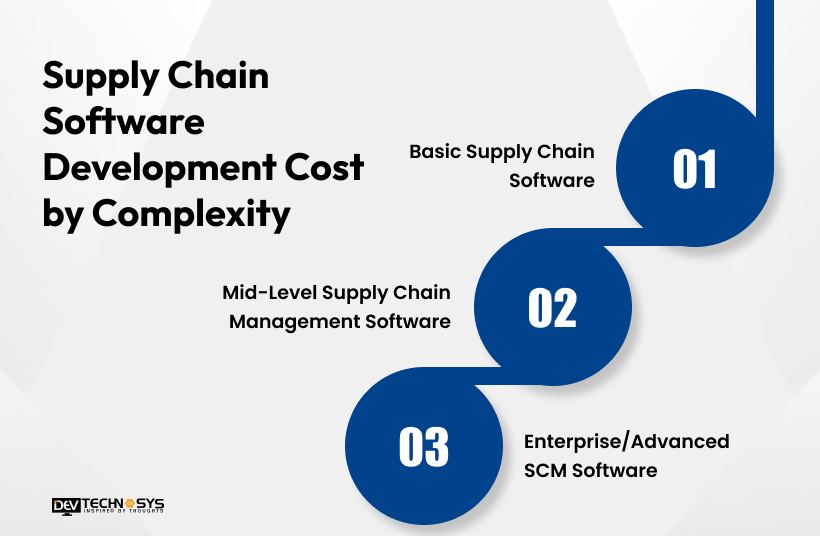
1. Basic Supply Chain Software (AED 110,000 – AED 185,000)
Startups and small companies with comparatively straightforward supply-chain processes are the target audience for basic supply chain software. Order management, procurement, inventory, and basic reporting are usually included. Without having to pay for enterprise-level infrastructure, these solutions assist companies in centralizing regular operations.
Scalability is the primary constraint. Basic systems could feature less automation, fewer interfaces, simple analytics, and little support for intricate multi-location operations.
2. Mid-Level Supply Chain Management Software (AED 185,000 – AED 330,000)
Growing companies that need to link several supply-chain operations on a single platform can benefit from mid-level SCM software. Compared to simpler systems, it offers greater operational insight and workflow automation.
Important skills include of:
- Inventory: Monitor movements and stock levels.
- Procurement: Oversee purchase orders and vendors.
- Warehouse: Oversee dispatch, storage, and receipt.
- Order management: Monitor orders as they are fulfilled.
- Transportation: Keep an eye on delivery and shipments.
- Analytics: Create dashboards and operational reports.
- Role-Based Access: Assign rights based on the duties of the user.
Industry Insights:
Accenture analyzed 1,148 companies across 15 countries and 10 industries and found that companies with the most mature supply chains achieved 23% higher profitability/margins than their peers.
3. Enterprise/Advanced SCM Software (AED 550,000+)
Enterprise or advanced supply chain management (SCM) software is designed for companies that oversee extensive, dispersed, and intricate supply networks. To enhance decision-making, these platforms integrate numerous business systems, intelligent automation, and real-time data.
Multi-location operations, AI-powered forecasting, digital twins, IoT connectivity, control towers, enhanced analytics, ERP integration, real-time visibility, and automated decision-making are examples of typical capabilities.
Factor |
Basic |
Mid-Level |
Advanced/Enterprise |
| Functionality | Core operations | Integrated SCM | Intelligent & automated SCM |
| Users | Small businesses | Growing businesses | Large enterprises |
| Integrations | Limited | ERP, APIs, logistics | ERP, IoT, AI, multiple systems |
| Timeline | 3–5 months | 5–8 months | 8–14+ months |
| Estimated Cost | AED 110K–185K | AED 185K–330K | AED 330K–550K+ |
What Factors Affect Supply Chain Software Development Cost in the UAE?
The supply chain management software cost in the UAE are determined by several aspects, including: Functional scope, architecture, integrations, AI capabilities, localization, security, and scalability.
Businesses should identify the benefits of supply chain management software objectives up front, as adding complicated features later might raise development effort, testing requirements, integration labor, infrastructure costs, and long-term maintenance.
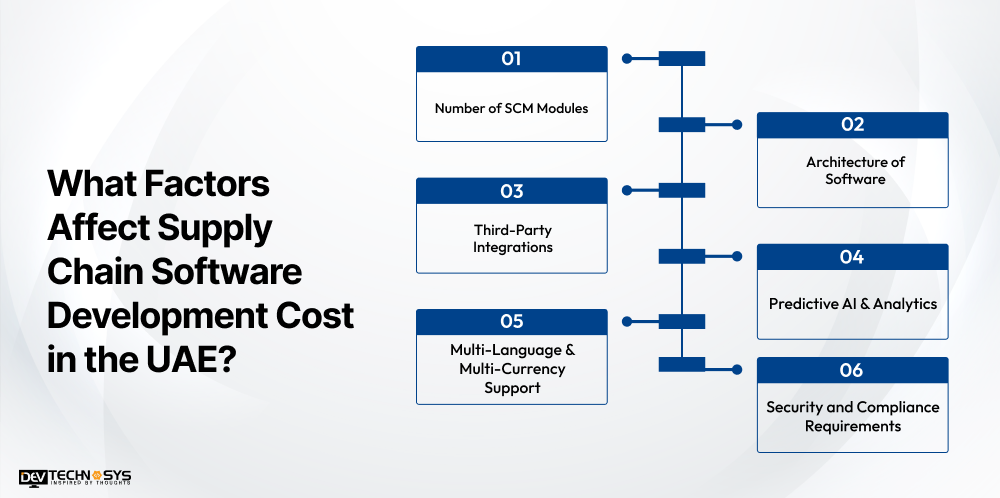
1. Number of SCM Modules
Every SCM module added increases the scope of development, as it needs its own workflows, interfaces, business rules, databases, testing, and integrations. Procurement, inventory, warehouse, transportation, supplier management, and analytics each add capability.
So, a business that needs numerous interconnected modules will need more development time and resources than a business that only needs simple inventory management.
Cost-Affecting Factor |
Example Scope |
Estimated Cost Impact |
| Core modules | Inventory, procurement | +10–15% |
| Operational modules | Warehouse, transportation | +15–25% |
| Advanced modules | Supplier management, analytics | +20–30% |
2. Architecture of Software
Architecture influences development complexity, scalability, infrastructure, and maintenance cost directly. For smaller applications, we may use a monolithic architecture, but for greater separation of functions, we might go for a modular architecture.
Microservices allow for independently scalable services, but need more technical work. Cloud-native design provides elasticity and resilience, but it also increases the total ERP software development cost.
Cost-Affecting Factor |
Architecture |
Estimated Cost Impact |
| Simple architecture | Monolithic | +5–10% |
| Scalable architecture | Modular | +10–20% |
| Distributed architecture | Microservices / cloud-native | +20–35% |
3. Third-Party Integrations
Integrations can greatly add to the custom SCM software cost as each external system involves API configuration, authentication, data mapping, error handling, testing, and maintenance.
Typical interfaces are ERP, WMS, TMS, CRM, accounting packages, payment gateways, GPS/telematics, mapping APIs, EDI, and IoT platforms, subject to the operational ecology of the firm.
Cost-Affecting Factor |
Integration Scope |
Estimated Cost Impact |
| Basic integrations | CRM, accounting | +5–10% |
| Operational integrations | ERP, WMS, TMS | +10–20% |
| Complex integrations | IoT, EDI, GPS/telematics | +20–30% |
4. Predictive AI & Analytics
AI capabilities demand more data engineering, model creation, integration, validation, and monitoring. SCM platforms can include demand forecasting, inventory prediction, route optimization, supplier risk prediction, anomaly detection, and automatic replenishment.
The exact price varies based on the availability of data, model complexity, integration needs, computer capacity, and whether firms employ existing AI services or build unique models.
Cost-Affecting Factor |
AI/Analytics Scope |
Estimated Cost Impact |
| Basic analytics | Dashboards, reports | +5–10% |
| Predictive capabilities | Demand and inventory forecasting | +15–25% |
| Advanced AI | Optimization, anomaly detection, automation | +25–40% |
Industry Insights:
Gartner forecasts global annual spending on supply chain management software to grow from $29 billion in 2023 to $62 billion by 2028, representing a five-year CAGR of 16.3%.
5. Multi-Language & Multi-Currency Support
SCM platforms targeting the UAE may require Arabic and English interfaces, AED and other currency support, and right-to-left interface features. Additional localization requirements may exist for multi-country operations, such as regional formats and flexible business rules.
Supporting different languages and currencies adds complexity to the platform across UI/UX, testing, database, reporting, and localization.
Cost-Affecting Factor |
Localization Scope |
Estimated Cost Impact |
| Two languages | Arabic + English | +5–10% |
| Multiple currencies | AED + international currencies | +5–10% |
| Regional operations | RTL + multi-country support | +10–20% |
6. Security and Compliance Requirements
Security needs may play a significant role in SCM development, as supply-chain systems manage data relating to operations, finance, suppliers, and employees. Encryption, MFA, RBAC, audit trails, secure APIs, backup & disaster recovery, data minimization, and access monitoring.
Key controls may include: The specific compliance duties should be evaluated depending on the organization’s data, industry, jurisdictions, and processing operations.
Cost-Affecting Factor |
Security Scope |
Estimated Cost Impact |
| Standard security | Encryption, RBAC | +5–10% |
| Enhanced security | MFA, audit trails, secure APIs | +10–20% |
| Enterprise security | Monitoring, DR, advanced access controls | +20–30% |

Cost Breakdown of Supply Chain Software Development
Planning, design, development, integrations, quality assurance, deployment, and security all get the total SCM software budget. The breakdown that follows offers a workable planning framework for predicting where development spending may be channeled.
Development Component |
Approx. Cost Share |
| Business Analysis | 5–10% |
| UI/UX Design | 10–15% |
| Frontend Development | 15–20% |
| Backend Development | 20–25% |
| Integrations | 10–20% |
| Testing & QA | 10–15% |
| DevOps & Deployment | 5–10% |
| Security | 5–10% |
Note: These are planning estimates, not universal pricing regulations. Actual cost allocation can depend on SCM modules, architecture, integrations, AI needs, security controls, development team, project complexity and deployment environment.
What is the Cost of Developing Different SCM Modules?
The price of each SCM module depends on the complexity of workflows, automation, integrations, user responsibilities, data needs, and scalability.
They can opt to build individual modules themselves or combine them into a single platform. This means they can focus on the key supply-chain operations and manage the investment in development in line with their operational requirements.
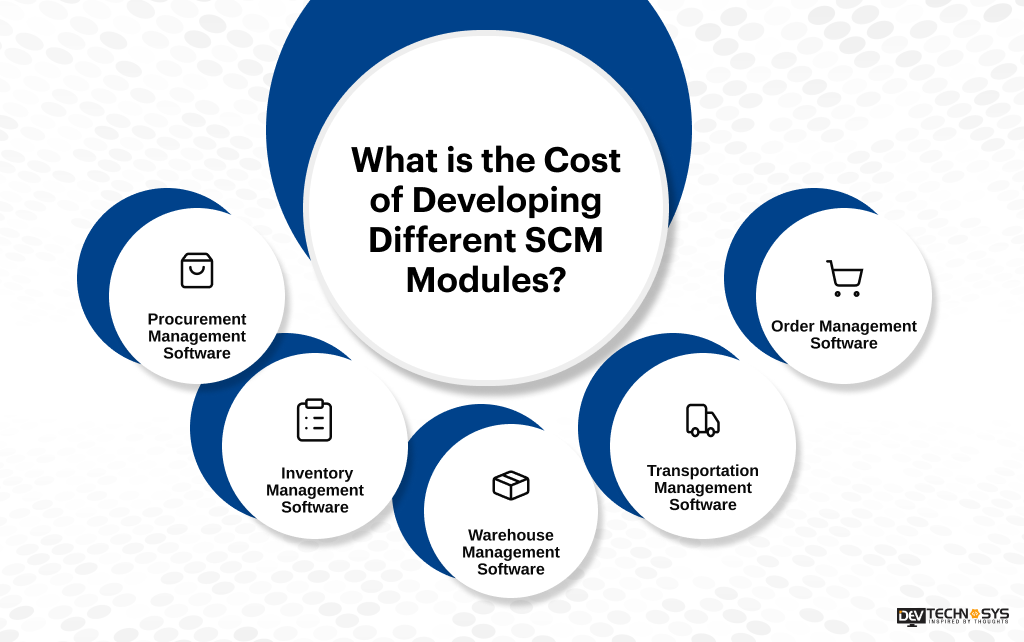
1. Procurement Management Software
- Use: Simplifies purchasing and supplier processes.
- Key Capabilities: include supplier management, buy orders, approvals, quotes, and procurement tracking.
- Complexity: Medium, and increases with approval workflows and ERP integration.
- Cost impact: Usually moderate, as procurement is typically governed by many business rules, contacts with suppliers, notifications, reporting, and integration with inventory or accounting systems.
2. Inventory Management Software
- Purpose: Controls stock and inventory movements in real-time.
- Key Features: Stock management, product management, reorder levels, barcode scanning, inventory reporting.
- Complexity: Low to high depending on warehouses and automation.
- Cost impact: Moderate. Real-time synchronization, barcode scanning, forecasting, and multi-location inventory management increase costs.
3. Warehouse Management Software
- Purpose: To optimize the operations of warehouse receipt, storage, pick, pack, and dispatch. Key capabilities include bin management, barcode scanning, stock transfers, picking procedures, and warehouse dashboards.
- Complexity: Medium to high, as warehousing processes are very different.
- Cost impact: Increases when combining scanners, automation systems, WMS platforms, IoT devices, or several warehouse locations.
4. Transportation Management Software
- Purpose: Provides cargo planning, carrier operations, deliveries, and transportation visibility.
- Key Features: Route Planning, Shipment Tracking, Carrier Management, Dispatch, Delivery Monitoring.
- Complexity: High, because of logistics procedures and external data sources.
- Cost impact: High if GPS, mapping APIs, telematics, TMS, real-time tracking, and route optimization are necessary.
5. Order Management Software
- Purpose: Manage the process of orders from creation to fulfillment and delivery.
- Basic Functions: Process orders, track status, fulfill orders, cancel orders, notify customers, and provide reports.
- Complexity: Medium based on order volume and fulfillment rules.
- Cost impact: Higher with multi-channel orders, ERP/CRM connectivity, payment systems, automated processes, real-time inventory synchronization, and sophisticated fulfillment requirements.
SCM Module |
Estimated Cost (AED) |
Complexity |
| Procurement Management | AED 40,000–80,000 | Medium |
| Inventory Management | AED 45,000–90,000 | Medium |
| Warehouse Management | AED 60,000–120,000 | Medium–High |
| Transportation Management | AED 70,000–140,000 | High |
| Order Management | AED 35,000–75,000 | Medium |
How Much Does It Cost to Add AI to Supply Chain Software?
Depending on the AI use case, data maturity, integration needs, and infrastructure, adding AI to supply chain software can result in a large rise in AI-powered supply chain software cost. AED 30,000 to AED 70,000 may be needed for a basic AI feature, and more than AED 200,000 may be needed for several advanced AI features.
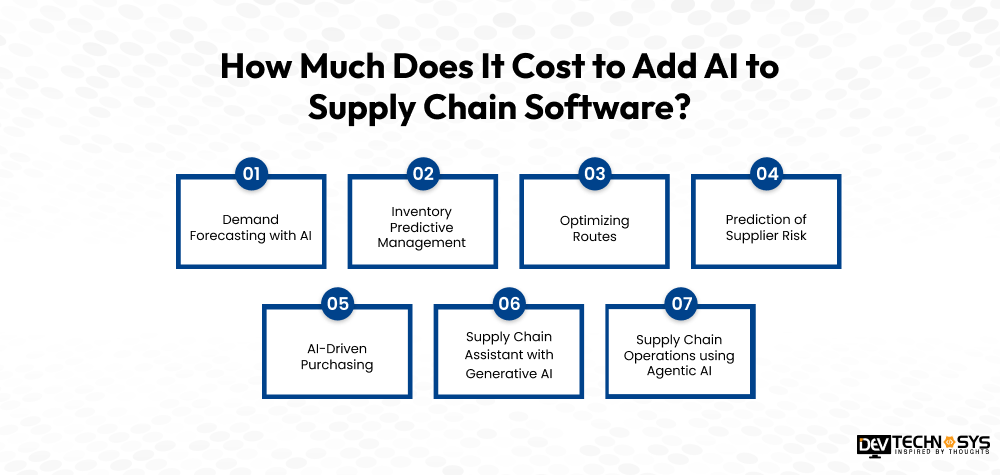
1. Demand Forecasting with AI
In order to forecast future demand, AI demand forecasting examines past sales, seasonal trends, market signals, and operational data. Data pipelines, forecasting models, data quality, and interface with ERP or inventory systems can affect development complexity. AED 40,000–90,000 is the estimated cost impact.
2. Inventory Predictive Management
AI development is used in predictive inventory management to detect possible overstocking, stockouts, and replenishment needs. Demand projections and purchase procedures can be linked to inventory data. Depending on data volume, automation needs, integrations, and forecast accuracy, the estimated cost ranges from AED 40,000 to AED 85,000.
3. Optimizing Routes
In order to suggest effective routes, AI-powered route optimization assesses traffic, delivery locations, vehicle capacity, fuel consumption, and delivery constraints.
Complexity increases when mapping APIs, GPS, and telematics are integrated. Depending on optimization needs and real-time tracking capabilities, the estimated cost ranges from AED 45,000 to AED 100,000.
4. Prediction of Supplier Risk
To find possible interruptions, supplier risk models might assess supply delays, quality problems, price adjustments, past performance, and external indicators.
Monitoring and enough historical data are necessary to build trustworthy prediction models. AED 50,000–110,000 is the estimated cost, depending on the model complexity and data sources.
Market Insights:
McKinsey states that early adopters successfully implementing AI-enabled supply-chain management achieved 15% improvement in logistics costs, 35% improvement in inventory levels, and 65% improvement in service levels compared with slower-moving competitors.
5. AI-Driven Purchasing
AI may help procurement teams by making supplier recommendations, spotting buying trends, comparing prices, forecasting needs, and automating some purchases.
Software development services effort can be increased by integrating with ERP and procurement operations. AED 50,000–120,000 is the estimated cost, depending on the level of automation and corporate regulations.
6. Supply Chain Assistant with Generative AI
Users can utilize natural language to ask queries about inventories, orders, suppliers, shipments, or operational performance with a generative AI assistant.
LLM APIs, retrieval systems, authorization, secure data access, and monitoring may all be necessary for development. Depending on features and integrations, the estimated cost ranges from AED 60,000 to AED 130,000.
7. Supply Chain Operations using Agentic AI
By managing multi-step processes including detecting a stock deficit, assessing suppliers, formulating a buy recommendation, and asking clearance, agentic AI can go beyond recommendations.
Costs can range from AED 100,000 to AED 250,000+ since autonomous actions necessitate more stringent controls, testing, permits, monitoring, and exception handling.

UAE-Specific Factors That Influence SCM Software Cost
Supply chains in the UAE frequently need localization that goes beyond basic SCM capabilities. Customization, testing, infrastructure, and maintenance expenses might be increased by regional languages, logistics models, warehouse networks, trade procedures, integrations, and governance needs.
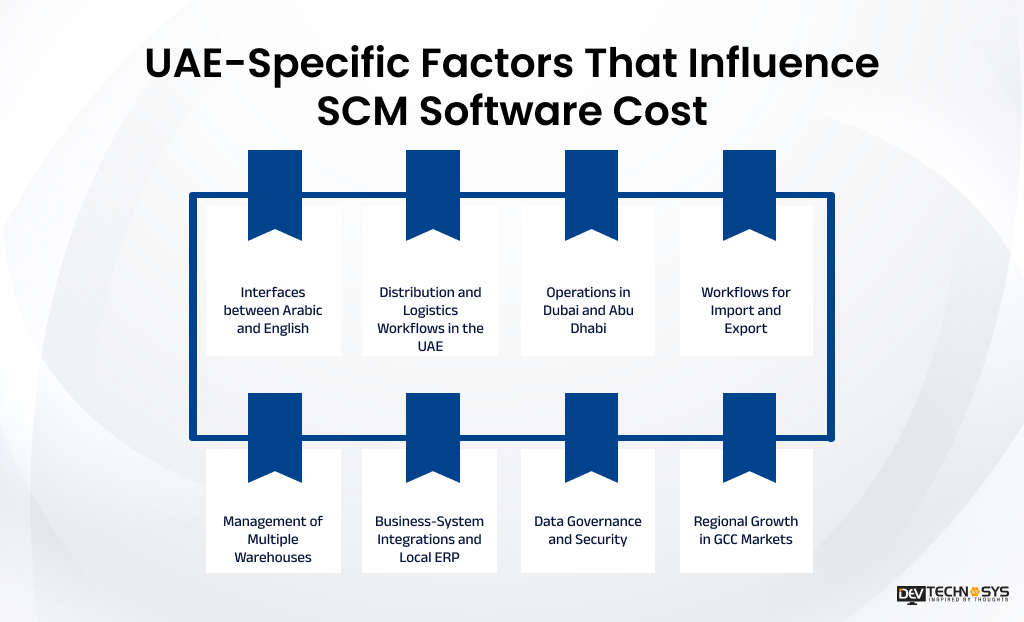
1. Interfaces between Arabic and English
Multilingual content management, RTL interface design, localized notifications, reports, and user workflows are all needed to support Arabic and English. Further testing increases UI/UX and development work by ensuring consistent usability across both languages.
2. Distribution and Logistics Workflows in the UAE
Time-sensitive shipments, fleet coordination, last-mile distribution, and intricate delivery networks are all possible aspects of UAE logistics operations. Customized routing, dispatching, tracking, and delivery-management features may be needed to support these workflows.
3. Operations in Dubai and Abu Dhabi
Location-specific warehouses, delivery zones, inventory regulations, and operational dashboards may be necessary for businesses operating throughout Dubai and Abu Dhabi. Configuration, data management, and integration requirements rise when globally dispersed teams are supported.
4. Workflows for Import and Export
Shipment documentation, supplier coordination, customs-related data, cargo tracking, and status management may be necessary for import and export operations. Business-rule complexity, integration needs, and testing effort all rise when these procedures are incorporated.
5. Management of Multiple Warehouses
Centralized inventory visibility, stock transfers, warehouse-specific permissions, replenishment guidelines, and location-based reporting are all necessary for managing several warehouses. Database, workflow, synchronization, and integration needs rise with warehouse complexity.
6. Business-System Integrations and Local ERP
APIs, data mapping, authentication, synchronization, and error handling are necessary for integrating SCM software with current ERP, accounting, WMS, TMS, CRM, or business platforms. Integration costs and complexity may be further increased by legacy systems.
7. Data Governance and Security
Operational, commercial, supplier, and employee data are managed by supply-chain platforms. Engineering, infrastructure, testing, and continuous maintenance requirements are increased when encryption, access controls, MFA, audit trails, monitoring, backups, and suitable governance mechanisms are implemented.
8. Regional Growth in GCC Markets
It may be necessary to add more currencies, languages, tax arrangements, company regulations, locations, and integrations in order to expand from the UAE into GCC markets. Early customizable architecture design can lower later redevelopment and localization expenses.
Hidden Costs to Consider When Developing Supply Chain Software in the UAE
Seldom are all costs included in the initial development estimate. Hidden expenses, including third-party integrations, cloud infrastructure, data migration, security audits, compliance requirements, maintenance, staff training, and future feature upgrades, should also be taken into consideration by UAE firms. Budget overruns and implementation delays can be avoided by anticipating these costs in advance.
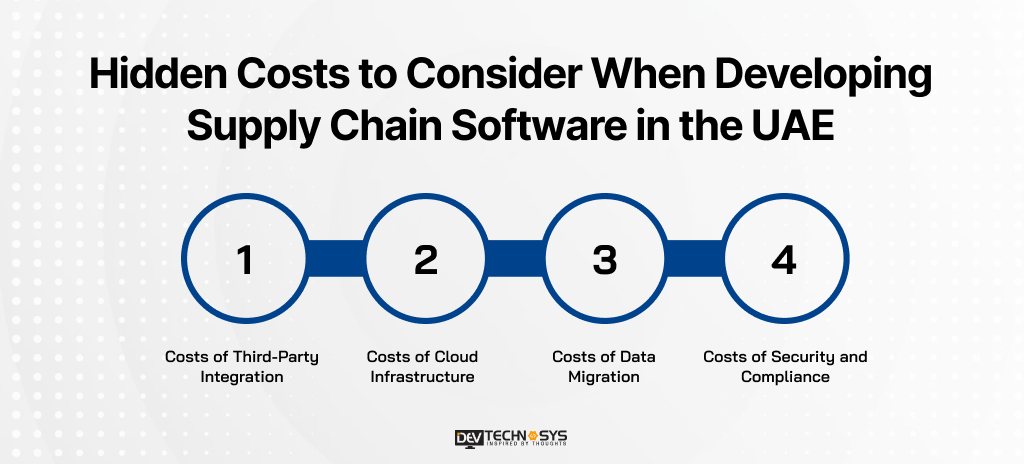
1. Costs of Third-Party Integration
The supply chain management software development cost may rise if ERP, WMS, TMS, CRM, payment gateways, GPS, EDI, or IoT platforms are integrated.
Additionally, companies can require middleware, costly APIs, integration licenses, and more testing. When several external systems are involved, these expenses might grow substantial and are frequently left out of initial estimates.
2. Costs of Cloud Infrastructure
Recurring costs for servers, databases, storage, backups, monitoring, bandwidth, load balancing, and disaster recovery are introduced by cloud hosting.
Infrastructure needs may expand as transaction volumes, warehouses, users, and integrations rise. Before deciding on a software budget, businesses should account for both the initial implementation costs and ongoing cloud usage.
3. Costs of Data Migration
Extra planning is needed to migrate supplier, inventory, warehouse, procurement, and historical transaction data from legacy systems. Significant resources may be used for data cleansing, transformation, mapping, validation, deduplication, and migration testing.
Legacy databases that are complicated or poorly organized might need specialized development work, which would raise the total cost of implementation.
4. Costs of Security and Compliance
Beyond core development, security needs may result in costs. Specialized experts and equipment may be needed for penetration testing, vulnerability assessments, encryption, identity management, audit logging, security monitoring, compliance checks, and backup plans. When supply chain platforms manage sensitive operational, financial, supplier, or customer data, these investments are especially crucial.
Technology Stack for Supply Chain Software & How it Impacts Cost
Development effort, scalability, performance, infrastructure, and maintenance expenses are all impacted by technology decisions. Software complexity, users, integrations, transaction volume, and future expansion all influence the appropriate stack.
Layer |
Technologies |
Cost & Scalability Impact |
| Frontend | React / Angular / Vue | Affects UI complexity, performance, and development effort. |
| Backend | Node.js / .NET / Java / Python | Influences scalability, integrations, performance, and maintenance. |
| Database | PostgreSQL / MySQL / MongoDB | Impacts data complexity, performance, storage, and scaling. |
| Cloud | AWS / Azure / Google Cloud | Determines infrastructure, scaling, availability, and operating costs. |
| APIs | REST / GraphQL | Affects integration flexibility and development complexity. |
| Analytics | Power BI / Custom BI | Influences dashboard customization, licensing, and reporting costs. |
| AI/ML | Python / ML frameworks / AI APIs | Adds model development, API, infrastructure, and monitoring costs. |
| IoT | MQTT / IoT platforms | Increases real-time data processing and device integration costs. |
| DevOps | Docker / Kubernetes / CI/CD | Improves deployment and scalability but requires additional expertise. |
How Much Does It Cost to Maintain Supply Chain Software?
The average annual cost of supply chain software maintenance is 15-25% of the initial cost to develop supply chain management software. Businesses may budget roughly AED 16,500-137,500+ annually for a platform that costs AED 110,000-550,000+.
Bug repairs, security patches, cloud infrastructure, database upkeep, API updates, third-party integration support, performance optimization, technical support, and regular enhancements are often covered by this expenditure. Higher maintenance expenses may be necessary for advanced SCM solutions with AI, IoT, numerous integrations, or large-scale operations.
Maintenance Area |
What It Includes |
| Bug Fixes | Identifying and resolving functional issues |
| Security Updates | Patches, vulnerability fixes, and access-control updates |
| Cloud Infrastructure | Hosting, storage, backups, and resource management |
| Database Maintenance | Optimization, backups, monitoring, and data management |
| API Changes | Updating integrations when external APIs change |
| Third-Party Integrations | Maintaining ERP, WMS, TMS, IoT, and other connections |
| Performance Optimization | Improving speed, scalability, and system reliability |
| AI Model Monitoring | Monitoring accuracy, drift, performance, and model updates |
| New Features | Adding business capabilities and workflow improvements |
| Technical Support | Troubleshooting, monitoring, and user assistance |

Build vs Buy Supply Chain Software in the UAE
Business workflows, budget, scalability, and customization needs all play a role in the decision between developing and purchasing supply chain software. While custom development offers more flexibility and integration control, off-the-shelf systems offer quicker deployment and more stable costs.
Before making a decision, UAE companies should consider implementation time, localization, security, integrations, ownership, maintenance, and long-term operating requirements.
Factor |
Custom SCM |
Off-the-Shelf SCM |
| Customization | High | Limited |
| Initial Cost | Higher | Lower |
| Integrations | Flexible | Vendor-dependent |
| Scalability | High | Depends on platform |
| Ownership | Greater | Vendor-controlled |
| Implementation | Longer | Faster |
| Industry Workflows | Custom | Predefined |
How to Reduce Supply Chain Software Development Costs?
It is not necessary to eliminate crucial functionality in order to lower the cost to develop supply chain management software. Controlling scope, prioritizing quantifiable business results, reusing dependable technologies, and creating a scalable foundation are superior strategies. These tactics assist UAE companies in launching more quickly while controlling the demands of future growth and integration.
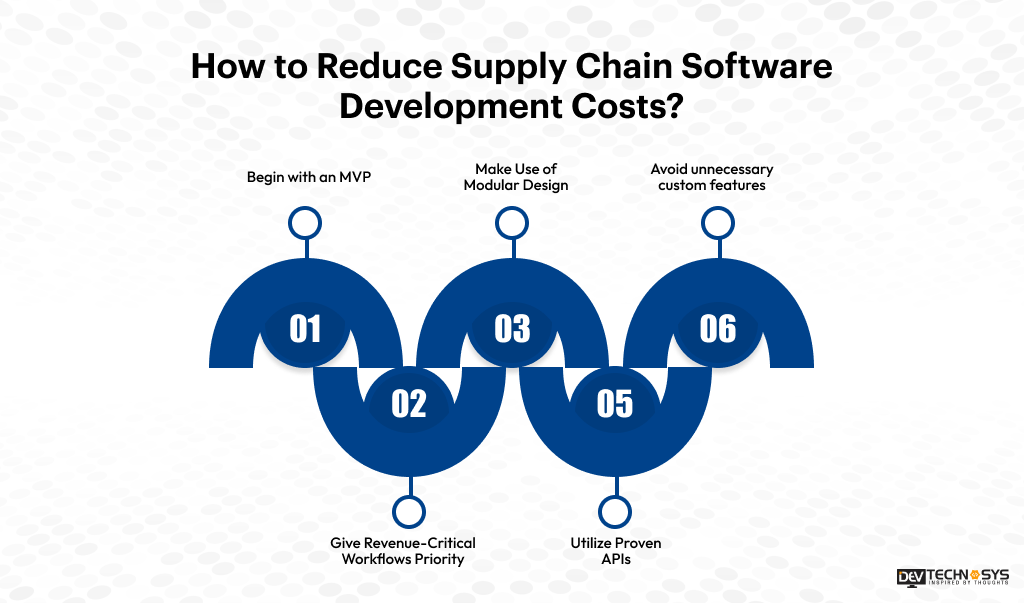
1. Begin with an MVP
Start with basic SCM processes including orders, inventory, procurement, and warehouse operations. Before implementing more sophisticated features, test the solution with actual users. An MVP shortens time-to-market, lowers the initial development expense, and offers useful input that can direct future features based on real operational needs.
2. Give Revenue-Critical Workflows Priority
Workflows that directly affect revenue, fulfillment, inventory accuracy, or operational efficiency should be the main focus of development. Don’t develop additional features for the initial release.
Setting priorities for business-critical processes facilitates efficient budget allocation, increases time-to-value, and enables teams to assess outcomes prior to making investments in new supply chain software features.
3. Make Use of Modular Design
Major SCM tasks are divided into manageable parts with a modular architecture, which facilitates future growth. Without completely rewriting the platform, businesses can add features related to procurement, warehousing, transportation, or analytics. This strategy can lower the cost of reconstruction, make maintenance easier, and provide incremental growth as operating needs change.
4. Utilize Proven APIs
For services like mapping, payments, notifications, authentication, analytics, and logistical integrations, use well-established APIs as needed. Custom development and testing requirements might be decreased by reusing dependable services. Prior to integration, teams should still assess API price, security, documentation, performance limitations, data handling, and long-term availability.
5. Avoid unnecessary custom features
Not every feature that is sought has to be created from the ground up. Determine whether a skill actually enhances decision-making, customer experience, compliance, or operational efficiency. Avoiding low-value modification keeps the platform easier to maintain, upgrade, integrate, and scale while reducing development and testing work.
How Long Does It Take to Develop Supply Chain Software?
Depending on the necessary modules, integrations, customization, and testing scope, supply chain software development normally takes three to six months.
While platforms requiring ERP connection, advanced analytics, AI, IoT, or multi-location support may need the entire six-month timetable for dependable creation, testing, and deployment, a basic solution can be produced more quickly.
Stage |
Estimated Duration |
| Discovery | 2–4 weeks |
| UI/UX | 3–6 weeks |
| MVP Development | 12–20 weeks |
| Integrations | 4–10 weeks |
| Testing | 3–6 weeks |
| Deployment | 1–3 weeks |
Conclusion
The cost of building supply chain software in UAE relies on features, integrations, architecture, security needs, AI capabilities, and scalability. A well-planned MVP helps firms manage the initial investment and provide a basis for future growth.
The selection of an experienced supply chain software development company can make the process of requirements analysis, architectural planning, integration, testing, and deployment easier. Businesses should also factor in hidden costs, maintenance, and continual improvements. When drawing up their budget to ensure long-term reliability, performance, and verifiable operational value.
Frequently Asked Questions
1. How Much Does Supply Chain Software Development Cost In The UAE?
The cost to build supply chain management software is AED 110,000-550,000+ based on modules, integrations, architecture, AI capabilities, security, and customization. Basic solutions are cheaper, whereas business platforms with full automation and real-time visibility are far more expensive.
2. How Long Does It Take To Develop SCM Software?
SCM software development time ranges from 3-6 months, depending on functionality, integrations, customization, and testing requirements. Simple systems can go live earlier, but developing ERP connectors, AI, IoT, multiple warehouses, and advanced analytics solutions usually takes longer.
3. Is Custom SCM Software Better Than Off-The-Shelf Software?
For enterprises that need unique workflows, regional localization, sophisticated integrations, or more scalability, custom SCM software is better. Off-the-shelf solutions usually offer speedier setup and reduced upfront expenditures. Which one is right for you depends on your budget, operational complexity, customization needs, and long-term business ambitions.
4. How Much Does Supply Chain Software Maintenance Cost?
The ongoing costs of supply chain software are typically 15%-25% of what was spent to develop it. These often include bug patches, security upgrades, cloud infrastructure, database management, API changes, integration support, performance enhancements, technical support, and general improvements. Major feature development is typically billed individually.
5. Is Supply Chain Software Suitable For UAE Logistics Companies?
Yes, SCM software is ideal for UAE logistics organizations since it can centralize the inventory, procurement, warehouse, transportation, and order processes. Custom solutions can also include Arabic-English interfaces, multi-location operations, regional processes, ERP connectors, real-time tracking, analytics, and scalable logistics management.