





The United Arab Emirates (UAE) is changing the face of business, and it is doing so using its supply chains as an asset. Modern business is characterized by the rapid expansion of global trade; its speed and sophisticated nature put pressure on UAE traders to apply technology in order to stay one step ahead.
Benefits of supply chain management software include speeding up the delivery cycle, decreasing expenses, and making better decisions using artificial intelligence-powered forecasting, real-time monitoring, automation, and intelligent systems for logistics.
The goal set by the UAE is ambitious. It places the country among the leading nations in the area of digital transformation. Nevertheless, it is a reality of today’s business.
What Is Supply Chain Technology and What Does It Include?
Supply chain technology is a set of electronic devices and systems that allow companies to efficiently plan, source, create, store, transport, and distribute products. It includes SCM platforms for end-to-end coordination and ERP solutions for business operations integration.
AI, machine learning, predictive analytics, and IoT enhance prediction, decision-making, and monitoring. WMS handles the operations of warehouses, and TMS streamlines transportation. Cloud computing allows for scalable and interconnected systems.
Robotics and automation make physical processes more efficient. Digital twins to model supply chains for testing and supply chain optimization. Tracking and visibility solutions track and offer real-time data on shipments and inventory. Most are in commercial use now, with advanced digital twin and AI capabilities still evolving.
Answer a few quick questions and our experts will share a tailored project estimate.
Why Are UAE Businesses Investing in Supply Chain Technology?
UAE businesses are invest to build inventory management software to handle rising complexity, increase real-time visibility, cut operational costs, speed up fulfillment and boost resilience against interruptions.
This boom in e-commerce and omnichannel commerce has also increased the urgency for efficient operations. The geographical position of the UAE as a global logistics center further adds to the importance of supply chain innovation.
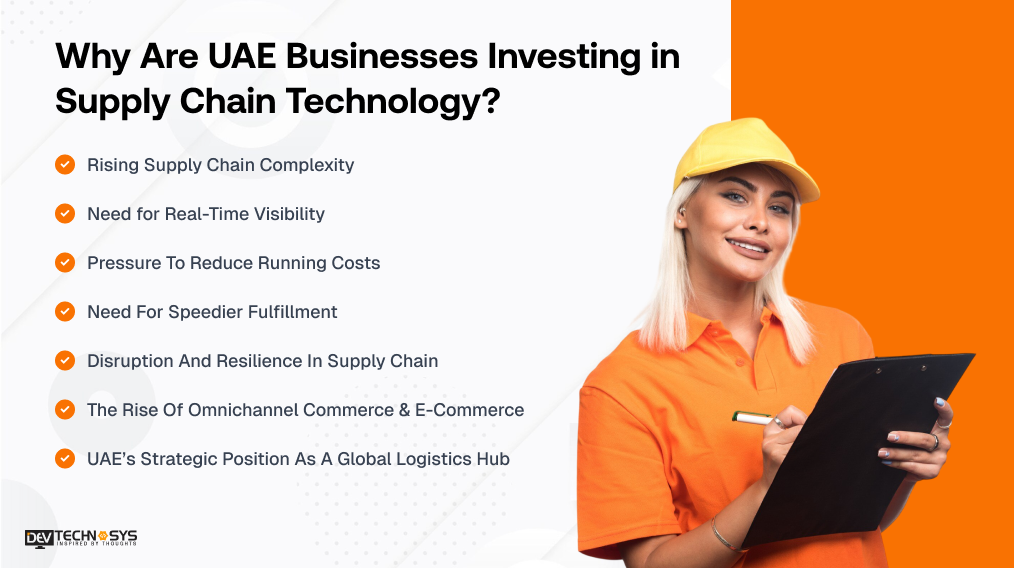
1. Rising Supply Chain Complexity
UAE businesses are dealing with more complicated supply chains, encompassing worldwide suppliers, different transit modes, varied markets, and changing customer expectations.
Supply chain technology helps firms to coordinate these moving parts from a single platform. Improved integration, automation, and data exchange reduce operational bottlenecks and enhance planning, inventory management, procurement, and supply chain performance overall.
2. Need for Real-Time Visibility
UAE firms can see what’s happening to their inventory, shipments, orders, and supplier activity in real time. IoT, tracking platforms, cloud systems and analytics offer precise data for operations. This allows managers to immediately spot delays, respond to exceptions, increase contact with customers, and make faster, more informed decisions.
3. Pressure To Reduce Running Costs
Companies in the UAE are develop transportation software to offset rising expenses of logistics, labor, inventory, and transportation. Automation can reduce human labor, and analytics may maximize inventory, routes, warehouse capacity, and purchasing.
Supply chain technology can help reduce operating costs by identifying inefficiencies and optimizing the use of resources, while maintaining service levels and enabling sustainable business growth.
4. Need For Speedier Fulfillment
Customers want rapid, accurate, and dependable delivery more than ever. In response, UAE businesses are deploying systems such as warehouse automation, WMS, TMS, AI, and real-time visibility to accelerate order processing and fulfillment.
These technologies enable organizations to enhance inventory availability, optimize picking and transportation, eliminate delivery delays, and provide customers with more reliable service.
5. Disruption And Resilience In Supply Chain
Recent global disruptions, geopolitical uncertainty, transportation delays, and supplier issues have cast a spotlight on the significance of resilient supply chains. UAE businesses are using technology to spot risks earlier, track suppliers, run simulations, and respond promptly to disruptions.
According to the AI development company, more visibility and predictive skills assist firms to diversify alternatives, keep the business moving, and recover faster from unforeseen catastrophes.
6. The Rise Of Omnichannel Commerce & E-Commerce
The rise of e-commerce and omnichannel retail is compelling UAE businesses to handle orders, inventory, warehouses, and deliveries across various channels.
Supply chain technology in UAE integrates these processes, offering better visibility into inventories and faster fulfillment. This allows companies to provide a seamless consumer experience across websites, marketplaces, brick-and-mortar stores, and any other sales channel.
7. UAE’s Strategic Position As A Global Logistics Hub
The UAE’s strategic position between key global markets means that logistics and supply chain efficiency are particularly crucial. Its ports, airports, free zones, and international commerce links support huge volumes of regional and worldwide travel.
As the UAE continues to evolve as a global logistics hub, businesses are investing in modern technologies to enhance connectivity, logistical performance, visibility, and competitiveness.

How Is AI Transforming Supply Chain Management in the UAE?
AI is advancing from theory to real-world application in the supply chain. Companies are also using AI for demand forecasting, inventory optimization, predictive maintenance, logistics optimization, supplier risk analysis, and automated buying.
These tools assist organizations in predicting demand, cutting costs, preventing interruptions, increasing asset performance, optimizing logistics, and making faster, data-driven operational choices.
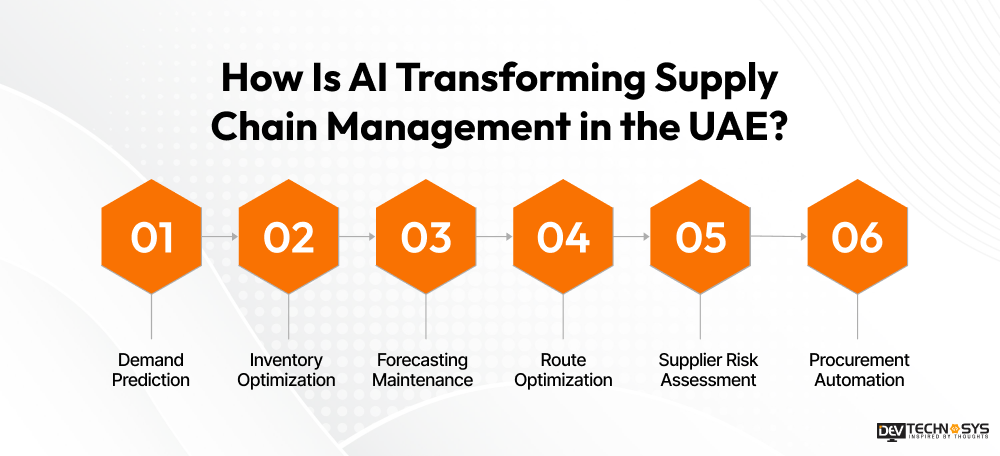
1. Demand Prediction
AI uses past sales, seasonality, market trends, promotions, and external factors to predict future demand. Businesses may use these predictions to better plan purchasing and manufacturing, decrease stockouts, eliminate excess inventory, and react faster to changing client demand across products, locations, and sales channels.
2. Inventory Optimization
AI-driven digital transformation for UAE businesses analyzes inventory levels, sales trends, lead times, and supplier performance to determine ideal stock levels.
Businesses can spot slow-moving products to avoid shortages and excess inventory. This enhances working-capital efficiency and guarantees products are available when and where customers need them.
3. Forecasting Maintenance
AI analyzes equipment data from sensors, maintenance history, and operational conditions to detect early symptoms of possible equipment failure. Maintenance can be scheduled to avoid malfunctions, decreasing unplanned downtime, repair costs, and business impact. This is especially beneficial for warehouses, manufacturing facilities, automobiles, and automated equipment.
4. Route Optimization
The AI takes into account traffic, delivery locations, vehicle capacity, fuel consumption, delivery windows, and historical transportation data to suggest the best route to take.
Firms may cut travel time, fuel expenses, and delivery delays, and improve fleet utilization. Routes can also be dynamically changed to respond to unexpected traffic or operational interruptions.
5. Supplier Risk Assessment
AI in manufacturing can examine supplier performance, delivery records, pricing, financial indicators, geopolitical changes, and other pertinent data to identify potential threats.
Businesses may identify susceptible suppliers earlier, estimate interruption probability, compare alternatives, and establish contingency plans. This enables more robust sourcing selections and helps to mitigate unforeseen supply disruptions.
6. Procurement Automation
Artificial intelligence can also take over repetitive procurement duties such as demand analysis, inventory levels, supplier prices, and purchasing history.
When stock falls to established thresholds, systems can provide recommendations or place buy orders. Helping companies reduce manual processing, enhance purchasing accuracy, shorten procurement cycles, and maintain proper inventory levels.
How Does Supply Chain Technology Help UAE Businesses Reduce Costs?
Supply chain technology helps UAE firms cut costs through improved inventory control, transportation efficiency, warehouse productivity, and asset use.
Automation reduces order errors, administration, fuel use, stockouts, and product waste. However, savings will vary by business and implementation; thus, percentage reductions can only be reported with acceptable supporting information.
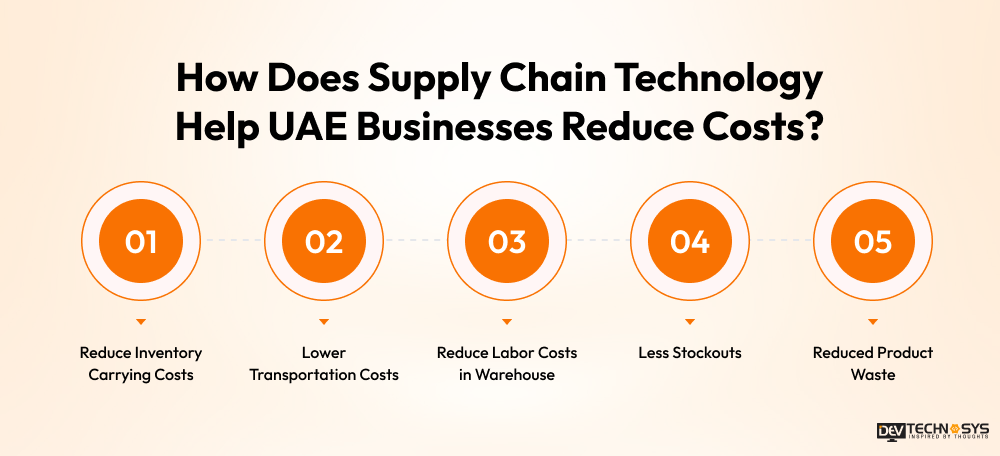
1. Reduce Inventory Carrying Costs
Supply chain technology enables companies to improve demand forecasts, replenishment, and stock visibility, helping them to maintain appropriate inventory levels.
This eliminates excess inventory, storage requirements, and the operating capital tied up in unsold goods. This enables companies to respond more effectively to demand while reducing logistics software development cost.
2. Lower Transportation Costs
Transportation management systems and artificial intelligence can optimize delivery routes, decrease empty journeys, make better use of vehicles, and combine goods.
With better planning, companies may meet service levels and still reduce transportation costs. Real-time visibility also helps organizations react rapidly to delays, routing adjustments, and other logistical difficulties.
3. Reduce Labor Costs in Warehouse
Warehouse management systems, robotics, and automation can help to cut down on repetitive manual tasks like picking, sorting, scanning, and stocktaking.
Enhanced workflows and productivity allow businesses to handle more work with less manual intervention. Technology also frees personnel to focus on more valuable operational and customer-facing tasks.
4. Less Stockouts
Good inventory data, demand forecasts, and automatic replenishment enable a company to spot a potential shortfall before it happens. Avoiding stockouts means avoiding lost revenue, emergency buying, and customer discontent. Better supplier collaboration between suppliers, warehouses, and sales channels means products are ready when customers want them.
5. Reduced Product Waste
Technology enables organizations to monitor inventory conditions, shelf life, demand patterns and product movement. This is particularly suitable for food, pharmaceuticals and other time-critical products. By identifying slow-moving or expiring stock earlier, organizations can modify their purchase, redistribution or sales strategy and prevent unnecessary product waste.

Which Supply Chain Technologies Are UAE Businesses Adopting?
UAE businesses are using a mix of proven and new supply chain technologies to boost efficiency and visibility. Depending on operational requirements and technology maturity, some common solutions are SCM and ERP systems, WMS, TMS, cloud computing, IoT, AI, machine learning, predictive analytics, real-time tracking, robotics, automation, and digital twins.
Technology |
Supply Chain Application |
Primary Business Benefit |
| AI & ML | Forecasting and optimization | Better decisions |
| IoT | Asset and shipment tracking | Real-time visibility |
| WMS | Warehouse management | Higher productivity |
| TMS | Transport planning | Lower logistics costs |
| ERP | End-to-end business integration | Centralised data |
| Robotics | Picking, packing and movement | Automation |
| Cloud | Data and system accessibility | Scalability |
| Digital Twins | Simulation and optimization | Lower implementation risk |
| Predictive Analytics | Demand and risk forecasting | Proactive planning |
What Are the Business Benefits Of Supply Chain Management Software for UAE Companies?
Supply chain technology offers quantifiable corporate value across operations, finance, customer service, and strategy. UAE companies can optimize processes, cut costs, boost inventory and asset utilization, speed up deliveries, gain visibility, build resilience, support better forecasting, make faster choices, and grow operations without compromising on quality and efficiency.
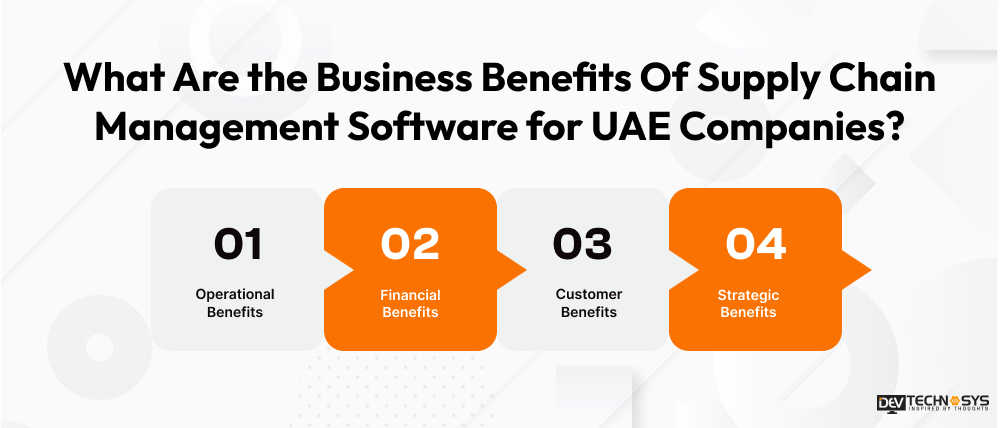
1. Operational Benefits
UAE businesses may optimize procedures, automate repetitive activities, and decrease errors with supply chain technology, while improving the use of resources.
Integrated systems link procurement, inventory, warehousing, and transportation to allow for speedier operations and greater coordination. Benefits of supply chain management software UAE enhance operational efficiency, increase productivity, and help the organization better respond to changing supply chain demands.
2. Financial Benefits
Technology can assist UAE businesses in managing operating costs through better inventory use, transportation planning, warehouse productivity, and asset performance.
Automation also eliminates unneeded manual work, errors, and waste. The financial results will be a factor of the organization and implementation, but greater visibility and process control can help in the enhancement of cost management and resource efficiency.
3. Customer Benefits
Supply chain tech enables companies to process orders faster, increase order accuracy, and get better supply chain visibility. This means more reliable fulfillment, accurate delivery information, and fewer service interruptions for customers.
Benefits of supply chain management software can boost consumer happiness and trust, especially as UAE businesses cater to rising e-commerce and omnichannel demands.
4. Strategic Benefits
Technology may enhance supply chain resilience through better forecasting, visibility, risk monitoring, and decision-making. Businesses in the UAE can respond to disruptions faster, scale operations more efficiently, and adjust to fluctuating market conditions.
Benefits of supply chain management software can utilize these capabilities to create more agile supply chains and potentially gain a competitive edge in regional and global marketplaces.
What Challenges Should UAE Businesses Consider Before Investing in Supply Chain Technology?
Before you invest, UAE firms have to think about installation expenses, integrating systems, data quality, supply chain cybersecurity, how well employees will adopt it, and the reliability of the provider.
Companies should also consider scalability, training requirements, ongoing support, and compatibility with existing workflows to ensure technology investments generate long-term operational value without adding extra complexity or disruption.
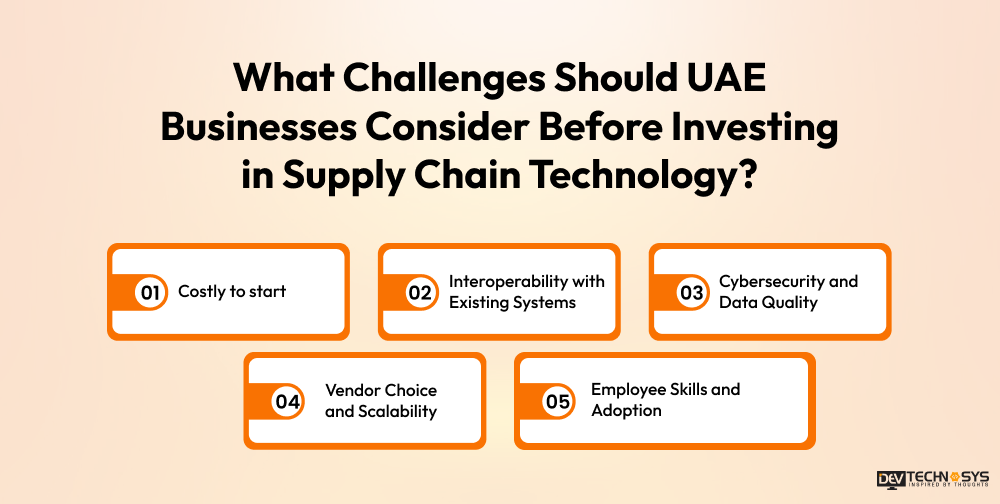
1. Costly to start
Deploying supply chain technology may require a large investment in software, hardware, ERP integration, training, and continuous maintenance. UAE enterprises must assess the overall cost of ownership, not just purchase pricing. Having a clear business case, implementation roadmap, and expected outcomes can help ensure technology investments provide sustainable value.
2. Interoperability with Existing Systems
New supply chain solutions generally have to interface with current ERP, accounting, warehouse, transportation, and customer systems. Poor integration can result in data silos, duplication of effort, and operational interruption.
Benefits of supply chain management software should consider interoperability, APIs, data standards, and integration needs to enable the smooth flow of information.
3. Cybersecurity and Data Quality
Good, consistent, secure data is the foundation of technology. Poor quality information can compromise forecasting, inventory management, and reporting; cyber assaults can lead to operational disruptions or the exposure of important business information.
UAE organizations must use data governance, restriction of access, supply chain data security precautions, backup procedures, and clear duties before deployment.
4. Vendor Choice and Scalability
Businesses need to adopt technology that can support future growth, not only address current needs. It is important to carefully analyze vendor trustworthiness, implementation skills, support services, scalability, customization, and supply chain software development. UAE organizations should also ask whether the solution can adapt to changes in operations, regulation, and market conditions.
5. Employee Skills and Adoption
For technology to be adopted successfully, personnel need to understand and use the new systems efficiently. Expected benefits of supply chain management software can be reduced by resistance to change, lack of technical skills, and inadequate training.
Businesses need to involve staff from the outset, provide hands-on training, clarify why a change is being made, and build ongoing support to drive successful adoption.

Conclusion
It is time to say goodbye to this blog. As we have seen, the era of automation is here, and the UAE is a developed region where new technologies are constantly emerging. As is evident, many businesses are investing in supply chains, and rightly so.
This sector has grown rapidly and propelled businesses to great heights. UAE businesses can also use artificial intelligence in supply chain software to make their operations easier and faster.
It can also eliminate manual or human errors. To get this software in the UAE, connect with a CMMI Level 3 supply chain development company in UAE, and they will work under proper security and data privacy compliance measures.
Frequently Asked Questions
1. How Does Supply Chain Technology Help UAE Businesses Reduce Costs?
Supply chain technology enables UAE firms to better manage inventory, optimize transportation and warehouse operations, reduce human effort and minimize errors and waste, allowing them to better control expenses. Better visibility allows firms to pinpoint inefficiencies, optimize asset utilization, and make data-driven decisions for more efficient resource allocation.
2. How Does Technology Strengthen Supply Chain Resilience in the UAE?
Technology helps enhance resilience by offering real-time information on suppliers, inventory, shipments, and operational hazards. Companies may use AI, supply chain analytics, IoT, and cloud platforms to anticipate disruptions earlier, evaluate options, and respond rapidly. This allows UAE enterprises to keep going, deal with uncertainty, and bounce back better when things go wrong.
3. Which Supply Chain Technologies Are UAE Businesses Adopting?
UAE companies are implementing technologies including SCM and ERP platforms, warehouse and transportation management systems, cloud computing, IoT, AI, machine learning, predictive analytics, real-time tracking, robots and supply chain automation. The level of adoption varies with the size of the firm, the industry, the operational requirements and the digital maturity, with legacy systems gradually being supplemented by emerging technology.
4. How Are UAE Government Initiatives Accelerating Supply Chain Digital Transformation?
The UAE government’s policies are facilitating digital transformation via investments in smart infrastructure, logistical connections, digital platforms, trade facilitation, and a technology-focused economic strategy. These initiatives promote the use of linked technologies, streamline trade processes, enhance data interchange, and bolster the UAE’s position as a tech-enabled global logistics center.
5. What Are the Business Benefits Of Supply Chain Management Software for UAE Companies?
Supply chain technology brings operational, financial, customer, and strategic benefits. It allows UAE organizations to optimize processes, decrease costs, boost inventory utilization, speed up fulfillment, increase shipping visibility, enhance resilience, improve forecasting, and enable faster choices. Such capabilities can enhance service quality while enabling companies to scale efficiently in competitive marketplaces.