





Supply chain management software connects various activities of the supply chain into one unified system, allowing companies to run operations more effectively and efficiently. It lets users see their inventory and purchase orders, organize warehouses, work with suppliers, manage shipping, and control deliveries.
Good software lets firms automate processes to minimize manual labor, get insights from the information they have got, and track their activity in real-time. Some advanced software products rely on AI to enhance demand predictions and minimize supply chain risks.
At the same time, these functions can be completely utilized only if supply chain management is integrated with the ERP, CRM, accounting, eCommerce systems, GPS, etc. The following sections of the guide will discuss the main supply chain software features and the benefits this software offers.
What Is Supply Chain Management Software?
A centralized digital system called supply chain management software aids companies in organizing, overseeing, and managing their supply chain operations from a single location.
Procurement, inventory control, warehouse operations, supplier management, transportation, order processing, and delivery tracking are just a few of the important tasks it links.
SCM software integrates data into a shared system rather than storing it in individual spreadsheets, emails, or handwritten recordkeeping. For instance, the system can update stock records, initiate a purchase request, and communicate pertinent data to suppliers and procurement when inventory levels drop. This improves teams’ visibility into day-to-day operations and establishes a connected data flow throughout the supply chain.
Answer a few quick questions and our experts will share a tailored project estimate.
How Does Supply Chain Management Software Work?
Procurement, inventories, warehouses, suppliers, transportation, and orders are all connected via supply chain management software. It follows movement, gathers real-time data, automates processes, and offers analytics for quicker, better decisions.
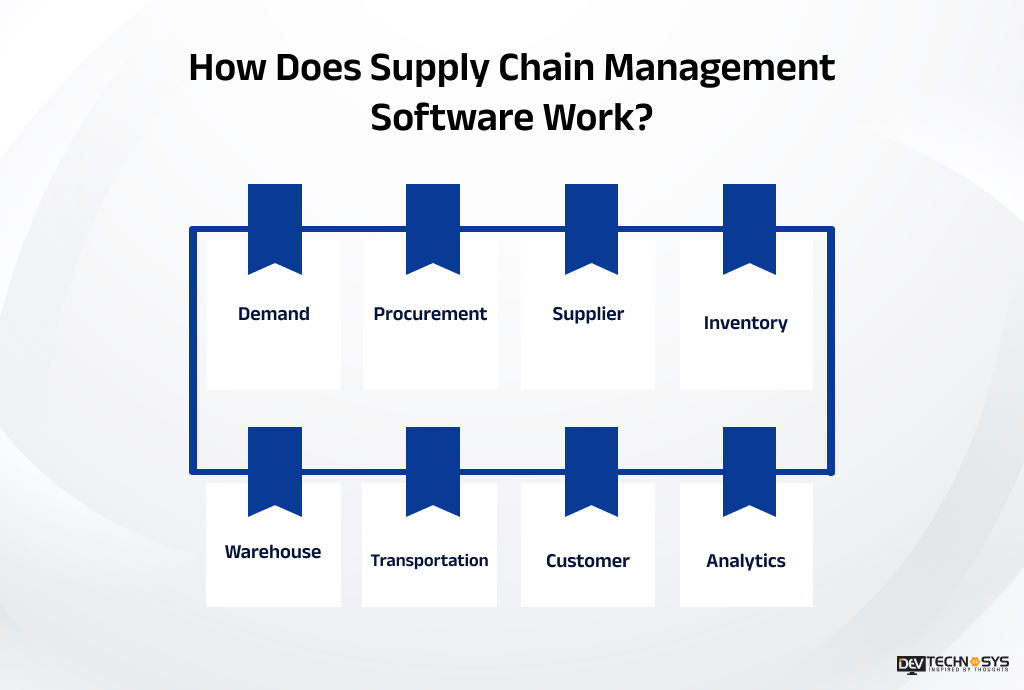
- Demand: Forecast customer demand using historical data, market trends, and current orders to determine required inventory and purchasing needs.
- Procurement: Automate purchasing workflows by creating purchase orders, comparing requirements, tracking approvals, and ensuring materials are ordered on time.
- Supplier: Manage supplier information, orders, communication, pricing, performance, and delivery schedules through one centralized platform.
- Inventory: Stock level monitoring, product movements, availability, and replenishment needs across multiple locations using real-time inventory data.
- Warehouse: Manage receiving, storage, picking, packing, stock transfers, and dispatch activities while improving warehouse accuracy and operational efficiency.
- Transportation: Plan shipments, optimize delivery routes, track vehicles, monitor shipment status, and manage transportation activities from one connected system.
- Customer: Process customer orders, track deliveries, provide shipment updates, and help ensure products reach customers accurately and on time.
- Analytics: Analyze supply chain data to identify performance gaps, rising costs, delays, demand patterns, and opportunities for operational improvement.
What Are the Key Features of Supply Chain Software?
Businesses may manage operations using a single, integrated platform thanks to the essential characteristics of supply chain management software. Efficiency, accuracy, coordination, and decision-making are enhanced by real-time visibility, demand forecasting, inventory control, procurement, supplier management, and warehouse and transportation management.
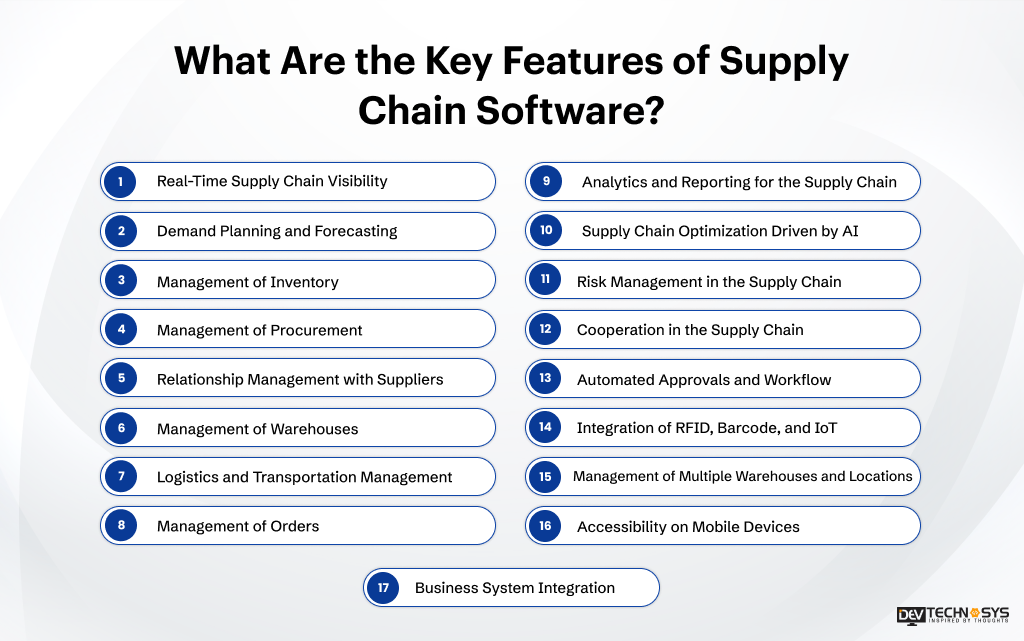
1. Real Time Supply Chain Visibility
Businesses may examine inventory, shipments, suppliers, orders, and transportation activity centrally with real-time insight. Teams can promptly discover delays and shortages by using dashboards that display current operational data.
Centralized visibility enhances coordination, closes information gaps, and facilitates quicker, more precise decision-making for UAE companies with several suppliers, warehouses, and logistics partners.
2. Demand Planning and Forecasting
In order to forecast future needs, demand forecasting examines past sales, purchasing trends, seasonality, market shifts, and present demand signals. Demand sensing and real-time data can help AI and ML models increase forecasting accuracy.
Improved planning helps companies maintain product availability while lowering stockouts, overstocking, excess inventory, lost sales, and needless storage expenses.
3. Management of Inventory
Real-time visibility into stock levels across several locations is made possible via inventory management. SKUs, reorder points, safety stock, batch and lot numbers, stock transfers, and product availability can all be managed by businesses using a single system. This helps teams keep the correct products at the proper locations, minimizes extra stock, avoids shortages, and increases inventory accuracy.
Why Inventory Management Is Critical for SCM
Inventory links sales, fulfillment, warehousing, and procurement. Businesses can determine what is available, where goods are kept, and when replenishment is necessary with the use of accurate inventory information.
Dedicated supply chain software development can offer more control, automation, and visibility throughout the whole inventory lifecycle for businesses handling complicated processes.
4. Management of Procurement
The entire purchase process, from request to payment, is automated via procurement management. buy requisitions, buy orders, approvals, supplier comparisons, purchase tracking, invoice matching, and procurement cost analysis are all possible for teams. Automation speeds up approval, minimizes repetitive manual labor, avoids purchase errors, and gives you more control over supplier spending and purchasing choices.
5. Relationship Management with Suppliers
Supplier profiles, onboarding details, contracts, ratings, communication histories, and performance statistics are all kept in one location by supplier relationship management.
Companies may keep an eye on supplier risks, pricing, quality, and delivery timelines. For instance, the system can alert a supplier for evaluation before the problem impacts operations if the supplier consistently misses delivery dates.
6. Management of Warehouses
Receiving, put-away, picking, packing, inventory movement, and cycle counting are all supported by warehouse management software. Accurate product tracking across warehouse sites is made possible by barcode and RFID technologies.
Additionally, by keeping an eye on storage spaces, inventory movements, and warehouse performance, businesses may lower manual errors and increase order fulfillment speed, inventory accuracy, and overall warehouse productivity.
SCM Software vs Warehouse Management Software
The entire supply planning chain, including purchasing, inventory, suppliers, shipping, orders, and analytics, is managed by SCM software. Receiving, storage, picking, packing, and stock transportation are among the warehouse operations that are the primary emphasis of warehouse management software. As a result, WMS can function as a crucial part of a broader SCM ecosystem.
7. Logistics and Transportation Management
Businesses may plan shipments, manage carriers, optimize routes, keep an eye on fleets, track deliveries, and manage freight operations with the aid of transportation and logistics tools.
Additionally, they can facilitate real-time shipment visibility and last-mile delivery. Businesses can better coordinate transportation operations with inventory, warehouse, and order processes by integrating these capabilities with logistics software development.
8. Management of Orders
Order management links fulfillment and inventory operations with sales channels. Order creation, validation, processing, fulfillment, status tracking, refunds, and customer alerts are all supported by the system.
Delays, overselling, and order processing problems can be minimized by automatically checking inventory availability upon order placement and providing fulfillment teams with updated instructions.
9. Analytics and Reporting for the Supply Chain
Supply chain analytics uses dashboards, KPI tracking, and bespoke reports to transform operational data into practical business insights. Suppliers, inventories, logistics, and procurement performance can all be examined by teams.
Inventory turnover, order fulfillment rate, supplier lead time, perfect order rate, stockout rate, on-time delivery, and inventory carrying cost are all significant KPIs.
10. Supply Chain Optimization Driven by AI
It is one of the most advanced supply chain software features and is integrated into most SCM software. Demand forecasting, predictive inventory planning, supplier risk prediction, route optimization, anomaly detection, and intelligent suggestions can all be enhanced by AI-powered supply chain management software.
In 2026, artificial intelligence (AI) is shifting more and more toward automated decision support and agentic workflows that are capable of reasoning across supply chain data, identifying operational problems, suggesting solutions, and supporting execution as opposed to merely offering rudimentary support.
11. Risk Management in the Supply Chain
Businesses can detect and address supplier issues, shipment delays, shifts in demand, geopolitical disruptions, inventory shortages, and weather-related catastrophes with the use of supply chain risk management.
Before major disruptions occur, predictive systems can monitor operational indicators and produce risk alarms. Teams have more time to change suppliers, amend plans, reroute shipments, and manage inventories when early warnings are issued.
12. Cooperation in the Supply Chain
Suppliers, manufacturers, distributors, logistics companies, warehouse teams, retailers, and consumers all benefit from a shared environment created by supply chain collaboration.
Businesses can enhance coordination and close communication gaps by exchanging pertinent information among linked systems. A more responsive supply chain is created by sharing data, improving supplier collaboration, reducing delays, and making decisions more quickly.
13. Automated Approvals and Workflow
SCM software can manage repeated operational tasks without continual human intervention thanks to automated workflows. Purchase approvals, supplier onboarding, reorder alerts, invoice processing, shipment exceptions, escalation rules, and notifications can all be automated by businesses.
By converting business principles into automated activities that enhance speed, consistency, and control, SCM software becomes more than just a data-storage system.
14. Integration of RFID, Barcode, and IoT
Real-time product and asset tracking throughout supply chain operations is enhanced by barcode, RFID, and IoT interfaces. RFID tracks objects without direct barcode scanning, barcode scanners record product movements, and Internet of Things sensors keep an eye on variables like temperature.
GPS tracking and warehouse sensors can support UAE logistics, cold-chain, fleet, and warehouse applications by providing location and operational data.
15. Management of Multiple Warehouses and Locations
Businesses can manage inventory across several warehouses, branches, distribution centers, and regional sites with the use of multi-location management.
Teams may monitor warehouse performance, transfer product across locations, view location-based availability, and centrally manage replenishment. Better inventory balance is produced, needless transfers are decreased, local stock shortages are avoided, and fulfillment across dispersed supplier networks is enhanced.
16. Accessibility on Mobile Devices
Warehouse managers, drivers, procurement teams, inventory employees, field workers, and executives can all access crucial supply chain data from any location thanks to mobile accessibility.
Stock checks, shipping status updates, request approvals, alarms, and real-time operations monitoring are all available to users. Without requiring teams to stay at desktop workstations, this facilitates quicker decision-making.
17. Business System Integration
Supply chain processes are linked to other business systems through SCM connectors, which keep data from being separated. ERP integration, WMS, TMS, CRM, accounting, eCommerce, payment gateways, GPS, and IoT platforms are examples of common connections. Webhooks, EDI, REST APIs, GraphQL, and cloud connectors enable data interchange, process synchronization, and consistent information.
What Security Features Should SCM Software Have?
Supply chain management software manages sensitive corporate data such as supplier records, inventories, purchase orders, shipment details, customer information, and financial transactions.
This data must be protected by strong security controls across applications, APIs, databases, cloud infrastructure, and connected devices, while enabling compliance, monitoring, and controlled access.
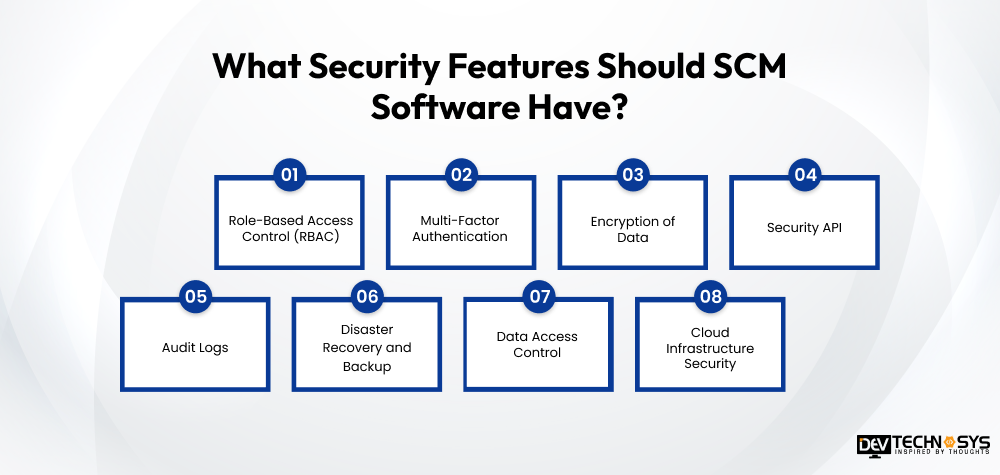
1. Role-Based Access Control (RBAC)
Role-Based Access Control (RBAC) limits system rights based on user roles and responsibilities. Administrators can assign granular privileges to procurement teams, warehouse staff, suppliers, drivers, managers, and executives.
RBAC ensures the concept of least privilege, permission segregation, access restrictions, and resource-level authorization, thus minimizing unauthorized access to sensitive supply chain data.
2. Multi-Factor Authentication
Multi-Factor Authentication (MFA) is an extra layer of protection to usernames and passwords. SCM solutions can support OTPs, authenticator apps, biometrics, hardware security keys, and adaptive authentication.
MFA is effective in preventing credential theft, account takeover, and illegal access when combined with password rules, session management, device verification, and risk-based authentication.
3. Encryption of Data
SCM software should encrypt sensitive information both in transit and at rest. Data in motion between apps, APIs, and users is secured using TLS/HTTPS, while AES-256 encryption can be used to secure data at rest.
Additional protection for operational and financial data is provided via secure key management, encryption key rotation, database encryption, tokenization, and certificate management.
4. Security API
SCM software connects to ERP, WMS, TMS, CRM, accounting, eCommerce, GPS, and IoT systems via APIs; thus, it’s crucial to secure APIs. To mitigate vulnerabilities associated with ERP software development solutions, think about using OAuth 2.0, OpenID Connect, API keys, JWT validation, rate limiting, input validation, schema enforcement, endpoint authorization, threat detection, and secure API gateways.
5. Audit Logs
The SCM platform generates a thorough audit log of the activities performed. Systems should have a record of user authentication, modifications to data, approvals, configuration changes, API calls, and administrative operations with timestamps and user identities.
Tamper-proof logging, centralized monitoring, SIEM integration, anomaly detection, and automated notifications enhance security investigation and accountability.
6. Disaster Recovery and Backup
SCM platforms should have encrypted and automated backups to secure operational data from ransomware, unintentional deletion, hardware failures, and infrastructure outages.
Disaster recovery plans may involve: Replication, geographically isolated backups, specific RPO and RTO targets, failover infrastructure, recovery testing, versioned backups, and business continuity measures.

7. Data Access Control
Data access restrictions establish who is allowed to access specific information or resources, including users, systems, applications, and services. SCM platforms should have RBAC, least-privilege policies, attribute-based access control (ABAC), database permissions, network segmentation, IP limitations, session controls, and data classification to secure sensitive supplier, customer, inventory, and financial information.
8. Cloud Infrastructure Security
In a secure cloud environment, you should use network segmentation, private subnets, firewalls, WAF protection, intrusion detection, DDoS mitigation, vulnerability scanning, container security, endpoint protection, and ongoing monitoring.
You may also use secure configurations, patch management, secrets management, and cloud IAM controls to help protect SCM applications deployed on AWS, Azure, or Google Cloud. Infrastructure-as-Code security can help as well.
How Do These SCM Features Work Together?
The actual value of supply chain management software is how the capabilities work together as a connected workflow, not in individual modules. Data collected in one stage is instantly transferred to the next, letting companies go from demand planning to fulfillment with fewer delays, manual activities, and information gaps.
Demand Forecasting
↓
Procurement
↓
Supplier Management
↓
Inventory Management
↓
Warehouse Management
↓
Transportation Management
↓
Order Fulfillment
↓
Analytics & Optimization
Demand Forecasting → Procurement: Forecasts help procurement teams decide what products or materials need to be bought and when by identifying anticipated product requirements.
Procurement → Supplier Management: Suppliers are informed of purchase requirements, and performance, pricing, lead times, contracts, and delivery dependability may all be tracked.
Supplier Management → Inventory Management: Inventory teams may plan replenishment, reorder points, safety stock, and anticipated stock levels with the use of supplier availability and delivery timetables.
Inventory Management → Warehouse Management: Warehouse staff are informed by real-time inventory data about what products are available, where they are kept, and which items need to be picked, transferred, or replenished.
Warehouse Management → Transportation Management: Transportation teams can plan routes and carriers by using the cargo information, quantities, destinations, and delivery requirements provided by packed and ready-to-ship orders.
Transportation Management → Order Fulfillment: Fulfillment teams may keep an eye on orders from dispatch to final delivery with the use of shipment tracking, carrier updates, route information, and expected delivery timings.
Order fulfillment → Analytics & Optimization: To find inefficiencies and enhance future planning, analytics dashboards are fed by completed orders, delivery performance, inventory movement, procurement activity, and supplier data.
Key SCM Software Features by Business Function
Supply chain software features facilitate various company operations while maintaining connectivity through shared data. Certain operational needs are met via procurement, inventories, warehousing, transportation, supplier management, order fulfillment, and analytics.
Businesses may discover the appropriate capabilities, close process gaps, and build inventory management software by understanding these aspects by function.
Business Function |
Important Supply Chain Software features |
Main Benefit |
| Procurement | Purchase orders, approvals, supplier management | Faster purchasing |
| Inventory | Stock tracking, reorder points, transfers | Better inventory control |
| Warehouse | Picking, packing, barcode/RFID | Faster fulfillment |
| Transportation | Tracking, routing, carrier management | Better delivery visibility |
| Suppliers | Performance, contracts, risk monitoring | Stronger supplier control |
| Analytics | Dashboards, KPIs, forecasting | Better decisions |
| Customer Orders | Order tracking, fulfillment, returns | Better customer experience |
Future of Supply Chain Management Software
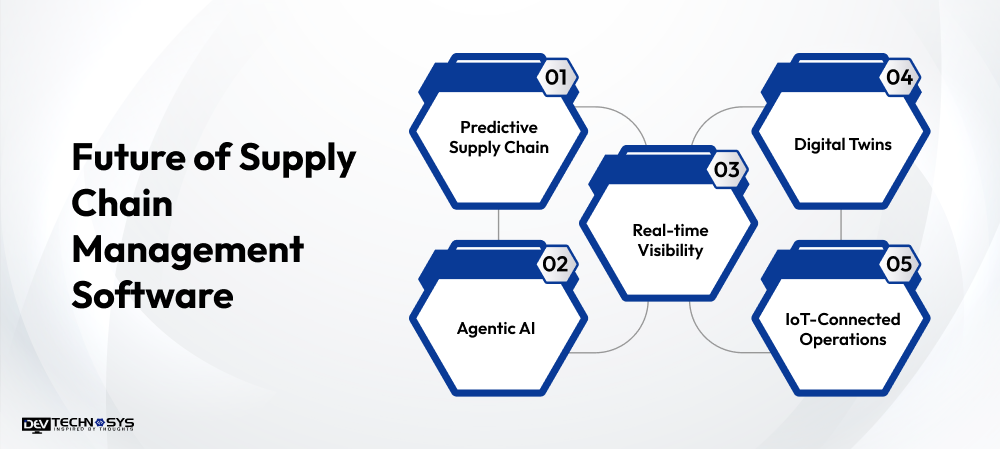
In 2026, supply chain management software will be more predictive, linked, and autonomous. Agentic AI, digital twins, IoT devices, real-time visibility, and predictive analytics enable businesses to anticipate disruptions, automate decisions, optimize resources, and develop GPS tracking systems that respond quickly to changing market conditions.
1. Predictive Supply Chain
Predictive SCM anticipates demand changes, inventory shortages, supplier delays, and transportation interruptions by combining AI, machine learning, historical data, and real-time signals. Businesses may act sooner, optimize resources, lower operational risks, and strengthen supply chain resilience.
2. Agentic AI
In 2026, agentic AI in manufacturing will propel SCM systems beyond recommendations and toward autonomous workflows. Artificial intelligence agents can evaluate demand, discover disturbances, compare possibilities, recommend actions, initiate approved processes, and coordinate tasks across procurement, inventory, logistics, and supplier operations.
3. Real-time Visibility
Real-time visibility is becoming increasingly important in modern supply chains, giving continually updated information about inventory, shipments, orders, suppliers, vehicles, and warehouses. Connected dashboards enable teams to immediately spot exceptions, coordinate operations, and make choices based on current supply chain conditions.
4. Digital Twins
Digital twins generate virtual models of supply chain activities, enabling firms to test inventory, warehouse, transportation, and demand scenarios. Companies can use these models in 2026 to test decisions, detect bottlenecks, evaluate disruptions, and optimize processes before implementing them in the real world.
5. IoT-Connected Operations
Real-time operational data is captured via IoT-linked SCM processes using sensors, GPS devices, RFID systems, and connected equipment. Businesses may monitor cargo locations, temperature, asset conditions, warehouse activity, and vehicle performance, allowing for automated alarms, predictive maintenance, improved tracking, and faster operational responses.

Final Words!
In order for supply chains to work efficiently, visibility, automation workflows, EDI integration, intelligence, and security have to be in place. Supply chain management software unites procurement, inventory, warehouses, suppliers, shipments, and orders while eliminating processes that require manual work and enhancing the decision-making process.
Integrations ensure synchronization of business data. Besides, AI and analytics make forecasting and risk detection possible. The more closely connected supply chains become, the greater the need for the right technology necessary for sustainable growth.
Thus, a skilled supply chain management software company like Dev Technosys can help provide a solution that is designed according to the individual business needs of a customer.
Frequently Asked Questions
1. What Are The Most Important Features Of Supply Chain Management Software?
Real-time visibility, demand forecasting, inventory management, procurement, supplier management, warehouse management, transportation, purchase order management, analytics, artificial intelligence, risk management, workflow automation, IoT integration, multi-location management, mobile access, and business-system integrations for linked supply chain operations are among the most crucial supply chain software features.
2. What Does SCM Software Include?
Procurement, supplier performance management, inventory, warehouse operations, transportation, order fulfillment, demand forecasting, analytics, supplier risk management, and collaboration are all commonly included in SCM software.
AI forecasting, automation, support for barcodes and RFID, IoT connectivity, mobile access, dashboards, APIs, and connectors with ERP, CRM, and accounting systems are further supply chain software features of modern platforms.
3. How Does Supply Chain Management Software Improve Inventory Management?
Real-time inventory visibility across warehouses and locations is made possible by SCM software. It automates replenishment notifications and keeps track of stock movements, SKUs, batches, reorder points, safety stock, and transfers.
Businesses can improve product availability and fulfillment while reducing stockouts, excess inventory, carrying costs, manual errors, and delays by using accurate inventory data.
4. How Does AI Improve Supply Chain Management Software?
By examining operational, historical, and real-time data to spot trends and forecast future occurrences, AI enhances SCM software. In order to assist firms in reacting more quickly to shifting supply chain conditions, it can support demand forecasting, inventory planning, supplier risk detection, route & inventory optimization, anomaly detection, intelligent suggestions, and automated decision-making.
5. Can SCM Software Manage Multiple Warehouses?
Yes, with centralized controls, contemporary SCM software can oversee numerous warehouses, distribution hubs, and local locations. Companies are able to keep an eye on receiving, picking, packaging, replenishment, transfers, warehouse performance, and stock availability. Better product allocation based on demand is made possible by real-time synchronization, which also aids in maintaining correct inventory records.