





Key takeaways:
-
-
- Modern POS systems connect payments, inventory, accounting, customer data, and reporting, making them more than simple checkout platforms.
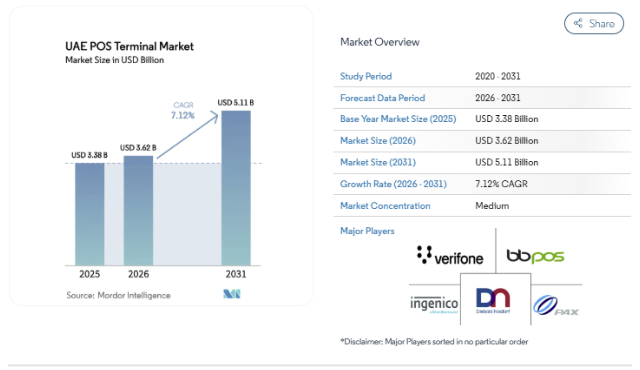
- The UAE POS Terminal market is estimated at $3.62 billion in 2026 and projected to reach $5.11 billion by 2031, growing at a 7.12% CAGR.
- Custom POS software development in UAE typically costs $15,000 to $55,000+, depending on features, integrations, security, and business complexity.
- UAE POS solutions should incorporate PCI DSS, encryption, secure APIs, payment security, VAT, and e-invoicing readiness from the development stage.
-
Eight in ten payments in the UAE are now made digitally.
Visa’s January 2026 report highlights how quickly consumer payment habits are moving away from cash toward cards and mobile payments.
This places the POS system at the heart of daily business activities. One transaction can handle a payment, change inventory, create an invoice, and communicate sales data to accounting or reporting systems.
For businesses planning POS software development in UAE, the focus is no longer just on faster checkout. It creates a connected system that matches their operations, integrations, and compliance needs.
The blog covers the start-to-end process of development, from basic features and the development method to technology, security, and the cost. Without further ado, let’s get cracking!
What is POS Software?
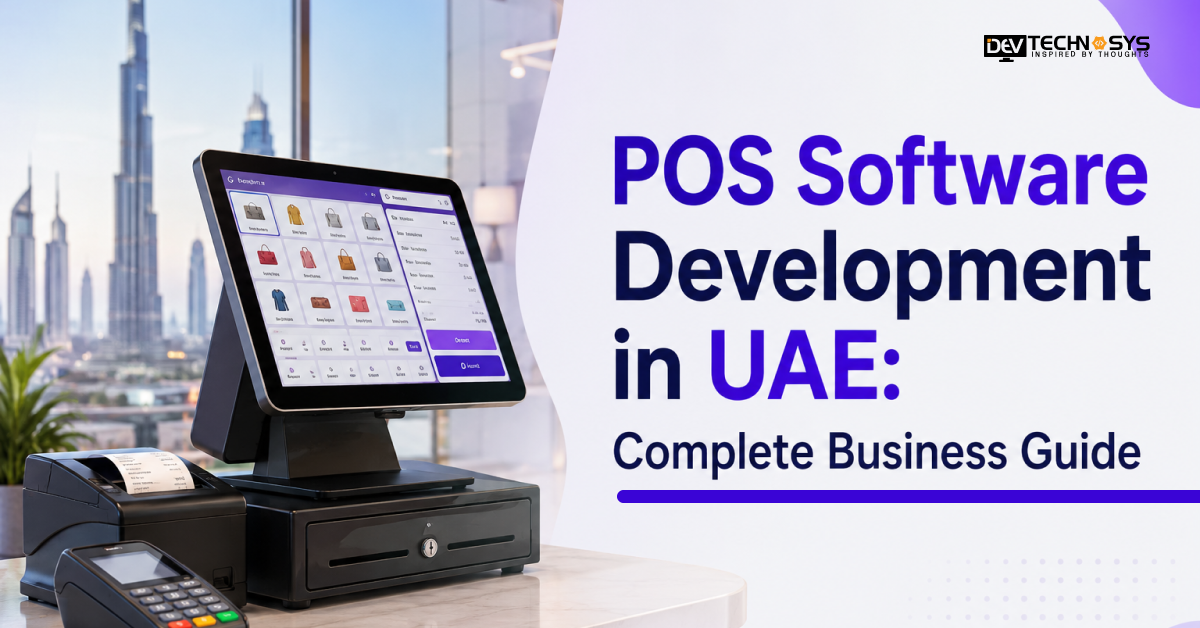
A payment terminal completes a transaction, but POS software manages what happens around that transaction. It records sales, processes orders, applies discounts, handles refunds, and helps businesses keep checkout operations organized.
Modern POS software also connects sales activity with inventory, customer records, employee permissions, invoices, and business reporting. When a product is sold, for example, the system can update stock levels and record the transaction for future analysis. This makes POS software an operational hub rather than simply a billing tool.
Today, businesses can choose from cloud-based, mobile, and multi-store POS systems based on their operational needs. Effective point of sale software development also focuses on integrations that connect the POS with accounting, payment, e-commerce, and inventory platforms. For UAE businesses, this connected approach can support more efficient and scalable operations.
Why Do UAE Businesses Need Custom POS Software?
The UAE POS Terminal market is estimated at $3.62 billion in 2026 and is projected to reach $5.11 billion by 2031, growing at a 7.12% CAGR. Contactless systems already accounted for 62.15% of market share in 2025, according to Mordor Intelligence. These figures reflect a market where businesses increasingly expect faster, connected, and flexible payment experiences.
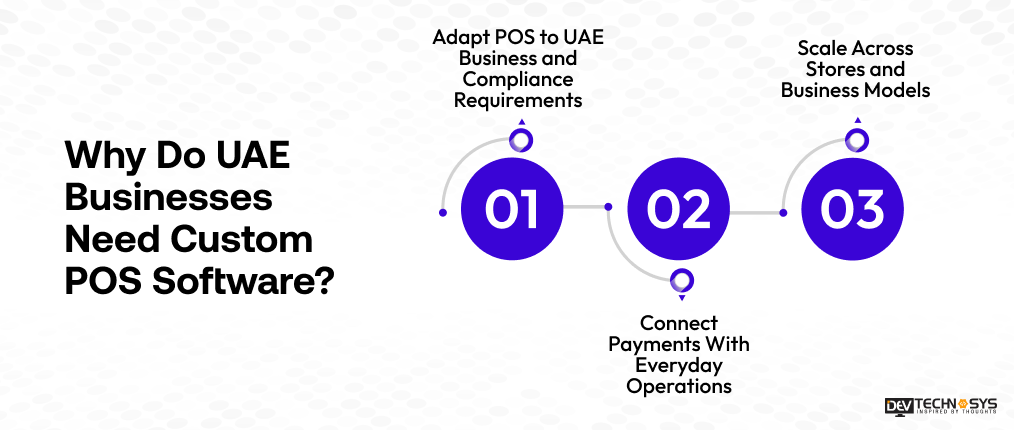
1. Adapt POS to UAE Business and Compliance Requirements
A standard POS may not accommodate every business workflow. Custom POS software UAE can be designed around VAT calculations, tax invoices, refunds, credit notes, and evolving e-invoicing requirements. It can also support business-specific pricing, promotions, and reporting rules.
2. Connect Payments With Everyday Operations
A modern POS should connect payment processing with inventory, accounting, CRM, and reporting. POS payment gateway integration can help synchronize transactions while reducing manual data entry between different systems.
3. Scale Across Stores and Business Models
A growing retailer may need centralized inventory and branch-level reporting, while a restaurant may require table management and kitchen workflows. Custom POS system development allows businesses to build these capabilities into one scalable platform and add new outlets, users, products, and integrations as operations expand.
What Types of Businesses Use POS Software in UAE?
POS requirements vary by business model. A fashion retailer needs different workflows from a restaurant, pharmacy, or hotel. Here are the major use cases.
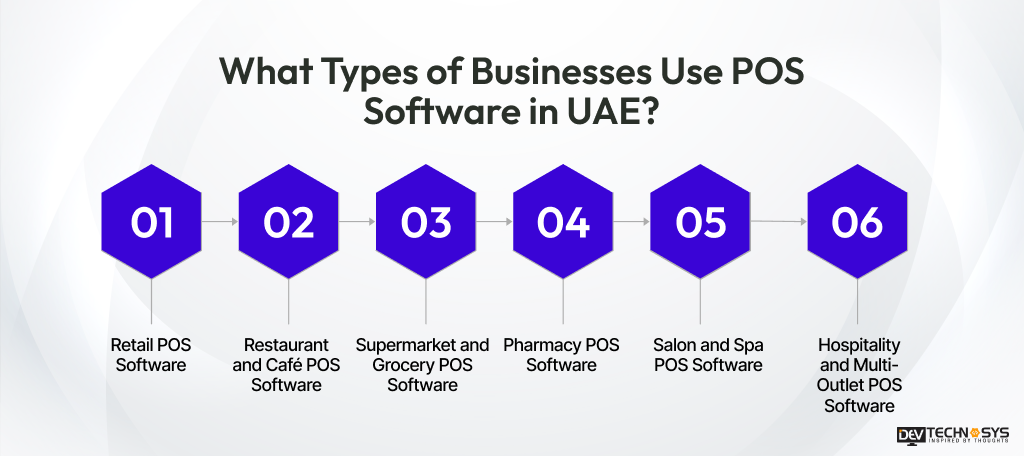
1. Retail POS Software
Retailers use POS systems for barcode scanning, inventory tracking, product variations, discounts, returns, and sales reporting. A UAE retail POS system can also connect physical stores with e-commerce channels and centralized inventory.
2. Restaurant and Café POS Software
Restaurant systems manage menus, tables, kitchen orders, split bills, discounts, and delivery orders. Restaurant POS software development can also integrate multiple payment methods and accounting platforms.
3. Supermarket and Grocery POS Software
Supermarkets handle high transaction volumes and large product catalogs. Their POS systems typically require barcode scanning, weighing scales, stock tracking, multiple checkout counters, and centralized inventory.
4. Pharmacy POS Software
Pharmacy POS systems can support product and batch tracking, expiry monitoring, inventory management, billing, and sales reporting. These capabilities help businesses manage large inventories more accurately.
5. Salon and Spa POS Software
Salon systems combine service billing with appointments, memberships, customer profiles, employee commissions, and retail product sales.
6. Hospitality and Multi-Outlet POS Software
Hotels, resorts, and businesses operating several outlets need centralized reporting, shared inventory visibility, branch controls, and role-based access. This makes a multi-store POS system UAE businesses particularly useful.
Industry Insight
According to the Central Bank of the UAE (CBUAE), debit-card transactions conducted through POS terminals increased by 4% in 2025, demonstrating continued growth in card-based payments across the UAE.
What is the 5-Step POS Software Development Process in UAE?
The development process should begin with the business workflow, not the technology stack. A retailer, restaurant, or multi-store business may require very different POS architecture, integrations, and controls.
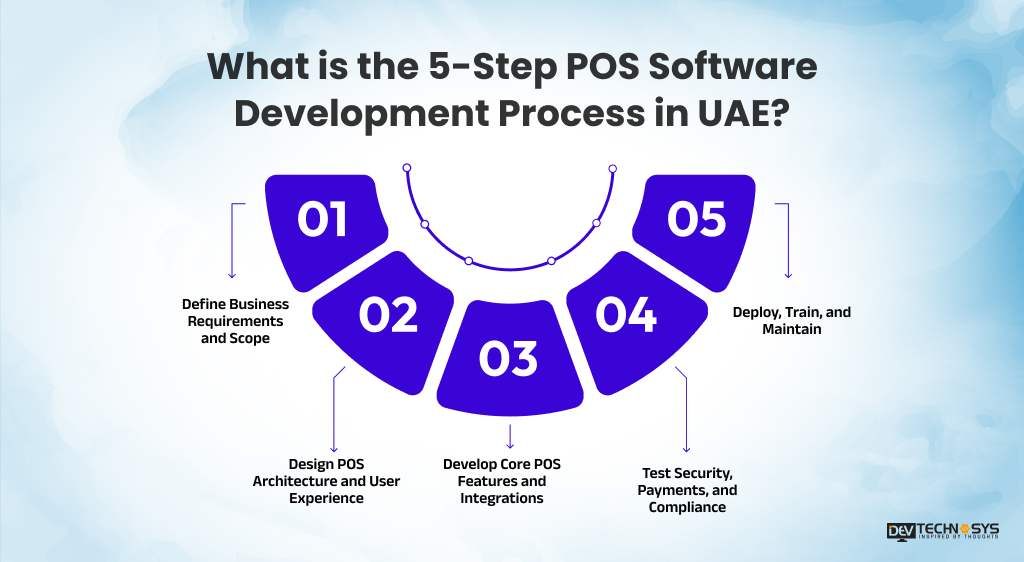
Step 1. Define Business Requirements and Scope
Start by identifying the business model, number of outlets, users, transaction volume, payment methods, inventory needs, and required integrations. UAE VAT and e-invoicing requirements should also be considered during planning. This stage establishes the scope before businesses build POS software in UAE.
Step 2. Design POS Architecture and User Experience
Next, developers design the system architecture and interfaces for cashiers, managers, administrators, and other users. The design should support fast checkout, clear navigation, role-based access, and cloud or offline functionality where required.
Step 3. Develop Core POS Features and Integrations
Developers then build billing, inventory, customer management, employee management, reporting, and payment functionality. Accounting, ERP, e-commerce, and e-invoicing integrations can be added based on business requirements. Choosing suitable POS software development services can help coordinate these components within one system.
Step 4. Test Security, Payments and Compliance
Before deployment, the POS undergoes functional, performance, payment, API, and security testing. Teams should also validate VAT calculations, invoice generation, integrations, and device compatibility to identify operational issues before launch.
Step 5. Deploy, Train and Maintain
The final stage includes deployment, data migration, device configuration, staff training, monitoring, and post-launch updates. Working with a reliable custom software development company can also support maintenance, troubleshooting, security updates, and future feature enhancements.
What Features Should POS Software Have?
The right POS feature set should connect what happens at checkout with the operations happening behind it. Businesses should prioritize features that improve transaction accuracy, inventory visibility, payment processing, and management control.
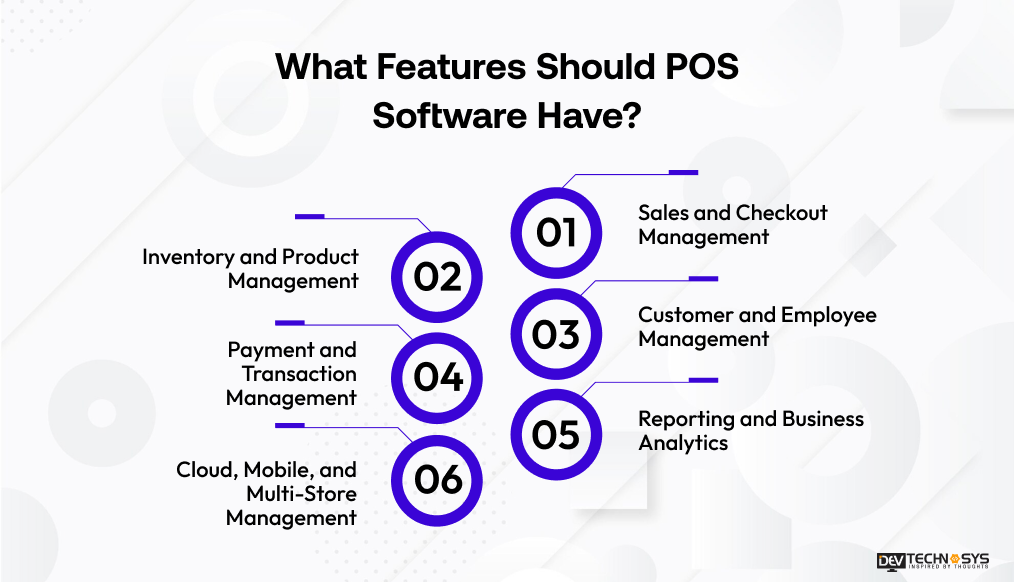
1. Sales and Checkout Management
Core functionality should include fast billing, barcode scanning, product search, discounts, promotions, returns, refunds, digital receipts, and tax calculations. Offline transaction support can also help businesses continue operating during temporary connectivity issues.
2. Inventory and Product Management
A POS should provide real-time stock visibility, SKU management, product variants, low-stock alerts, stock adjustments, and transfers between locations. Businesses with complex inventory requirements may also need dedicated solutions to build inventory management software that integrates with the POS.
3. Customer and Employee Management
Customer profiles, purchase history, loyalty programs, employee accounts, role-based permissions, shift management, and sales performance tracking can help businesses manage both customer relationships and staff activity.
4. Payment and Transaction Management
Modern systems should support card payments, digital wallets, payment gateways, split payments, refunds, and transaction reconciliation. POS payment gateway integration can connect payment processing with transaction records and reduce manual reconciliation.
5. Reporting and Business Analytics
Managers should have access to sales dashboards, revenue reports, product performance, inventory insights, employee performance, and branch-level reporting. Real-time analytics can help identify sales trends and operational issues faster.
6. Cloud, Mobile and Multi-Store Management
Cloud synchronization allows authorized users to monitor operations remotely, while mobile POS can support flexible checkout. Multi-store capabilities can centralize inventory, reporting, user permissions, and branch management as the business expands.
What Integrations Does a UAE POS System Need?
A POS becomes more valuable when it can exchange data with the systems a business already uses. The right integrations reduce manual work, improve data accuracy, and keep business operations connected.
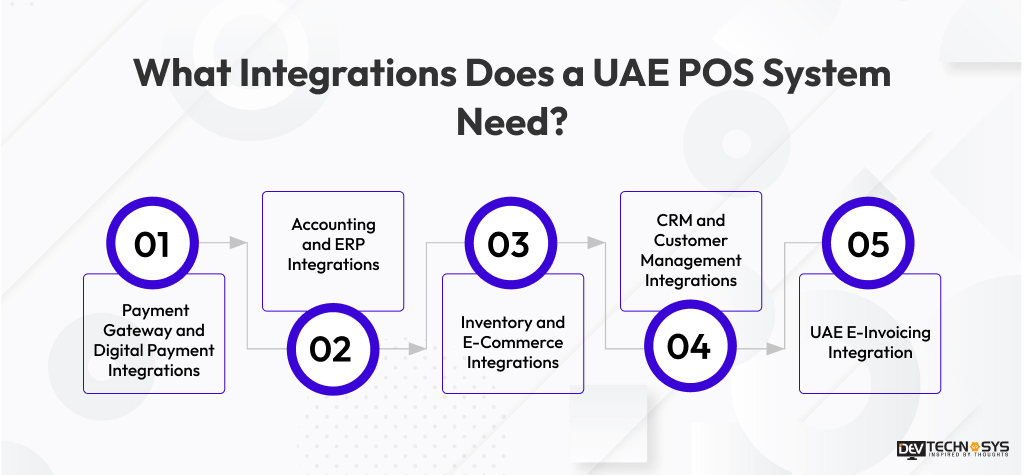
1. Payment Gateway and Digital Payment Integrations
A UAE POS can connect with card terminals, payment gateways, and digital wallets to process transactions and update payment status. Payment gateway integration UAE businesses can also support automated refunds and transaction reconciliation.
2. Accounting and ERP Integrations
Connecting the POS with accounting or ERP software can synchronize sales, revenue, refunds, inventory, and tax data. This reduces duplicate data entry and gives finance teams more consistent records.
3. Inventory and E-Commerce Integrations
POS and online stores should share product, order, and stock information in real time. Businesses planning to build an ecommerce website can connect it with their POS to maintain consistent inventory across physical and digital channels.
4. CRM and Customer Management Integrations
CRM integration can synchronize customer profiles, purchase history, loyalty information, and marketing data. This helps businesses understand buying patterns and create more relevant customer experiences.
5. UAE E-Invoicing Integration
For businesses preparing for UAE e-invoicing requirements, the POS should be capable of passing transaction and tax information into the appropriate invoicing workflow. Building UAE e-invoicing integration into the architecture early can reduce future system changes.
Development Insight
According to the UAE Ministry of Finance, electronic invoices must include the applicable tax category for each transaction, reinforcing the importance of configurable tax logic when developing POS and invoicing software for the UAE market.
What UAE VAT and E-Invoicing Requirements Should POS Software Support?
UAE POS software needs to handle tax and invoicing requirements at the system level, especially as electronic invoicing moves toward phased implementation. The Ministry of Finance has published technical guidance covering system readiness, tax codes, data requirements, and implementation timelines.
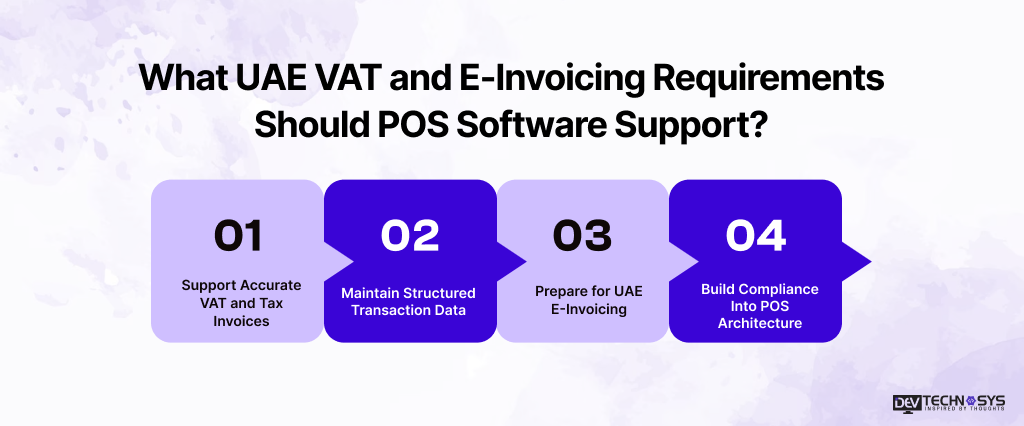
i. Support Accurate VAT and Tax Invoices
A POS should calculate applicable VAT correctly and generate invoices with the required transaction and tax information. It should also manage refunds, credit notes, and related records without creating inconsistencies between sales and accounting data. This forms an important part of UAE POS compliance.
ii. Maintain Structured Transaction Data
POS architecture should capture the transaction details required for invoicing and reporting, including invoice identifiers, tax information, transaction values, and relevant customer data. Accurate records also make reconciliation and future system integrations easier.
iii. Prepare for UAE E-Invoicing
The UAE e-invoicing framework uses accredited service providers and a structured electronic invoicing model. The Ministry’s current guidance sets phased implementation, with businesses generating annual revenue of AED 50 million or more required to implement e-invoicing by January 1, 2027. For businesses that plan for an online retail business, POS and e-commerce systems should also be designed to keep sales, tax, and invoice data synchronized across physical and digital channels.
iv. Build Compliance Into POS Architecture
Rather than adding compliance after development, businesses should consider tax fields, invoice structures, audit trails, API connectivity, and update mechanisms during architecture planning. This makes the system easier to adapt as UAE e-invoicing requirements evolve.
What Technology Stack is Used for POS Software Development?
The technology stack determines how a POS handles transactions, integrations, data, and future growth. Businesses evaluating custom software development cost should consider technology alongside features because infrastructure, scalability, and development complexity can significantly influence the overall investment.
Technology Layer |
Common Technologies |
Purpose |
| Frontend | React, React Native, Flutter | Cashier, admin, and mobile interfaces |
| Backend | Node.js, .NET, Java | Business logic and APIs |
| Database | PostgreSQL, MySQL, MongoDB | Transaction and operational data |
| Cloud | AWS, Azure, Google Cloud | Scalability, backups, and availability |
| APIs | REST, GraphQL | Third-party integrations |
| Security | OAuth 2.0, JWT, TLS | Authentication and secure communication |
The right stack depends on transaction volume, POS devices, number of locations, integrations, and scalability requirements. Cloud POS development can support centralized management and real-time synchronization across branches, while React Native or Flutter can support mobile POS development across devices. For businesses working with POS developers in UAE, technology selection should also account for reliable APIs, secure data handling, offline capabilities, backups, and future feature expansion.
How Much Does POS Software Development Cost in UAE?
The custom POS software development cost in UAE typically starts from $15,000 and can exceed $55,000, depending on features, integrations, security requirements, hardware support, and business complexity. A single-store system requires a smaller investment, while multi-location and enterprise platforms need more advanced infrastructure and integrations.
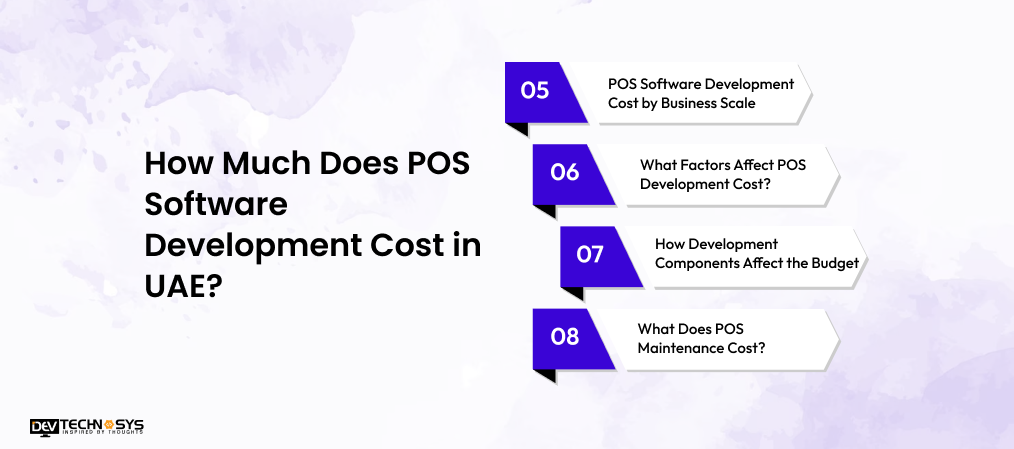
POS Software Development Cost by Business Scale
These are indicative development estimates. The final budget depends on the exact technical scope and business requirements.
POS System Type |
Estimated Cost |
Typical Scope |
| Single-store POS | $15,000–$25,000 | Billing, inventory, payments, basic reporting |
| Multi-purpose and multi-location POS | $25,000–$40,000 | Real-time sync, hardware integration, centralized reporting |
| Enterprise POS | $40,000–$55,000+ | Multi-store management, advanced analytics, compliance, custom integrations |
1. What Factors Affect POS Development Cost?
Several factors can increase the development budget. Advanced inventory management, multiple payment gateways, accounting and ERP integrations, hardware connectivity, e-invoicing, cloud infrastructure, analytics, and multi-store functionality all add development complexity.
Security requirements also influence the budget. Features such as role-based access, POS data encryption, secure APIs, payment tokenization, and compliance-focused architecture require additional development and testing.
2. How Development Components Affect the Budget
The overall investment is distributed across UI/UX design, frontend and backend development, database architecture, third-party integrations, testing, deployment, and quality assurance. Businesses comparing a retail software development cost in UAE should also consider whether the POS needs to connect with e-commerce, inventory, accounting, or other retail systems.

3. What Does POS Maintenance Cost?
Ongoing maintenance generally costs around 15%–20% of the initial development investment annually. This can cover bug fixes, security updates, cloud infrastructure, payment API changes, device compatibility, compliance updates, and new feature enhancements.
How Long Does It Take to Develop POS Software in UAE?
The timeline for POS software development in UAE depends on system complexity, integrations, security requirements, and the number of locations it needs to support. A basic POS may take around 3–4 months, while advanced multi-store platforms can require 6–9 months or longer.
1. POS Development Timeline by Complexity
POS Type |
Estimated Timeline |
Typical Scope |
| Basic POS | 3–4 months | Billing, inventory, payments, reporting |
| Mid-level POS | 4–6 months | Advanced inventory, CRM, cloud features, integrations |
| Enterprise POS | 6–9+ months | Multi-store management, complex integrations, analytics, advanced security |
2. What Can Increase the Development Timeline?
Several factors can extend the schedule. Payment gateway and hardware integrations may require additional testing, while multi-store functionality can increase architecture and synchronization requirements. Custom workflows, e-invoicing integration, data migration, security testing, and third-party API dependencies can also add development time.
Businesses planning for POS software development in UAE should therefore finalize requirements and integrations early. A clear scope helps development teams estimate the timeline more accurately and reduces major changes during implementation.
How Can You Secure POS Software?
POS security extends beyond the payment screen. A modern system can handle payment data, customer information, transaction records, inventory data, and connections to other business systems. Security therefore needs to be built into the architecture from the beginning.
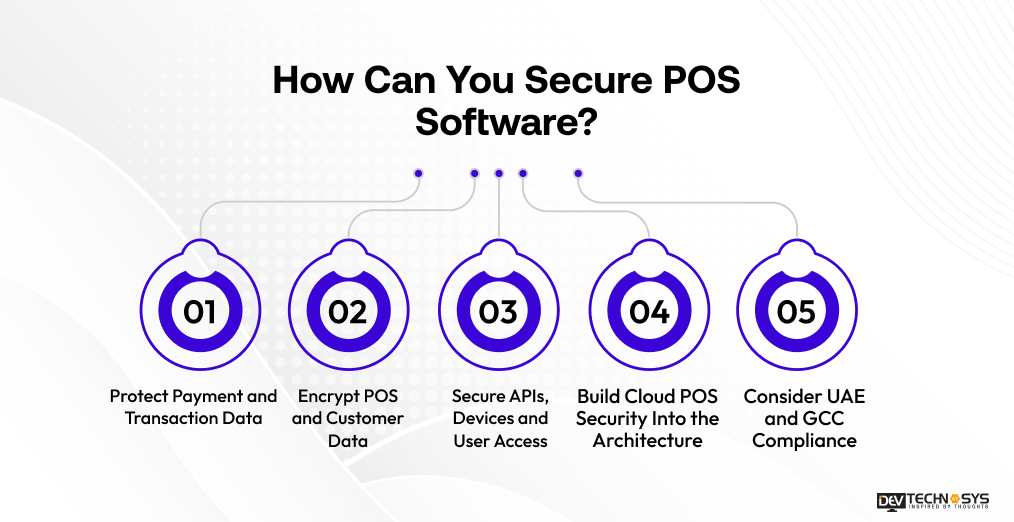
1. Protect Payment and Transaction Data
A PCI DSS-compliant POS should follow applicable requirements for protecting cardholder data. PCI DSS provides technical and operational requirements for entities that store, process, or transmit payment card data. Payment tokenization and secure payment processing can also reduce exposure of sensitive payment information.
2. Encrypt POS and Customer Data
POS data security should include encryption for sensitive information during transmission and storage. Strong cryptography, secure TLS configurations, and appropriate access controls help protect transaction and customer information. Businesses should also implement POS data encryption and appropriate customer data protection measures.
3. Secure APIs, Devices and User Access
Every connected component should be protected through authentication, role-based permissions, secure API integration, session controls, and device authorization. Regular monitoring and security testing can help identify vulnerabilities before they affect business operations.
4. Build Cloud POS Security Into the Architecture
Cloud POS security should include secure configurations, encrypted backups, access controls, monitoring, disaster recovery, and regular vulnerability testing. These controls become particularly important when multiple branches share centralized POS infrastructure.
5. Consider UAE and GCC Compliance
Businesses should evaluate UAE POS compliance alongside applicable payment and data protection requirements. Requirements can differ when the system operates across GCC markets, so regional deployments may also need to consider requirements such as Saudi PDPL compliance.
Working with an experienced POS software development solution provider can help businesses implement appropriate security controls, follow relevant payment standards, and address compliance requirements during development rather than retrofitting them after launch.
What is the Future of POS Software Development in UAE?
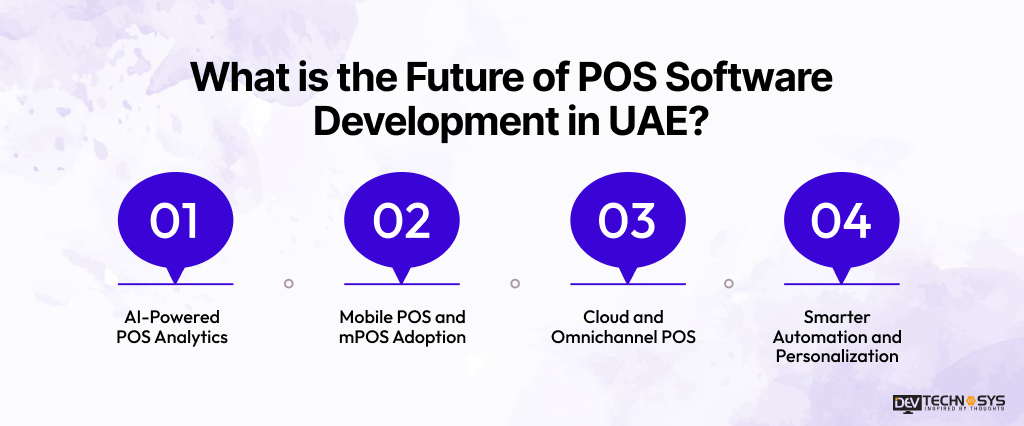
POS systems are moving beyond transaction processing toward intelligent platforms that help businesses understand customers, manage operations, and make faster decisions. Several technologies are shaping this shift.
1. AI-Powered POS Analytics
AI can analyze transaction and inventory data to identify sales patterns, forecast demand, recommend stock levels, and generate automated business insights. Predictive analytics can help retailers reduce stockouts, while customer insights can support more relevant promotions and loyalty strategies.
2. Mobile POS and mPOS Adoption
mPOS software development enables smartphones and tablets to function as flexible checkout devices. This can support tableside ordering in restaurants, pop-up stores, events, delivery operations, and businesses that need checkout outside a fixed counter.
3. Cloud and Omnichannel POS
Cloud-based systems can synchronize sales, inventory, and customer information across multiple locations and online channels. As businesses combine physical stores with e-commerce, connected POS platforms can provide a unified view of orders and inventory.
4. Smarter Automation and Personalization
Future POS platforms can automate reporting, inventory alerts, promotions, and customer segmentation. Combined with AI, these capabilities can help businesses turn transaction data into actionable insights.
Future Take
The future of POS is less about processing transactions and more about turning transaction data into better business decisions.
Conclusion
A modern POS system should do more than process payments. For UAE businesses, it should connect sales, inventory, payments, accounting, customer data, and compliance within one scalable platform.
The right POS software development in UAE approach starts with clear business requirements and extends through integrations, security, e-invoicing readiness, and long-term maintenance. Development costs can range from $15,000 to $55,000+, depending on system complexity and business scale.
For growing retailers, restaurants, and multi-location businesses, customization can provide greater flexibility than a rigid off-the-shelf system. Partnering with an experienced POS software development company can help align the technology with operational needs while supporting security and compliance requirements.

FAQs
1. How Much Does It Cost to Develop POS Software in UAE?
Custom POS software development in UAE typically costs $15,000 to $55,000+ in UAE. The final investment depends on features, integrations, number of locations, hardware support, security requirements, and overall system complexity.
2. How Long Does It Take to Develop a POS System in UAE?
A basic POS system can take around 3–4 months, while mid-level systems may require 4–6 months. Complex multi-store or enterprise platforms can take 6–9 months or longer.
3. Should a UAE POS System Support E-Invoicing?
Yes. Businesses should consider e-invoicing requirements during POS architecture and development. The system should be capable of handling structured invoice data, tax information, and integrations required for compliant electronic invoicing workflows.
4. Is Cloud POS Better for Businesses With Multiple Locations?
Cloud POS can be useful for multi-location businesses because it enables centralized management, real-time synchronization, branch-level reporting, remote access, and shared inventory visibility across different outlets.
5. How Secure Should a POS System Be?
A POS should implement strong payment and data security controls, including PCI DSS compliance, encryption, payment tokenization, secure APIs, role-based access, monitoring, and customer data protection. Security requirements should be addressed throughout development rather than after deployment.