





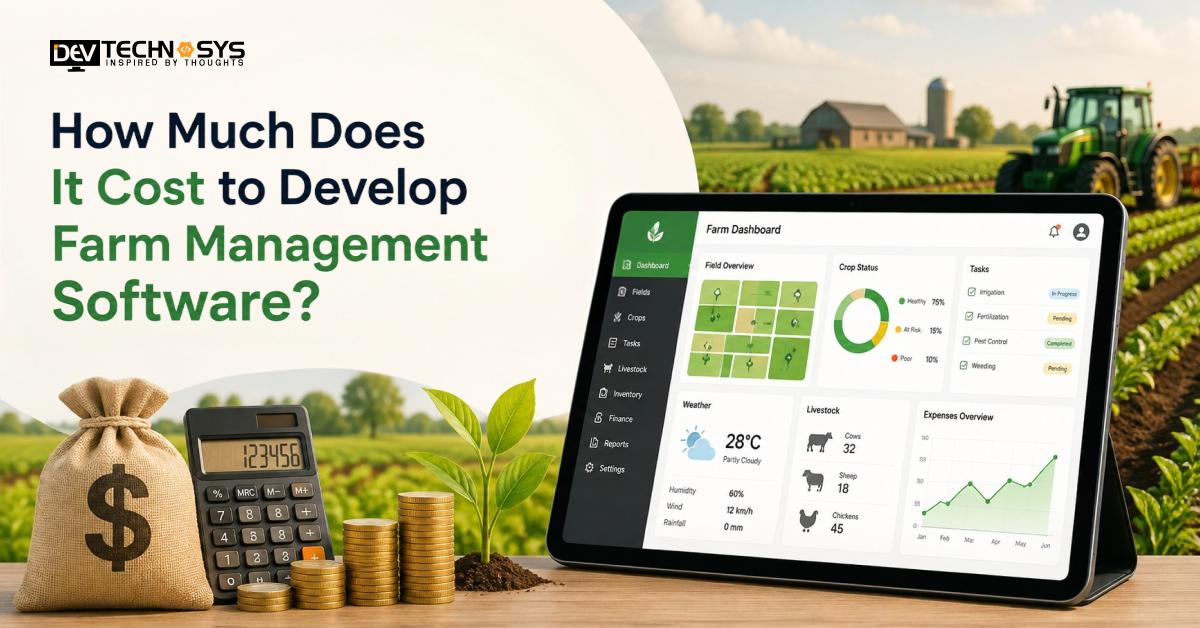
The farming business has grown a lot in the past few years. It is a lot more than simply producing food for a business venture. Today, with the help of cutting-edge tools and technologies, agriculturists easily focus on their farming activities while generating more profit and revenue. The farm management software also empowers businesses to manage their finances and other activities to get a deep insight into the farming performance.
All of this wouldn’t have been possible without agriculture development software. That’s why the demand to develop farming apps has increased, and more businesses are searching for the cost to develop farm management software. So, this blog focuses on everything about developing agriculture management software, its cost, and more.
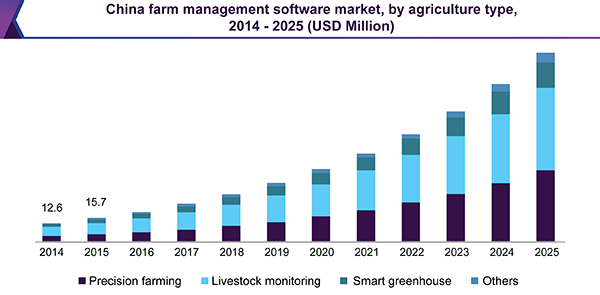
UAE Farm Management Software Development Market Statistics
- According to Grand View Research, the UAE Farm Management Software market size is expected to grow at a CAGR of 19.6% by 2033.
- Precision farming is expected to generate the largest revenue, which is why most businesses are investing in it.
- Most UAE businesses choose farm management software because it simplifies workflows and helps monitor all agricultural activities.
- Fortune Business Insights reports that the current value of the farm management software market is USD 3.73 billion.
- Cloud adoption is driving the market, with a share of 72.31%.
What Is Farm Management Software?
Farm management software or agriculture management app is basically a digital platform that helps to centralize, automate, and optimize the farming processes. The software is very efficient in solving product and yield challenges that are quite difficult to tackle offline. The agriculture software development solutions have helped all-scale farming businesses overcome the major challenges faced during farming and planning.
One can access all types of farming activities through the software, right from keeping track of the products to delivering them to multiple farming service providers. Overall, agriculture app development has streamlined the farming process while increasing revenue and business productivity.
How Much Does it Cost to Develop Farm Management Software in UAE?
The agriculture software development cost typically ranges from AED 110,000 to AED 551,000+. The final cost depends on software complexity, number of features, platform selection, integrations, AI capabilities, IoT devices, security requirements, UI/UX design, and development team expertise. For UAE businesses, integrating AI, IoT sensors, GPS, weather data, drones or farm machinery can push the development budget toward the upper end of this range.
Software Type |
Estimated Cost |
Typical Scope |
| Basic Farm Management Software | AED 110,000–180,000 | Farm records, crop tracking, inventory, basic dashboard |
| Medium-Level Software | AED 180,000–350,000 | GPS, weather APIs, analytics, notifications, reporting, multiple user roles |
| Advanced Farm Management Software | AED 350,000–551,000+ | AI analytics, IoT integration, predictive insights, automation, advanced dashboards |
What Factors Affect Farm Management Software Development Cost?
Several technical and business factors can influence the smart farming app development cost. Understanding these key cost drivers can support building a long-term investment strategy. AI integration, UI/UX design, and software complexity are major factors.
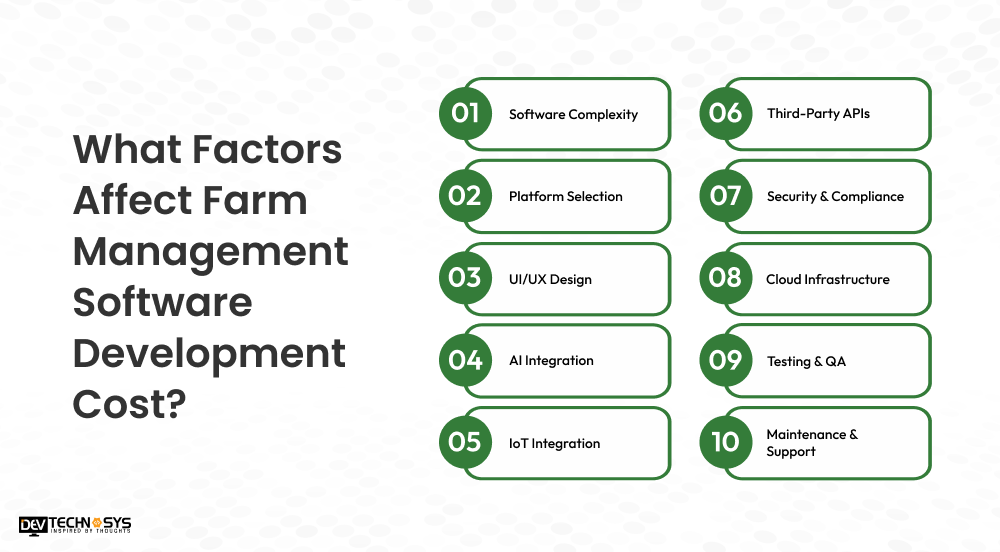
Cost Factor |
Estimated Cost Impact |
Why It Matters |
|
AED 20,000–80,000+ | More workflows, automation and user roles require additional development |
| 2. Platform Selection | AED 15,000–60,000+ | Web, Android, iOS or multi-platform development changes the workload |
| 3. UI/UX Design | AED 15,000–40,000+ | Custom dashboards and farmer-friendly interfaces require additional design effort |
| 4. AI Integration | AED 40,000–120,000+ | AI-based prediction, recommendations and computer vision require specialized development |
| 5. IoT Integration | AED 35,000–100,000+ | Sensors, gateways, and real-time device data increase integration complexity |
| 6. Third-Party APIs | AED 10,000–50,000+ | Weather, maps, satellite and external agricultural APIs require integration and maintenance |
| 7. Security & Compliance | AED 20,000–70,000+ | Encryption, access controls, audits, and security testing increase project requirements |
| 8. Cloud Infrastructure | AED 15,000–60,000+ | Storage, databases, real-time processing and scalability affect infrastructure costs |
| 9. Testing & QA | AED 15,000–50,000+ | Multi-device, performance, security, and field-condition testing require additional resources |
| 10. Maintenance & Support | AED 20,000–100,000+ annually | Updates, monitoring, bug fixes, and security patches create recurring costs |
Note: This is a cost estimate and not the final price of the project.
What Are the Different Types of Farm Management Software?
There are several agriculture management software available in the market. Each of them serves a different purpose in agriculture. So, let’s discuss each of them one by one to help you explore agriculture business ideas and choose the right agriculture management software.
1. Broadacre Cropping Software
This farm management app follows a significant farming practice to optimize soil health for a sustainable future. It is specifically designed to manage, monitor, and optimize crop production for streamlined processing and improved business output. Also, the cost to develop broadacre cropping software isn’t that high, and all-scale farmers can get this app.
2. Precision & Agriculture Software
This is the best farm management software focuses on making farming and production activities more accurate while ensuring efficiency, profitability, and sustainability with data accuracy. The farmers can also integrate this small farm management software with modern-age technology such as drones, automated hardware, and GPS-based soil sampling. Today, many agriculture software development companies in UAE and other regions are developing this type of mobile app due to the high demand among businesses.
3. Commodity Management Software
This software basically follows the process of developing a systematic approach to use the entire cycle for a group of items. The system is perfectly developed to manage commodity inventories, track production activities, generate logistic reports, and more for an improved agriculture process.
These three are the most popular farm management software accessed by most agriculturists and farmers. The cost to develop a farm management app varies from one type of app to the other. You can pick any of them as per your farming & production needs, avail custom web development services, and get started with the process right away.
10 Core and Advanced Features of Farm Management Software with Cost
The feature set directly influences the development budget. For example, developing an agriculture app like AgriApp must include basic to advanced features after understanding the cost. This helps to build a scalable solution. A basic platform can begin with core farm-management functionality, while advanced features can be introduced as the business scales.
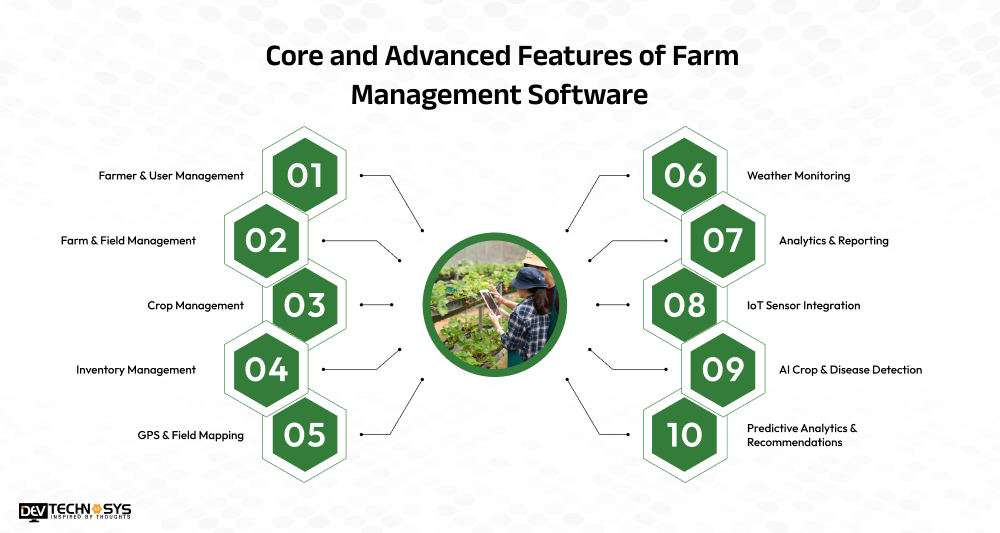
Feature |
Type |
Estimated Cost |
| 1. Farmer & User Management | Core | AED 10,000–20,000 |
| 2. Farm & Field Management | Core | AED 15,000–25,000 |
| 3. Crop Management | Core | AED 15,000–30,000 |
| 4. Inventory Management | Core | AED 12,000–25,000 |
| 5. GPS & Field Mapping | Core | AED 15,000–30,000 |
| 6. Weather Monitoring | Advanced | AED 15,000–30,000 |
| 7. Analytics & Reporting | Advanced | AED 20,000–40,000 |
| 8. IoT Sensor Integration | Advanced | AED 35,000–70,000 |
| 9. AI Crop & Disease Detection | Advanced | AED 40,000–90,000 |
| 10. Predictive Analytics & Recommendations | Advanced | AED 40,000–100,000+ |
Advanced Technologies Used in UAE Farm Software
Agritech app development can combine advanced technologies to improve productivity, optimize resource utilization, and support data-driven decision-making. These technologies help farms monitor field conditions, automate repetitive processes, and respond faster to changes in crops, weather, and irrigation needs. Five technologies are particularly relevant for developing smart farm management software in the UAE:
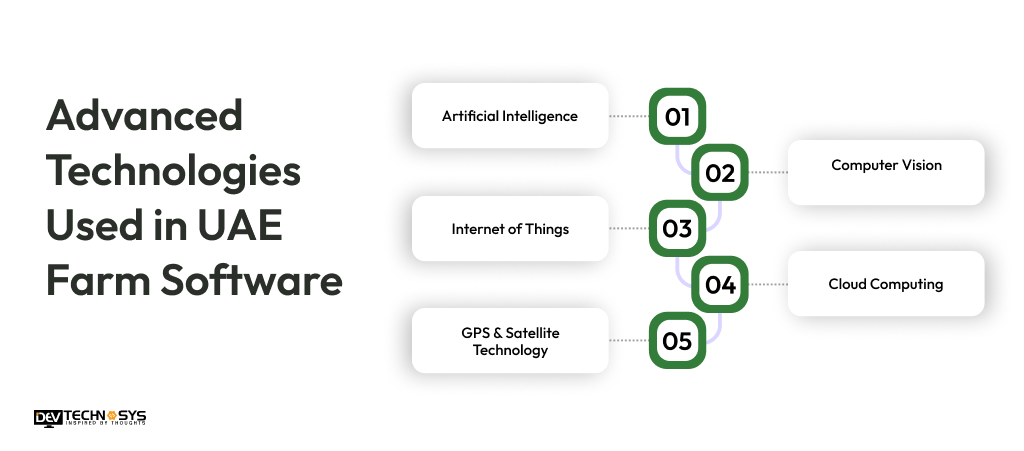
1. Artificial Intelligence
AI can analyze large volumes of farm data to provide recommendations for crop planning, irrigation, fertilization, disease detection, and yield prediction. Machine learning models can identify patterns in historical crop data and environmental conditions to support better operational decisions.
Smart farming software development must include both. AI in agriculture can also help predict potential crop risks and recommend resource allocation based on farm conditions. AI-powered features generally require additional model development, data preparation, training, testing, and infrastructure, which can increase development and operating costs.
2. Internet of Things
IoT sensors can collect real-time information about soil moisture, temperature, humidity, water levels, weather conditions, and other environmental factors. Agriculture marketplace app development is incomplete without IoT technology.
The integration supports automated irrigation, equipment monitoring, and alerts when predefined conditions are detected. The overall implementation cost depends on the number of connected devices, sensor types, communication protocols, gateways, and farm coverage.
3. Computer Vision
Computer vision can analyze images captured through smartphones, cameras, drones or other imaging devices to identify crop diseases, pests, plant stress and visible health issues. UAE businesses can hire agtech software developers who can detect abnormalities and develop a feasible system.
Computer vision can also support crop counting, growth monitoring and quality assessment. Implementing these capabilities requires image datasets, model training, image-processing infrastructure and continuous model improvement.
4. GPS & Satellite Technology
GPS and satellite technology can support field mapping, farm navigation, crop monitoring and location-based analysis. Farm managers can use geographic data to divide fields into zones, monitor crop conditions and track agricultural activities across different locations.
Satellite imagery can also provide additional information for monitoring vegetation, identifying changes and supporting precision agriculture workflows. Integration requirements may vary depending on mapping providers, satellite data availability, update frequency and the level of location accuracy required.
5. Cloud Computing
Cloud infrastructure enables farms to securely store large volumes of agricultural data and access management dashboards from different locations and devices. It can support data collected from IoT sensors, mobile applications, GPS systems, satellite imagery and analytics platforms.
To develop an agritech mobile app, UAE businesses must consider this technology as it scales the software. Depending on the solution, cloud services may also support automated backups, real-time processing, analytics workloads and AI model deployment.
Farm Management Software Security in UAE
Farm management software can process sensitive business information, farm records, employee details, location data and operational information. Since these platforms may also connect with IoT devices and cloud infrastructure, security should be considered throughout the software lifecycle. Building security into the architecture from the beginning helps protect farm data, reduce unauthorized access and support applicable UAE compliance requirements.
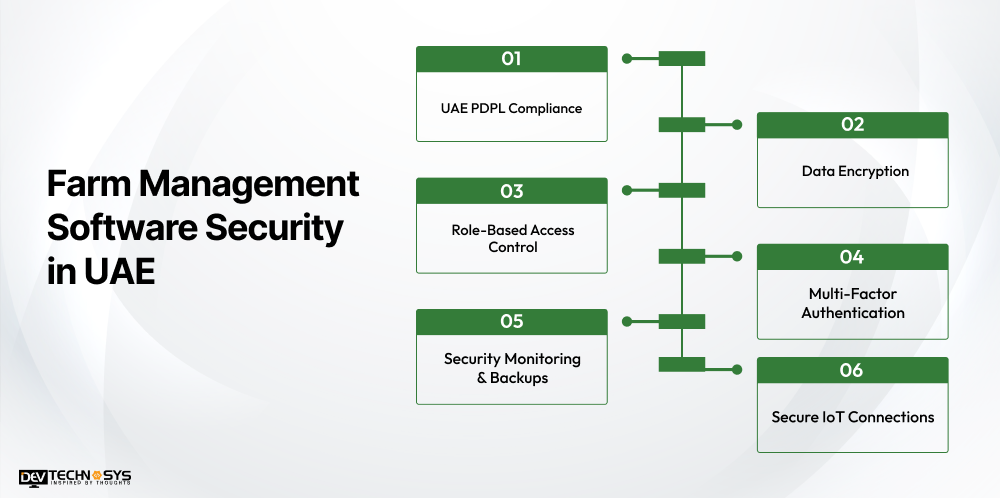
1. UAE PDPL Compliance
Businesses should consider applicable requirements under the UAE Personal Data Protection Law (PDPL) when collecting, storing and processing personal information through farm management platforms. The software should include appropriate controls for data access, processing, storage and protection. Early compliance planning can also help reduce costly security changes during later development stages.
2. Data Encryption
Sensitive farm and user information should be encrypted both during transmission and while stored within databases or cloud infrastructure. Secure communication protocols can help protect data exchanged between mobile applications, servers, APIs and IoT devices. Strong encryption practices can reduce the risk of unauthorized data interception and exposure.
3. Role-Based Access Control
Role-Based Access Control (RBAC) ensures that farmers, managers, administrators and other employees can only access the information and functionality required for their responsibilities. Permissions should be defined according to specific roles and business workflows. This limits unnecessary data exposure and reduces the potential impact of compromised user accounts.
4. Multi-Factor Authentication
Multi-Factor Authentication (MFA) provides an additional verification layer for users accessing the farm management platform. It is particularly useful for administrator accounts and other users with access to sensitive operational or financial information. MFA can reduce the security risks associated with stolen, reused or compromised passwords.
5. Secure IoT Connections
IoT-connected farms require secure communication between sensors, gateways, agricultural equipment and the central software platform. Device authentication, encrypted connections, access controls and regular firmware updates can help prevent unauthorized device access. Continuous monitoring can also help identify unusual device activity before it affects farm operations.
6. Security Monitoring & Backups
Regular security monitoring, audit logs and vulnerability testing can help businesses identify suspicious activity and potential security weaknesses. Automated backups should protect important farm records against accidental deletion, system failures or security incidents. Combining monitoring with tested backup and recovery procedures can improve business continuity and reduce operational disruption.
Unexpected Farm Management Software Development Costs
The initial development quotation does not always represent the complete investment. UAE businesses should also account for several hidden or recurring expenses related to hardware, infrastructure, integrations, AI, security, and ongoing operations. Identifying these costs early helps create a more accurate development budget and reduces unexpected expenses after launch.
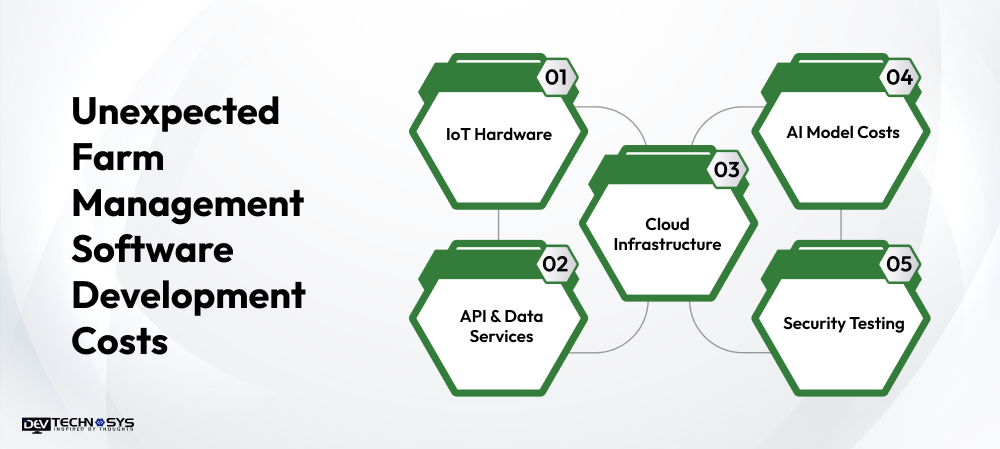
1. IoT Hardware
IoT-enabled farm management software may require sensors, gateways, controllers, and connected agricultural equipment. The cost can vary depending on the number of devices, sensor types, and farm coverage requirements. Businesses may also need installation, device configuration, and periodic hardware replacement. These expenses should be considered separately from the core software development budget.
2. API & Data Services
The cost to develop a smart farming app is affected by third-party services for weather forecasts, maps, satellite imagery, geolocation and agricultural data. Some providers charge based on API requests, data volume, users or subscription plans. Costs can increase as more farms, devices, and users are connected to the platform. Businesses should therefore estimate both initial integration costs and recurring API expenses.
3. Cloud Infrastructure
Cloud infrastructure is required to store farm records, sensor data, images, reports and other operational information. As the number of farms, users, and connected devices increases, storage, computing, and bandwidth requirements can grow. Real-time IoT monitoring and AI processing may also require additional cloud resources. Choosing a scalable cloud architecture helps control infrastructure costs as the platform expands.
4. AI Model Costs
AI-powered disease detection, crop prediction and recommendation features require more than basic software development. Businesses may need costs for data preparation, model training, inference, AI APIs and ongoing model optimization. Large datasets and frequent AI processing can also increase cloud computing expenses. Regular model monitoring and updates may be required to maintain accuracy as farming conditions change.
5. Security Testing
Farm management platforms can contain sensitive business data, user information, location details and connected-device data. Businesses may need penetration testing, vulnerability assessments, security audits and compliance reviews before deployment.
Additional monitoring can also be required to identify unauthorized access, suspicious activity and potential data breaches. Investing in security testing early can help reduce the financial and operational impact of security issues later.
How to Reduce Farm Management Software Development Cost?
Reducing the cost to develop a software like Farmbrite does not mean removing important functionality or compromising software quality. Instead, UAE businesses can control their farm management software budget by defining clear priorities, selecting the right technology stack and following a scalable development approach. A phased strategy also allows businesses to launch essential features first and invest in advanced capabilities as operational needs grow.
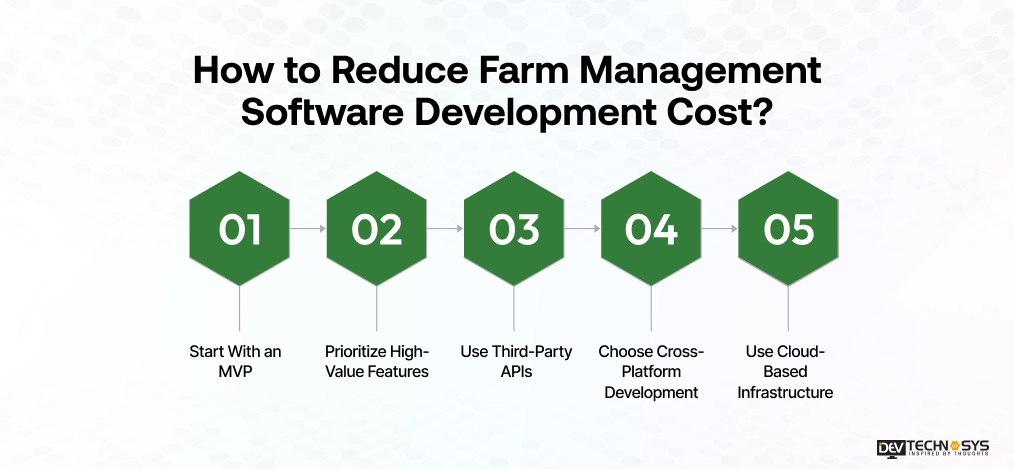
1. Start With an MVP
Begin with essential functionality such as farm management, crop tracking, inventory management, GPS mapping, user management and basic reporting. An MVP allows businesses to validate workflows with real users before investing in advanced capabilities. AI, IoT, predictive analytics and automation can be introduced in later phases based on actual business requirements and user feedback.
2. Prioritize High-Value Features
Identify features that directly improve productivity, water management, crop monitoring, resource utilization or operational visibility. Focus the initial development budget on capabilities that deliver measurable business value. Low-priority features can be added after launch instead of increasing the initial development scope and budget unnecessarily.
3. Use Third-Party APIs
Instead of building every service from scratch, integrate reliable third-party APIs for weather data, maps, geolocation, notifications, payment services and other standardized capabilities where appropriate. This can reduce development time and engineering effort while providing access to established infrastructure. API pricing, usage limits and long-term availability should still be evaluated before integration.
4. Choose Cross-Platform Development
If both iOS and Android applications are required, a suitable cross-platform development approach can reduce duplicate coding and testing compared with maintaining completely sep1arate applications. A shared codebase can also simplify future updates and maintenance. The technology should be selected based on the application’s performance requirements, device integrations and expected scalability.
5. Use Cloud-Based Infrastructure
Cloud infrastructure allows businesses to scale computing, storage and database resources according to actual usage rather than investing heavily in physical infrastructure upfront. It can also support automated backups, centralized data management, remote access and integration with IoT devices. UAE businesses can optimize cloud expenses by selecting appropriate resources, monitoring usage and scaling infrastructure as the number of farms, users and connected devices increases.
Ready to Develop Farm Management Software? We Can Help!
This is all about developing farm management software or agriculture management app. Now that you know, how to develop a farm management software or how much it costs to develop an agriculture app, it is time to step into the process. You can also hire one of the best agriculture software development companies to craft a budget-friendly and cost-effective mobile application.
FAQ’s
Q1. How to Build a Farm Management System?
To build a farm management system, you need to follow the below steps:
-
Identify key requirements and objectives for the farm management system.
-
Select suitable hardware and software technologies.
-
Develop a user-friendly interface for data input and retrieval.
-
Implement modules for crop and livestock management, inventory tracking, and resource planning.
-
Integrate analytics for data-driven decision-making.
-
Test and validate the system thoroughly.
-
Provide training and support for users.
Q2. How Much Does It Cost to Hire A Developer?
The cost to hire a developer varies based on factors such as experience, location, and project requirements. On average the hourly rates can range from $15-$25 per hour.
Q3. How Much Time Does It Take to Build a Farm Management System?
The time required to build a Farm Management System can vary significantly depending on the complexity and scope of the project. Typically, it may take 3-8 months or more for development, testing, and deployment.
Q4. What Benefits Does a Farm Management System Offer?
Some of the benefits of using a Build Farm Management System include:
- Increased Efficiency: Automation of the build process reduces manual effort and speeds up the development cycle.
- Consistency: Ensures that all builds are performed in a consistent manner, minimizing discrepancies between different environments.
- Scalability: Can handle a large number of builds across multiple platforms simultaneously.
- Error Detection: Helps identify build errors, test failures, and code integration issues early in the development process.
- Centralized Management: Provides a single point of control for managing the entire build infrastructure.