





Key takeaways:
- The cost to build an app like Cura ranges from around $30,000 to $1,50,000, depending on the compliance, features, and complexity of the app.
- You need to ensure compliance with GDPR, HIPAA, HITECH, along with encryption and multi-factor authentication to protect the data of patients.
- According to Grand View Research, the global healthcare IT market is expected to grow from USD 998.8 billion in 2026 to USD 2,864.4 billion by 2033, at a 16.2% CAGR.
- The key features of healthcare apps include telemedicine, EHR integration, appointment booking, secure payments, AI, and support for wearable devices.
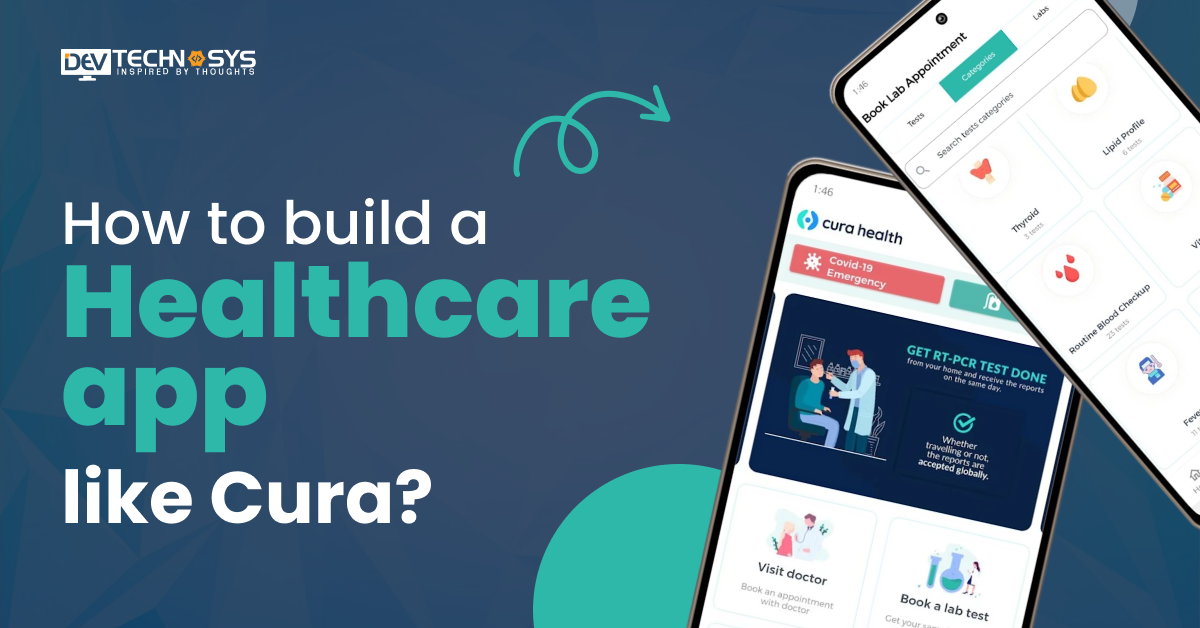
If you have decided to build a healthcare app like Cura but are not sure about the remaining process, then you have come to the right place. In developing an app, there are so many things that are required, such as features, the right process, AI tools, and more.
Especially to make a healthcare app, you need to take care of the needs of patients and doctors/nurses. This helps the app target your core audience in the initial stages.
In this blog, we have provided detailed information to create a healthcare app like Cura. We have explained the reasons why you should invest in such apps, the process of developing them, their features, the AI modern trends, and the cost to develop an app like Cura.
Why Invest in Healthcare App Development?
If you are not able to make the decision whether you should invest in and build a healthcare app like Cura, then here are some of the reasons why you should consider this:
1. The market is growing rapidly
In this modern era, we see most people wearing smartphones and wearable devices to track their habits and overall health. Hence, the market to build a healthcare app like Cura is increasing day by day, and this is the right time for you to build a profitable healthcare app.
2. Investment options are good
In the healthcare sector, there is no shortage of funding for good technology that can really help patients and doctors. Many big hospitals, pharmaceuticals, and insurance companies are ready to invest in healthcare technology.
3. Telemedicine is becoming mainstream
Virtual care has become mainstream after the pandemic, and everyone is preferring online services rather than going physically for consulting. With a healthcare app, patients can get video consultations, digital prescriptions, and remote monitoring from doctors.
4. Remote Care is now normal
Monitoring patients from their home has now become easier as they have started wearing sensors and wearables nowadays. If you make an app for remote monitoring or managing chronic diseases, then it is already a hit. This also helps in reducing costs, hospital visits, and improves the quality of life.
Answer a few quick questions and our experts will share a tailored project estimate.
Types of Healthcare and Medical Apps You Can Build
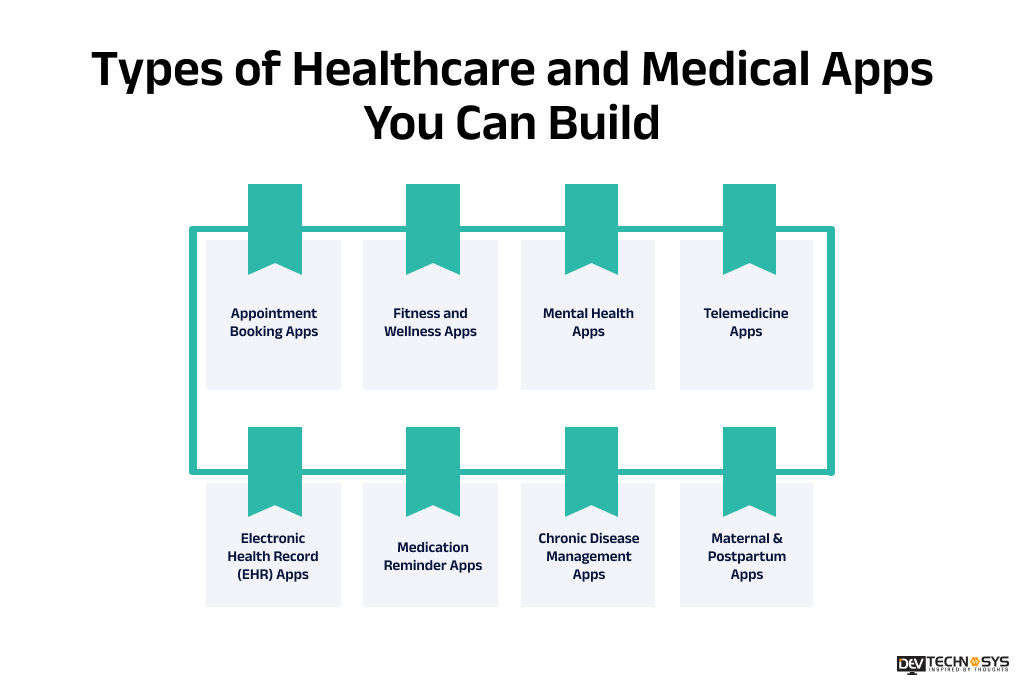
The healthcare industry depends on so many digital solutions in this modern world to improve patient care, enhance operational efficiency, and streamline clinical workflows. Here are different types of Medical and Healthcare apps that you can build:
1. Appointment Booking Apps
Appointment Booking apps in the healthcare industry simplify the process for finding doctors, booking appointments, and checking their availability online. To improve clinic efficiency and reduce no-shows with these types of apps, you can add features such as cancellation management, reminders, and online payments. You can simply proceed with the process from home; you just need to visit the doctor on the appointment day.
2. Fitness and Wellness Apps
Fitness and wellness apps are very useful for users in maintaining a healthy lifestyle. They help in tracking your physical activity, nutrition, sleep, hydration, workout routines, and more. You can also add the feature to integrate it with wearable devices; this can provide you with real-time insights and customized recommendations made for you.
3. Mental Health Apps
People are gradually taking mental health seriously, and they are more open about their struggles. Also, traditional therapy is not always affordable or accessible. You can create a healthcare app like Cura that can fulfill these tasks: CBT exercises, guided meditation, mood tracking, peer support communities, etc. It would also be great if they could provide direct access to licensed coaches or therapists.
4. Telemedicine Apps
These apps connect patients with providers locally through voice, chat, video, or even through asynchronous messaging (sending photos or symptoms now and getting reviews later). You can help people from remote places get treatment. With your healthcare app, people in rural areas can get consultation with a specialist many miles away. This really contributes to improving people’s lives.
5. Electronic Health Record (EHR) Apps
EHR in healthcare industry are considered the digital backbone of clinics and hospitals. They allow doctors to log patient information, assign tasks, manage the billing process, and track treatment records. Building an EHR system from the start can be a difficult task, and it’s better to focus on one niche, such as an app tailored for physical therapists or mental health clinics.
6. Medication Reminder Apps
Medication tracking apps help users who are juggling multiple prescriptions with specific timings, dosages, and interactions. These apps help them set reminders, scan pill bottles, connect with pharmacies, and log side effects.
You can also add this feature to your app that syncs data with caregivers or family members. This can be really helpful for elderly patients or those with chronic diseases.
7. Chronic Disease Management Apps
It can be quite exhausting to manage a chronic disease, such as asthma, diabetes, or heart disease. It includes tracking numbers, adjusting routines, watching symptoms, and more. Tracking and Management apps can include workout history, sleep data, hydration levels, food intake, etc.
You can make your app special by personalizing it if it can be integrated with wearables like Apple Watches, Fitbits, etc.
8. Maternal & Postpartum Apps
Maternal health apps have been proven to be so helpful because pregnancy and early parenthood are full of excitement, anxiety, and so many questions. These healthcare apps guide users through each week of pregnancy, create checklists, send reminders about prenatal vitamins, and even support postpartum mental health.
Some apps also provide video consultations with midwives and connect moms to provide newborn care tips.
How to Build a Healthcare App: Step-By-Step Process
To build a healthcare app like Cura, you would require careful planning, security compliance, and a user-friendly approach. You need to understand your target audience and conduct proper market research to make a secure and scalable healthcare application.
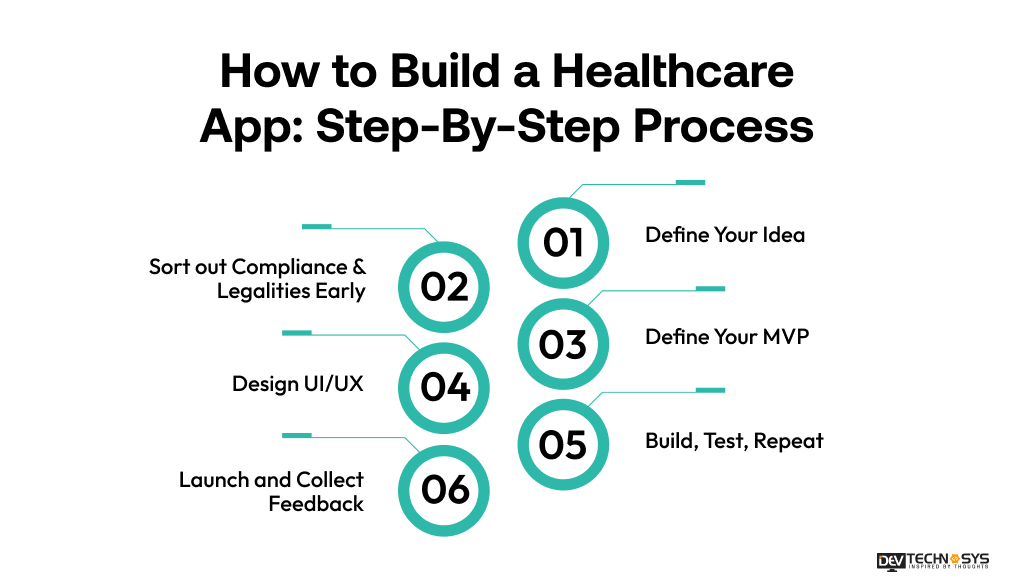
Here are the steps that you need to follow to develop a healthcare app like Cura:
1. Define Your Idea
Before you start developing your healthcare app, the first and main part is to define your goal. You should know what you want to build and what features you want to integrate, and more. You should also know your customer base for whom you are building an app, such as patients. Doctors, nurses, or busy patients.
2. Sort out Compliance & Legalities Early
You should at least consider HIPAA compliance, GDPR (for European users), and include FDA regulations (only if the app is used for diagnosis or treatment). You should build security from the start, such as encryption, access controls, etc. For more benefits and legal knowledge, you should hire a consultant or lawyer with healthcare compliance experience.
3. Define Your MVP
You should define your MVP clearly to make a healthcare app like Cura. The complete version of your app might have the features: mood graphs, AI insights, therapist integrations, etc. But if you are building a mental health app, then your MVP should be a text entry, a simple daily prompt, mood rating, or export feature.
4. Design UI/UX
The interface of the healthcare product is sensitive; you need to make sure that it is attractive as well as usable. You need to focus on making the website minimalistic and simple; fancy designs are avoidable in this sector. You should also focus on how users transition from screens, what actions they take, or where they enter or see information.
5. Build, Test, Repeat
You should work with trusted developers to make your designs work, as they are just features and basic UI. You must test your app in the early stages to detect any issues. The developers should use Firebase or AWS Amplify, Node.js, MongoDB, or Python in the backend and React Native, Flutter, Swift, or Kotlin in the frontend.
6. Launch and Collect Feedback
When your app is ready, you need to launch it. You should use soft launches to fix last-minute bugs and see the reactions of the users. You may adjust the marketing strategy and collect feedback in various ways, such as In-app surveys, social media polls, and email follow-ups.
Must-Have Features of a Modern Medical App
Whether you know the process to build a healthcare app like Cura, it is very necessary to include the must-have features. These features make your app usable, trustworthy, and helpful.
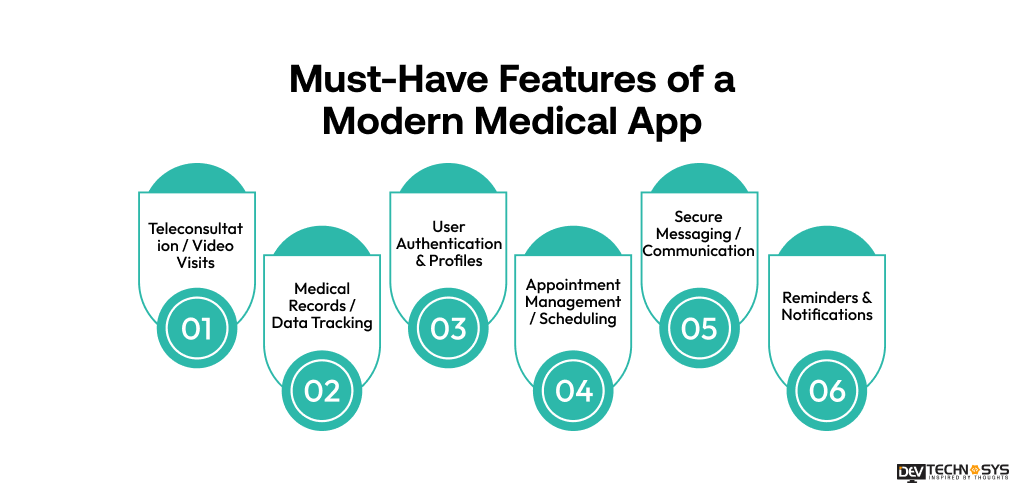
In this section, we have mentioned a list of core features that every medical app should consider integrating. Some of them are non-negotiable, while the others depend on the specific use case, but all of them are important.
1. Teleconsultation / Video Visits
To make a healthcare app like Cura, this has become an important feature after the pandemic. The app should include the following features: screen sharing, In-app video calling, Recording, waiting room function, and low-bandwidth support.
2. Medical Records / Data Tracking
It is necessary to integrate the records and data of the patients in the app. You need to consider having these features according to your audience: Lab results, Medical history logs, Symptom tracking, Medication lists, and Progress charts.
3. User Authentication & Profiles
Caregivers, doctors, nurses, patients, etc. should not have the same level of access to prevent the sensitive data of the patients from being compromised. You need to separate the user roles, set up profiles accurately, and provide login/sign up options.
4. Appointment Management / Scheduling
If your app is going to schedule booking visits, then you need to include calendar integration, waitlist management, booking, rescheduling, cancellation options, reminders via SMS/email, and the app should sync with EHRs or practice systems.
5. Secure Messaging / Communication
It is important to keep the communication secure, as the data of the users is sensitive. The hospital should use an app that includes Encrypted data, read receipts, File sharing, and group chats. Reminders & Notifications
In this busy era, it is very easy to forget about things, such as meds, hydration, appointments, etc, especially if you are a patient. So, for a healthcare app, it is important to have notifications, reminders, customizable alerts, snooze/reschedule options, etc.
Key Technologies and Trends in Healthcare App Development
The healthcare app development industry is evolving day by day; then the important question is how you would stay in trend? You should know the technologies to implement in your product. They not only enhance patient care but also improve operational efficiency, data security, etc.
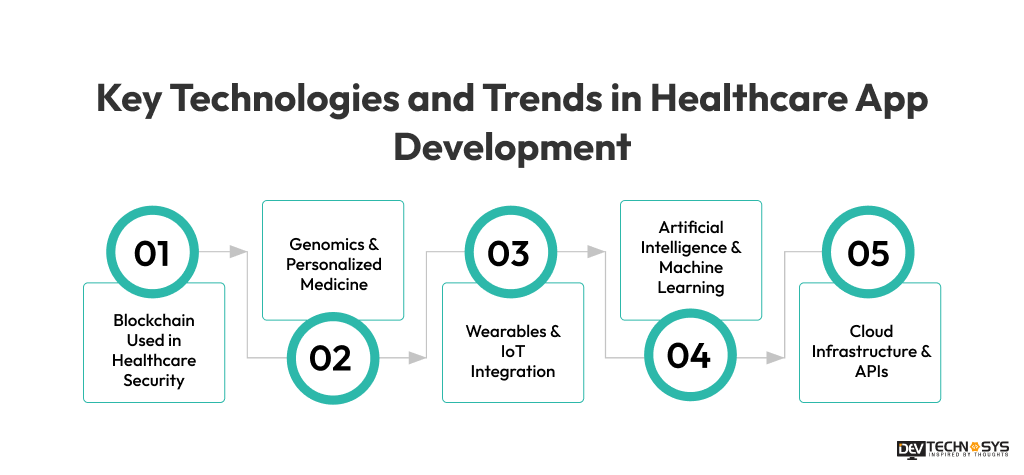
Here are some of the key technologies and trends you can implement to build a healthcare app like Cura:
Blockchain Used in Healthcare Security
The main priority is to protect the sensitive medical information of the patients. Blockchain technology offers a transparent and secure method to build a healthcare app like Cura. It reduces the risk of data fraud by decentralizing the architecture and also improves trust across the healthcare systems.
Key Features include:
- This is best for pharma-specific apps or supply chain software and helps in drug traceability.
- This can also track who looked at what information and when; it requires consent.
- With this, the patient records remain safe and unchanged. It is decentralized storage of medical records.
Genomics & Personalized Medicine
They apply machine learning and genomic information to generate tailored recommendations. Some technologies even partner with the labs to provide results within the app. Consumer genomics apps are still new in the market, but they have much bigger potential. With the new trends, DNA tests have become cheap and more mainstream.
Apps that offer:
- Drug Sensitivity Predictions
- Genetic risk scores
- Tailored diets or exercise regimens
Wearables & IoT Integration
In today’s world, you can see most people wearing health-tracking wearables, such as Apple Watches, Fitbits, etc., and users expect them to track their body movement all the time.
Your app should support the following:
- It should sync sleep, heart rate, oxygen levels, steps, etc.
- The app should alert the users if there is something unusual.
- It should have an option for manual entry. The user should be able to choose the data they want to submit.
Artificial Intelligence & Machine Learning
AI in healthcare industry is on the beat nowadays. Artificial Intelligence and Machine Learning are evolving digital healthcare by automating routine tasks and delivering correct, data-driven insights. Instead of replacing healthcare professionals, AI focuses on complex patient care.
Key Usages include:
- Image recognition: Radiology or Dermatology apps are used to detect skin lesions or lung nodules.
- Symptom screening: AI can ask targeted questions based on the patient’s input. This can help the doctor before the appointment.
- Predictive analytics: It helps in finding various patterns in the patient’s data to predict flare-ups or hospital readmission.
- Personalized recommendations: It prescribes a diet or exercise plan based on medical history.
The most important thing here is training the AI. To develop a healthcare app like Cura, lots of healthcare data is required.
Cloud Infrastructure & APIs
Nowadays, lots of apps are running in the cloud instead of big servers at the hospital.
Here are the reasons why you should use this new trend to create a healthcare app like Cura:
- The app gets better scalability and can reach more users.
- It becomes way faster for things to roll out.
- It can be easily integrated with other systems, such as EHRs and labs.
There are many services, such as AWS HealthLake, Firebase, or Google Cloud Healthcare API, that provide enterprise-level infrastructure without a team of software developers and IT operations.
Remember that APIs are very simple to integrate into existing systems, especially the FHIR-based ones.
Market Statistics to Build a Healthcare App
There are many opportunities to build a healthcare app like Cura and invest in the development of this industry. The healthcare app is developing very rapidly as most of the population has adopted AI, telemedicine, wearable devices, sensors, digital health solutions, etc.
Here are the market insights and statistics in the healthcare market in the coming years:
Market Insight |
Statistics |
| Global Healthcare IT Market | It is expected to grow from USD 998.8 billion (2026) to USD 2,864.4 billion by 2033, at a 16.2% CAGR. |
| Global Telemedicine Market | It is going to increase from USD 157.9 billion (2026) to USD 514.2 billion by 2033, with an 18.4% CAGR. |
| Healthcare Mobile App Market | It is projected to reach USD 1,070.6 billion by 2030, growing at a 45.2% CAGR from 2025-2030. |
Data Security and Compliance Requirements
Security of data and maintaining compliance requirements in the healthcare sector is strictly important. The first step in building trust among users is by staying compliant and protecting people’s privacy. Your app needs to make sure that it does not become a liability.
Here are some of the data security and compliance requirements you should follow:
GDPR (General Data Protection Regulation)
If your app has users in Europe, then this is mandatory compliance. It covers all personal data, including health information. Health data is considered ‘sensitive’ under GDPR, and strict rules are applied for collecting things like medications or symptoms.
Requirements:
- It provides users with the right to access, delete, or export personal data.
- It requires explicit consent for collecting data.
- It also includes appointing a Data Protection Officer.
- It includes data breach notifications within 72 hours.
HIPAA (Health Insurance Portability and Accountability Act)
This security compliance covers the health data to identify a person (PHI or Protected Health Information). It should be applicable in the case of handling medical records, prescriptions, appointments, or communication between patients/providers.
Requirements:
- Audit Logs
- Access Controls
- Secure transmission/storage of data
- Signed BAAs (Business Associate Agreements) with third-party services
- Encryption at rest and in transit
HITECH (Health Information Technology for Economic and Clinical Health Act)
HITECH is considered the stronger version of HIPAA. In this compliance, the violation penalties are increased, and the enforcement is strengthened. Suppose you violate HIPAA; then the fines for HITECH will be increased by hundreds or thousands of times the amount, depending on the violation.
With HITECH, the developers are inclined towards adopting Electronic Health Records (EHRs) to build healthcare software. It supports the secure exchange of health information and molds the entire healthcare system into using modern tech.
Best Practices for Data Security of Healthcare Apps
- For the security of a similar app like Cura, you should encrypt everything, such as stored data, API calls, video visits, etc.
- You should choose HIPAA-compliant tools. You can use AWS, Google Cloud, and Azure for hosting, as they are all HIPAA-compliant.
- You should implement role-based access, and not everyone should get access to everything. Doctors should be able to see full records, but nurses might see limited details. The Admins get more control than the regular users of the app.
- You should include Audit logs and activity tracking. You should know who logged in. Who can access the records, etc.
Healthcare App Development Costs in 2026
The healthcare software development cost typically ranges from $30,000 to $ 150,000+, and it depends on the complexity of the app. There are various factors that can affect the price of the app, such as AI capabilities, compliance requirements, third-party integrations, and other supported platforms, but the primary factor is the complexity of the app.
App Complexity |
Estimated Cost (USD) |
Development Time |
| Basic Healthcare App | 30,000 – 50,000 | 3-5 months |
| Medium Complexity App | 50,000 – 1,00,000 | 5-8 months |
| Complex Healthcare App | 1,00,000 – 1,50,000 | 8-12+ months |
How to Make Money From Medical Apps?
It can be quite challenging to monetize a medical app because most patients or providers are not used to healthcare tools. But if you want to build a healthcare app like Cura and want to make money, then you need to implement some commercial models.
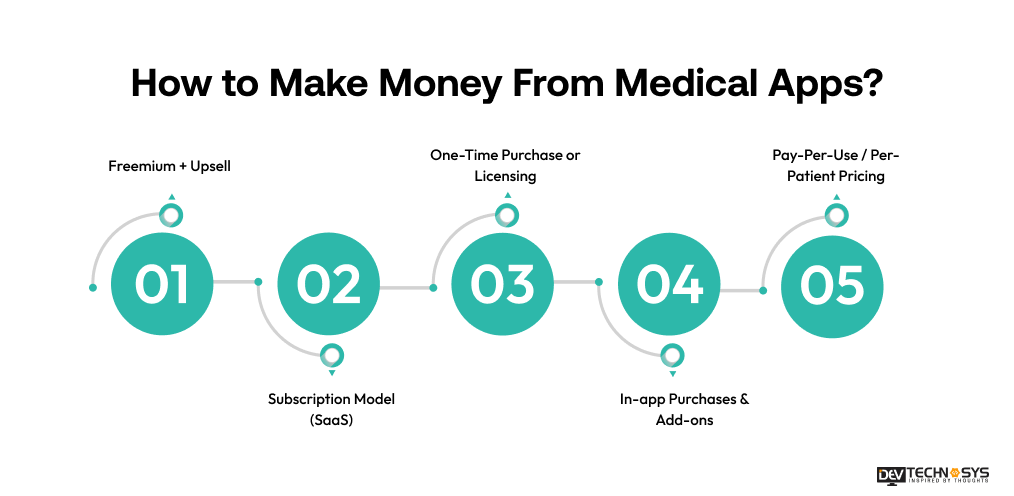
Here are some of the models that may work out for you:
Freemium + Upsell
In this model, you offer a free version to the users, then sell them the premium features (e.g., reporting, detailed tracking, integrations). But remember that the freemium model only works if your free version is great and valuable; then only people will stick around for a long time to convert.
Best for:
- Symptom Checkers
- Patients who are facing mental health and wellness apps
- Medication adherence trackers
Subscription Model (SaaS)
This model is considered the most popular model, especially for the provider-facing apps. You can choose to bill monthly or annually for different tiers. The features, like integrations, more users, analytics, etc., are provided at the premium level.
Who it is great for:
- Telemedicine Platforms
- EHR systems
- Clinical decision support systems
- Practice management tools
One-Time Purchase or Licensing
This is not in much trend nowadays, but some niches still use this model. With this monetization model, users purchase a one-time download or installation fee.
Who is it suitable for:
- Offline clinical calculators
- Training modules
- Medical reference apps (anatomy guides)
In-app Purchases & Add-ons
This is one of the most common models in the market for consumer-facing apps rather than in provider tools. In this model, the core app is free or low-cost, with additional content or features that can be bought separately.

Best for:
- Meditation and mindfulness tools
- Mental health apps
- Parenting or maternal health apps
Pay-Per-Use / Per-Patient Pricing
This is the favorite model in B2B healthcare, where utilization is variable. In these models, if your tool reduces readmissions, then the hospital will pay for it; that means it works on incentives.
You can charge according to the number of patients, interactions, or visits. The fee can also be one-time for a month or variable, depending on the volume of queries.
Best for:
- Remote monitoring applications
- Teleconsultation services
- Diagnostic tools
Conclusion
In today’s world, Healthcare is a very demanding and growing industry. You need to follow the compliance rules and understand the pain points of your users to develop a healthcare app like Cura. You need to integrate the transing technologies in your app to make it relevant in this industry.
You may contact Dev Technosys UAE for healthcare app development, as they hire dedicated developers on their team who have many years of experience. They can develop your healthcare app at affordable prices.
FAQs
Q1. Can You Improve Healthcare Mobile Apps With AI?
Yes, AI can enhance healthcare apps by enabling various features including predictive analytics, symptom assessment, medical image analysis, personalized treatment recommendations, automated administrative tasks, and virtual assistants. It improves the experience of patients and helps clinics increase their outcomes.
Q2. How Long Does It Take To Make A Healthcare Ap?p
You can develop a basic healthcare app in around 3-5 months, while an app with so many features, such as AI, EHR connectivity, telemedicine, and wearable integration, may take 6-12 months.
Q3. What Are The Reasons For Businesses To Invest In Healthcare App Development?
Healthcare apps can be a valuable investment for businesses like healthcare providers and startups. They improve the overall patient experience by streamlining clinical workflows, reducing operational costs, and providing access to many healthcare services; hence, they are proving to be a good investment.
Q4. What Is The Price For Developing A Healthcare App?
The price for developing a healthcare app usually ranges from $30,000 to $1,50,000. The healthcare app development cost depends on the features, complexity, integrations, and requirements of the app.
Q5. Can You Launch A Healthcare App Globally?
Yes, you can launch a healthcare app globally, but you need to comply with all local regulations, consider data localization laws, and adapt to regional healthcare systems.
Q6. What Is The Difference Between A Medical App And A Wellness App?
Medical apps are made for clinical purposes, such as diagnosing, monitoring, or treating health conditions, while wellness apps primarily focus on fitness, general health, or lifestyle improvement. Also, medical apps often require regulatory compliance, such as FDA approval, HIPAA compliance, or CE marking, especially if they support clinical decision-making or handle patient data.
If you have decided to build a healthcare app like Cura but are not sure about the remaining process, then you have come to the right place. In developing an app, there are so many things that are required, such as features, the right process, AI tools, and more. Especially to make a healthcare app, you need to take care of the needs of patients and doctors/nurses. This helps the app target your core audience in the initial stages.
In this blog, we have provided detailed information to create a healthcare app like Cura. We have explained the reasons why you should invest in such apps, the process of developing them, their features, the AI modern trends, and the cost to develop an app like Cura.