





Key takeaways:
- To build a property management software, you need to integrate the essential features, such as lease tracking, online payments, tenant management, AI automation, and analytics, to improve business growth and efficiency.
- To protect the data of tenants and ensure secure property management, security features like AES-256 encryption, RBAC, MFA, and GDPR/PCI DSS compliance are incorporated.
- The cost for development generally ranges from $30,000 to $1,50,000+, according to the integrations, features, and complexity of the platform.
- According to Fortune Business Insights, the market for global property management software is expected to reach USD 61.41 billion by 2034, growing at a 9.7% CAGR, driven by cloud adoption and AI.
It can be quite complex to manage commercial, residential, or both properties. The property managers cannot handle lease agreements, maintenance costs, tenant communication, rent collections, and more altogether with disconnected systems. It often leads to delayed responses, costly errors, and inefficiencies. Property management software becomes really important.
It combines all the important operations in one centralized platform, so that businesses can automate different tasks and decisions will be more data-driven. Nowadays, the real estate industry has started to embrace artificial intelligence (AI), mobile technologies, and the Internet of Things (IoT).
In this guide, we have explained all the details regarding property management software development. It includes benefits, development process, costs, AI capabilities, technology stack, and future trends. Also, keep in mind that custom property management software can provide you with a competitive advantage and flexibility.
What is Property Management Software?
Property Management Software (PMS) is a solution that operates digitally and helps management companies, property owners, and real estate firms in overseeing daily property operations from a single platform. With PMS, you can manage tenants, leases, accounting, payments, reporting, and maintenance through a centralized system instead of using disconnected tools and juggling multiple spreadsheets.
The property management platform/software is designed to improve communication, streamline administrative work, and automate routine processes. With this software, the property managers can schedule maintenance tasks, collect rent online, monitor occupancy, generate financial reports, and maintain compliance with the local regulations in real time.
Who Needs Property Management Software?
Property Management Software has proven to be valuable for all types of organizations. The software helps businesses improve operational efficiency and tenant satisfaction, whether you are managing ten apartments or thousands of commercial properties.
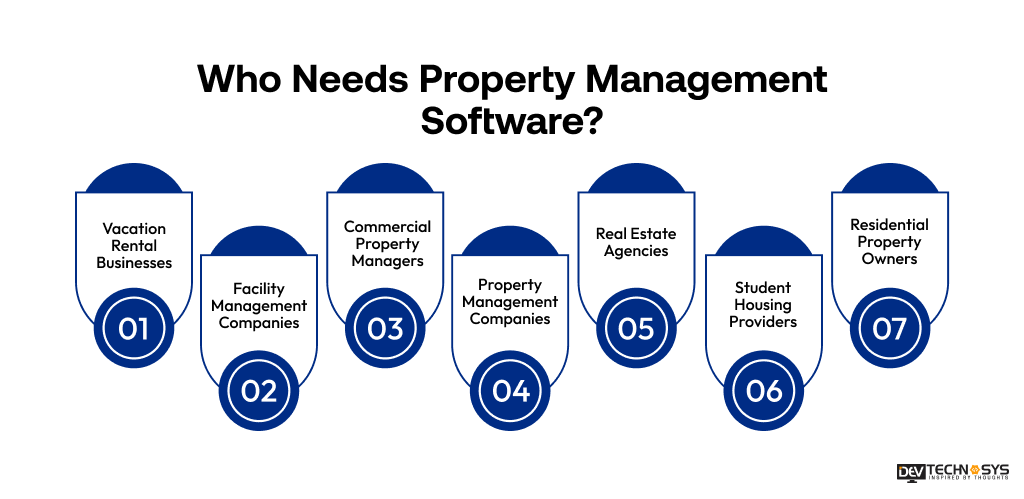
1. Vacation Rental Businesses
The businesses that build a property management software and operate on short-term rentals require tools that automate guest communication, manage housekeeping schedules, and process payments across various booking channels.
2. Facility Management Companies
There are many organizations that are responsible for maintaining hospitals, educational institutions, buildings, and industries. They use a property management system to manage inspections, vendor services, and maintenance. It provides many benefits to the organizations, such as compliance reporting, work order management, and more.
3. Commercial Property Managers
In the case of commercial buildings, many vendors, facility maintenance, complex lease structures, and compliance requirements are involved. Custom property management software helps in managing these operations smoothly, and it also provides detailed financial analytics to them. It provides the facility for lease management, multi-property management, and expense tracking.
4. Property Management Companies
Professional property management companies look over multiple clients and many properties altogether. Hence, a centralized platform can simplify accounting, maintenance coordination, lease management, and reporting. This reduces the manual work for the firms.
5. Real Estate Agencies
Real Estate Agencies usually manage the rental properties along with buying and selling operations. The businesses can organize their listings, schedule inspections, track the activities of tenants, and monitor rental income from a single platform.
6. Student Housing Providers
Hostels, Universities, and student accommodation providers manage so many tenants or students every academic year. With the property management software, your work can be a lot easier. It can renew the contracts, collect rent, and maintain the room allocation process. Hence, they need to create a property management software.
7. Residential Property Owners
The residential communities and individual landlords use the property administration software to simplify the daily tasks and work order management. The features, such as tenant communication, automated payment reminders, and maintenance requests, can reduce the administrative burdens significantly while improving the relationships with tenants.
Types of Property Management Software
As we know, different organisations have their unique requirements for operations. This results in various property management systems in their specialized forms. These are collaborated with property listing app like Bayut and work in the users’ benefit.
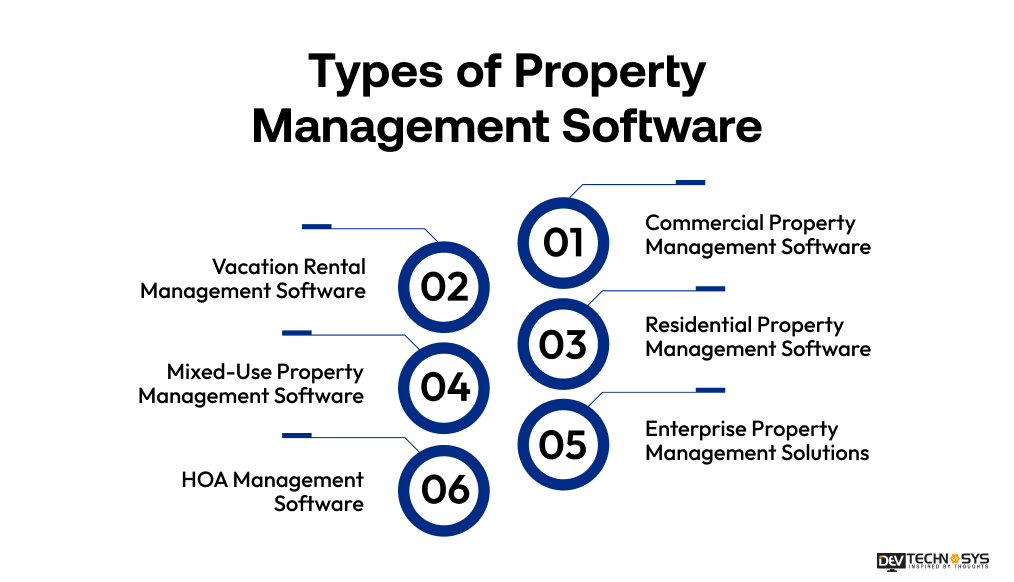
1. Commercial Property Management Software
The commercial management software is designed for industrial properties, retail centers, office spaces, and mixed-use developments. The features that are included in this are facility management, advanced lease administration, budgeting, vendor coordination, and compliance features.
2. Vacation Rental Management Software
This software helps businesses in managing the pricing, reviews, housekeeping, guest communication, and integrations with different hotel booking platforms. You can find the right property by using a property search app like Rightmove. These vacation rental solutions are helpful for Holiday rentals, Airbnb hosts, Boutique hotels, Resort operators, etc.
4. Residential Property Management Software
This real estate management software primarily focuses on tenant communication, rent collection, lease management, financial reporting, and maintenance requests. This landlord management software is mainly designed for residential communities, apartment complexes, and independent landlords.
5. Mixed-Use Property Management Software
For the mixed-use Property Management Software Developments, combine the retail, residential, commercial, and recreational spaces. The businesses use these platforms to support diverse lease structures, centralized reporting, and multiple tenant categories. This software is usually for Urban developments, Smart cities, and Large real estate developers.
6. Enterprise Property Management Solutions
For the organisations that manage thousands of properties across various regions, Enterprise-grade systems are built. The businesses make a property management software system that includes ERP integrations, advanced analytics, AI automation, scalable cloud infrastructure, and compliance tools.
6. HOA Management Software
HOA refers to the Homeowners Association (HOA) software, and it helps communities manage fee collection, communication, maintenance requests, community events, and document sharing. This platform is used by Gated societies, Condominium associations, and Residential communities. It ensures transparency between board members and residents.
Key Features of Property Management Software
In this section, we have mentioned all the primary features of Project Management Software:
Admin Panel |
User (Tenant) Panel |
Vendor Panel |
Property Manager Panel |
| Dashboard & Business Analytics | User Registration & Login | Vendor Login & Profile Management | Dashboard Overview |
| Financial & Payment Management | Online Rent Payments | Update Work Order Status | Lease Management |
| Reports & Performance Analytics | Payment History & Receipts | Availability & Schedule Management | Property Inspection Management |
| System Settings & API Integrations | Document & Lease Downloads | Service History Management | Reports & Analytics |
| User & Role Management | Profile Management | View Assigned Work Orders | Property & Unit Management |
| Subscription & Billing Management | Lease Agreement Access | Upload Service Reports & Photos | Rent Collection & Payment Tracking |
| Property Approval & Management | Browse Property Details | Accept or Reject Service Requests | Tenant Management |
| Vendor Management | Maintenance Request Submission | Invoice Generation & Payment Tracking | Maintenance & Work Order Management |
| Security, Permissions & Audit Logs | Notifications & Alerts | Chat with Property Manager | Owner & Vendor Communication |
| Content, Compliance & Backup Management | Support Tickets & Feedback | Ratings & Performance Reviews | Calendar, Tasks & Appointment Scheduling |
Nowadays, with the growth in digitalisation, businesses are also rapidly adopting AI-driven capabilities, reducing operational costs, implementing automation tools to improve efficiency, and integrating smart building technologies. Here are some of the Advanced features of Property Management Software:
7. AI Chatbots
The AI-powered chatbots provide full-time support to customers by answering their queries and scheduling the time for property visits. It also collects the maintenance requests, shares lease information, and guides the users through the general process.
8. Predictive Maintenance
When the equipment fails, the traditional maintenance process comes into place, which is reactive in nature. The Modern Predictive Maintenance uses IoT sensors, AI, and old data to detect the warning signs of equipment failure to prevent it before any major damage happens.
9. Digital Lease Signing
The onboarding processes can be delayed because of the paper-based lease agreements, which makes the document management process complex. With digital lease signing, the tenants and property managers can sign and complete agreements safely from any device. This can make the process faster, reduce paperwork, and more.
10. AI-based Tenant Screening
To minimize property disputes and payment defaults, it is important to select reliable tenants. With the help of AI-powered tenant screening, you can check the rental history, credit scores, and income, and run background checks of the tenant to create a comprehensive risk assessment.
11. Business Intelligence Dashboard
Business Intelligence (BI) dashboards can collect data from various properties into interactive visual reports. The property owners and managers can monitor rental income, tenant satisfaction, occupancy rates, maintenance expenses, and overall business performance in real time. It also enables the stakeholders to identify growth opportunities.
Benefits of Custom Property Management Software Development
The ready-made property management software can meet all the basic operational needs, but it often comes with some restrictions, such as unnecessary features, workflows, limited integrations, and recurring subscription costs. The custom property management software is designed specifically for your business processes, ensuring efficiency, greater flexibility, and long-term value.
Here are some of the benefits of custom software development:
1. Centralized Property Operations
It centralizes all the various business operations into a single dashboard. It provides instant access to tenant records, maintenance requests, lease agreements, communication history, and financial records.
2. Improved Tenant Experience
Modern tenants expect fast communication, transparency, and convenience. With the custom software, businesses provide self-service portals where the tenants can submit maintenance requests, pay rent online, receive notifications, download lease documents, and communicate with the property managers.
3. Faster Rent Collection
Late rent payments affect the cash flow and require administrative effort. Rent collection is automated with the custom software through digital invoices, recurring payment schedules, payment reminders, and multiple online payment methods.
4. Data-Driven Decision Making
With the custom software development, you can access real-time business intelligence. Analytics and interactive dashboards help the managers monitor mobile app maintenance costs, occupancy rates, tenant retention, rental income, and property performance.
5. Easy Business Scalability
Operational complexity increases when businesses expand. Custom property management software is built while keeping scalability in mind. It allows the organizations to add new users, properties, locations, and features without disrupting existing operations.
Property Management Software Market Statistics (2026)
The property management software market is growing rapidly because real estate businesses are adopting AI, cloud computing, and automation to improve tenant experiences and streamline operations. The market will expand over the next decade as the demand for SaaS-based solutions and smart property management increases.
Market Statistic |
Value |
| Global Market Size (2025) | USD 26.55 Billion |
| Expected Market Size (2026) | USD 29.19 Billion |
| Projected Market Size (2034) | USD 61.41 Billion |
| CAGR (2026–2034) | 9.7% |
| Leading Deployment Model | Cloud-Based Solutions |
| Key Growth Drivers | AI, SaaS, IoT & Automation |
| Major End Users | Property Managers, Real Estate Agencies & Housing Associations |
| Fastest-Growing Trend | AI-powered Property Management |
(Source: Fortune Business Insights, Property Management Software Market Size, Share & Industry Analysis).
Property Management Software Development Process
To develop a property management software solution, the right technology, careful planning, and a user-friendly approach are required. Every stage of the process plays a vital role in making a scalable, secure, and high-performing app. It goes from identifying business requirements to post-launch maintenance.
In this section, we have mentioned the step-by-step development process that is followed by leading software development companies:
1. Requirement Gathering
Every successful project starts with knowing the business objectives, operational challenges, and target audience of the clients. In this phase, the stakeholders define the software’s features, scope, user roles, budget, and timeline. The business analysts can identify the need for automation, and they can make a blueprint that aligns with long-term business goals.
2. Market Research
Businesses can build a standout product by understanding the competitive landscape. It involves identifying market trends, analyzing the existing property management software, and discovering feature gaps. The research also helps in prioritizing the features for the MVP and calculating the development cost to build a property management software more correctly.
3. UI/UX Design
User engagement can be improved with a well-designed interface, and it also simplifies navigation for property managers, tenants, vendors, and owners. The designs make interactive prototypes, wireframes, and user flows to ensure a smooth user experience before development starts. The ensign should be simple, easy to access, and it should have mobile responsiveness.
4. MVP Planning
Many businesses launch an MVP (Minimum Viable Product) with important functionalities, such as lease management software, tenant management, rent collection, and maintenance requests, instead of building every feature at once. The businesses can validate their product with an MVP. It also reduces initial development costs and collects user feedback.
5. Software Development
Once the design and requirements are finalized, developers begin coding the application. Frontend, backend, mobile, and database development are carried out simultaneously using Agile methodologies to ensure faster iterations and continuous improvements.
6. API Integration
Modern property management applications depend on external services to enhance their functionality. The user convenience and automation can be improved by mapping services, integrating payment gateways, e-signature tools, accounting platforms, and communication APIs. The manual process is eliminated with these integrations, creating a seamless digital ecosystem.
7. Testing & Quality Assurance
The software goes through comprehensive testing to ensure reliability, performance, and security before deployment. The quality assurance teams identify the bugs and fix them while validating that every feature works as intended across various devices and browsers. If you do regular testing, then the post-launch issues can be reduced, and it also enhances user satisfaction.
8. Deployment
The software is only deployed to a production environment after successful testing, and after that, the end users can access it. Deployment includes cloud setup, server configuration, migrating data, and application publishing for web and mobile platforms. If you monitor the application continuously, then it helps in identifying and resolving issues rapidly after launch.
9. Ongoing Maintenance & Updates
After deployment, software development does not stop; it goes on even after the launch. Security patches, regular updates, performance optimization, and feature enhancements are necessary to keep the platform safe and competitive. Maintenance also ensures compatibility with the other new operating systems, third-party API integrations, and evolving business requirements.

Technology Stack for Property Management Software Development
Technology Layer |
Popular Technologies & Tools |
Purpose |
| Frontend Technologies | Vue.js, React.js, Angular | It is used to make responsive web interfaces. |
| Backend Technologies | Spring Boot, .NET, Node.js, Django, Laravel | It is used to manage business logic and APIs. |
| Database | MySQL, MongoDB, PostgreSQL, Firebase | It is used to keep application data safe. |
| Third-party APIs | DocuSign, Salesforce, Twilio, QuickBooks | It enables integrations and communications. |
| Mobile Technologies | Swift, Flutter, React Native, Kotlin | It is used to develop iOS and Android apps. |
| Payment Gateway | PayPal, Stripe, Razorpay | It is used to make secure online payment processing. |
| AI & Machine Learning | TensorFlow, OpenAI API, PyTorch | It is used to make predictive analytics and AI automation. |
| Maps & Geolocation | Mapbox, Google Maps | It is used to navigate and locate property. |
| Cloud Infrastructure | Azure, Google Cloud, AWS | It is used for storage and scalable hosting. |
AI in Property Management Software
Artificial Intelligence (AI) is changing the property management industry by improving operational efficiency, automating repetitive tasks, and delivering data-driven insights. Developers build property management app with AI instead of relying on the manual process to optimize rental pricing, predict maintenance issues, enhance customer support, manage work order management, and streamline decision-making.
AI Rent Price Prediction
It is important for rental property management software to set the right price to increase occupancy and revenue. AI-powered pricing models analyze market demand, historical rental data, competitor pricing, location, seasonality, and property features to recommend accurate rental rates.
AI Document Processing
Real Estate App Development Services involves taking care of large volumes of documents, including invoices, lease agreements, inspection reports, and tenant records. This decreases manual data entry and improves accuracy.
AI Tenant Support
It is crucial to find reliable tenants to reduce the rental risks. AI-powered tenant screening calculates employment records, credit history, background checks, rental history, and income verification to create a risk assessment.
Fraud Detection
Property transactions have sensitive personal and financial information. AI monitors the behaviour of the user and their transaction patterns to identify suspicious activities, such as identity theft, fraudulent payments, or unauthorized access.
Property Management Software Development Cost
The property management mobile app development cost depends on various factors, including the platform selection, number of features, third-party integrations, UI/UX complexity, AI capabilities, and the location of the development team. The cost goes from $30,000 – $1,50,000 according to the complexity of the software.
Cost by Software Complexity
Software Type |
Estimated Development Time |
Estimated Cost (USD) |
| Basic Property Management Software | 3-5 Months | $30,000 – $50,000 |
| Mid-Level Property Management Software | 5-8 Months | $50,000 – $100,000 |
| Enterprise Property Management Software | 8-14+ Months | $100,000 – $150,000+ |
Factors Affecting Property Management Software Development Cost
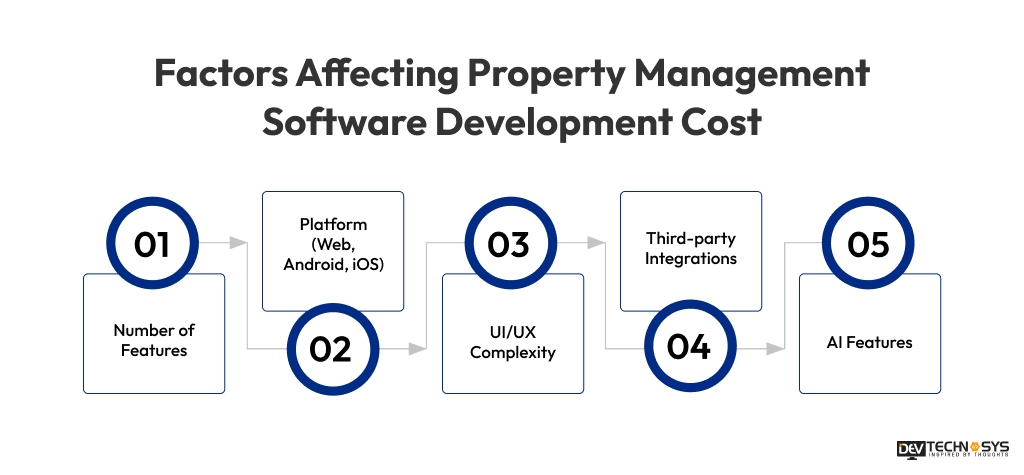
In this section, we have mentioned the various factors that affect the cost to develop a property management software:
Number of Features
One of the biggest factors for the cost is the number of features the software has. Also, various resources and more development are required for adding functionalities, such as AI chatbots, tenant management software, advanced analytics, and predictive maintenance.
Platform (Web, Android, iOS)
It is also a factor whether you are developing for Android, web, or iOS platforms, as all of them require different development efforts and technologies. The budget of the Android app development or iOS app development can be increased when you build multiple platforms simultaneously.
UI/UX Complexity
Users adopt those interfaces that are clear and intuitive, but detailed research is needed along with prototyping, wireframing, and design iterations. These types of advanced UI/UX designs increase the cost to develop a property management software and development efforts.
Third-party Integrations
You can enhance the functionality of your software by integrating payment gateways, accounting software, CRM systems, e-signature tools, mapping services, and more, but it also adds integration complexity and mobile app maintenance costs.
AI Features
AI-powered capabilities, including predictive maintenance, chatbots, tenant screening, and business analytics, involve advances in larger datasets, machine learning models, and algorithms. Hence, this can increase the complexity and the cost to build a property management software.
Table for Factors Affecting Property Management Software Development Cost
Cost Factor |
Estimate Cost (USD) |
| Number of Features | $30,000 – $150,000 |
| Platform (Web, Android, iOS) | $35,000 – $120,000 |
| UI/UX Complexity | $30,000 – $70,000 |
| Third-party Integrations | $40,000 – $90,000 |
| AI Features | $60,000 – $150,000 |
Security & Compliance Requirements
The Real Estate App Development Company stores sensitive information, such as financial transactions, tenant records, property documents, and payment details. Hence, it is essential to create a property management software that ensures strong security and compliance to maintain trust, protect user data, and avoid legal penalties.
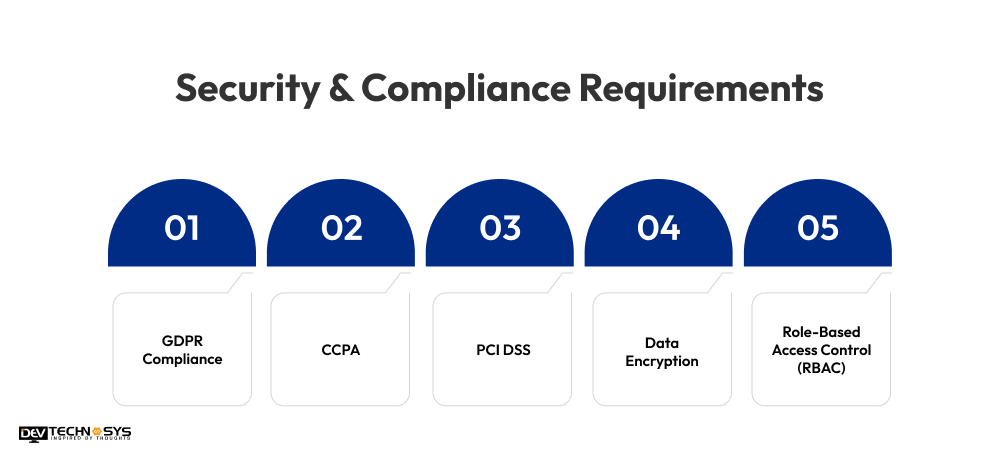
Here are some of the key security standards and compliance measures that should be used to make a property management software:
GDPR Compliance
GDPR compliance is mandatory if your software deals with people in the European Union. You need to provide clear consent to the users so that they know what data is collected and why. They should have the ability to export their data, access it, or delete it on their request. This will also help the software in maintaining transparency with the users.
CCPA
Maintaining CCPA compliance is mandatory for businesses that are operating in California. It is all about being clear about the personal information you collect and how the businesses are going to use it. Clear privacy notices should be mentioned. The users should have the ability to control their data, such as requesting its access, sharing, or deleting it.
PCI DSS
PCI DSS compliance is mandatory because the property management software handles online rent payments most of the time. It includes protecting the data of the cardholder, processing payments securely, and keeping your network safe against threats. With regular security monitoring, you can catch vulnerabilities at an early stage and reduce the risk of expensive payment fraud.
Data Encryption
Data encryption keeps the sensitive data of the users safe. The software should use AES-256 encryption for stored data because it keeps the data unreadable without the correct key, and SSL/TLS protects the data when it travels between systems. The encrypted backups add another layer of protection, so that they can be saved from the attackers.
Role-Based Access Control (RBAC)
RBAC is important because not everyone needs access to everything. It provides access to the managers, tenants, administrators, owners, and vendors, relevant to their role. It enhances data security, minimizes insider threats, and provides stronger operational control.
Common Challenges in Property Management Software Development
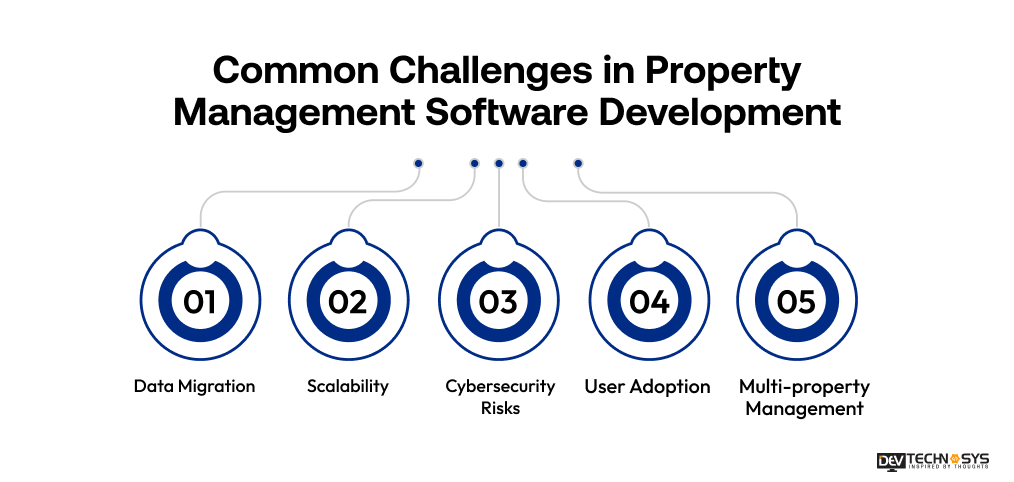
There are many technical and operational challenges while developing property management software. If you identify these challenges, then it can help in minimizing risks and provide a more accurate solution:
Data Migration
If you are trying to migrate data, then it requires careful planning to prevent inconsistencies and data loss. Data Migration involves lease agreements, payment history, tenant records, and maintenance logs.
Solution: You should use automated migration tools and perform a complete data validation.
Scalability
The software should be able to handle scalability because when the property portfolios grow, it should handle the increasing number of properties, users, and transactions. It should also not affect the performance of the software.
Solution: The software should include a cloud-native and microservices architecture.
Cybersecurity Risks
Cyberattacks are generally attracted by the sensitive financial and personal information of the users registered on the property management platforms.
Solution: You implement encryption, continuous monitoring, MFA, and regular security audits.
User Adoption
If the property management software is difficult to use, then tenants and employees may resist adopting a new system.
Solution: You should go for the companies that hire dedicated developers to design intuitive interfaces, offer ongoing support, and provide onboarding tutorials.
Multi-property Management
It can be difficult to manage commercial, residential, and mixed-use properties from one platform because it requires centralized reporting and flexible workflows.
Solution: You should build role-based dashboards and configurable modules.
Build vs Buy: Should You Develop Custom Property Management Software?
Most of the businesses find it quite difficult to choose between an off-the-shelf solution or develop custom software while investing in property management technology. There are many factors on which this critical decision depends:
Factor |
Custom Development |
Ready-made Software |
Hybrid Approach |
| Feature Control | Full control | Fixed feature set | Mix of built-in and custom features |
| Maintenance | Managed by your team | Managed by vendor | Shared responsibility |
| Long-Term ROI | High | Moderate | High |
| Initial Cost | High | Low | Medium |
| Customization | Fully customizable | Limited customization | Moderate customization |
| Ownership | Full ownership | Vendor-owned | Shared ownership |
| Best For | Enterprises & growing businesses | Small businesses | Mid-sized businesses |
| Integrations | Unlimited integrations | Limited by the provider | Flexible integrations |
| Deployment Time | 6–12 months | A few days to weeks | 2–6 months |
| Scalability | Highly scalable | Depends on the vendor | Scalable with custom modules |
Conclusion
Real Estate management software is an important tool for modern businesses looking to enhance tenant experiences, improve operational efficiency, and scale their operations. It automates the entire process, from rent collection and maintenance management to using AI for predictive analytics and smart decision-making. Building a custom property management software empowers businesses to stay competitive in an evolving market.
If you are planning to build a feature-rich, secure, and future-ready property management solution, then it is a great idea to partner with an experienced software development company, such as Dev Technosys. They can deliver you exceptional results with the right strategy, technology stack, and development approach.
Frequently Asked Questions
Q. 1 How Much Does Property Management Software Development Cost?
The cost of property management software development generally ranges from $30,000 to $250,000+. This cost can vary depending on the software’s features, integrations, and complexity.
Q. 2 How Long Does It Take To Build Property Management Software?
A basic property management software solution may take around 3-5 months, while the complex-level software with all the advanced features needs 8-14 months or longer.
Q. 3 Which Features Should an MVP Include?
The features that an MVP includes are property management, tenant management, basic reporting, authentication, online rent collection, and more.
Q. 4 Can AI Improve Property Management Operations?
Yes, AI can improve the property management operations by providing business insights through advanced analytics. Also, AI can automate tenant support, streamline document processing, and predict maintenance needs.
Q. 5 How Do You Ensure Data Security In Property Management Software?
You can ensure data by implementing the security and compliance regulations, such as multi-factor authentication, encryption, security audits, role-based access control, secure payment gateways, GDPR, and PCI DSS.