





Building an event management application within the Middle East by 2025 means moving into a part of the world where digital transformation, innovation, and large events are all happening simultaneously.
World-class expos, corporate conferences, ceremony and wedding planning, and cultural festivals are all currently happening.
Within these events, the demand for seamless and easy tech integration is rising exponentially. In these events, audiences are looking for a personalized approach, real-time digital communication, and smooth digital payments.
Given the rapid developments of smart cities, there is a rise in smartphone usage and penetration, and there are governments investing in digital initiatives, making the Middle East a great place to build next-gen event tech.
Stick to this blog to know how to develop an event management app in Middle East and how it can be a profitable opportunity.
Let’s In!
Market Statistics of Event Management Applications in Middle East
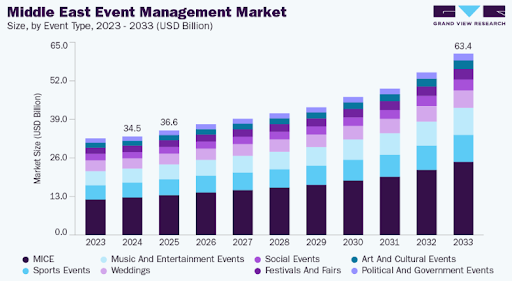
- The Middle East market of event management is valued at around $34.47 billion in 2024; it is expected to reach around $63.44 billion by the end of 2033.
- As per the segment-wise, the MICE events segment holds the revenue share of around 37.90% in 2024.
- Look at the service type, event production, and technical services, which accounted for a revenue share of around 28.73% in 2024.
- According to a recent study, the event management market in the Middle East is projected to grow with a CAGR of 7.1% from 2025 to 2033.
- In 2024, the UAE has one of the highest revenue shares of around 28.23% and it can be increased during the forecast period.
What is an Event Management App?
An event management app is an online platform where users can manage, plan, organize, and run events easily. These platforms simplify event planning for weddings, parties, business meetings, festivals, and more. Event management apps like Socio include various features such as registration, ticket booking, schedule management, centralized hub, gamification, badge management, attendee engagement, and more.
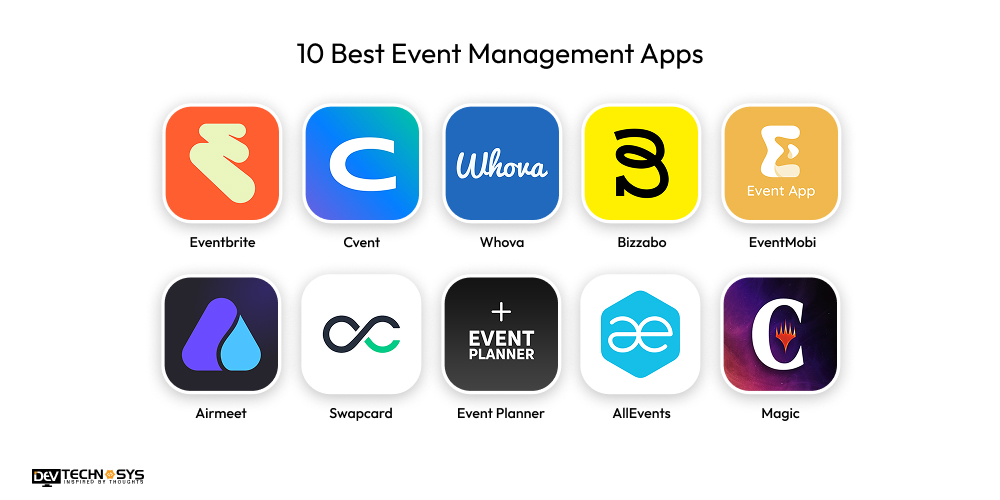
10 Best Event Management Apps
Are you ready to build an event management app? But hang on, what type of event management app do you want to build? Let’s explore the existing event management apps that have already gained higher popularity:
App Name |
Launched Year |
Platforms |
Typical Rating |
Estimated Downloads |
| Eventbrite | 2006 | iOS, Android, Web | 4.4 | 10M+ |
| Cvent | 1999 | iOS, Android, Web | 4.5 | 1M+ |
| Whova | 2013 | iOS, Android, Web | 4.9 | 1M+ |
| Bizzabo | 2011 | iOS, Android, Web | 3.5 | 100K+ |
| EventMobi | 2010 | iOS, Android, Web | 4.5 | 100K+ |
| Airmeet | 2019 | iOS, Android, Web | 4.4 | 100K+ |
| Swapcard | 2013 | iOS, Android, Web | 4.2 | 100K+ |
| Event Planner | 2015 | iOS, Android, Web | 4.4 | 100K+ |
| AllEvents | 2013 | Web, Mobile | 4.7 | 1M+ |
| Magic | 2012 | iOS, Android | 3.6 | 1M+ |
Why Do Businesses Want to Invest in Event Management App Development?
Companies are adopting event management applications in 2025 in order to manage live, hybrid, and fully virtual events more seamlessly, efficiently, and in a data-driven manner. What makes these applications especially valuable is their ability to manage fully virtual events in real time, and their growing importance in facilitating digital-first events.
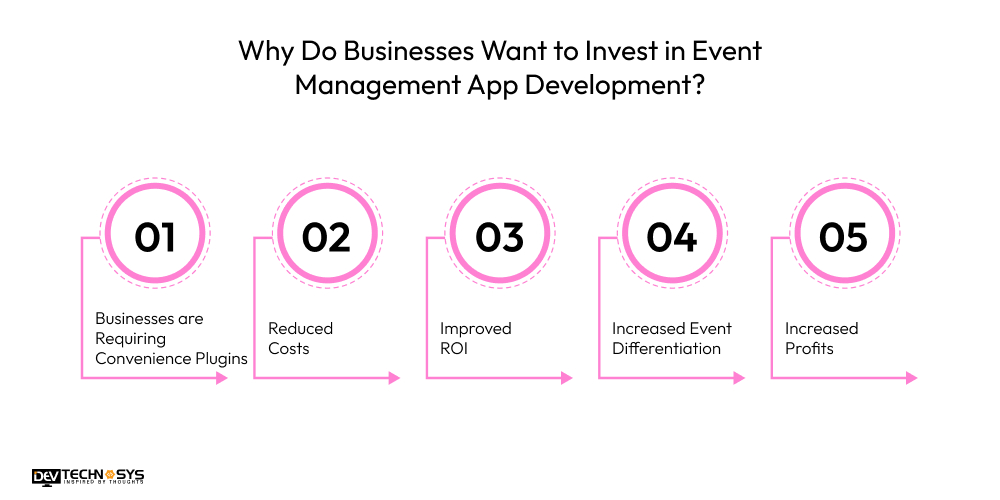
1. Businesses are Requiring Convenience Plugins
Businesses desire technology applications that allow for seamless event planning, registration, scheduling, and communicating. Companies are willing to integrate technology solutions to automate event planning and create a better experience.
2. Reduced Costs
Event management app development solutions reduce manual work, minimize errors, and centralize event operations. With tools for budgeting, vendor coordination, and real-time updates, businesses save time and resources while improving productivity.
3. Improved ROI
Apps offer powerful analytics for tracking attendance, engagement, and performance. Businesses invest in event apps to leverage insights that help refine strategies, optimize future events, and deliver higher ROI.
4. Increased Event Differentiation
Businesses like to use event management applications that improve their brand visibility and professionalism, and allow for event diversification. Investing in the event management Android app development services helps to differentiate them in their respective industries.
5. Increased Profits
Digital event management technologies create and enhance additional revenue streams through ticket sales, sponsorship opportunities, targeted advertising, and premium features. So, it is one of the best benefits for businesses to invest in it.
What are the Steps to Develop an Event Management App in Middle East?
To create an event management app requires various types of steps, from resource planning to post-launch maintenance services. These stages clarify every process in detail and explain how they work. So, here we provide a step-by-step guide to the event management Android and iOS app development process:
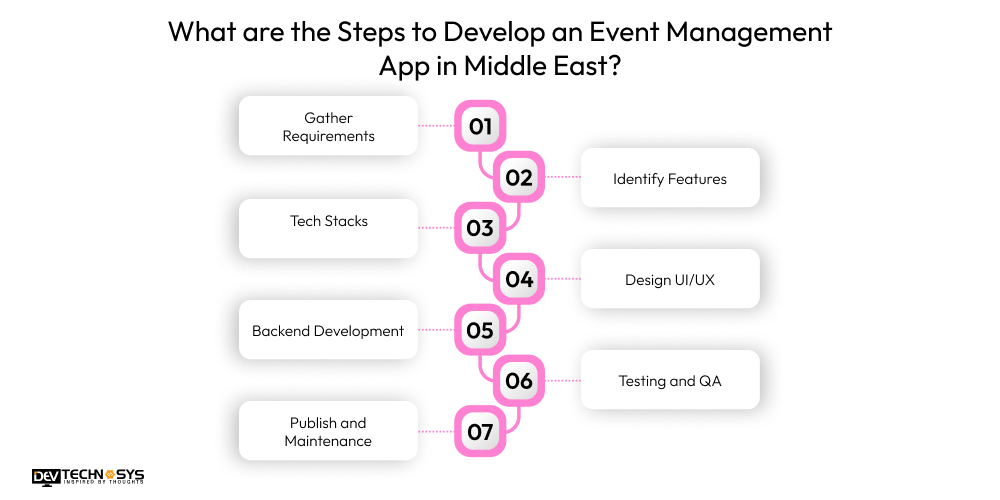
1. Gather Requirements
At the beginning of the development process, you will need to outline your project needs and requirements, and what your future goals are. After that, observe the existing event management apps to understand their services and features. You can also identify the ways to stay in this competitive market and what the ideal users are.
2. Identify Features
In the second step to make an event management app, create a proper list of core and advanced features. First, you integrate the required features, and after that,choose features as per the personalized preferences. You can also check out the features of existing event scheduling apps and implement them in your application.
3. Tech Stacks
Hire event management app developers from an artificial intelligence development company to select the tech stacks that are useful in creating a robust event booking app. There are various types of tech stacks involved, such as database, cloud storage, frontend and backend development, testing, designing, and more.
4. Design UI/UX
Moving to the fourth stage of event planning app development, designing a user interface is the most important task in the whole development process. It is the first interaction of users with the application. Need to use various types of UI elements such as fonts, navigation bars, styles, templates, colors, textures, in-built plugins, and more.
5. Backend Development
In another step to make an event management app, hire skilled backend developers from a mobile app development company to start the real coding. All backend infrastructure includes handling servers, creating APIs, user authentication, ensuring correct data flow, and more. Developers also integrate third-party tools such as payment gateways, CRM, communication tools, and social media logins.
6. Testing & QA
Are you ready to launch the app? Wait, you should test your app’s functionalities and make sure all services and features are working smoothly. It includes various testing techniques such as functional, unit, integration, security, black-box, and user acceptance testing. These ensure that your application works at its peak.
7. Publish and Maintenance
Finally, publish your event management app on the specific platform, such as Android and iOS. Make sure all phases and third-party integrations are successfully published. Now it’s over. You think, but it’s not. You need to conduct the post-launch maintenance services to keep up-to-date.
It involves fixing glitches, adding new features, regular updates, backups, and solving security issues.
Must-Have Features of Event Management Applications
No matter what type of application you build, but selection of features is necessary. Unique and special features can easily increase user engagement. So, here we provide the must-have features for event management apps:
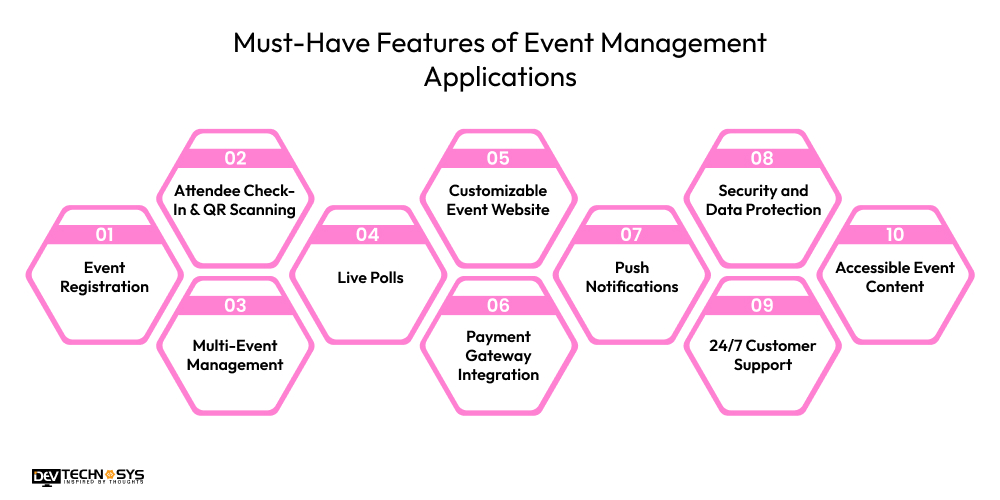
1. Event Registration
The event booking apps enable users to register event and book a ticket for the event, receive a notification of confirmation instantly.
2. Attendee Check-In & QR Scanning
Event management apps enable faster check-ins using QR codes, and they can eliminate the long queues and offer real-time entry data.
3. Multi-Event Management
Event scheduling apps allow organizers to maintain multiple events and track their real-time operations. It is ideal for large organizations or agencies.
4. Live Polls
Allows attendees to participate in real-time surveys, quizzes, and question sessions. It increases engagement, gathers insights, and helps speakers better interact with their audience.
5. Customizable Event Website
Provides ready-made templates for creating branded event pages with schedules, speakers, and tickets, enhances visibility, and boosts professionalism.
6. Payment Gateway Integration
Event productivity apps provide secure payment options such as credit or debit cards, digital wallets, net banking, and more to purchase event tickets.
7. Push Notifications
It sends alert messages to users when they book tickets, announcements, new updates available, and any reminders.
8. Security and Data Protection
To protect the users’ data, integrate security measurements such as end-to-end encryption techniques, authentication, biometrics, and more.
9. 24/7 Customer Support
Event booking apps have a customer support team to handle or manage the users’ daily concerns and issues, and solve them with immediate effect.
10. Accessible Event Content
Offers downloadable presentations, videos, documents, and session recordings. Ensures attendees can revisit materials and supports hybrid or post-event engagement.
What is the Cost to Build an Event Management App in Middle East?
The cost to develop an event management app ranges from $8,000 to $25,000 or 29380 AED to 91800 AED; it can be higher depending on the business’s requirements. There are several factors that can also impact the event management software & app development cost, such as premium features, functions, project complexity, backend infrastructure, testing, designing, and more.
According to the rules and regulations of the Middle East, need to take care of security and privacy, integrating higher security measurements and privacy methods.
Tier Name |
Features |
Estimated Cost (USD) |
| MVP | Basic event listing, registration, ticketing | $8,000 – $10,000 |
| Basic Native | Single native app (iOS or Android) with schedule & check-in | $10,000 – $13,000 |
| Cross-Platform | Flutter/React Native app with push notifications & agenda | $12,000 – $15,000 |
| Medium | QR check-in, speaker management, basic networking/chat | $15,000 – $18,000 |
| Virtual/Hybrid | Livestream, virtual booths, networking features | $18,000 – $21,000 |
| Full-Featured | Live polls, Q&A, sponsor management, badge printing | $21,000 – $23,000 |
| Enterprise | Multi-event support, analytics, multi-language, high security | $23,000 – $25,000 |
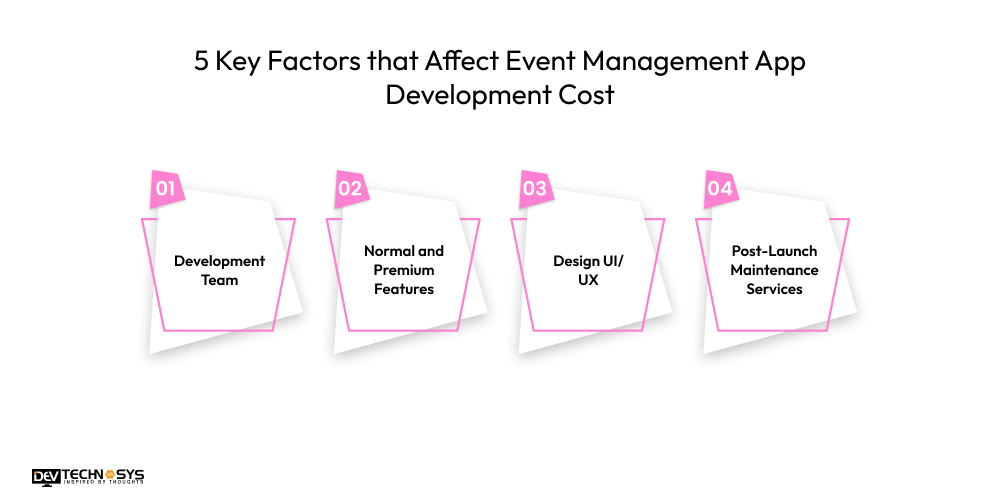
5 Key Factors that Affect Event Management App Development Cost
Ready to create an event management app? Wait, first look at the several factors that can influence your overall project budget. To maintain the budget, you need to observe each factor and get an idea of how to avoid them. Here is the list of key factors:
1. Development Team
Move to the first factor, developers who have higher experience in creating applications it definitely demand a higher cost. This can affect the cost to develop a mobile app for event management. On the other side, hiring developers from high-tech regions like the USA, the UK, and others, developers demand a higher salary package.
Level |
Description |
Estimated Additional Cost (USD) |
| Low | Small local team or solo freelancer | $1,000 – $3,000 |
| Medium | Mid-size development agency | $3,000 – $6,000 |
| High | Large or international experienced team | $6,000 – $10,000 |
2. Normal and Premium Features
In the second factor, integrated features are necessary in every type of application, but some of the features are very expensive. It includes various premium features such as personalized recommendations, live polls, multi-event management, secure payment options, and more. But these features can raise the cost to build an event management app.
Level |
Description |
Estimated Additional Cost (USD) |
| Low | Only core/basic features | $500 – $1,500 |
| Medium | Some premium features (polls, Q&A, check-in) | $2,000 – $5,000 |
| High | Many advanced features (analytics, networking, virtual events) | $5,000 – $10,000 |
3. Design UI/UX
Let’s know about another factor: implementing a high-quality and attractive design is important to increase user engagement. It includes various UI elements such as layouts, built-in plugins, templates, premium themes, fonts, styles, textures, colors, and navigation buttons. These design elements can significantly fluctuate the total event management app development cost.
Level |
Description |
Estimated Additional Cost (USD) |
| Low | Template-based or basic design | $800 – $1,500 |
| Medium | Custom UI with simple animations | $1,500 – $4,000 |
| High | Fully custom design with advanced animations | $4,000 – $8,000 |
4. Post-Launch Maintenance Services
In the last cost-impacting factor, to keep the app up-to-date, you need to conduct the post-launch maintenance services. This involves fixing security patches, upgrading OS versions, adding new enhancements, performance optimization, regular backups, and solving bugs or errors. But these can influence the cost to maintain an app and also affect the initial development cost.
Level |
Description |
Estimated Annual Cost (USD) |
| Low | Minimal: bug-fixing only | $800 – $2,000 |
| Medium | Regular updates and minor features | $2,000 – $5,000 |
| High | Full support, scaling, and ongoing feature development | $5,000 – $10,000 |
Tech Stacks Required to Develop an Event Management App
Let’s create your own digital platform, but confused about choosing the technologies that which is best for your project. We provide a detailed description table for tech stacks:
Component |
Technologies (Examples) |
Purpose |
| Frontend (Web/Mobile) | React, Flutter, React Native | User interface for attendees & organizers |
| Backend Framework | Node.js (Express), Django | Core logic & API handling |
| Database | PostgreSQL, MongoDB | Store events, users, and tickets |
| Authentication | Firebase Auth, Auth0, JWT | Secure login & user management |
| Real-time Features | Socket.io, Firebase | Live updates, chat, notifications |
| Cloud Hosting | AWS, Google Cloud, Azure | Deploy and host app services |
| Storage | AWS S3, Firebase Storage | Store images, documents, and event media |
| Payments | Stripe, PayPal, Razorpay | Ticketing and transactions |
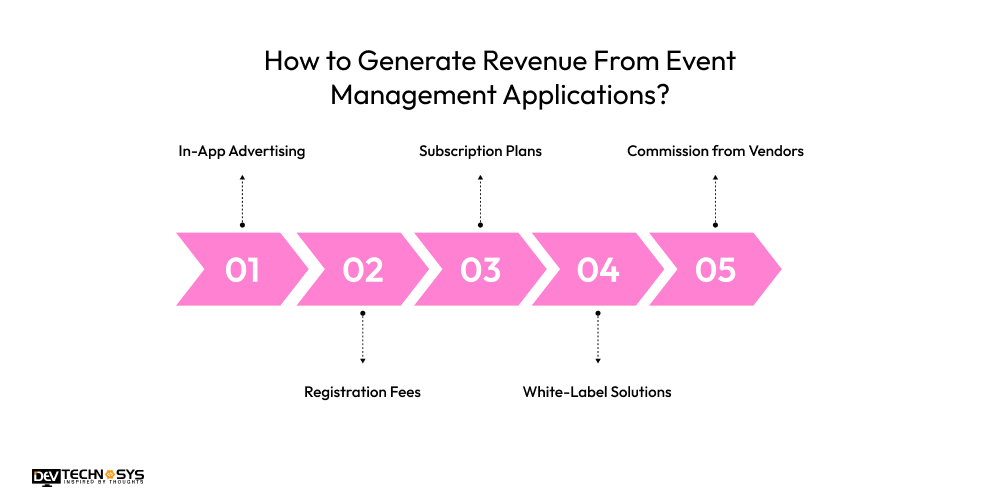
How to Generate Revenue From Event Management Applications?
Now the time has come for every entrepreneur is wait after the development. Yes, making money from their own digital platform. But most entrepreneurs don’t know where to or how to start. So, here we provide the robust monetization techniques:
1. In-App Advertising
The event booking apps can display ads within the app of sponsors, third-party agencies, and exhibitors. The advertising has different formats such as banner, native, image, pop-up windows, display, and many more. So, it can be a steady revenue source and increase the overall app’s valuation.
2. Registration Fees
If users register or book an event through event management apps, then they need to pay a small percentage of booking fees. Means each transaction done through the app can charge fees of around 3% to 5% of the total amount of payment. It is mainly a direct revenue-generating method with full transparency.
3. Subscription Plans
The event scheduling applications offer subscription plans for event organizations to access the full potential of the app. It involves various types of subscription plans such as basic, premium, and enterprise. Users need to purchase a premium or enterprise on a yearly or monthly basis. They access the networking tools, analytics dashboards, and virtual event capabilities.
4. White-Label Solutions
Businesses can offer their app as a white label platform to other event organizers to brand it their own. They can charge maintenance fees, setup fees, licensing fees, and more to generate revenue from those event organizations. So, it can be another best option for businesses to make huge profits from their app.
5. Commission from Vendors
In this last monetization method, you can charge a commission from the event vendors and exhibitors. It means you can convert your app into a marketplace where every event organizer can sell their services or products, and you can charge an acceptable commission on each sale.

Conclusion
Yes, it’s time for final remarks. We hope that you got the answers that were raised from the beginning of this blog. Develop an event management app can take various steps such as market analysis, resource planning, integrating features, choosing technologies, and more. It is one of the lucrative opportunities to invest in event management app development and increase online visibility.
Still one last question? Where to build an event management app? Simply connect with a best event management app development company to get affordable solutions with custom features.
Frequently Asked Questions
1. How Much Does it Cost to Develop an Event Management App?
The cost to build an event management app lies between $8,000 and $25,000, depending on project requirements. It can fluctuate due to various factors such as features, project size, backend infrastructure, security measurements, tech stacks, third-party integrations, and more.
2. How Long Does it Take to Create an Event Management App?
To create an event management app with basic functionalities, it takes around 2 to 4 months, and with advanced functionalities, it takes around 3 to 6 months. The total development time mainly depends on the project complexity, the number of features, the complex design, and more.
3. What Challenges are Faced During Event Management App Development?
There are various challenges are occur during the mobile event management app development process:
- High traffic loads
- Data security and privacy
- Offline functionality
- Third-party integrations
- Higher development cost
4. Which Technologies are Used to Make an Event Management App?
We provide the list of technologies that are required in custom event management app development for startups and enterprises:
- Java
- Python
- C++
- .NET
- PHP
- Swift
5. How to Reduce the Event Management App Development Cost?
To reduce the cost of end-to-end event app development services, here is the list:
- Define clear requirements
- Use open-source frameworks
- Outsource development
- Develop an MVP
- Use built-in templates & plugins