





Key takeaways:
- The average construction management software development cost ranges from $20,000 to $75,000+, depending on software complexity, features, platform selection, integrations, security requirements, technology stack, and scalability needs.
-
Cost based on development complexity:
- Basic Construction Management Software ($20,000–$35,000): Core features like project planning, task management, scheduling, dashboards, and document sharing.
- Advanced Construction Management Software ($55,000–$75,000+): BIM integration, AI analytics, IoT-enabled monitoring, ERP integration, advanced security, and real-time insights.
-
Development timeline based on complexity:
- Basic platforms: 2–4 months for essential construction workflows.
- Mid-level platforms: 4–6 months with integrations and automation.
- Advanced platforms: 6–8+ months for enterprise-grade features and scalability.
-
Business size-wise construction software development cost:
- Small construction businesses ($20,000–$35,000): Basic project tracking, scheduling, document sharing, and reporting.
- Mid-sized construction companies ($35,000–$55,000): Mobile apps, analytics, workflow automation, and integrations.
- Large construction enterprises ($55,000–$75,000+): BIM integration, AI capabilities, ERP connectivity, advanced security, and real-time analytics.
Managing construction projects involves coordinating teams, tracking resources, monitoring budgets, and maintaining accurate documentation across multiple project stages. As construction workflows become more complex, companies are adopting digital platforms to improve project visibility and operational efficiency. However, understanding the construction management software development cost is essential before investing in a custom solution.
The cost to develop construction management software varies based on several factors, including feature complexity, platform selection, third-party integrations, security requirements, and technology stack. A basic project tracking system may require a smaller investment, while an enterprise-grade platform with BIM integration, AI capabilities, and real-time analytics demands a higher budget.
This construction management software development cost guide explains pricing factors, essential features, development phases, technology requirements, security considerations, and hidden expenses to help businesses estimate the investment required for building a scalable construction management platform in 2026.
What is Construction Management Software?
Construction management software is a digital platform designed to help construction companies manage projects, teams, resources, and documentation from a single system. It replaces manual spreadsheets and disconnected tools with a centralized solution for better project visibility and control.
These platforms support essential workflows such as project planning, project scheduling, task management, milestone tracking, budgeting, and team collaboration. Construction teams can monitor progress, share documents, assign tasks, and make faster decisions using real-time project data.
Modern construction management software can also include advanced capabilities like BIM integration, mobile access, reporting dashboards, and automated workflows. From small contractors to large infrastructure project management firms, businesses use these solutions to improve coordination, reduce delays, and manage complex construction operations more efficiently.
Industry Insight
According to Fortune Business Insights, the global construction management software market was valued at $11.72 billion in 2025 and is projected to reach $28.05 billion by 2034, growing at a CAGR of 10.18%.
Construction Management Software Development Cost in 2026
The average construction management software development cost depends on factors such as software complexity, required features, integrations, security requirements, and customization needs. A basic platform with essential project management tools requires a lower investment, while advanced solutions with BIM integration, AI capabilities, and enterprise workflows require a higher budget.
Generally, the construction management system cost ranges from $20,000 to $75,000+, with development timelines starting from 2 months and extending beyond 8 months depending on the project scope. The final construction project management software cost depends on business requirements, technology choices, and the level of customization required to support daily construction operations.
Software Type |
Estimated Development Cost |
Development Timeline |
Key Features |
| Basic Construction Management Software | $20,000 – $35,000 | 2 – 4 months | Project planning, task management, project scheduling, dashboards, document sharing |
| Medium-Level Construction Management Software | $35,000 – $55,000 | 4 – 6 months | Mobile app, milestone tracking, reporting, team collaboration, API integration, workflow automation |
| Advanced Construction Management Software | $55,000 – $75,000+ | 6 – 8+ months | BIM integration, AI analytics, IoT-enabled monitoring, ERP integration, advanced security, real-time insights |
Construction Management Software Development Cost Breakdown by Features
The overall investment required for a construction management platform depends heavily on the features and functionalities included. Basic tools need fewer development resources, while advanced capabilities like BIM integration, AI automation, and real-time analytics increase complexity and budget requirements.
Feature |
Estimated Cost Impact |
Purpose |
| User Management & Role-Based Access | Low–Medium | Controls access for admins, contractors, managers, and field workers |
| Project Dashboard | Medium | Provides real-time project visibility and performance tracking |
| Task Management | Medium | Helps assign, monitor, and complete project activities |
| Project Scheduling & Gantt Charts | Medium | Manages timelines, milestones, and project progress |
| Document Management | Medium | Stores drawings, contracts, and construction documents securely |
| Budget & Cost Tracking | Medium–High | Tracks expenses, estimates, and financial performance |
| Mobile Construction App | High | Allows field teams to access project data remotely |
| BIM Integration | High | Connects 3D models with construction workflows |
| AI Analytics & Automation | High | Enables forecasting, reporting, and workflow optimization |
Factors Affecting Construction Management Software Development Cost
The overall construction software development cost depends on multiple factors, including software complexity, required features, integrations, security needs, and technology choices. Each factor influences the development effort, timeline, and final investment required for building a scalable platform.
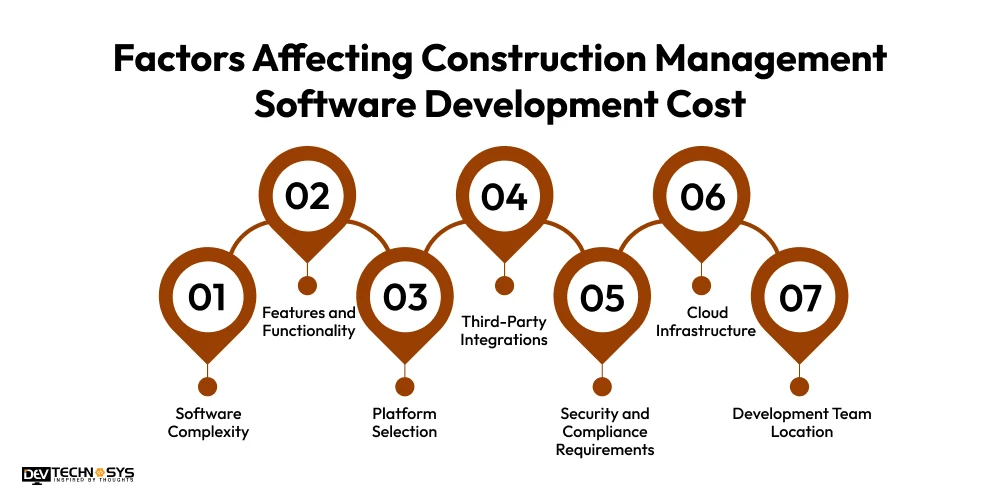
1. Software Complexity
The complexity of the platform directly impacts the development budget. A basic project tracking tool requires fewer resources, while enterprise solutions with advanced workflows, automation, analytics, and multiple user roles need more development time and technical expertise.
2. Features and Functionality
The number and type of features significantly affect the custom construction software cost. Core features like task management and scheduling require less effort, while advanced capabilities such as AI analytics, BIM integration, and real-time monitoring increase development requirements.
3. Platform Selection
Building a web-based construction management system, a mobile construction app, or both affects pricing. Multiple platforms require additional development, testing, and maintenance efforts. Cross-platform solutions can help reduce expenses while supporting wider user accessibility.

4. Third-Party Integrations
Integrations with external systems like ERP, accounting tools, payroll platforms, and CRM solutions add development complexity. Businesses that require Construction CRM integration need additional API connections to improve customer management, project tracking, and operational workflows.
5. Security and Compliance Requirements
Construction platforms often handle sensitive project documents, financial information, and employee data. Implementing role-based access control, multi-factor authentication, data encryption, and compliance standards increases development efforts but improves platform reliability.
6. Cloud Infrastructure
Cloud-based construction software requires proper infrastructure planning for storage, performance, and scalability. Selecting cloud services, database architecture, backup systems, and hosting requirements can influence both initial development expenses and long-term operational costs.
7. Development Team Location
The location and expertise of the development team also affect pricing. Teams with specialized experience in construction technology, APIs, cloud platforms, and enterprise software may charge higher rates but can deliver more reliable and scalable solutions.
Industry Insight
According to Software Advice, 48% of construction businesses switch software because of inefficient, manual processes, while 28% switch due to missing functionality such as job costing, change orders, and project tracking.
Construction Management Software Development Cost by Business Size
The investment required for a construction management platform varies based on business size, project complexity, number of users, and operational requirements. Small contractors may need basic tools, while larger companies require scalable solutions with advanced features and integrations.
Small construction businesses usually focus on essential features that improve daily operations and project visibility. Mid-sized companies often require automation, integrations, and better collaboration tools to manage multiple projects.
Large enterprises typically need a complete construction management software development solution with advanced workflows, data security, and scalable architecture to support complex infrastructure projects and multiple stakeholders.
Business Size |
Estimated Development Cost |
Suitable For |
Features |
| Small Construction Businesses | $20,000 – $35,000 | Contractors and small teams | Task management, project scheduling, document sharing, basic reporting |
| Mid-Sized Construction Companies | $35,000 – $55,000 | Growing construction firms | Mobile app, API integration, analytics, workflow automation, team collaboration |
| Large Construction Enterprises | $55,000 – $75,000+ | Large-scale projects and infrastructure firms | BIM integration, AI capabilities, ERP integration, advanced security, real-time analytics |
Construction Management Software Development Cost by Development Phase
The total investment for a construction software platform is divided across multiple development stages. Each phase, from planning and design to development and maintenance, contributes to the overall construction software development cost and determines the quality, scalability, and performance of the final solution.
The development phase usually requires the largest portion of the budget because it involves building core functionalities, integrations, and custom workflows. Businesses planning a detailed custom software development cost should consider both initial development expenses and ongoing maintenance requirements.
Development Phase |
Estimated Cost Percentage |
Activities |
| Discovery & Planning | 10–15% | Requirement analysis, project scope definition, feature planning, and technical strategy |
| UI/UX Design | 10–15% | Wireframes, prototypes, user interface design, and user experience planning |
| Development | 40–50% | Frontend, backend, database setup, API integration, and feature development |
| Testing & Quality Assurance | 10–15% | Functional testing, performance testing, security checks, and bug fixing |
| Deployment | 5–10% | Cloud configuration, software launch, environment setup, and final deployment |
| Maintenance & Updates | 15–20% annually | Security updates, feature improvements, performance optimization, and scaling |
Essential Features of Construction Management Software
The features included in a construction management platform determine its ability to handle project workflows, improve collaboration, and support business operations. Basic features help manage daily activities, while advanced capabilities enable automation, real-time tracking, and better decision-making.
Feature |
Purpose |
| Project Dashboard | Provides a centralized view of project progress, deadlines, budgets, and performance |
| Task Management | Helps teams assign tasks, monitor completion, and improve accountability |
| Project Scheduling & Gantt Charts | Supports timeline planning, milestone tracking, and resource coordination |
| Document Management | Stores contracts, drawings, reports, and project files securely |
| Budget & Cost Tracking | Monitors expenses, estimates, and financial performance |
| Team Collaboration | Improves communication between contractors, managers, and field teams |
| Mobile Construction App | Allows on-site teams to access and update project data remotely |
| BIM Integration | Connects 3D models with construction planning workflows similar to Construction Management Software Like BIM 360 |
| Reporting & Analytics | Provides real-time insights through reports and performance metrics |
| AI-Powered Automation | Enables predictive analysis, smart scheduling, and workflow optimization |
Latest Technology Stack Used in Construction Management Software
The technology stack plays an important role in determining the scalability, security, and performance of a construction platform. Businesses choosing construction management software development services need the right combination of cloud infrastructure, APIs, databases, and modern development frameworks to build reliable solutions.
Technology Category |
Common Technologies |
| Frontend Development | React.js, Angular, Vue.js |
| Mobile App Development | Flutter, React Native, Swift, Kotlin |
| Backend Development | Node.js, Python, Java, .NET |
| Database | PostgreSQL, MySQL, MongoDB, Redis |
| Cloud Platforms | AWS, Microsoft Azure, Google Cloud |
| API Integration | REST API, GraphQL API, Webhooks |
| BIM & 3D Integration | Autodesk APIs, BIM platforms, Digital Twin technologies |
| AI & Automation | Machine Learning, Predictive Analytics, AI-based scheduling |
| IoT Integration | RFID tracking, IoT-enabled monitoring, sensor data processing |
Hidden Costs of Construction Management Software Development
The initial development budget does not cover every expense involved in building and maintaining a construction platform. Additional costs related to infrastructure, integrations, security, updates, and ongoing support can influence the overall construction software pricing over time.
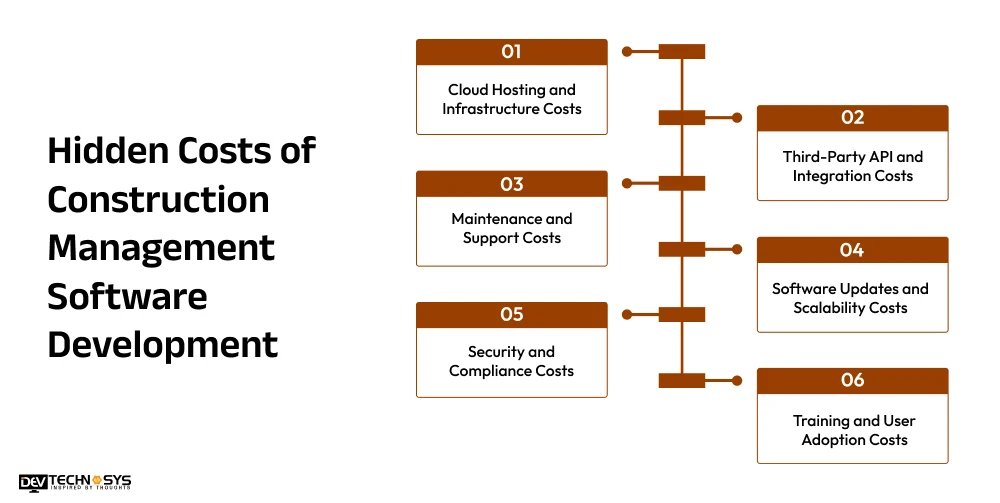
1. Cloud Hosting and Infrastructure Costs
Cloud infrastructure is an ongoing expense that depends on storage requirements, user traffic, database size, and scalability needs. Services like AWS, Google Cloud, and Microsoft Azure may increase costs as the platform grows and requires additional resources.
2. Third-Party API and Integration Costs
Connecting external systems such as ERP, payroll, accounting software, and other business tools may require paid APIs or additional development efforts. These integrations improve functionality but can increase the overall custom construction software cost.
3. Maintenance and Support Costs
Regular maintenance is required to keep the platform secure, updated, and reliable. Expenses may include bug fixes, security patches, performance optimization, technical support, and feature improvements. Understanding the benefits of construction management software development helps businesses evaluate the long-term value of these ongoing investments.
4. Software Updates and Scalability Costs
As construction companies expand, they may need additional users, features, storage, or advanced workflows. Updating the architecture and adding new capabilities can create additional expenses beyond the initial development phase.
5. Security and Compliance Costs
Security improvements such as vulnerability testing, audits, data protection measures, and compliance requirements like GDPR, ISO 27001, and SOC 2 may require additional investment to protect sensitive construction data.
6. Training and User Adoption Costs
Employee training, onboarding resources, documentation, and support materials are often overlooked expenses. Proper training helps teams adopt the platform effectively and improves the overall return from the software investment.
How to Reduce Construction Management Software Development Cost
Businesses can optimize their software investment by making strategic decisions during the planning and development stages. Reducing unnecessary complexity, selecting the right features, and using scalable technologies can help control expenses without affecting the platform’s performance or future growth.
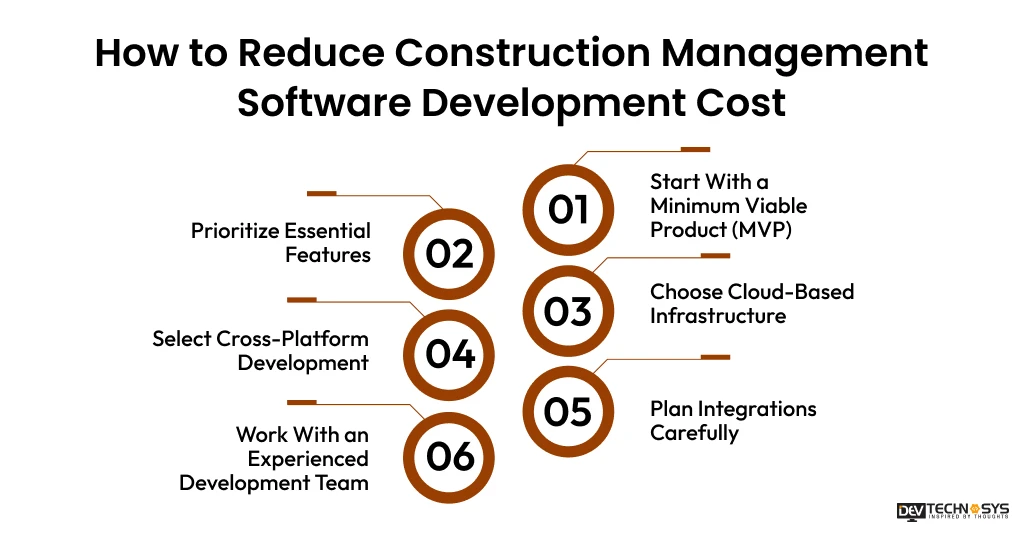
1. Start With a Minimum Viable Product (MVP)
Developing an MVP allows businesses to launch essential functionalities before investing in advanced features. Core modules such as project scheduling, task management, document sharing, and reporting can be tested first, reducing initial development risks and unnecessary expenses.
2. Prioritize Essential Features
Including every possible feature in the first version can increase development costs. Businesses should focus on high-value features that solve immediate operational challenges and add advanced capabilities like AI automation, IoT monitoring, or advanced analytics later.
3. Choose Cloud-Based Infrastructure
Using cloud platforms helps reduce hardware and infrastructure expenses. Cloud-based construction software allows businesses to scale resources based on usage, improve accessibility, and avoid large upfront investments in servers and maintenance.
4. Select Cross-Platform Development
Cross-platform frameworks like Flutter and React Native can reduce development expenses by enabling applications to run across multiple platforms with a single codebase. This approach also simplifies future updates and maintenance.
5. Plan Integrations Carefully
Third-party integrations can improve functionality but may increase costs. Businesses should identify essential connections such as ERP, payroll, or accounting systems and avoid unnecessary integrations during the initial development phase.
6. Work With an Experienced Development Team
Partnering with professionals offering custom software development services helps businesses avoid costly technical mistakes, choose the right architecture, and build scalable solutions within their planned budget.
Industry Insight
According to Dedale Intelligence, the biggest challenges in adopting construction management software are integration with existing systems, implementation costs, and employee resistance, highlighting why scalable and customizable software solutions are increasingly important.
Security and Compliance Considerations in Construction Management Software
Security is a critical requirement for modern construction platforms because they manage sensitive project documents, financial records, employee information, and operational data. Implementing strong security measures helps businesses protect information, reduce risks, and maintain trust among project stakeholders.
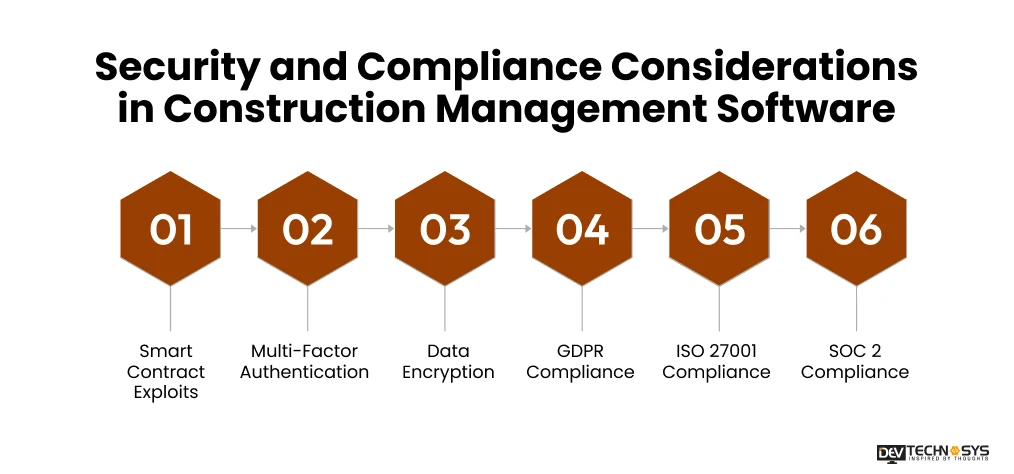
1. Role-Based Access Control
Role-based access control allows businesses to manage user permissions based on their responsibilities. Project managers, contractors, administrators, and workers can access only the information required for their roles, reducing unauthorized data exposure.
2. Multi-Factor Authentication
Multi-factor authentication adds an additional security layer by requiring users to verify their identity through multiple methods. This helps prevent unauthorized access even if login credentials are compromised.

3. Data Encryption
Data encryption protects sensitive information during storage and transfer. Secure databases, encrypted communication channels, and protected file storage help safeguard project documents, financial details, and confidential business data.
4. GDPR Compliance
GDPR compliance ensures that construction companies follow proper data protection practices when handling personal information. It helps businesses maintain transparency, improve privacy controls, and meet international data security requirements.
5. ISO 27001 Compliance
ISO 27001 provides a structured framework for managing information security risks. Following these standards helps organizations establish strong security processes, improve data management, and build confidence among clients and partners.
6. SOC 2 Compliance
SOC 2 compliance focuses on security, availability, confidentiality, and data management practices. It ensures that software platforms maintain reliable controls for protecting sensitive business information
Cloud-Based vs On-Premise Construction Management Software
Businesses can choose between cloud-based and on-premise construction management solutions based on their budget, security requirements, scalability needs, and operational goals. The deployment model affects infrastructure costs, accessibility, maintenance efforts, and the long-term flexibility of the platform.
Factor |
Cloud-Based Construction Software |
On-Premise Construction Software |
| Initial Cost | Lower upfront investment with subscription-based pricing and reduced infrastructure requirements | Higher initial cost due to hardware, servers, and setup expenses |
| Scalability | Easily scalable based on users, projects, and storage requirements | Requires additional hardware and resources for expansion |
| Maintenance | Cloud providers manage updates, backups, and infrastructure maintenance | Requires internal IT teams for updates, monitoring, and maintenance |
| Accessibility | Accessible remotely through web and mobile platforms from any location | Usually limited to company-controlled infrastructure |
| Security | Includes secure cloud hosting, encryption, monitoring, and backup solutions | Security depends on internal systems and IT capabilities |
| Best For | Growing businesses needing flexibility and remote collaboration | Enterprises requiring complete control over infrastructure |
Cloud-based construction software is becoming popular among businesses that need faster deployment, remote access, and easier scalability. On-premise solutions can still be suitable for organizations with strict data control requirements or existing IT infrastructure. Many businesses also consider hybrid approaches to combine the flexibility of cloud systems with internal security preferences.
Construction Management Software Development Process
Developing a construction management platform requires a structured approach to ensure better functionality, scalability, and user experience. Each stage, from requirement analysis to deployment and maintenance, helps create a reliable solution that supports complex construction workflows and business operations.
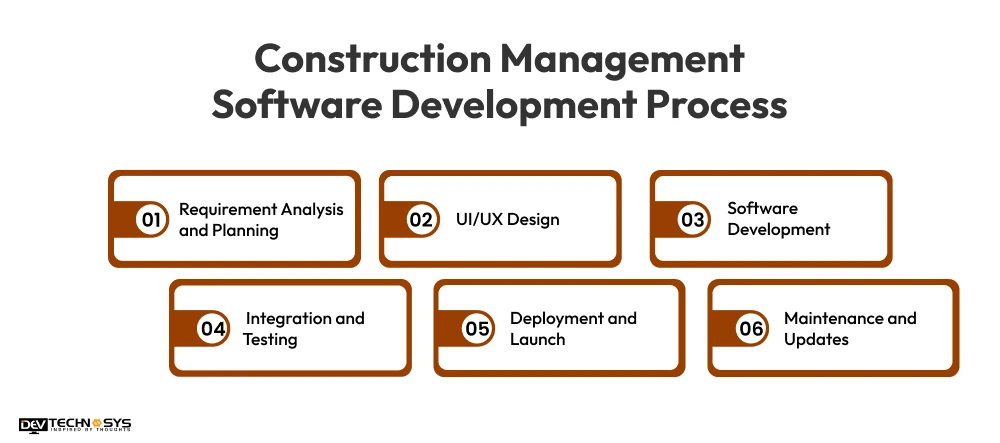
1. Requirement Analysis and Planning
The first stage focuses on understanding business goals, user roles, project workflows, and required features. Developers analyze operational challenges, define technical requirements, plan integrations, and create a roadmap for building the software.
2. UI/UX Design
The design phase focuses on creating intuitive interfaces for project managers, contractors, and field workers. Wireframes and prototypes are developed to ensure easy navigation, efficient workflows, and better accessibility across web and mobile platforms.
3. Software Development
During development, frontend and backend systems are built with the required functionalities. Developers create databases, APIs, dashboards, and features such as task management, project scheduling, reporting, and third-party integrations.
4. Integration and Testing
The platform is connected with external systems such as ERP, CRM, and accounting tools. Quality assurance teams perform functional testing, performance testing, security checks, and usability testing to ensure smooth operation.
5. Deployment and Launch
After successful testing, the software is deployed on the selected infrastructure. Cloud configuration, database setup, security settings, and user access controls are finalized before launching the platform.
6. Maintenance and Updates
Post-launch maintenance ensures long-term performance through security updates, feature improvements, bug fixes, and scalability enhancements. Regular monitoring helps businesses adapt the platform as project requirements evolve.
Conclusion
The overall investment for building a construction management platform depends on features, technology choices, integrations, security requirements, and scalability needs. The construction management software development cost generally ranges from $20,000 to $75,000+, with development timelines between 2 months and 8+ months based on complexity.
Businesses should focus on creating a scalable solution that supports project planning, scheduling, collaboration, and real-time operations. Working with an experienced construction management software development company can help organizations build secure, flexible, and future-ready platforms that align with their operational goals.
FAQs About Construction Management Software Development Cost
Q1. How Much Does It Cost to Develop Construction Management Software?
The cost depends on features, complexity, integrations, technology stack, and customization requirements. A basic platform may start around $20,000, while advanced solutions with BIM integration, AI features, mobile apps, and enterprise capabilities can reach $75,000 or more.
Q2. How Long Does It Take to Build Construction Management Software?
The development timeline depends on the project scope and required features. A simple construction management platform may take around 2 to 4 months, while complex solutions with advanced integrations and automation can require 8+ months.
Q3. What Features Should Construction Management Software Include?
A modern construction platform should include project planning, task management, scheduling, Gantt charts, document management, milestone tracking, reporting dashboards, mobile access, and integrations with tools like ERP, payroll, and accounting systems.
Q4. Is Custom Construction Management Software Better Than Ready-made Solutions?
Custom software provides flexibility to match specific business workflows, improve scalability, and integrate existing systems. Ready-made solutions may offer faster deployment, but they often include limitations in customization, features, and long-term adaptability.
Q5. What Technologies Are Used to Build Construction Management Software?
Developers use technologies such as React.js, Flutter, Node.js, cloud platforms, databases, APIs, and advanced systems like AI, IoT, and BIM integration. These technologies help create scalable, secure, and efficient construction management platforms.
Q6. Can Construction Management Software Integrate With Existing Business Systems?
Yes, construction management software can integrate with existing systems through APIs, including ERP, CRM, payroll, accounting, and project collaboration tools. These integrations help businesses centralize data, improve workflow efficiency, and reduce manual processes across construction operations.