





Key takeaways:
- Define your niche and content strategy before starting development.
- Build scalable streaming infrastructure with CDN, adaptive streaming, and cloud technology.
- Protect content and user data with DRM, encryption, and secure authentication.
- Choose the right monetization model based on audience and content strategy.
- Video streaming app development can cost $25,000–$90,000+, depending on scope and features.
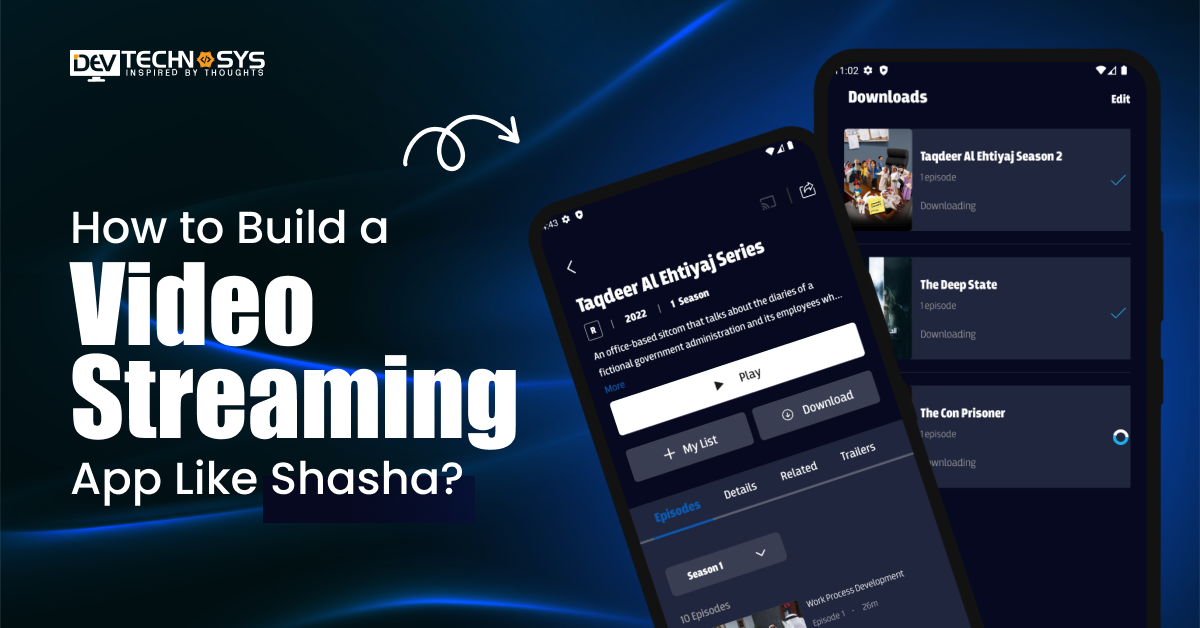
A strong cultural and storytelling value is not enough to ensure that regional and independent films reach wider audiences. Shasha showed how a targeted streaming platform can help the cinema industry move towards the audiences in the region by offering something more appealing and more focused. This presents some fascinating possibilities for businesses that want to build a video streaming app like Shasha for a particular audience, language, region, or content type.
Launching such a platform involves far more than developing a mobile video player. Requirements for the product include a secure payments system, user accounts, analytics, scalable cloud infrastructure, a reliable video streaming architecture, a content management system, adaptive streaming, and integration with a CDN. Localization may also affect the user experience, especially for Arabic content, subtitles, multiple languages, and RTL interfaces.
This guide discusses the development process, important features, tech stack, security measures, monetization options, cost of development, and timeline of making a Shasha-inspired streaming platform.
What Is Shasha?
Shasha is a streaming platform focused on independent films from the Middle East and North Africa (MENA), helping regional cinema reach audiences beyond traditional distribution channels. Its positioning centers on curated films and culturally relevant content, including productions in Arabic, Farsi, Turkish, and Kurdish with English subtitles.
For businesses planning to build a video streaming app like Shasha, this focused content identity can be an important differentiator. Instead of competing through a massive catalog, a similar platform can specialize in regional content, curation, language support, and audience experience.
How Does a Shasha-Like Video Streaming App Work?
A Shasha-inspired platform connects multiple systems behind the viewer-facing application:
Content acquisition → CMS → video encoding → cloud storage → CDN → DRM → video player → analytics
Content is uploaded through a content management system, encoded into suitable formats, and stored securely in cloud infrastructure. CDN integration then helps deliver video efficiently based on viewer location and network conditions.
When users select a film, the platform verifies access, delivers the appropriate stream, and uses adaptive bitrate technology to maintain playback quality as bandwidth changes. DRM and encryption help protect licensed content, while analytics monitor viewing behavior, playback performance, and engagement.
Answer a few quick questions and our experts will share a tailored project estimate.
Why Build a Video Streaming App Like Shasha in 2026?
A Shasha-inspired streaming platform can target a clear content niche instead of competing directly with global services that depend on massive entertainment catalogs. The opportunity becomes stronger as streaming infrastructure and audience demand continue expanding across regional markets.
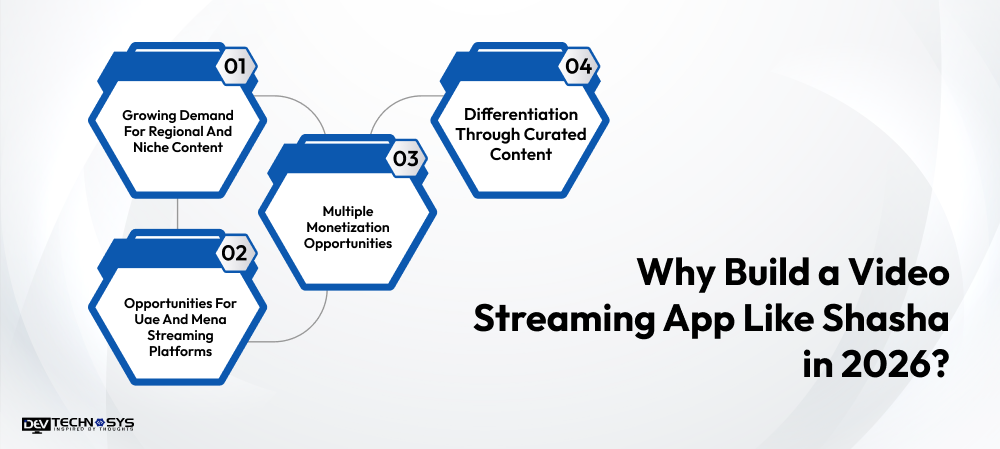
1. Growing Demand For Regional And Niche Content
Market Research Future estimates that the global video streaming software market will grow from $20.03 billion in 2026 to $76.18 billion by 2035, representing a 16.0% CAGR. The report also estimates that video-on-demand accounted for 69.0% of the market in 2025, highlighting the continued importance of on-demand content libraries.
For businesses looking to develop a video streaming app like Shasha, this creates room for focused platforms built around regional cinema, independent films, documentaries, language-specific content, or other underserved categories.
2. Opportunities For Uae And Mena Streaming Platforms
The same report projects the Middle East and Africa video streaming software market to grow at an 18.4% CAGR through 2035. This growth supports opportunities for platforms that understand local viewing preferences, Arabic content, multilingual subtitles, RTL interfaces, regional payment methods, and content rights.
3. Multiple Monetization Opportunities
A Shasha alternative can combine subscription plans, rentals, advertising, premium releases, or strategic content partnerships. The right model depends on audience size, catalog value, and licensing economics.
4. Differentiation Through Curated Content
The strongest advantage is specialization. A focused video streaming platform development strategy can build loyalty through curated collections, regional storytelling, personalized discovery, and a viewing experience designed around a specific audience.
The 5-Step Process to Build a Video Streaming App Like Shasha
To create a video streaming app like Shasha requires more than developing a mobile application. The content strategy, streaming architecture, user experience, security, and post-launch operations should be planned together to create a reliable platform.
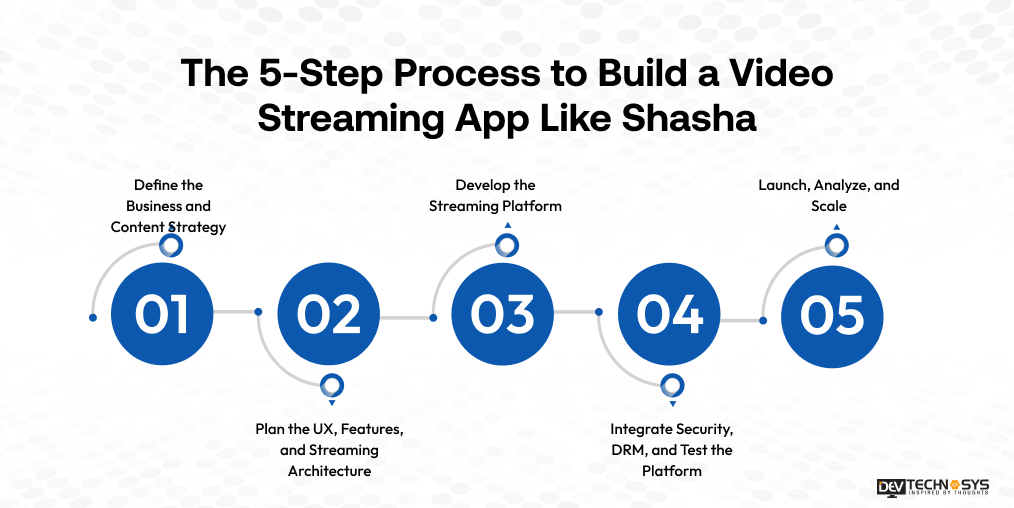
Step 1: Define the Business and Content Strategy
Start by identifying your target audience, content niche, geographic markets, and distribution rights. Decide whether the platform will focus on independent films, regional cinema, documentaries, or another specialized category. Content licensing should be evaluated before development because geographic rights and distribution terms can directly affect platform functionality.
Step 2: Plan the UX, Features, and Streaming Architecture
Map the complete viewer journey from registration and content discovery to playback, payment, and account management. Create wireframes and prototypes for the mobile, web, or TV experience before development begins.
At the same time, plan the video streaming app architecture, including the backend, content management system, video processing pipeline, cloud storage, CDN, authentication, analytics, and playback infrastructure. Arabic language support, subtitles, RTL interfaces, and regional discovery should also be considered where relevant.
Step 3: Develop the Streaming Platform
Once the product architecture is finalized, development can begin across the selected platforms. The team builds the user application, backend APIs, CMS, user management, subscription workflows, payment integration, and video delivery components.
Working with experienced video streaming app development services can help connect these components into a scalable platform rather than treating the streaming player as an isolated feature. Video encoding, cloud storage, CDN integration, and analytics should be integrated into the core platform during development.
Step 4: Integrate Security, DRM, and Test the Platform
Streaming platforms need protection for both user information and licensed content. Integrate DRM technologies, encryption, secure authentication, authorization controls, and protected APIs before launch.
Testing should cover playback across devices, different network conditions, adaptive bitrate switching, subscription flows, payment processing, content access rules, and system performance. Load testing is particularly important because traffic spikes can affect streaming quality and backend reliability.
Step 5: Launch, Analyze, and Scale
After testing, deploy the platform and monitor real-world performance. Track viewing duration, content completion, search behavior, subscription conversions, churn, playback failures, CDN performance, and audience engagement.
AI can then support personalized recommendations, content discovery, and audience insights through approaches covered in AI in video streaming app strategies. Use these insights to improve the catalog, refine recommendations, optimize the user experience, and prioritize future features.
Must-Have Features of a Video Streaming App Like Shasha
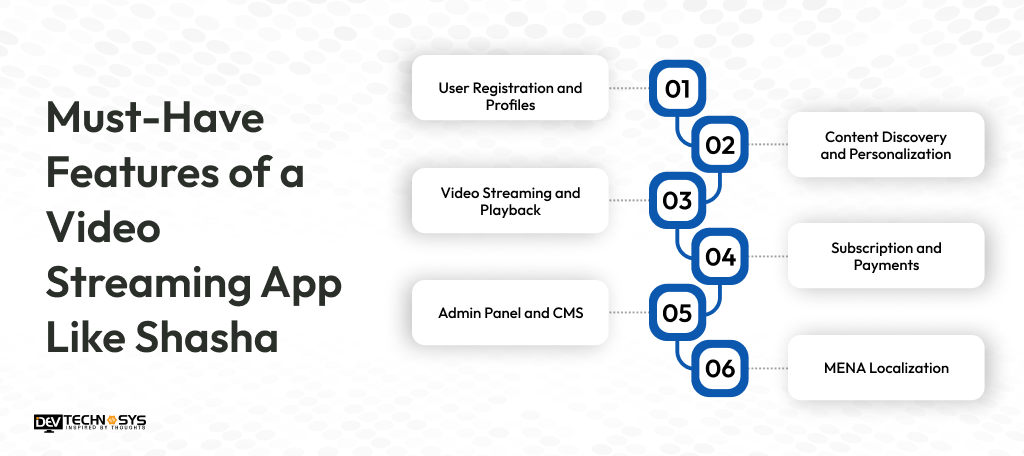
The right features should support effortless content discovery, reliable playback, secure subscriptions, and efficient content management. For a Shasha-inspired platform, localization and curated regional content can further strengthen the viewing experience.
1. User Registration and Profiles
Provide secure sign-up and login through email, phone, or social authentication. User profiles can store preferences, watch history, watchlists, and continue-watching progress. Multiple profiles can also help households maintain separate viewing preferences.
2. Content Discovery and Personalization
A strong video content library needs intuitive search, genres, categories, language filters, curated collections, and personalized recommendations. Featured releases and region-specific collections can help users discover relevant films without navigating an overwhelming catalog.
3. Video Streaming and Playback
The core experience should support adaptive bitrate streaming, multiple video resolutions, subtitles, captions, and multiple language tracks. HLS or MPEG-DASH can help deliver content across supported devices and network conditions. Offline viewing can also be considered for selected content where licensing permits.
For platforms supporting live video streaming, the architecture should additionally account for low-latency delivery, real-time monitoring, and higher infrastructure demands.
4. Subscription and Payments
Users should be able to view available plans, subscribe, renew, upgrade, or cancel their memberships. Secure payment gateways, recurring billing, invoices, promotional offers, and transaction history can simplify subscription management while improving revenue operations.
5. Admin Panel and CMS
A centralized CMS allows administrators to upload videos, manage metadata, organize categories, schedule releases, manage subtitles, and control content availability. The admin panel should also provide user management, subscription controls, content-rights tracking, and performance analytics.
6. MENA Localization
For a Shasha-focused audience, localization can become a major differentiator. Support for Arabic and English, RTL interfaces, multilingual subtitles, regional categories, and locally relevant content discovery can make the platform more accessible to MENA viewers.
Technology Stack to Build a Video Streaming App Like Shasha
The technology stack determines how reliably your platform can process, protect, deliver, and analyze video content. A scalable video streaming technology stack should balance playback quality, device compatibility, infrastructure cost, and future growth.
| Layer | Recommended technologies | Purpose |
| Mobile | Flutter, React Native, Kotlin, Swift | Build responsive Android and iOS streaming apps |
| Web | React, Next.js | Create fast, scalable web streaming interfaces |
| Backend | Node.js, Python, Java | Handle APIs, users, subscriptions, and business logic |
| Database | PostgreSQL, MongoDB | Store user, content, subscription, and platform data |
| Cloud | AWS, Azure, Google Cloud | Provide scalable cloud streaming infrastructure |
| Video delivery | HLS, MPEG-DASH | Enable adaptive video streaming across devices |
| CDN | CloudFront, Cloudflare | Deliver video content efficiently to viewers |
| Storage | Amazon S3, cloud storage | Store video files and media assets securely |
| DRM | Widevine, FairPlay, PlayReady | Protect licensed video content from unauthorized access |
| Payments | Stripe, regional payment gateways | Process subscriptions and digital payments securely |
| Analytics | GA4, Mixpanel, custom analytics | Track viewing behavior, engagement, and conversions |
1. Mobile and Web Development
Flutter or React Native can support cross-platform applications, while Kotlin and Swift provide native options for Android and iOS. Businesses requiring platform-specific performance can invest in dedicated Android app development alongside iOS development. React or Next.js can power a responsive web streaming experience.
2. Backend, Cloud and Streaming Infrastructure
Node.js, Python, or Java can support APIs, authentication, subscriptions, content management, and analytics. PostgreSQL or MongoDB can manage application data, while AWS, Azure, or Google Cloud provide scalable cloud streaming infrastructure.
The video streaming app architecture should use HLS or MPEG-DASH for adaptive delivery, with CDN integration through providers such as CloudFront or Cloudflare. A video streaming server, cloud storage, and video content delivery network work together to deliver streams efficiently across locations and network conditions.
3. Video Codecs and DRM
H.264 remains widely compatible across devices, while H.265/HEVC can provide better compression at suitable quality levels. AV1 can improve compression efficiency but requires careful consideration of device and browser support.
Widevine, FairPlay, and PlayReady can provide DRM protection across major platforms. The final selection should reflect supported devices, licensing requirements, bandwidth targets, and infrastructure costs.
Because this architecture combines application development with specialized video infrastructure, businesses may hire dedicated developer resources with experience in streaming, cloud, backend, and mobile technologies.
Security, DRM and Compliance for a Shasha-Like Video Streaming App
A streaming platform must protect two critical assets: user data and licensed video content. Security should therefore be designed into the architecture from development rather than added after launch.
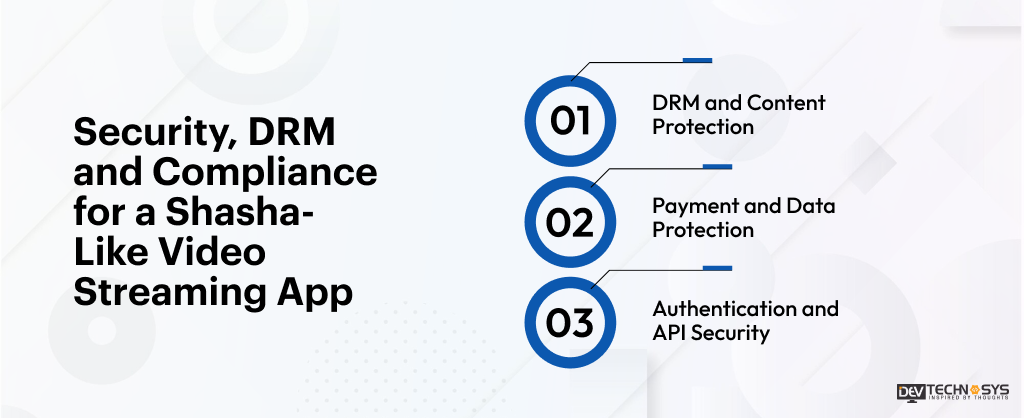
1. DRM and Content Protection
Digital rights management (DRM) helps prevent unauthorized access, copying, and redistribution of protected video content. Widevine, FairPlay, and PlayReady can support different devices and operating systems, while encryption protects video during storage and delivery.
Businesses planning to build a video streaming app like TOD can also consider how established streaming platforms combine content protection with controlled playback and access management. Geographic rights should be enforced where licensing agreements restrict content availability by region.
2. Payment and Data Protection
Subscription platforms should use established payment gateways and tokenization to minimize direct handling of sensitive card information. PCI-DSS requirements should be considered when payment workflows fall within their scope. Content licensing, user privacy, secure APIs, DRM, and continuous vulnerability testing together create a stronger security foundation for a Shasha-like streaming platform.
For privacy, the platform should evaluate applicable data privacy compliance requirements such as GDPR, CCPA, CPRA, VPPA, or COPPA based on its audience, markets, and data practices. These regulations should not be treated as universal checkboxes. Proper consent management, data minimization, retention controls, access management, and privacy policies should align with the platform’s actual operations.
3. Authentication and API Security
OAuth 2.0, JWT-based authentication, and role-based access control (RBAC) can protect user accounts and administrative functions. APIs should use secure communication, input validation, rate limiting, monitoring, and appropriate authorization controls to reduce common attack risks.
An experienced mobile app development company should also include security testing across the mobile application, backend, APIs, CMS, and connected third-party services.
How Does a Video Streaming App Like Shasha Make Money?
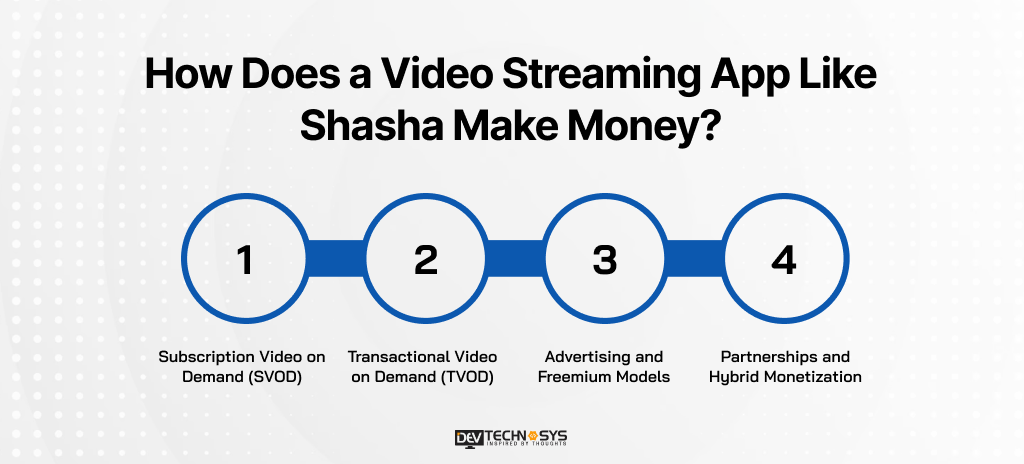
A Shasha-inspired platform can combine recurring subscriptions with rentals, advertising, and strategic partnerships. The right model depends on its audience, content catalog, licensing costs, and willingness to pay.
1. Subscription Video on Demand (SVOD)
Subscriptions can provide predictable recurring revenue through monthly or annual plans. A platform can offer access to its full catalog, premium collections, or different tiers based on features and content availability. For an app like Shasha, curated regional content can become the main reason users maintain a subscription.
2. Transactional Video on Demand (TVOD)
TVOD allows viewers to rent or purchase individual films without committing to a long-term subscription. This model can work well for independent releases, festival films, premieres, or premium titles with strong individual demand.
3. Advertising and Freemium Models
An advertising-supported model can provide free access to selected content while generating revenue through video or display advertisements. A freemium approach can combine a limited free catalog with premium subscription access. However, advertising becomes more effective when the platform has sufficient audience scale.
4. Partnerships and Hybrid Monetization
Telecom operators, film festivals, media companies, and content distributors can create additional revenue opportunities through bundled subscriptions or strategic partnerships. A hybrid approach can reduce dependence on one revenue source while helping the video-on-demand platform reach new audiences.
How Much Does It Cost to Build a Video Streaming App Like Shasha?
The Shasha app development cost depends on the platform scope, number of supported devices, streaming infrastructure, security requirements, integrations, and level of customization. For a Shasha-inspired product, a practical development estimate can be divided into three levels.
| Development level | Estimated cost | Key inclusions |
| Basic MVP | $25,000–$40,000 | User accounts, content library, video playback, basic CMS, subscriptions, payments, and essential analytics |
| Mid-level platform | $40,000–$65,000 | Advanced CMS, DRM, multilingual support, recommendations, multiple platforms, enhanced analytics, and stronger security |
| Advanced platform | $65,000–$90,000+ | Multi-platform streaming, scalable cloud infrastructure, advanced personalization, enterprise security, extensive analytics, and complex integrations |
What affects Shasha app development cost?
A basic MVP may include user accounts, content discovery, video playback, subscriptions, CMS functionality, and essential analytics. A mid-level platform can add advanced recommendations, multilingual support, stronger DRM, multiple platforms, and more sophisticated administration tools. An advanced custom video streaming app may require broader device support, scalable cloud infrastructure, advanced personalization, extensive analytics, and enterprise-level security.
Businesses can review the broader video streaming app development cost factors to understand how features, platforms, third-party integrations, infrastructure, and development expertise influence the final estimate.
Development cost vs content licensing
One important distinction is that Shasha app development costs do not automatically include content acquisition. Film licensing, distribution rights, royalties, subtitles, content preparation, CDN usage, cloud storage, and ongoing content operations can create additional expenses.
After launch, ongoing costs also need to be considered. Security updates, bug fixes, infrastructure optimization, new device support, feature improvements, and platform updates contribute to the overall mobile app maintenance cost.
Therefore, the actual investment should be calculated as development plus infrastructure, content rights, and ongoing operational expenses rather than relying on the initial development estimate alone.

How Long Does It Take to Build a Video Streaming App Like Shasha?
The time required to develop a video streaming app like Shasha depends on its features, supported platforms, streaming infrastructure, integrations, and development team size. A typical Shasha-inspired platform can take approximately 4–8 months from planning to launch.
Businesses planning to create a video streaming app like Shasha should therefore define the MVP scope early to maintain a predictable development timeline.
| Development stage | Estimated time | Main activities |
| Discovery and planning | 2–3 weeks | Business requirements, audience research, content strategy, feature scope, and technical planning |
| UI/UX design | 3–5 weeks | User flows, wireframes, visual design, player experience, and responsive layouts |
| Core development | 8–14 weeks | Mobile/web apps, backend, APIs, CMS, accounts, subscriptions, and payments |
| Streaming infrastructure | 3–6 weeks | Video processing, cloud storage, CDN, adaptive streaming, and DRM integration |
| Testing and security | 3–4 weeks | Functional testing, device compatibility, playback testing, security checks, and load testing |
| Deployment | 1–2 weeks | Production setup, app-store submission, monitoring, analytics, and launch configuration |
How to Choose a Video Streaming App Development Company?
Choosing the right partner for Shasha app development requires more than checking general mobile development experience. The company should understand the technical and operational requirements of a complete streaming ecosystem.
Look for a video streaming app development company with proven experience in:
- OTT and streaming: Experience building VOD platforms, streaming players, and content management systems.
- Streaming infrastructure: Strong knowledge of cloud platforms, CDN integration, adaptive bitrate streaming, and video processing.
- Security and DRM: Experience with encryption, authentication, access controls, and DRM technologies such as Widevine, FairPlay, and PlayReady.
- Localization: Ability to support Arabic, multilingual content, RTL interfaces, and regional payment requirements.
- Scalability: Architecture designed to handle growing users, content catalogs, devices, and concurrent streams.
- Post-launch support: Ongoing monitoring, maintenance, security updates, performance optimization, and feature improvements.
Review relevant case studies, technical capabilities, development methodology, communication practices, and long-term support before selecting a partner. A strong team should also be able to explain how its architecture decisions affect performance, security, scalability, and overall development cost.
Conclusion
Building a video streaming platform inspired by Shasha requires more than developing a feature-rich video player. Success depends on combining a focused content strategy with reliable streaming architecture, scalable cloud infrastructure, CDN integration, DRM protection, secure payments, and localized user experiences.
Businesses planning to build a video streaming app like Shasha should also consider content licensing, compliance requirements, monetization, and long-term scalability before development begins. The overall investment and timeline will vary based on platform scope, integrations, streaming requirements, and personalization needs.
With the right technical expertise, including access to hire mobile app developers in Dubai, businesses can develop a secure, scalable streaming product that is built for long-term growth.
Frequently Asked Questions
Q1. How Much Does It Cost To Build A Video Streaming App Like Shasha?
The cost typically ranges from $25,000 to $90,000+, depending on platform complexity, features, streaming infrastructure, DRM, integrations, localization, and personalization. Advanced platforms with multiple apps, scalable cloud infrastructure, and sophisticated content management can require a larger development investment.
Q2. How Long Does It Take To Develop A Shasha-Like Streaming App?
A Shasha-like streaming platform generally takes around 4 to 8 months to develop. The timeline depends on the number of platforms, streaming architecture, UI complexity, integrations, security requirements, content management capabilities, testing scope, and development team size.
Q3.What Features Should A Shasha-Like Video Streaming App Have?
Essential features include user registration, profiles, content discovery, search, watchlists, personalized recommendations, adaptive video playback, subtitles, multilingual support, subscriptions, secure payments, content management, analytics, and DRM. Arabic and RTL support can also improve accessibility for MENA audiences.
Q4. What Technology Is Required For Video Streaming App Development?
A typical technology stack can include Flutter or React Native for mobile development, Node.js, Python, or Java for backend services, PostgreSQL or MongoDB for data, AWS or Azure for cloud infrastructure, HLS or MPEG-DASH for streaming, and CDN services for content delivery.
Q5. How Can A Video Streaming App Protect Copyrighted Content?
Copyrighted content can be protected through DRM technologies such as Widevine, FairPlay, and PlayReady, combined with encrypted streaming, secure authentication, access controls, tokenized playback URLs, geographic restrictions, monitoring, and proper licensing agreements for the content distributed through the platform.
Q6. How Can I Monetize A Video Streaming App Like Shasha?
A video streaming app can generate revenue through subscription plans, pay-per-view rentals, advertising, freemium access, or hybrid models. The best approach depends on the target audience, content licensing costs, catalog value, viewing behavior, and willingness to pay.