





Key Takeaways:
-
- AI integrates multiple technologies, such as Machine Learning (ML), Natural Language Processing (NLP), etc., to offer precise content recommendations.
- Also, AI technologies like AI-Enhanced Encoding and Dynamic Bitrate Adaptation (DBA) offer quality in video streaming, according to network conditions.
- A number of examples that successfully use Artificial Intelligence to streamline video content delivery.
- Along with so many perks, there are certain challenges that occur during the integration of AI in streaming apps.
The digital landscape of 2025 has taken a surprising turn with the use of Artificial Intelligence in almost every sector. Even the role of AI in video streaming apps is clearly evident and extremely massive. Basically, AI is not just a background feature, but has become a core engine in today’s digital world.
The rise of AI-driven personalization in video streaming (2025 Trends) brings quality in content and user engagement. It is used widely in platforms like Netflix, YouTube, Amazon Prime, and many others, as the market is studded with unlimited content.
In a nutshell, Artificial Intelligence in video streaming apps is essential as it serves the user exactly what they want. With AI integration, users can watch any series, video, movie, documentary, etc., without any interruption. This revolution has made simple movie recommendations an effortless, intuitive, and personal experience.
Market Stats Of AI In Media and Entertainment Industry
The market research of Grand View Research states that:
- In 2024, the market size of AI in media and entertainment industry was valued at USD 25.98 billion globally.
- It is expected to grow at a CAGR of 24.2% from 2025 to 2030 and reach USD 99.48 billion by 2030.
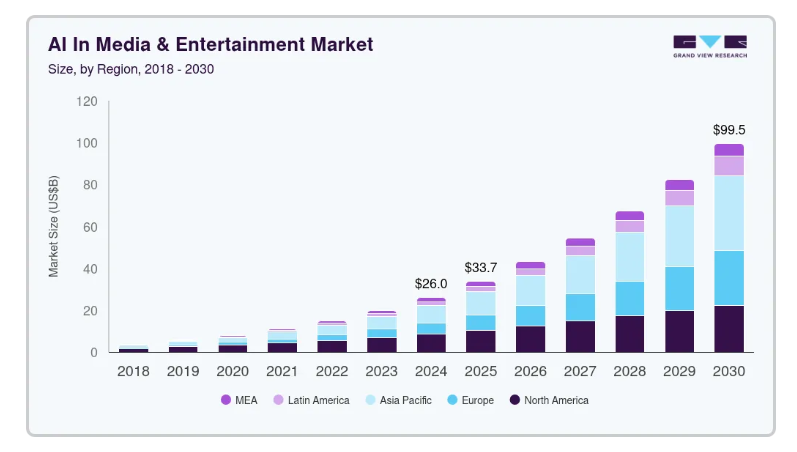
- 33.6% of the overall revenue of global AI in the media & entertainment market is dominated by North America in 2024.
- In 2024, the content creation, video streaming, and other services of AI in the entertainment sector earn the largest market share, accounting for 60.2%.
What is the Role of AI in Video Streaming in 2026?
In 2025, AI is working as a helping hand, which has transformed the future of video streaming apps. This has not only revolutionized the user experience but has become a business model in every major app. Let us have a look at some of the important features that elaborately define the role of Artificial Intelligence in video streaming:
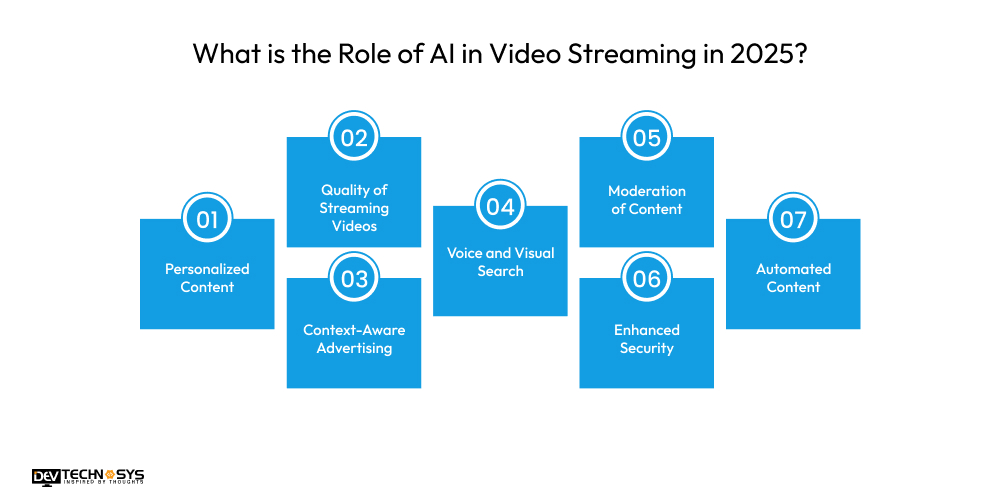
1. Personalized Content
AI-powered video recommendation is common in almost every video streaming app, whether providing content for Sunday or romantic content on Valentine’s Day. It keeps a check on your pauses and rewinds, and also offers suggestions according to your watch history. When build video streaming app like Jio Cinema using AI improves user retention and makes them feel “it is made for me.”
2. Quality of Streaming Videos
Imagine you are watching an intense scene, and suddenly your wifi stops working and the video starts buffering. This kills the excitement and breaks the intensity of the scene. But AI for video quality optimization adjusts the video quality as per the network availability. So, no breaks and buffering during an emotional, dramatic, or horror scene on a fluctuating network.
3. Context-Aware Advertising
Sometimes ads in between your video streaming become a headache and shatter the consistency. But if ads are based on the content you are watching, it will be a great monetization model that doesn’t irritate the viewers. For example, dishwashing or utensil ads while watching a cooking video. When ads become relevant, ad engagement and platform revenue increase.

4. Voice and Visual Search
You are doing some work and your hands are busy, voice search to play a video will help you out. For this, AI technologies, such as NLP and Speech Recognition, are used primarily that work on your voice. Similarly, if you want to stream the particular video that is on your reel, you can upload a screenshot of an actor or a scene.
5. Moderation of Content
As billions of videos get uploaded and streamed every minute, the moderation of the content is difficult for a human. That’s why smart video analytics are used to detect copyrighted, violent, or pornographic content. If businesses build a video streaming app like Aha generate a safer and more enjoyable experience for users and also protect the reputation of AI-powered video platforms.
6. Enhanced Security
Another major work of AI-powered content delivery is to defend against piracy and detect fraud. For improving security, AI works on anomaly detection by checking login patterns, device usage, and stream activities of the user. Also, it uses anti-piracy tools to spot when and where content is streamed and downloaded illegally.
7. Automated Content
Sometimes, you don’t recognize or recall the name of a movie, show, or even actor. In this scenario, AI video search and discovery use NLP that delivers actual content according to tags, objects, scenes, and dialogue. This enables smart searches and custom mixed recommendations to find and deliver exactly what the user is asking for.
Which Streaming Platforms Are Using AI in 2026?
Netflix, YouTube, Disney+, Amazon Prime Video, and Twitch are examples of AI streaming platforms. They are known for their quality and hyper-personalized recommendations. Let us learn about these top video streaming apps in detail.
1. YouTube
YouTube is the most popular video-sharing platform on which a large number of people rely. It uses AI for content moderation, which removes harmful and copyrighted content automatically. Its AI recommendation engines are important for encouraging what to watch next by boosting viewers’ watch time.
2. Amazon Prime Video
Amazon Prime Video is a video streaming app that uses AI to give personal suggestions based on the viewers’ watching habits. Like other apps, the impact of AI on OTT business models like Amazon Prime Video is enhancing user engagement and retention by offering them a tailored viewing experience.
visit: How To Build A Video Streaming App for Middle East Audience?
3. Twitch
Twitch is a livestreaming platform where you will get content related to gaming, entertainment, sports, music, etc. It is widely known for adaptive streaming with AI, in which spam and offensive messages get filtered immediately. You will get a safe, engaging, and seamless experience during live streaming.
4. Netflix
Netflix is one of the most famous AI-driven streaming solutions. It analyzes watching patterns, time, location, and speed of the user, and presents content accordingly. It adjusts video quality dynamically so that bandwidth maintains its efficiency. It also uses advanced algorithms to improve user experience.
5. Disney+
Disney+ is another app competing in the AI video streaming market trends 2025. It employs AI to generate customized homepages for users with their favorite content, such as Marvel or Star Wars content. This platform also uses predictive analytics to examine which shows or videos are worth investing in.
Best Cases To Use AI in Video Streaming Apps
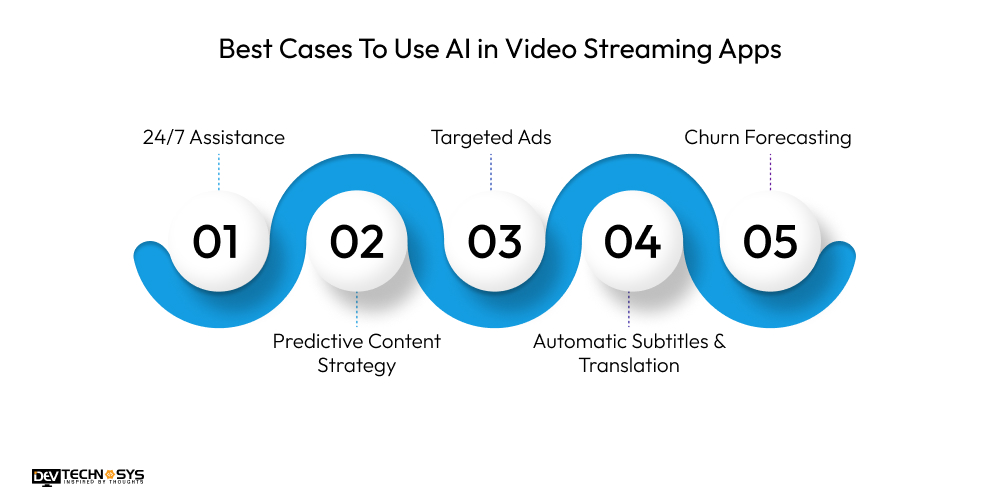
The utilization of AI in streaming platforms is guided by specific and highly impactful use cases. These can be used to boost user engagement and efficiency in operations. Here are some of the best cases to use AI in video streaming apps.
1. 24/7 Assistance
A 24/7 support from the AI video streaming app to the users through chatbots is really important. These chatbots use Natural Language Processing (NLP) to give quick and effective solutions to the problems. It is a round-the-clock customer support system that answers users’ queries, whether it is about content or billing.
2. Predictive Content Strategy
AI in OTT app development is also useful because it predicts the ongoing and upcoming demand of the users. It also provides guidance on which shows or movies to produce next to boost user retention. It also helps in providing strategies for commissioning decisions and optimizing ROI of AI in media streaming.
3. Targeted Ads
AI takes the user profile and real-time watching information to run targeted ads while video streaming. This helps it deliver highly personalized ads as per the content the user is watching. This maximizes the revenue from the ads running on the app while diminishing the disturbance caused by ads.
4. Automatic Subtitles & Translation
The use of Artificial Intelligence in video streaming apps also generates subtitles and dubs in foreign languages immediately with maximum accuracy. It makes the content accessible to be watched in various regions of the world. This is a rapid and cost-effective way to localize the content to be viewed everywhere.
5. Churn Forecasting
AI uses Machine learning in OTT apps, which helps to identify and track the viewing patterns of the user. It supports finding customers who are at risk of canceling their subscription anytime. So, AI activates personalized offers to retain such customers and to save the app from customer loss.
AI-Powered Technologies Used In Making Video Streaming Apps
AI-powered technologies, such as Machine Learning, Generative AI, predictive analytics, and so on, are used to build a video streaming apps. Let us learn about these technologies in brief:
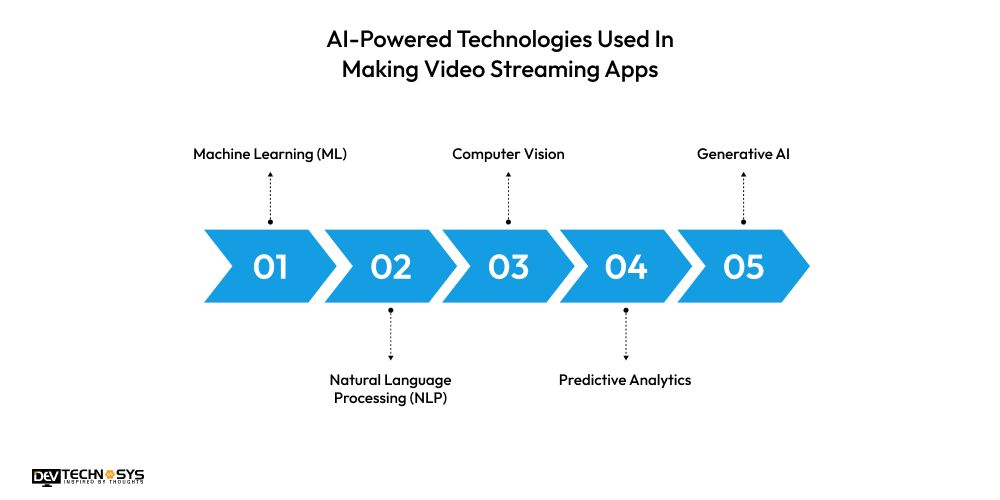
1. Machine Learning (ML)
Machine learning for video streaming apps is used to examine the watching behavior and habits of the users. It provides recommendations for personalized content and also analyzes current viewing trends. It also allows the app to make smarter and data-driven decisions to expand viewer satisfaction and retention.
2. Natural Language Processing (NLP)
Due to NPL, a video streaming app can enable accurate and instant subtitles, content categorization, and voice searches. It also includes dubbing and 24/7 virtual assistance. It encourages user intent and improves accessibility while developing strong engagement among audiences throughout the world.

3. Computer Vision
Computer Vision organizes video content efficiently by detecting scenes, objects, and faces to tag. It even optimizes visuals of the video in real time by supporting stream quality improvement AI. With this, users can have a high-quality viewing experience on multiple devices in different network conditions.
4. Predictive Analytics
By its name, it is clear that predictive analytics helps anticipate upcoming releases and viewers’ choices. It also optimizes the placement of ads in the video. It is among the most essential AI-powered technologies. It offers amazing business and revenue-generating strategies by enhancing user retention.
5. Generative AI
Generative AI transformed video streaming app development completely by creating new content. This content includes artificial voices for low-cost dubbing and personalized trailers. It upgrades user engagement by reducing manual editing work. It stands out because it helps the business grow beyond what traditional video streaming can do.
Why Businesses are Integrating AI in Video Streaming Apps?
Integrating Artificial Intelligence in video streaming apps is not just an option but a necessity to be upgraded with time and technology. So, here is detailed information on why businesses are turning towards adding AI in streaming apps.
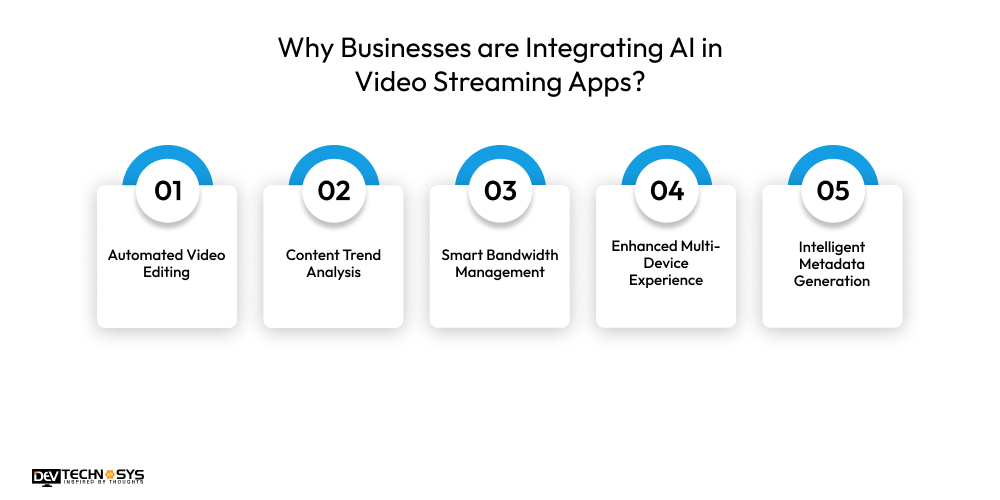
1. Automated Video Editing
AI saves time and operational cost by trimming, cropping, and editing videos by itself. It allows the streaming platforms to give and maintain good-quality content, that too, without human exertion. It makes videos faster with ease and efficiency for businesses as well as content creators.
2. Content Trend Analysis
AI evaluates the behavior of the users and the trend going on to find out the most viral topic to make content. With this, streaming apps not only create but also promote content that is popular currently. It keeps platforms appropriate and makes sure users always get to see trending and engaging videos.
3. Smart Bandwidth Management
AI smartly manages bandwidth by estimating when there is high traffic and controls network resources with productivity. This confirms that the video streams effortlessly. It also terminates buffering even in peak hours. It offers a reliable experience to users and optimizes the infrastructural costs for platforms.
4. Enhanced Multi-Device Experience
AI helps in adapting video playback according to different devices, screen sizes, and resolutions automatically. Whether users are watching videos on a phone, tablet, or smart TV, they get consistent, high-quality streaming. This also enhances customer satisfaction and makes the platform accessible everywhere.
5. Intelligent Metadata Generation
AI develops a comprehensive metadata for videos, including scenes, actors, and keywords. This streamlined content licensing and distribution with rights management globally. It also helps streaming platforms organize libraries efficiently while maximizing revenue opportunities across regions and markets.
Significant Challenges of Integrating AI In Video Streaming App
Here, we will study some challenges that you might have to face while integrating AI in video streaming apps.
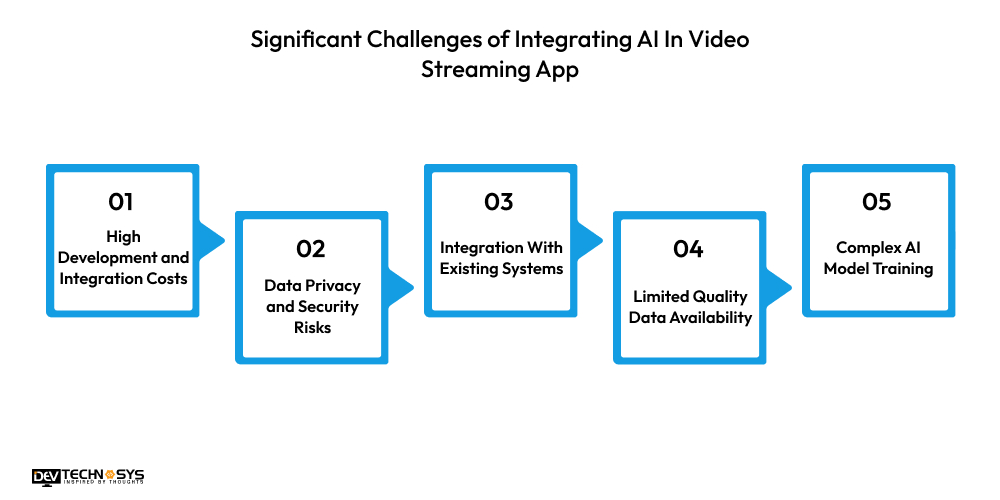
1. High Development and Integration Costs
Adding advanced AI video recommendation systems in a video streaming app demands strong infrastructure, advanced tools, and expert developers. Even though all the workings are managed by a mobile app development company, the overall setup becomes expensive for businesses with a small budget.
2. Data Privacy and Security Risks
The AI-powered personalization in streaming apps relies on assembling a large amount of data from users. Sometimes, this becomes an issue for safety and compliance. However, streaming apps should ensure secure data handling. Also, they have to build user trust while utilizing personalized tools that are AI-driven.
3. Integration With Existing Systems
The seamless and adaptable integration of the latest AI tools with the existing platforms decides the future of AI in streaming. There might be chances of compatibility issues, outdated APIs, and system limitations. These challenges make it difficult to implement modern AI solutions effortlessly in the old platforms.
4. Limited Quality Data Availability
To implement AI adoption by streaming service providers, you must have different, structured, and unbiased data. If the quality of the data is poor, it limits the ability of the system to offer recommendations accurately. This will lead to lowering the effectiveness of machine learning algorithms.
5. Complex AI Model Training
An Android app development company also works on complex AI model training. AI models development requires constant upgrades, testing, and optimization. Training these models requires substantial computing power, time, and professional data scientists. This can slow down the development and performance of the app.

Conclusion
After learning so much about Artificial Intelligence in video streaming apps, it is clear that this is a massive spectrum. We can honestly state that AI is remodeling the future of entertainment and media. Users take video streaming optimization using AI for terminating buffering and getting personalized content.
In comparison, businesses are investing in video streaming app development services with AI to earn revenue and gain a competitive edge. Last but not least, it is evident that the use of AI in streaming is a necessity to capture the audience globally.
FAQs
Q1. How Do AI Algorithms Improve Streaming Quality?
AI improves the quality of a video by adjusting the video compression according to the internet speed and availability. This makes sure you get quality video with clear pixels and fewer interruptions.
Q2. Can AI Help Reduce Buffering In Video Apps?
Yes, AI helps reduce buffering by predicting network issues and increasing pre-loading of the video. It modifies the quality of the video and removes the frustration caused by such interruptions.
Q3. How Does AI Enhance Personalization In Streaming Platforms?
As AI examines your history and habits of watching videos, it offers you movies and shows based on your taste.
Q4. Why 2025 Will Be The Year Of AI In OTT Platforms?
2025 will be the year of AI in OTT platforms because it is being used extensively and efficiently. AI helps in target advertising for the target audience and customer retention. It also suggests new and popular content that a platform must create.
Q5. How to Use AI To Optimize Video Streaming Quality?
AI reduces video file size without losing quality and automatically adjusts the bitrate for smooth streaming, even when the internet speed changes.
Q6. How AI Personalization Works In Streaming Apps?
By analyzing users’ video-watching behavior and comparing it with others, it personalizes the video streaming.