





Key Takeaways:
-
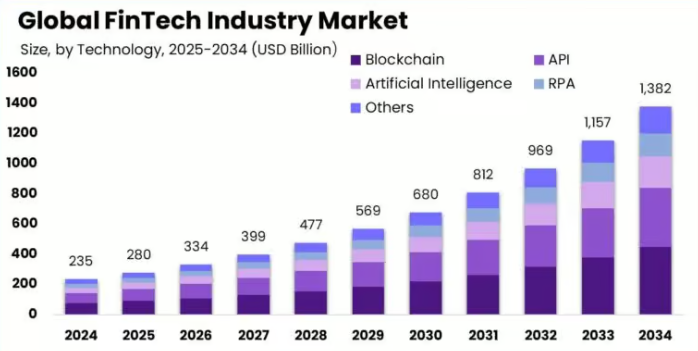
- In 2034, the global fintech app market is expected to surpass USD 1,382 billion, driven by digital banking adoption, rising mobile payments, and financial inclusion initiatives.
- Fintech leaders like Paytm and Cash App thrive due to seamless onboarding, secure transactions, and tailored financial services that meet user needs.
- The cost to develop a fintech app ranges from $8,000 to $25,000, depending on complexity, compliance integration, and real-time data handling capabilities.
- Core features include secure login, KYC verification, bank account linking, real-time transactions, budgeting tools, and push notifications for financial updates and alerts.
In today’s fast-moving digital world, managing money has become easier thanks to financial technology, or fintech.
From mobile wallets to investing apps, fintech is changing how we handle our finances.
But have you ever wondered how these amazing apps are created?
In this guide, we will take you through the exciting steps to develop a fintech app, from idea to launch!
We find it fascinating how apps can solve real-life problems. Building a fintech app isn’t just about coding; it involves smart planning, security, user-friendly design, and following important rules.
Whether you dream of creating an app like Paytm or a personal budgeting tool, this article will give you a basic but clear roadmap to get started.
So, let’s dive in and discover how you can turn your fintech idea into a reality!
Market Analysis of Fintech Applications
- The size of the global fintech industry market is anticipated to increase from USD 6 billion in 2024 to USD 1,382 billion by 2034, with a compound annual growth rate (CAGR) of 19.40% from 2025 to 2034.
- With about 6% of the market share in the FinTech sector, Payments maintained its leading position in 2024.
- In 2024, the Fraud Monitoring category secured a major portion of the FinTech market, accounting for almost 2% of the total.
- In the FinTech sector, banks dominated in 2024, accounting for almost 0% of the market share.
- With more than7% of the market share and USD 93.1 billion in sales, North America led the FinTech sector in 2024.
What is Fintech App?
A fintech app is a web or mobile application that provides financial services including budgeting, investing, payments, and banking using technology. These applications let users handle their money more quickly, easily, and conveniently.
Fintech app like Pyypl integrates finance and technology to streamline routine financial processes and provide safe, real-time solutions for both consumers and organizations, whether they are involved in transmitting money, managing spending, or purchasing stocks.
Success Story: STC Pay
- Launched: October 2018 by Saudi Telecom Company (STC).
- User Base: Grew from 500,000 in 2019 to 5 million by October 2020.
- Services: Offers digital wallet, bill payments, international money transfers, and merchant solutions.
- Investment: Secured $200 million from Western Union in November 2020.
- Valuation: Achieved a valuation of $1.33 billion, earning ‘unicorn’ status.
- Ownership: Western Union acquired a 15% stake in STC Pay.
- Partnerships: Collaborated with Mastercard to launch Bahrain’s first world prepaid card.
- Bahrain Launch: Introduced services in Bahrain, including prepaid cards and utility bill payments.
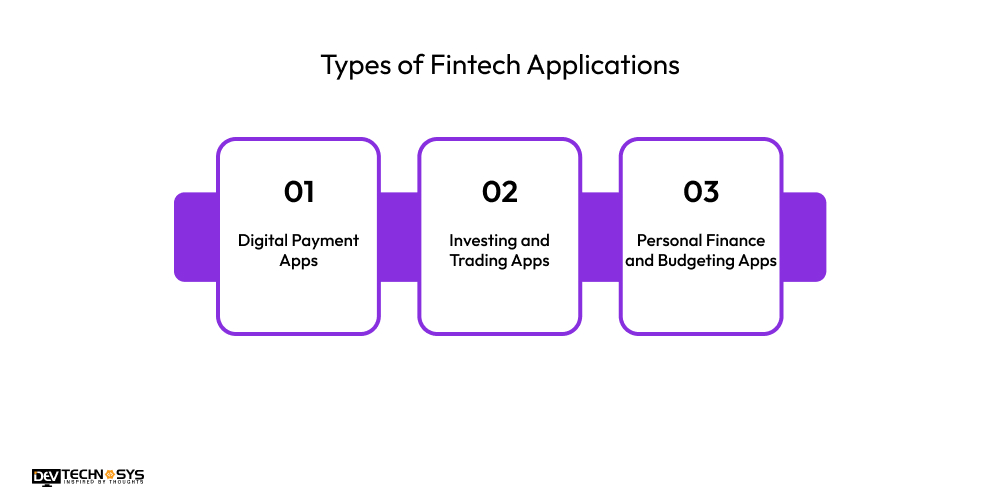
Types of Fintech Applications
Discover the main types of fintech applications transforming finance, digital payments, investment platforms, and personal finance tools, designed to make money management smarter, faster, and more secure.
1. Digital Payment Apps
These applications enable users to transfer and receive money instantaneously using mobile phones. Examples include Google Pay, Paytm, and Venmo. They enable peer-to-peer transfers, bill payments, and QR code scanning. Digital payment applications are popular due to their speed, convenience, and safe transaction capabilities in daily financial transactions.
2. Investing and Trading Apps
With these services, consumers may easily invest in equities, mutual funds, or cryptocurrency. Apps like as Zerodha, Groww, and Robinhood provide real-time data, portfolio tracking, and simple investment features. They make trading more accessible to both novices and pros by charging minimal fees and providing educational tools to help them make decisions.

3. Personal Finance and Budgeting Apps
These applications let users keep track of their costs, create savings goals, and manage their budgets. Examples are Mint and YNAB. They link to bank accounts, classify expenditure, and provide insights into financial patterns. Personal finance applications encourage better money management by helping users stay organized, avoid debt, and achieve their financial objectives faster.
Answer a few quick questions and our experts will share a tailored project estimate.
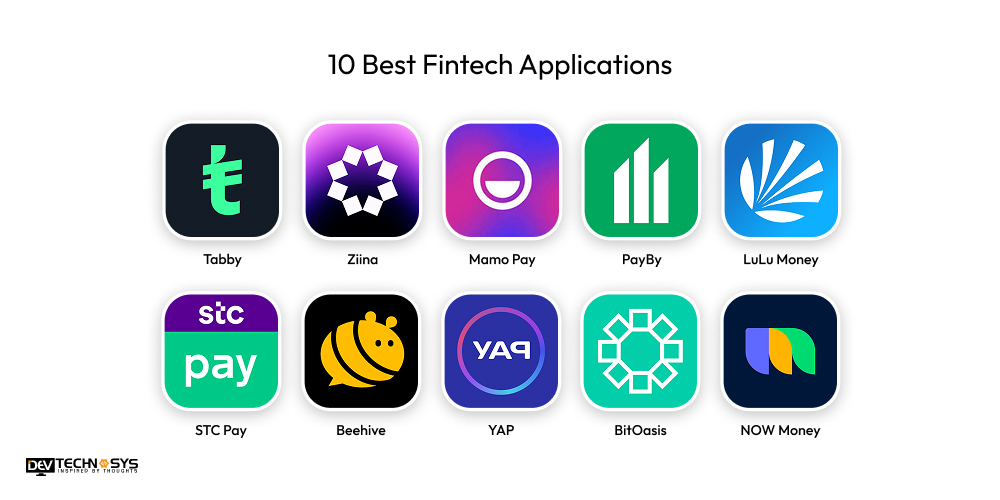
10 Best Fintech Applications
Discover the top fintech apps in Middle East transforming finance worldwide. From seamless payments to smart investing, these top apps simplify money management, enhance security, and offer innovative financial solutions for everyone.
App Name |
Launch Year |
Downloads |
Rating (Approx.) |
Platform Availability |
| Tabby | 2020 | 5M+ | 4.6 | iOS / Android |
| Ziina | 2020 | 1M+ | 4.5 | iOS / Android |
| Mamo Pay | 2019 | 1M+ | 4.5 | iOS / Android |
| PayBy | 2018 | 1M+ | 4.4 | iOS / Android |
| LuLu Money | 2017 | 800K+ | 4.5 | iOS / Android |
| STC Pay | 2018 | 10M+ | 4.2 | iOS / Android |
| Beehive | 2014 | 300K+ | 4.6 | iOS / Android |
| YAP | 2021 | 600K+ | 4.4 | iOS / Android |
| BitOasis | 2015 | 1M+ | 4.5 | iOS / Android |
| NOW Money | 2016 | 500K+ | 4.4 | iOS / Android |
Why Entrepreneurs Want to Invest in Fintech App Development Middle East?
Fintech, or financial technology, is rapidly changing how people manage money, pay bills, and invest. Many entrepreneurs are excited to invest in fintech app development Egypt because it offers huge opportunities and benefits. Here are five key reasons why fintech apps attract entrepreneurs:
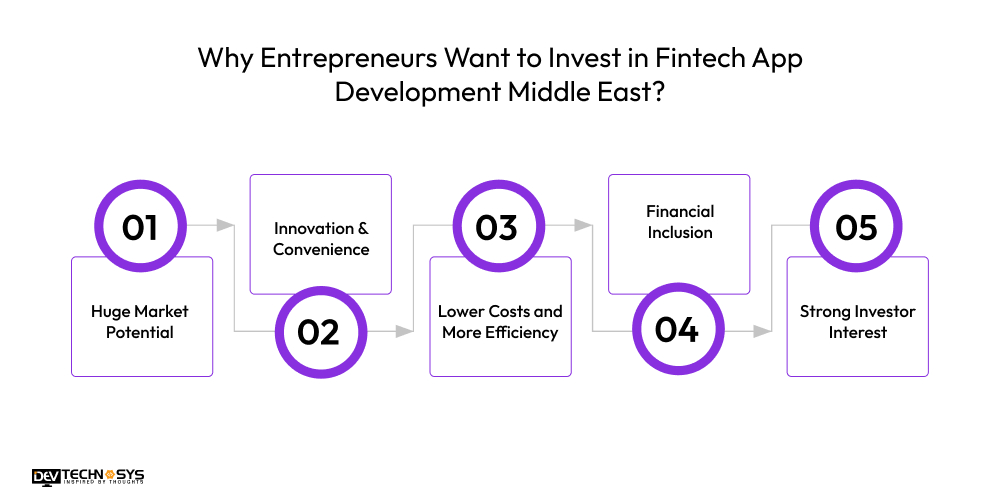
1. Huge Market Potential
The fintech business is expanding rapidly worldwide. More consumers are use cellphones for banking, payments, and investing. Entrepreneurs view this rising need as an opportunity to reach millions of customers and generate significant revenues by providing helpful, simple financial solutions.
2. Innovation & Convenience
Fintech applications make sophisticated financial services quicker and more accessible. Entrepreneurs aim to develop ewallet apps that solve common issues, such as moving money quickly or managing budgets efficiently. Fintech innovation has the potential to improve the lives of consumers while also increasing client loyalty.
3. Lower Costs and More Efficiency
Traditional banks and financial organizations can have expensive fees and sluggish processes. Fintech applications cut expenses by automating operations and relying on technology rather than paperwork and employees. This efficiency attracts entrepreneurs looking to establish scalable enterprises with higher profit margins.
4. Financial Inclusion
Many people, particularly in poor countries, have limited access to financial services. Fintech applications may aid by offering digital wallets, microloans, and cost-effective payment solutions. Entrepreneurs want to invest in fintech app development services because it enables businesses to serve disadvantaged communities while also having a beneficial social impact.
5. Strong Investor Interest
Because fintech is so promising, many investors are eager to support fintech firms. This financial support motivates entrepreneurs, allowing them to produce better goods and expand more swiftly in competitive marketplaces.
6. How AI Can Help Fintech Applications to Perform Their Operations Smoothly?
- AI analyzes large data sets quickly, detecting fraud and unusual activities to protect users and secure transactions effectively.
- It automates customer support with chatbots, providing instant responses and improving user satisfaction without human intervention.
- AI personalizes financial advice by studying user behavior, helping customers make smarter investment and budgeting decisions.
- Machine learning predicts credit risks, allowing fintech apps to approve loans faster while minimizing default rates.
- Role of AI in fintech app development Muscat enhances compliance by monitoring transactions continuously, ensuring adherence to financial regulations and reducing legal risks.
- It optimizes payment processing speed by detecting errors and streamlining workflows, improving the overall user experience.
7 Premium Steps to Develop a Fintech App
Learn how to develop a powerful, secure, and user-friendly fintech app. From idea to launch, discover the key steps to create digital banking, payment, or investment solutions that meet modern financial needs and user expectations. So, here we provide the finance software development process:
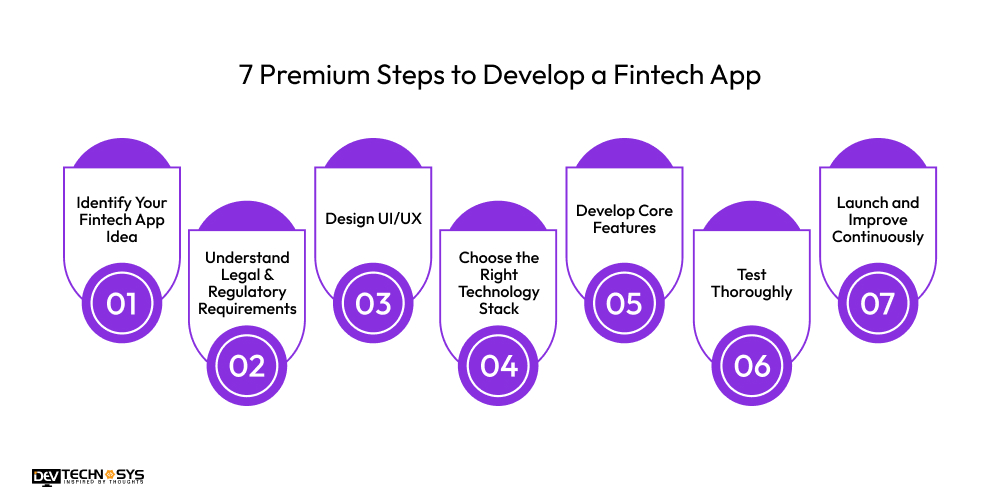
1. Identify Your Fintech App Idea
Start by choosing the type of fintech app you want to build, like payments, investing, or budgeting. Hire dedicated developers in UAE to research your target audience, their needs, and the problems they face. A strong, clear idea will help guide the entire fintech app development UAE process and ensure your app has a unique purpose in the market.
2. Understand Legal & Regulatory Requirements
Fintech apps deal with sensitive financial data, so it’s important to follow laws like KYC (Know Your Customer), AML (Anti-Money Laundering), and data protection rules. Study your country’s financial regulations to avoid legal trouble. Work with legal experts to ensure your app is fully compliant and safe for users to trust.
3. Design UI/UX
A user-friendly design is key to fintech success. Hire mobile app developer in UAE to plan your app’s layout, buttons, and features using simple and attractive visuals. Focus on easy navigation and quick access to key tools. Good UI/UX design builds trust, improves user experience, and keeps people using your app longer.
4. Choose the Right Technology Stack
Hire fintech app developers in Dubai to pick the programming languages, frameworks, and tools needed to build your app. For example, use React Native or Flutter for mobile development, and secure databases for storing information. Your tech stack must support speed, scalability, and security to handle financial data safely and efficiently.
5. Develop Core Features
Hire a prominent fintech app development company in UAE to start building essential features like user registration, bank linking, transactions, budgeting tools, and notifications. Always focus on security, add encryption, multi-factor authentication, and real-time fraud detection. These features must work smoothly and protect users’ money and data at all times.
6. Test Thoroughly
Hire fintech app developers Bahrain to test your app for bugs, speed, and safety. Perform unit tests, security checks, and real-user testing to find and fix problems. Testing helps ensure your app works perfectly under different conditions and gives users a secure, smooth experience from day one.
7. Launch and Improve Continuously
You can consult with an experienced ewallet app development company to launch your app to the public. Gather user feedback, monitor app performance, and keep updating features. The fintech world changes fast, so always look for ways to improve security, user experience, and services. A great app keeps evolving with its users’ needs.
5 Common Challenges in Fintech App Development in UAE
Creating a fintech app like Benefits Pay in the UAE involves more than just cutting-edge technology. It requires compliance with stringent regulations, implementing high-end security, connecting financial systems, ensuring the scalable capacity of the application, and providing users with an exceptional experience. Solving these problems in advance leads to building successful, compliant, safe, and reliable fintech solutions for future business development.
1. Compliance with Regulations
Fintech companies in the UAE must adhere to their rapidly changing financial rules, fintech app regulatory licensing obligations, and anti-money laundering (AML) and Know Your Customer (KYC) policies. One of the primary challenges in Fintech development is the need to remain in line with regulatory bodies while also ensuring ease of use for customers.
2. Implementing Security for Data Protection
Fintech app development solutions must guarantee the safety of confidential financial and personal data. To do this, developers need to use advanced encryption methods, security protocols, fraud detection tools, and round-the-clock safety monitoring.
3. Connecting to Banks and Payment Processes
The process of establishing links between Fintech applications and banking, payment systems, and third-party financial services is complicated. Issues like the necessity to ensure compatibility of APIs, reliability of transactions, and different standards of integration require proper planning of the connections.
4. Creating Scalable and High-Performance Applications
Fintech app like urpay must be able to scale up their operations to accommodate high transaction volumes as user adoption increases. Therefore, developers must have access to scalable cloud architectures, optimized databases, and effective backend architectures for maintaining quality performance.
5. Providing Exceptional User Experience
The personal finance apps that users in the UAE expect need to be fast, intuitive, and multilingual so that they can cater to their needs in Arabic as well as English. To enhance customer engagement, retention, and overall satisfaction, an effective onboarding process must be developed along with simplified, complex financial services and reliable customer service.
What Benefits Does the User Gain from Fintech Applications?
Discover how fintech applications offer users faster transactions, smarter money management, secure payments, easy investing, and greater financial access, making everyday finance simple, safe, and accessible for everyone.
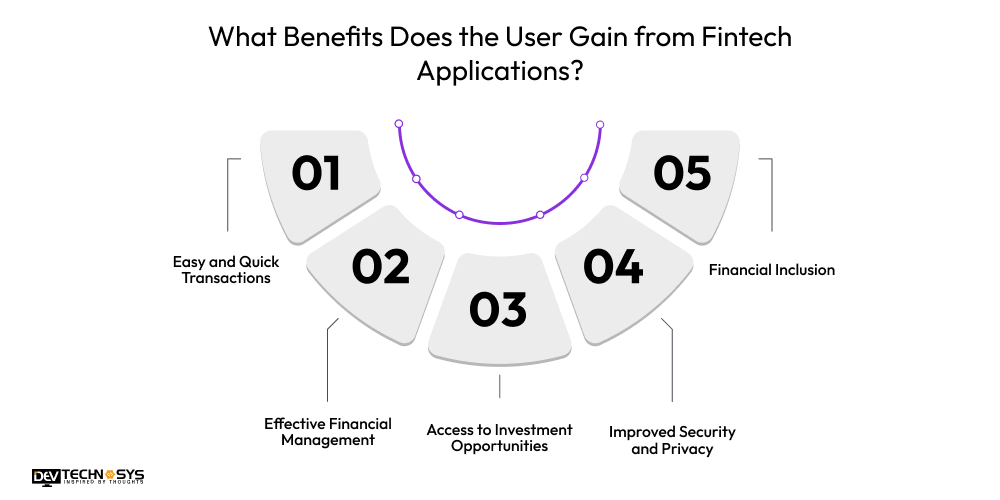
1. Easy and Quick Transactions
Fintech applications enable users to transfer and receive money instantaneously, pay bills, and make purchases without visiting a bank. This speed and convenience save time and effort, simplifying and streamlining daily banking transactions.
2. Effective Financial Management
Fintech applications allow users to manage their costs, build budgets, and set savings objectives. These solutions give users with clear insights into their spending habits, allowing them to manage their money intelligently and prevent excessive debt.
3. Access to Investment Opportunities
Fintech applications allow anybody, not just specialists, to invest in equities, mutual funds, and cryptocurrencies. They provide simple platforms and assistance, allowing customers to develop their money directly from their phones.
4. Improved Security and Privacy
Most financial applications safeguard user data and transactions with advanced technologies such as encryption and biometric authentication. According to the iOS app development company, this assures safer financial transactions than traditional ways, offering users piece of mind.
5. Financial Inclusion
Fintech applications offer banking and credit services to those without access to traditional banks, particularly in rural places. This inclusion enables numerous people to engage in the financial system and increase their economic potential.
10 Must-Have Features of Fintech Applications
Fintech applications combine finance and technology to offer seamless, secure, and innovative financial services. To stand out and succeed, these apps must include essential features that meet users’ expectations and regulatory requirements.
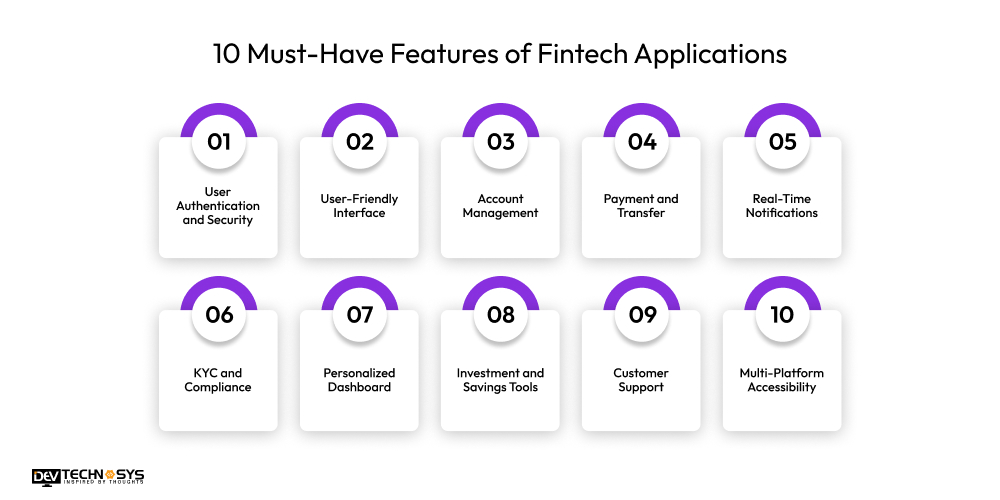
1. User Authentication and Security
Strong security mechanisms, such as two-factor authentication, biometrics, and encryption, safeguard user data and prevent fraud, fostering trust and safety.
2. User-Friendly Interface
The app’s straightforward and easy design allows users of various ages and technical levels to effortlessly utilize it, increasing engagement and pleasure.
3. Account Management
Users should be able to examine balances, transaction history, and account data right away, providing them complete control over their funds.
4. Payment and Transfer
Fast, dependable methods for sending and receiving money, such as peer-to-peer payments, bill payments, and overseas transfers, are essential.
5. Real-Time Notifications
Instant notifications of purchases, offers, or questionable activity keep consumers informed and improve app transparency.

6. KYC and Compliance
Fintech business app development solutions can integrate KYC verification and compliance with local rules to help prevent money laundering and fraud.
7. Personalized Dashboard
Customizable dashboards provide insights, budgeting tools, and financial advice suited to each user’s specific requirements.
8. Investment and Savings Tools
Users may develop and manage their money with features such as easy investment, savings goals, and portfolio tracking.
9. Customer Support
24/7 support via chatbots, FAQs, or live agents guarantees that consumers receive assistance when they need it.
10. Multi-Platform Accessibility
Users may access services at any time and from any location thanks to their availability on iOS, Android, and the web.
What is the Cost to Develop a Fintech App?
The cost to develop a fintech app varies widely based on features, complexity, and region. Basic apps with essential functions like payments and account management typically start around $8,000 to $25,000. More advanced apps with features like AI integration, real-time analytics, and strong security can cost $25,000 or more.
The cost to build a fintech app also depend on the platform (iOS, Android, web), design quality, and compliance with financial regulations. Ongoing maintenance and updates add to the total investment. Planning carefully helps optimize budget and value.
Feature/Aspect |
Basic App Cost (USD) |
Advanced App Cost (USD) |
| Core Features | $5,000 – $8,000 | $10,000 – $12,000 |
| Security & Authentication | $3,000 – $5,000 | $6,000 – $9,000 |
| Payment Integration | $4,000 – $7,000 | $8,000 – $10,000 |
| AI & Advanced Tools | — | $10,000 – $18,000 |
| Maintenance (Annual) | $5,000 – $8,000 | $10,000 – $15,000 |
5 Major Factors That Can Affect the Overall Fintech App Development Cost
Understand the key factors that influence fintech app development costs, including feature complexity, design quality, platform choice, security requirements, and developer location, each playing a crucial role in shaping your app’s budget, quality, and overall success.
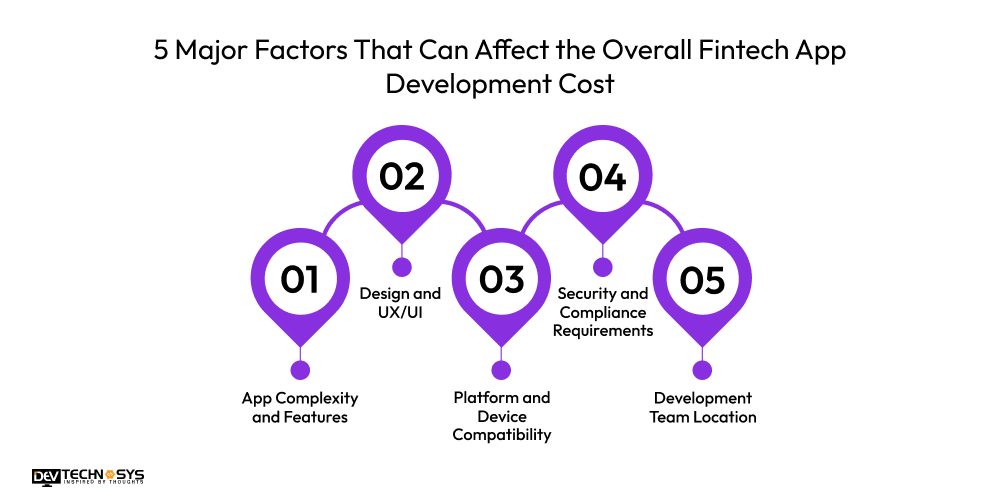
1. App Complexity and Features
The cost of Islamic fintech app development Saudi Arabia increases as the features get more complex, such as AI integration, real-time analytics, or investment tools. Basic applications with simple payment and budgeting capabilities are less expensive, but complicated apps with multi-layer security, dashboards, and user personalization need more development time, resulting in considerable cost increases.
Level |
Description |
Estimated Cost (USD) |
| Basic | Simple payments, account info, limited features | $5,000 – $8,000 |
| Moderate | Budgeting tools, notifications, basic analytics | $8,000 – $12,000 |
| Advanced | AI, investments, real-time data, advanced dashboards | $12,000 – $15,000 |
2. Design and UX/UI
Creating a slick, user-friendly interface necessitates the services of professional designers and additional development time. A well-designed financial app increases user engagement but raises the overall cost to develop an app. Custom animations, fluid navigation, and mobile responsiveness all have an impact on price, particularly when striving for a professional and current visual experience.
Design Type |
Features Included |
Estimated Cost (USD) |
| Basic UI | Simple layout, standard buttons | $3,000 – $7,000 |
| Custom UI/UX | Branded design, icons, animations | $7,000 – $10,000 |
| High-end UX/UI | Unique visuals, seamless navigation, responsiveness | $10,000 – $13,000 |
3. Platform and Device Compatibility
Developing an app for both iOS and Android raises costs as compared to a single-platform launch. If you want web app compatibility or tablet optimization, you will need to spend more time on development. Cross-platform development tools such as Flutter assist to cut expenses, however performance and feature quality might vary.
Platform |
Scope |
Estimated Cost (USD) |
| Single Platform | iOS or Android only | $8,000 – $12,000 |
| Dual Platform | iOS and Android | $14,000 – $18,000 |
| Multi-platform (Web + Mobile) | iOS, Android, Web | $18,000 – $22,000+ |
4. Security and Compliance Requirements
Fintech apps must adhere to severe data security standards such as KYC, AML, and GDPR. Implementing robust encryption, biometric identification, and secure APIs necessitates specialized development and compliance support, which increases total cost to maintain an app. Failure to fulfill these criteria might result in fines, thus security is an important investment.
Security Feature |
Purpose |
Estimated Cost (USD) |
| Basic Security (SSL, Passwords) | Standard protection | $3,000 – $6,000 |
| Biometric/2FA Integration | Enhanced user authentication | $5,000 – $10,000 |
| KYC/AML Compliance | Legal compliance and user verification | $10,000 – $15,000 |
5. Development Team Location
The geographic location of your development team has a considerable impact on expenses. Developers in North America or Europe charge higher rates than those in Asia or Eastern Europe. Hiring Riyadh fintech app developers may cost more up front, but it promises better performance, fewer errors, and faster product delivery.
Region |
Hourly Rate (USD) |
Estimated Total Cost |
| North America | $50 – $70/hr | $40,000 – $60,000+ |
| Western Europe | $40 – $60/hr | $30,000 – $50,000+ |
| Eastern Europe/Asia | $30 – $50/hr | $28,000 – $40,000 |
| Freelancers/Mixed | $15 – $25/hr | $8,000 – $25,000 |
Security and Compliance Considerations in Fintech App Development
Fintech app development depends largely on security and compliance, which play a very crucial role in keeping sensitive financial data safe and also ensuring secure transactions. Businesses can utilize encrypted systems to build trust in the fintech apps and make use of authentication, fraud detection, API security measures, or compliance frameworks in the services provided in order to be successful.
1. Data Security Protection
Advances in technology have made it possible for fintech companies to use encryption technology like AES-256 in order to facilitate secure data transfer around the world. The use of encrypted databases and technologies for secure key management and data masking helps ensure that confidential information is protected from theft, misuse, and hacking.
2. Multi-factor Authentication (MFA)
The MFA system helps provide security in fintech applications by incorporating multiple authentication techniques such as passwords, token numbers, biometric identification, and device identification. With the use of risk-sensitive authentication, the risk of unauthorized access, fraud, and identity theft is greatly reduced.
3. Regulatory Compliance and Financial Standards
Open banking regulation compliance and financial standards are expectations built into fintech applications. Such solutions must comply with a variety of regulatory requirements, including KYC, AML, PCI DSS, GDPR, and other regulations from local financial agencies. In addition to implementing compliance management systems, transaction monitoring, customer due diligence, and audit trails are also essential for safe and legal live finance.
4. Secure Payment Processing
Secure Payment processing is a unique aspect of fintech applications. Integrating PCI DSS-compliant payment gateways, tokenization systems, and encryption technologies are vital to ensuring secure payment transactions. Technologies such as 3D Secure authentication, payment encryption, and secure APIs help to secure cardholder data and protect against various kinds of payment fraud.
5. AI-Based Fraud Detection and Risk Management
AI-based fraud detection and risk assessment technologies are used in fintech applications. AI in fintech app development detects financial fraud by conducting real-time transaction analysis, monitoring behavior, and detecting anomalies in activities. AI-based risk scoring technology identifies risk patterns to prevent financial crimes.
6. API Security and Third-Party Integration
Fintech applications are dependent on API’s when it comes to finishing banking transactions as well as executing payments through integration with many other services as well. The secure architecture for API includes features such as authentication on the basis of OAuth 2.0, gateways for API, encoding, limits of requests and access rules.
7. Security Testing and Vulnerability Management
Doing security tests throughout fintech apps is important for discovering existing vulnerabilities. Activities like testing via penetration methods, scanning for vulnerabilities, checking the code, and monitoring security help to enhance financial service software against cyberthreats.
What are the Future Trends in Fintech App Development?
Revolutionary technologies like artificial intelligence, blockchain technology, open banking, embedded finance, and advanced security solutions have been the driving forces of the fintech app development industry. They bring about more comfortable customer experiences, with multiple innovations helping businesses enhance transparency, automation, compliance, and customer trust in digital financial environments.
1. Financial Services Enhanced by AI
Artificial intelligence is changing the face of financial technologies through the use of intelligent chatbots and automated financial planning services, tailored advice about investment, and real-time fraud detection technology. AI-powered analytics allow businesses to optimize their operations, create better user experiences, and provide quicker and more secure financial services.
2. Open Banking and API Technologies
Open Banking facilitates financial transactions thanks to secure application programming interfaces (APIs) that make it possible for fintech applications to connect with banking systems and services of third parties. As a result of this development, payments are made quicker, banking services are more personalized, and customers receive wider access to control over their own finances.
3. Blockchain and Digital Asset Innovation
Blockchain technology provides better transparency, security of transactions, and operational efficiency in the field of financial technologies. Smart contracts, tokenized assets, decentralized finance (DeFi), and cashless transfer services minimize the number of intermediaries in financial transactions, which positively influences cost-cutting.
4. Embedded Finance and Super Apps
Embedded finance enables firms to introduce services for payments, lending, banking, etc. into other applications that are not associated with finance. The combination of this with the increasing popularity of super apps results in convenient, all-purpose, digital experiences that boost customer interaction.
How to Make Money From Fintech Applications?
Fintech apps are not just transforming the way people manage money, they’re also great business opportunities. Entrepreneurs and startups can earn revenue through several proven strategies. Here are five effective ways to monetize a fintech application:
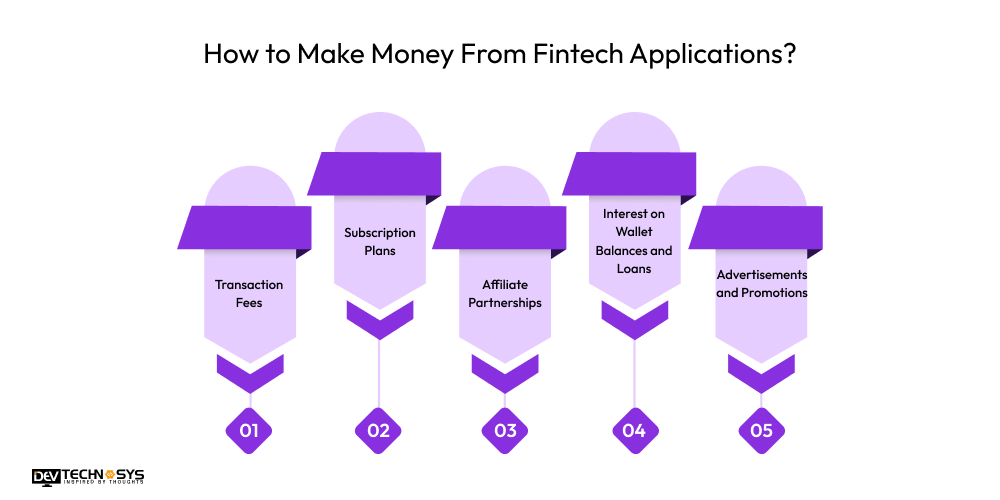
1. Transaction Fees
One of the most typical ways to make money is to charge a modest fee for each transaction completed through the app. Fintech applications, whether they facilitate money transfers, bill payments, or investments, may generate constant revenue from user activity. Even a tiny cost adds up rapidly with frequent use.
2. Subscription Plans
Fintech apps can provide premium functionality through a subscription model. Users pay monthly or yearly for enhanced resources such as in-depth analytics, individualized financial advice, and priority customer assistance. This strategy assures a consistent revenue stream and a loyal user base.
3. Affiliate Partnerships
Many fintech apps work with banks, insurance firms, and investing platforms. Apps that promote third-party financial goods and services can receive a fee for each successful referral, account opening, or transaction completed through their platform.
4. Interest on Wallet Balances and Loans
Apps that provide digital wallets or lending services might make money by charging interest. According to the mobile app development firm, they lend user balances to financial institutions or provide microloans directly to users at attractive interest rates.
5. Advertisements and Promotions
Some financial applications generate revenue through tailored advertising. These advertisements frequently promote financial services or tools that consumers may be interested in. Promoting partner services or running in-app sponsored content can increase revenue without hurting user experience.

Conclusion
Making a fintech app is a smart move in today’s digital-first economy. It gives users new ways to handle their money and helps businesses make money in the long run. Fintech apps can change the way people handle their money by giving them safe ways to pay and personalized money tools. Success, on the other hand, rests on careful planning, current features, and skilled execution.
If you work with an experienced mobile app development company in UAE, your app will be sure to follow local rules, run smoothly, and stand out in a crowded market. For your financial idea to become a powerful, user-centered reality, you need the right team.
Frequently Asked Questions
1. How Much Does It Cost To Develop a Fintech App?
The cost to build a fintech app typically ranges from $8,000 to $25,000, depending on features, complexity, platform choice, security requirements, and the development team’s location.
2. How Long Does it Take to Create a Fintech App?
To create a fintech app usually takes 3 to 6 months, depending on app complexity, features, design requirements, platform compatibility, and testing needs for compliance, security, and smooth user experience.
3. Which Technologies Are Used to Make a Fintech App?
There are various technologies used to make a fintech app. So here is the list of technologies:
- PHP
- C++
- JavaScript
- React Native
- Java
- Python
4. What Are Common Compliance Challenges?
Common compliance challenges in fintech include adhering to data privacy laws like GDPR, implementing strong KYC and AML procedures, meeting local financial regulations, and ensuring secure transaction monitoring to prevent fraud and money laundering.
5. What Is The Role of APIs In Fintech Apps?
APIs enable fintech apps to connect securely with banks, payment gateways, and third-party services, allowing seamless data exchange, faster transactions, and integration of features like identity verification and real-time financial updates.