





Key Takeaways
- An AI agent is a software system that can perceive information, reason about a goal, use tools, take actions, and adapt based on results.
- AI agents typically combine an LLM reasoning model, memory, tools, orchestration, state management, and security controls.
- UAE Personal Data Protection Law, security and access controls are followed to create an AI agent. This helps to build trust among consumers.
- The cost to develop an AI agent ranges from AED 92,000 to AED 441,000+, depending on complexity and AI features.
- AI agents differ from chatbots because agents can execute approved actions, not just generate conversational responses.
- UAE businesses should have a clear objective for building an AI agent to reduce costs.
An AI agent allows users to manage workflows with critical queries. It generates the next steps for users to take effective actions. UAE businesses should understand that these are not chatbots that simply answer your specific queries. But these can give you patient history, along with doctor appointment scheduling and treatment.
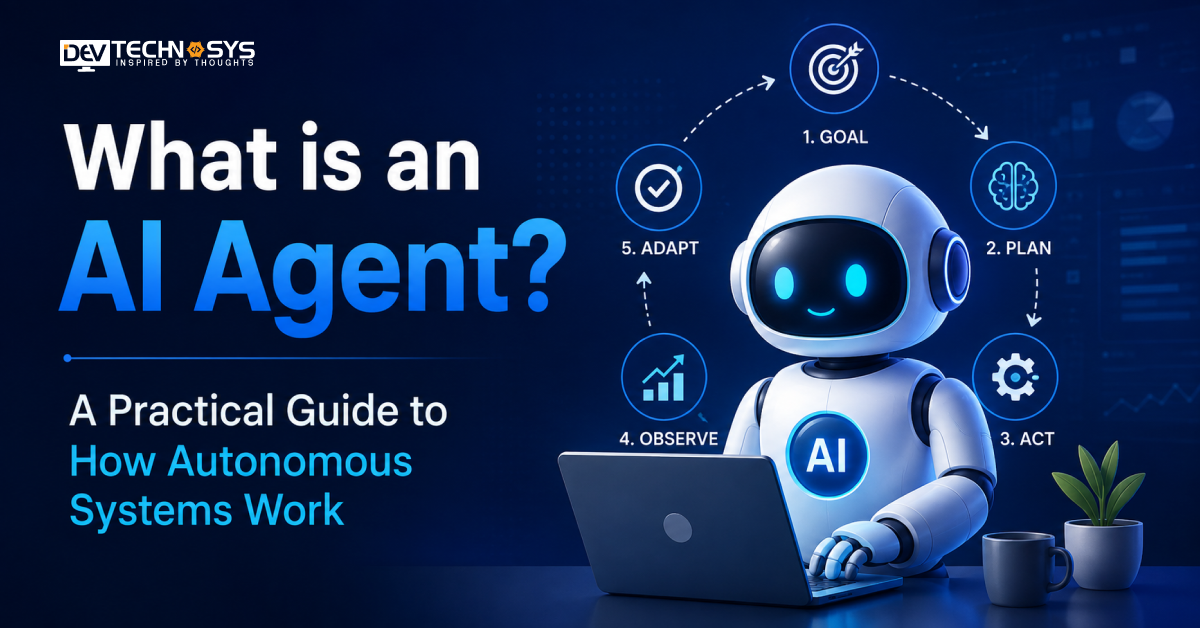
In simple terms, what is an AI agent can understand customers’ requirements, generate next steps, and update the CRM. A simplified model is:
Goal → Perception → Reasoning → Planning → Tool Use → Action → Evaluation → Next Action
AI agents work in 4 to 6 steps, starting from receiving a goal, to plan, using tools, and taking a relevant action.
Benefits of AI Agents
Most businesses gets confused between AI agent vs automation. AI agents support 24/7 customer service, operational efficiency, personalized experiences, data-driven decisions, and scalable workflows while maintaining appropriate security, access controls, and human oversight for sensitive processes. The following are the top seven benefits of AI agents for UAE businesses.
Top 7 Benefits of AI Agents |
How AI Agents Help UAE Businesses? |
| 1. 24/7 Business Operations | AI agents can handle customer queries, routine tasks, and operational workflows around the clock without requiring continuous human involvement. |
| 2. Lower Operational Costs | Automating repetitive processes can reduce manual workload, improve employee productivity, and control long-term operational expenses. |
| 3. Faster Customer Service | AI agents can respond instantly to common customer requests, retrieve information, and route complex issues to the right employee. |
| 4. Better Decision-Making | AI agents can analyze business data, identify patterns, generate insights, and support faster decisions across sales, finance, operations, and customer service. |
| 5. Scalable Business Processes | Businesses can handle increasing transaction volumes, customer interactions, and internal workflows without scaling headcount at the same rate. |
| 6. Personalized Customer Experiences | AI agents can use customer context and business data to provide more relevant recommendations, responses, and support across digital channels. |
| 7. UAE Compliance & Control | With appropriate security architecture, access controls, audit logs, and human approvals, AI agents can be designed to support UAE businesses with controlled and traceable automated workflows. |
Types of AI Agents
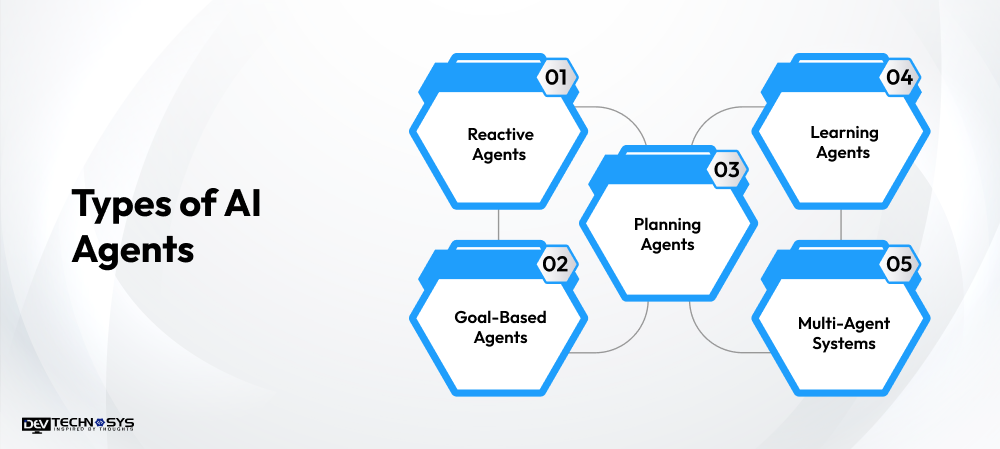
AI agents can be classified by how they respond to information, pursue goals, plan tasks, learn from feedback, and collaborate with other agents. For UAE businesses, this classification is useful because the right agent architecture depends on the business process, level of autonomy, data sensitivity, integrations, and required human oversight.
1.Reactive Agents
Reactive agents respond to current inputs without maintaining extensive historical context or independently planning long sequences of actions. They are generally suitable for straightforward, well-defined interactions where the system needs to interpret an input and provide an immediate response.
For UAE businesses, reactive agents can support common customer-facing tasks across websites, mobile applications, WhatsApp-based workflows, and internal service portals.
Examples include:
- Answering product or service questions.
- Providing business hours and location information.
- Checking basic order or booking status.
- Responding to frequently asked questions.
- Guiding users through simple application processes.
- Providing basic information about property listings or services.
UAE example:
A Dubai-based retail company could deploy a reactive AI agent that answers questions about product availability, delivery areas, return policies, and store timings without independently changing customer orders. Reactive agents are relatively easier to control because their actions can be limited to predefined responses, approved knowledge sources, or specific API calls.
2. Goal-Based Agents
Goal-based agents work toward a defined business objective rather than simply responding to individual inputs. The agent evaluates available information and selects actions that help it achieve the assigned goal.
This architecture can be useful for UAE organizations that want to automate structured business processes while keeping clear boundaries around what the AI agent is allowed to do. This can also include AI-powered chatbot development according to the business needs.
Example:
An AI sales agent may have the goal of qualifying incoming leads and scheduling approved follow-ups.
The workflow could include:
- Receive a new lead.
- Analyze the lead information.
- Ask relevant qualification questions.
- Determine whether the lead meets predefined criteria.
- Update the CRM.
- Recommend an appropriate sales action.
- Schedule a follow-up after obtaining the required approval.
UAE business applications include:
- Real estate lead qualification.
- Insurance inquiry management.
- B2B sales development.
- Hospitality booking assistance.
- Automotive sales inquiries.
- Financial-service customer onboarding.
3. Planning Agents
Planning agents are designed for more complex objectives that require multiple steps. Instead of responding to one request at a time, the agent can decompose a larger goal into smaller tasks, determine an execution sequence, use approved tools, evaluate intermediate results, and escalate when human intervention is required.
This makes planning agents particularly relevant to UAE enterprises managing complex operational, analytical, and administrative workflows.
Example:
Goal: Prepare a UAE market report.
Subtasks:
- Collect approved market data.
- Validate the available information.
- Analyze relevant datasets.
- Identify market trends.
- Generate charts and supporting analysis.
- Prepare the report.
- Conduct validation checks.
- Request human review before publication.
A planning agent could potentially connect with approved databases, business intelligence platforms, CRM systems, document repositories, and analytics tools. However, access should be restricted according to the agent’s role and business requirements.
UAE use cases include:
- Real estate market analysis.
- Supply-chain planning.
- Financial reporting assistance.
- Procurement workflows.
- Business intelligence.
- Document processing.
- Hospitality operations.
- Enterprise research.
Planning agents require stronger controls than simple conversational agents because they may execute multiple actions across different systems. Access permissions, audit logs, validation rules, human-in-the-loop controls, and failure-handling mechanisms should therefore be part of the architecture.
4. Learning Agents
Learning agents improve their behavior using feedback, evaluation results, historical interactions, or updated information. Rather than relying entirely on fixed behavior, these systems can use feedback mechanisms to improve responses or decision-making over time.
For UAE businesses, learning capabilities can be useful when customer requirements, product information, market conditions, or operational data change frequently.
Examples include:
- Improving customer-service responses based on evaluated conversations.
- Learning which product recommendations receive positive engagement.
- Improving lead qualification using approved historical outcomes.
- Detecting recurring customer-service issues.
- Adapting recommendations based on changing business data.
However, learning should not mean that an AI agent is allowed to change its own objectives or permissions without governance. Businesses should establish model evaluation, data-quality controls, approval processes, monitoring, and rollback mechanisms.
This is especially important when agents process personal, financial, employee, healthcare, or other sensitive information. UAE organizations should align the design with applicable privacy and cybersecurity requirements, including appropriate controls for personal data processing.
5. Multi-Agent Systems
A multi-agent system uses multiple specialized AI agents that collaborate on a broader business workflow. Instead of asking one agent to perform every task, organizations can assign different responsibilities to specialized agents.
For example:
Research Agent → Analysis Agent → Compliance Agent → Reporting Agent
An orchestration layer can coordinate the workflow, determine which agent should handle each task, and manage the sequence of operations. Agent handoff or delegation transfers specific tasks between agents according to predefined rules.
UAE Business Example: A UAE real estate company could use a multi-agent architecture where:
- Property Research Agent collects approved property information.
- Market Analysis Agent analyzes pricing and demand data.
- Customer Agent identifies relevant buyer requirements.
- Compliance Agent checks predefined regulatory or policy requirements.
- Reporting Agent prepares an internal report.
- Human Reviewer approves sensitive recommendations or external communication.
This approach can help organizations separate responsibilities and apply different permissions to different agents.
Why Multi-Agent Systems Need Strong Governance?
Multi-agent systems can increase flexibility, but they also introduce additional complexity. Every agent may have its own tools, data access, instructions, and decision boundaries.
Businesses therefore need to consider:
- Agent authentication and authorization.
- Role-based access control.
- Secure API integrations.
- Data privacy and access restrictions.
- Agent-to-agent communication security.
- Prompt-injection protection.
- Audit logging.
- Human approval checkpoints.
- Model and agent performance monitoring.
- Error handling and fallback mechanisms.
- Evaluation of individual agents and the complete workflow.
What is the Primary Difference Between an AI Agent and Chatbot?
The primary difference is autonomy. A chatbot mainly responds to user inputs, while an AI agent can understand a goal, plan multiple steps, use tools or APIs, make decisions, and take actions with limited human intervention.
Chatbot |
AI Agent |
| Primarily responds to questions or commands | Works toward a defined goal |
| Usually follows predefined or model-generated conversation flows | Can plan and execute multi-step workflows |
| Mainly provides information | Can take actions using tools, APIs, databases, or business systems |
| Limited decision-making | Can make contextual decisions within defined permissions |
| Usually requires the user to initiate each interaction | Can trigger or continue tasks based on events, rules, or goals |
| Example: Answers customer questions about an order | Example: Checks an order, identifies a delivery issue, contacts the logistics system, and initiates an approved resolution |
A chatbot primarily talks with users; an AI agent can act on their behalf.
For UAE businesses, the distinction is especially important when an AI system can access customer data, execute transactions, modify records, or interact with external systems because those capabilities introduce additional security, privacy, authorization, auditability, and human-oversight requirements.
AI Agent Examples by Industry
Before understanding how to build an AI model, decision makes should know the examples. AI agents can support UAE businesses across customer service, operations, compliance, sales, and decision-support workflows. Their capabilities should be aligned with the organization’s data-access permissions, risk level, and human-approval requirements.
Industry |
AI Agent Examples |
Typical Tasks |
Human Oversight |
| Financial Services | Banking agent, fraud-monitoring agent, document-processing agent | Classify customer requests, retrieve approved account information, analyze documents, identify fraud indicators, prepare case summaries, escalate suspicious cases | Required for sensitive financial decisions, transactions, and high-risk cases |
| Healthcare | Patient-support agent, healthcare administration agent, insurance agent | Coordinate appointments, communicate with patients, retrieve medical documents, verify insurance, support administrative workflows, retrieve approved clinical information | Strong oversight required for clinical decisions, diagnosis, treatment, and sensitive patient data |
| Real Estate | Property-search agent, lead-qualification agent, CRM agent | Understand buyer requirements, search property databases, recommend properties, qualify leads, update CRM records, schedule viewings, prepare follow-ups | Human review for contractual, financial, and property-transaction decisions |
| Retail & E-commerce | Shopping agent, customer-service agent, order-management agent | Discover products, answer customer questions, check inventory, manage orders and returns, provide recommendations, support marketing workflows | Approval controls for refunds, discounts, purchases, and other financial actions |
| Manufacturing | Maintenance agent, operations agent, supply-chain agent | Handle maintenance requests, retrieve production information, check inventory, communicate with suppliers, generate quality reports, issue operational alerts | Human approval for safety-critical or production-impacting actions |
| Telecom | Customer-support agent, network operations agent, service-diagnostic agent | Resolve customer queries, diagnose service issues, recommend plans, answer billing questions, route technical tickets, support network workflows | Human escalation for complex technical issues, service changes, and high-impact network actions |
| Travel & Hospitality | Booking agent, guest-service agent, travel-planning agent | Recommend itineraries, answer guest questions, manage bookings, coordinate requests, process approved changes, personalize offers | Human intervention for exceptional bookings, refunds, and high-value transactions |
| Logistics & Transportation | Dispatch agent, shipment-tracking agent, logistics-support agent | Track shipments, identify delays, coordinate deliveries, update customers, optimize approved workflows, escalate exceptions | Human control for route changes, high-value shipments, and operational exceptions |
| Government & Public Services | Citizen-service agent, document agent, case-routing agent | Answer public-service queries, retrieve approved information, classify applications, route cases, summarize documents, support service requests | Strong governance and human oversight for eligibility, benefits, and official decisions |
| Energy & Utilities | Operations agent, maintenance agent, customer-service agent | Monitor operational data, identify maintenance needs, answer billing questions, manage service requests, generate alerts and reports | Human approval for safety-critical infrastructure and operational changes |
Can AI Agents Work Without Human Input?
Yes. AI agents can work without continuous human input when they are given defined goals, permissions, tools, and decision rules. However, the level of autonomy should depend on the risk of the action.
- Low-risk: Search information, summarize documents, draft content, and categorize tickets can often run automatically.
- Medium-risk: Updating CRM records, sending routine notifications, and creating internal tasks can be automated with validation and monitoring.
- High-risk: Financial transactions, deleting data, changing permissions, regulated decisions, and legally significant communications should typically require human approval, strong authorization, and additional validation.
In short: AI agents can operate autonomously, but enterprise deployments should use risk-based autonomy rather than unrestricted autonomy.

What Happens When an AI Agent Makes a Mistake?
A production AI agent should not simply fail silently.
A robust system should use:
Detection → Validation → Fallback → Escalation → Logging → Recovery
For example: If an agent cannot verify a customer’s identity, it should stop the workflow and escalate rather than guessing.
Important reliability mechanisms include:
- Fallback and escalation logic
- Model output validation
- Tool response validation
- Human approval
- Retry limits
- Rate limiting
- Agent action rollback
- Audit logging
- Error monitoring
For high-risk workflows, the ability to stop or roll back an agent action can be as important as the ability to execute it.
AI Agent Readiness Checklist for UAE Businesses
Before development, evaluate the following.
1. Business Readiness
- Is the business objective clearly defined?
- Is there a measurable KPI?
- Is an AI agent actually required?
- Could conventional automation solve the problem?
2. Data Readiness
- Is the required data available?
- Is the data accurate?
- Is sensitive information identified?
- Are data retention rules defined?
- Is RAG required?
3. Integration Readiness
- Are APIs available?
- Are CRM/ERP systems accessible?
- Can tools be permission-scoped?
- Is MCP useful for the integration architecture?
4. Security Readiness
- Are prompt-injection defenses implemented?
- Are tools restricted?
- Is least privilege applied?
- Are agents sandboxed where required?
- Are agent actions logged?
- Are rate limits and spend caps configured?
5. UAE Compliance Readiness
- Has UAE PDPL applicability been assessed?
- Are personal-data flows mapped?
- Are cross-border transfers assessed?
- Are retention requirements defined?
- Are human approval gates defined for sensitive workflows?
6. Operational Readiness
- Is there fallback logic?
- Is human escalation available?
- Are outputs evaluated?
- Are latency and token costs monitored?
- Can actions be rolled back?
AI Agent Development for UAE Businesses
Building an AI agent requires more than connecting an LLM to an API.
A production system needs a complete architecture covering:
Business objective → Agent design → LLM → Memory → RAG → Tools → APIs → Security → Human oversight → Monitoring
For UAE organizations, the architecture should additionally account for applicable privacy, data-processing, security, and sector-specific requirements.
The UAE’s national AI strategy identifies strong governance and effective regulation as part of its strategic objectives, alongside AI adoption, infrastructure, talent, and ecosystem development. Businesses planning an implementation can explore AI agent development services for support with discovery, architecture, development, integration, security, testing, and deployment.
How Much Does an AI Agent Cost?
The cost to develop an AI agent depends on its complexity, integrations, model requirements, data architecture, security controls, and degree of autonomy. A practical UAE development range can be structured as:
AI Agent Complexity |
Estimated Development Cost |
| Minimum Viable Product | AED 92,000 – AED 145,000 |
| Business AI Agent | AED 145,000 – AED 260,000 |
| Advanced AI Agent | AED 260,000 – AED 441,000+ |
| Enterprise Multi-Agent System | AED 441,000+ |
If businesses are willing to know cost of hiring an AI developer then it is $15 to $25 per hour.
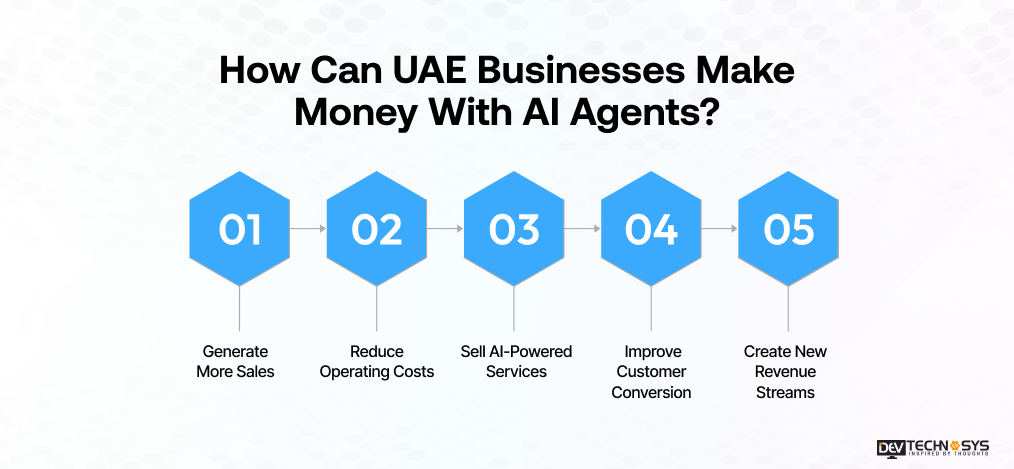
How Can UAE Businesses Make Money With AI Agents?
AI agents provide qualified leads to businesses and reduce operational costs. By defining the next steps, businesses do not need an employee to manage tasks.
1. Generate More Sales
An AI sales agent can operate continuously across digital channels.
For example:
Website visitor → AI qualification → Product recommendation → Lead scoring → CRM update → Sales appointment
This can help businesses respond faster to prospects and allow sales teams to focus on higher-value opportunities.
2. Reduce Operating Costs
AI agents can automate repetitive workflows that previously required employees to perform manually.
Examples include:
- Customer support
- Document processing
- Data entry
- Internal knowledge retrieval
- Appointment scheduling
- Report preparation
- Lead qualification
- Invoice processing
The financial benefit comes from reducing the amount of manual work required per transaction or customer.
3. Sell AI-Powered Services
UAE technology companies can also build AI agents as commercial products. For example, a software company could create an AI agent specifically for:
- Real estate agencies
- Restaurants
- Clinics
- Banks
- Insurance companies
- Logistics companies
- Retail businesses
The company could use a setup fee + monthly subscription + usage-based pricing model.
4. Improve Customer Conversion
AI agents can interact with customers throughout the buying journey.
For example:
Customer question → Product discovery → Personalized recommendation → Objection handling → Purchase assistance → Follow-up
This can potentially improve the customer experience and reduce abandoned interactions, although actual revenue impact should be measured using business-specific data.
5. Create New Revenue Streams
An AI agent can become a standalone product rather than simply an internal automation tool.
A UAE company could develop an agent that provides specialized services such as:
- Property search
- Financial document analysis
- Business research
- Customer support
- Travel planning
- Procurement assistance
- Enterprise knowledge search
The business can then monetize the agent through subscriptions, licensing, transaction fees, or usage-based pricing.
A simple business calculation is:
AI Agent ROI = Additional Revenue + Cost Savings − AI Agent Operating Costs
For example, if an AI sales agent contributes AED 500,000 in additional annual revenue and saves AED 150,000 in operating costs while costing AED 200,000 per year to operate, the estimated annual financial benefit would be:
AED 500,000 + AED 150,000 − AED 200,000 = AED 450,000
This is an illustrative calculation, not a guaranteed return.
Answer a few quick questions and our experts will share a tailored project estimate.
Final Thoughts
UAE businesses must consider technical issues affecting workflow. For example, managing real estate agents through an app can be challenging if the app is outdated. The secondary part is a close review of how an AI agent can reduce operational costs.
Decision makers can partner with an AI development company to clarify the type of AI agent required. Experts provide consultation tailored to the business’s objectives to address specific challenges. This approach helps organizations implement automation with secure integrations while achieving measurable KPIs.
FAQs
Q1. Can AI Agents Work Without Human Input?
AI agents can work without a human within defined rules. However, for sensitive actions, it might require human approval. For example, when suspecting fraud on UAE e-commerce company orders or a payment issue, an AI agent should pause checkout until a human verifies it. This helps customers to continue using secure services.
Q2. What Happens When an AI Agent Makes a Mistake?
When an AI agent makes a mistake, a technical team typically handles it by reviewing the design flow. Experts check for contextual errors, anomaly flagging, or a rollback. AI engineers adjust code, identify & reduce hallucinations, and improve system failures. They consistently monitor the agent to check for issues, preventing future concerns.
Q3. When Should a UAE Business Not Use an AI Agent?
Startups and small businesses with a simple workflow should avoid using an AI agent. This is because, in the long term, it requires upgrades for advanced capabilities. Also, if you are a fintech or healthcare organization with sensitive data, then make sure that the performance of an AI agent is monitored by an expert.
Q4. How Long Does it Take to Build an AI Agent?
The average development time to build a custom AI agent is 2 to 4 months, depending on the type and its complexity. For example, building a multi-agent system with security can take longer than a basic planning agent. UAE businesses can discuss a dedicated project timeline with our project managers.
Q5. What are the Best Examples of an AI Agent?
Delivery, recommendation engines used in Netflix, Waymo, and Uber’s financial data agent are the top examples of an AI agent. However, a particular agent can be developed according to specific business requirements. Each agent includes different features & functionalities for which different level of expertise is required.