





Key takeaways:
-
- The role of AI in chatbot development includes natural language processing, context awareness, sentiment analysis, personalized conversation, and more.
- Different types of key use cases of AI-based chatbots include customer support, sales assistance, healthcare assistance, HR and internal support, and banking support.
- Offer real-world examples of AI-based chatbots such as ChatGPT, Drift, H&M Chatbot, and many more.
AI, or Artificial Intelligence, has transformed the technology that we use daily, making it more intuitive and user-friendly. A great example of this new technology is AI chatbots. From answering questions to resolving user issues, AI chatbots are able to simulate human-level interaction and reasoning.
You can find chatbots in the customer service of almost every website, and even in virtual assistant applications on mobile devices. With the help of natural language processing, chatbots understand human language, reason logically, and respond in real-time. For every intelligent chatbot, there exists an intelligent structure made of data, algorithms, and machine learning models. These chatbots are able to teach themselves in order to improve their performance over time.
AI chatbots are used in various real-life industries, including but not limited to education, healthcare, finance, and e-commerce, to enhance operational efficiency and save time. This case study centers the focus on chatbots and emphasizes the value that AI introduces to the table.
What is the Role of AI in Chatbot Development?
Modern chatbot development services are fundamentally reliant on AI, which facilitates the following: sentiment analysis, context awareness, natural language comprehension, personalized conversations, multilingual support, and predictive insights. It enhances efficiency, user experience, and business outcomes across industries in 2026 by automating tasks, integrating with enterprise systems, and supporting voice interfaces.
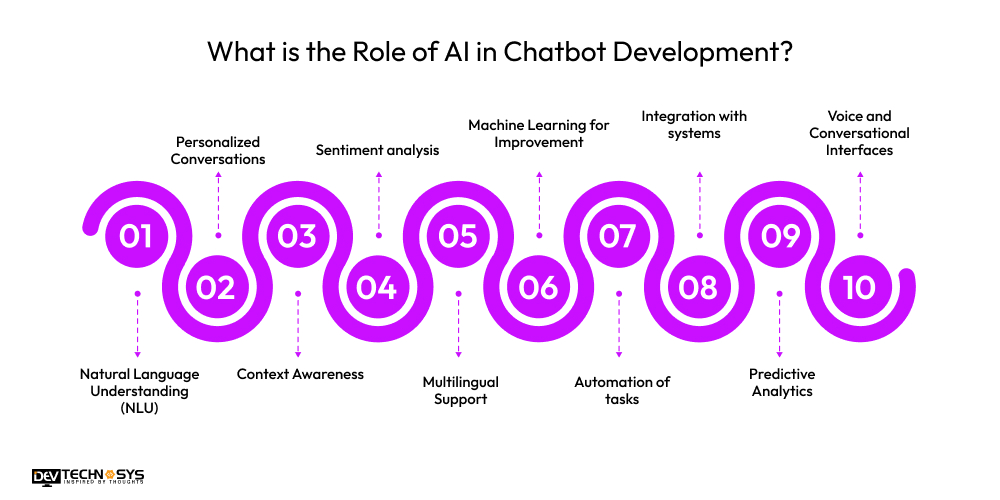
1. Natural Language Understanding (NLU)
Natural Language Understanding is a feature of AI that allows chatbots to understand human input. Bots properly discern meaning by evaluating the text, grammar, and context. This enables conversational systems to handle complicated questions, comprehend intent, and react properly, increasing engagement while decreasing human involvement, resulting in interactions that feel natural and customized across different languages and dialects.
2. Personalized Conversations
Chatbots may provide tailored experiences by assessing user data, preferences, and behavioral patterns. This customisation increases consumer engagement, retention, and satisfaction. AI-powered customization may promote items, customize replies, and proactively suggest activities, resulting in a dynamic and human-like interaction that adapts to user demands over time.
3. Context Awareness
AI in chatbot development provides chatbots with context awareness, allowing them to keep track of conversations and grasp situational context. This allows for meaningful multi-turn interactions, minimizes repetitious inquiries, and assures correct replies. Context-aware chatbots enable continuity in user interactions, resulting in a more natural, human-like discourse that enhances the customer experience and operational efficiency.
4. Sentiment analysis
Artificial intelligence-powered sentiment analysis enables chatbots to recognize emotions in user communications such as displeasure, happiness, or bewilderment. This knowledge enables the bot to adjust tone, escalate issues to people when necessary, and customize replies, hence boosting customer support quality and engagement, loyalty, and brand perception across many digital channels.
5. Multilingual Support
AI agent development services enable conversing in different languages and regional dialects, which is crucial in global and Middle Eastern marketplaces. Natural language processing enables smooth language transition, knowledge of local phrases, and correct interpretation. Multilingual AI improves accessibility, engagement, and user happiness across various audiences while minimizing manual translation labor.
6. Machine Learning for Improvement
AI in chatbot development employs machine learning to constantly enhance chatbot answers. Bots learn which replies are most effective by studying chat logs, user comments, and interaction patterns, and change over time. This lowers mistakes, improves accuracy, and guarantees that the chatbot grows with user demands and corporate objectives, resulting in long-term efficiency and dependability.
7. Automation of tasks
AI allows chatbots to perform repetitive and regular operations like answering FAQs, scheduling appointments, and processing orders. Automation decreases human effort, speeds up reaction times, and improves operational efficiency. This enables firms to focus human resources on higher-value tasks while ensuring constant service quality.
8. Integration with systems
AI enables chatbots to effortlessly interact with business systems like CRM, ERP, and analytics platforms. This allows for real-time data access, tailored suggestions, and effective process automation. Integrated AI chatbots speed up corporate processes, deliver actionable insights, and boost overall productivity and customer happiness.
9. Predictive Analytics
AI in chatbot development can employ predictive analytics to anticipate user demands and actions. Bots provide proactive recommendations for appropriate items, services, or solutions based on previous encounters. When make a chatbot in Python, it improves decision-making, sales possibilities, and customer relationships by providing timely, tailored, and contextually relevant assistance.
10. Voice and Conversational Interfaces
AI enables chatbots to support voice and conversational interfaces, converting text-based interactions to natural speech. Speech recognition and synthesis, along with contextual knowledge, enable users to converse seamlessly. Voice-enabled AI chatbots improve accessibility, engagement, and convenience by making digital interactions quicker, more intuitive, and more humanlike.
What are the Key Use Cases of AI Chatbots?
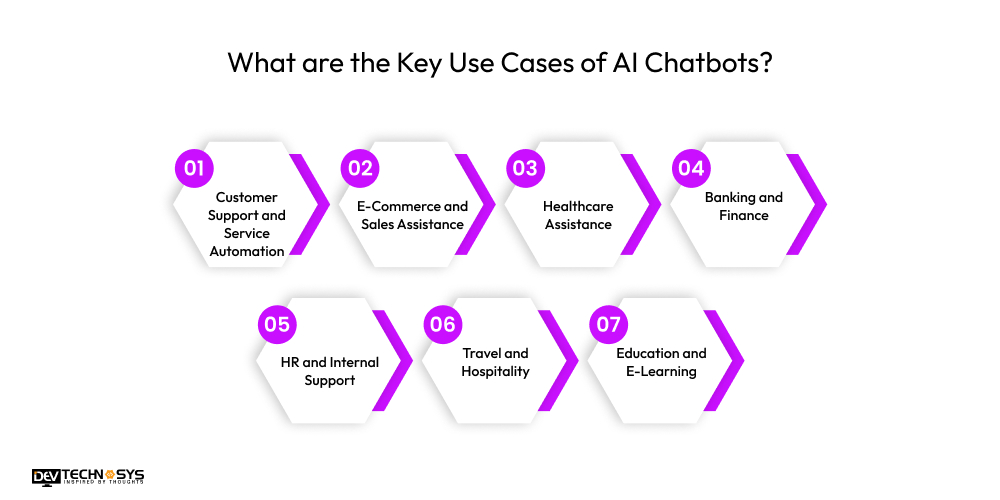
AI chatbots revolutionize interactions across industries by automating customer support, guiding e-commerce purchases, assisting in healthcare, banking, HR, travel, and education. They enhance efficiency, provide personalized experiences, reduce workloads, and ensure 24/7 intelligent, context-aware support for users worldwide. So, here are the key use cases of AI in chatbot applications:
1. Customer Support and Service Automation
AI chatbots are available 24/7 to answer repeated requests, FAQs, complaints, and troubleshooting. They cut wait times, deliver consistent replies, and free up human agents to handle difficult situations. By assessing user attitude and context, chatbots boost customer happiness, streamline processes, and assure effective service delivery, making them crucial for contemporary customer care.
2. E-Commerce and Sales Assistance
AI chatbots let users navigate product catalogs, propose things based on their interests, recover abandoned carts, and respond to order-related inquiries. They also manage promotions, oversee shipments, and respond to billing queries. Chatbots improve conversion rates, revenue, and the entire e-commerce experience by personalising conversations and simplifying the purchasing process.
3. Healthcare Assistance
Healthcare chatbots can do symptom checks, appointment scheduling, prescription reminders, and post-visit follow-ups. They minimize administrative duties, increase patient involvement, and assure prompt communication. Chatbots facilitate telemedicine and remote monitoring while ensuring anonymity, allowing patients to get healthcare more effectively and clinicians to focus on complicated medical duties.
4. Banking and Finance
AI chatbots may help with account questions, transactions, fraud detection, and financial advice. If businesses build a chatbot with Laravel, it provides real-time help for balance checks, fund transfers, and loan inquiries. Chatbots improve customer experience, cut wait times, and enable institutions to grow assistance quickly without requiring extra human personnel.
5. HR and Internal Support
AI chatbots automate HR processes such as onboarding, leave management, payroll inquiries, and IT help. They give immediate responses to employee inquiries and provide access to business policies or training resources. Chatbots improve internal communication and reduce administrative duties, increasing employee productivity, satisfaction, and overall organizational efficiency.
6. Travel and Hospitality
Travel chatbots let customers book flights, hotels, and experiences while offering real-time information. They promptly respond to itinerary inquiries, make trip recommendations, and manage cancellations or changes. Chatbots help travel and hospitality firms improve traveler comfort, happiness, and operational efficiency by providing personalized assistance and seamless support.
7. Education and E-Learning
AI chatbots help students by answering queries, recommending courses, and giving individualized learning aid. They can automate administrative chores such as enrollment and reminders while also tracking progress. Chatbots promote engagement, knowledge retention, and support for educational institutions by providing engaging, accessible, and adaptable learning experiences.
Architecture of AI-Powered Chatbots
AI chatbots rely on a multi-layered architecture that combines AI, natural language processing, machine learning, and interaction with external systems; they are not just straightforward written bots. Usually, the architecture has five main layers:
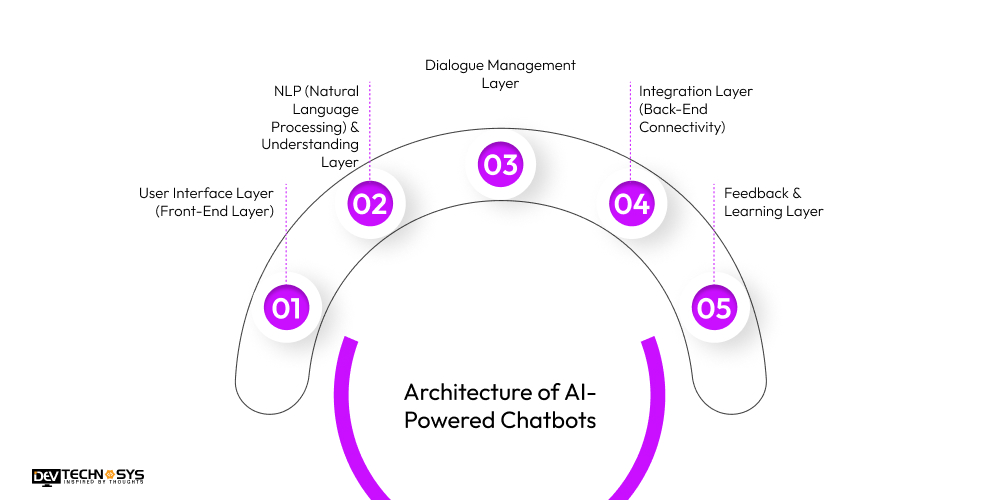
1. User Interface Layer (Front-End Layer)
- Purpose: This is the point of interaction between users and the chatbot.
- Components:
- Web chat interfaces
- Mobile app chat windows
- Messaging platforms (WhatsApp, Messenger, Slack, Telegram)
- Voice interfaces (Alexa, Google Assistant)
- Functions:
- Captures user input (text, voice, or button clicks).
- Displays chatbot responses in an intuitive, user-friendly format.
- Example: When a user types “Book a flight to Paris,” the UI layer collects the input and sends it to the processing engine.
2. NLP (Natural Language Processing) & Understanding Layer
- Purpose: This is the core AI component that allows the chatbot to understand and interpret human language.
- Components:
- Intent Recognition: Determines the purpose behind user input (e.g., “Book flight,” “Check balance”).
- Entity Extraction: Identifies key data points like names, dates, locations, or amounts.
- Context Management: Keeps track of conversation context for multi-turn dialogues.
- Functions:
- Converts unstructured human language into structured data the chatbot can act upon.
- Handles language variations, typos, and slang.
- Example: “I need a flight to Paris next Monday” → NLP identifies intent = “Book Flight,” entities = {Destination: Paris, Date: next Monday}.
3. Dialogue Management Layer
- Purpose: Determines how the chatbot should respond based on the input and context.
- Components:
- Rule-Based Logic: Predefined if-then rules for structured conversations.
- Machine Learning Models: Predicts the best response using previous interactions.
- Context Tracker: Maintains conversation state across multiple interactions.
- Functions:
- Generates appropriate responses.
- Decides when to ask clarifying questions.
- Handles multi-turn conversations intelligently.
- Example: If a user asks, “Can I change my flight?” the dialogue manager checks previous bookings and asks, “Which flight would you like to change?”
4. Integration Layer (Back-End Connectivity)
- Purpose: Connects the chatbot with external systems, databases, and APIs to fetch or store data.
- Components:
- CRM systems (Salesforce, HubSpot)
- E-commerce platforms (Shopify, Magento)
- ERP and HR systems
- Payment gateways and banking APIs
- Functions:
- Fetch user-specific information like order status, account balance, or appointment schedules.
- Update databases or trigger actions (e.g., booking tickets, processing payments).
- Example: The bot checks a flight booking system and confirms availability before responding to the user.
5. Feedback & Learning Layer
- Purpose: Enables continuous improvement of the chatbot through AI and machine learning.
- Components:
- Analytics Module: Tracks user interactions, drop-offs, and engagement metrics.
- Supervised Learning System: Improves accuracy using labeled conversation data.
- Reinforcement Learning Module: Learns optimal responses based on feedback or success metrics.
- Functions:
- Refines intent recognition and response generation.
- Detects knowledge gaps or recurring errors.
- Enhances personalization based on user behavior.
- Example: If a user frequently asks, “Do you have vegetarian meals?” the chatbot learns to proactively offer meal options for future queries.
7 Popular Real-World AI-Based Chatbots
Chatbots driven by AI are revolutionizing businesses by offering intelligent, round-the-clock support. These chatbots, such as ChatGPT, Drift, and Erica, improve user experiences, streamline operations, provide individualized advice, and increase engagement across many platforms globally, ranging from customer service and sales to healthcare, banking, and mental health.
1. ChatGPT (OpenAI)
OpenAI created ChatGPT, a conversational AI that can produce content, respond to queries, and carry on organic conversations. It is extensively utilized in content production, education, and customer service. ChatGPT is incredibly adaptable because of its sophisticated language understanding, which allows it to manage multi-turn discussions, offer thorough explanations, and modify replies according to user context.
2. Drift
Drift is a chatbot for business-to-business (B2B) sales and marketing that uses artificial intelligence. It answers questions, qualifies leads, schedules meetings, and interacts with website visitors in real time. Drift reduces the effort for human sales teams while increasing conversion rates, speeding up the sales funnel, and allowing companies to offer individualized assistance by automating client interactions.
3. Molly by Kaiser Permanente
Kaiser Permanente created Molly, an AI nursing assistant, to increase patient engagement. It answers frequently asked medical inquiries, records patient progress, and offers health advice. Molly helps lessen the administrative load on medical personnel, guarantees prompt follow-ups, and improves the patient experience when managing chronic diseases by automating regular healthcare communication.
4. H&M Chatbot
Customers may locate clothing products, browse the product catalog, and get styling advice via H&M’s AI chatbot. By identifying preferences and making pertinent product recommendations, it offers individualized shopping experiences. The chatbot enhances user engagement, expedites the purchasing experience, and increases online conversion rates by automating client inquiries and providing immediate assistance.
5. Sephora Virtual Artist
Customers can schedule in-store appointments, sample cosmetics virtually, and receive product suggestions using Sephora’s AI chatbot. By offering tailored advice based on skin tone, tastes, and past purchases, it improves shopping experiences through the use of AI and augmented reality. The bot bridges the gap between online and physical shopping experiences, increases consumer pleasure, and promotes online purchases.
6. Bank of America – Erica
Bank of America’s AI virtual assistant, Erica, assists clients with banking duties such as bill payment, balance queries, transaction searches, and financial guidance. Erica uses AI and predictive analytics to improve user engagement, identify anomalous activities, and offer proactive insights. It offers safe, customized banking experiences while increasing efficiency.
7. Woebot
Woebot is an AI-powered chatbot for mental health that offers advice on mental wellness and emotional support. Woebot detects mood trends, provides coping mechanisms, and engages users in everyday discussions using cognitive-behavioral approaches. It offers a broad range of people easily accessible, round-the-clock mental health care while easing the symptoms of stress, anxiety, and depression.

What Type of AI Models Are Used in Chatbot Development?
AI in enterprise chatbot development depend on sophisticated models to comprehend and reply with intelligence. Principal models encompass NLP for linguistic understanding, machine learning for responsive adaptation, deep learning for context-sensitive dialogues, reinforcement learning for enhanced interactions, and hybrid models integrating several AI methodologies. Collectively, they allow chatbots to provide tailored, human-like interactions.
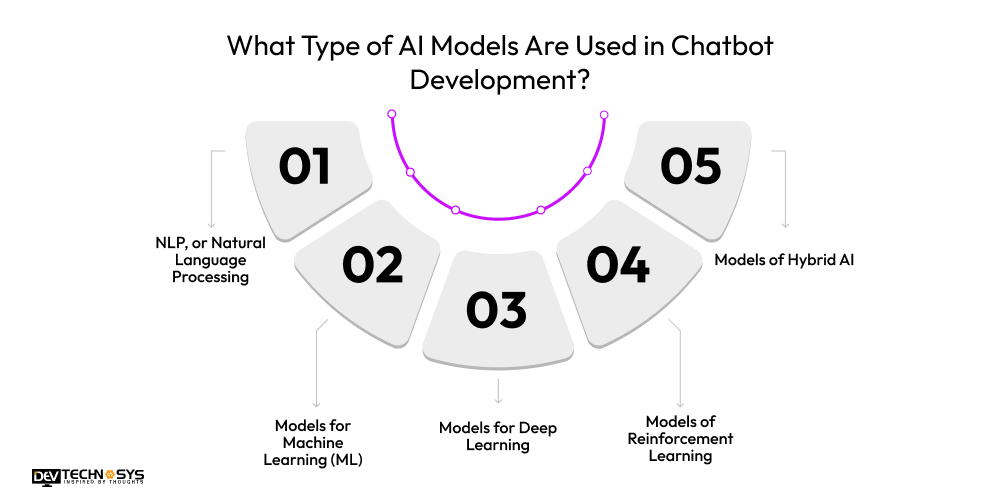
1. NLP, or Natural Language Processing
NLP gives chatbots the ability to decipher and comprehend human language. From text or voice inputs, NLU, a subset of NLP, extracts pertinent items and user intent. Together, they provide the fundamental intelligence of conversational AI, enabling chatbots to understand context, deal with changes in language, and produce meaningful replies.
2. Models for Machine Learning (ML)
Smart chatbot solutions can learn from conversations and get better over time thanks to machine learning algorithms. ML assists in anticipating suitable answers, streamlining communication, and improving customization by examining user queries, preferences, and behaviors. As they process more chats, these models allow for intelligent, adaptable chatbots that are more precise and efficient.
3. Models for Deep Learning
AI in customer support chatbots can manage intricate, multi-turn discussions thanks to deep learning models like transformers and recurrent neural networks (RNNs). They are quite good at deciphering mood, context, and subtle linguistic patterns. Chatbots can provide realistic, human-like replies because to deep learning, which improves conversational coherence and engagement.
4. Models of Reinforcement Learning
Chatbots can improve their replies by using reinforcement learning, which learns from incentives or feedback. These models modify conversation tactics to optimize task completion, user engagement, or satisfaction. Based on ongoing learning, chatbots can eventually improve their decision-making, manage unclear questions more skillfully, and deliver more pertinent, context-aware replies.
5. Models of Hybrid AI
To improve chatbot performance, hybrid AI models integrate many AI approaches, including rule-based systems, natural language processing, and machine learning. By utilizing the advantages of each model type, they enable chatbots to concurrently handle organized jobs, intricate inquiries, and multi-turn interactions. In practical applications, hybrid models provide adaptability, precision, and dependability.
What are the Challenges & Considerations of AI in Chatbot Development?
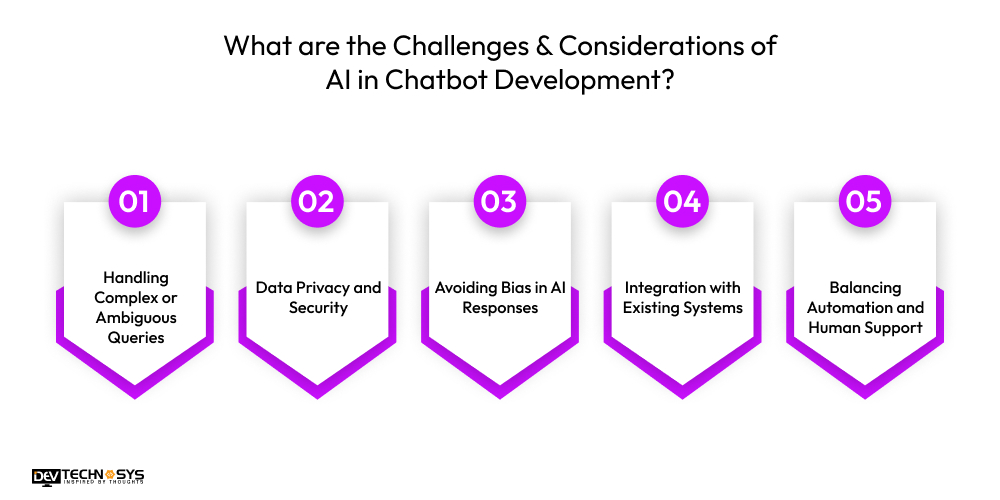
Handling complicated inquiries, protecting data privacy, avoiding biased replies, integrating with current systems, and striking a balance between automation and human help are some of the issues associated with developing AI chatbots. Taking care of these guarantees dependable, moral, and easy-to-use communication encounters.
1. Handling Complex or Ambiguous Queries
AI chatbots frequently struggle with ambiguous, imprecise, or extremely complicated requests. Misunderstanding user intent might result in inappropriate replies and dissatisfaction. Developers must provide robust NLP, backup techniques, and escalation mechanisms to human agents to ensure the chatbot can gracefully manage problems outside its capabilities while maintaining user experience.
2. Data Privacy and Security
Chatbots manage sensitive user data, such as personal, financial, and medical information. Ensuring compliance with privacy rules such as GDPR and HIPAA is crucial. Developers must utilize encryption, secure authentication, and stringent access restrictions to protect data from breaches while preserving user confidence and guaranteeing the ethical handling of personal information.
3. Avoiding Bias in AI Responses
AI chatbots learn from data, which may contain prejudice. Without sufficient monitoring, chatbots may produce prejudiced, disrespectful, or culturally insensitive replies. Developers of a hybrid app development company must carefully curate training data, integrate bias detection, and continually monitor interactions to guarantee fairness, inclusiveness, and ethical conduct across a wide range of user groups and settings.
4. Integration with Existing Systems
AI chatbots must work smoothly with CRM, ERP, databases, and third-party APIs. Poor integration can result in inaccurate data, failed transactions, and disrupted processes. To respond to user requests accurately, quickly, and reliably, developers must enable solid API connections, real-time data access, and cross-platform synchronization.
5. Balancing Automation and Human Support
AI-based chatbot applications can automate monotonous activities, but they cannot completely replace human judgment. Users may need escalation for complex issues or emotional help. Developers must create hybrid systems in which AI conducts regular activities while delegating complicated inquiries to human agents, ensuring efficiency without sacrificing quality, empathy, or customer happiness.

What are the Future Trends in AI Chatbots?
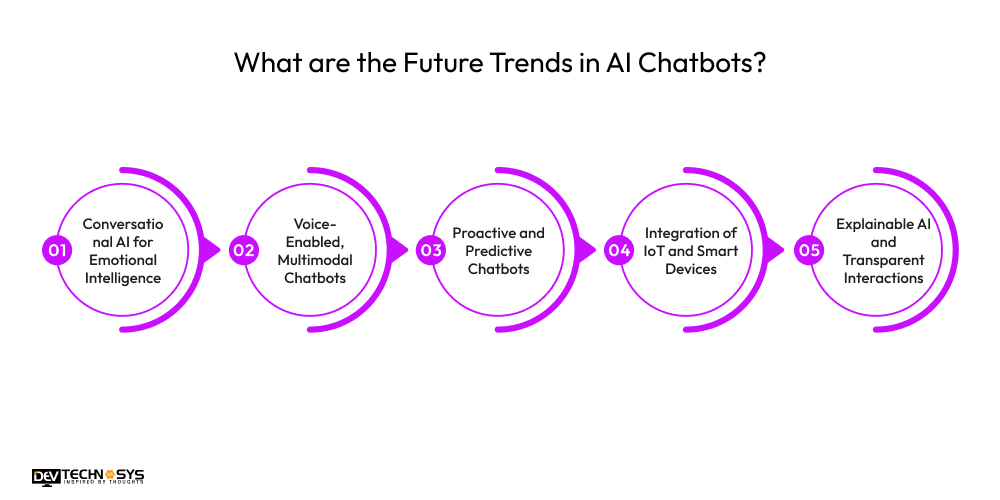
Trends including emotional intelligence, voice and multimodal interactions, proactive support, IoT connectivity, and explainable AI are driving the evolution of AI chatbots. These enterprise mobile application development services will make it possible to have interactions that are more intelligent, transparent, context-aware, and tailored, turning chatbots into essential digital assistants for a variety of global sectors.
1. Conversational AI for Emotional Intelligence
Future of AI in chatbot will identify users’ emotions, tone, and attitude in order to give sympathetic, context-aware replies. Chatbots that recognize emotions may adjust interactions, provide emotional support, and boost user engagement, making discussions more human-like and increasing consumer satisfaction in areas such as healthcare, banking, and customer service.
2. Voice-Enabled, Multimodal Chatbots
Speech AI and multimodal chatbots will blend text, speech, visuals, and gestures to provide more engaging conversations. Users will converse naturally across several platforms, including smart speakers, mobile apps, and AR/VR settings. This approach improves accessibility, convenience, and user engagement, incorporating chatbots into everyday digital encounters.
3. Proactive and Predictive Chatbots
Future chatbots will anticipate user demands by leveraging predictive analytics and historical data. Instead of responding to questions, they will provide proactive suggestions for tasks, reminders, or recommendations. This strategy improves productivity, customization, and customer loyalty by changing chatbots from reactive helpers to intelligent, predictive digital agents.
4. Integration of IoT and Smart Devices
AI chatbots will increasingly operate and interact with IoT devices, allowing for seamless automation in smart homes, businesses, and healthcare. According to the mobile app development company in Dubai, they will manage connected devices, monitor sensors, and deliver real-time information, resulting in highly personalised, intelligent, and automated settings for people.
5. Explainable AI and Transparent Interactions
As chatbots evolve, explainable AI will promote openness in decision-making. Users will learn how answers or suggestions are created. This trend fosters trust, assures responsibility, and allows businesses to comply with rules while providing intelligent, ethical, and dependable chatbot experiences.
Conclusion
AI in chatbot development is transforming how businesses interact with customers by providing intelligent, 24/7 support, personalized experiences, and streamlined operations. From understanding complex queries through advanced NLP to integrating with backend systems, their architecture ensures efficiency and scalability. With real-world applications across healthcare, finance, e-commerce, and education, investing in chatbot solutions is essential. Partnering with a reliable artificial intelligence development company in Middle East can help organizations leverage AI effectively, build smarter chatbots, and stay ahead in the competitive digital landscape.
Frequently Asked Questions
Q1. What is an AI chatbot?
An AI chatbot is a software program that employs machine learning, natural language processing, and artificial intelligence to answer questions, have human-like conversations with users, and correctly and effectively automate activities in a variety of sectors.
Q2. How Does AI Improve Chatbot Functionality?
Natural language comprehension, context awareness, predictive replies, and tailored interactions are all made possible by AI, which improves chatbots. It enables bots to handle complicated inquiries, learn from discussions, and provide intelligent, human-like consumer experiences.
Q3. How Do Chatbots Handle Complex Conversations?
AI chatbots analyze intent, extract entities, and sustain multi-turn conversation flow using natural language processing, dialogue management, and context monitoring, guaranteeing precise and cohesive answers to challenging user inquiries.
Q4. What Industries Use AI Chatbots?
In order to automate processes, increase engagement, and offer round-the-clock intelligent help, AI chatbots are extensively utilized in e-commerce, healthcare, finance, HR, education, travel, hospitality, and customer service.
Q5. Can AI Chatbots Replace Human Agents?
Although they can automate tedious work, AI chatbots cannot completely replace people. To guarantee quality and satisfaction, human interaction is still necessary for complex, nuanced, or emotionally sensitive issues.