





Quick Summary:
Modern healthcare apps in 2026-2027 support telemedicine, remote monitoring, digital pharmacies, patient portals, and connected clinical workflows.
Healthcare enterprises search for experts who offer security, compliance, integration, scalability, and post-launch support.
Dev Technosys, EPAM, HCLTech, Cognizant, IBM, TCS, Infosys, Deloitte, and others are a few of the top healthcare app development companies.
The average cost to develop a healthcare app ranges between $45,000 and $135,000. It takes almost 3 to 7+ months to build a healthcare app.
The healthcare industry is increasingly becoming software-driven in 2026-2027. Now patients expect easy access to their appointments, medications, medical records, consultation services, health tracking, and telehealth solutions.
At the same time, healthcare companies need technology that integrates fragmented systems while keeping patients’ private data safe. Entrepreneurs, hospitals, clinics, pharmacies, healthtech startups, and existing healthcare companies have a great opportunity to create a dedicated digital solution.
But choosing a healthcare app development company can be complicated.
A development partner may be experienced in mobile development but lack experience with healthcare projects. Another company may be perfect for enterprise-level business but completely unfit for startups with an MVP budget.
Instead of choosing only by company size, this list analyzes companies depending on healthcare expertise, development skills, and scalability.
Top 10 Healthcare App Development Companies With Expertise To Consider In 2026-2027
Before hiring a development partner, compare healthcare software development companies based on what they’re best suited for. We compared the 10 top healthcare app development companies in 2026-2027 based on best for, business size, industry focus, and global delivery.
| Company | Best For | Ideal Business Size | Healthcare Focus | Global Delivery |
| Dev Technosys | Custom healthcare apps & startup products | Startups to Enterprise | Strong | High |
| Coforge | Healthcare digital transformation | Mid-size to Enterprise | Strong | High |
| HCLTech | Enterprise healthcare engineering | Mid-size to Enterprise | Strong | Very High |
| IBM | AI, cloud & enterprise healthcare | Enterprise | Strong | Very High |
| Wipro | Scalable healthcare applications | SMB to Enterprise | Strong | Very High |
| Globant | Digital health UX & product engineering | Startups to Enterprise | Moderate-Strong | High |
| Infosys | Healthcare modernization & automation | Mid-size to Enterprise | Strong | Very High |
| GlobalLogic | Healthcare product engineering | Startups to Enterprise | Strong | High |
| Xebia | Cloud-native healthcare solutions | Growing to Enterprise | Strong | High |
| UST | Digital healthcare modernization | Mid-size to Enterprise | Strong | High |
Best 20 Healthcare App Development Companies in 2026-2027
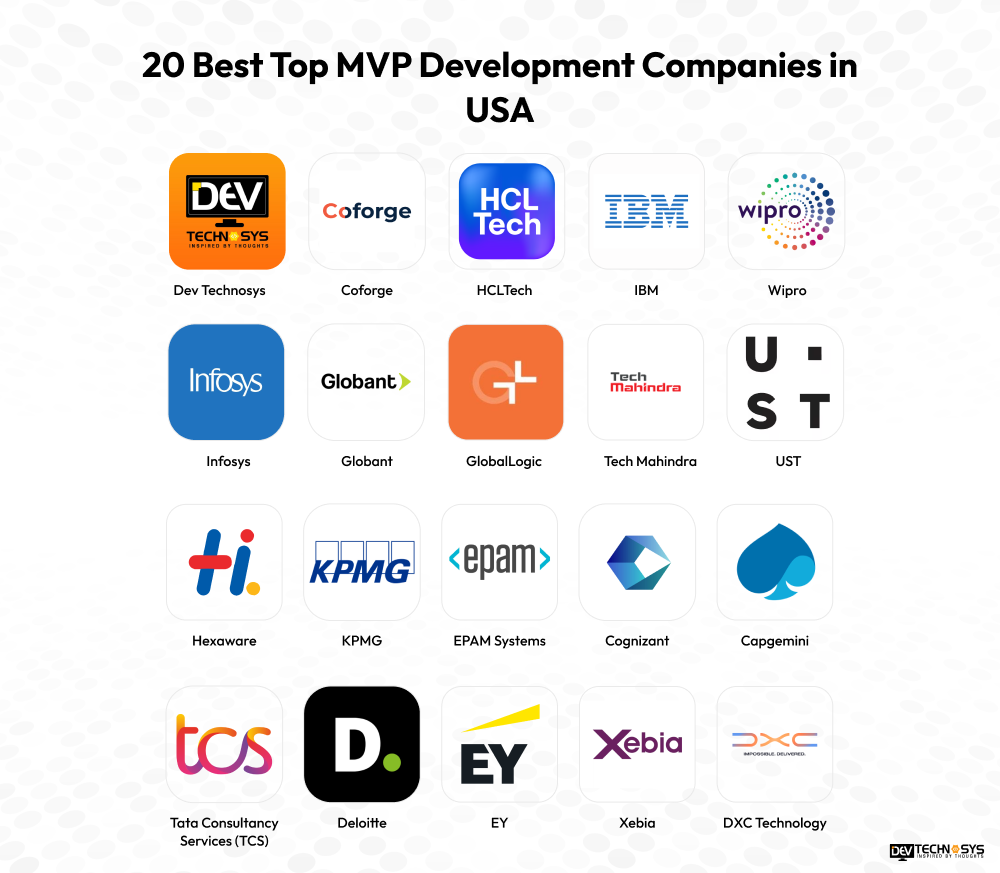
Dev Technosys, Tech Mahindra, Infosys, Hexaware, Wipro, and KPMG are among the best healthcare app development companies. Here, we will explain their expertise, top services, and how they help businesses develop a healthcare platform.
1. Dev Technosys
Dev Technosys is listed among the top healthcare app development companies in 2027. It suits startups and enterprises looking to build custom healthcare applications without limiting the product to a basic mobile interface.
With 16+ years of experience and 2,900+ delivered projects across 71+ countries, Dev Technosys works across healthcare and other technology domains. Its healthcare development capabilities cover solutions such as patient portals, telemedicine platforms, medicine delivery apps, healthcare software, and custom mobile applications. For healthcare startups, the company can support the journey from MVP development to feature expansion, integrations, maintenance, and scaling.
Top Healthcare App Development Services:
-
- Healthcare Mobile App Development
- Telemedicine App Development
- Patient Portal Development
- Medicine Delivery App Development
Healthcare Software Development
- EHR/EMR Integration
- Healthcare App Maintenance
- AI-Powered Healthcare Solutions
2. Coforge
Coforge focuses on digital transformation and technology modernization across industries, including healthcare. Healthcare businesses can consider Coforge when their application requires integration with existing systems, workflow automation, analytics, and scalable digital infrastructure.
Top Services:
- Healthcare Technology
- Digital Transformation
- Application Development
- Data Analytics
- Process Automation
- Cloud Services
3. HCLTech
HCLTech, the top healthcare app developers, suits healthcare organizations seeking enterprise-grade engineering and modernization capabilities. The company supports healthcare businesses with digital platforms, cloud solutions, data technologies, automation, and application modernization. This makes it particularly relevant for established organizations replacing fragmented or legacy technology environments.
Top Services:
- Healthcare Application Development
- Cloud Computing
- Digital Engineering
- Healthcare Platforms
- Automation
- Application Modernization
4. IBM
IBM is a suitable option for enterprises exploring healthcare applications involving AI, hybrid cloud, data analytics, cybersecurity, and enterprise integration. Its technology ecosystem makes it particularly relevant to healthcare organizations that need advanced infrastructure and data capabilities alongside application development.
Top Services:
- AI & Machine Learning
- Healthcare Data Solutions
- Hybrid Cloud
- Cybersecurity
- Enterprise Software
- Data Analytics
5. Wipro
Wipro is one of the leading healthcare app development companies. It provides healthcare technology and digital engineering capabilities for businesses looking to modernize healthcare applications and infrastructure. Its capabilities can support applications involving cloud, automation, analytics, mobile experiences, and connected healthcare workflows.
Top Services:
Healthcare CRM Software Development
- Digital Engineering
- Cloud Services
- Automation
- Data Analytics
- Healthcare IT
6. Globant
Globant is particularly relevant for healthcare products where user experience, digital product design, AI, and modern application engineering are important. For startups competing in consumer-facing digital health, UX can become a major differentiator. Their healthcare mobile app developers make the product engineering and experience design valuable.
Top Services:
- Healthcare App Development
- UX/UI Design
- Digital Product Engineering
- AI Development
- Cloud Solutions
- Digital Innovation
7. Infosys
Infosys stands out among healthcare app development companies worldwide. It helps healthcare organizations modernize applications, automate workflows, and adopt cloud and data technologies. Its enterprise capabilities make it relevant for healthcare businesses looking to connect existing technology environments with newer digital applications.
Top Services:
- Healthcare Technology
- Application Modernization
- Cloud Platforms
- Automation
- Data Analytics
- Digital Transformation
8. GlobalLogic
Our list features GlobalLogic as a well-known healthcare software developer. It focuses strongly on digital product engineering, making it relevant for healthcare businesses building differentiated digital products. Its capabilities include product engineering, UX, cloud development, and healthcare software development.
Top Services:
- Healthcare Product Engineering
- Mobile App Development
- UX/UI Design
- Cloud Development
- Digital Engineering
- Healthcare Software
9. Tech Mahindra
Tech Mahindra is a strong candidate for organizations building connected healthcare ecosystems rather than isolated applications. Its capabilities span digital health, cloud, AI, mobile development, data, and enterprise technology. This can support healthcare platforms that connect patients, providers, administrators, and other stakeholders.
Top Services:
Telemedicine App Development Services
- AI & Automation
- Digital Health Solutions
- Cloud Services
- Data Engineering
- Enterprise Solutions
10. UST
UST supports healthcare organizations with digital modernization, application engineering, cloud adoption, and technology transformation. It can be considered by growing healthcare businesses that need to modernize their technology stack while maintaining enterprise scalability.
Top Services:
- Healthcare Technology
- Digital Engineering
- Cloud Migration
- Application Development
- Data & Analytics
- Digital Modernization
11. Hexaware
Hexaware is worth considering for healthcare businesses focused on cloud adoption, automation, and application modernization. Its technology capabilities can support healthcare platforms that need scalable infrastructure, automated workflows, analytics, and integration with existing systems.
Top Services:
- Healthcare Technology
- Cloud Solutions
- Application Modernization
- AI & Automation
- Data Engineering
- Digital Transformation
12. KPMG
KPMG is particularly relevant when risk, governance, compliance, and healthcare transformation are major considerations. Rather than focusing exclusively on application coding, KPMG brings consulting and technology capabilities. It helps larger healthcare organizations plan digital transformation programs around regulatory and operational requirements.
Top Services:
- Healthcare Technology Consulting
- Compliance & Risk Advisory
- Digital Transformation
- Data & Analytics
- Cybersecurity
- Healthcare Strategy
13. EPAM Systems
EPAM Systems is well-suited to businesses developing complex healthcare products that require sophisticated engineering, cloud infrastructure, APIs, and enterprise-level integration. Its strength lies in engineering-heavy digital transformation projects where healthcare applications need to communicate with multiple systems and support large user bases.
Top Services:
-
- Healthcare Software Engineering
- Digital Health Platforms
- Cloud Engineering
- API Development
- Data & Analytics
- Fitness App Development
14. Cognizant
Cognizant is a strong choice for enterprises looking to build or modernize large healthcare technology ecosystems. Its capabilities cover healthcare consulting, cloud engineering, digital platforms, data, AI, and cybersecurity. This makes it suitable for organizations managing complex healthcare workflows and integrations.
Top Services:
- Healthcare Application Development
- Cloud Engineering
- Digital Health
- AI & Data Analytics
- Cybersecurity
- Enterprise Platforms
15. Capgemini
Capgemini works with healthcare organizations on digital transformation, cloud adoption, application modernization, and enterprise technology. It can be considered for large healthcare products requiring integration between digital applications and existing enterprise systems.
Top Services:
- Healthcare Technology
- Cloud Transformation
- Digital Engineering
- Application Modernization
- Data & AI
- Cybersecurity
16. Tata Consultancy Services (TCS)
To develop an app like BetterMe, TCS is a major enterprise technology provider. It offers healthcare capabilities spanning application development, cloud, data, automation, and digital transformation. It is generally better suited to organizations with larger technology programs and complex enterprise requirements.
Top Services:
- Healthcare Software Development
- Enterprise Application Development
- Cloud Services
- Data & Analytics
- Digital Transformation
- AI Solutions
17. Deloitte
Deloitte combines healthcare consulting, technology strategy, risk management, and digital transformation. It can be a strong option for enterprises where technology decisions involve significant organizational, regulatory, operational, or transformation considerations.
Top Services:
- Healthcare Technology Consulting
- Digital Transformation
- Risk & Compliance
- Data & Analytics
- Cybersecurity
- Technology Strategy
18. EY
EY supports healthcare organizations with technology consulting, digital transformation, risk management, and modernization initiatives. It is particularly relevant for larger healthcare businesses that need strategic guidance alongside technology implementation.
Top Services:
- Healthcare Technology Consulting
- Digital Strategy
- Technology Transformation
- Risk Advisory
- Data Solutions
- Cybersecurity
19. Xebia
Xebia is a suitable option for organizations prioritizing cloud-native development, DevOps, data engineering, and modern application architecture. Healthcare startups and enterprises building scalable platforms can consider its cloud and engineering capabilities when infrastructure flexibility is a major requirement.
Top Services:
- Meditation App Development
- Cloud Solutions
- DevOps
- Data Engineering
- Agile Development
- Application Modernization
20. DXC Technology
DXC Technology is one of the healthcare app development companies for startups. It is particularly relevant to healthcare organizations dealing with legacy infrastructure and complex enterprise environments. Its healthcare technology capabilities focus on modernization, cloud, managed services, application transformation, and connected IT ecosystems.
Top Services:
- Healthcare IT Modernization
- Cloud Transformation
- Application Services
- Managed IT Services
- Data Solutions
- Enterprise Technology
Answer a few quick questions and our experts will share a tailored project estimate.
Security & Compliance: What Should You Expect From a Healthcare App Development Company?
Healthcare, fitness, or pet care app development handles sensitive information. It includes PHI, medical records, prescriptions, insurance information, patient identities, and payment data. Security therefore needs to be considered during architecture and development. These should not be added after the application is finished.
When evaluating a healthcare app development company, check whether its development and infrastructure practices can support applicable security, privacy, and healthcare requirements.
Security / Compliance Area |
Why It Matters for Healthcare Apps |
| ISO 27001 | Establishes an information security management framework |
| ISO 9001 | Supports quality management processes |
| SOC 1 | Evaluates controls relevant to financial reporting |
| SOC 2 | Assesses controls around security, availability, confidentiality, privacy, and related trust principles |
| GDPR | Protects personal data of individuals in the EU/EEA |
| CCPA/CPRA | Governs privacy rights and personal information in California |
| HIPAA | Protects PHI handled by covered entities and business associates in the US |
| HITECH | Strengthens HIPAA-related privacy, security, and breach requirements |
| HITRUST CSF | Provides a framework for managing healthcare information security risks |
| NIST Frameworks | Helps organizations structure cybersecurity risk management |
| PCI DSS | Important when healthcare applications process payment-card data |
| HL7/FHIR | Supports standardized healthcare data exchange and interoperability |
| BAA Readiness | Important when a vendor handles PHI as a healthcare business associate |
What Should a Healthcare App Development Company Actually Provide?
Do not select a company simply because its website lists compliance names. Ask how those requirements are reflected in the actual product architecture.
Look for:
- Encryption: TLS/HTTPS for data in transit and AES-256 or equivalent encryption at rest where supported by the infrastructure.
- Access Control: RBAC, least-privilege access, MFA, and secure authentication.
- Auditability: Detailed audit logs for sensitive data access and administrative actions.
- API Security: Secure APIs, authentication, authorization, rate limiting, and monitoring.
- Data Governance: Defined rules for collecting, storing, accessing, retaining, and deleting healthcare data.
- Secure Infrastructure: Isolated environments, secure cloud configurations, backups, monitoring, and vulnerability management.
- Privacy Controls: Consent management, data minimization, appropriate retention, and privacy-by-design practices.
- Testing: Security testing, vulnerability assessment, penetration testing, and regular remediation.
- Compliance Documentation: Clear evidence of applicable certifications, assessments, policies, and contractual arrangements such as a BAA when required.
Important Tip:
ISO 27001 or SOC 2 certification does not automatically make an application HIPAA compliant. The development company should be able to explain which compliance requirements apply to your product. Also, it should explain how it will implement them across architecture, infrastructure, development, and operations.
Narayan Das (Healthcare IT Expert at Dev Technosys)
How To Choose A Healthcare App Development Company In 2026-2027?
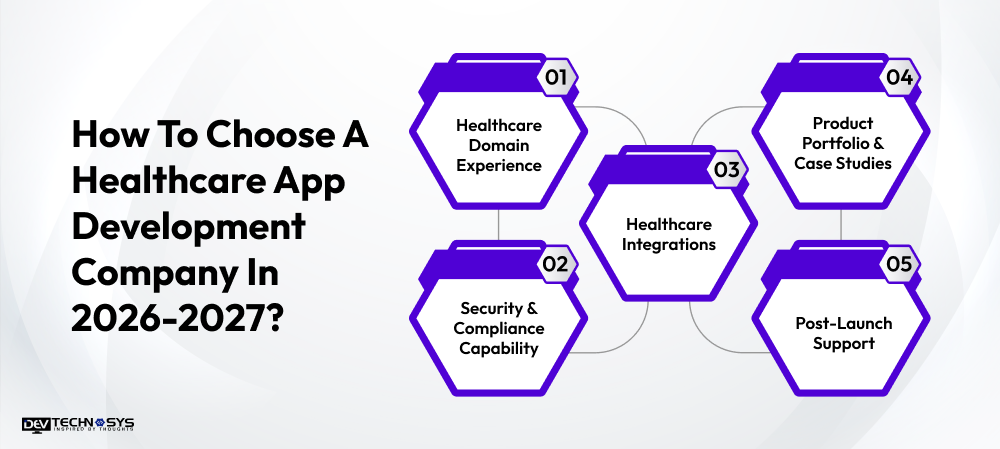
Choosing a healthcare app development company requires more than comparing portfolios or development rates. Evaluate its healthcare expertise, security capabilities, integration experience, previous work, support model, and pricing structure to reduce technical and compliance risks.
1. Healthcare Domain Experience
Choose a company with practical healthcare experience across telemedicine, patient portals, EHR/EMR, e-prescriptions, remote patient monitoring, hospital management, clinical applications, and pharmacy apps. Familiarity with healthcare workflows can reduce development errors and help your product address real operational requirements.
2. Security & Compliance Capability
Healthcare applications handle sensitive patient information, so security should be evaluated before development begins. Check experience with HIPAA, HITECH, ISO 27001, ISO 9001, SOC 1, SOC 2, GDPR, CCPA, HITRUST, encryption, access controls, audit logs, and secure APIs.
3. Healthcare Integrations
Healthcare applications rarely operate independently. Your development partner should understand integrations with EHR/EMR systems, laboratories, pharmacies, insurance platforms, payment gateways, and wearables. Experience with HL7, FHIR, FHIR APIs, REST APIs, and healthcare data exchange can simplify future expansion.
4. Product Portfolio & Case Studies
Review relevant healthcare case studies instead of relying on company logos or generic portfolios. Examine the actual functionality, technologies, integrations, client feedback, deployment experience, and business outcomes. This helps determine whether the company’s expertise matches your healthcare product requirements.
5. Post-Launch Support
Healthcare applications require continuous technical maintenance after deployment. Confirm whether the company provides security patches, bug fixes, operating-system updates, API maintenance, performance monitoring, compliance updates, infrastructure support, and feature enhancements. Reliable post-launch support keeps the product secure, functional, and scalable.
Final Thoughts
Selecting a healthcare app development company for custom solutions essentially boils down to choosing the right product. The ideal choice will be a firm that knows about your healthcare:
- Workflow
- Target audience
- Business model
- Regulations
- Requirements
- Budget prior to any development work
If you are a startup, choose a company that can help you develop an MVP without building technical debt. For enterprises, there is more focus on integration, security architecture, governance, scalability, and support.
A reliable healthcare app development company could prove to be a good choice for both startups and enterprises.
FAQs
1. How Much Does It Cost to Build a Healthcare App in 2026?
The average healthcare app development cost can range from $45,000 to $135,000+. A basic MVP may cost around $30,000–$60,000, while advanced healthcare platforms with EHR integration, AI, telemedicine, remote monitoring, or extensive compliance requirements can exceed $100,000. The final budget depends on features, integrations, platforms, security, compliance, and development location.
2. What Should I Check Before Hiring a Healthcare App Development Company?
Check healthcare domain experience, previous projects, security practices, compliance knowledge, EHR/EMR integration experience, HL7/FHIR capabilities, development methodology, team composition, communication process, and post-launch support. Also ask for a detailed scope and cost estimate instead of selecting a company based only on its hourly rate.
3. Does My Healthcare App Development Company Need to Be HIPAA Certified?
The US government does not issue a general “HIPAA certification.” Instead, the application and organizations handling protected health information must meet applicable HIPAA requirements. If your development partner will function as a business associate, determine whether a Business Associate Agreement (BAA) is required and ask how the company will support your HIPAA compliance obligations.
4. How Do I Know Whether a Healthcare App Development Company Takes Security Seriously?
Ask for evidence rather than relying on marketing claims. Review relevant ISO 27001, SOC 2, HIPAA-related experience, security testing practices, encryption, access controls, audit logging, vulnerability management, secure API architecture, and incident-response procedures. Also ask exactly which controls the company will implement for your application.
5. Should a Healthcare Startup Build an MVP Before Developing the Full App?
Usually, yes, when the product concept still needs market validation. An MVP can focus on the core patient, provider, pharmacy, or business workflow before investing in advanced integrations and automation. The key is to design the underlying architecture so security, data privacy, and future scalability aren’t afterthoughts.