





Key Takeaways
The POS software development cost in UAE typically starts at around $15,000 and can exceed $55,000, depending on business complexity, locations, integrations, hardware, security requirements, and scalability needs.
Cost Based on POS Software Complexity:
- Basic POS ($15,000–$25,000): Suitable for single-store businesses requiring core billing, inventory management, sales tracking, employee access, receipt generation, and basic reporting.
- Multi-Location POS ($25,000–$40,000): Designed for growing businesses needing centralized inventory, customer management, payment integrations, branch reporting, and real-time synchronization.
- Advanced POS ($40,000–$55,000+): Built for retail chains and enterprise operations requiring complex integrations, hardware connectivity, offline functionality, advanced analytics, granular permissions, and scalable infrastructure.
Cost Based on Business Type:
- Retail POS ($20,000–$45,000): Inventory, barcode scanning, promotions, and customer management influence the overall budget.
- Restaurant POS ($20,000–$45,000): Table management, kitchen workflows, menus, and payment processing add to the scope.
- Grocery POS ($25,000–$50,000): Large product catalogs, barcode scanning, stock synchronization, and pricing workflows increase complexity.
- Café and Salon POS ($15,000–$30,000): Generally focused on billing, payments, customer management, loyalty, appointments, or employee management.
- Pharmacy POS ($25,000–$50,000+): Product tracking, inventory management, permissions, and compliance requirements can increase development costs.
- Hospitality POS ($30,000–$55,000+): Multi-outlet operations, centralized management, integrations, and reporting create greater technical complexity.
Ways to Control POS Development Costs:
- Prioritize business-critical functionality before advanced features.
- Use phased development to spread investment across planned releases.
- Integrate only the third-party platforms required for current operations.
- Define workflows, users, hardware, integrations, and reporting requirements before development.
- Choose scalable architecture without overengineering the initial system.
- Focus on reducing unnecessary complexity rather than cutting essential security or reliability requirements.
The biggest mistake businesses make when budgeting for custom POS software is to assume the first development quote is the final cost. That number can change if you start to look at integrations, numerous outlets, hardware compatibility, security requirements, and regulatory considerations.
A single-store merchant may need a fairly simple system, but a developing business may need consolidated inventory, numerous payment choices, staff permissions, and real-time reporting across multiple locations. The scope of each demand is added, and the POS software development cost in UAE might shift.
The upfront quote is only part of the story. Knowing what is included in the budget, where unexpected costs may occur, and which criteria should be prioritized makes it easier to realistically evaluate a proposal and plan the investment with more confidence.
What Does Custom POS Software Actually Cost in UAE?
For a UAE business, custom POS software can start at around $15,000 for a focused single-store system and exceed $55,000 as the platform becomes more complex. The final figure depends less on the word “POS” and more on the business processes, integrations, locations, and infrastructure the software needs to support.
POS Type |
Estimated Cost |
Best Suited For |
Typical Scope |
| Basic POS | $15K–$25K | Single-store businesses | Core billing, inventory management, sales tracking, employee access, receipt generation, basic reporting |
| Multi-Location POS | $25K–$40K | Growing businesses with multiple outlets | Centralized inventory, customer management, payment integrations, branch reporting, real-time synchronization |
| Advanced POS | $40K–$55K+ | Retail chains and enterprise operations | Complex integrations, hardware connectivity, offline functionality, advanced analytics, granular permissions, scalable infrastructure |
These figures are planning estimates rather than fixed quotations. A business with fewer features but complex integrations could cost more than a feature-rich system with a simpler setup. The specific requirements ultimately determine the POS software development cost in UAE.
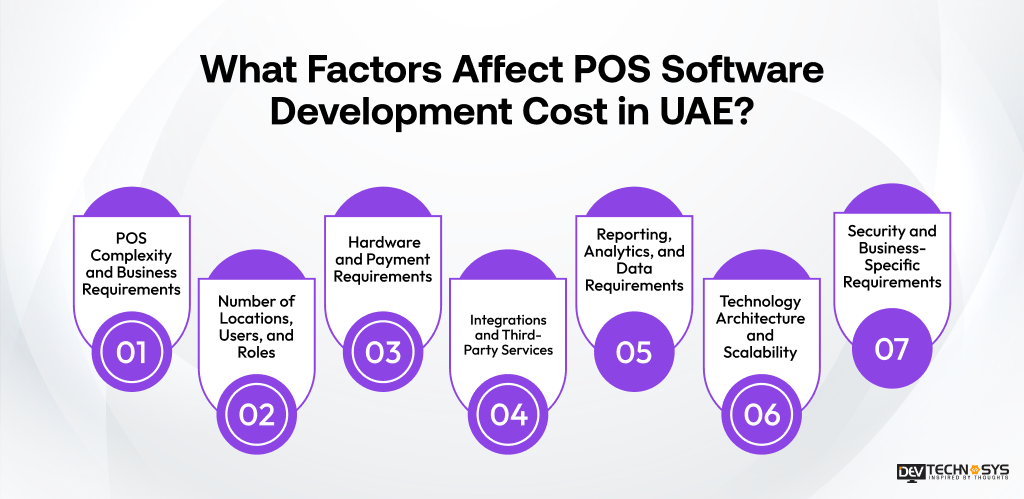
What Factors Affect POS Software Development Cost in UAE?
A custom POS quote is shaped by more than the number of features on a checklist. The real cost depends on how the software needs to work with your business, employees, locations, payments, hardware, data, and existing systems.
1. POS Complexity and Business Requirements
A focused billing system is less demanding than a POS that also handles inventory management, sales tracking, customer management, employee management, loyalty, and advanced reporting. If a business also needs to build inventory management software into the POS ecosystem, stock movement, product variants, warehouse control, and synchronization can add considerable scope to the project.
2. Number of Locations, Users, and Roles
A single-store POS has a simpler structure than a system serving multiple outlets. Branch-level permissions, centralized administration, shared inventory, and real-time synchronization introduce additional complexity. Multi-location POS architecture also needs to keep data consistent across stores and users.
3. Hardware and Payment Requirements
Barcode scanners and receipt printers are relatively straightforward compared with more complex payment and hardware environments. Card terminals, NFC payment integration, contactless payment integration, and other peripherals may require additional compatibility work and testing, increasing the overall POS application development cost.
4. Integrations and Third-Party Services
Integrations can have a noticeable effect on POS integration cost. Payment gateways, accounting software, ERP platforms, CRM systems, e-commerce stores, and delivery services may each require separate API work, authentication, data mapping, testing, and error handling. Working with a custom software development company can also help businesses assess integration requirements before finalizing the scope.
5. Reporting, Analytics, and Data Requirements
Basic sales reports require less work than real-time dashboards covering inventory, employee performance, customers, and multiple branches. Advanced reporting can increase the budget because the system needs more sophisticated data processing, database structures, dashboards, and analytics capabilities.
6. Technology Architecture and Scalability
The underlying architecture also influences cost. A simple POS may need a straightforward application structure, while a growing business may require POS system architecture, cloud infrastructure, real-time synchronization, offline functionality, or a microservices-based POS. Building for future scale can increase the initial investment but reduce the need for major restructuring later.
7. Security and Business-Specific Requirements
Role-based access, encryption, audit logs, backup systems, fraud controls, and customized business workflows can add further engineering and testing requirements. These considerations become particularly important when the POS handles sensitive payment and customer information.
Insight
According to the UAE Ministry of Finance, the country’s eInvoicing system is being introduced through a phased rollout, with implementation beginning for selected businesses in 2026 and expanding to additional businesses in 2027.
POS Software Development Cost by Business Type
The type of business has a direct effect on POS pricing because each operation handles different products, transactions, workflows, and integrations. A focused café POS can cost considerably less than a system built for a multi-outlet hospitality business. Those starting to plan for an online retail business should account for these connected requirements.
Business Type |
Estimated Cost |
Typical Scale |
Key Cost Drivers |
| Retail | $20K–$45K | Single or multiple stores | Inventory, barcode scanning, promotions, customer management |
| Restaurant | $20K–$45K | Single or multi-outlet | Table management, kitchen workflows, menu, payments |
| Grocery | $25K–$50K | High-volume retail | Large inventory, barcode scanning, stock sync, pricing |
| Café | $15K–$30K | Single or small chain | Billing, menu, payments, loyalty |
| Pharmacy | $25K–$50K+ | Single or multiple stores | Product tracking, inventory, permissions, compliance |
| Salon | $15K–$30K | Single or multi-branch | Appointments, employee management, customers, payments |
| Hospitality | $30K–$55K+ | Multi-department / multi-outlet | Centralized operations, integrations, reporting |
These figures are planning estimates, not fixed industry rates. The actual budget depends on the required scope, integrations, number of locations, and operational complexity. For broader retail technology planning, retail software development cost in UAE can provide additional context.
How Much Do POS Integrations Cost?
Integration costs vary because each connection has different data and operational requirements. A payment gateway may involve a relatively focused transaction flow, while an ERP integration can require continuous synchronization of sales, inventory, invoices, and financial records.
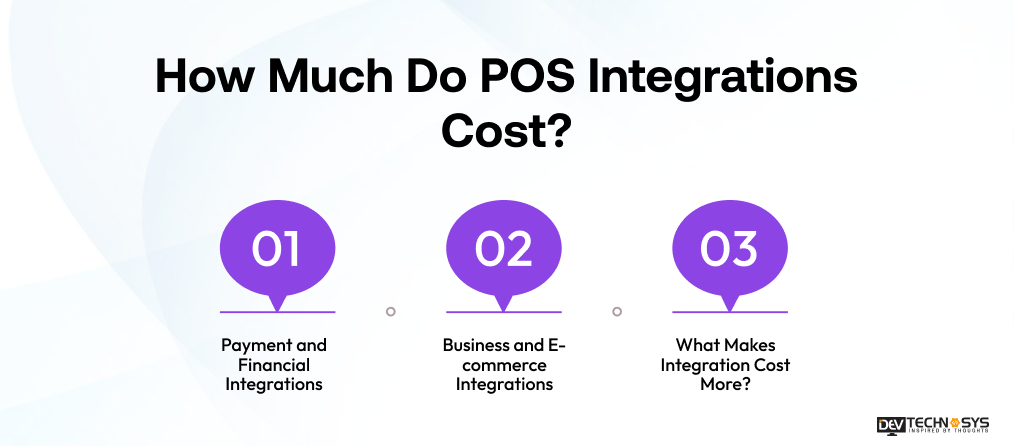
1. Payment and Financial Integrations
Payment gateway integration can cover card payments, digital wallets, refunds, transaction status, and reconciliation. Supporting several payment providers or payment methods can increase the POS integration cost, particularly when each requires separate API handling and testing.
2. Business and E-commerce Integrations
Accounting, ERP, CRM, e-commerce, delivery, and loyalty integrations usually require data to move reliably between systems. Businesses that build an e-commerce website may also need POS synchronization for products, orders, pricing, and inventory. More complex data mapping and real-time synchronization can increase the cost.
3. What Makes Integration Cost More?
The POS API integration cost depends on API complexity, authentication, data mapping, webhooks, error handling, documentation, and testing requirements. An API-driven POS platform with well-documented third-party APIs is generally easier to connect than a system with limited API access or highly customized workflows.
Integration |
What It Connects |
Estimated Cost |
| Payment gateway | Cards, wallets, refunds, transaction status | $1K–$4K |
| Accounting / ERP | Sales, invoices, inventory, financial data | $3K–$10K+ |
| E-commerce / CRM | Orders, products, customers, pricing | $2K–$8K+ |
| Delivery / Loyalty | Orders, delivery status, rewards, customer data | $2K–$6K+ |
| Hardware APIs | Terminals, scanners, printers, cash drawers | $1K–$5K+ |
How Much Does POS Hardware Add to the Cost?
Hardware can add a separate layer to the POS budget, particularly when a business operates multiple checkout points or needs specialized payment and store equipment. The actual expense depends on the number of devices, their specifications, and how closely they need to work with the software.
POS Hardware |
Typical Cost |
Primary Use |
Integration / Cost Consideration |
| POS terminal | $500–$1,500+ | Billing and checkout | Device specifications, OS compatibility, configuration |
| Barcode scanner | $100–$500+ | Product identification | Wired or wireless connectivity, scanning compatibility |
| Receipt printer | $150–$500+ | Receipt generation | Drivers, connectivity, POS compatibility |
| Cash drawer | $100–$300+ | Cash handling | Automatic opening and terminal compatibility |
| Card payment terminal | $200–$800+ | Card transactions | Payment provider, API connectivity, transaction handling |
| NFC/contactless reader | $100–$500+ | Contactless payments | NFC support, payment integration, device compatibility |
| Customer display | $100–$400+ | Showing order totals | Display compatibility and POS configuration |
| Kitchen display/printer | $300–$1,000+ | Restaurant order handling | POS-to-kitchen synchronization and workflow configuration |
These figures represent indicative hardware costs, not fixed UAE supplier prices. The software budget should also distinguish between hardware procurement and hardware integration. Buying a card terminal or scanner is one expense, while connecting, configuring, testing, and supporting it within the POS is another.
A single checkout counter may need only a terminal, scanner, printer, and payment device. A multi-store deployment can multiply those requirements across locations, increasing both equipment and configuration costs. Specialized requirements such as NFC payment integration and contactless payment integration can also require additional compatibility testing.
Insight
According to the Federal Tax Authority, UAE eInvoicing involves the secure, structured, and electronic exchange of invoice data between businesses and reporting that data to the FTA.
Security and Compliance Considerations for POS Software in UAE
Security should be treated as a cost component of custom POS software, not something added after development. A POS can process payment information, customer records, employee data, and transaction histories, making the required security controls dependent on what the system stores, processes, and transmits.
Security / Compliance Requirement |
Cost Impact |
What May Be Required |
| POS data encryption | Low–Medium | Encryption at rest and in transit |
| Tokenization | Medium | Replacing sensitive payment data with tokens |
| PCI DSS requirements | Medium–High | Secure payment flows, access controls, testing |
| Security testing | Medium | Vulnerability testing and remediation |
| UAE e-invoicing integration | Medium–High | Structured invoice exchange and system integration |
| Advanced access controls | Medium | Role permissions, audit logs, administrative controls |
1. Payment Data Security
If the POS stores, processes, or transmits cardholder data, PCI DSS becomes an important consideration. PCI DSS provides technical and operational requirements for protecting payment account data. Encryption, tokenization, secure authentication, access controls, and security testing can therefore increase the engineering scope. Encryption alone does not automatically remove cardholder data from PCI DSS scope.
2. UAE Data and E-Invoicing Requirements
Customer data protection and appropriate access controls should be considered when designing a UAE POS platform. Businesses also need to assess whether their POS must support UAE e-invoicing integration. The Ministry of Finance has published the national e-invoicing guidelines, with mandatory implementation being introduced in phases from 2027 based on the applicable criteria.
The cost impact ultimately depends on the compliance obligations applicable to the business and how deeply they need to be built into the POS workflow. This makes security and compliance an important factor when estimating the final development budget.
What Are the Hidden Costs of Custom POS Software?
The development quote is not always the complete budget. Some expenses appear during implementation, after launch, or when the business expands. Planning for them early can prevent unexpected additions to the custom software development cost.
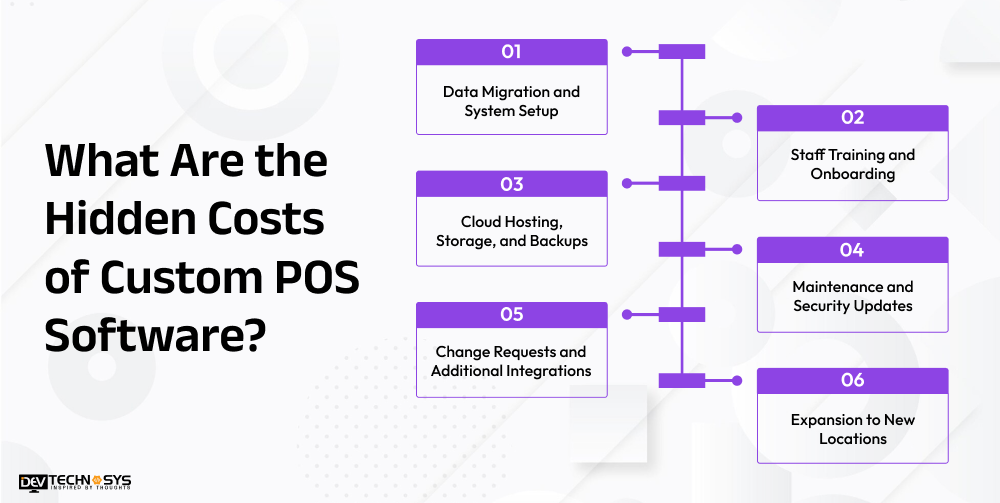
1. Data Migration and System Setup
Moving existing product catalogs, customer records, inventory, and transaction history into a new POS can require data cleaning, mapping, validation, and migration. Large or poorly structured datasets may need additional preparation before the system goes live.
2. Staff Training and Onboarding
Employees and administrators need to understand new billing workflows, inventory controls, reporting, and user permissions. Businesses with multiple outlets may also need separate training sessions, rollout support, and onboarding materials.
3. Cloud Hosting, Storage, and Backups
Cloud-based POS development can become a recurring expense after deployment. Hosting, database storage, automated backups, monitoring, and disaster recovery requirements can add to the ongoing operating budget, particularly as transaction volumes and data grow.
4. Maintenance and Security Updates
A custom POS requires ongoing maintenance after launch. Bug fixes, security patches, device compatibility updates, API changes, performance improvements, and operating system updates can contribute to the POS maintenance cost over time.
5. Change Requests and Additional Integrations
Requirements can change once employees start using the system. Adding another payment provider, accounting platform, report, hardware device, or workflow after scope approval may require additional development and testing. Clearly defining the initial scope can help control these costs.
6. Expansion to New Locations
Opening new branches can create additional expenses for hardware, user configuration, training, deployment, and infrastructure scaling. A POS designed with future expansion in mind can make these rollouts easier to manage.
How Can You Reduce POS Software Development Costs?
Reducing the custom POS software cost does not mean removing essential functionality or compromising security. The better approach is to control scope, prioritize important workflows, and avoid paying for complexity the business does not need yet.
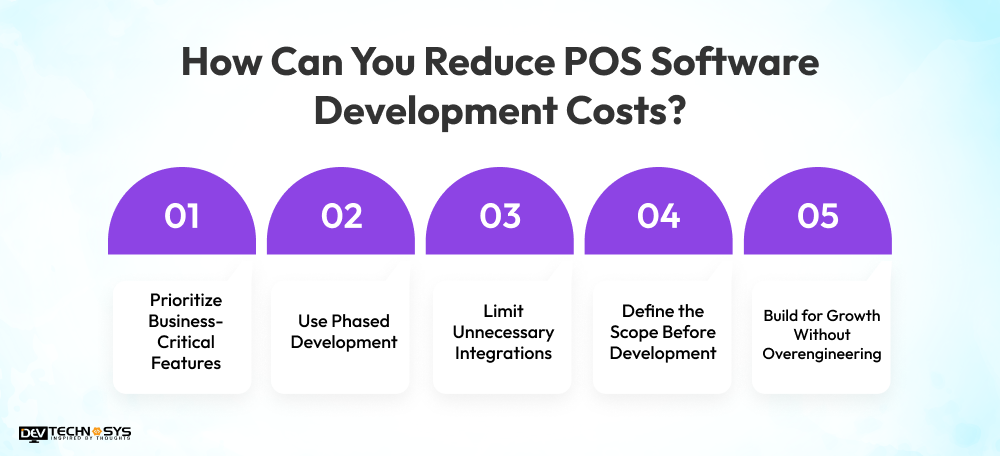
1. Prioritize Business-Critical Features
Start with the functions employees use every day, such as billing, inventory management, payments, sales tracking, receipts, and employee access. Advanced analytics, loyalty programs, or complex automation can be introduced later when they provide a clear business benefit.
2. Use Phased Development
Instead of building everything at once, businesses can release the POS in planned phases. A first release can cover core operations, while later phases add advanced reporting, additional integrations, or multi-location capabilities based on actual business requirements.
3. Limit Unnecessary Integrations
Every third-party connection can add development, testing, and maintenance work. Prioritize payment, accounting, e-commerce, or other integrations that are genuinely required for daily operations. Additional connections can be introduced as the business grows.
4. Define the Scope Before Development
Clearly documenting workflows, user roles, locations, integrations, hardware requirements, and reporting needs can reduce expensive changes later. Working with an experienced provider offering POS software development solutions can also help identify unnecessary complexity before development begins.
5. Build for Growth Without Overengineering
The architecture should support future expansion, but businesses do not necessarily need enterprise-level infrastructure from day one. A scalable foundation allows the POS to grow without paying upfront for features or infrastructure that are not yet required.
Industry Insight
According to Mordor Intelligence, contactless payments represented 62.15% of the UAE POS terminal market in 2025. Therefore, supporting NFC and other modern payment methods can be an important component of UAE POS software development.
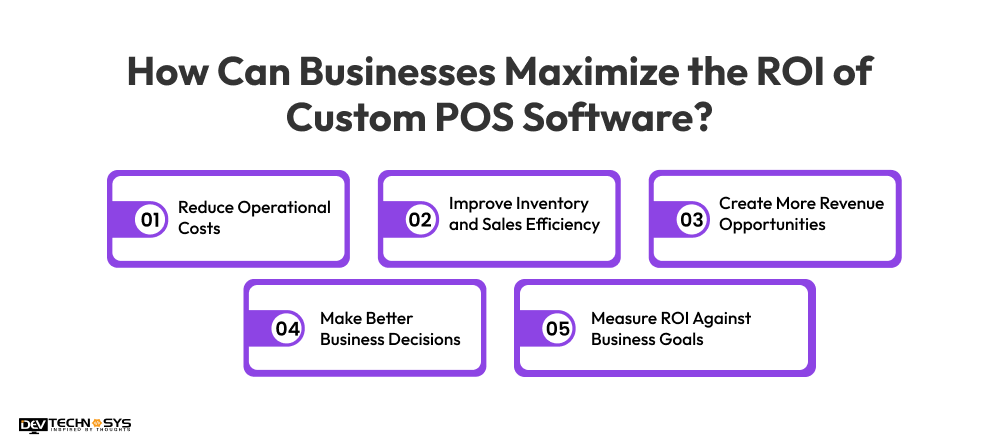
How Can Businesses Maximize the ROI of Custom POS Software?
A custom POS is more than an operational expense. Businesses investing in POS software development services should also consider how the system can reduce inefficiencies, improve control, and support revenue growth over time.
1. Reduce Operational Costs
Automation can reduce manual data entry, reconciliation work, inventory errors, and repetitive reporting. Centralized workflows also allow employees to spend less time handling administrative tasks and more time serving customers.
2. Improve Inventory and Sales Efficiency
Real-time inventory management and sales tracking can help businesses identify fast-moving products, reduce stock discrepancies, and improve purchasing decisions. For multi-location businesses, centralized inventory visibility can also make it easier to monitor stock across outlets.
3. Create More Revenue Opportunities
A custom POS can use customer and transaction data to support loyalty programs, targeted promotions, upselling, and cross-selling. Connecting POS data with online sales channels can also give businesses a clearer view of customer purchasing patterns.
4. Make Better Business Decisions
Sales dashboards and operational reports can show product performance, employee activity, customer trends, and branch-level results. Instead of relying on spreadsheets or disconnected systems, management can use centralized data to identify problems and respond faster.
5. Measure ROI Against Business Goals
The return on a custom POS depends on how well it addresses the business’s actual operational challenges. A system that reduces errors, saves employee time, improves stock control, and supports additional sales can deliver greater long-term value than a cheaper platform that requires extensive manual work.
Conclusion
Custom POS software is not priced by features alone. The final investment depends on how the system fits your business workflows, integrations, hardware, security requirements, and future expansion plans. A straightforward single-store system can require a very different budget from a multi-location platform with complex integrations and centralized operations.
Businesses should also look beyond the initial quote and account for data migration, hardware, security, maintenance, and other hidden expenses. Defining these requirements before development makes it easier to compare estimates and avoid unexpected costs later.
If you are planning a custom POS solution, working with a reliable POS software development company can help translate your operational requirements into a realistic scope and budget.
FAQs
Q1. How Much Does POS Software Development Cost in UAE?
The POS software development cost in UAE typically ranges from $15,000 to $90,000+ for a custom solution. A basic single-store system may sit near the lower end, while multi-location and enterprise platforms with advanced integrations, security, analytics, and hardware support can exceed $90,000.
Q2. Is Custom POS Software Worth the Investment for a Business?
Custom POS software can be worthwhile when standard systems cannot support a business’s workflows, integrations, or operational scale. The investment can deliver value through automation, better inventory control, centralized reporting, reduced manual work, and improved customer management.
Q3. Can a Custom POS System Integrate With Existing Business Software?
Yes. A custom POS can integrate with accounting platforms, ERP systems, CRM software, e-commerce stores, payment gateways, delivery platforms, and other business tools. The complexity and cost depend on API availability, authentication, data mapping, synchronization requirements, and the workflows that need to be connected.
Q4. Does POS Software Require Ongoing Maintenance?
Yes. Custom POS software typically requires ongoing maintenance for bug fixes, security updates, operating system compatibility, hardware changes, API updates, performance improvements, and technical support. New features or major integrations are generally treated as additional development rather than routine maintenance.
Q5. Can POS Software Support Multiple Stores and Locations?
Yes. A custom POS can support multiple locations with centralized administration, branch-level permissions, shared inventory, real-time synchronization, consolidated reporting, and location-specific workflows. The required architecture and infrastructure become more complex as the number of stores, users, and transactions increases.