





Key Takeaways:
-
- Entrepreneurs can capitalize on the fast-growing EdTech ecosystem by choosing to build an education app like Abwaab, especially as demand for digital learning continues to rise across MENA markets.
- An Abwaab clone app enables features like curriculum-aligned video lessons, interactive quizzes, gamified learning, live classes, and real-time progress tracking, ensuring higher student engagement and retention across K-12 segments.
- The cost to build an education app like Abwaab typically ranges from AED 110,100 to AED 550,500+ depending on app complexity, feature set, platform selection, UI/UX design, and third-party integrations such as video streaming and payment systems.
- A diversified monetization strategy combining subscriptions, freemium access, institutional licensing, in-app purchases, and partnerships can maximize user acquisition while creating sustainable revenue streams for an EdTech app like Abwaab.
The EdTech revolution is no longer a future prediction; it’s happening right now, and the MENA region is at its epicenter. With millions of students seeking curriculum-aligned, affordable, and accessible digital learning, the demand for platforms that genuinely deliver results has never been higher.
Abwaab, one of the region’s most celebrated online learning platforms, proved that a well-executed EdTech product can transform how an entire generation studies.
If you’re an entrepreneur, startup founder, or business looking to build an education app like Abwaab, this guide is your complete roadmap from core features and tech stack to development costs and monetization strategies.
Whether you’re targeting the Arab world or a broader global audience, this blog walks you through everything you need to know to turn your EdTech vision into a fully functional, market-ready product.
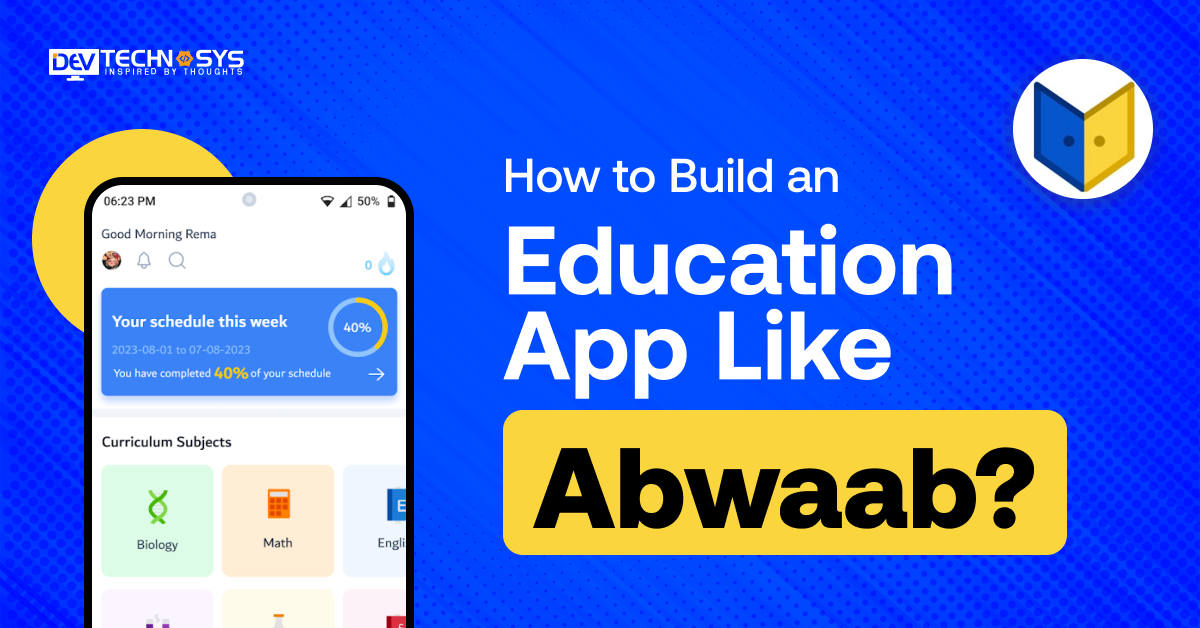
What is Abwaab?’
Abwaab is a Jordan-based EdTech platform founded in 2020, purpose-built for K-12 students across the Arab world. The name “Abwaab” translates to “doors” in Arabic, symbolizing open doors to quality education for every student, regardless of location or income. The platform offers thousands of curriculum-aligned video lessons, interactive quizzes, and detailed performance reports tailored to national syllabi in Jordan, Saudi Arabia, Egypt, and beyond.
What sets apps like Abwaab apart from generic e-learning tools is their hyper-local focus; content is mapped directly to government-approved curricula, making it a trusted study companion rather than just another video library. Since its launch, Abwaab has attracted significant venture funding and millions of student users, establishing itself firmly as a leading Abwaab alternative in the MENA EdTech space.
Answer a few quick questions and our experts will share a tailored project estimate.
EdTech Market Stats & Opportunities in 2026
- The global edtech and smart classroom market size is projected to grow from USD 215.8 billion in 2026 to USD 688.56 billion by 2034, exhibiting a CAGR of 15.60% during the forecast period.
- According to the education intelligence provider HolonIQ, around 3% of global education expenditure is allocated to digital infrastructure.
- The mobile learning segment held the largest share of the market in 2026, accounting for 56.22% of the total market share.
- In the previous year, the North American market stood at USD 75.49 billion, representing 41.40% of global demand, and is projected to grow to USD 87.62 billion in 2026.
How to Build an Education App Like Abwaab: Step-by-Step Development Process
Building Abwaab alternatives requires a structured approach that covers everything from research and planning to development, testing, and launch. Each step plays a crucial role in ensuring the platform is scalable, engaging, and aligned with student learning needs.
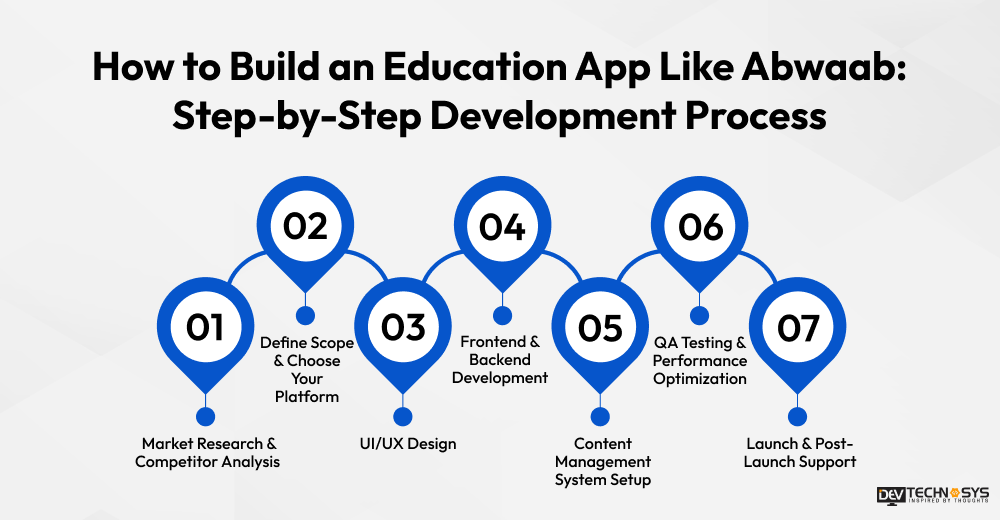
1. Market Research & Competitor Analysis
Before building an education app like Abwaab, start with in-depth market research. Identify your target audience, such as school students in specific regions like MENA, and understand curriculum needs. Study competitors like Noon Academy, Edraak, and Classera to analyze their strengths and gaps. This helps validate your idea and ensures your product solves real learning challenges.
2. Define Scope & Choose Your Platform
Clearly define your MVP scope by deciding which core features to include in the first version. Avoid unnecessary complexity in early stages. Choose whether to build for Android, iOS, or both platforms based on your audience. Select native or hybrid development depending on budget, scalability needs, and long-term growth plans for your education platform.
3. UI/UX Design
Hire an e-learning app development company in Dubai with skilled designers. Design plays a crucial role in student engagement and learning experience. Create simple, intuitive interfaces that are easy for students aged 10–18 to navigate. Ensure support for multilingual and RTL layouts if targeting regions like MENA. Build interactive prototypes, test them with real users, and refine the design for maximum usability and engagement.
4. Frontend & Backend Development
Frontend development focuses on building smooth and responsive mobile interfaces using technologies like Flutter or React Native. Backend development handles APIs, authentication, databases, and content delivery systems. A strong full-stack setup provided by an e-learning app development company Dubai ensures seamless interaction between users and the platform, supporting video lessons, quizzes, progress tracking, and real-time learning features efficiently.
5. Content Management System Setup
A robust CMS is essential for managing educational content effectively. It allows teachers and administrators to upload, organize, and update video lessons and study materials easily. The system should support multilingual content and a scalable architecture. Integration with third-party video hosting or streaming APIs ensures smooth and high-quality content delivery to users.
6. QA Testing & Performance Optimization
After Islamic education app development, testing is the next step. Testing ensures the app performs reliably across devices and network conditions. Conduct functional, usability, performance, and security testing to identify and fix issues. Special attention should be given to video streaming performance in low-bandwidth regions. Beta testing with real students helps refine the experience before the official public launch.
7. Launch & Post-Launch Support
Once development is complete, launch the app on the Google Play Store and Apple App Store. Monitor performance metrics, crash reports, and user feedback closely in the initial phase. Post-launch support is critical for fixing bugs, improving features, and ensuring continuous updates that enhance user satisfaction and long-term engagement.
Tech Insights
Dev Technosys education apps include live video classes, course management, quizzes and assessments, progress tracking, and secure payment gateways.
– Pramod Jangid, Tech Head
What Features Does an App Like Abwaab Have?
When you create an education app like Abwaab, features are what separate a forgettable platform from one that students genuinely rely on every day. The right feature set must balance curriculum delivery, engagement, and performance tracking, all within a clean, intuitive interface. Here are the eight core features your app cannot launch without.
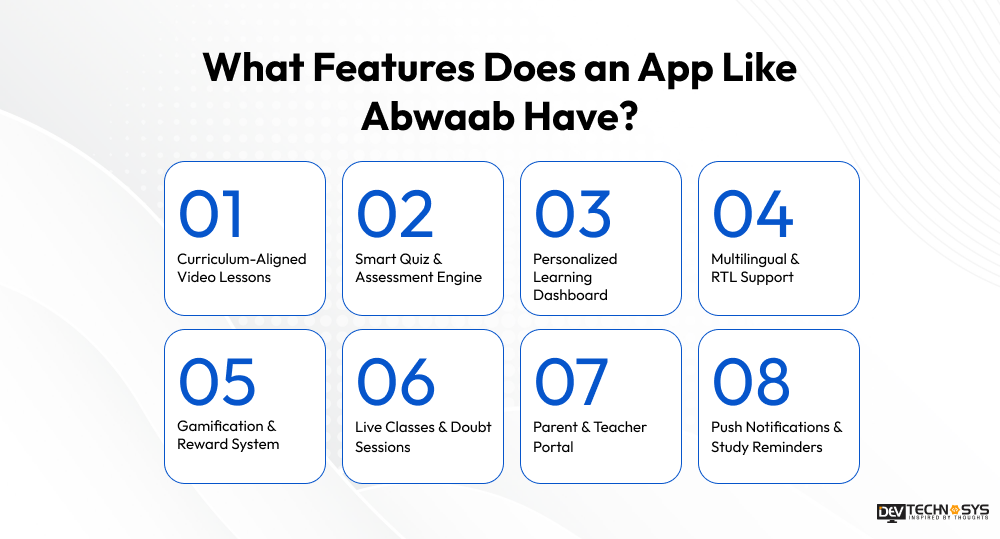
1. Curriculum-Aligned Video Lessons
Short, structured video lessons mapped directly to national syllabi are crucial to build an education app like Blackboard or Abwaab. Content is delivered by qualified local teachers whom students already trust, covering every subject across multiple grade levels. Offline download support ensures students in low-connectivity regions across the MENA market never miss a critical lesson.
2. Smart Quiz & Assessment Engine
Topic-specific quizzes auto-generated after every lesson actively reinforce what students have just learned. Timed mock exams simulate real national test conditions, while instant scoring paired with detailed answer explanations helps students pinpoint exactly where they went wrong and how to improve next time.
3. Personalized Learning Dashboard
A smart dashboard tracks completion rates, quiz scores, and weak topic areas in real time, surfacing recommended lessons based on each student’s performance. This adaptive approach represents the core student engagement features that make learners return to the platform consistently every single day.
4. Multilingual & RTL Support
Full Arabic right-to-left interface design is non-negotiable for any similar app like Abwaab targeting the MENA region. Content must support multiple dialects where curricula differ across countries, ensuring every student feels the platform was purpose-built specifically for their educational environment and native language.
5. Gamification & Reward System
A kids learning app like Lamsa involves points, badges, streaks, and leaderboards, transforming daily revision into something students genuinely anticipate rather than avoid. Weekly subject challenges make studying feel competitive and rewarding, significantly improving session frequency, daily active users, and long-term platform retention across all grade levels.
6. Live Classes & Doubt Sessions
Scheduled live video sessions with subject teachers restore real-time interaction to digital learning. Built-in chat, polls, and Q&A tools keep students actively involved rather than passively watching pre-recorded content, effectively bridging the engagement gap between a physical classroom and an online learning environment.
7. Parent & Teacher Portal
Parents monitor progress, session time, and upcoming assessments from a dedicated dashboard, while teachers upload content and track class-wide performance. This connected multi-role architecture is something every experienced education app development services provider should be fully equipped to build and deploy.
8. Push Notifications & Study Reminders
Automated reminders for pending lessons, upcoming exams, and newly published content keep students consistently active on the platform. Personalized nudges built around each student’s individual study pattern ensure every notification feels timely and genuinely useful rather than repetitive or intrusive.
Tech Stack to Build an Education App Like Abwaab
Choosing the right technology foundation is one of the most critical decisions when you develop an education app like Abwaab. According to experts who develop an app like Duolingo, the stack you select directly impacts your app’s speed, scalability, security, and long-term maintenance cost. Here is the complete tech stack recommended for a production-ready EdTech platform.
Layer |
Technology |
Why It’s Used |
| Frontend (Mobile) | React Native / Flutter | Single codebase for both iOS and Android, reducing development time and cost |
| Frontend (Web) | React.js | Fast rendering, component-based architecture ideal for dynamic dashboards |
| Backend | Node.js / Django | High performance, scalable, supports real-time features like live classes |
| Video Streaming | AWS CloudFront / Vimeo API | CDN-backed streaming ensures smooth playback even in low-bandwidth regions |
| Cloud Infrastructure | AWS / Google Cloud Platform | Enterprise-grade reliability with global availability and disaster recovery |
| AI & Personalization | TensorFlow / OpenAI API | Powers personalized lesson recommendations and performance predictions |
| Payment Gateway | Stripe / PayTabs | PCI-compliant, supports multi-currency transactions across MENA markets |
| Architecture | Microservices | Microservices architecture for EdTech platforms allows video, quiz, and auth services to scale separately without affecting the entire system |
| API Layer | REST / GraphQL | Enables seamless API integration with third-party LMS, payment, and analytics tools |
| DevOps & CI/CD | Docker / Kubernetes / GitHub Actions | Faster release cycles, zero-downtime deployments, and consistent environments |
| Security | SSL, OAuth 2.0, JWT | Ensures encrypted communication and secure session management across all user roles |
Why Should Entrepreneurs Invest in Building an App Like Abwaab?
The MENA EdTech space is no longer a niche bet; it is a high-growth, high-demand market with proven commercial viability. If you are looking to develop an app like Abwaab, the timing, market conditions, and technology infrastructure have never been more favorable for a well-executed entry. Here is why serious entrepreneurs are paying close attention.
1. A Massively Underserved Student Population
The Arab world has one of the youngest populations globally, with millions of K-12 students relying on outdated, resource-limited traditional schooling. Curriculum-aligned digital platforms that genuinely complement national syllabi remain scarce relative to demand. Create a significant first-mover advantage for entrepreneurs who create an education app like Abwaab, targeting specific countries or grade levels.
2. Predictable Recurring Revenue Through Subscriptions
Unlike one-time purchase models, EdTech subscription platforms generate consistent monthly and annual revenue from a loyal user base. Students renew as long as they are enrolled in school, meaning your Abwaab clone app benefits from a naturally recurring customer lifecycle that most consumer app categories simply cannot replicate.
3. Government-Backed Digital Education Initiatives
Saudi Arabia’s Vision 2030, UAE’s National Education Strategy, and Egypt’s digital transformation roadmap are all actively accelerating EdTech adoption. These government initiatives create direct partnership, licensing, and grant opportunities for platforms that deliver measurable learning outcomes through a structured education app development solution.
4. High Scalability Across Borders
A platform built for Jordan can be adapted for Saudi Arabia, Egypt, or Kuwait with curriculum and language adjustments, without rebuilding from scratch. This cross-border scalability means your initial investment in Abwaab clone app development can multiply in value as you expand into new MENA markets.
5. Growing Investor Confidence in MENA EdTech
Abwaab itself raised significant venture capital, proving that regional investors are actively backing EdTech startups with strong curriculum alignment and user retention metrics. Entrepreneurs who want to build an Islamic e-learning app with solid growth data are entering a funding landscape that is increasingly receptive to EdTech pitches across the region.
What Are The Top Abwaab Alternatives in 2026?
Apps like Abwaab are now competing with advanced learning ecosystems that combine gamification, live classes, and AI-driven personalization. With evolving demand, businesses are investing in scalable platforms using mobile app development solutions to build next-gen education apps.
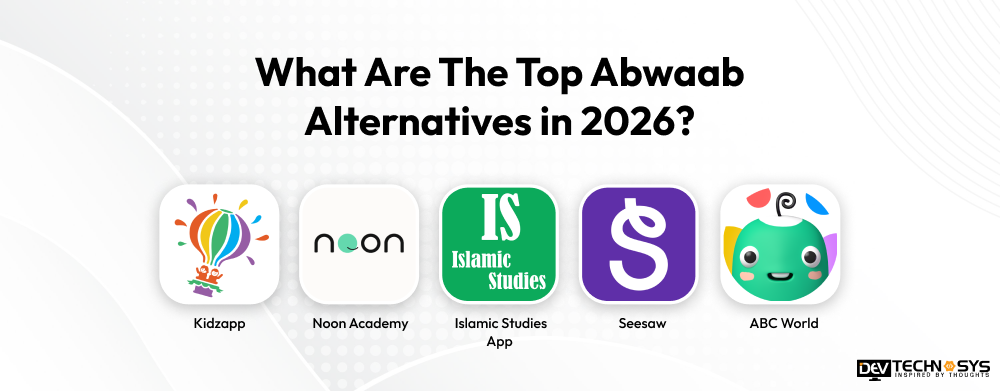
1. Kidzapp
Kidzapp is a family-focused learning and activity discovery platform that helps parents find educational and fun experiences for children. Businesses looking to develop a similar platform can explore building an education app like Kidzapp to understand the development approach, features, and architecture required for such apps.
2. Noon Academy
Noon Academy is one of the leading edtech platforms in the MENA region, offering live interactive classes and peer-to-peer learning. It focuses on collaborative education where students can compete, engage, and learn together in real time, making it a strong alternative to Abwaab.
3. Islamic Studies App
This platform is designed for learners seeking structured Islamic education, including Quran recitation, Tafsir, and quizzes. It supports self-paced learning with engaging multimedia content. Developers looking to build similar platforms can refer to this to build an educational app for Islamic studies and gain insights into structured development.
4. Seesaw
Seesaw is a digital learning journal used in schools to connect teachers, students, and parents. It allows students to showcase their work while teachers provide real-time feedback. The platform is widely used in primary education. Its development complexity and feature set are detailed in the cost to develop an app like Seesaw.
5. ABC World
ABC World is an early learning platform designed for preschool and kindergarten children. It uses animations, storytelling, and interactive lessons to improve foundational skills in reading and math. Businesses planning to develop a similar platform can explore build an education app like ABC World for detailed development guidance.
Industry Insight
According to HolonIQ, the UAE EdTech market is rapidly expanding due to strong government support, AI adoption in classrooms, and increasing demand for personalized digital learning platforms across K-12 education.
How Much Does it Cost to Build an Education App Like Abwaab?
The cost to build an education app like Abwaab ranges from AED 110,100 to AED 550,500+ (approx $30K to $150K), depending on features ( online tutoring, curriculum-aligned content, exam preparation (Tawjihi, EmSAT, board exams), and teacher dashboard), platform choice, and development complexity.
A curriculum-aligned EdTech platform requires robust video infrastructure, multilingual support, video streaming SDK / HLS adaptive streaming, LMS integration (Moodle, SCORM), and assessment engines, all of which directly influence the overall mobile app development cost. Below is a clear breakdown to help you plan your investment smartly.
App Development Level |
Estimated Cost (AED) |
Development Timeline |
| Basic Education App | AED 110,100–183,500 | 3–4 months |
| Mid-Level Abwaab-Like App | AED 183,500–330,300 | 4–6 months |
| Advanced Education App | AED 330,300–440,400 | 6–8 months |
| Enterprise-Level Platform | AED 440,400–550,500+ | 8–12+ months |
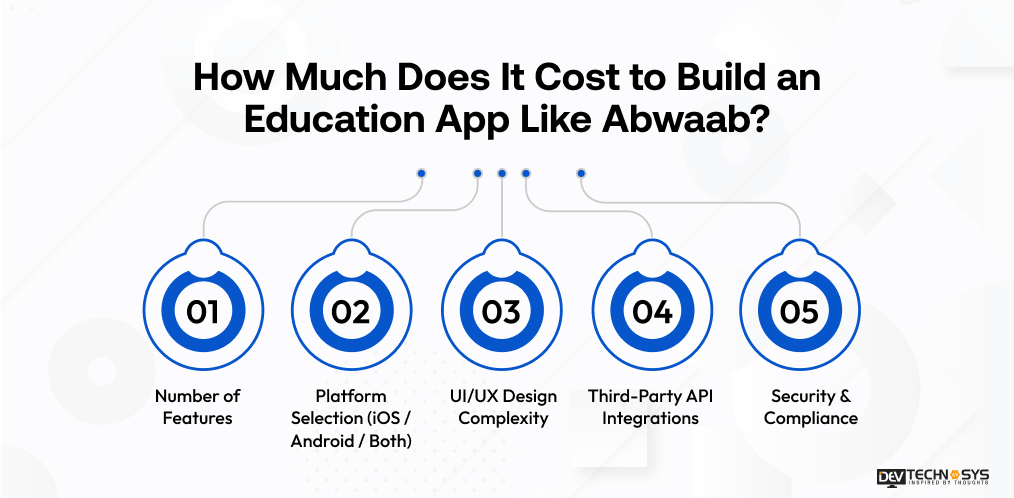
The following are the key factors that affect the education app development cost:
1. Number of Features
The scope of features is the single biggest driver of Abwaab app development cost. Basic registration and video delivery require relatively less backend effort, while advanced capabilities like AI-powered personalization, video lectures and recorded lessons, Arabic RTL support, gamification engine (points, streaks, leaderboards), and live class infrastructure significantly increase development time, testing cycles, and overall system complexity when you build an app like Abwaab.
2. Platform Selection (iOS / Android / Both)
A single-platform app is faster and more budget-friendly, but it limits your student reach significantly. Building for both iOS and Android simultaneously through iOS app development services requires parallel development, additional QA cycles, and device-specific optimization, all of which add to the overall investment. According to a top education app development company in Saudi Arabia, building a cross-platform app is much cheaper because both iOS and Android are built at once.
3. UI/UX Design Complexity
Design quality directly influences student trust, engagement, and daily retention on your platform, ultimately affecting the cost to develop an education app like Abwaab. A clean, simple interface reduces cost and accelerates delivery, while custom dashboards, RTL Arabic layouts, animations, and interactive lesson flows require considerably more design effort. Premium UI investment pays dividends in user retention for targeting young learners when you create an education app like Abwaab.
4. Third-Party API Integrations
APIs power critical capabilities like payment processing, video streaming, push notifications, and analytics, which affect the cost to develop an Education App Like Abwaab in the long run. Basic integrations are cost-effective, but advanced connections such as AI learning engines, live class video APIs, and on-demand app development infrastructure significantly increase the education app development cost when building a fully scalable platform like Abwaab.
5. Security & Compliance
Security is especially critical when your platform handles student data, parent information, and payment records. Implementing encryption, secure authentication, and data protection standards increases development cost but ensures legal compliance and long-term user trust. Factoring in the cost to maintain an app post-launch is equally important for sustaining a secure, compliant EdTech platform. The table below showcases the factors affecting the Arabic learning app development cost.
Cost Factor |
Lower-Cost Scenario |
Higher-Cost Scenario |
Approx. Cost Impact in AED |
| Number of Features | Core learning, videos, quizzes, profiles | AI personalization, offline video download, live classes, analytics | AED 29,360–146,800+ |
| Platform Selection | Single platform or cross-platform | Separate native iOS & Android | AED 18,350–91,750+ |
| UI/UX Design Complexity | Standard layouts and navigation | Custom dashboards, animations, RTL Arabic UI | AED 14,680–55,050+ |
| Third-Party API Integrations | Payment, analytics, notifications, video APIs | AI, live streaming, CRM, advanced learning APIs | AED 11,010–73,400+ |
| Security & Compliance | Authentication, encryption, secure APIs | Advanced security, RBAC, enhanced data protection | AED 14,680–73,400+ |
Now that we know the cost to build an education app, let’s take a look at the development timeline in the following section as well.
How Long Does It Take to Build an App Like Abwaab?
Wondering how long it will take to build an Arabic language learning app? An app like Abwaab typically takes 4 to 8 months for a feature-rich MVP, while a more advanced platform with AI personalization, live classes, multilingual content, complex analytics, and scalable video infrastructure can take 8 to 12+ months. The timeline depends on the number of platforms, features, integrations, UI/UX complexity, testing, and compliance requirements.
Development Stage |
Estimated Time |
| Planning & Requirements | 2–3 weeks |
| UI/UX Design | 3–5 weeks |
| Backend & API Development | 5–8 weeks |
| Mobile App Development | 8–14 weeks |
| Video & Third-Party Integrations | 2–4 weeks |
| Testing & Security | 3–5 weeks |
| Deployment | 1–2 weeks |
| Total | 4–8 months |
For an MVP version, focusing on core Arabic education app development features such as user registration, courses, video lessons, quizzes, subscriptions, progress tracking, notifications, and an admin panel can help launch faster. Advanced AI, live learning, parental controls, and enterprise integrations can be added in later phases.
Timeline Insight
A custom education app from Dev Technosys is typically delivered in 4 to 7 months, including UI/UX design, backend development, and multi-platform testing.
What are the Key Monetization Models for Your Education App?
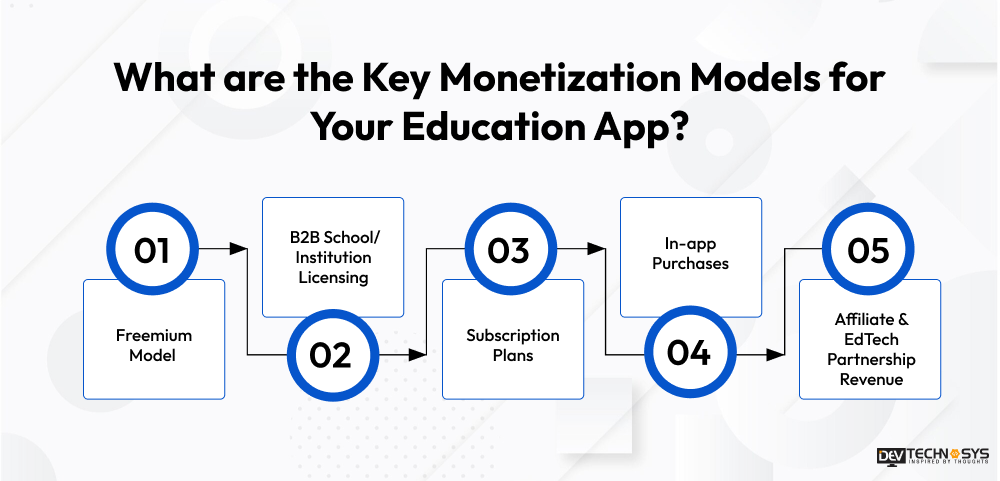
Monetization plays a crucial role in the success of any education app development project. Whether you are building a learning platform, an Abwaab clone app, or a large-scale EdTech solution, selecting the right revenue model ensures long-term profitability and user retention.
1. Freemium Model
The freemium model is widely used in modern EdTech app development UAE. Users get access to basic learning materials for free, while advanced courses, live classes, and performance analytics are offered under premium tiers. This model works well for attracting users initially and converting them into paying subscribers over time.
2. B2B School/Institution Licensing
This model enables schools and institutions to purchase bulk licenses for students and teachers. It is highly scalable and widely adopted in enterprise-level education app development company solutions, helping institutions digitize their learning systems efficiently.
3. Subscription Plans
Subscription-based pricing is one of the most stable monetization strategies in EdTech app development solutions. Users can choose monthly, yearly, or family bundles depending on their learning needs. It ensures consistent revenue flow while offering uninterrupted access to structured educational content.
4. In-app Purchases
In-app purchases allow learners to buy specific resources such as mock exams, revision packs, or certification programs. This flexible model enhances user engagement and is commonly used in exam-focused learning platforms and Abwaab clone app development solutions.
5. Affiliate & EdTech Partnership Revenue
Education apps can generate additional income through partnerships with EdTech providers, course creators, and certification bodies. Referral commissions and content collaborations expand monetization without significantly increasing development costs. To implement these models effectively, companies often rely on full-stack development services to build scalable, secure, and high-performing platforms.
Security & Compliance Required for an Education App Like Abwaab
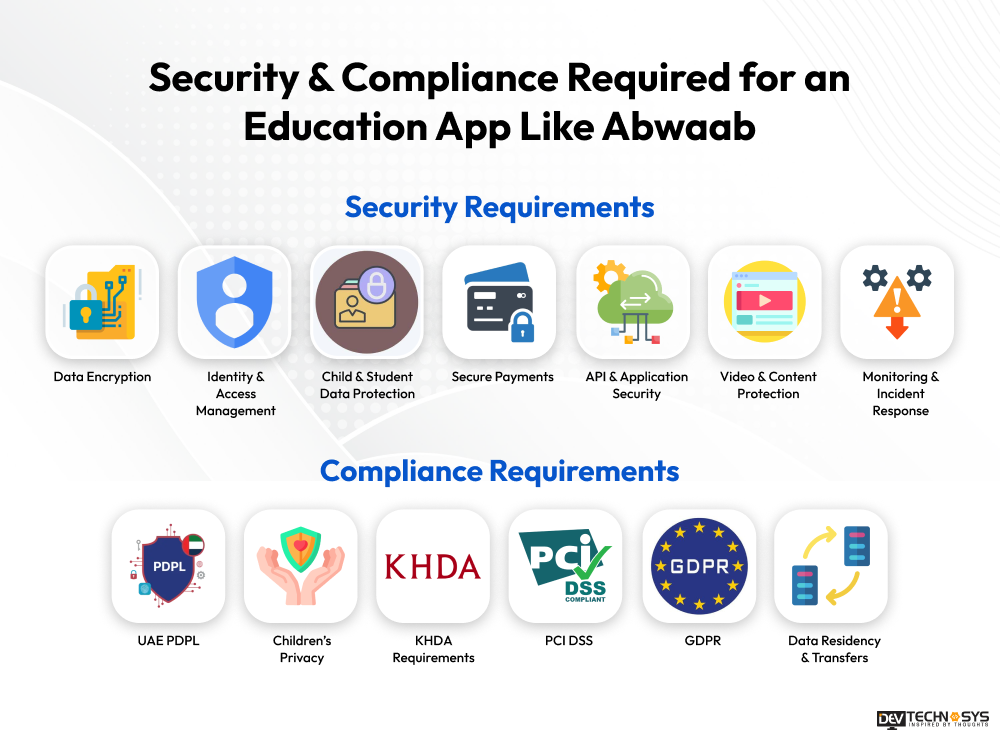
Here’s the list of security and compliance requirements needed to create an app like Abwaab:
Security Requirements
- Data Encryption: AES-256 encryption for stored data and TLS 1.2/1.3 for data in transit.
- Identity & Access Management: Secure authentication, MFA, RBAC, and session management for students, parents, teachers, and administrators.
- Child & Student Data Protection: Strong privacy controls, parental consent mechanisms where applicable, and restricted access to minors’ information.
- Secure Payments: PCI DSS-aligned payment processing when handling card transactions.
- API & Application Security: OWASP-aligned secure coding, API authentication, input validation, and vulnerability testing.
- Video & Content Protection: DRM, signed URLs, access controls, and anti-piracy measures for premium educational content.
- Monitoring & Incident Response: Security logging, threat monitoring, backups, breach detection, video piracy protection (Widevine, FairPlay), and recovery procedures.
Compliance Requirements
- UAE PDPL: Follow the UAE Personal Data Protection Law for collecting, processing, storing, and transferring personal data.
- Children’s Privacy: Apply appropriate safeguards for student/minor data, including consent and age-appropriate privacy practices where required.
- KHDA Requirements: If the platform provides regulated educational or training services in Dubai, assess applicable KHDA licensing/approval requirements for the specific business model.
- PCI DSS: Required when your platform directly stores, processes, or transmits payment card data; using a compliant payment provider can reduce your PCI scope.
- GDPR: Consider GDPR obligations when collecting or processing personal data of users located in the European Economic Area.
- Data Residency & Transfers: Review where student data is hosted and whether cross-border data transfers meet applicable UAE requirements.
Abwaab vs. Noon Academy: Which Option Is Better?
Both Abwaab and Noon Academy are strong EdTech models, but they focus on different learning experiences. Abwaab is more centered on curriculum-based, self-paced learning, assessments, and personalized study plans, while Noon Academy emphasizes live classes (WebRTC / Agora / Zoom SDK), social, teacher-led learning, and peer interaction.
Comparison Factor |
Abwaab |
Noon Academy |
| Primary Learning Model | Self-paced digital learning | Live and social learning |
| Video Lessons | Extensive animated video lessons | Primarily teacher-led live classes |
| Assessments | Large question banks, practice exams, timed assessments | Practice questions alongside and after classes |
| Live Classes | Available within the app | Core part of the learning experience |
| Teacher Interaction | Q&A and mentor support | Direct interaction through live classes, chat, and microphone |
| Personalization | Study schedules, progress reports, curriculum-based learning | Teacher guidance and interactive learning support |
| Gamification | Abwaab League, leaderboards, and challenges | Challenges and interactive social features |
| Social Learning | Moderate | Strong |
| Curriculum Focus | Strong curriculum-specific content for Grades 4–12 | Strong exam preparation and teacher-led learning |
| Best For | Students who prefer structured, self-paced study | Students who learn better through live interaction |
| Best Development Inspiration | Content + assessment-heavy EdTech app | Live-class + social learning platform |
Which Model Should You Choose?
Each one has its own benefits and shortcomings; the best choice depends on your target audience, learning format, content strategy, budget, and business goals.
- Choose the Abwaab model if your goal is to build an app focused on curriculum-based content, recorded lessons, progress tracking & analytics dashboard, assessments, personalized learning paths, and exam preparation.
- Choose the Noon Academy model if your platform’s competitive advantage will come from live classes, teacher-student interaction, social learning, peer engagement, and real-time support.
- For businesses planning an Abwaab like app development, Abwaab is the better reference model when the goal is to build a scalable curriculum-driven platform.
Why Choose Dev Technosys to Build Your Education App in UAE?
Selecting a suitable development company is critical to the success of a robust EdTech platform. Dev Technosys excels in this field due to its extensive experience in developing modern education apps across MENA, South Asia, and other parts of the globe, resulting in successful learning platform deliveries for clients. Devtechnosys has been listed in BizzBuzz’s list of ‘top education app development companies’, solidifying its reputation.
Devtechnosys adheres to GDPR, SOC 1, SOC 2, ISO 27001, and PCI DSS standards throughout the entire development process. Our full-cycle app development methodology includes stages such as idea creation, UI/UX design, development, quality assurance, and support after the launch of the app. It guarantees an effective application development process that leads to high-quality products.
The company’s past projects demonstrate a 98% fraud detection rate, 99.50% transaction uptime, and a 30% decrease in operating costs. Additionally, businesses can hire on-demand app developers to quickly scale their teams based on project requirements, making development more flexible and cost-efficient.
Conclusion
Building a successful EdTech platform today requires a strong understanding of user needs, scalable architecture, and evolving learning trends. If you plan to build an education app like Abwaab or develop an Abwaab clone app, focusing on personalization, engagement, and monetization is essential for long-term success. With the rapid growth of MENA EdTech market trends, the demand for interactive and mobile-first learning solutions continues to rise across the region.
Partnering with an experienced mobile app development company ensures you get the right technology stack, UI/UX design, and scalable infrastructure to compete in the fast-growing digital education space and deliver impactful learning experiences.
FAQ
Q1. How Long Does It Take to Build an Education App Like Abwaab From Scratch?
It typically takes 2 to 6+ months to build an education app like Abwaab from scratch, depending on complexity, features, and team size. MVP versions can be developed in 2 to 4 months, while advanced versions with AI, live classes, and analytics require more development time and testing cycles.
Q2. Can I Build an Abwaab Clone App for a Country-specific Curriculum?
Yes, an Abwaab clone app can be customized for any country-specific curriculum by integrating a localized syllabus, language support, and regional exam patterns. This approach is widely used in EdTech to meet local education standards and improve student engagement through relevant and structured learning content.
Q3. What’s the Difference Between a White-label EdTech Solution and a Custom-built App Like Abwaab?
A white-label EdTech solution is pre-built and quickly deployable with limited customization, while a custom-built app like Abwaab is developed from scratch with tailored features, scalability, and branding. Custom apps offer better long-term flexibility, performance, and alignment with unique business goals and user needs.
Q4. Does My Education App Need AI Features From Day ONE, or Can I Add Them Later?
AI features are not mandatory from day one and can be added in later phases. Most startups begin with core functionalities like video lessons and quizzes, then gradually integrate AI-driven personalization, recommendations, and performance analytics as the user base and data grow over time.
Q5. How Do I Handle Multilingual Content and Right-to-left (RTL) UI for Arabic-speaking Users?
Multilingual support and RTL UI should be planned during the initial design phase. Proper localization frameworks, font support, and flexible UI layouts ensure smooth Arabic language integration. This is especially important for EdTech platforms targeting the MENA region to improve accessibility and user experience.
Q6. How Do Education Apps Make Money in MENA?
Education apps in MENA commonly generate revenue through subscriptions, paid courses, freemium plans, one-time purchases, live-class fees, institutional licensing, advertising, and certification charges. Apps can also use tiered pricing, family plans, premium learning content, and partnerships with schools or educational organizations to diversify revenue streams.
Q7. Which Is the Best Education App Development Company in UAE?
The best education app development company in UAE depends on your required features, target students, curriculum, budget, and scalability needs. When selecting a development partner, evaluate its eLearning portfolio, UAE market experience, UI/UX capabilities, technology expertise, security practices, integration experience, and post-launch support.
Q8. How Do You Build an App for the UAE School Curriculum?
To build an app for the UAE school curriculum, begin by defining the curriculum, grade levels, subjects, learning objectives, and content structure. Then design the learning experience, develop core features such as lessons, quizzes, progress tracking, and address applicable UAE education and data requirements before launch.
Q9. Do Learning Apps Need KHDA Approval in Dubai?
Not every learning app automatically requires KHDA approval simply because it operates in Dubai. Whether approval, licensing, or other regulatory requirements apply depends on the services offered, educational activities, business model, and whether the platform is providing regulated education or training services. Businesses should verify their specific model with the relevant Dubai authorities before launch.