





Course access for students and instructors Assignment submission and tracking Grade management and feedback Discussion forums and collaborative spaces Notifications and reminders Live classes and video sessions Analytics dashboards for performance insights Resource management, including documents, videos, and quizzes" } }, { "@type": "Question", "name": "How Can I Monetize The App?", "acceptedAnswer": { "@type": "Answer", "text": "Monetization strategies include subscriptions, freemium plans, in-app purchases, advertising, white-label licensing, a.nd pay-per-course content access, enabling flexible revenue streams while catering to both institutions and individual learners." } }, { "@type": "Question", "name": "How Long Does It Take To Develop A Blackboard-Like App?", "acceptedAnswer": { "@type": "Answer", "text": "A basic MVP can take 3 to 4 months, mid-level development 5 to 7 months, and advanced enterprise solutions 8 to 12 months or more, including testing, deployment, and iterations based on feedback and institutional requirements." } }, { "@type": "Question", "name": "What Are the Key Trends in Blackboard App Development?", "acceptedAnswer": { "@type": "Answer", "text": " Here are the key trends of building top education apps Dubai:
AI-driven personalization for adaptive learning AR/VR immersive learning experiences Advanced analytics for educators and institutions Mobile-first design with offline capabilities Collaborative tools and social learning integration Gamification with badges, leaderboards, and rewards" } } ] }
Key Takeaways:
-
- Developing the top eLearning apps MENA region requires a combination of region-specific strategies, advanced technologies, and user-focused design to meet the diverse needs of students, educators, and institutions.
- The cost to create an app like Blackboard will be around $8,000 to $30,000+, depending on various factors. The simple MVP development cost will be around $8,000 to $12,000.
- The cost to develop the best learning apps Saudi Arabia with advanced features like AR/VR, AI, and multi-platform support will be $30,000.
- To make an education app like Blackboard, you need AI-driven personalization, AR/VR experiences, and gamification, which are trending technologies that enhance learning outcomes.
- Monetization can be achieved through subscriptions, freemium plans, in-app purchases, advertising, licensing, and pay-per-course models.
Building an education app like Blackboard Learn in the Middle East presents a significant opportunity amid rapid digital transformation in education, government-backed eLearning initiatives, and increasing mobile adoption. Countries such as the UAE and Saudi Arabia are heavily investing in smart education ecosystems, making advanced learning platforms highly relevant.
By aligning technology with regional educational needs and cultural preferences, entrepreneurs can build a scalable and impactful eLearning solution with a scalable eLearning architecture tailored to the Middle Eastern market.
Through this blog, we will learn how to build an education app like Blackboard with all the crucial factors, including essential features, technology stack, development process, cost estimation, and monetization strategies required to succeed in this rapidly growing digital education landscape.
What is the Blackboard App?
The Blackboard app is a mobile solution that integrates with Blackboard Learn, allowing students and instructors to access courses, assignments, grades, and notifications anytime. It also supports collaboration through discussions and shared content.
For educators, it enables remote course management, including announcements and grading. Compatible with iOS 14+ and Android 11+, the app also offers accessibility features such as VoiceOver, zoom, color filters, and support for external devices for an inclusive learning experience.
Education App Market Stats
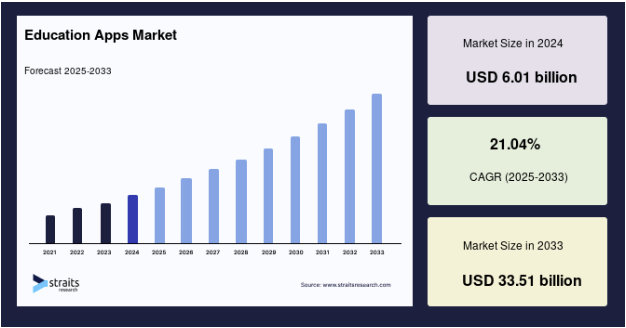
- The global education apps market size is estimated to grow from USD 7.27 billion in 2026 to reach USD 33.51 billion by 2033, growing at a CAGR of 21.04% during the forecast period (2025–2033).
- The latest data from Ericsson shows that there are approximately 7.4 billion smartphones in use worldwide, representing about 87% of the global population.
- The K-12 students segment accounts for a substantial share of the global education apps market, driven by the increasing integration of digital learning tools in primary and secondary education.
- Increasing digital literacy and smartphone penetration, greater adoption of e-learning methodologies, and rising demand for language-learning apps are among the notable growth trends in the education apps market.
Understanding the Mechanism: How Do Apps Like Blackboard Work?
According to a top Android app development company, apps like Blackboard streamline digital education by connecting students and instructors through a centralized platform. Here’s how the application works:
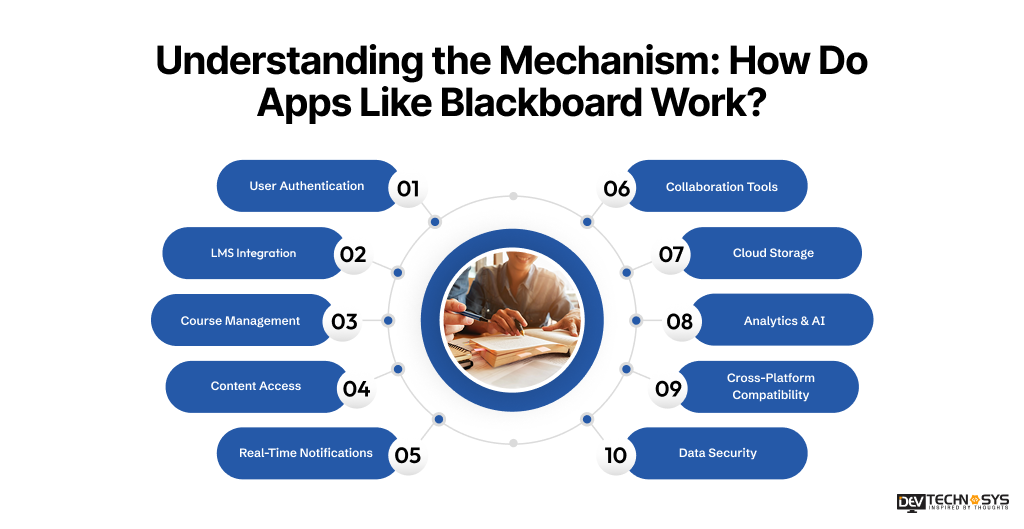
- User Authentication: Secure login system assigns roles (student, instructor, admin) with specific access permissions.
- LMS Integration: The education apps Middle East connects to the LMS via APIs to fetch and sync data in real time.
- Course Management: Instructors upload lectures, assignments, notes, and study materials through the backend system.
- Content Access: Course management system development allows students can view courses, download resources, submit assignments, and track progress.
- Real-Time Notifications: Push alerts for deadlines, announcements, and grade updates keep users informed.
- Collaboration Tools: Features like discussion forums, chat, and virtual classrooms enable interaction.
- Cloud Storage: Cloud-based LMS development involves ensuring scalable and secure storage of course data and user information.
- Analytics & AI: Tracks user performance and provides personalized learning insights.
- Cross-Platform Compatibility: Works smoothly across mobile (iOS/Android) and web platforms.
- Data Security: Implements encryption, compliance standards like End-to-End Encryption (E2EE), OAuth 2.0 / JWT Authentication, and secure databases to protect user data.
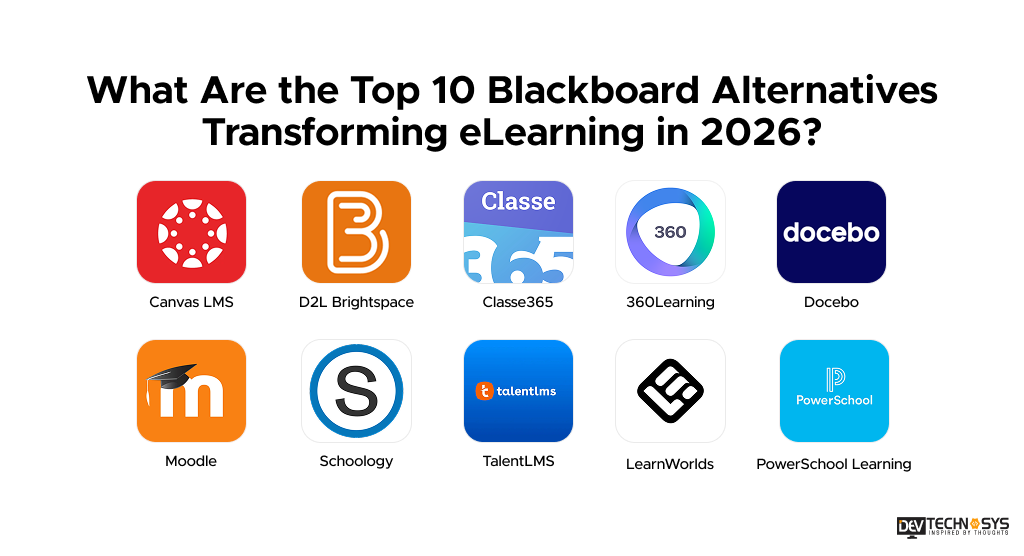
What Are the Top 10 Blackboard Alternatives Transforming eLearning in 2026?
As digital education evolves, many advanced platforms are emerging as strong alternatives to Blackboard, offering better flexibility, scalability, and user experience. These modern LMS solutions are transforming how institutions deliver and manage eLearning in 2026.
| Platform | Launch Year | Ratings | Availability |
| Canvas LMS | 2011 | 4.5/5 | Web, iOS, Android |
| Moodle | 2002 | 4.3/5 | Web, iOS, Android |
| D2L Brightspace | 1999 | 4.3/5 | Web, iOS, Android |
| Schoology | 2009 | 4.3/5 | Web, iOS, Android |
| Classe365 | 2013 | 4.5/5 | Web, iOS, Android |
| TalentLMS | 2012 | 4.6/5 | Web, iOS, Android |
| 360Learning | 2013 | 4.5/5 | Web, iOS, Android |
| Docebo | 2005 | 4.4/5 | Web, iOS, Android |
| LearnWorlds | 2014 | 4.6/5 | Web, iOS, Android |
| PowerSchool Learning | 1997 | 4.2/5 | Web, iOS, Android |
Still not sure? Then check out the top 5 Blackboard alternatives mentioned below. From AI-driven learning tools to cloud-based collaboration features, these alternatives offer innovative capabilities that meet the growing demands of students, educators, and organizations worldwide.
1. Canvas LMS
Canvas LMS is a modern, cloud-based platform known for its intuitive interface and seamless integration capabilities. eLearning app development Middle East, like Canvas LMS, supports interactive learning through multimedia content, real-time collaboration, and mobile accessibility, making it a preferred choice for universities and institutions seeking flexible and scalable eLearning solutions. If you’re looking forward to on demand app development like Canvas LMS, contact a top app development company.
Industry Insights: 6Sense states that the vast majority of Canvas LMS customers are located in the United States (84.19%), followed by the United Kingdom (3.90%) and Australia (3.17%).
2. Moodle
Moodle is a widely used open-source LMS that offers high customization and flexibility. It enables educators to create personalized learning environments with plugins, assessments, and student performance tracking tools. Its strong community support and cost-effectiveness make it ideal for institutions with specific educational requirements.
3. D2L Brightspace
D2L Brightspace is an advanced LMS app created by a top mobile app development company. The app focuses on personalized learning experiences and data-driven insights. It provides AI-powered analytics, adaptive learning paths, and robust assessment tools, helping educators improve student engagement and outcomes while maintaining scalability and security across institutions.
4. Schoology
Schoology combines LMS functionality with social offering features, enabling better collaboration between students and teachers. Modern LMS app development solutions like this offers tools for assignments, grading, and communication, along with seamless integration into K-12 systems, making it a strong choice for schools aiming to enhance digital classrooms.
Read more: How to Build an Islamic eLearning App in 2026
5. Classe365
Classe365 is an all-in-one education management platform that goes beyond traditional LMS capabilities. It is one of the best learning apps Saudi Arabia that includes student information systems, CRM tools, and course management features, allowing institutions to manage admissions, learning, and communication efficiently within a single unified platform.
Classroom 2.0: How to Build an Education App Like Blackboard in Middle East?
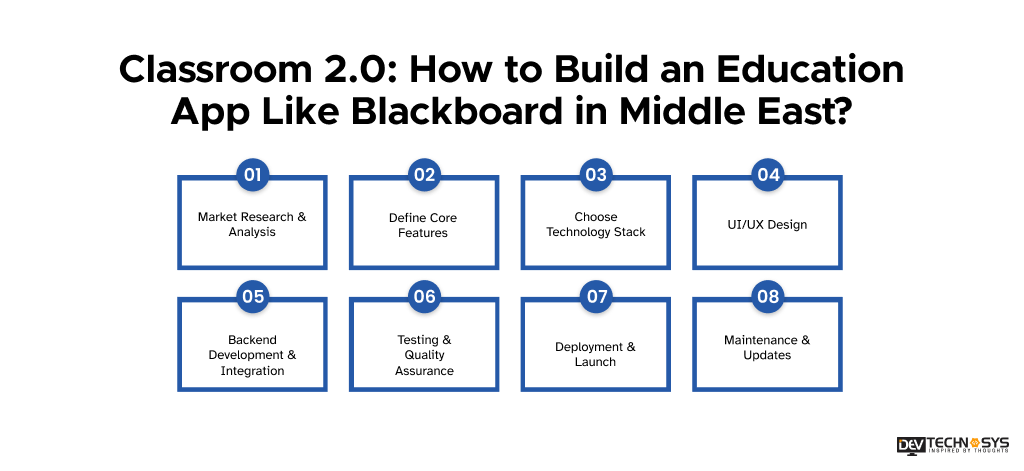
Want to know how to build an education app like Blackboard? Well, building an education app like Blackboard in the Middle East requires a strategic approach that blends advanced technology with regional educational needs.
1. Market Research & Analysis
Start the process to create an education app like Blackboard by analyzing the Middle Eastern education landscape, including government initiatives, mobile adoption, and eLearning trends. Identify user needs, competitor offerings, and gaps in the existing education app development solution. Understanding local preferences, like language support and cultural nuances, ensures your app resonates with students, educators, and institutions in the region.
Industry Insights: According to Business of Apps, the MENA eLearning market is rapidly expanding, expected to grow from $13.6 billion in 2022 to $35.76 billion by 2030 (CAGR 12.8%), driven by digital adoption and government initiatives.
2. Define Core Features
Your education app development company will determine the essential features, including course management, assignment submissions, grading, notifications, discussion forums, and live virtual classes. Include instructor tools for remote course control and analytics. create an education app like Blackboard by focusing on functionality that supports engagement, collaboration, and learning efficiency, and set the foundation for a Blackboard-style app.
3. Choose Technology Stack
Developers at your hybrid app development company will select appropriate technologies for frontend, backend, and database systems. Opt for cloud-based infrastructure for scalability, and consider frameworks like React Native or Flutter for cross-platform mobile development. Blockchain, AI, and analytics tools can enhance performance and personalized learning experiences.

4. UI/UX Design
Design an intuitive, user-friendly interface suitable for both students and instructors. Ensure smooth navigation, visually appealing layouts, and responsive design across devices. To make an education app like Blackboard, incorporate accessibility features like voice guidance, zoom, and color contrast to meet inclusivity standards.
5. Backend Development & Integration
The backend forms the core of your education app, handling all data and processes. It securely stores courses, user profiles, assignments, grades, and notifications. API integration for education apps with third-party tools like video conferencing (Zoom, Microsoft Teams), cloud storage (AWS, Google Cloud), and authentication systems ensures seamless functionality.
To build an education app like Blackboard, you need to add real-time updates that keep students and instructors in sync, while role-based access controls ensure data privacy. Advanced features like AI-powered analytics, adaptive learning paths, automated grading, and virtual classroom app features can also be implemented to enhance learning outcomes and decision-making for educators.
6. Testing & Quality Assurance
Thorough testing is a crucial step if you want to build an educational app for Islamic Studies. It ensures reliability and a smooth user experience. Functional testing checks that all features, such as assignment submissions and grade tracking, work as expected. Usability testing ensures the app is intuitive for both students and instructors. Performance testing evaluates speed, load handling, and responsiveness, while security testing protects sensitive student and institutional data.
7. Deployment & Launch
Once tested, the app is deployed to iOS and Android stores, while backend servers are configured for cloud scalability to handle high user loads. Providing onboarding guides, tutorials, and live support ensures smooth adoption by schools and universities. Marketing strategies tailored to the Middle Eastern market, highlighting features like Arabic language support, culturally relevant content, and mobile accessibility, help maximize user acquisition and engagement.
8. Maintenance & Updates
Post-launch, continuous monitoring of app performance and user feedback is essential. Regular updates release new features, fix bugs, enhance security, and improve performance. Analytics can guide feature improvements and content optimization. This ongoing maintenance ensures your app remains competitive, secure, and engaging, adapting to evolving educational trends and technological advancements in the Middle East.
What are the Features to Incorporate in an App Like Blackboard?
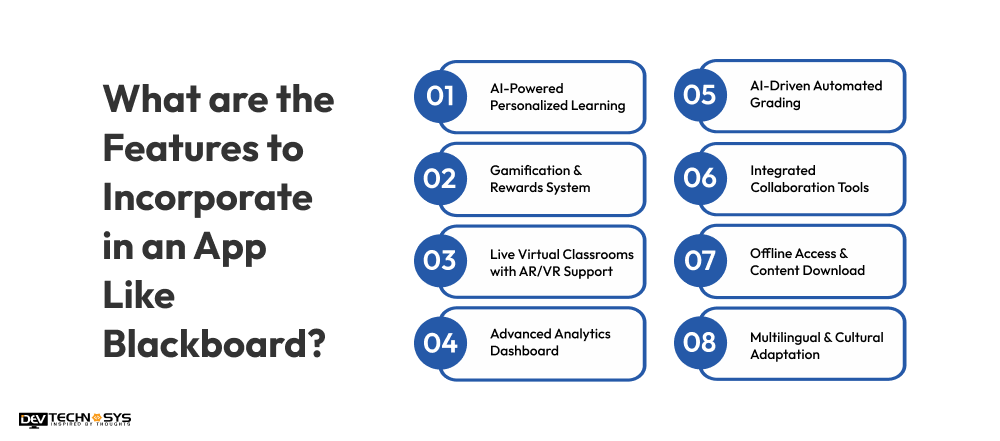
Building an education app like Blackboard requires incorporating features that enhance learning, collaboration, and course management for both students and instructors. The right set of tools ensures a seamless, interactive, and engaging eLearning experience.
| User Panel (Student) | Instructor/Teacher Panel | Admin Panel |
| Course access | Course creation | User management |
| Assignment submission | Material uploads | Course oversight |
| Grade tracking | Assignment management | Content approval |
| Discussion participation | Grading & feedback | Reporting & analytics |
| Notifications | Student communication | App settings |
| Calendar & reminders | Analytics & reports | Role-based permissions |
| Resource downloads | Scheduling live classes | Security management |
| Quiz participation | Content version control | System monitoring & backups |
1. AI-Powered Personalized Learning
Build an education app like Kidzapp offer everaging artificial intelligence to analyze student behavior, learning pace, and performance. AI-powered learning apps offers adaptive content and personalized learning paths. It ensures each learner receives tailored recommendations, enhancing engagement, comprehension, and overall academic success.
2. Gamification & Rewards System
Integrate gamified elements like badges, points, leaderboards, and achievement tracking to motivate students. Gamification encourages participation, healthy competition, and consistent engagement, making learning interactive, enjoyable, and more likely to improve retention rates over traditional classroom experiences.
3. Live Virtual Classrooms with AR/VR Support
Mobile learning app features like this enable immersive online classes with augmented reality (AR) or virtual reality (VR) integration. It allows students to explore simulations, virtual labs, or interactive 3D models, enhancing conceptual understanding and creating highly engaging learning experiences.
4. Advanced Analytics Dashboard
Provide instructors and administrators with detailed insights into student engagement, progress, completion rates, and content effectiveness. Real-time analytics help identify struggling learners, optimize course materials, and make data-driven decisions to improve educational outcomes.
Industry Insights: With the LMS market growing at 18% CAGR in the Middle East & Africa, analytics dashboards are key to tracking engagement and optimizing performance, according to straitsresearch.com.
5. AI-Driven Automated Grading
Implement AI algorithms to automatically grade quizzes, assignments, and assessments. AI automated grading feature saves educators time, ensures consistency in evaluation, and allows them to focus on personalized feedback and instructional improvement for individual students.
6. Integrated Collaboration Tools
Offer real-time discussion forums, group chats, project collaboration spaces, and peer-to-peer messaging. These tools enhance student-instructor interaction, encourage teamwork, and create a more connected and supportive learning environment.
7. Offline Access & Content Download
Allow students to download lectures, assignments, and course materials for offline use. Build an education app like ABC World that ensures uninterrupted learning in areas with limited internet connectivity. It caters to regions with varying digital infrastructure, such as parts of the Middle East.

8. Multilingual & Cultural Adaptation
Support multiple languages, including Arabic and English, while adapting content to regional cultural preferences. It improves accessibility, enhances comprehension, and ensures the app is inclusive and effective across diverse Middle Eastern educational institutions.
Why Businesses Should Consider Investing in Blackboard App Development?
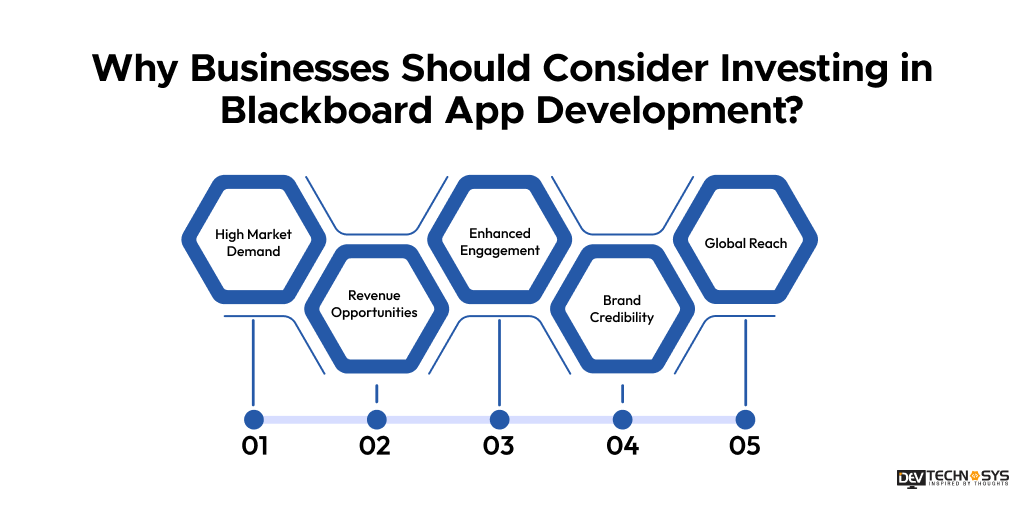
Investing in education app development services offers businesses a strategic advantage by tapping into the growing digital education market. With eLearning adoption increasing globally, organizations can provide scalable, interactive, and personalized learning experiences that meet modern educational demands.
1. High Market Demand:
Educational institutions, universities, and corporate training programs increasingly rely on digital learning platforms. Investing in a Blackboard-style app helps businesses meet this rising demand while capturing a growing, scalable edtech market.
2. Revenue Opportunities:
Monetization through subscription models, licensing, and premium features creates multiple income streams. Businesses can leverage the app to generate steady revenue while offering additional services and content tailored to educational institutions or corporate clients.
3. Enhanced Engagement:
Features like live virtual classes, interactive discussions, gamification, and collaborative tools boost student participation. Active engagement improves learning outcomes and encourages repeated use, increasing both retention and satisfaction across the platform.
4. Brand Credibility:
Offering a robust education app positions a company as a forward-thinking leader in the digital learning space. Strong platform performance and reliable features strengthen trust and professional reputation among clients and institutions.
5. Global Reach:
Mobile compatibility and multilingual support expand access to diverse learners worldwide. Businesses can expand into international markets, ensuring the app addresses cultural and linguistic needs and increasing adoption and engagement.
Industry Insights: According to IMARC Group, the Middle East eLearning market alone is projected to reach $28.2 billion by 2034, indicating strong potential for businesses to expand across regions through cloud-based LMS platforms.
What is the Cost to Build an App Like Blackboard?
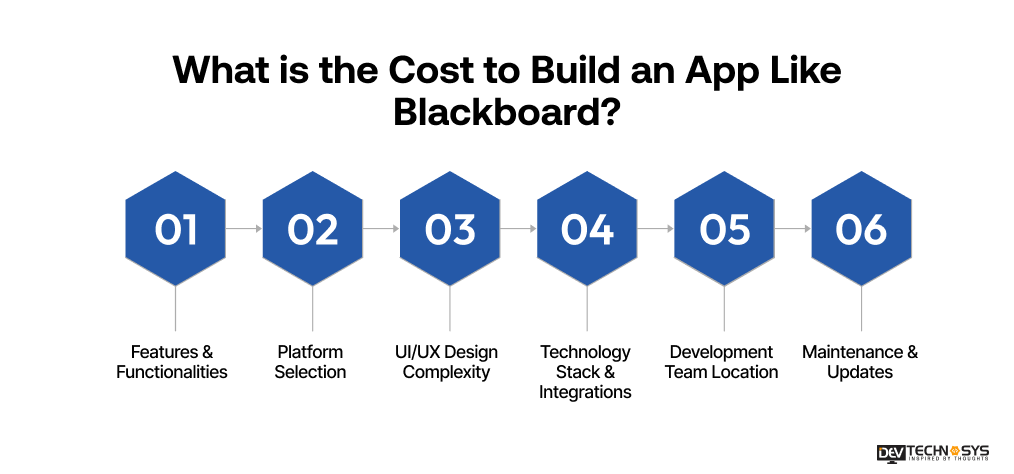
The cost to build an app like Blackboard generally starts from $8,000 and goes up to $30,000+, depending on factors like features, platform, UI/UX design, tech-stack, and geographic location of developers. The basic MVP development with simple features and functionalities costs between $8,000 to $12,000. The mid-level education app development cost, including live classes, discussion forums, and analytics dashboards, lies between $12,000 to $20,000.
| Development Level | Estimated Cost |
| Basic / MVP | $8,000 – $12,000 |
| Mid-Level | $12,000 – $20,000 |
| Advanced / Enterprise | $20,000 – $30,000+ |
Advanced Blackboard app development cost with AI-based personalization, gamification, offline access, AR/VR integration, multi-platform support, and higher security measures will exceed $30,000. Now, let’s dive into the major factors that impact the education app development cost.
1. Features & Functionalities
The number and complexity of features directly influence the cost to develop an app like Seesaw. Core functionalities like course management and notifications are basic, while advanced options such as AI-based personalization, gamification, AR/VR integration, and offline access significantly increase the overall cost to develop an app like Blackboard.
| Level | Estimated Cost |
| Basic | $2,000 – $3,000 |
| Mid-Level | $3,000 – $4,500 |
| Advanced | $4,500 – $6,000+ |
2. Platform Selection
Developing for a single platform, either iOS or Android, is less expensive than building a cross-platform solution. Cross-platform app development (iOS & Android) requires additional coding, testing, and optimization, which directly impacts timelines, resources, and cost.
| Platform Type | Estimated Cost |
| Single Platform (iOS or Android) | $3,000 – $5,000 |
| Cross-Platform | $3,500 – $6,000 |
| Web + Mobile | $5,000 – $8,000+ |
3. UI/UX Design Complexity
Creating a visually appealing and intuitive interface significantly impacts the Blackboard mobile app development cost. Custom animations, interactive elements, and responsive layouts require additional design hours while ensuring smooth navigation and accessibility, ultimately enhancing user experience and engagement.
| Design Type | Estimated Cost |
| Basic UI/UX | $3,000 – $5,000 |
| Mid-Level UI/UX | $5,000 – $8,000 |
| Advanced UI/UX | $8,000 – $10,000+ |
4. Technology Stack & Integrations
Choosing advanced backend technologies and third-party integrations, such as video conferencing, cloud storage, AI tools, and analytics modules, increases development complexity and cost to build an education app like Blackboard. Secure, scalable, and future-proof technology stacks generally require higher investment.
| Team Type | Estimated Cost |
| Offshore / Junior Team | $8,000 – $12,000 |
| Experienced Regional Team | $12,000 – $20,000 |
| Premium / North America / Western Europe | $20,000 – $30,000+ |
5. Development Team Location
The geographic location and skill level of the development team significantly influence the cost to build an app like Blackboard. Teams from North America or Western Europe charge higher hourly rates. If you hire dedicated developers from Southeast Asia, the cost to build an education app like Blackboard will fall on the lower side, though expertise and quality remain the same.
| Team Location | Estimated Cost |
| Southeast Asia / Offshore | $15– $25+ |
| Eastern Europe / Regional Experts | $50 – $80 |
| North America / Western Europe | $40 – $90+ |
6. Maintenance & Updates
Post-launch support involves regular security patches, content updates, bug fixes, and implementation of new features. Continuous maintenance ensures the app remains competitive, secure, fully functional, and aligned with evolving educational needs, which contributes to the ongoing cost of maintaining an app over time.
| Maintenance Level | Estimated Cost |
| Basic | $1,000 – $3,000/year |
| Standard | $3,000 – $7,000/year |
| Advanced / Enterprise | $7,000 – $11,000+/year |

What Are the Monetization Strategies for the Blackboard Clone App?
Monetizing a Blackboard clone app is essential to ensure sustainable revenue while providing value to educational institutions and learners. Hire on-demand app developers who will select the right strategies for your project. Choosing the right strategies is crucial because it allows businesses to balance user growth, engagement, and profitability effectively.
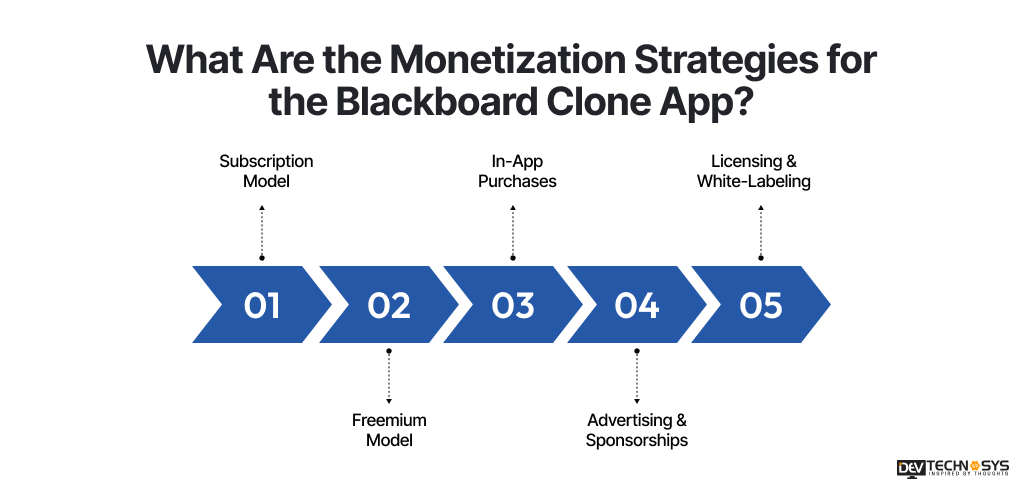
1. Subscription Model
Charge educational institutions, universities, or schools a recurring monthly or yearly fee for access to premium LMS features, advanced analytics, and collaboration tools. It ensures steady revenue while providing institutions with scalable solutions tailored to their learning needs.
2. Freemium Model
Offer basic features of the app for free to attract a large user base while charging for premium features such as advanced analytics, live classes, or extra collaboration tools. Freemium strategy encourages users to upgrade while maintaining widespread engagement.
3. In-App Purchases
Enable users to buy additional resources, courses, certifications, or multimedia study materials directly within the app. It allows targeted revenue generation while giving students flexible access to enhanced content and educators opportunities to monetize specialized learning modules.
4. Advertising & Sponsorships
Display relevant educational ads or partner with edtech brands and institutions for sponsorships. It generates revenue without charging end users directly while offering targeted promotion opportunities to brands seeking to reach students, teachers, and academic organizations.
5. Licensing & White-Labeling
Offer the app’s source code or a fully customizable white-labeled version to schools, universities, or corporate training providers. Institutions can brand, deploy, and manage their LMS independently, providing businesses with a substantial licensing revenue stream.
What are the Trends Happening the Future of Blackboard App Development?
Emerging trends in Blackboard‑style app development are reshaping how digital learning platforms evolve, driven by technological advancements and changing learner expectations. Here are the top trends shaping the future of Blackboard app development.
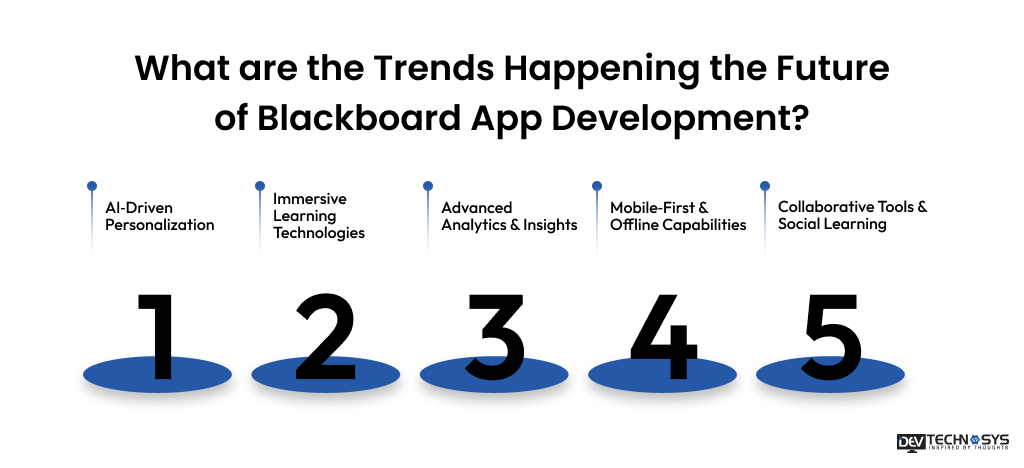
1. AI‑Driven Personalization
Artificial intelligence can tailor individual learning paths, recommend relevant content, predict performance trends, and offer smart tutoring. This enables adaptive learning experiences, ensuring each student receives targeted support to maximize engagement and improve academic outcomes.
2. Immersive Learning Technologies
Hire experienced developers for full stack development services for AR and VR integration in your app. It allows students to participate in simulated practices, virtual labs, and interactive 3D environments. These immersive experiences make complex concepts easier to understand, enhancing engagement, retention, and practical learning outcomes in a visually rich manner.
3. Advanced Analytics & Insights
Real-time dashboards provide educators with actionable insights into student progress, engagement patterns, and learning gaps. Data-driven decision-making allows instructors to customize interventions, improve content delivery, and track the effectiveness of teaching methods.
4. Mobile‑First & Offline Capabilities
Optimizing apps for mobile devices ensures learners can access educational content anytime, anywhere. Offline features allow uninterrupted study in low-connectivity regions, expanding accessibility and inclusivity for students in remote or resource-limited areas.
5. Collaborative Tools & Social Learning
Discussion forums, peer collaboration spaces, and social features foster community learning. Students can engage in group projects, exchange ideas, and receive feedback, enhancing interaction, knowledge sharing, and overall engagement within the educational platform.
Conclusion
Building an education app like Blackboard in the Middle East is a promising opportunity given the growing edtech market. By focusing on regional needs, mobile-first design, advanced features, and robust backend systems, developers can create a scalable, secure, and engaging platform for students and educators. If you are a business looking to develop an education app like Blackboard, contact Dev Technosys, a top education app development company in Middle East.
FAQs
Q1. How Much Does It Cost To Develop An App Like Blackboard In The Middle East?
The cost to develop an app like Blackboard in Middle East ranges from $8,000 to $30,000+. The final cost depends on feature complexity, UI/UX design, platform choice, technology stack, and the geographic location of your development team
Q2. Which Platforms Should I Target For Development?
For maximum reach, target both iOS and Android. Including a web version is also recommended to provide accessibility for institutions with existing LMS infrastructure or students preferring desktop learning
Q3. What Are The Must-Have Features For a Blackboard Clone?
Here are the top features of building a similar app like Blackboard:
- Course access for students and instructors
- Assignment submission and tracking
- Grade management and feedback
- Discussion forums and collaborative spaces
- Notifications and reminders
- Live classes and video sessions
- Analytics dashboards for performance insights
- Resource management, including documents, videos, and quizzes
Q4. How Can I Monetize The App?
Monetization strategies include subscriptions, freemium plans, in-app purchases, advertising, white-label licensing, and pay-per-course content access, enabling flexible revenue streams while catering to both institutions and individual learners.
Q5. How Long Does It Take To Develop A Blackboard-Like App?
A basic MVP can take 3 to 4 months, mid-level development 5 to 7 months, and advanced enterprise solutions 8 to 12 months or more, including testing, deployment, and iterations based on feedback and institutional requirements.
Q6. What Are the Key Trends in Blackboard App Development?
Here are the key trends of building top education apps Dubai:
- AI-driven personalization for adaptive learning
- AR/VR immersive learning experiences
- Advanced analytics for educators and institutions
- Mobile-first design with offline capabilities
- Collaborative tools and social learning integration
- Gamification with badges, leaderboards, and rewards