





Key Takeaways:
-
- Chatbots are used in everything from smart speakers at home and consumer-facing versions of SMS, WhatsApp, and Facebook Messenger to workplace messaging apps like Slack.
- The cost to develop a chatbot depends on factors such as complexity, AI integration, platform support, and features.
- Essential features for a chatbot include NLP, intent recognition, conversation flows, multi-platform support, user authentication, and multilingual support.
- AI-powered chatbot development leverages AI, natural language processing (NLP), and machine learning to understand user intent, context, and language nuances.
2026 marks a new era of digitalization. Businesses keep searching for innovative ways that enhance customer engagement and simplify core operations. Chatbot development is probably among the top technological tools that became popular very fast. But what is chatbot development? Simply put, chatbots are intelligent virtual assistants created to enhance marketing, sales, and customer support environments.
Chatbots offer round-the-clock support, tailored experiences, and affordable solutions. Businesses can remotely manage internal operations, onboarding, sales queries, and customer support with chatbot creation. With time, these bots get more accurate and personalized as they continue to learn from interactions.
Because of this, chatbot creation is essential for improving user experience, boosting engagement, optimizing workflows, guaranteeing 24/7 availability, and cutting the cost to develop a chatbot. Read the blog and get informed on what chatbot development is, types of chatbot apps ruling the industry, features involved in custom chatbot development, and more. So without further ado, let’s begin!
What is a Chatbot?
A chatbot is a computer program that uses text messaging, voice commands, or both to mimic human communication. Chatbots are now ubiquitous, appearing in everything from smart speakers at home and consumer-facing versions of SMS, WhatsApp, and Facebook Messenger to workplace messaging apps like Slack.
They use machine learning, artificial intelligence (AI), and natural language processing (NLP) to understand user intent and provide automated, instant responses for tasks, customer service, and information retrieval. Only understanding about the development is not enough. Businesses that follow chatbot development trends in UAE gain competitive edge in the market.
How Does Chatbot Development Work?
Chatbot development combines conversational design, backend engineering, artificial intelligence, data processing, and system integrations to create software that can understand user requests and respond through natural language.
A typical chatbot interaction follows this flow:
User Input → Language Understanding → Intent & Context Analysis → Knowledge Retrieval/AI Processing → Response Generation → API/Action → Response Delivery

What are the Types of Chatbot Development?
Now that we know what is chatbot development, let’s take a step further and see the different types of chatbot development. Each type is designed to serve specific business needs, user expectations, and levels of automation. Let’s see what role each chatbot plays in enhancing technological development.
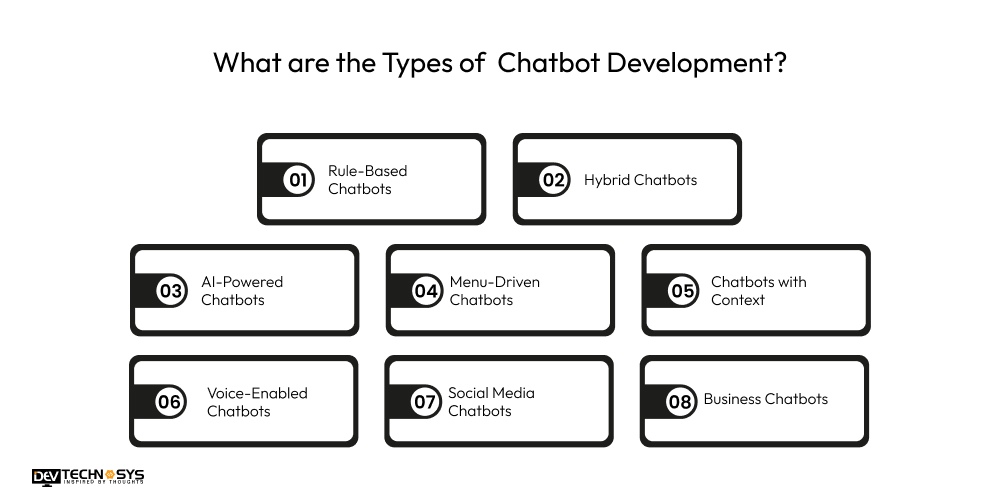
1. Rule-Based Chatbots
Rule-based chatbots use developers’ pre-established rules, keywords, and decision trees. They only respond when the user’s input satisfies the predetermined criteria, using “if–then” logic. These chatbots are appropriate for FAQs, simple troubleshooting, and guided user journeys since they are dependable, simple to use, and quick to implement.
However, their inability to comprehend context, intent, or linguistic differences makes it difficult for them to respond to complicated or unexpected questions. Need a leading rule-based chatbot developed with precision? Look for a top hybrid app development company to hire.
App Examples:
- HDFC Bank EVA: Handles basic banking FAQs and predefined queries.
- IRCTC RailMadad: Assists with ticket status and complaint registration.
- Zomato Help Bot (basic flows): Order status, refunds, and delivery issues.
2. Hybrid Chatbots
The flexibility of AI-driven responses and the dependability of rule-based reasoning are combined in hybrid chatbots. AI models process complex or open-ended inquiries, whereas established rules handle simple and repetitive queries.
This method permits natural interactions when necessary while guaranteeing consistent responses for important jobs. Because they strike a compromise between accuracy, performance, and cost effectiveness, hybrid chatbots are frequently employed in banking, healthcare, and eCommerce.
App Examples:
- SBI YONO App Chatbot: Rules for transactions, AI for support queries.
- Domino’s App Chatbot: Menu-based ordering with AI suggestions.
- Swiggy Chat Assistant: Structured flows plus smart issue resolution.
3. AI-Powered Chatbots
AI-powered chatbots leverage artificial intelligence, natural language processing (NLP), and machine learning to understand user intent, context, and language nuances. They can process unstructured inputs, learn from conversations, and continuously improve their responses over time.
These chatbots are ideal for customer support, sales assistance, virtual agents, and enterprise automation. According to chatbot development services providers, AI-powered chatbots are highly scalable and intelligent, but they require quality training data, ongoing optimization, and higher development investment.
App Examples:
- ChatGPT App: Advanced AI conversations and assistance.
- Replika: AI companion chatbot with emotional intelligence.
- KLM Royal Dutch Airlines App: AI chatbot for flight info and travel updates.
4. Menu-Driven Chatbots
Menu-driven chatbot app development involves buttons, lists, or menus to lead users through organized dialogues. Users choose options rather than entering questions, which minimizes misunderstandings and mistakes. A chatbot development company builds this bot for scheduling appointments, ordering orders, monitoring deliveries, and making service requests.
Exports who provide chatbot development services design these chatbots because are simple to use and quite efficient. However, if consumers seek greater flexibility or individualized interactions, they may feel constricted and lack conversational depth.
App Examples:
- McDonald’s App: Menu-based food ordering chatbot.
- BookMyShow App: Ticket booking through guided options.
- Uber Help Section Bot: Select-based issue resolution.
5. Chatbots with Context
Contextual chatbots employ natural language processing (NLP) and machine learning to remember past conversations and comprehend user context over time. In order to provide more pertinent and individualized answers, they are able to recall preferences, past inquiries, and behavioral patterns.
They are therefore ideal for long-term engagement tactics, customer retention, and recommendation systems. Their development is more intricate, involving privacy concerns, model training, and reliable data processing.
App Examples:
- Amazon App Chatbot: Product suggestions based on browsing history.
- Netflix Support Chatbot: Personalized account and viewing help.
- Spotify App Assistant: Music recommendations based on listening habits.
6. Voice-Enabled Chatbots
What is chatbot development with voice features? Voice-enabled chatbots interact with users via speech recognition and natural language understanding. They enable hands-free communication and are commonly used in smart speakers, call centers, in-car systems, and virtual assistants.
These chatbots enhance accessibility and convenience but require advanced speech processing, noise handling, and language accuracy to ensure a smooth user experience. If you want to develop a net-gen voice-enabled chatbot, then hire professionals with expertise in voice-enabled AI agent development services.
App Examples:
- Amazon Alexa App: Voice-based assistant for smart devices.
- Google Assistant App: Voice commands and conversational AI.
- Apple Siri: Voice-enabled personal assistant on iOS devices.
7. Social Media Chatbots
Popular messaging services, including Instagram, Telegram, Facebook Messenger, and WhatsApp are connected with social media chatbots. Social media chatbot development enables companies to automate lead nurturing, marketing campaigns, customer service, and transactional updates using channels that customers already like.
Although they must abide by platform-specific regulations and data privacy requirements, these chatbots aid in increasing response times and engagement.
App Examples:
- WhatsApp Business Chatbots: Order tracking, payments, and support.
- Facebook Messenger Bots: Customer engagement and marketing.
- Telegram Bots: News alerts, customer support, and automation.
8. Business Chatbots
Enterprise chatbots are designed to assist with internal organizational functions such as employee onboarding, IT support, HR assistance, and financial inquiries. They deliver real-time data and automate processes by integrating with corporate systems like CRM, ERP, HRMS, and knowledge bases.
An enterprise chatbot development ensures output increase, decreases manual labor, and promotes employee satisfaction, but they require robust security, scalability, and system integration capabilities.
App Examples:
- Microsoft Teams Bots: HR, IT, and workflow automation.
- Slack Bots (e.g., Slackbot): Internal queries and task automation.
- Salesforce Einstein Bot: CRM-based sales and customer support.
What Features Are Used For Chatbot Development?
The features included in a chatbot depend on its purpose, target users, data requirements, and level of intelligence. A basic customer-support chatbot may require predefined conversations and FAQs, while an enterprise AI chatbot may need RAG, LLM integration, multilingual capabilities, analytics, authentication, API integrations, and human handoff.
Core Feature |
Advanced Feature |
| Conversational Interface | LLM Integration |
| NLP/NLU | Retrieval-Augmented Generation (RAG) |
| Predefined Responses | Conversational Memory |
| Intent Recognition | Multilingual AI |
| Context Management | Sentiment Analysis |
| Knowledge Base Integration | Voice Interaction |
| API Integration | AI Personalization |
| Human Handoff | Tool & Function Calling |
| Multichannel Support | AI Guardrails |
| Analytics & Reporting | Predictive Analytics |
Understanding the Chatbot Architecture
A well-designed architecture allows each component to perform a specific role while working together as a complete conversational system. Businesses should understand the foundation before choosing chatbot development services. The key components of chatbot architecture include:
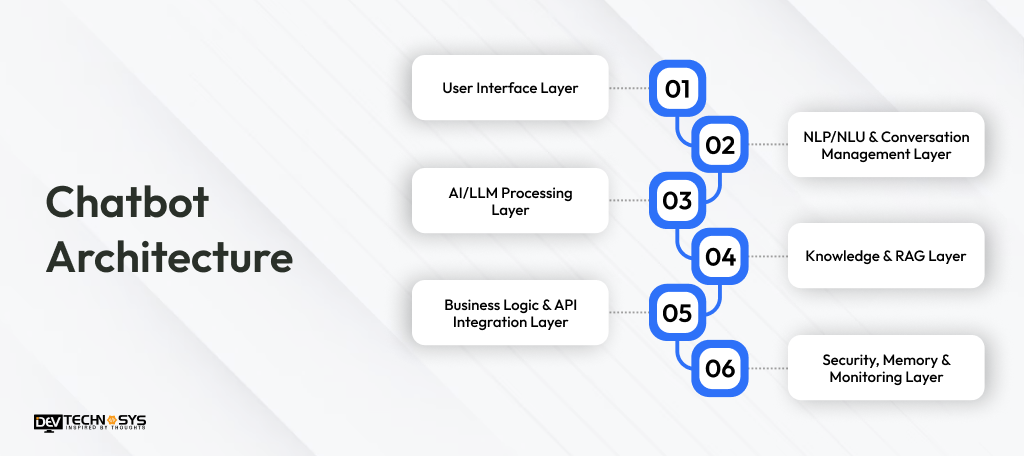
1. User Interface Layer
The user interface is the front-facing layer where people interact with the chatbot. It can include website chat widgets, mobile apps, messaging platforms, or voice interfaces and should provide a smooth, accessible conversational experience.
2. NLP/NLU & Conversation Management Layer
This layer processes user messages, identifies intent and entities, understands context, and manages the conversation flow. It determines what the user wants and what the chatbot should do next.
3. AI/LLM Processing Layer
The AI layer handles natural-language understanding and response generation. Depending on the chatbot’s requirements, it can use machine learning models, large language models (LLMs), generative AI, or a combination of models.
4. Knowledge & RAG Layer
This layer connects the chatbot with business knowledge, documents, FAQs, databases, and other trusted information sources. If a business wants to build a chatbot from scratch, then this step is important. RAG enables the system to retrieve relevant information before generating a response, improving factual accuracy and relevance.
5. Business Logic & API Integration Layer
The integration layer allows the chatbot to interact with external systems such as CRM, ERP, payment gateways, booking platforms, inventory systems, and enterprise applications. This enables the chatbot to perform actions rather than simply answer questions.
6. Security, Memory & Monitoring Layer
This layer manages authentication, authorization, encryption, conversation memory, logging, performance monitoring, and AI safeguards. It helps protect user data while allowing developers to track chatbot accuracy, failures, usage, and overall performance.
Technologies Used in Chatbot Development
The technology stack for chatbot development depends on whether the solution is rule-based, AI in chatbot development, RAG-enabled, voice-enabled, or designed to execute business workflows.
Technology Category |
Common Technologies |
Purpose |
| Frontend | React.js, Next.js, Angular | Build web-based chatbot interfaces |
| Mobile | Flutter, React Native, Swift, Kotlin | Develop chatbot-enabled mobile applications |
| Backend | Node.js, Python, Java, .NET | Build APIs, business logic, and backend services |
| NLP/NLU | NLP libraries, intent classification models | Understand user language |
| AI/ML | Machine learning, deep learning | Improve intent recognition and personalization |
| LLMs | GPT-family models, Claude, Gemini, open-weight models | Generate contextual responses |
| RAG | LlamaIndex, LangChain and retrieval pipelines | Connect LLMs with external knowledge |
| Vector Databases | Pinecone, Qdrant, Weaviate, FAISS | Store and retrieve semantic embeddings |
| Databases | PostgreSQL, MySQL, MongoDB, Redis | Store application and conversation data |
| Cloud | AWS, Microsoft Azure, Google Cloud | Host and scale chatbot infrastructure |
| Real-Time Communication | WebSockets, Socket.IO | Enable real-time conversations |
| Voice AI | Speech-to-text, text-to-speech | Support voice conversations |
| APIs | REST, GraphQL, webhooks | Connect business applications |
| DevOps | Docker, Kubernetes, CI/CD | Deploy and manage production systems |
| Monitoring | Application and AI observability tools | Monitor latency, failures, usage, and quality |
AI Chatbot vs Traditional Chatbot
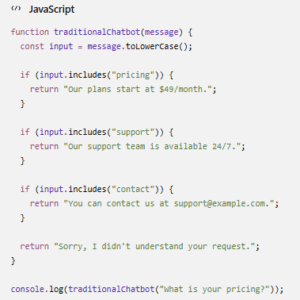
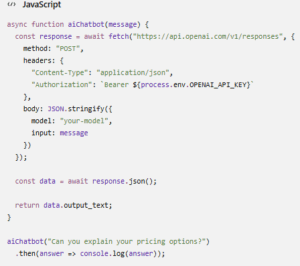
Traditional chatbots generally depend on predefined rules, keywords, decision trees, and scripted responses. AI chatbots use technologies such as NLP, machine learning, generative AI, and LLMs to interpret a broader range of natural-language requests.
Let’s understand the difference first with basic code.
For a Traditional Chatbot (rule-based)
For an AI Chatbot (LLM-based)
The table below compares the two based on specific parameters.
Parameter |
Traditional Chatbot |
AI Chatbot |
| Technology | Rules, decision trees, keyword matching | NLP, ML, LLMs, generative AI |
| Response Generation | Predefined responses | Dynamically generated or retrieved responses |
| Context Understanding | Limited | Advanced |
| Handling Complex Queries | Limited | Better suited for open-ended queries |
| Personalization | Basic | Advanced |
| Knowledge Sources | Preconfigured database/rules | Knowledge bases, RAG, APIs, enterprise data |
| Learning/Adaptation | Requires manual updates | Can be improved through data, evaluation, tuning, and configuration |
| Business Actions | Usually workflow-specific | Can use tools/APIs for broader task execution |
| Development Complexity | Relatively low | Moderate to high |
Chatbot Security and Data Privacy in the UAE
Chatbots can process names, contact details, account information, customer conversations, documents, payment-related information, and other personal data. For businesses operating in the UAE, data processing should therefore be designed around applicable UAE privacy and cybersecurity requirements.
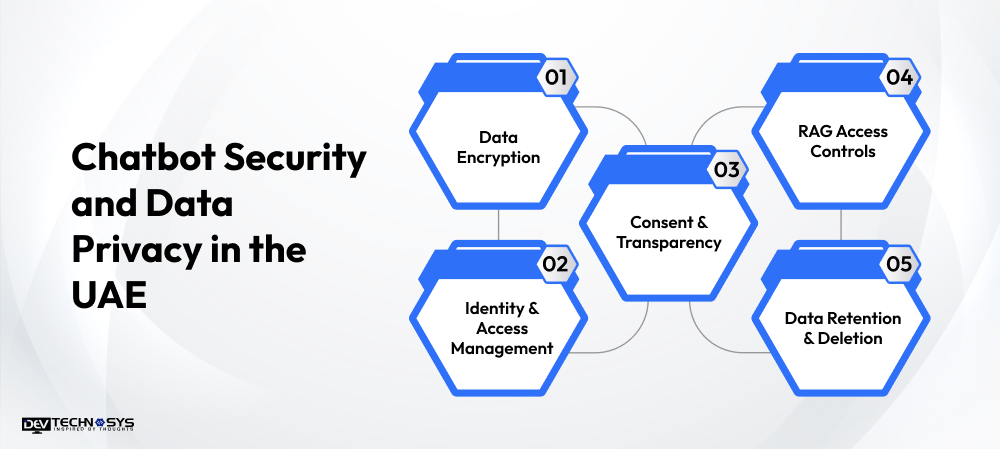
1. Data Encryption
Use encryption for data transmitted between users, APIs, databases, and AI services, as well as appropriate protection for stored data.
2. Identity & Access Management
Implement strong authentication, authorization, role-based access controls, and least-privilege access for users, administrators, APIs, and internal systems. This practice directly affects the chatbot development cost. Thus, businesses should plan for the budget beforehand.
3. Consent & Transparency
Clearly communicate what personal data the chatbot collects, why it is processed, and how it is used. Where applicable, obtain and document appropriate consent.
4. RAG Access Controls
When a chatbot uses RAG, retrieval permissions should follow the user’s authorization level. A user should not receive confidential information simply because it exists inside the connected knowledge base.
5. Data Retention & Deletion
Define how long conversation and personal data should be retained and establish procedures for deletion or other data-subject requests where applicable.
Conclusion
We hope the above blog helped you learn more about chatbot development. As technology evolves, chatbot development continues to integrate advanced features, making it a crucial tool for businesses and users in the digital era. All in all, chatbot development is a lucrative investment for businesses, especially when developed with professional care.
If you are a business looking to create your own chatbot app, then consult Dev Technosys, a leading artificial intelligence development company in the Middle East. For more informative insights regarding chatbot development, stay tuned with us.
FAQs
1. What are the Challenges in Chatbot Development?
The primary challenge is to prevent hallucinations. Following this, handling higher traffic, response accuracy, and protection of sensitive data. Software engineers need to put in extra development effort to maintain performance of the chatbot. Experts use Retrieval-Augmented Generation, fraud detection techniques, and compliance to resolve the concerns.
2. What are Chatbot Development Use Cases?
Chatbots in the logistics industry are used to track shipments. This helps businesses to reduce delays. Also, customers can inquire through a chatbot by simply sharing their order details. Chatbots are being widely used for sales and marketing purposes. The bot helps businesses to find qualified leads with a simple chat interaction.
3. How Much Does Chatbot Development Cost?
The chatbot development cost in 2026 and beyond is estimated to be between AED 110,000 and AED 550,000+, depending on AI competence, multilingual support, UX design, connectors, and business capabilities. Kindly note that solution maintenance, security and compliance adds to the total budget.
4. How Do AI-Powered Chatbots Differ From Rule-Based Chatbots?
AI-powered chatbots use machine learning and NLP to understand context and generate intelligent responses, while rule-based chatbots follow pre-defined scripts and respond only to specific commands or keywords.
5. What Is The Future Of Chatbot Development?
The future includes advanced AI capabilities, voice and video integration, predictive analytics, deeper personalization, omnichannel support, and more intelligent human-like interactions, making chatbots central to digital business strategy.