





Building a chatbot from scratch is no longer the preserve of tech giants; it’s an exciting opportunity for startups, enterprises, and creators alike. With rapid advances in AI, natural language processing, and cloud computing, chatbots have evolved from simple rule-based responders into intelligent digital assistants that can understand context, learn from interactions, and deliver human-like conversations.
Whether you want to automate customer support, boost sales engagement, or create a smart virtual assistant, developing a chatbot gives you full control over functionality, data, and user experience.
From defining clear goals and choosing the right technology stack to training models and deploying them across platforms, the journey of chatbot development is both strategic and creative. This guide walks you through the essential steps to build a chatbot from scratch, helping you turn a simple idea into a powerful conversational solution that adds real value to your business and users.
Business Benefits of Investing in Chatbot App Development
Investing in custom chatbot app development offers significant business benefits, including 24/7 customer support, up to 90% reduction in service costs, improved user engagement, and higher conversion rates. So, before we learn how to make a Chatbot in Python or Laravel, let’s study these benefits in detail.
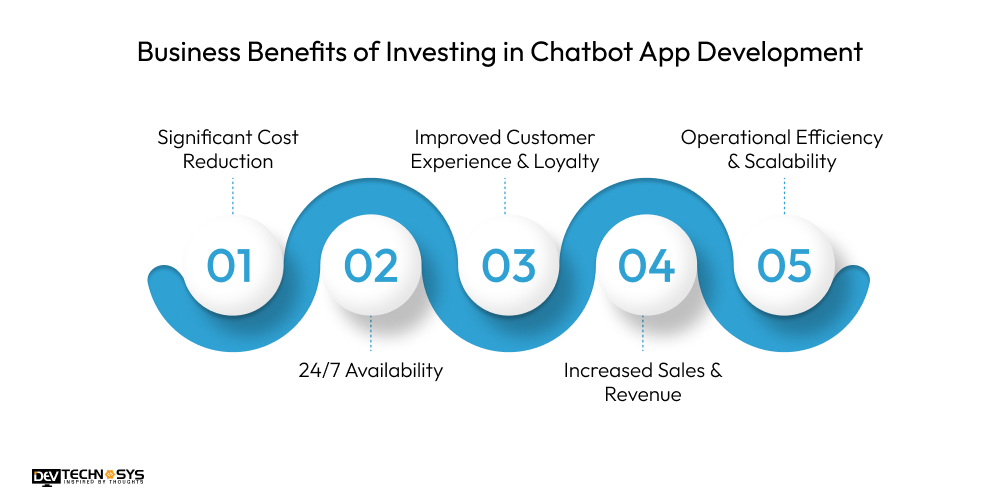
1. Significant Cost Reduction
Chatbots help businesses significantly reduce customer service costs by handling a high volume of routine, repetitive queries without human intervention. By automating FAQs, order tracking, and basic troubleshooting, companies can reduce support costs by up to 30%. It is one of the reasons why chatbot development is skyrocketing in 2026.
2. 24/7 Availability
AI-powered chatbots provide uninterrupted, round-the-clock support, ensuring customers receive instant assistance regardless of time zones, holidays, or business hours. This always-on availability improves responsiveness, builds trust, and ensures that customer queries are addressed immediately, even outside traditional support windows.
3. Improved Customer Experience & Loyalty
Chatbots deliver fast, consistent, and personalized responses by analyzing user behavior and preferences. By minimizing wait times and offering immediate solutions, they enhance overall customer satisfaction. This seamless experience reduces frustration, strengthens brand perception, and helps prevent customer churn, ultimately improving long-term loyalty.
4. Increased Sales & Revenue
Acting as virtual sales assistants, chatbots engage website visitors, qualify leads, and guide users through the buying journey. They provide tailored product recommendations, answer purchase-related questions, and prompt timely follow-ups. Research indicates that chatbots can increase sales conversion rates and drive revenue growth by up to 67%. This data shows that businesses are choosing AI chatbot development services to build scalable solutions.
5. Operational Efficiency & Scalability
Chatbots can handle thousands of conversations simultaneously without any drop in performance, making them highly scalable. As business demand grows, chatbots easily adapt without requiring additional staffing, improving operational efficiency while maintaining consistent service quality.
What are the Steps to Build a Chatbot From Scratch?
Businesses are moving beyond the question: what is chatbot development? They now need to know the advanced capabilities they can incur to maximize ROI. Moreover, chatbot development from scratch is a feasible solution to all queries. Follow these steps to create an advanced chatbot for today’s generation.
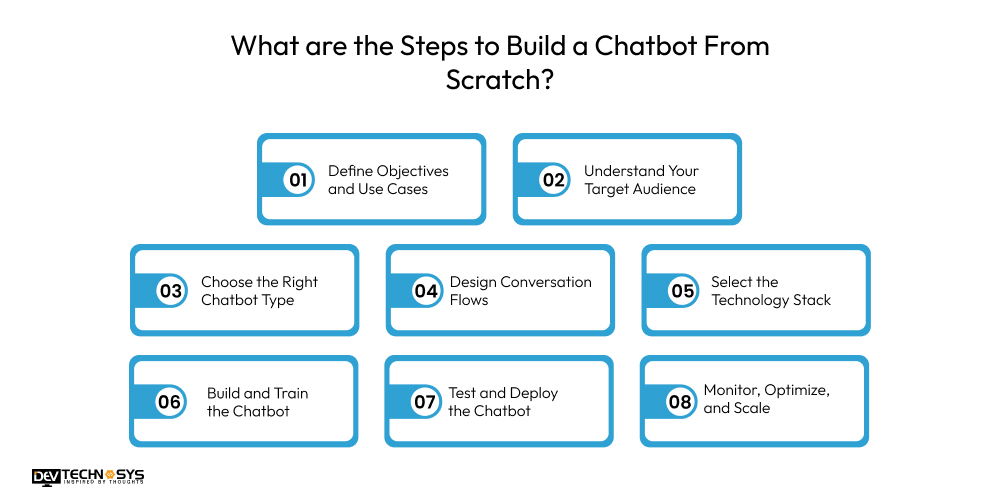
Step 1. Define Objectives and Use Cases
The first step to build a chatbot from Scratch is defining its core purpose and business objectives. Determine whether the chatbot will be used for customer support, lead generation, sales, onboarding, or internal assistance. Make a chatbot application by clearly outlining use cases.
It helps shape the conversation, the required features, and the success metrics. Also, make a rough estimate of the cost to build a chatbot. Well-defined objectives ensure the chatbot delivers measurable value and aligns with overall business goals from the start.
Step 2. Understand Your Target Audience
Looking forward to AI application development for businesses? For that understanding your audience is crucial for designing meaningful chatbot interactions. Analyze user demographics, behavior patterns, preferences, and frequently asked questions.
Identify the problems users expect the chatbot to solve and how they prefer to communicate. This insight helps create natural conversation flows, appropriate language tone, and relevant responses, ensuring the chatbot feels intuitive, helpful, and user-centric rather than robotic.
Step 3. Choose the Right Chatbot Type
To build a chatbot from scratch, select the chatbot type based on complexity, scalability, and budget. Rule-based chatbots follow predefined scripts and work well for simple queries. AI-powered chatbots use natural language processing to understand intent and learn over time.
A top hybrid app development company creates Hybrid chatbots by combining both approaches for better accuracy and flexibility. Choosing the right model ensures optimal performance, better user experience, and long-term adaptability.
Step 4. Design Conversation Flows
The next step is creating an appealing UI/UX design for chatbots. Conversation design defines how users interact with the chatbot. Create a low-latency chatbot response architecture with structured dialogue flows that guide users smoothly toward solutions while maintaining a natural tone.
Include greetings, clear response paths, and fallback messages for unrecognized inputs. Well-designed conversation flows reduce confusion, improve engagement, and ensure users receive accurate answers without frustration, even when interactions become complex.
Step 5. Select the Technology Stack
Choosing the right technology stack is essential for chatbot performance and scalability. Decide on programming languages like Python or JavaScript, NLP frameworks, databases, and cloud platforms. According to the experts who provide enterprise mobile application development services, the stack should support integration with existing systems, data security, and future enhancements.
A flexible and scalable technology foundation ensures the chatbot can handle growing user demand and evolving business requirements efficiently.
| Layer | Tech Stack |
| Frontend | Web Chat, React |
| Backend | Python, Node.js |
| NLP Engine | Dialogflow, Rasa |
| Database | MongoDB |
| Deployment | AWS, Google Cloud |
Step 6. Build and Train the Chatbot
This step to build a chatbot from scratch involves developing the chatbot logic and training it using sample conversations, intents, and entities. For AI chatbots, machine learning models must be trained with diverse datasets to improve intent recognition and response accuracy.
Continuous training helps the chatbot learn from real interactions, refine responses, and deliver more human-like, context-aware conversations over time.
Step 7. Test and Deploy the Chatbot
Before launch, your mobile app development company in Dubai will thoroughly test the chatbot across different scenarios, devices, and platforms. Identify errors, improve response accuracy, and ensure smooth conversation flow.
Testing helps eliminate bugs and user experience issues. Once optimized, deploy the chatbot on selected channels such as websites, mobile apps, or messaging platforms to start engaging with real users.
Step 8. Monitor, Optimize, and Scale
After deployment, continuously monitor chatbot performance using metrics like response accuracy, resolution rate, and user satisfaction. Collect user feedback and conversation data to identify areas for improvement.
Regular optimization, content updates, and retraining ensure the chatbot remains relevant and efficient. As business needs grow, the chatbot can be scaled to handle higher volumes and advanced use cases.

What is the Cost to Build a Chatbot From Scratch in 2026?
The chatbot development cost typically ranges from AED 110,000 to AED 551,000+, depending on the chatbot’s intelligence, integrations, security requirements, AI model, and overall complexity. A basic chatbot development with predefined conversations and limited integrations will sit toward the lower end, while an AI-powered enterprise chatbot with LLM integration, RAG, multilingual support, voice capabilities, analytics, and enterprise-grade security can exceed AED 551,000.
Chatbot Complexity |
Estimated Development Cost (AED) |
Typical Scope |
|---|---|---|
| Basic Chatbot | AED 110,000 – AED 184,000 | Rule-based conversations, FAQs, basic NLP, web/mobile integration, admin panel |
| AI-Powered Chatbot | AED 184,000 – AED 330,500 | LLM integration, contextual conversations, personalization, API integrations, analytics |
| Advanced Chatbot | AED 330,500 – AED 551,000 | RAG, knowledge-base integration, multilingual support, advanced NLP, workflow automation, CRM/ERP integrations |
| Enterprise Chatbot | AED 551,000+ | Custom AI models, multi-agent workflows, voice capabilities, enterprise integrations, advanced security, compliance, scalability |
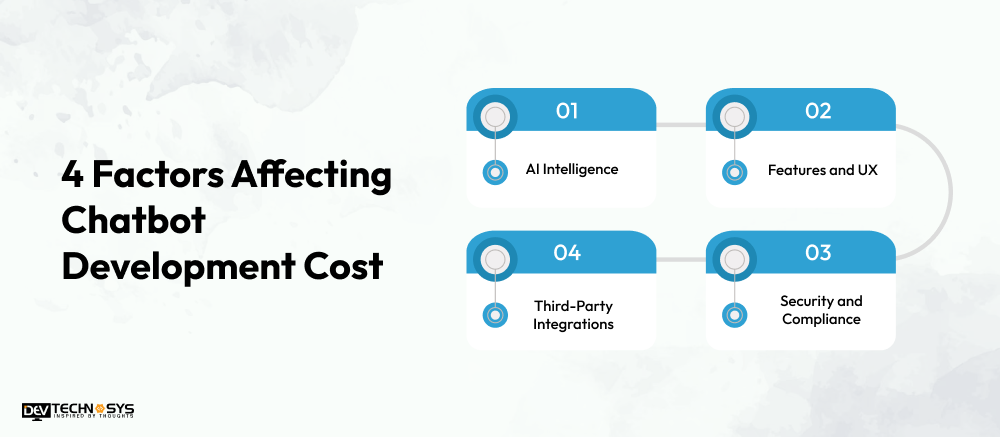
4 Factors Affecting Chatbot Development Cost
Several technical and business factors influence the budget to develop a chatbot from scratch. The following four are among the most significant:
Cost Factor |
What It Includes |
Estimated Cost Impact (AED) |
|---|---|---|
| AI Intelligence | Rule-based logic, NLP, LLM integration, RAG, contextual memory, intent recognition, AI agents | AED 37,000 – AED 184,000+ |
| Features and UX | Conversational UI, personalization, multilingual support, voice, recommendations, analytics, admin dashboard | AED 29,000 – AED 129,000+ |
| Third-Party Integrations | CRM, ERP, payment gateways, databases, APIs, WhatsApp, websites, mobile apps, helpdesk systems | AED 18,000 – AED 110,000+ |
| Security and Compliance | Encryption, authentication, RBAC, audit logs, data privacy controls, compliance implementation, security testing | AED 26,000 – AED 147,000+ |
Challenges of Building a Chatbot From Scratch
Building a chatbot from scratch gives you greater control over its functionality, data, integrations, and user experience, but it also introduces several technical challenges. Businesses that want to opt for enterprise chatbot development need to plan the chatbot architecture, select the right AI models, manage data securely, and ensure the bot can handle real-world conversations reliably.
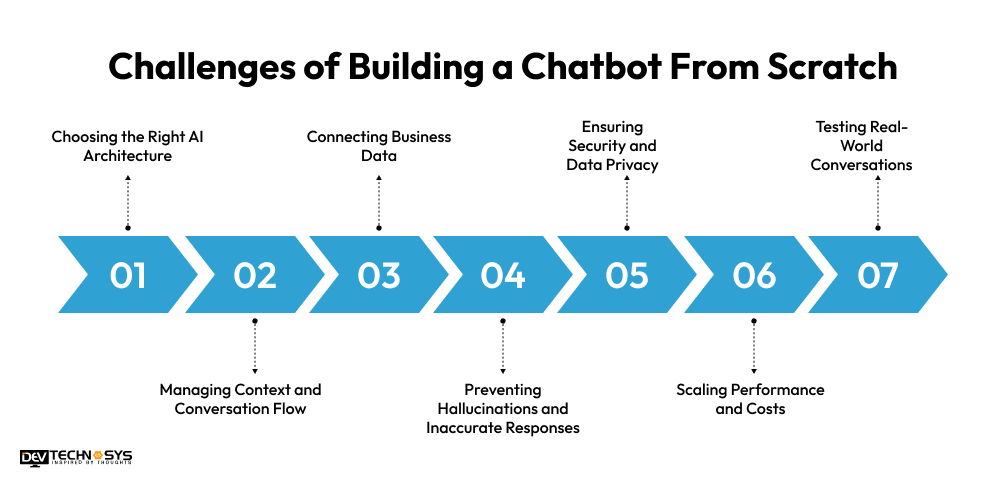
1. Choosing the Right AI Architecture
Selecting between rule-based logic, NLP models, LLMs, or a hybrid architecture can significantly affect the chatbot’s capabilities and development complexity. An LLM-powered chatbot may provide more natural conversations, but it also requires careful prompt design, context management, model selection, and evaluation. Businesses planning advanced AI chatbot development should choose an architecture based on their use cases, data requirements, scalability, and expected conversation volume.
2. Managing Context and Conversation Flow
A chatbot must understand what users mean, remember relevant conversation history, and respond appropriately to follow-up questions. Maintaining context becomes more difficult when conversations involve multiple topics, long sessions, or ambiguous requests. Developers need to implement session management, conversation state, fallback handling, and context-window strategies to prevent irrelevant or repetitive responses.
3. Connecting Business Data
A chatbot becomes significantly more useful when it can access business-specific information such as product catalogs, FAQs, customer records, policies, or internal documents. However, connecting these data sources requires APIs, databases, authentication mechanisms, and sometimes retrieval-augmented generation (RAG). Poor data integration can result in outdated information or inaccurate responses, making RAG chatbot development an important consideration for knowledge-intensive applications.
4. Preventing Hallucinations and Inaccurate Responses
Generative AI chatbots can occasionally produce confident but incorrect information. This is particularly risky when the chatbot handles financial, healthcare, legal, or other business-critical queries. Developers should use grounded data sources, response validation, carefully designed prompts, confidence thresholds, and human escalation workflows to improve reliability.
5. Ensuring Security and Data Privacy
Chatbots may process names, contact information, customer conversations, documents, payment-related information, or other sensitive business data. Security therefore needs to be considered throughout development rather than added after deployment. Encryption, authentication, authorization, secure API design, access controls, logging, and appropriate data-retention policies can help protect chatbot interactions and connected systems.
6. Scaling Performance and Costs
A chatbot that works well with a few hundred conversations may face performance and cost challenges when usage increases. API calls, model inference, database queries, vector searches, and conversation history can all affect infrastructure requirements and operating expenses. Developers need to optimize prompts, cache appropriate responses, select models according to task complexity, and design an architecture that can scale without compromising response quality.
7. Testing Real-World Conversations
Chatbot testing goes beyond checking whether predefined questions receive the correct answers. Users may misspell words, change topics, use slang, ask ambiguous questions, or provide incomplete information.
Developers need to test different conversation paths, edge cases, adversarial prompts, integration failures, and fallback scenarios before deployment. Continuous monitoring after launch is equally important because chatbot performance can change as user behavior and underlying data evolve.

What Are the Must-Have Features For Chatbot Development?
Now that we know how to build a chatbot from scratch, let’s see what features are crucial to add for AI in chatbot development. These features help chatbots better understand users, respond accurately, and scale across platforms.
Feature |
Purpose |
| NLP & Intent Recognition | Understands user queries and intent accurately |
| Context Awareness | Maintains conversation flow across interactions |
| Multilingual Support | Enables communication in multiple languages |
| Omnichannel Deployment | Works across web, apps, and messaging platforms |
| Personalization | Delivers tailored responses based on user data |
| CRM & API Integration | Automates workflows and connects systems |
| Human Handoff | Escalates complex queries to live agents |
| Analytics & Reporting | Measures performance and user engagement |
| Data Security & Compliance | Protects user data and meets regulations |
| Scalability | Handles growing user demand efficiently |
How to Choose The Right Chatbot Development Company?
Choosing the right chatbot development company is critical to building a solution that delivers real business value. Here are the criteria and parameters through which you can filter out the best chatbot development company.
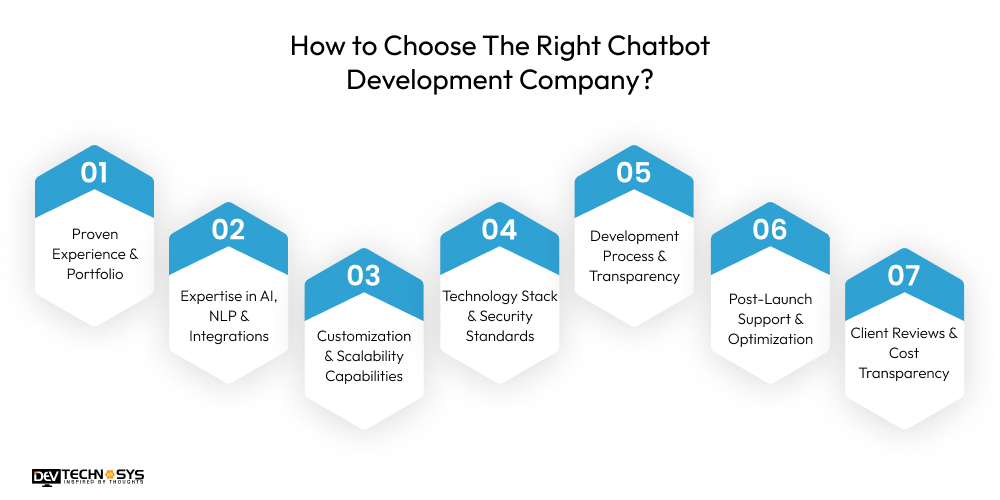
1. Proven Experience & Portfolio
When selecting a chatbot development company, reviewing their portfolio is critical. A company with a diverse range of completed projects across industries demonstrates its ability to handle varying use cases, complexities, and platforms.
Real-world experience ensures that they understand common challenges, know how to optimize user engagement, and can deliver solutions that align with business objectives. Case studies and success stories provide valuable insight into their technical competence and project execution capabilities.
2. Expertise in AI, NLP & Integrations
The ideal artificial intelligence development company should have hands-on expertise in AI, machine learning, and natural language processing technologies. These skills are essential for creating chatbots that understand user intent, provide accurate responses, and improve over time.
Additionally, they must be capable of seamless integration with CRM systems, ERP solutions, payment gateways, and other third-party APIs, ensuring your chatbot functions effectively within your existing business ecosystem and adds measurable operational value.
3. Customization & Scalability Capabilities
Every business has unique needs, so avoid companies offering generic, one-size-fits-all chatbot solutions. The right partner should deliver fully customized chatbots tailored to your brand, workflows, and audience. Equally important is scalability; your chatbot should handle growing user traffic, expanded functionality, and increasingly complex queries without performance degradation.
A scalable and adaptable solution ensures long-term usability, cost efficiency, and the ability to evolve alongside your business goals and customer expectations.
4. Technology Stack & Security Standards
Evaluate the technologies and tools the company uses to build chatbots. A modern, reliable tech stack ensures performance, flexibility, and maintainability. Equally crucial are security measures, especially for chatbots that process sensitive customer data.
Ensure the company follows industry-standard practices for data protection, encryption, and compliance with regulations like GDPR or CCPA. Strong security protocols safeguard your users, reinforce trust in your brand, and minimize legal and operational risks.
5. Development Process & Transparency
A transparent and structured development process is key to a successful project. Choose an AI agent development services provider that follows an organized workflow, communicates regularly, provides progress updates, and sets realistic timelines.
Agile or iterative methodologies are preferable, allowing adjustments based on feedback. Transparency reduces misunderstandings, ensures alignment on project goals, and fosters collaboration. A clear roadmap also provides measurable milestones, helping you track progress and stay confident that the chatbot will meet expectations.
6. Post-Launch Support & Optimization
Chatbot development does not end with deployment. Continuous support, performance monitoring, and optimization are essential to maintain efficiency and user satisfaction. Chatbot monetization beyond subscription models, the company should provide model retraining, software updates, and feature enhancements to adapt to changing business needs and user behaviors.
Ongoing support ensures that your chatbot remains effective, learns from real interactions, and continues to deliver high-quality conversations while preventing downtime or operational issues.
7. Client Reviews & Cost Transparency
Finally, examine client testimonials, reviews, and case studies to assess reliability and service quality for conversational AI development. Positive feedback demonstrates credibility, trustworthiness, and a history of successful project delivery.
Transparent pricing is equally important; ensure the company provides clear cost structures without hidden charges. A company that balances quality with honest pricing, backed by proven client satisfaction, is more likely to deliver a chatbot solution that aligns with your budget, expectations, and business goals.
Security and Compliance for a Chatbot in the UAE
Security should be built into a chatbot from the beginning, particularly when it processes customer conversations, personal information, business records, payment-related data, or other sensitive information. Businesses that keep up with the chatbot development trends in UAE gain a competitive edge.
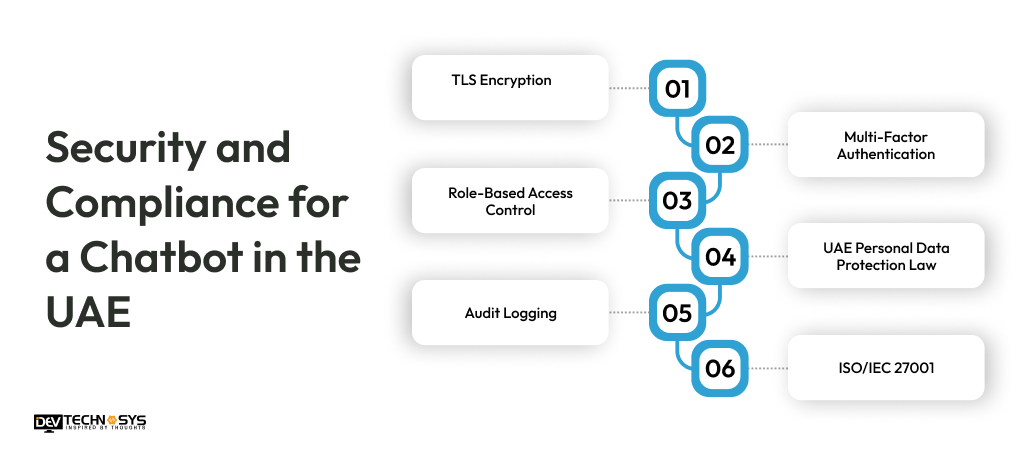
The chatbot must include TLS encryption, encryption at rest, secure API authentication, role-based access control (RBAC), multi-factor authentication (MFA), input validation, secrets management, audit logging, vulnerability testing, and secure data-retention policies.
AI-powered chatbots should also include controls against prompt injection, unauthorized knowledge-base access, sensitive-data leakage, malicious inputs, and unsafe AI-generated responses.
For UAE-based chatbot solutions, the primary compliance consideration when developing a chatbot from scratch is the UAE Personal Data Protection Law (Federal Decree-Law No. 45 of 2021). This establishes requirements for processing and protecting personal data.
Businesses should implement appropriate consent and privacy mechanisms, limit data collection to legitimate purposes, protect personal information against unauthorized access, and establish appropriate procedures for data retention, processing, and data-subject rights.
Depending on the sector and location of operations, additional UAE-specific requirements may apply, such as DIFC Data Protection Law for organizations operating within the Dubai International Financial Centre or ADGM Data Protection Regulations for entities operating within Abu Dhabi Global Market.
For organizations seeking an established information-security framework alongside UAE privacy requirements, ISO/IEC 27001 can also be adopted as an international security standard. However, it is important to distinguish it from UAE legislation: ISO 27001 is a voluntary information-security standard, whereas UAE data-protection requirements may be legally applicable depending on the organization and its processing activities.
Note: Our developers always refer to ISO 27001 guidelines when developing a chatbot to improve data structure and ensure security.
Conclusion
Building a chatbot from scratch in 2026 combines strategic planning, advanced AI capabilities, and user-centric design. By defining clear objectives, understanding your audience, choosing the right technology stack, and designing intuitive conversation flows, you can create a chatbot that enhances customer engagement, drives sales, and improves operational efficiency.
With the right approach, a well-built chatbot can become a powerful business asset in the AI-driven era. If you are a busines looking for a top chatbot app development company, then contact Dev Technosys. With 150+ dedicated chatbot developers and 1500+ successful projects, we are the leading providers of chatbot development services in the Middle East.
FAQs
Q1. How to Integrate AI Personalization in Chatbots in 2026?
AI personalization uses machine learning and user behavior analysis to deliver tailored responses. By tracking past interactions, preferences, and engagement patterns, chatbots can suggest relevant content, recommend products, or provide contextual support. Integration with CRM systems, analytics tools, and AI engines allows real-time adaptation to each user, enhancing satisfaction and loyalty.
Q2. Why is Chatbot Development Skyrocketing in 2026?
Chatbot adoption is booming due to advancements in AI, NLP, and cloud computing. Businesses are leveraging chatbots for 24/7 support, cost reduction, sales automation, and improved customer experiences. The growing demand for instant, personalized interactions across industries has made chatbot development a critical part of digital transformation strategies.
Q3. How Long Does it Take to Develop a Chatbot From Scratch?
The time taken to develop a chatbot from scratch depends on complexity. A simple rule-based chatbot can be built in 3 to 6 weeks, while AI-powered, multi-platform chatbots with integrations and analytics can take 3 to 6 months. Timelines vary based on features, training data, and testing requirements, but structured planning and iterative development help speed up delivery.
Q4. Can I Build a Chatbot Without Coding?
Yes. In 2026, low-code and no-code platforms allow non-technical users to create functional chatbots. Tools like Dialogflow, ManyChat, and Microsoft Power Virtual Agents provide visual builders, templates, and AI-powered automation, enabling businesses to deploy chatbots quickly without deep programming knowledge.
Q5. What Are The Must-Have Features for Chatbots?
Key features to develop a chatbot from scratch include: AI-powered natural language understanding, 24/7 availability, personalized responses, multi-platform integration, proactive notifications, analytics tracking, secure data handling, and seamless escalation to human agents when needed.