





Key Takeaways:
-
- Chatbots are evolving from rule-based automation to agentic AI, acting proactively and independently to support users and business operations.
- UAE chatbots increasingly support multiple languages and culturally relevant interactions to cater to a diverse population.
- Advanced cloud-based chatbots detect user sentiment and provide hyper-personalized recommendations, improving engagement and trust.
- Chatbots are being deeply integrated with CRM, IoT, and enterprise systems, enabling streamlined workflows and enhanced CX.
In 2026, chatbot development in the UAE is moving beyond simple, scripted automation toward highly sophisticated AI that functions as autonomous, proactive team members. Enterprises are adopting advanced conversational AI solutions that incorporate multilingual support, emotional intelligence, and seamless integration with CRM and IoT systems.
These innovations are transforming customer experience (CX), optimizing operations, and setting new standards for intelligent, interactive digital services. Today, we will discuss the top chatbot development trends in UAE, shaping the future of AI-powered apps and digital experiences in the UAE.
Chatbot Development Market Statistics 2026-27
- The global chatbot market size is estimated to grow USD 40.37 billion by 2033, growing at a CAGR of 23.10% .
- North America dominated the global market with a market share of 38.93%.
- Based on type, the standalone segment accounted for 53.34% of the market.
- By business model, the bot-for-service segment dominated the market and is estimated to grow at a 23.04% CAGR.
- Based on end users, the large enterprises segment dominates the market with a 50.63% revenue share.
What are the Top Chatbot Development Trends to Consider in 2026?
Businesses across industries are adopting next-generation chatbot technologies to enhance customer experience, improve operational efficiency, and deliver personalized, proactive interactions. This is one of the top reason to choose AI chatbot development services in 2026 and beyond. Let’s see what these industry-leading chatbot development trends in UAE are:
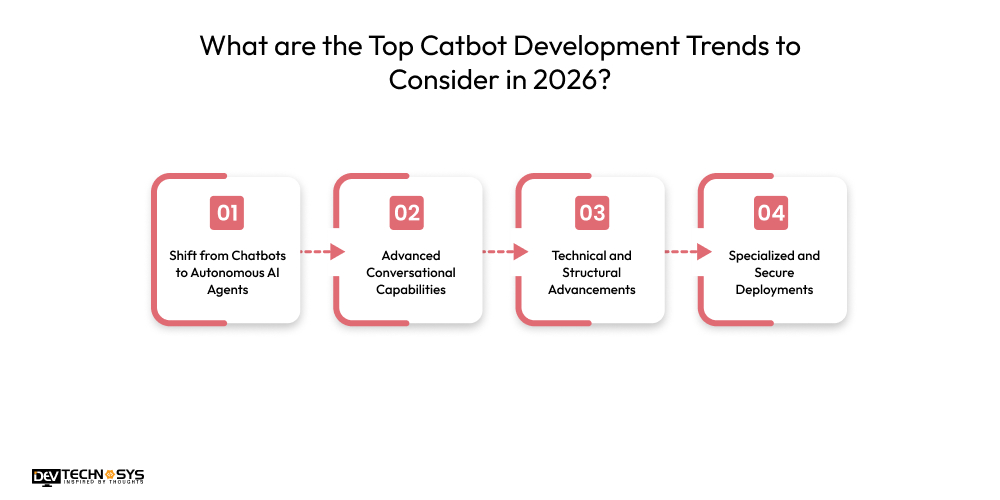
i. Shift from Chatbots to Autonomous AI Agents
The shift from chatbots to autonomous AI agents marks a transition from passive, text-based responders to proactive, goal-oriented systems that plan, execute, and self-correct multi-step workflows.
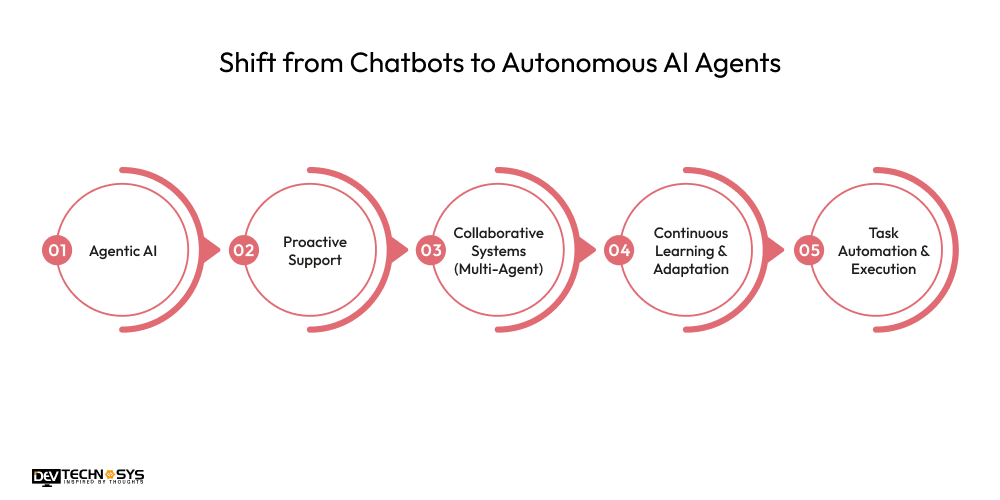
1. Agentic AI
One of the top chatbot development trends in UAE is agentic AI Development. It refers to autonomous artificial intelligence systems capable of acting independently to achieve specific goals. Unlike traditional chatbots that wait for user input, agentic AI can analyze complex data, make decisions, and take actions without constant human supervision.
Examples include AI virtual assistants that manage email inboxes, prioritize tasks, or optimize workflows automatically. In enterprise settings, agentic AI can monitor system performance, predict failures, and proactively implement solutions, reducing human intervention and increasing efficiency.
2. Proactive Support
Chatbot development trends 2026 involve proactive support. It allows AI agents to anticipate user needs and act before being asked. For instance, an AI agent might detect unusual activity in a user account and provide instant guidance, or a virtual assistant may remind a customer about subscription renewals or upcoming deadlines. This approach enhances customer experience, reduces friction, and builds trust, as users feel the system is actively assisting them rather than passively responding.
3. Collaborative Systems (Multi-Agent)
Collaborative or multi-agent AI systems involve multiple autonomous agents working together to solve complex tasks. These agents share information, coordinate actions, and learn from one another, mimicking human team collaboration.
For example, in supply chain management, one AI agent may handle inventory tracking, another shipping logistics, and a third customer notifications, all collaborating to optimize the end-to-end process. This structure enables scalability, specialization, and highly efficient task execution. Contact top chatbot development services providers to implement this trend in your chatbot.
4. Continuous Learning & Adaptation
Autonomous AI agents are equipped with continuous learning mechanisms, allowing them to adapt to new situations, user behavior, and environmental changes. Unlike static chatbots with fixed rules, these agents improve over time through reinforcement learning, feedback loops, and predictive modeling. For example, a virtual sales agent can refine product recommendations based on user interactions, boosting engagement and conversion rates without manual updates.
5. Task Automation & Execution
A defining feature of autonomous AI agents is their ability to perform actions beyond conversation. Chatbot development trends in UAE, such as task automation, can schedule meetings, place orders, execute transactions, or trigger workflows automatically.
This capability transforms them from simple communication tools into action-oriented assistants that reduce human workload, improve efficiency, and ensure tasks are completed faster and more accurately. For example, AI agents in smart homes can automatically adjust climate, lighting, and security settings based on user preferences.
ii. Advanced Conversational Capabilities
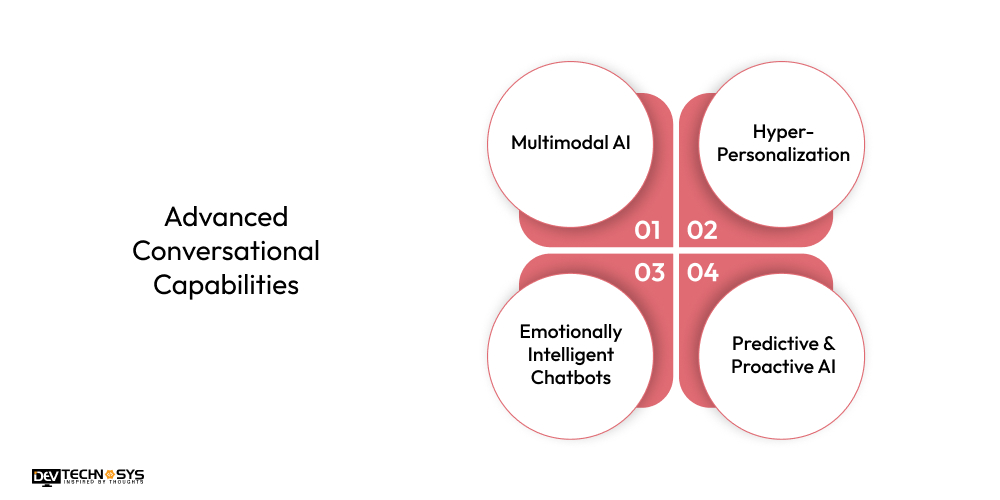
Advanced conversational capabilities allow chatbots to understand complex sentences, context, idioms, and follow-up questions, making interactions feel natural and human-like. These conversational AI trends 2026 help your chatbot in managing multi-turn dialogues, maintaining context over long conversations, and providing accurate, relevant responses for diverse user needs.
1. Multimodal AI
Experts who provide AI agent development services incorporate Multimodal AI in chatbots to process and respond using multiple data types, including text, images, audio, and video. Users can interact using voice commands, upload pictures, or receive visual guides, creating a richer, more engaging, and interactive experience beyond simple text-based communication.
2. Hyper-Personalization
Hyper-personalization uses AI to customize chatbot responses and recommendations based on user preferences, behavior, location, and past interactions. This approach creates a tailored experience, increasing engagement, trust, and conversion rates by ensuring every conversation feels relevant and individualized. Live chatbot development trends like hyper-personalization are shaping the future of chatbots tremendously.

3. Emotionally Intelligent Chatbots
Emotionally intelligent chatbots detect user sentiment and emotional cues through text, voice tone, or facial expressions. They can adjust tone, language, and responses accordingly, providing empathetic support, improving customer satisfaction, and creating human-like interactions that resonate emotionally with users.
4. Predictive & Proactive AI
Businesses that want to start an AI voice assistant development project must know the benefits of Predictive & Proactive AI. This empowers chatbots and autonomous agents to anticipate user needs and intentions before they are explicitly expressed.
By analyzing historical behavior, interaction patterns, and contextual data, the system can proactively provide recommendations, alerts, reminders, or solutions. This not only enhances user experience by reducing waiting time but also boosts engagement, builds trust, and ensures that businesses can address potential issues before they escalate.
iii. Technical and Structural Advancements
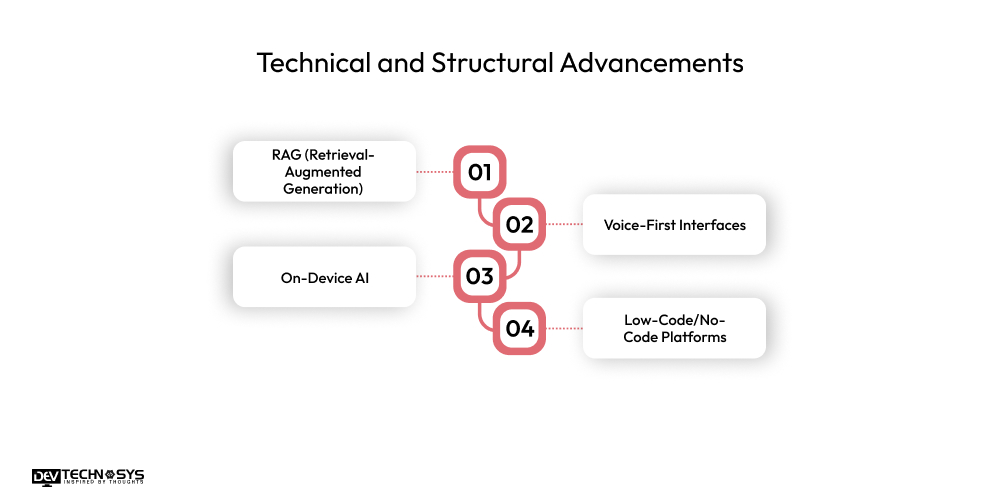
The field of chatbot and AI development is rapidly evolving with innovative technical and structural advancements. These chatbot development trends in UAE improve efficiency, accuracy, and user experience by integrating smarter architectures, faster processing, and more accessible development tools.
1. RAG (Retrieval-Augmented Generation)
Retrieval-Augmented Generation (RAG) combines retrieval-based methods with generative AI to enable chatbots to provide highly accurate, contextually relevant responses. By fetching data from external knowledge bases or APIs and dynamically generating informative answers, RAG enhances reliability and reduces the risk of misinformation.
Enterprise mobile application development services providers implement RAG in chatbots to handle complex queries efficiently, ensuring users receive up-to-date, actionable information while maintaining smooth, human-like conversational flow.
2. Voice-First Interfaces
Voice-first interfaces enable chatbots and AI agents to prioritize natural speech over text, allowing users to interact using voice commands for hands-free operation. This technology improves accessibility, supports integration with virtual assistants and IoT devices, and creates a more intuitive, human-like conversational experience. By understanding tone, pronunciation, and contextual intent, voice-first chatbots can deliver seamless, efficient, and engaging communication in a variety of real-world scenarios.
3. On-Device AI
On-device AI are some of the top chatbot development trends in UAE that processes information directly on the user’s device, reducing reliance on cloud servers and improving both speed and privacy.
By enabling offline functionality and minimizing latency, on-device AI allows chatbots and AI agents to respond quickly, maintain context, and safeguard sensitive user data. This approach is particularly useful in mobile apps, smart devices, and regions with limited connectivity, providing fast, secure, and efficient AI-powered interactions anytime, anywhere.
4. Low-Code/No-Code Platforms
Low-code and no-code platforms allow developers and non-technical users to build, deploy, and customize chatbots quickly using drag-and-drop interfaces and prebuilt modules. These platforms accelerate development timelines, reduce costs, and democratize access to AI technology.
According to a top artificial intelligence development company, they also enable rapid prototyping, workflow automation, and integration with multiple channels, making it easier for businesses of all sizes to implement advanced, intelligent chatbots without extensive programming expertise.
iv. Specialized and Secure Deployments
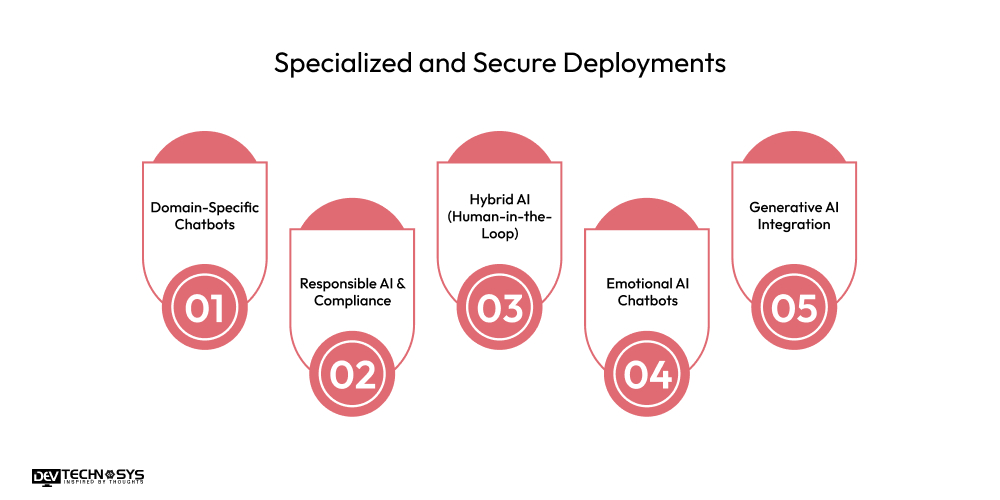
Modern chatbots are increasingly being deployed in specialized and secure environments to address industry-specific needs while maintaining strict privacy and compliance standards. These deployments combine domain expertise, responsible AI practices, and advanced generative capabilities to provide accurate, reliable, and personalized interactions.’
1. Domain-Specific Chatbots
AI in chatbot development serves particular industries or business functions, such as healthcare, finance, eCommerce, or education. Enterprise chatbot development trends like domain-specific chatbots leverage specialized knowledge, terminology, and workflows to provide accurate, relevant, and context-aware responses. By focusing on a specific domain, these chatbots can handle complex queries, support compliance requirements, and deliver highly tailored interactions, improving efficiency, user satisfaction, and trust within their target sector.
2. Responsible AI & Compliance
Responsible AI ensures chatbots operate ethically, transparently, and in line with regulatory standards such as GDPR or HIPAA. It involves bias detection, privacy protection, and accountability in AI decision-making.
By integrating compliance measures, businesses can safeguard sensitive user data, maintain trust, and deploy AI solutions confidently, meeting legal and ethical requirements while providing secure, reliable, and fair conversational experiences.
3. Hybrid AI (Human-in-the-Loop)
Hybrid AI combines the efficiency of autonomous chatbots with human expertise for complex decision-making. Human-in-the-loop systems allow AI to handle routine tasks while escalating nuanced queries to live agents. This approach ensures accuracy, contextual understanding, and empathy, enhancing user satisfaction while retaining automation benefits.
Hybrid AI is particularly valuable in customer support, healthcare, legal services, and industries where errors can have significant consequences. Contact a top hybrid app development company to know the benefits of Hybrid AI in chatbot development.
4. Emotional AI Chatbots
Emotional AI chatbots can detect and respond to users’ emotions through text, voice tone, or facial cues. By understanding sentiment, frustration, or satisfaction, these chatbots can adjust their responses to be empathetic and supportive.
This enhances customer experience, builds trust, and creates more human-like interactions, making AI suitable for applications in mental health support, customer service, and personalized engagement where emotional intelligence is critical.
5. Generative AI Integration
Generative AI integration allows chatbots to create original content, including text, images, summaries, and recommendations, based on user input or context. Generative AI chatbots expands its capabilities from answering questions to generating creative outputs, reports, or personalized suggestions. It enables businesses to offer richer, more interactive experiences, automate content workflows, and improve engagement across marketing, education, eCommerce, and entertainment platforms.
Cost to Develop a Chatbot in UAE in 2026
The chatbot development cost in the UAE in 2026 generally ranges from AED 110,000 to AED 551,000+. The final investment depends on the chatbot’s complexity, AI capabilities, Arabic-language support, integrations, security requirements, conversational design, and deployment infrastructure.
Chatbot Complexity |
Estimated Cost (AED) |
Typical Scope |
|---|---|---|
| Basic Chatbot | AED 110,000 – AED 184,000 | FAQs, predefined conversations, basic NLP, web integration, admin dashboard |
| AI-Powered Chatbot | AED 184,000 – AED 331,000 | LLM integration, contextual conversations, personalization, analytics, API integrations |
| Advanced Chatbot | AED 331,000 – AED 551,000 | RAG, multilingual support, Arabic NLP, workflow automation, CRM/ERP integrations |
| Enterprise Chatbot | AED 551,000+ | Advanced AI agents, voice capabilities, custom workflows, enterprise integrations, high-level security and scalability |
Factors Affecting Chatbot Development Cost in UAE
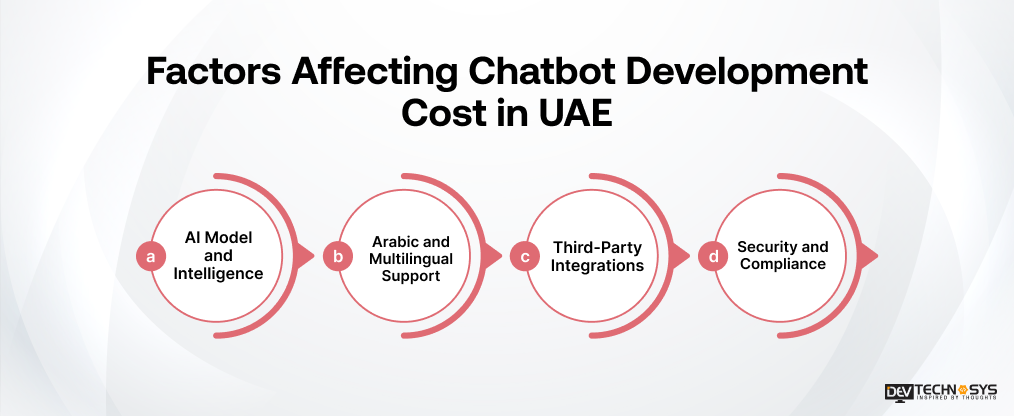
The development budget can vary significantly depending on the technology and business requirements. Four major factors have the greatest impact on chatbot development costs in the UAE.
Cost Factor |
How It Affects Development |
Estimated Cost Impact (AED) |
|---|---|---|
| AI Model and Intelligence | LLM integration, NLP, RAG, contextual memory, intent detection, AI agents, personalization, and response generation increase development complexity. | AED 37,000 – AED 184,000+ |
| Arabic and Multilingual Support | Arabic NLP, English-Arabic conversations, multilingual interfaces, translation, dialect handling, and voice recognition require additional AI and testing capabilities. | AED 18,000 – AED 92,000+ |
| Third-Party Integrations | CRM, ERP, payment systems, WhatsApp, websites, mobile apps, databases, APIs, and contact-center platforms add integration and testing requirements. | AED 18,000 – AED 110,000+ |
| Security and Compliance | Encryption, authentication, RBAC, audit logs, privacy controls, security testing, data governance, and compliance implementation increase the overall project scope. | AED 26,000 – AED 147,000+ |
Chatbot Security and Compliance in UAE
Security and regulatory compliance should be considered from the architecture stage when developing a chatbot for the UAE market. If UAE businesses are planning to build a chatbot from scratch then they must comply with regulatory requirements. Chatbots can process names, contact details, customer conversations, account information, business documents, and other personal data, making strong security controls essential.
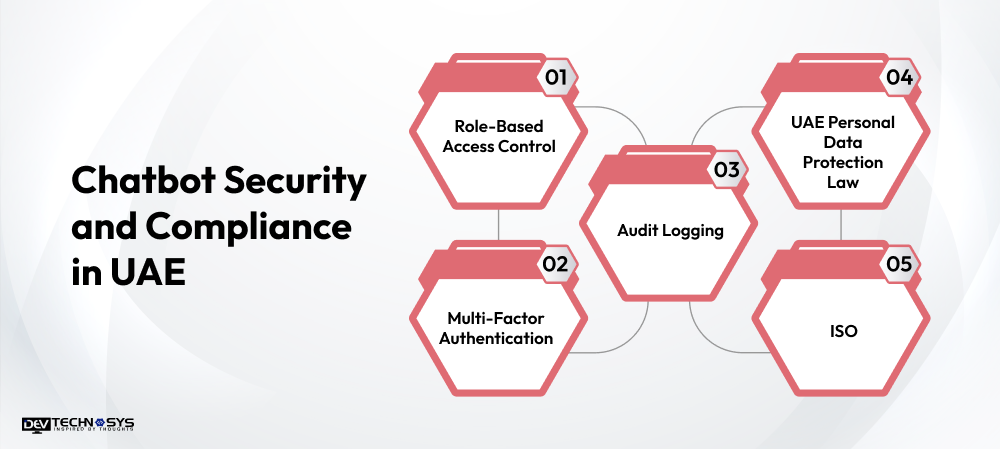
Developers should implement TLS encryption, encryption at rest, secure API authentication, role-based access control (RBAC), multi-factor authentication (MFA), audit logging, input validation, secure secrets management, vulnerability testing, and controlled data retention.
AI-powered chatbots should additionally use safeguards against prompt injection, unauthorized knowledge-base access, sensitive-data leakage, malicious inputs, and unsafe AI-generated responses.
The UAE Personal Data Protection Law (Federal Decree-Law No. 45 of 2021) is a key privacy regulation to consider when a chatbot processes personal data in the UAE. Organizations should establish appropriate mechanisms for lawful data processing, consent where applicable, transparency through privacy notices, data minimization, secure processing, retention controls, and procedures for applicable data-subject rights. Depending on the organization’s location and activities, additional requirements may apply in specialized jurisdictions such as DIFC or ADGM.
Businesses can also adopt ISO/IEC 27001 as an information-security management framework to establish structured controls for identifying security risks, protecting information assets, managing access, responding to incidents, and continuously improving security practices.
ISO 27001 is not a UAE law, but it can complement an organization’s security and governance program. The exact regulatory requirements should be assessed according to the chatbot’s industry, data types, users, and operating jurisdiction.
How to Monetize a Chatbot in UAE?
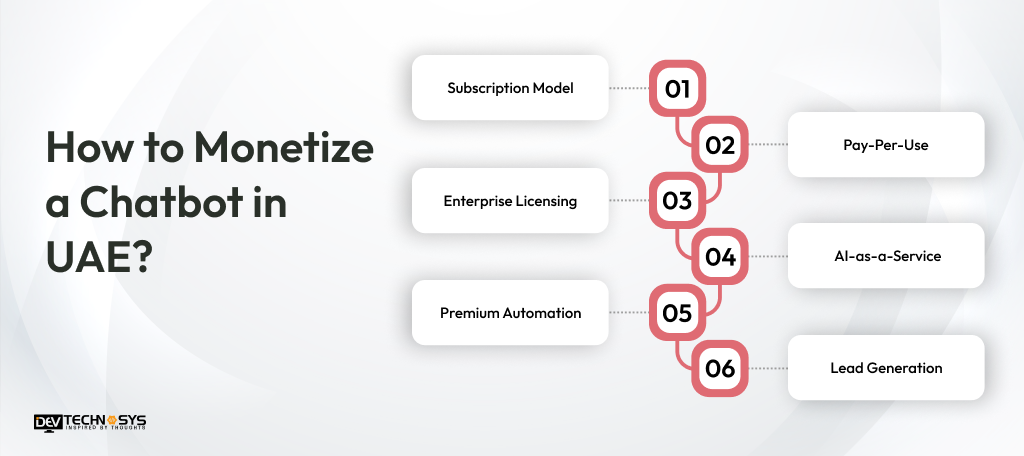
A chatbot can generate revenue directly or contribute to business growth by automating customer interactions, improving conversions, and reducing operational costs. UAE businesses can select a monetization model based on their target customers, chatbot capabilities, and industry.
1. Subscription Model
Businesses can offer chatbot services through monthly or annual subscription plans. Different tiers can provide different limits for conversations, users, AI features, integrations, analytics, and automation. This model works particularly well for SaaS chatbot platforms targeting SMEs and growing UAE businesses.
2. Pay-Per-Use
Under a pay-per-use model, customers are charged based on conversations, API calls, processed requests, AI tokens, or completed transactions. It can be suitable when chatbot usage varies significantly between customers because businesses pay according to actual consumption.
3. Enterprise Licensing
Large UAE organizations can be offered customized chatbot solutions through annual or multi-year enterprise licensing. Pricing can be based on the number of users, departments, locations, integrations, or AI capabilities. Enterprise licensing can also include dedicated support, security features, analytics, and customization.
4. AI-as-a-Service
Businesses can provide chatbot intelligence as an AI-as-a-Service (AIaaS) offering. Chatbot Saas software for enterprises provides conversational AI APIs, knowledge retrieval, AI agents, voice capabilities, or automation tools that other businesses integrate into their own applications and systems.
5. Premium Automation
Advanced automation features can be offered as paid upgrades. These may include AI agents, automated workflows, appointment scheduling, document processing, CRM updates, personalized recommendations, voice interactions, and intelligent customer-service automation. Businesses can charge more for features that directly reduce manual work or improve operational efficiency.
6. Lead Generation
A chatbot can also function as a digital sales representative by qualifying visitors, recommending products or services, collecting contact information with appropriate consent, scheduling consultations, and transferring high-intent leads to sales teams. UAE businesses can monetize these capabilities by using the chatbot to increase qualified leads and improve conversion rates rather than charging customers directly for chatbot access.
Final Thoughts
In 2026, chatbot development in the UAE is defined by the transition from basic automation to intelligent, autonomous AI systems that actively support business operations and customer engagement.
Backed by the National AI strategy 2031, organizations are embracing agentic AI, multimodal interactions, emotional intelligence, and secure, compliant deployments. If you are in search of a top mobile app development company in Dubai to build a trendy and industry-leading chatbot app, then contact Dev Technosys.
Answer a few quick questions and our experts will share a tailored project estimate.
FAQs
Q1. Why Is The UAE Leading In Chatbot And AI Adoption?
The chatbot development trends in UAE lead with chatbot and AI adoption due to its strong commitment to digital transformation, smart city initiatives, and the National AI Strategy 2031. Government support, innovation-friendly policies, and enterprise readiness accelerate AI deployment across both public and private sectors.
Q2. What Makes Chatbots In The UAE Different In 2026?
Chatbots in the UAE stand out for their multilingual capabilities, cultural awareness, emotional intelligence, and seamless integration with enterprise platforms like CRM and IoT. These features enable highly personalized, context-aware interactions tailored to the region’s diverse population.
Q3. Which Industries In The UAE Are Using Chatbots The Most?
Industries such as banking, fintech, healthcare, eCommerce, travel, real estate, and government services are leading chatbot adoption in the UAE. These sectors use AI chatbots to enhance customer experience, automate workflows, improve accessibility, and increase operational efficiency.
Q4. How Important Is Responsible AI And Compliance In The UAE?
Responsible AI is crucial in the UAE, with organizations prioritizing ethical AI practices, data privacy, and regulatory compliance. Adhering to standards like GDPR and sector-specific governance ensures secure, transparent, and trustworthy chatbot deployments across industries.
Q5. Are UAE Businesses Moving Toward Autonomous AI Agents?
Yes, many UAE businesses are transitioning from traditional chatbots to autonomous, agentic AI systems. These AI agents can proactively make decisions, execute tasks, and learn continuously, helping organizations improve efficiency, scalability, and customer engagement.