





“Increase your business growth by going online with a custom taxi application.”
Do you run a taxi business in the UAE and want to go online? Search for a reliable and experienced custom taxi booking app development agency that has developed multiple solutions in this domain. It is quite fascinating to know for modern businesses that the taxi booking industry is growing in the Middle East and UAE region.
So, it is the right time for modern entrepreneurs to build a taxi app and emerge as a leading brand in the ride-hailing business. For this, there are a lot of things you have to understand before investing money in the development process.
Let’s dive into our blog and understand the strong demand for taxi apps by first looking at the market stats for this industry.
Current Taxi Booking Market
With rising urbanization, tourism, and smartphone penetration, the Middle Eastern and United Arab Emirates cab booking markets are expanding significantly. Ride-hailing platforms are growing quickly due to smart mobility solutions and technological developments. You can create a taxi app with advanced features and services. So, businesses must invest in a taxi app to get success:
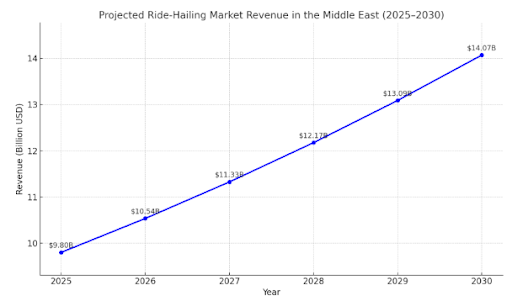
- Market Revenue: The Middle East ride-hailing and taxi market is projected to reach $9.8 Billion in revenue.
- Growth Rate: Expected to grow at a rate of 7.5% CAGR from 2025 to 2030.
- UAE Market Share: UAE contributes over 25% of the regional ride-hailing market, led by Dubai and Abu Dhabi.
- User Penetration: Ride-hailing app penetration in the UAE stands at over 70% among urban smartphone users.
- Fleet Expansion: Major players like Careem and Uber operate a combined fleet of over 100,000 vehicles across the region.
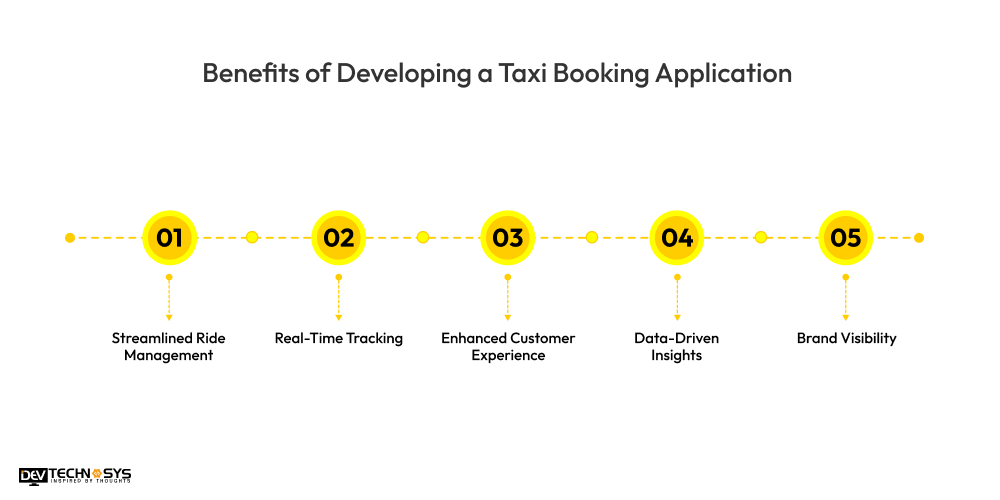
Benefits of Developing a Taxi Booking Application
By automating processes and improving client comfort, businesses can build a taxi app. It opens up new growth and income prospects while facilitating smooth journey experiences:
-
Streamlined Ride Management
Through automated processes, taxi applications streamline reservations, dispatch, and fare computation. From a single dashboard, operators can oversee driver assignments, keep tabs on ride histories, and assess performance. This increases operating efficiency and decreases manual labor.
-
Real-Time Tracking
Both users and administrators can track the status of rides in real time using live GPS monitoring. It gives precise ETAs, decreases wait times, and increases safety. It is beneficial to develop a taxi app that fosters openness and trust.
-
Enhanced Customer Experience
User satisfaction is increased by features like fast booking, multilingual assistance, ride ratings, and cashless payments. Loyalty is increased by prompt assistance and Android app development services. Convenience and reliable service delivery are guaranteed by a well-designed app.
-
Data-Driven Insights
Data about rides, user activity, peak hours, and income patterns are all gathered by the app. Making wise business decisions and enhancing service performance are made easier with the aid of these insights. Effective fleet management and targeted marketing are also made possible by analytics.
-
Brand Visibility
You can create a taxi app that improves consumer recognition and market visibility. It enables direct user communication through offers and push alerts. By serving as a digital identity, the app strengthens customer confidence and company legitimacy.
Use of AI in Shaping the Taxi Booking Industry
The taxi booking industry is undergoing a change because of artificial intelligence, which makes transportation smarter, quicker, and more customized. AI improves consumer happiness and operational efficiency through real-time route optimization and predictive analytics. A mobile app development company enables ride-hailing platforms to provide dynamic pricing, enhance safety, and guarantee smooth fleet management through AI.
- Demand Prediction: AI forecasts ride demand based on location, time, and user behavior patterns.
- Route Optimization: AI-powered navigation suggests the fastest and most fuel-efficient routes.
- Dynamic Pricing: Adjusts fares in real-time based on demand, traffic, and availability.
- Safety Monitoring: Uses facial recognition and behavior analysis to detect risks or unusual activities.
- Fleet Management: Automates vehicle dispatching, maintenance alerts, and driver allocation.

How to Develop a Taxi Booking Application?
Now, it’s time to discuss the custom taxi booking app development process for cost and resource management. Here we will also look upon some major questions related to each development step:
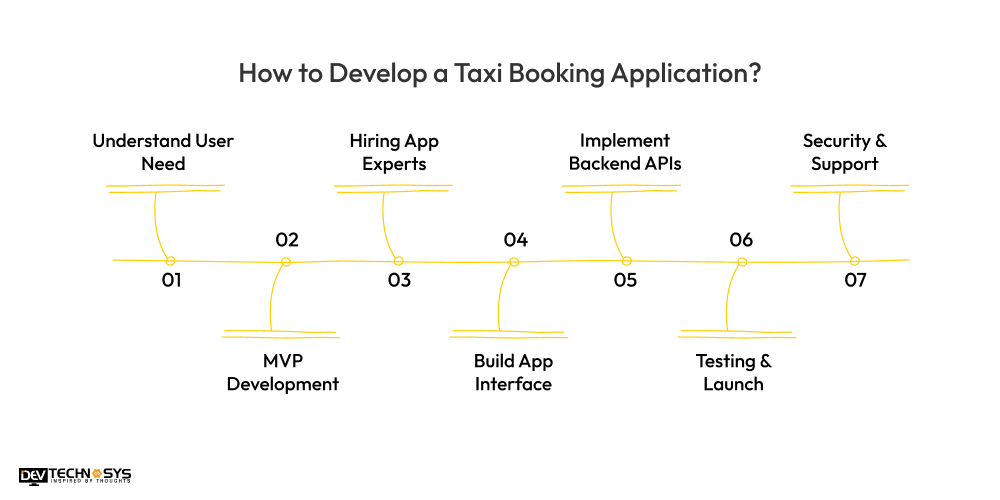
1. Understand User Need
Investigate your target audiences like administrators, drivers, and passengers to build a taxi app. Determine the main issues, such as route monitoring, fare transparency, or booking simplicity. Analyze user expectations, research rivals, and conduct surveys.
Make thorough usage scenarios and user personas. Features like real-time tracking, payment options, and multilingual support are prioritized with the aid of these data.
- Who are the primary users ?
- What challenges are users facing?
- What core features do users want?
2. MVP Development
Create an MVP that includes necessary functions like driver tracking, ride booking, and payment processing. You may test the app with actual users and launch it more quickly with MVP development. This reduces the cost to develop a taxi app.
By reducing the upfront cost of full-scale functionality, it lowers risk. To iterate and enhance the product, get customer input. Prioritize bug-free operations, quick speed, and a clean design.
- Which essential features are in the MVP version?
- What tools help to develop the MVP?
- How will we gather user feedback?
3. Hiring App Experts
It is important to hire a taxi app development company to choose seasoned project managers, QA testers, UI/UX designers, and developers. Depending on your project’s size and budget, you can select freelancers or outsourced firms to create a taxi app.
Examine client testimonials, technological know-how, and portfolios. Make project deliverables, communication, and timelines clear.
- How to hire freelancers?
- What skills should be checked?
- How can we evaluate a developer?
4. Build App Interface
Create a user interface that is easy to use for administrators, drivers, and passengers. Prioritize a layout that is aesthetically pleasing, has few clicks, and is easy to navigate. Make sure the booking process is easy and speedy.
Make use of fonts, colors, and icons that are consistent with your brand. Make sure the app works on all kinds of devices. Early on, accessibility and language support should be taken into account.
- What design principles ensure high user experience?
- How can we make the interface accessible?
- What branding elements should be used?
5. Implement Backend APIs
Create the backend of the app to manage users, dispatch rides, process payments, and send out notifications. Include APIs for SMS or email services, payments, and GPS tracking. Make sure the backend is secure and scalable.
GraphQL or RESTful APIs are good choices for seamless front-end interactions. For flexibility, go with a cloud-based architecture. Real-time updates and quick queries must be supported by database design.
- Which third-party APIs are to be integrated?
- How will the app handle data storage?
- What backend architecture supports scalability?
6. Testing & Launch
Perform testing, including user acceptability, integration, and unit testing. Resolve issues and guarantee cross-platform compatibility through taxi app development services. Conduct usability testing to get input from actual users. Check that alerts, payments, and GPS all function perfectly.
Get your app store listings ready by adding descriptions, screenshots, and keywords. Soft-launch for real-world input in a small market.
- What types of testing should be conducted?
- How to perform beta testing?
- What metrics determine the time for a public release?
7. Security & Support
Use secure login procedures, end-to-end encryption, and adherence to privacy regulations. Keep dependencies up to date and keep an eye out for vulnerabilities. It is necessary to make a taxi app that assures secure payment processing and frequent data backups.
Create customer service channels to address problems. Analytics affects the cost to maintain an app but can be used to track crash reports and performance.
- What security regulations are necessary?
- How will we handle bug fixes?
- What measures will ensure data protection?
Exciting Features of Ride-Sharing Apps
Numerous features are included in ride-sharing apps to provide smooth experiences. These features guarantee effective management across all platforms, increase convenience, and improve safety:
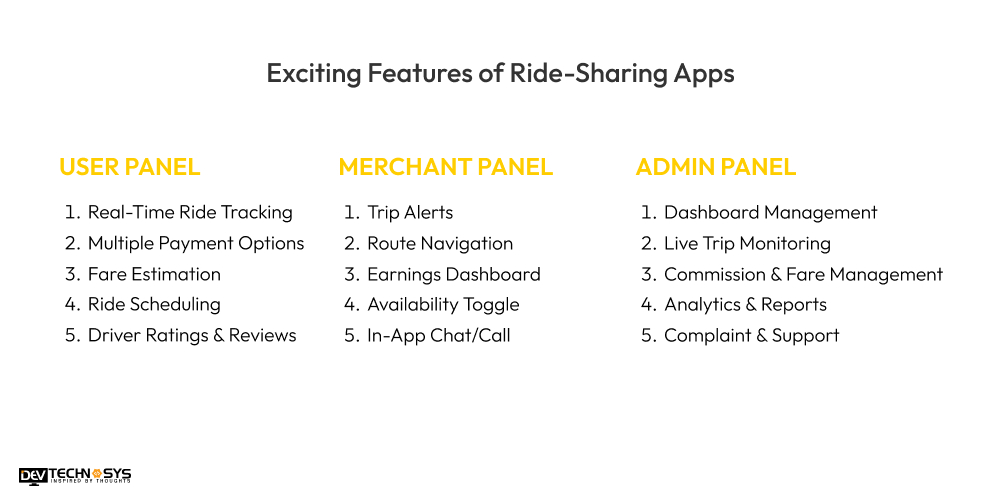
User Panel
-
Real-Time Ride Tracking
Businesses can make a taxi app that allows users to track their ride live on the map, increasing transparency and security.
-
Multiple Payment Options
Different taxi applications support credit/debit cards, wallets, UPI, and cash to suit user preferences for payments.
-
Fare Estimation
An app like Maxim helps to display an estimated fare before booking, helping users make informed decisions.
-
Ride Scheduling
This feature of taxi apps lets users book rides in advance for specific dates and times, improving convenience.
-
Driver Ratings & Reviews
Various ride booking services platforms allow users to rate drivers and leave feedback, ensuring service quality and accountability.
Driver Panel
-
Trip Alerts
A taxi booking mobile app provides instant notifications for new ride requests, cancellations, and ride completions.
-
Route Navigation
These apps provide integrated GPS guidance that help drivers follow the best and fastest routes within their scope.
-
Earnings Dashboard
You can build a taxi app that helps drivers to display daily, weekly, and monthly income summaries and trip history.
-
Availability Toggle
This feature helps drivers to go online/offline anytime, offering flexibility in work hours and reducing the workload.
-
In-App Chat/Call
It allows direct communication between drivers and passengers for smoother coordination and prevents any chaos.
Admin Panel
-
Dashboard Management
A taxi booking app provides a central console to oversee users, drivers, trips, and app activities with just one click.
-
Live Trip Monitoring
Trip monitoring feature enables real-time tracking of ongoing rides to ensure safety of users with business efficiency.
-
Commission & Fare Management
You can create a taxi app that manages fare structures, surge pricing, and driver commissions from the backend.
-
Analytics & Reports
This feature helps admins to easily generate data-driven insights on performance, usage patterns, and revenue.
-
Complaint & Support
A taxi booking application allows admin to view, assign, and resolve complaints raised by users or drivers efficiently.

10 Leading Taxi Booking Applications in UAE
The ride-hailing industry in the UAE is flourishing due to digital transformation and smart city initiatives. Numerous taxi booking applications offer practical and advanced transportation solutions. To improve user experience, these apps provide features including cashless payments, real-time tracking, and language support:
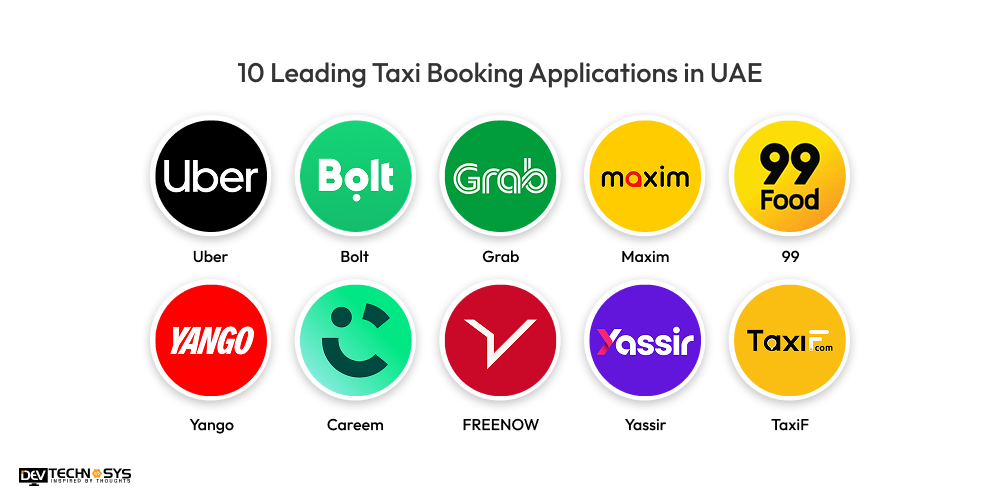
Top 10 Taxi Booking Apps in UAE |
Supported Devices |
Downloads |
Ratings |
| Uber | Android|iOS | 500M+ | 4.8 |
| Bolt | Android|iOS | 100M+ | 4.8 |
| Grab | Android|iOS | 100M+ | 4.8 |
| maxim | Android|iOS | 100M+ | 4.7 |
| 99 | Android|iOS | 100M+ | 4.3 |
| Yango | Android|iOS | 50M+ | 4.8 |
| Careem | Android|iOS | 50M+ | 4.3 |
| FREENOW | Android|iOS | 10M+ | 4.5 |
| Yassir | Android|iOS | 10M+ | 4.5 |
| TaxiF | Android|iOS | 5M+ | 4.8 |
Tech Stack Used for Custom Taxi Booking App Development
A strong and scalable tech stack is necessary when developing a custom taxi booking app to guarantee smooth operation and user-friendly interfaces. Core features like GPS tracking, payment processing, and push notifications are powered by integration of processes involving iOS app development in UAE with advanced tech stack. A table listing the essential elements and their applications may be seen below:
Component |
Application |
| Frontend (React Native / Flutter) | Cross-platform app development for iOS and Android with a single codebase. |
| Backend (Node.js / Django) | Handles server-side logic, API integrations, and data management. |
| Database (MongoDB / PostgreSQL) | Stores user profiles, ride history, payment data, and vehicle info. |
| Real-Time Tracking (Google Maps API / Mapbox) | Enables live GPS location tracking and route mapping. |
| Authentication (Firebase Auth / OAuth) | Manages secure login, registration, and identity verification. |
| Payment Gateway (Stripe / PayPal / Razorpay) | Facilitates secure in-app payments and fare processing. |
| Cloud Services (AWS / Google Cloud) | Provides hosting, scalability, and storage solutions. |
| Push Notifications (Firebase Cloud Messaging) | Sends trip alerts, promo offers, and ride updates. |
| Admin Dashboard (React / Angular) | Manages drivers, users, payments, and analytics via a web panel. |
| Chat Support (Socket.IO / Twilio) | Enables real-time driver-passenger communication within the app. |
What is the Custom Taxi Booking App Development Cost?
Based on a number of technical aspects, the custom taxi booking app development cost varies. Every component affects the ultimate budget, from geographic target audiences to app functionality. Comprehending these elements facilitates efficient planning and optimization of development costs:
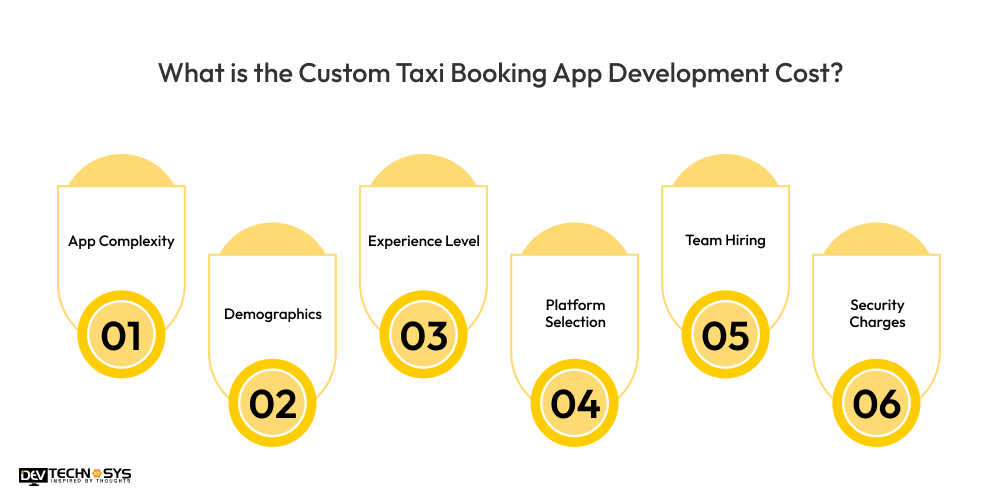
-
App Complexity
The cost to build a taxi app increases with the sophistication of its features, such as real-time tracking, several payment choices, and driver statistics. While full-featured solutions necessitate more code, testing, and integrations, basic MVPs are less expensive. Overall complexity is also impacted by UI/UX design.
-
Demographics
The cost to develop a mobile app gets increased because of compliance, localization, and design preferences. Budget requirements are impacted by regional factors like cash payments or fare standards, as well as language support and local laws.
-
Experience Level
The cost to develop a taxi app increases by hiring of senior developers or a seasoned development firm. However, by guaranteeing scalable architecture and avoiding flaws, seasoned professionals lower long-term costs. Junior teams may save money up front, but quality may suffer.
-
Platform Selection
It is more expensive to create apps for both iOS and Android than for just one. Cross-platform development can save money but has less native functionality than native apps, which offer superior performance but need separate codebases.
-
Team Hiring
The location and composition of the development team like freelancers or in-house developers affects the cost to develop a taxi booking app. Although they may charge more, agencies often include design, QA, and project management. Teams working offshore are frequently more economical.
-
Security Charges
The development budget is increased by putting advanced security measures like encryption, secure payment gateways, GDPR compliance, and data backups into place. Nonetheless, these are necessary for both legal compliance and user trust, particularly in areas with stringent data privacy regulations.
How to Make Money From Taxi Booking Apps?
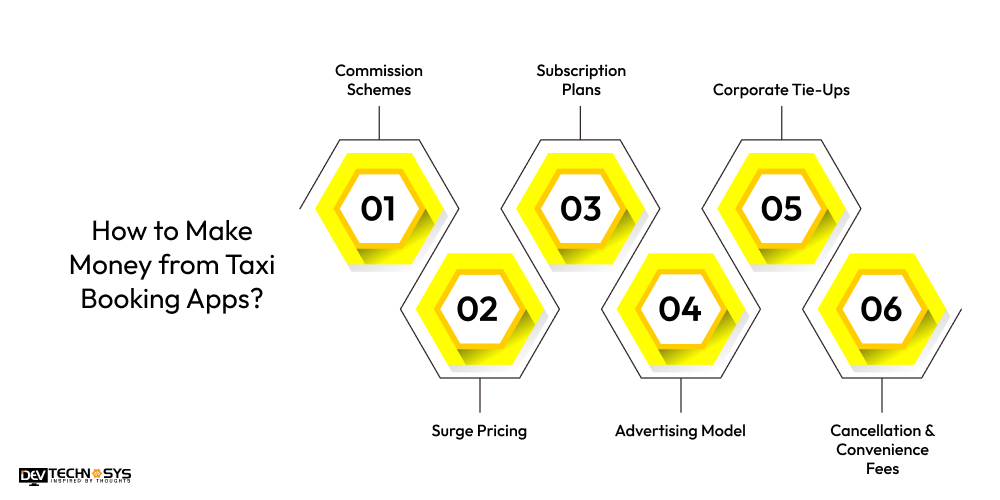
Taxi booking applications can make a lot of money by using a variety of monetization techniques. These strategies improve service effectiveness and customer engagement while guaranteeing steady revenue:
-
Commission Schemes
Drivers are charged a set percentage commission by apps for each ride that is completed via the platform. This is the most popular income model, and it grows with the number of rides. So, you can make a taxi app that synchronizes driver earnings with platform growth.
-
Surge Pricing
Fares automatically rise during times of high demand based on supply and demand in real time. This dynamic pricing strategy encourages new investors to approach a taxi app development company for developing taxi booking apps. Additionally, it guarantees that users can find rides.
-
Subscription Plans
Businesses should develop a taxi app that gives users the option to purchase premium memberships for perks like priority rides, lower commissions, or loyalty points. These programs encourage regular use and offer a steady flow of income.
-
Advertising Model
Additional revenue is generated by in-app adverts from nearby companies or third-party brands. Ad placement is the future of taxi apps that display partner promotions and booking phases. App traffic is monetized using this strategy without compromising essential functions.
-
Corporate Tie-Ups
Employee transportation partnerships allow for bulk ride bookings with personalized billing. By availing taxi app development services, it guarantees recurrent revenue and fosters brand trust. Dedicated support and price packages are frequently included in these partnerships.
-
Cancellation & Convenience Fees
Small costs are assessed to users for additional services including priority pickup, late cancellations, and no-shows. These fees increase user accountability and make up for wasted time for drivers. Additionally, they boost the app’s revenue.

Let’s Summarize!!
Now, you can easily build a successful taxi app to ensure growth and revenue generation for your business. As a smart investor, you should follow a few checkpoints before developing a ride booking application:
- Examine various business models to develop a taxi app.
- Avail trusted taxi app development services in UAE at affordable rates.
- Approach a reliable custom taxi booking app development company.
- Make use of intelligent monetary models.
The above points will help to easily sail in the taxi industry and become a leading brand with the highest number of users and market value.
FAQs
1. Which are the Leading Taxi Booking Apps in the UAE?
In the United Arab Emirates, Careem, Uber, Hala (Dubai Taxi), and Yango are the top taxi booking applications. These platforms provide a variety of services, including carpooling, automobile rentals, and ride-hailing.
2. How Long Does it Take for Custom Taxi Booking App Development?
Depending on the team size and feature complexity, creating a custom taxi booking software usually takes 3 to 6 months. Advanced apps take longer to develop, but basic versions with the most important functionality can be completed in less than 12 weeks.
3. What is the Maintenance Cost of Ride-Sharing Applications?
Depending on the architecture and scale of the app, ride-sharing applications might cost anywhere from $1,500 to $5,000 per month to maintain. Updates, customer support systems, third-party APIs, and server maintenance are all expenses.
4. How to Hire a Taxi Booking App Developer?
- Outline the features, platforms, and budget.
- Choose developers with experience.
- Ensure use of technologies like Flutter/React Native.
- Review past work, ratings, and testimonials.
- Get updates, bug fixes, and maintenance.
5. Do Carpooling Apps Provide User Data Security?
Yes, the majority of carpooling applications use user authentication procedures, secure payment channels, and data encryption. They follow local equivalents in the UAE or regional data protection regulations like GDPR.