





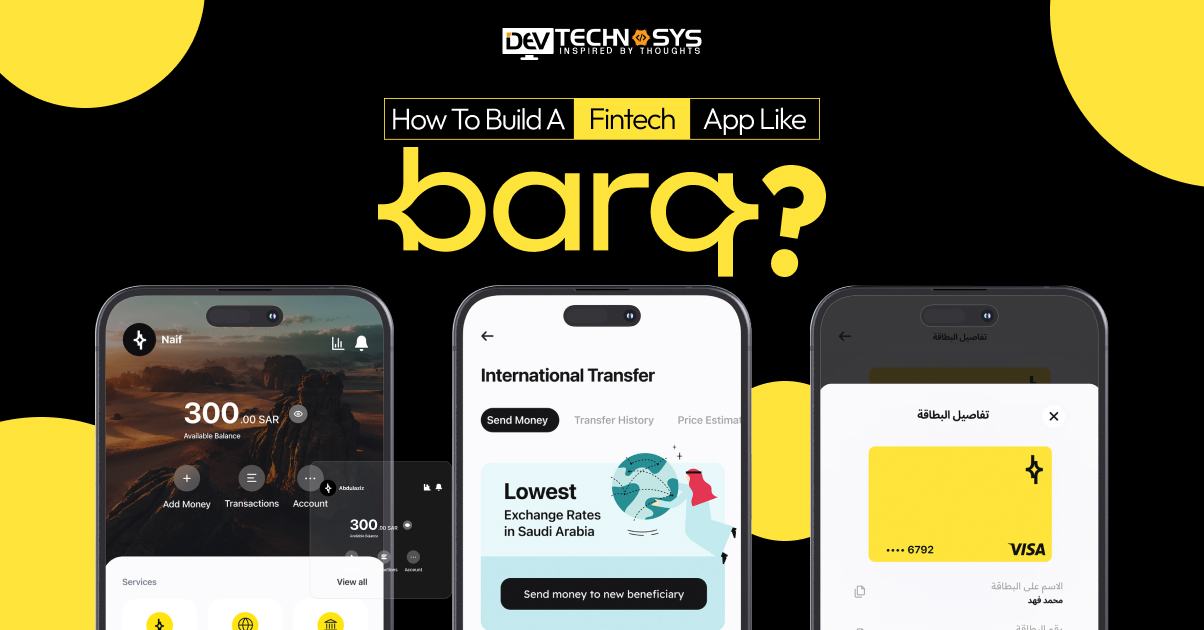
The fintech sector is expanding rapidly, and digital payment apps have become an integral part of our daily lives. Applications such as Barq allow users to transfer funds, pay bills, and manage their finances with just a few taps. If you are considering developing a similar app like barq you need more than just a good idea. The right features, robust security, adherence to legal standards, and a seamless user experience are essential to build an app like Barq.
The positive aspect? With the right strategy, technology stack, and development team, you can easily launch a secure, scalable fintech app. Follow this guide to build a fintech app like Barq and learn the key steps, features, costs, and other aspects of the process. Whether you’re a startup founder or an established enterprise, this blog will help you move forward with clarity and confidence.
What is the Barq App?
Barq is a fintech startup based in Saudi Arabia that offers a digital wallet app and a range of financial services, including international money transfers, virtual and physical Visa cards, and digital payment solutions. It enables users to handle finances, conduct digital transactions, and execute Peer-to-Peer (P2P) transfers across more than 200 countries. It serves both individuals and small enterprises, especially aiming to ease cross-border payments.
Global Fintech Market Insights
- The global fintech market is projected to reach USD 460.76 billion in 2026 and USD 1,760.18 billion by 2034.
- The Fintech Market is exhibiting a CAGR of 18.20% during the forecast period. North America dominated the global market with a share of 32.30% in 2025.
- The blockchain segment is projected to dominate the market with a share of 38.40% in 2026.
- According to the survey, the Asia Pacific is expected to overtake the U.S. and become the world’s largest market by 2032.
- The fraud monitoring segment is projected to dominate the market with a share of 45.28% in 2026.
Answer a few quick questions and our experts will share a tailored project estimate.
How Does the Barq App Operate? Payments, Transfers & Security Explained
Before you decide to develop a fintech app, it is crucial to understand how fintech apps operate. Its smooth interface and powerful backend ensure users can manage money efficiently, whether sending funds, paying bills, or topping up mobile accounts.
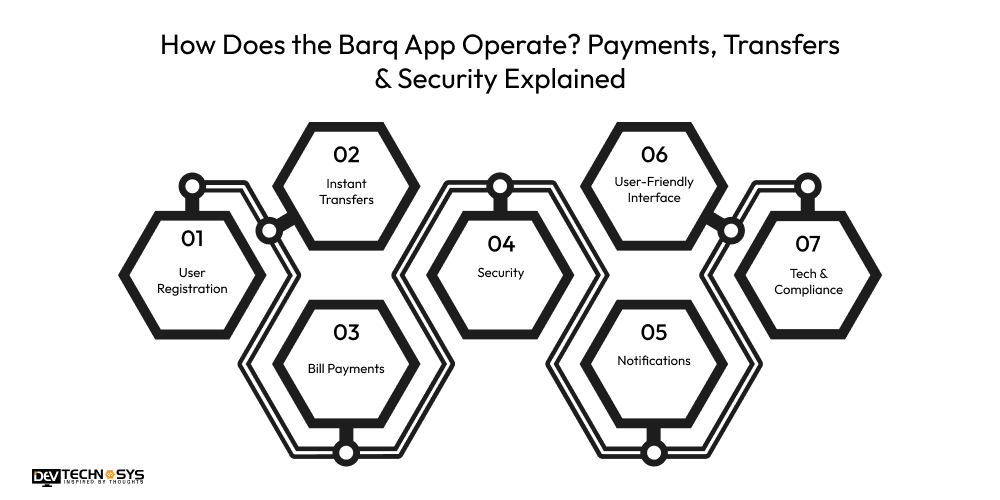
- User Registration: Sign up with personal details and link a bank account or card. KYC verification ensures compliance and security.
- Instant Transfers: Send and receive money between users or bank accounts instantly using secure APIs.
- Bill Payments & Top-Ups: Pay utilities, recharge mobile accounts, and manage recurring payments in-app.
- Security: End-to-end encryption and multi-factor authentication protect transactions and user data.
- Notifications & History: Receive real-time alerts and track all transactions for easy record-keeping.
- User-Friendly Interface: Simple dashboard shows balance, recent activity, and quick-access features.
- Tech & Compliance: The Android app development, like Braq, integrates digital wallets, APIs, and banking systems while following strict financial regulations.
How to Develop a Fintech App Like Barq in Middle East?
To develop a fintech app like Barq, you need meticulous planning, strategizing, and execution. Here we have mentioned the entire process in detailed steps to help you build a scalable, secure, and user-friendly fintech application.
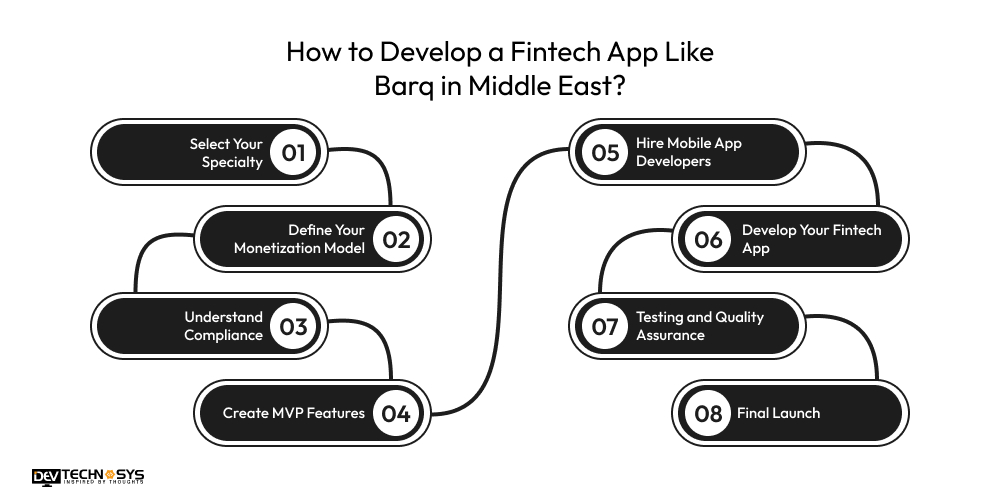
1. Select Your Specialty
To build a fintech app like Slice or Braq, it is crucial to define a well-defined target niche before you begin. Conduct comprehensive market research, or enlist a business analyst, to pinpoint deficiencies in the fintech sector and opportunities that rivals might have overlooked.
It might refer to a particular financial service, a localized market demand, or an innovative payment solution. By ensuring your app addresses genuine user issues, a clearly delineated niche boosts adoption and minimizes unnecessary development work.
2. Define Your Monetization Model
When creating your Minimum Viable Product (MVP), focus on a single, effective revenue stream. Barq clone app includes in-app payments, subscription plans, transaction fees, and premium features. To build a fintech app like Barq, you must avoid trying to add all possible monetization methods at once.
Start with the one that requires the least effort and is easiest to implement for early users. Later, as the app gains traction and user feedback, you can expand revenue streams and optimize profitability.
3. Understand Compliance
Compliance is critical to build a fintech app like Barq. Beyond App Store and Play Store rules, you need to research local financial regulations, banking laws, anti-money laundering (AML) protocols, and data privacy standards.
Adhering to these rules is mandatory to avoid fines, legal issues, and security risks. This step to create a fintech app like Barq may also involve stricter security measures, such as encrypted transactions and penetration testing, to ensure the Barq clone app meets both legal and industry standards.

4. Create MVP Features
The next step to build an app like Barq is creating an MVP. The MVP defines the core functionalities your app needs to provide value to users. Identify the most important user stories and features, like money transfers, digital wallets, or bill payments, and focus on building them first.
To create a fintech app like Barq, avoid scope creep or adding too many secondary features, which can delay development and increase costs. Once your MVP is live, you can gather user feedback, run A/B tests, and iteratively add new features based on actual usage and evolving business goals.
5. Hire Mobile App Developers
If you do not have an in-house development team, partner with a trusted mobile app development company in UAE. Experienced developers can recommend open-source libraries, proven frameworks, and cost-effective solutions to accelerate your project.
They will also ensure that your app architecture is scalable, secure, and aligned with your fintech business model, reducing the risk of technical pitfalls and costly rework later.
6. Develop Your Fintech App
This is the main and most time-intensive step to create a fintech app like Barq. Your team should have a deep understanding of fintech systems, payment processing, and regulatory requirements. Select the top innovative fintech business models, reliable tools, and a tech stack that supports scalability, security, and easy maintenance.
The development process for the Barq clone app should focus on building robust, testable, and user-friendly features while avoiding unnecessary complexity and unstable third-party dependencies. If you want to build a fintech app like Barq, collaborate closely with business analysts and subject-matter experts (SMEs) to ensure it meets market needs and business objectives.
7. Testing and Quality Assurance
Once the process to build a fintech app like Barq is done, it’s time for testing. QA is crucial for any fintech app. Implement a comprehensive testing strategy to ensure security, functionality, performance, and usability. Use automated testing tools for routine checks and manual testing for complex scenarios.
Enforce quality gates to verify that all code meets security standards and performs reliably under real-world conditions. This process to build a similar app like Barq helps prevent vulnerabilities, reduce bugs, and ensure the app delivers a smooth, trustworthy user experience.
8. Final Launch
Once testing is complete and compliance is verified, it’s time to launch your app on the App Store and Google Play Store. Even after launch, your work isn’t finished. Continuously monitor performance, gather user feedback, and roll out updates to fix issues and improve functionality. Post-launch support and regular updates are essential to maintain user trust, meet evolving regulatory requirements, and scale your fintech app successfully in a competitive market.
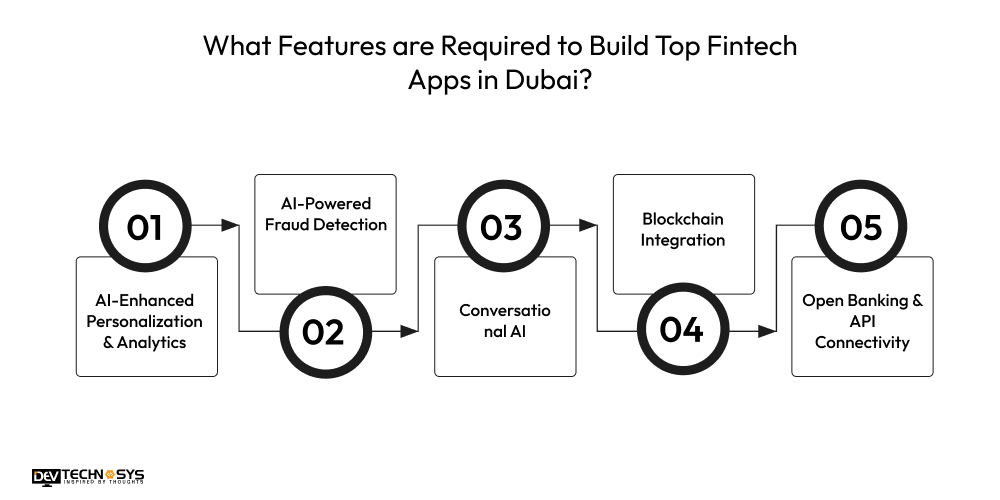
What Features are Required to Build Top Fintech Apps in Dubai?
Fintech apps in Dubai need to meet high user expectations for security, speed, and convenience. Let’s explore the essential features that make apps like Barq popular, trusted, and highly engaging. These fintech app features are key to driving user adoption, retention, and long-term growth.
| User Panel Features | Admin Panel Features | Merchant Panel Features |
| Registration & KYC | User Management | Merchant Registration |
| Digital Wallet / Bank Linking | Transaction Monitoring | Payment Acceptance |
| Money Transfers | Reports & Analytics | Transaction History |
| Bill Payments & Top-Ups | Fraud Detection & Security | Promotional Tools |
| Transaction History | Content & Offer Management | Support & Notifications |
| Notifications & Alerts | Role-Based Access | Revenue Reports |
| Security & Authentication | Security & Compliance | Integration with Platforms |
| Spending & Budgeting Tools | N/A | Insights & Analytics |
- AI-Enhanced Personalization & Analytics: To build an fintech app like STC Pay, utilize machine learning for personalized financial advice, spending insights, and tailored product recommendations. It keeps users engaged and adds high value.
- AI-Powered Fraud Detection: Moving beyond standard security, top apps use AI to analyze transaction patterns in real time to prevent fraud, a critical step as e-commerce fraud costs rise.
- Conversational AI (Chatbots & Voice Assistants): 24/7 support using Natural Language Processing (NLP) provides instant, personalized help, reducing support costs and improving user experience.
- Blockchain Integration: Provides secure, tamper-proof transaction records, ensuring data integrity and transparency. It builds trust with users, enables safe financial operations, and supports innovative business models.
- Open Banking & API Connectivity: Securely connects with third-party providers to aggregate financial data. Offers a 360-degree view of users’ finances, enabling personalized insights and enhanced financial decision-making within a single app.
Why Businesses Must Invest in Fintech App Development?
The financial industry is rapidly evolving, and users now expect fast, secure, and convenient digital services on their smartphones. Fintech apps help businesses meet these expectations while improving customer engagement. Here are the reasons why businesses should invest in Fintech app development.
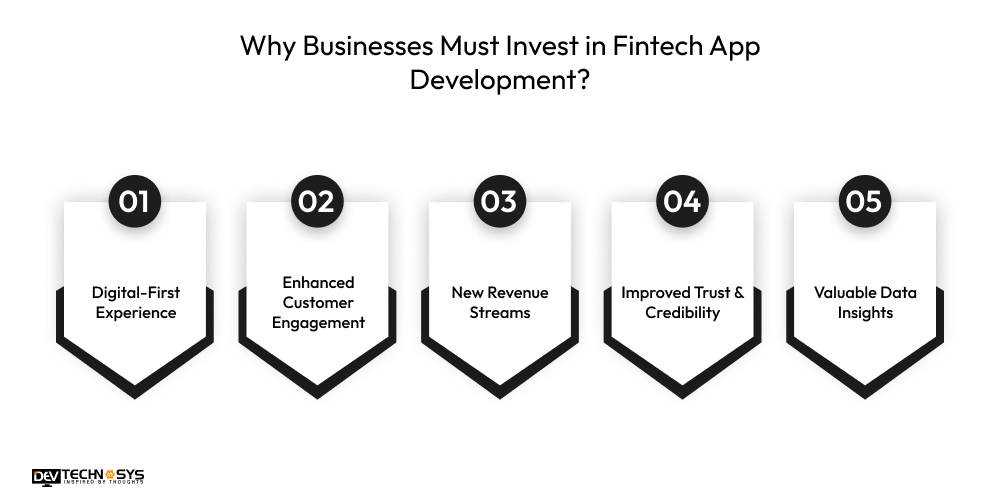
1. Digital-First Experience:
A fintech app provides users with fast and convenient access to financial services anytime, anywhere. Mobile accessibility enhances user engagement and loyalty, making transactions seamless and reducing reliance on traditional banking methods.
2. Enhanced Customer Engagement:
Real-time notifications, personalized insights, and intuitive interfaces keep users actively engaged. By offering a smooth experience, businesses can increase retention rates, encourage frequent app usage, and strengthen customer relationships over time.
3. New Revenue Streams:
Fintech apps enable monetization through subscriptions, transaction fees, premium features, and in-app purchases. These multiple income channels help businesses diversify revenue, add value to users, and sustain long-term growth.
4. Improved Trust & Credibility:
Secure, encrypted, and compliant fintech apps build user confidence. Adhering to local financial regulations ensures reliability, encourages adoption, and establishes the business as a credible and trustworthy financial service provider.
5. Valuable Data Insights:
Fintech apps track spending patterns, transaction trends, and user behavior. These insights enable businesses to make informed decisions, optimize services, and develop tailored offerings that effectively meet customer needs.
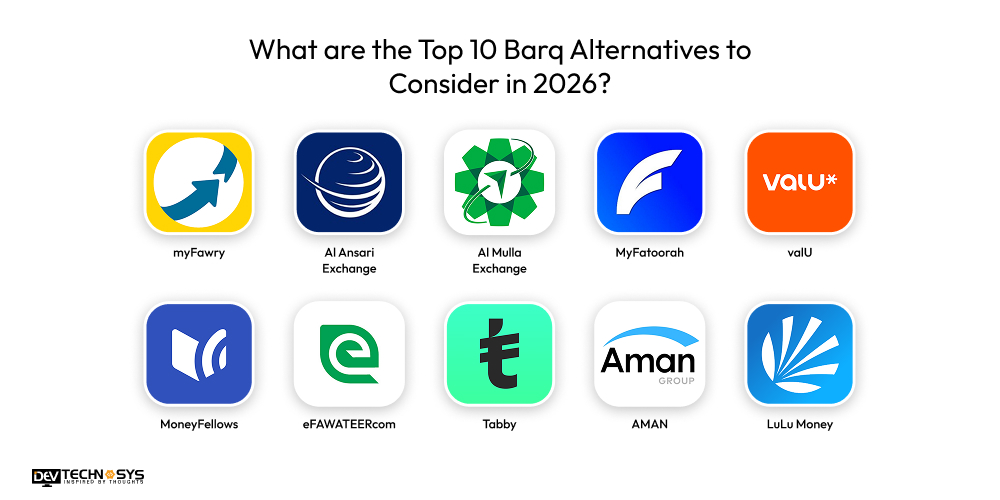
What are the Top 10 Barq Alternatives to Consider in 2026?
Exploring the top Barq alternatives not only helps users find the best fit for their needs but also inspires businesses to build the next generation of fintech apps. Below are the top fintech apps in Dubai.
| App Name | Rating (Approx.) | Downloads | Platform Availability |
| myFawry | 4.5 | 3M+ | iOS, Android |
| Al Ansari Exchange | 4.6 | 1M+ | iOS, Android |
| Al Mulla Exchange | 4.1 | 300K+ | iOS, Android |
| MyFatoorah | 4.3 | 150K+ | iOS, Android |
| valU | 4.4 | 500K+ | iOS, Android |
| MoneyFellows | 4.5 | 5M+ | iOS, Android |
| eFAWATEERcom | 4.2 | 500K+ | iOS, Android |
| Tabby | 4.8 | 10M+ | iOS, Android |
| AMAN | 4.0 | 100K+ | iOS, Android |
| LuLu Money | 4.3 | 800K+ | iOS, Android |
Among these top fintech apps in Middle East, the following are the most popular, trusted by hundreds of users.
1. myFawry
myFawry is a leading, award-winning “super app” for electronic payments and financial services in Egypt. Users can pay utility bills, top up mobile credit, and manage payments quickly. Just add a debit or credit card once, and pay all your bills in seconds with a few taps. It also offers donation services, installment payments, and digital financial solutions for everyday convenience.
2. Tabby
Tabby is one of the best fintech apps in UAE. It lets users split purchases into interest-free installments at online and in-store merchants. Tabby makes shopping more flexible and affordable without needing a traditional credit card.
The app provides instant approvals and transparent payment schedules to help users manage spending responsibly. If you want a tabby-like app developed for your own business, then reach out to a reliable provider of fintech app development services.
3. MoneyFellows
MoneyFellows is a digital community savings and lending app. As one of the top Barq alternatives, it helps users join or create saving circles and access funds when needed. With transparent tracking and automated contributions, it modernizes traditional savings groups with digital convenience. The platform also uses credit scoring technology to enhance trust and reduce financial risk for participants.
Industry Insights: As of May 2025, MoneyFellows serves over 8.5 million users, a significant jump from 4.5 million in late 2022, serving as a primary financial tool for unbanked and underbanked populations—source: FF news.
Read also: How to Build a Currency Transfer App Like Al Mulla?
4. MyFatoorah
MyFatoorah is a secure payment gateway and fintech platform. It enables businesses to accept online payments via cards, e-wallets, and local payment methods. Customers enjoy smooth checkout experiences, while merchants benefit from multiple payment options and reporting tools. It also supports invoicing solutions and API integrations for seamless business operations.
5. LuLu Money
LuLu Money is a cross-border remittance service widely used in the Middle East. Users can send money internationally at competitive exchange rates, with fast delivery and low fees. It’s designed to make remittances easier, more affordable, and more accessible. The app also offers real-time tracking and multiple payout options for added user convenience.
Industry Insight: According to Fintech Times, it serves over 190 countries, focusing on fast, secure, and transparent digital transactions and often processing transfers to India within a few hours.
How Much Does it Cost to Build a Fintech App Like Barq?
Building a fintech app like Barq involves multiple components, from secure payments and user authentication to compliance and backend infrastructure. As a result, the cost to develop a fintech app will be around $8,000 to $25,000.
The cost varies widely based on features, complexity, and development choices. The final cost to develop an app like Barq depends on factors such as integrations, platform choice, security requirements, and the team’s location.
| Component | Estimated Cost (USD) |
| UI/UX Design | $1,000 – $2,500 |
| User Authentication & KYC | $1,000 – $2,000 |
| Wallet & Dashboard | $1,500 – $3,000 |
| Money Transfer | $1,500 – $3,000 |
| Payment Gateway Integration | $1,500 – $3,000 |
| Backend Development | $1,500 – $3,000 |
| Testing & Security | $1,000 – $2,000 |
| Total Estimated Cost | $8,000 – $25,000 |
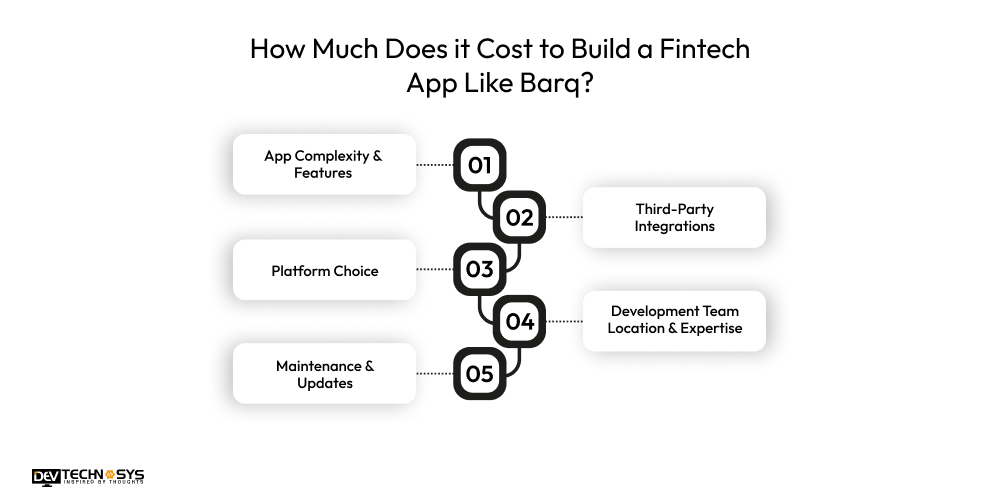
Barq app development cost will be lower with simple features and functionalities, while core payment and wallet features will sit at the lower end. Advanced analytics, AI risk scoring, multi-currency support, and compliance automation will significantly increase the fintech app development cost in Saudi Arabia. Here are some of the major factors that affect the cost to develop a fintech app like Barq:
1. App Complexity & Features
The more features your fintech app has, like money transfers, bill payments, digital wallets, AI risk scoring, or analytics, the higher the mobile app development cost will be. Complex functionalities require additional coding, integrations, and testing. Adding advanced features also increases user expectations, so careful planning is needed to ensure usability and smooth performance.
| Feature | Description | Estimated Cost (USD) |
| Money Transfers | Peer-to-peer payments | $800 – $2,000 |
| Bill Payments | Utilities, mobile top-ups | $500 – $1,500 |
| Digital Wallet | Wallet & account dashboard | $700 – $1,500 |
| Analytics & AI | User insights, risk scoring | $500 – $2,000 |
| Total | Core app functionalities | $2,500 – $7,000 |
2. Third-Party Integrations
Connecting to payment gateways, banks, KYC/AML systems, or other APIs adds technical complexity. Each integration requires development, testing, and ongoing maintenance, which increases the cost to build an app like Barq. The reliability and security of these integrations directly affect user trust, making them a critical part of the app’s success.
| Integration | Description | Estimated Cost (USD) |
| Payment Gateways | Card, debit/credit, e-wallets | $800 – $2,000 |
| Bank APIs | Account verification & transfers | $500 – $1,500 |
| KYC/AML Verification | Identity and compliance checks | $200 – $500 |
| Other APIs | Optional services like notifications | $0 – $1,000 |
| Total | Essential integrations | $1,500 – $4,000 |
3. Platform Choice
Developing for iOS only is cheaper than building a cross-platform app (iOS + Android). Native Barq app development costs more, but it provides better performance, security, and user experience than hybrid solutions. Choosing the right platform early also helps optimize development time and avoid costly redesigns later. The table below highlights the cost to develop an app like Barq based on the choice of platform.
| Platform | Description | Estimated Cost (USD) |
| iOS Only | Native iOS app | $1,000 – $2,500 |
| Android Only | Native Android app | $1,000 – $2,500 |
| Cross-Platform | iOS + Android (hybrid) | $2,000 – $4,000 |
| Total | Platform-dependent cost | $1,500 – $4,000 |
4. Development Team Location & Expertise
Hiring developers in North America or Europe is more expensive than hiring teams in South Asia or the Middle East. The hourly cost to hire mobile app developers in Dubai will be higher, but they deliver faster, reducing errors and saving costs in the long run. A skilled team can also recommend efficient tools and technologies, further reducing overall cost to create a fintech app like Barq.
| Team Type | Description | Estimated Cost (USD) |
| North America / Europe | High hourly rate, faster delivery | $2,000 – $3,500 |
| South Asia / Middle East | Lower hourly rate, reliable output | $1,000 – $2,500 |
| Mixed / Remote Team | Optimized cost and efficiency | $1,000 – $3,000 |
| Total | Team-related cost | $1,000 – $3,500 |
5. Maintenance & Updates
Post-launch maintenance, including bug fixes, OS updates, and compliance upgrades, typically accounts for 15% to 20% of the initial mobile app maintenance cost. Regular updates ensure smooth operation, security, and regulatory compliance. Continuous maintenance also helps retain users by providing new features, improved performance, and enhanced security over time.
| Maintenance Type | Description | Estimated Cost (USD) |
| Bug Fixes | Regular issue resolution | $300 – $800 |
| OS & Compatibility Updates | iOS/Android version support | $400 – $1,000 |
| Compliance & Security Updates | Regulatory adherence & encryption | $300 – $1,000 |
| Feature Upgrades | Adding small new functionalities | $200 – $700 |
| Total | Annual maintenance estimate | $1,000 – $3,500 |
How to Monetize Fintech Apps Like Barq?
Building a fintech app like Barq is not just about providing seamless payments; it’s also about establishing a strong and sustainable revenue model. By combining different revenue streams, apps can balance growth, profitability, and user experience. Here are the most common and effective strategies:
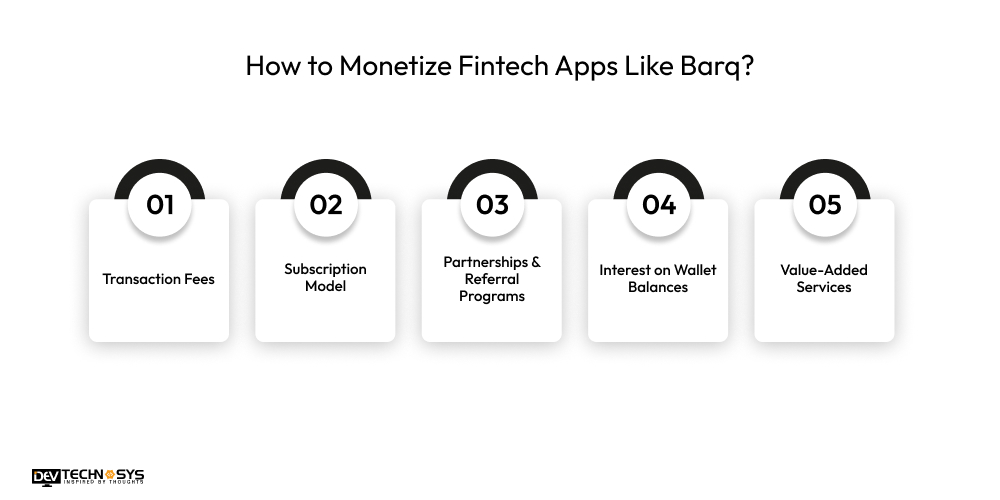
1. Transaction Fees
Charging a small fee for every money transfer, bill payment, or wallet top-up is one of the most straightforward monetization methods for fintech apps. These fees can be either fixed or a percentage of each transaction. Over time, this creates a reliable and consistent revenue stream from regular user activity. For example, even micro-transactions from thousands of daily users can generate significant income, making it a cornerstone strategy for payment and remittance platforms.
2. Subscription Model
The subscription model allows users to pay a recurring monthly or yearly fee for premium features. These may include faster transfers, higher wallet limits, detailed financial analytics, priority support, or exclusive tools. Recurring subscriptions provide predictable, long-term revenue while encouraging customer loyalty. Additionally, subscriptions can be tiered, offering multiple plans for casual users and businesses, thereby increasing monetization potential without compromising the app’s accessibility.
3. Partnerships & Referral Programs
Collaborating with banks, insurance companies, e-commerce platforms, or other service providers is another effective monetization method. Apps earn revenue through referral commissions, co-branded offers, or affiliate programs. Users benefit from discounts, bundled services, or special offers, while the app strengthens its business relationships and creates additional revenue streams. s.
Industry Insight: Fortune Business Insights states that the global referral marketing software market is projected to reach $713.3 million by 2027, growing at a 15.5%
4. Interest on Wallet Balances
When users maintain funds in their digital wallets, the app can generate interest income by holding these balances in regulated financial accounts. This strategy is especially effective for apps with a large, active user base and encourages users to keep their money in the wallet longer. Over time, even small interest earnings on millions of users’ balances can contribute significantly to overall revenue.
5. Value-Added Services
Offering additional services beyond core payments is a key way to diversify revenue. These can include instant credit, microloans, insurance policies, investment opportunities, or advanced financial planning tools. Charging fees for these services not only enhances the app’s utility but also attracts more users, increases engagement, and strengthens brand loyalty. Providing value-added services allows the app to differentiate itself in a competitive market.

What Are the Future Trends Driving Fintech Apps Like Barq?
Fintech apps are evolving rapidly, and staying ahead of trends is key for apps like Barq to remain competitive. Emerging technologies, changing user expectations, and regulatory shifts are shaping the future of digital financial services. Here are the major trends driving fintech app growth:
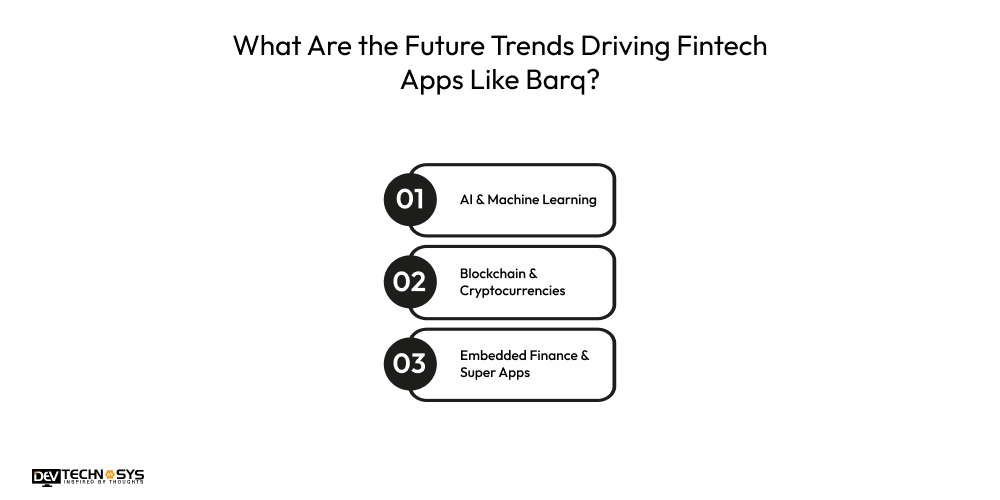
1. AI & Machine Learning
Artificial intelligence and machine learning are transforming fintech by enabling smarter fraud detection, personalized recommendations, credit scoring, and predictive analytics. AI fintech apps shape the future of digital identity. They analyze user behavior, detecting transaction anomalies, and providing tailored financial advice, thereby enhancing user trust and engagement.
2. Blockchain & Cryptocurrencies
Blockchain technology offers secure, transparent, and decentralized transaction processing. Fintech apps are increasingly incorporating blockchain for cross-border payments, digital wallets, and crypto trading. This trend enhances security, reduces transaction fees, and attracts tech-savvy users.
Industry Insight: The global blockchain market is projected to grow from roughly $33 billion in 2025 to over $393 billion by 2030, according to MarketsandMarkets.
3. Embedded Finance & Super Apps
Apps are expanding beyond payments to integrate loans, insurance, investments, and savings, creating “super apps.” Embedded finance allows businesses to offer financial services directly within their platforms, making financial management seamless and convenient for users.
Over to You
Building a fintech app like Barq requires careful planning, strategic execution, and a clear understanding of user needs. Building a fintech app like Barq requires careful planning, strategic execution, and a clear understanding of user needs. With the right team, technology, and roadmap, you can create a secure, scalable, and profitable fintech app that meets regulatory standards while delighting users. If you want to develop a similar fintech app like Braq, then contact a top fintech app development company in Middle East.
FAQs
Q1. How Much Does it Cost to Build a Fintech App Like Barq?
The cost to develop an app like Barq depends on features, complexity, and team location. The cost to build a fintech app like Barq with basic features can range from $8,000 to $25,000, while advanced apps with AI, multi-currency support, or enterprise-level security can cost more.
Q2. How Long Does it Take to Develop a Fintech App Like Barq?
Development time depends on app complexity and features. A basic MVP can take 3 to 5 months, while a fully featured app with multiple integrations and security measures can take 6 to 12 months.
Q3. What Are The Must-Have Features For A Fintech App?
The must-have features for building a fintech app like Barq include:
- User registration and KYC verification.
- Digital wallets, money transfers, and bill payments.
- Transaction history, notifications, and security protocols.
- Optional value-added services like microloans or investments.
Q4. Which Platform Should I Choose For My Fintech App?
The platform you choose depends on the target audience.
- iOS, Android, or cross-platform development.
- Native apps offer better performance and security.
- Cross-platform apps reduce development time and cost.
Q5. How Can A Fintech App Like Barq Make Money?
There are various ways in which Fintech apps like Barq generate revenue.
- Transaction fees on transfers, payments, and top-ups.
- Subscription model for premium services.
- Interest income on wallet balances.
- Partnerships and referral programs.
- Value-added services like credit, microloans, or insurance.