
Key Takeaways:
-
-
- AI hospital management system development combines traditional HMS modules with machine learning, NLP, and predictive analytics.
- Core features include patient management, EHR, appointments, billing, pharmacy, laboratory, and inventory management.
- Building an AI-powered hospital management system costs between $4,999 and $40,999.
- UAE hospitals may need to consider NABIDH or Malaffi integration, depending on their location and regulatory requirements.
-
Building an AI-powered hospital management system involves combining hospital administration software, clinical workflows, healthcare data, and artificial intelligence into one connected platform. Unlike traditional hospital software that mainly stores patient information and manages daily operations, an AI-enabled system can analyze data, ensure AI appointment scheduling, forecast resource requirements, automate repetitive tasks, and support clinical decision-making.
hospital ERP software
For hospitals, the goal isn’t simply to add AI features. It is to ensure a reliable AI hospital management system development that connects patient records, appointments, pharmacy, laboratory, radiology, billing, and other departments while maintaining data accuracy and patient privacy.
This guide explains how to build a hospital management system with AI, which features and technologies to consider, how to integrate healthcare data, and what hospitals should evaluate before deployment.
What Is an AI-Powered Hospital Management System?
An AI-powered hospital management system is a centralized healthcare software platform that uses artificial intelligence to manage administrative and clinical workflows. It combines conventional hospital management software features with technologies such as machine learning, natural language processing (NLP), computer vision, and predictive analytics.
Also Read: Explore our guide, [What is AI agents?], to understand how AI agents work and how businesses across different industries are using them.
A modern hospital information system may also connect multiple departments through shared patient records and integrated workflows. AI adds intelligence to these operations, but essential functions such as patient registration, billing, prescriptions, and medical record management still require reliable transaction processing.
What are the Essential Features of an AI-Powered Hospital Management System?
The required hospital management system features depend on the hospital’s size, specialties, patient volume, and existing infrastructure. A healthcare software development company utilizes these modules to provide a practical foundation.
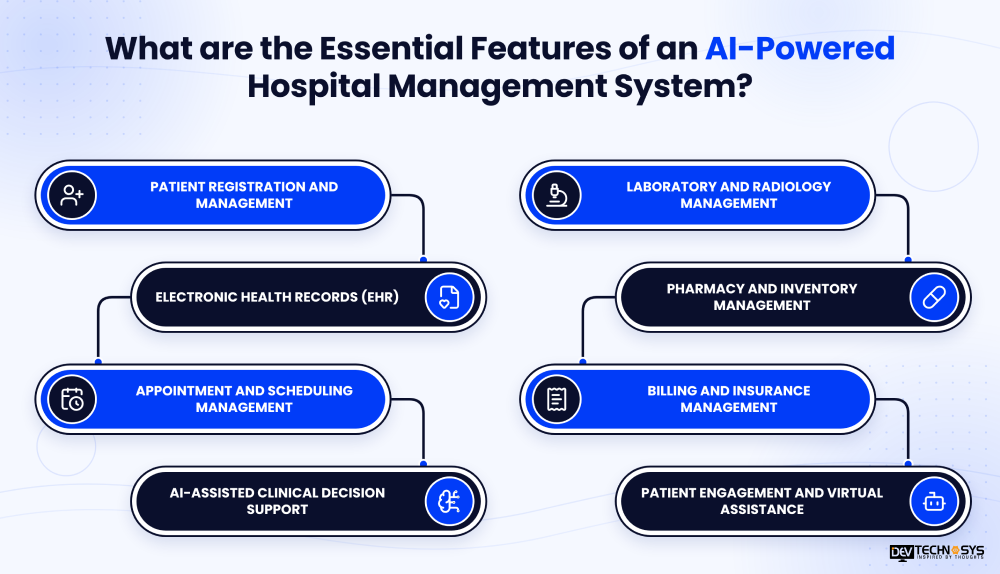
1. Patient Registration and Management
A patient management system maintains centralized profiles containing demographic details, contact information, medical history, allergies, insurance details, and visit records. AI can assist with duplicate-record detection, document classification, and patient data extraction. Staff should verify uncertain matches before merging records to avoid incorrect patient identification.
2. Electronic Health Records (EHR)
Electronic health records software stores patient diagnoses, prescriptions, treatment plans, laboratory results, clinical notes, and other medical information.
AI can support this module through:
- Patient history summarization.
- Clinical document classification and information extraction.
- Draft clinical note generation.
- Medical coding assistance.
- Alerts for missing or inconsistent information.
3. Appointment and Scheduling Management
This module manages doctor availability, patient appointments, cancellations, and rescheduling. AI can analyze historical appointment patterns, forecast demand, identify scheduling conflicts, and recommend available slots.
4. AI-Assisted Clinical Decision Support
AI in hospital management can support healthcare professionals by analyzing patient information and presenting relevant alerts, risk indicators, or recommendations. Potential capabilities of AI in healthcare include drug-allergy alerts, clinical guideline reminders, and patient history summaries.
5. Laboratory and Radiology Management
Laboratory workflows manage test orders, sample tracking, results, and reports. Radiology modules manage imaging requests, reports, and access to medical images.
Through PACS integration, a hospital system can connect with Picture Archiving and Communication Systems used to store and retrieve medical images. DICOM imaging standards support the exchange and management of medical imaging information.
6. Pharmacy and Inventory Management
This module manages prescriptions, medicine stock, medical supplies, purchase orders, and expiry dates. Machine learning models can forecast medicine demand using historical consumption, seasonal patterns, and current inventory levels.
7. Billing and Insurance Management
The financial module handles invoices, payments, insurance claims, refunds, and outstanding balances. Artificial intelligence development company creates AI insurance management system to assist with document extraction, claim categorization, billing anomaly detection, and more. Staff should review flagged transactions before taking financial or insurance-related action.
8. Patient Engagement and Virtual Assistance
An AI-powered patient portal or virtual assistant can answer routine questions, share appointment details, provide preparation instructions, and route requests to the right department.
How to Build an AI-Powered Hospital Management System?
If you are wondering how to develop a hospital management system, then you are in the right place. Hospital management system development should connect technical decisions with real hospital workflows, clinical requirements, and measurable operational goals.
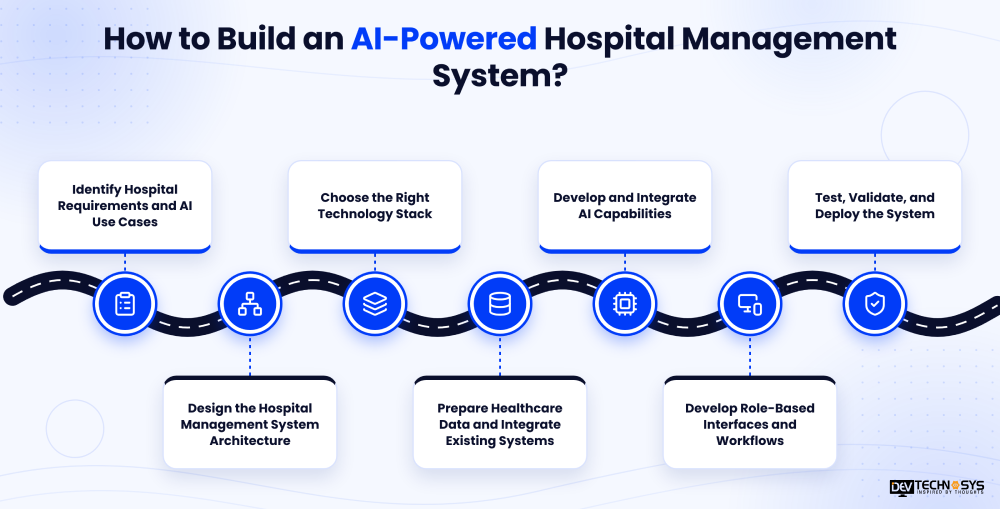
Step 1: Identify Hospital Requirements and AI Use Cases
AI agent development services for hospital management begin by assessing how the hospital currently manages administrative and clinical operations. Consult doctors, nurses, receptionists, pharmacists, laboratory staff, finance teams, IT administrators, and hospital management. Identify repetitive tasks, manual errors, disconnected systems, and operational bottlenecks. Then prioritize AI use cases based on business value, data availability, and risk.
Hospital challenge |
Potential AI application |
| Missed appointments | No-show prediction and automated reminders |
| Manual clinical documentation | AI-assisted note summarization |
| Medicine shortages | Inventory demand forecasting |
| Long waiting times | Appointment and resource optimization |
| Repetitive patient queries | Virtual patient assistance |
Avoid implementing every AI feature immediately. Begin with use cases that have clear objectives, accessible data, and manageable clinical risk.
Step 2: Design the Hospital Management System Architecture
To build an AI model for hospital management, define how the HMS modules, databases, AI services, and external healthcare systems will communicate. A modular architecture makes it easier to maintain the platform and add new capabilities. A typical AI-powered HMS architecture includes six layers:
- Presentation: Interfaces for doctors, staff, and patients.
- Application: Patient, appointment, EHR, and billing modules.
- Integration: APIs and interoperability services.
- Data: Patient records, documents, and reports.
- AI: ML models, NLP, and automation.
- Security: Access controls, encryption, and audit logs.
The AI layer should access only the information required for its specific task. For example: an appointment forecasting model may not need access to detailed clinical notes.
Step 3: Choose the Right Technology Stack
The technology stack depends on the hospital’s existing infrastructure, expected user volume, integration requirements, and deployment preferences.
Component |
Technology options |
| Web frontend | React, Angular, Vue.js |
| Mobile applications | Flutter, React Native |
| Backend | Python, Java, Node.js, .NET |
| API development | Python FastAPI, REST APIs |
| Database | PostgreSQL, MySQL, MongoDB |
| AI and machine learning | Python, PyTorch, TensorFlow, scikit-learn |
| Data processing | Apache Kafka, Apache Spark |
| Cloud infrastructure | AWS, Microsoft Azure, Google Cloud |
| Healthcare interoperability | HL7, FHIR, DICOM |
Python FastAPI can be used to build backend APIs and connect AI services with hospital application modules. The final technology combination should be selected after evaluating integration complexity, security requirements, scalability, and long-term maintenance.
Step 4: Prepare Healthcare Data and Integrate Existing Systems
AI performance depends on the quality, consistency, and relevance of the data used to train, test, and operate models. Hospital information may be distributed across EHR platforms, laboratory systems, pharmacy software, imaging systems, billing applications, and spreadsheets.
Important activities include:
- Standardizing patient and clinical data formats.
- Establishing reliable patient identity matching.
- Mapping clinical terminology and codes.
- Defining data ownership and access permissions.
- Creating data quality checks and validation rules.
- Maintaining data lineage and audit records.
HL7 FHIR integration supports structured healthcare data exchange, while integration of EHR in healthcare industry connects existing patient records. PACS integration and DICOM support enable radiology and imaging workflows. UAE-specific integrations: NABIDH (Dubai) and Malaffi (Abu Dhabi) require alignment with applicable health information exchange, interoperability, and data-sharing requirements.
Step 5: Develop and Integrate AI Capabilities
Once the data foundation is ready, experts providing AI chatbot development services will build AI features around the use cases selected during requirements analysis. Different AI technologies support different hospital workflows:
- Machine Learning: Appointment demand forecasting, inventory prediction, and operational risk analysis.
- Natural Language Processing: Clinical document extraction, note summarization, and patient query classification.
- Computer Vision: Medical image analysis and document processing, where appropriately validated.
- Generative AI: Drafting administrative content, summarizing records, and assisting with routine communication.
- Predictive Analytics: Estimating patient demand, resource requirements, and operational trends.
- Agentic AI: Agentic AI in healthcare helps by automating multi-step administrative workflows, coordinating tasks, and triggering actions based on predefined rules with human oversight.
Do not assume that a general-purpose AI model is suitable for clinical use. Clinical applications require representative data, appropriate validation, documented limitations, and clinician oversight.
Step 6: Develop Role-Based Interfaces and Workflows
Design role-based interfaces that provide each hospital user with relevant tools and information. Doctors need patient histories and clinical notes, nurses need medication schedules and care updates, receptionists need registration and appointment tools, while pharmacists need prescription and inventory records. Keep AI recommendations separate from verified clinical data, allowing authorized users to review, edit, accept, reject, or escalate suggestions.
Step 7: Test, Validate, and Deploy the System
Experts in your healthcare mobile app development company will test the healthcare management system. Testing should cover traditional software functionality and AI-specific performance.
- Functional Testing: Verify registration, appointments, billing, prescriptions, and reports.
- Integration Testing: Confirm that patient records, laboratory results, prescriptions, and billing data move accurately between connected systems.
- Security Testing: Assess authentication, authorization, encryption, vulnerabilities, audit trails, and backup recovery.
- AI Validation: Evaluate model performance using representative data, relevant metrics, and clinical review.
- Usability Testing: Check whether doctors and hospital staff can use the system without unnecessary steps or workflow disruption.
A useful approach is to run selected AI features in shadow mode before enabling them in live workflows. After validation, deploy the platform in stages, train staff, monitor performance, and maintain a rollback plan.
Advanced AI Capabilities That Can Make a Hospital Management System Smarter
Beyond common automation features, several capabilities can improve operational visibility and system reliability.
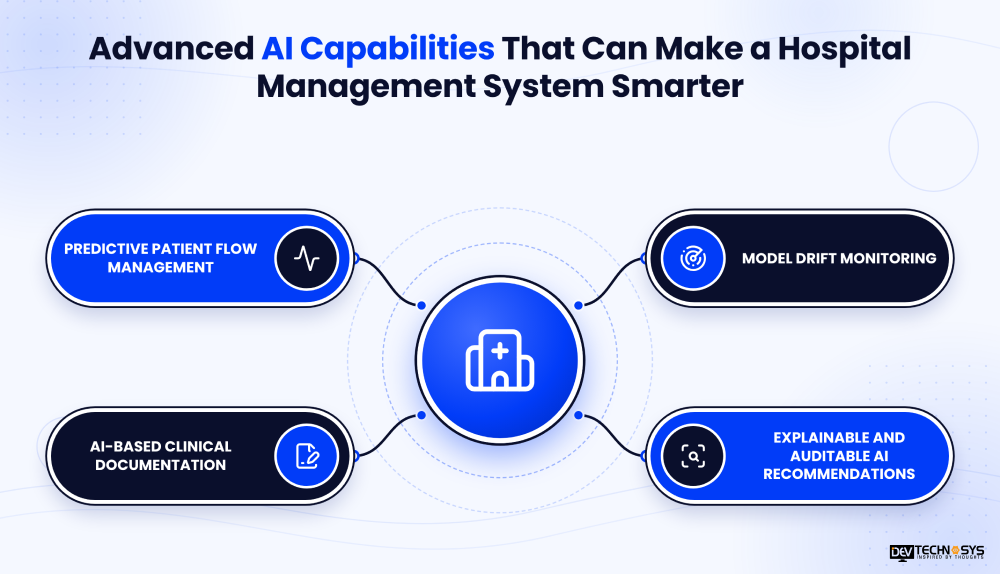
1. Predictive Patient Flow Management
AI can analyze admission trends, appointment schedules, discharge patterns, and historical occupancy to estimate demand for beds, staff, and other resources. Hospital managers can use these forecasts for capacity planning, but predictions should be treated as planning inputs rather than guaranteed outcomes.
2. AI-Based Clinical Documentation
Speech recognition and NLP can help convert clinician dictation into draft notes, summaries, or structured fields. Clinicians must review and approve generated documentation before it becomes part of the official patient record.
3. Model Drift Monitoring
An AI model may become less reliable when patient populations, clinical practices, data sources, or hospital workflows change. Model drift monitoring helps identify changes in input data or model performance that may affect reliability.
4. Explainable and Auditable AI Recommendations
Clinical users need context when a system produces a recommendation. Where technically appropriate, show relevant input factors, source records, model limitations, and confidence information. Maintain logs of model versions, outputs, user actions, and overrides.
Security, Privacy, and Regulatory Considerations
Hospital management systems handle sensitive patient information, including medical histories, diagnoses, prescriptions, and financial records. Therefore, security and regulatory compliance must be considered throughout development, not added after deployment.
Key Measures Include:
- Data Encryption: Protect patient information during transmission and storage.
- Role-Based Access Control: Restrict access according to user responsibilities.
- Multi-Factor Authentication: Add verification for staff and privileged accounts.
- Audit Logging: Track access, record changes, and data exports.
- API Security: Secure EHR, laboratory, pharmacy, and external system integrations.
- Backup and Recovery: Maintain secure backups and disaster recovery procedures.
- AI Governance: Monitor model accuracy, bias, data usage, and human oversight.
Healthcare Regulations to Consider
Regulatory requirements depend on the hospital’s location and intended use of the software.
Regulation / Framework |
Relevance to HMS Development |
| HIPAA (US) | Protects electronic protected health information. |
| GDPR (EU) | Governs the processing and protection of personal data. |
| UAE PDPL | Establishes personal data protection requirements in the UAE. |
| NABIDH / Malaffi | Require alignment with applicable UAE health information exchange standards. |
| FDA Guidance (US) | Helps determine whether certain AI-based clinical software functions fall under medical-device oversight. |
Important: Using AI does not automatically make a hospital management system compliant. Hospitals should conduct risk assessments, validate AI outputs, establish human-review procedures, and verify applicable regulatory requirements before deployment.
What are the Common Challenges in AI Hospital Management Software Development?
Common challenges in AI hospital management software development include:
Challenge |
Solution |
| Fragmented data | Use interoperability standards and data mapping. |
| Poor data quality | Apply validation and verification checks. |
| Staff resistance | Provide training and involve users early. |
| AI bias or errors | Validate models and monitor outputs. |
| Legacy integration | Use APIs and phased integration. |
| Implementation complexity | Start with an MVP and scale gradually. |
| Security risks | Enforce access controls and regular risk assessments. |
One important challenge is balancing automation with clinical responsibility. A system that saves administrative time but introduces confusing alerts or unreliable recommendations can create additional work and risk.
How Much Does It Cost to Develop an AI-Powered Hospital Management System?
The cost to develop an AI-powered hospital management system typically ranges from $4,999 to $40,999, depending on the number of modules, AI capabilities, integrations, and customization requirements.
A basic hospital management software development cost is around $4,999–$12,000 with patient registration, appointment scheduling, billing, and limited AI automation. On the other hand, an advanced platform with EHR integration, predictive analytics, AI-assisted documentation, and multi-department workflows costs much more.
Development Level |
Estimated Cost |
Typical Scope |
| Basic HMS with AI | $4,999–$12,000 | Patient management, appointments, billing, basic reporting, and simple AI automation. |
| Mid-Level AI HMS | $12,000–$25,000 | EHR integration, pharmacy, laboratory, inventory, predictive analytics, and AI assistance. |
| Advanced AI HMS | $25,000–$40,999 | Multiple hospital modules, advanced AI capabilities, PACS integration, analytics, and complex workflows. |
These are indicative development estimates, not fixed quotations. The final budget depends on data migration, third-party integrations, security requirements, AI model development, and deployment infrastructure.
Conclusion
Building an AI-powered hospital management system requires reliable hospital software, interoperable data architecture, carefully selected AI capabilities, and strong governance. The most effective approach is to begin with operational requirements, introduce AI in measurable stages, and validate each capability with the people who will use it.
Dev Technosys is a leading hospital management software development company that brings 16+ years of software development experience and a team of 250+ in-house professionals to custom software projects. Hospitals planning an AI-enabled management platform can discuss their requirements with the team to explore a suitable development approach.
FAQs
Q1. How Do You Build a Hospital Management System?
Start building smart hospital management system by identifying hospital workflows, defining the required modules, designing the architecture, selecting a technology stack, integrating healthcare data, developing core functionality, and testing the platform before deployment.
Q2. How Does AI Improve Hospital Management?
AI in hospital administration helps forecast patient demand, optimize appointment schedules, automate document processing, identify inventory trends, and support administrative decisions. Its impact should be measured through indicators such as waiting times, documentation effort, stock availability, and appointment utilization.
Q3. Which Technologies Are Used in AI Hospital Management Software?
Common technologies include Python, FastAPI, machine learning frameworks, natural language processing, computer vision, predictive analytics, cloud infrastructure, and healthcare interoperability standards such as HL7 FHIR and DICOM.
Q4. Can AI Be Integrated Into an Existing Hospital Information System?
Yes. AI capabilities can be integrated into an exisating hospital information system through APIs, interoperability layers, and secure data pipelines. Feasibility depends on the existing architecture, data quality, vendor access, and integration capabilities.
Q5. What Is the Role of HL7 FHIR in Hospital Management System Development?
HL7 FHIR provides a standardized way to represent and exchange healthcare information through structured resources and APIs. It can help connect compatible EHR platforms, patient applications, and other healthcare systems.
Q6. How Is AI Model Performance Monitored After Deployment?
Hospitals can monitor input data quality, prediction performance, error rates, model drift, and user feedback. Regular reviews help identify when a model needs recalibration, retraining, or removal from a workflow.