





When the day-to-day operations of a UAE business become difficult to manage, monitor, and grow, it may require the use of supply chain software. Constant mistakes in inventory, regular stock shortages, supplier delays, and low shipment visibility indicate that the current method may be not enough anymore.
Poorly connected ERP, procurement, warehouse, and transport systems can cause data loss and an increase in manual work, which leads to higher chances of errors and a lengthier decision-making process. An additional rise in costs may suggest the wrong allocation of resources. As the company expands, working with multiple suppliers, warehouses, orders, and transportation companies becomes harder.
Signs you need supply chain software make it easier since it links all the activities into one central platform, allowing for better analytics, real-time data, automation, and coordination.
What Is Supply Chain Management Software?
A unified platform that links procurement, inventory, warehouse operations, supplier management, transportation, orders, and delivery is known as UAE supply chain management software. Instead of depending on spreadsheets or other tools, it unifies supply-chain data into a single system, providing teams with real-time visibility.
Purchase orders, stock updates, approvals, and shipping tracking are examples of repetitive manual procedures that are replaced by automation. This lowers mistakes, saves time, and enhances team coordination. SCM software can help manufacturers, retailers, distributors, wholesalers, eCommerce enterprises, and logistics firms manage complicated operations, increase productivity, and scale more successfully.
Answer a few quick questions and our experts will share a tailored project estimate.
12 Signs Your UAE Business Needs Supply Chain Software
Adopting supply chain software at the appropriate moment might help avoid operational issues turning into expensive bottlenecks. These warning indicators show when your UAE company might require more automation, visibility, and centralized supply chain control. They range from erroneous inventory and supplier delays to disjointed systems, growing expenses, and quick expansion.
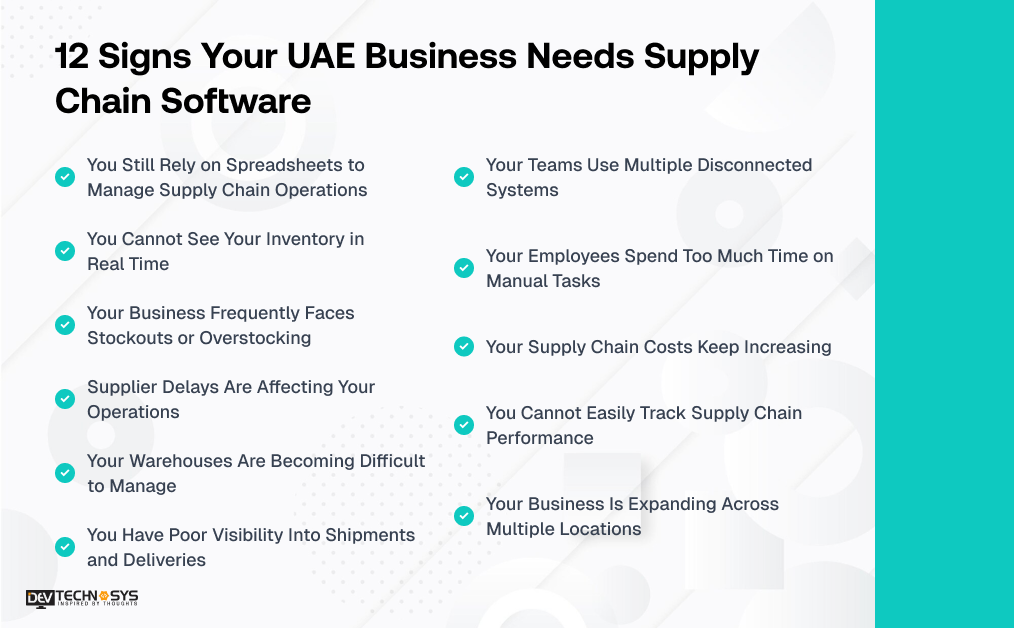
1. You Still Rely on Spreadsheets to Manage Supply Chain Operations
Duplicate data and out-of-date information can easily lead to errors if Excel or different spreadsheet-based inventory management systems are used to manage inventory, purchasing, supplier details, and shipment records. Time-consuming tasks include manual purchase orders and repetitive manual data entry.
According to the ERP software development company, these processes are combined by a centralized SCM platform, which also maintains information synchronization and lowers human error across activities.
2. You Cannot See Your Inventory in Real Time
When inventory updates rely on manual reconciliation or delayed systems, various warehouses may display different stock levels. Knowing what is truly available or where things are placed becomes challenging as a result.
SCM software lets teams make quicker decisions about fulfillment and restocking, provides real-time inventory insight across locations, and automatically updates stock movements.
3. Your Business Frequently Faces Stockouts or Overstocking
Two expensive issues can arise from poor demand visibility: too little inventory results in missed sales, while too much inventory raises carrying costs. To maintain healthier inventory levels, SCM software makes use of reorder points, safety-stock monitoring, demand forecasts, and automatic alarms. To make better purchase selections, AI-powered forecasting can further examine trends and market signals.
4. Supplier Delays Are Affecting Your Operations
Production and fulfillment might be hampered by late deliveries, uneven supplier performance, poor communication, and a lack of supplier comparison.
In addition to providing scorecards, delivery monitoring, performance metrics, and automated alarms, SCM software centralizes supplier records. The system can identify a provider who consistently misses deadlines, assisting teams in evaluating performance and implementing remedial measures.
5. Your Warehouses Are Becoming Difficult to Manage
Inaccurate stock counts, slow picking, lost goods, ineffective transportation, and longer fulfillment delays are all signs you need supply chain software because warehouse operations may require more oversight.
Receiving, put-away, picking, packing, barcode scanning, inventory movement, cycle counting, and connecting warehouse operations with inventory, procurement, orders, and transportation are all managed by WMS capabilities inside an SCM environment.
6. You Have Poor Visibility Into Shipments and Deliveries
Reliable shipping visibility is essential for companies engaged in UAE logistics, distribution, and regional trade. Teams may find it difficult to keep an eye on carriers, routes, delivery exceptions, and anticipated arrival times if they rely solely on manual tracking.
GPS and carrier data can be connected by SCM software to enable real-time tracking and route monitoring. Logistics operations can be strengthened even more with logistics software development.
7. Your Teams Use Multiple Disconnected Systems
Data becomes fragmented when procurement utilizes Excel, inventory uses different software, warehouses use a different system, accounting uses an ERP, and transportation is managed by hand.
SCM software uses shared databases, integrations, and APIs to link these functions. As a result, information flows across departments in a connected supply chain without the need for frequent human entry.
8. Your Employees Spend Too Much Time on Manual Tasks
Automation may be required if too much time is spent on data entry, purchase approvals, inventory updates, order processing, reporting, supplier interactions, and shipment updates.
To manage repeated tasks, SCM software makes use of workflow automation, approval rules, notifications, and system integrations. After that, workers can concentrate more on strategic choices, supplier management, problem-solving, and planning.
9. You Struggle to Forecast Demand
Weak forecasting skills are frequently indicated by erratic demand, seasonal variations, emergency purchases, surplus inventory, and poor purchasing selections.
To enhance projections, SCM software can integrate operational data, market signals, demand trends, and past sales data. AI-powered models can see shifting trends sooner, assisting companies in making more precise inventory and purchase plans.
10. Your Supply Chain Costs Keep Increasing
Excess inventory, rushed shipments, inefficient warehouses, procurement mistakes, manual labor, delayed delivery, and inadequate route planning can all contribute to rising supply chain expenses.
Inventory optimization, procurement automation, warehouse workflows, shipment tracking, route optimization, and analytics are some of the ways SCM software tackles these problems. Instead of just making mindless expense reductions, this assists companies in determining where money is being squandered.
11. You Cannot Easily Track Supply Chain Performance
It might be challenging to determine whether supply chain operations are getting better without unified dashboards. Inventory turnover, order fulfillment rate, stockout rate, supplier lead time, on-time delivery, procurement cycle time, and warehouse productivity are all covered by real-time KPIs and customizable reports offered by SCM software. Managers can use these insights to find bottlenecks and make data-driven operational decisions.
12. Your Business Is Expanding Across Multiple Locations
The complexity of managing inventory and suppliers rises with expansion into Dubai, Abu Dhabi, Sharjah, other UAE regions, or GCC markets. Multi-location inventory visibility, warehouse-level reporting, stock transfers, supplier coordination, and centralized procurement are all made possible by a centralized SCM platform.
Signs you need supply chain software companies to adjust operations across various locations and increasing demand while maintaining steady management.

When Is the Right Time for a UAE Business to Adopt SCM Software?
When manual procedures, disjointed systems, inventory problems, supplier delays, or growing expenses start to interfere with day-to-day operations, it’s time to use SCM software.
Centralized automation, real-time visibility, and scalable workflows might become crucial for UAE companies managing expanding supply networks or expanding across sites in order to preserve control and efficiency.
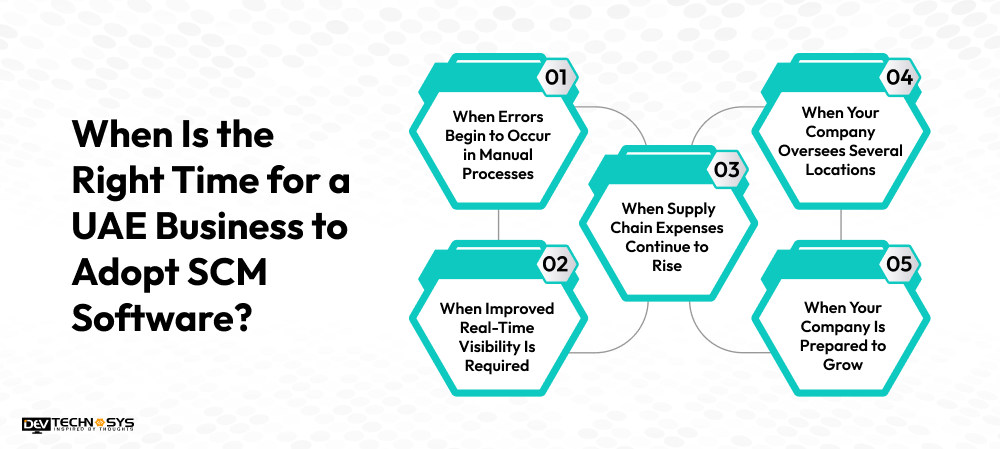
1. When Errors Begin to Occur in Manual Processes
SCM software can increase accuracy if your team primarily relies on spreadsheets, emails, manual stock changes, and repetitive data entry. Employees have greater time for planning, supplier coordination, and operational improvement when purchasing, inventory updates, approvals, reporting, and order processing are automated.
2. When Your Company Oversees Several Locations
Operational complexity rises with expansion to Dubai, Abu Dhabi, Sharjah, and other UAE and GCC areas. When teams require centralized inventory visibility, warehouse coordination, stock transfers, location-level reporting, and centralized procurement to maintain consistent control across numerous sites and expanding operations, SCM software becomes useful.
3. When Supply Chain Expenses Continue to Rise
Growing costs due to excess inventory, emergency shipments, inefficient warehousing, procurement errors, manual labor, or bad routes suggest that current procedures may need to be improved.
SCM software helps managers make better operational decisions by identifying cost drivers through analytics, automation, inventory optimization, and transportation visibility.
4. When Improved Real-Time Visibility Is Required
It might be time to implement SCM software if managers are unable to promptly ascertain inventory availability, shipping destinations, supplier performance, or order status.
By combining data from related activities, centralized dashboards offer real-time visibility and enable UAE companies to react more quickly to fulfillment problems, shortages, delays, and shifting consumer demands.
5. When Your Company Is Prepared to Grow
Adopting SCM software is best done before expansion makes managing current processes challenging. A scalable SCM platform can create integrated processes, automation, integrations, and centralized data to allow expansion without adding needless operational complexity if order quantities, suppliers, warehouses, staff, or transportation partners are growing.
Business Situation |
Need Level |
| One location + simple operations | Low |
| Multiple suppliers | Moderate |
| Multiple warehouses | High |
| Frequent stock issues | High |
| Regional distribution | High |
| Complex logistics | High |
| Rapid business growth | Very High |
| Heavy manual processes | Very High |
What Problems Can Supply Chain Software Solve?
Inaccurate inventory, supplier delays, shipment disruptions, disjointed systems, manual workflows, poor demand forecasting, inefficient warehouses, and growing expenses are just a few of the major operational issues that supply chain software for UAE businesses assists companies in resolving.
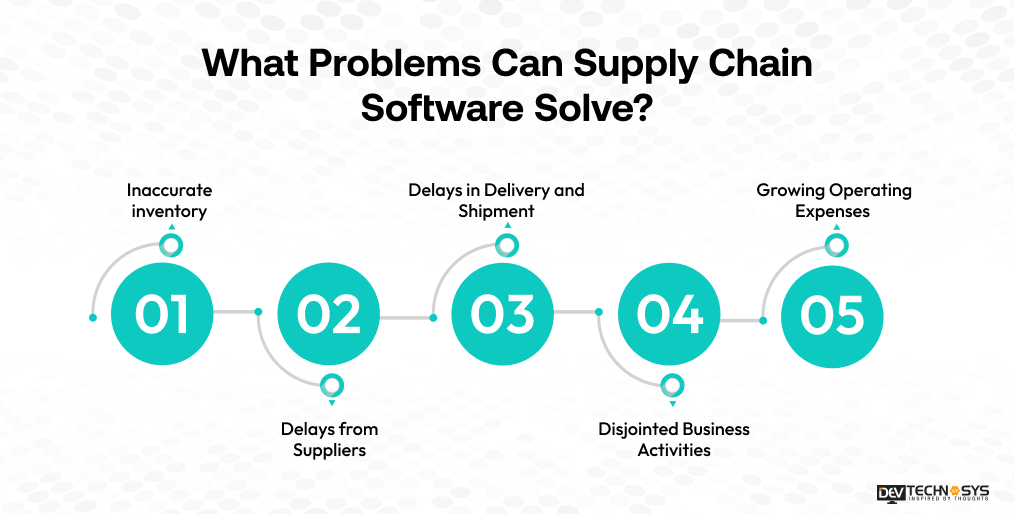
1. Inaccurate inventory
By coordinating stock data across warehouses, retail locations, and distribution hubs, supply chain management software UAE lowers inventory errors. Available quantities, stock movements, transfers, batches, and reorder levels are all displayed in real-time.
In addition to assisting companies with maintaining precise inventory and preventing needless purchases or supply shortages, this lowers manual reconciliation, duplicate entries, and counting errors.
2. Delays from Suppliers
Production, inventory availability, and customer satisfaction can all be impacted by supplier delays. SCM software uses consolidated supplier records and scorecards to monitor supplier lead times, purchase orders, delivery schedules, and performance.
Procurement teams may react sooner, consider other options, and lessen the effects of supplier disruptions by using automated alerts to identify late delivery or deteriorating performance.
3. Delays in Delivery and Shipment
By integrating transportation data, GPS, carriers, routes, and delivery updates, SCM software enhances shipment visibility. Teams are able to watch projected arrival times, detect delivery exceptions, and keep an eye on shipments in real time.
Logistics staff can respond to delays more quickly with the use of route optimization and automatic notifications, increasing delivery dependability and cutting down on needless transportation expenses.
4. Disjointed Business Activities
Information becomes fragmented when procurement, inventories, warehouses, transportation, accounting, and sales function independently. Through consolidated data and connections with ERP, WMS, TMS, CRM, eCommerce, and accounting systems, SCM software links various functions. This enhances information flow, decreases redundant data entry, and increases coordination throughout the whole supply chain.
5. Growing Operating Expenses
Excess inventory, rushed delivery, inefficient warehousing, procurement problems, manual labor, and poor route planning are just a few of the cost factors that supply chain software may help discover.
While inventory optimization, process automation, and transportation planning help firms reduce unnecessary costs and enhance resource utilization, analytics and automation offer a clearer picture of operational performance.

Which UAE Businesses Can Benefit Most From Supply Chain Software?
Software that enhances visibility, automation, and collaboration can be advantageous for UAE companies overseeing intricate supply chains. SCM systems can be used by retail, eCommerce, manufacturing, logistics, wholesale, distribution, and food and beverage businesses to manage inventory, suppliers, warehouses, transportation, and orders while cutting down on errors, delays, operational expenses, and supply chain inefficiencies.
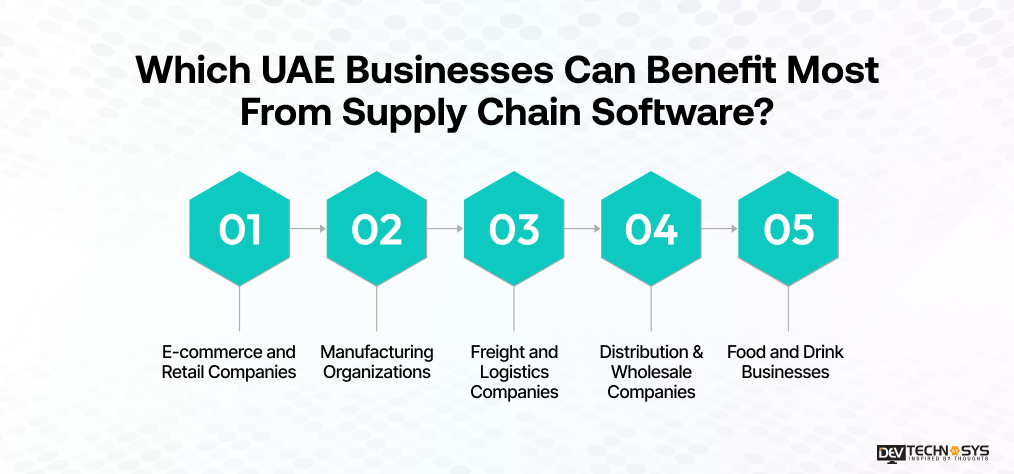
1. E-commerce and Retail Companies
SCM software allows retail and e-commerce companies to manage inventory, online orders, warehouses, suppliers, and delivery from a single platform.
Automated fulfillment, replenishment, and shipment tracking increase order accuracy, while real-time stock awareness helps avoid overselling and stockouts. Retailers with many locations can effectively manage inventory throughout UAE stores and warehouses.
2. Manufacturing Organizations
SCM software connects procurement, suppliers, inventories, production planning, warehousing, and transportation, all of which are advantageous to manufacturing organizations.
Companies are able to estimate demand, control supplier lead times, keep safety stock, and monitor raw materials. Manufacturers may minimize production delays, optimize inventory levels, detect shortages early, and coordinate operations across several facilities with the aid of real-time data.
3. Freight and Logistics Companies
Shipments, carriers, routes, fleets, warehouses, and delivery operations can all be managed by logistics and freight companies using SCM software. Teams can keep an eye on cargo movement and spot anomalies with the use of GPS monitoring and real-time visibility.
Automated warnings, route optimization, carrier performance analytics, and transportation planning can lower unnecessary operating and transportation expenses while increasing delivery reliability.
4. Distribution & Wholesale Companies
Large product volumes are frequently managed by wholesale and distribution companies between suppliers, warehouses, retailers, and delivery networks.
Order management, shipment tracking, automated procurement, warehouse visibility, and centralized inventory control are all made possible by SCM software. Companies can monitor product availability, plan stock transfers, increase fulfillment accuracy, and react more quickly to shifting demand across UAE locations.
5. Food and Drink Businesses
Because products may have batches, expiration dates, and special storage needs, food and beverage industries need precise inventory control. Batch and lot tracking, demand forecasting, warehouse management, supplier monitoring, and IoT connectivity pertaining to temperature are all supported by SCM software.
These supply chain software features assist companies in cutting waste, preserving product availability, enhancing traceability, and more effectively managing distribution.
Should You Buy Off-the-Shelf SCM Software or Build a Custom Solution?
How well your company’s processes match software capabilities determines whether you choose off-the-shelf or custom SCM software. Standardized processes work well with ready-made platforms, but organizations with unique workflows, complicated interconnections, specialized logistics, or UAE and GCC-specific requirements benefit from custom creation.
1. Off-the-Shelf SCM Software Makes Sense
When your organization uses typical manual supply chain processes and needs little customization, off-the-shelf SCM software may work. Ready-made systems offer inventory management, procurement, warehouse operations, supplier management, order processing, and basic analytics and are faster to deploy.
They function well when requirements are known, and your team can adapt workflows to the software. For firms that value speedy adoption over flexibility, an established SCM platform may be easier.
2. Custom SCM Software Makes More Sense
Standard platforms may not meet your operational needs; thus, custom SCM software is better. Software built for businesses with unique workflows, various integrations, specialized logistical procedures, complex approval systems, or industry-specific requirements may be needed.
Localized workflows, multi-location operations, regional logistics, and compliance may be needed for UAE and GCC firms. Advanced AI needs like demand forecasting, predictive risk identification, intelligent route optimization, and automated decision-making can be met with custom enterprise application development. This method gives more control over functionality, integrations, scalability, and upgrades.
3. UAE Business Custom SCM Software Development
Custom SCM development allows UAE companies to tailor supply chain technology to their own needs rather than adapting procedures to a generic platform.
Dev Technosys creates unique supply chain solutions to connect procurement, inventories, warehouses, transportation, suppliers, orders, ERP, and other corporate applications.
Companies may build an SCM platform that can grow with their supply chain by tailoring the development approach to business workflows, integration needs, scalability ambitions, and UAE/GCC operating conditions.

Conclusion: Is Your UAE Business Ready for Supply Chain Software?
If your UAE business faces issues such as inaccurate inventory, supplier delays, poor visibility of shipments, lack of integration between systems, high operational costs, or rapid expansion of activity, it may be the case that SCM software has gone from being a good-to-have piece of technology to becoming a necessity.
If you experience any of these signs you need supply chain software, it might be time to consider having a centralized SCM system implemented. Aside from that, Dev Technosys, a supply chain software development company, provides support for businesses that want to have custom supply chain software developed in the UAE.
Frequently Asked Questions
Q1. How Do I Know If My Business Needs Supply Chain Software?
When daily operations are impacted by manual processes, inventory errors, supplier delays, shipment tracking problems, unconnected systems, or growing expenses, your company may require supply chain software. Signs you need supply chain software that could enhance visibility, automation, coordination, and scalability include managing several suppliers, warehouses, locations, or increasing order quantities.
Q2. What Problems Can SCM Software Solve?
Common supply chain issues, including erroneous inventory, stockouts, supply chain delays, shipment disruptions, manual data input, inaccurate demand forecasting, inefficient warehouses, disjointed systems, and growing operating costs, can all be resolved using SCM software. Businesses may detect problems sooner and take quicker action by integrating supply chain activities, automating procedures, and delivering real-time data.
Q3. Is Supply Chain Software Suitable For Small Businesses In The UAE?
Yes, supply chain software can help small firms in the UAE when managing growing operations or manual processes becomes challenging. Scalable SCM solutions can be used by small businesses for orders, warehouses, deliveries, supplier management, inventory, and procurement. In addition to offering consolidated data and automation, cloud-based platforms can lower infrastructure needs.
Q4. When Should A Company Automate Its Supply Chain?
When manual processes take up a large amount of staff time, inventory problems rise, suppliers become challenging to monitor, shipments are not visible, or operating expenses keep going up, a business should think about supply chain automation. When order volumes, suppliers, warehouses, or locations are expanding and current processes are unable to scale effectively, automation becomes extremely useful.
Q5. Can SCM Software Manage Multiple Warehouses?
Yes, with unified inventory and operational controls, contemporary SCM software can oversee several warehouses. Stock levels, transfers, receiving, picking, packing, restocking, and warehouse performance may all be tracked by businesses across several sites. In addition to facilitating efficient product allocation, transfer coordination, and order fulfillment, real-time synchronization aids in maintaining correct inventory records.