





Key Takeaways
- The demand to build an Islamic eLearning app is rising rapidly due to increasing global interest in accessible, structured Islamic education across mobile-first platforms.
- AI-powered features like personalized learning, Quran pronunciation correction, and smart recommendations are becoming essential in modern Islamic EdTech platforms.
- The Islamic EdTech market is growing at over 18% CAGR globally, driven by strong adoption in the Middle East and Southeast Asia.
- The average Islamic eLearning App development cost ranges from $10,000 to $28,000, depending on features, scalability, and AI integration complexity.
The global eLearning industry is booming, and the Muslim world is no exception. With over 1.8 billion Muslims worldwide seeking accessible, authentic, and structured Islamic education, the demand for digital learning solutions has never been higher. Businesses and educational institutions are now looking to build an Islamic eLearning app that delivers personalized, accessible, and engaging learning experiences for users of all age groups.
If you’re an entrepreneur, startup, or Islamic institution wanting to design an Islamic eLearning app, you’re entering one of the most purpose-driven and profitable niches in EdTech today. With huge digital penetration across the Middle East, Southeast Asia, and Muslim-majority regions, 2026 is the best time to invest.
This guide will take you through the whole process, from features, development process, to the cost and monetization, so you can create an Islamic eLearning app with confidence that actually serves the Ummah and scales as a company.
What is an Islamic eLearning App?
An Islamic eLearning app is a dedicated digital platform designed to deliver structured Islamic education to learners across the globe. These apps bring together Quranic studies, Hadith learning, Arabic language courses, Islamic jurisprudence (Fiqh), and other religious disciplines into a single, accessible mobile or web-based experience.
Bayyinah TV, Quranic, and SeekersGuidance are some of the leading platforms that have already demonstrated the willingness of Muslim learners around the world to pay for excellent, structured Islamic digital education. This increased appetite makes now the right time for institutions and entrepreneurs to invest in developing their own Islamic app development services that meet real community needs.
How Does an Islamic eLearning App Work?
Before you begin to create an Islamic eLearning software that provides a seamless experience, you need to understand how it works. At its core, an Islamic eLearning app is an organized digital environment that integrates learners, instructors, and content. Here’s how it works, step by step.
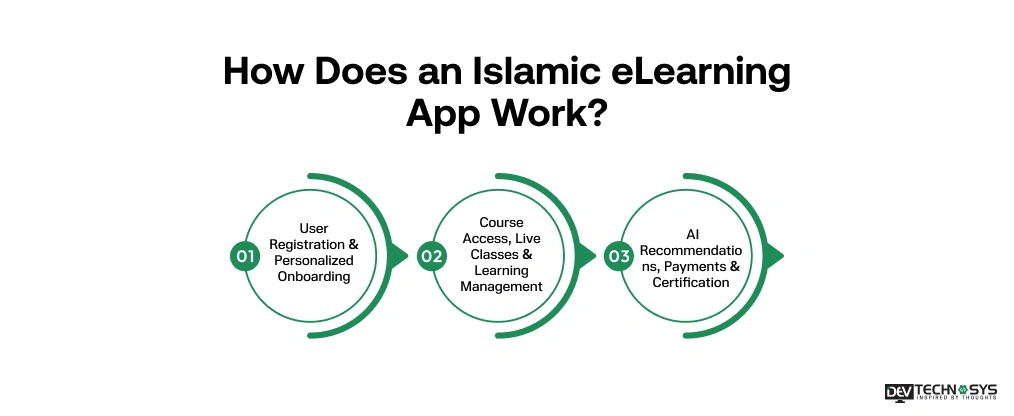
1. User Registration & Personalized Onboarding
Users create profiles, select preferred learning categories, languages, and study goals. Businesses that build an Islamic eLearning app now prioritize personalized onboarding to improve engagement and long-term course completion rates.
2. Course Access, Live Classes & Learning Management
Students can access Quran lessons, recorded lectures, quizzes, and live scholar sessions through a centralized dashboard. Many companies provide education app development solutions and services to integrate interactive assessments and progress tracking systems.
3. AI Recommendations, Payments & Certification
Advanced platforms use AI to recommend relevant Islamic courses, monitor learner performance, and automate certifications. Businesses looking for an Islamic eLearning app increasingly integrate secure subscriptions and multilingual payment gateways for global accessibility.
Industry Insight
According to Boost eLearning, AI, immersive technologies, and learner-centered design are reshaping digital education in 2026, enabling more personalized and accessible learning experiences.
Islamic EdTech Market Stats & Growth Potential in 2026
The numbers make a compelling case to make an Islamic eLearning app right now.
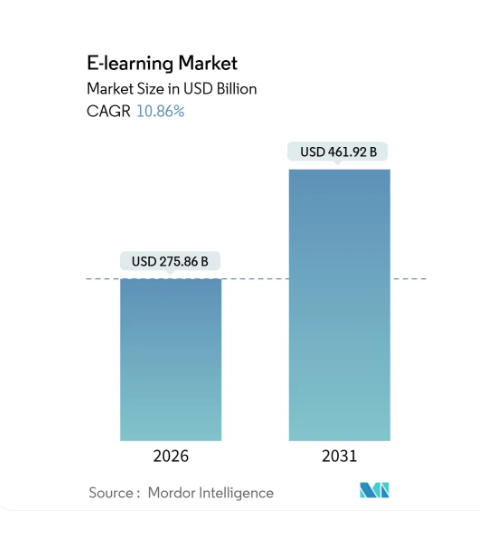
- The global eLearning market is valued at $275.86 billion in 2026 and is projected to reach $461.92 billion by 2031, growing at a CAGR of 10.86%.
- The Islamic EdTech app development sector is among the fastest-growing niches within this market, driven by Muslim-majority regions in the Middle East and Southeast Asia
- The global online learning market is projected to reach almost $400 billion by 2026, maintaining a CAGR of 9.1%.
- Asia Pacific led global eLearning service revenue in 2024 with approximately 29% market share, at $86.8 billion.
- There are 1.8 billion Muslims globally, with a significant youth population actively seeking a quality eLearning app for Islamic studies.
How to Build an Islamic eLearning App: Step-by-Step Development Process
Building a robust, scholar-approved, and scalable platform requires a structured approach. Here is a proven step-by-step process to build an Islamic eLearning app that performs well technically and resonates deeply with Muslim learners.
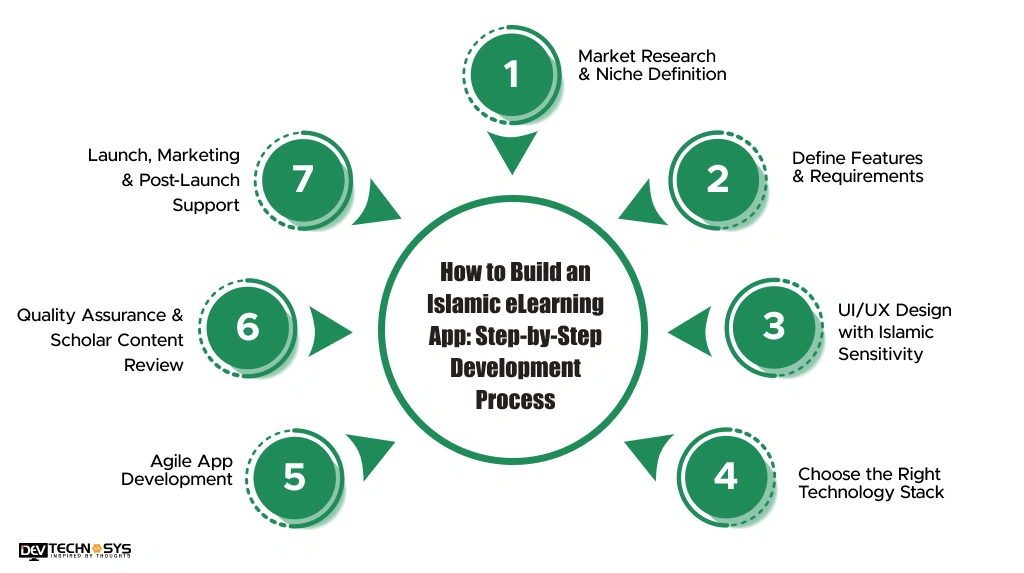
Step 1: Market Research & Niche Definition
Before writing a single line of code, define your target audience. Are you building for kids learning the Quran, adults pursuing Islamic finance certifications, or institutions managing Madrasah curricula? Research competitors, identify content gaps, and define your unique angle. This foundational step shapes every decision that follows.
Step 2: Define Features & Requirements
List the core and advanced features your platform needs. Work with Islamic scholars and educators to ensure content structure aligns with authentic learning methodologies. Document functional requirements, user roles learner, instructor, admin, and technical), and technical specifications before approaching any education app development solution partner.
Step 3: UI/UX Design with Islamic Sensitivity
Design matters deeply in this niche. Your interface should reflect Islamic aesthetics, clean layouts, Arabic typography support, RTL (right-to-left) language compatibility, and culturally appropriate visuals. A well-designed UX directly impacts learner retention and platform credibility among Muslim communities worldwide.
Step 4: Choose the Right Technology Stack
Selecting the right tech stack is critical for Islamic eLearning app development. Your stack should support video streaming, real-time communication, multilingual content, and high concurrent users. We cover the recommended tech stack in detail in a dedicated section below.
Step 5: Agile App Development
This is where your app comes to life. Development happens in sprints, frontend, backend, API integrations, Quran databases, and payment gateways are built and tested simultaneously. Following agile methodology ensures faster delivery, better quality control, and flexibility to incorporate feedback from Islamic educators during the build.
Step 6: Quality Assurance & Scholar Content Review
Testing goes beyond bug fixes here. Content accuracy, Tajweed correctness, fatwa authenticity, and scholar credentials must all be verified before launch. Conduct functional, performance, security, and usability testing across both Android and iOS devices to ensure a flawless experience.
Step 7: Launch, Marketing & Post-Launch Support
Deploy your app on Google Play and Apple App Store with an optimized listing. Leverage Islamic influencers, Masjid networks, and social media communities for launch marketing. Partner with a reliable app development company and maintenance team to ensure your platform stays updated, secure, and scalable post-launch.
Must-Have Features to Build an Islamic eLearning App in 2026
Features play a critical role in the success of modern Islamic learning platforms. Businesses planning to make an Islamic eLearning app must focus on interactive learning, personalized experiences, AI-powered engagement, and scalable infrastructure to improve user retention and long-term monetization. The right feature strategy also helps companies offering Islamic education app development services create platforms that stand out in the growing Middle East EdTech market.
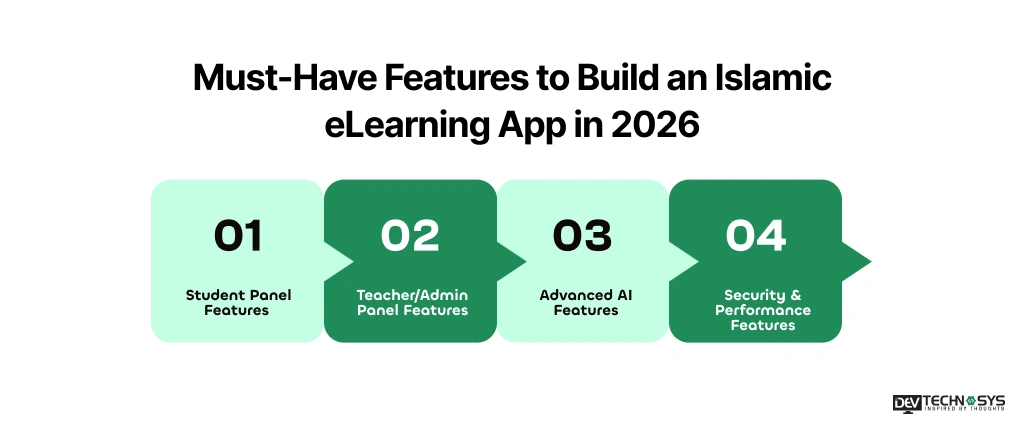
1. Student Panel Features
Businesses investing to build an educational app for Islamic studies solutions increasingly prioritize personalized and mobile-first learning experiences to improve student retention and platform scalability.
Feature |
Description |
| User Registration & Profiles | Allows users to create personalized learning accounts with language and course preferences. |
| Quran Learning With Tajweed | Helps students learn Quran recitation with pronunciation guidance and interactive audio support. |
| Live Classes & Recorded Lectures | Enables flexible learning through real-time scholar sessions and on-demand educational videos. |
| Progress Tracking Dashboard | Tracks completed lessons, quizzes, and learning milestones to improve engagement. |
| Gamification & Achievement Badges | Encourages users with rewards, streaks, and certificates for higher course completion rates. |
| Multilingual Learning Support | Makes the platform accessible for global audiences through multiple language options. |
| Prayer Time & Islamic Calendar | Integrates Islamic utilities that improve daily user engagement within the application. |
| Secure Subscription Management | Supports premium memberships and recurring payments for scalable revenue generation. |
2. Teacher/Admin Panel Features
Companies investing in Android app development for Islamic learning platforms are increasingly integrating advanced dashboards and automated management systems to handle growing user engagement efficiently.
Feature |
Description |
| Course Management Dashboard | Enables admins to upload, organize, and manage Quran courses, lectures, quizzes, and learning materials from a centralized system. |
| Student Management System | Helps educators monitor learner progress, attendance, subscriptions, and course completion data efficiently. |
| Live Session Scheduling | Allows instructors to schedule live Islamic classes, webinars, and scholar sessions with automated reminders. |
| Quiz & Assignment Management | Supports interactive assessments, mock tests, and automated grading to improve learning outcomes. |
| Certificate Generation System | Provides digital certificates after course completion to increase credibility and learner motivation. |
| Analytics & Reporting Dashboard | Gives businesses actionable insights into student engagement, retention, and learning performance trends. |
| Subscription & Payment Controls | Helps manage premium memberships, renewals, and monetization workflows securely. |
| Content Moderation Tools | Ensures all educational materials align with platform quality standards and authentic Islamic teachings. |
3. Advanced AI Features
AI is becoming a major differentiator in Islamic learning app development because it improves personalization, boosts learner retention, and creates more interactive educational experiences. Businesses looking to develop an Islamic app are increasingly adopting AI-driven features to deliver scalable and engaging learning ecosystems for global Muslim audiences.
AI Feature |
Description |
| AI-Powered Personalized Learning | Recommends courses, Quran lessons, and study materials based on user behavior, learning pace, and interests. |
| Quran Pronunciation Correction | Uses voice recognition technology to help users improve Tajweed and Arabic pronunciation accuracy. |
| AI Chatbot Assistance | Provides instant answers to learning queries, course navigation help, and study recommendations for better engagement. |
| Smart Course Recommendations | Suggests relevant Islamic content using AI-driven behavioral analysis and learner preferences. |
| Automated Quiz Generation | Creates personalized quizzes and assessments to improve retention and track student understanding levels. |
| Predictive Engagement Analytics | Identifies inactive users and helps businesses improve retention through targeted notifications and reminders. |
| AI-Based Multilingual Translation | Expands accessibility by automatically translating lectures, subtitles, and educational materials into multiple languages. |
4. Security & Performance Features
Businesses investing in Islamic eLearning App development increasingly prioritize security and scalability because modern users expect safe payments, uninterrupted learning, and fast platform performance across multiple devices and regions. With hybrid app development services, it helps businesses launch scalable Islamic learning platforms faster while reducing cross-platform development complexity and operational costs.
Feature |
Description |
| Secure Login & Authentication | Protects user accounts through encrypted login systems, OTP verification, and secure access management. |
| End-to-End Encrypted Payments | Ensures safe subscription transactions and protects sensitive financial information from security threats. |
| Cloud-Based Scalability | Supports growing user traffic, live classes, and content storage without affecting application performance. |
| Backup & Disaster Recovery | Prevents data loss through automated backups and recovery systems for uninterrupted learning experiences. |
| High-Performance Video Streaming | Delivers smooth live lectures and recorded Islamic sessions with minimal buffering and optimized content delivery. |
| Role-Based Access Control | Restricts access permissions for students, instructors, and administrators to improve platform security. |
| Real-Time Performance Monitoring | Tracks app performance, server health, and user activity to maintain a stable learning environment. |
Why Feature Selection Matters in Islamic Education Apps?
The success of any Islamic learning platform largely depends on its feature strategy. Businesses planning to create an Islamic eLearning app must focus on personalization, accessibility, AI-driven engagement, and scalable infrastructure to meet evolving user expectations. Features such as live Quran classes, multilingual support, gamification, and intelligent recommendations significantly improve learner retention and course completion rates.
Companies partnering with an iOS app development company can further optimize performance, usability, and cross-device learning experiences for premium user engagement.
A well-structured Islamic course management system also helps businesses streamline content delivery, student monitoring, and subscription management more efficiently. As competition in the Islamic EdTech industry continues to grow, platforms with advanced and user-centric features are more likely to attract long-term users and generate sustainable recurring revenue.

Tech Stack Required to Build an Islamic eLearning App
Choosing the right tech stack is essential when you build an Islamic eLearning app, as it directly impacts scalability, performance, security, AI capabilities, and long-term platform stability. Many businesses prefer to hire dedicated developer teams to ensure the smooth implementation of this tech stack while maintaining scalability and cost efficiency.
Development Area |
Technologies |
Purpose |
| Frontend Development | Flutter, React Native, Angular | Builds responsive and interactive user interfaces for learners and instructors |
| Backend Development | Node.js, Laravel, Django | Handles APIs, logic, user management, and platform operations |
| Mobile App Framework | Flutter, Kotlin, Swift | Enables cross-platform and native app performance for Android and iOS |
| Database Management | MongoDB, MySQL, PostgreSQL | Stores user data, courses, progress tracking, and analytics securely |
| Cloud & Hosting | AWS, Google Cloud, Azure | Provides scalability, storage, and high availability for global users |
| Live Streaming | Agora, Twilio, Wowza | Powers real-time Quran classes, lectures, and scholar sessions |
| AI/ML Integration | TensorFlow, PyTorch, OpenAI APIs | Enables personalization, recommendations, and intelligent learning features |
| Payment Gateway | Stripe, PayPal, PayTabs | Manages secure subscriptions, in-app purchases, and transactions |
| Security Layer | SSL, OAuth2, JWT | Ensures authentication, encryption, and secure user access |
| Analytics Tools | Google Analytics, Firebase, Mixpanel | Tracks user behavior, engagement, and platform performance |
Industry Insight
According to SolGuruz, the biggest eLearning app trends for 2025–2026 include gamification, AI-powered learning, microlearning, video-based education, and adaptive learning systems.
Why Entrepreneurs Are Rushing to Create an Islamic eLearning App in the Middle East?
The Middle East is not just a market, it is a movement. Governments across the UAE, Saudi Arabia, and Qatar are actively investing in digital education infrastructure, making it the perfect environment to build an Islamic eLearning app in Middle East.
Entrepreneurs who develop an Islamic eLearning app today position themselves at the intersection of faith, technology, and one of the world’s fastest-growing digital economies. The opportunity is massive, the timing is right, and the community need is genuine. Partner with a trusted mobile app development company to capitalize on this regional boom.
Here is why smart entrepreneurs are moving fast:
- Government Support: UAE Vision 2031 and Saudi Vision 2030 both prioritize digital education and Islamic heritage preservation.
- High Smartphone Penetration: Over 90% smartphone adoption across GCC countries drives massive app engagement.
- Wealthy, Faith-Driven Consumer Base: Middle Eastern Muslims actively spend on quality Islamic content and certified courses.
- Untapped Niche: Demand of Islamic eLearning app in Dubai far outpaces current supply, creating a first-mover advantage.
- Islamic EdTech App Development investment from regional VCs and Islamic finance institutions is growing rapidly year over year.
Islamic eLearning App Development Cost in 2026
The total Islamic eLearning App development cost depends on factors such as feature complexity, AI integrations, live streaming capabilities, platform selection, and scalability requirements. Businesses planning to make an Islamic eLearning app should also consider long-term maintenance, cloud infrastructure, and user engagement features while estimating the total project budget.
Estimated Cost to Build an Islamic eLearning App
App Type |
Estimated Cost |
Timeline |
| Basic MVP Islamic Learning App | $10,000 – $14,000 | 2–3 Months |
| Mid-Level AI-Enabled App | $15,000 – $22,000 | 4–6 Months |
| Advanced Scalable Islamic Learning App | $23,000 – $28,000 | 6+ Months |
Note: Businesses investing in Islamic eLearning App development often start with an MVP approach before scaling advanced AI and live-learning functionalities.
Cost Breakdown by Development Stage
Companies researching mobile app development cost strategies often reduce expenses by prioritizing essential features during the first launch phase. Here is a curated breakdown after making a few eLearning apps in UAE.
Development Stage |
Cost Contribution Percentage |
| UI/UX Design | 15% |
| Frontend & Backend Development | 40% |
| AI & Live Streaming Integration | 20% |
| Testing & Quality Assurance | 10% |
| Deployment & Launch | 5% |
| Project Management & Planning | 10% |
Businesses typically spend around 15–20% of the initial development cost annually on mobile app maintenance costs and platform improvements, depending on scalability and feature expansion requirements.
Factors Affecting Islamic eLearning App Development Cost
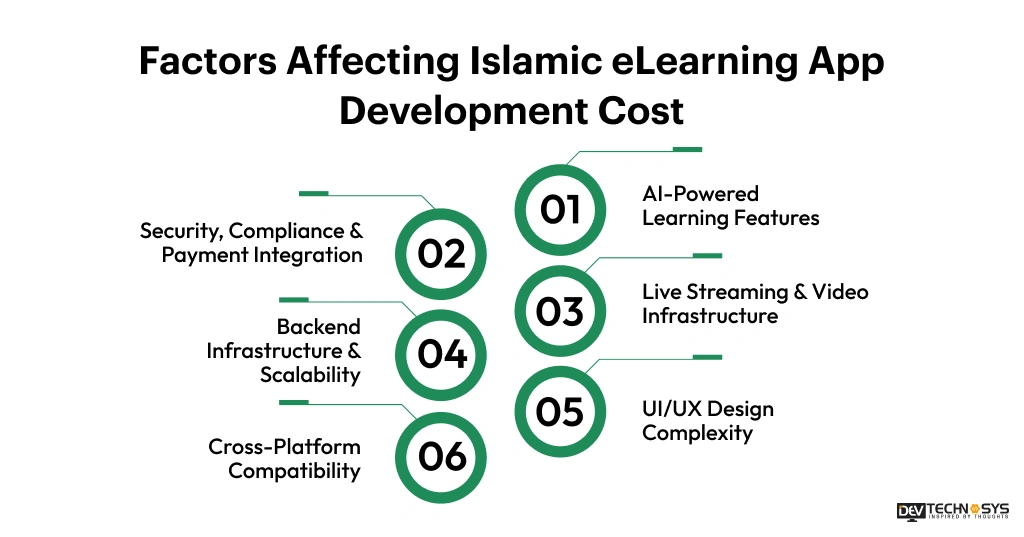
Several technical and business-related factors directly influence the overall Islamic eLearning App development cost. The final pricing depends on feature complexity, infrastructure requirements, scalability goals, AI integrations, and platform compatibility. Businesses planning to develop an Islamic eLearning app should carefully evaluate these factors before estimating the total project investment.
AI-Powered Learning Features
AI-based functionalities such as personalized course recommendations, Quran pronunciation correction, automated quizzes, and predictive learning analytics require advanced algorithms, machine learning models, and higher computing resources, which significantly increase development complexity and infrastructure expenses.
Live Streaming & Video Infrastructure
Features like live scholar sessions, real-time classes, and HD video streaming require scalable servers, CDN integration, low-latency architecture, and optimized bandwidth management, making video infrastructure one of the most resource-intensive components of development.
UI/UX Design Complexity
Interactive dashboards, gamification systems, multilingual interfaces, and personalized learning experiences demand extensive UI/UX research and custom design implementation, increasing both design timelines and frontend development costs.
Cross-Platform Compatibility
Businesses that launch apps simultaneously on Android, iOS, tablets, and web platforms require additional testing, optimization, and responsive interface development, which increases overall project timelines and engineering efforts.
Backend Infrastructure & Scalability
A scalable backend is essential for handling growing user traffic, cloud storage, live sessions, and secure data management. Advanced server architecture and cloud scalability planning significantly impact backend development and operational costs.
Security, Compliance & Payment Integration
Secure payment gateways, encrypted user data, authentication systems, and compliance-focused infrastructure require additional backend security layers and testing processes, increasing both development and long-term maintenance expenses.
Development Factor |
Estimated Cost Contribution |
Included Features |
| AI-Powered Learning Features | 20% | AI recommendations, smart quizzes, pronunciation correction |
| Live Streaming & Video Infrastructure | 15% | Live classes, HD video delivery, webinar systems |
| UI/UX Design Complexity | 15% | Gamification, multilingual UI, personalized dashboards |
| Cross-Platform Compatibility | 15% | Android, iOS, tablet, and web optimization |
| Backend Infrastructure & Scalability | 20% | Cloud hosting, APIs, databases, real-time synchronization |
| Security & Payment Integration | 15% | Secure payments, encryption, authentication systems |
Top Apps Like Islamic eLearning Platforms in 2026
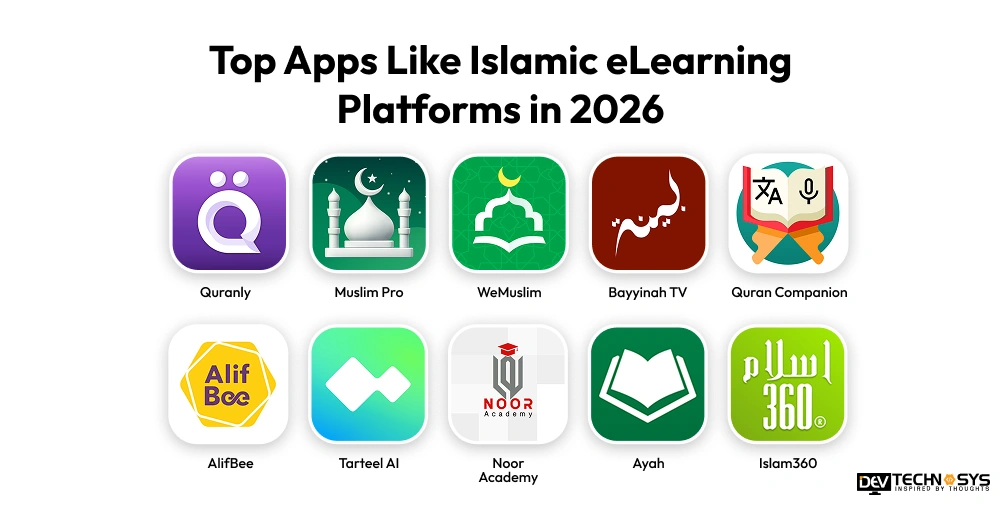
Successful Islamic learning platforms help businesses understand evolving user expectations, monetization opportunities, and feature trends before they start developing an Islamic eLearning app for global Muslim audiences.
App Name |
Core Focus |
Key Features |
Monetization Model |
| Muslim Pro | Islamic lifestyle & learning | Quran, prayer times, Qibla, audio lessons | Subscription + Ads |
| Quranly | Quran habit building | Daily Quran goals, reminders, streaks | Freemium |
| WeMuslim | Community-based Islamic learning | Live lectures, prayer tools, Islamic content | Subscription |
| Bayyinah TV | Quran education | Video courses, Tafsir lessons, Arabic learning | Paid Membership |
| Quran Companion | Gamified Quran learning | Memorization tracking, challenges, rewards | Freemium |
| Tarteel AI | AI Quran recitation | AI pronunciation correction, recitation analysis | Subscription |
| AlifBee | Arabic language learning | Gamified Arabic lessons, quizzes | Subscription |
| Noor Academy | Online Islamic classes | Live tutoring, Quran classes | Paid Courses |
| Ayah | Quran & Hadith learning | Audio learning, bookmarking, translations | Ads + Premium |
| Islam360 | Islamic knowledge platform | Hadith library, Quran search, lectures | Freemium |

1. Bayyinah TV
Bayyinah TV is a US-based Islamic e-learning platform founded by Sheik Nouman Ali Khan. It specializes in the Arabic language and Quranic tafsir through engaging, story-driven video lessons. Its subscription model and high-quality scholar-led content make it one of the most trusted platforms globally. Entrepreneurs looking to build an app like IslamApp can draw strong inspiration from Bayyinah’s content depth and community loyalty.
2. Quranic
Quranic is an AI-powered platform designed to make Quran learning accessible, interactive, and personalized. Its word-by-word breakdown, Tajweed guidance, and gamified progress system have made it extremely popular among younger Muslim learners worldwide across both iOS and Android.
3. SeekersGuidance
SeekersGuidance offers completely free, scholar-certified Islamic courses covering Fiqh, Aqeedah, Hadith, and Arabic. Its donation-based model makes quality Islamic education accessible to underprivileged Muslim communities globally, setting a powerful social impact benchmark for anyone looking to develop an Islamic eLearning app in Dubai or broader MENA markets.
4. Muslim Pro
Muslim Pro is the world’s most downloaded Islamic app with over 110 million users. While primarily a lifestyle app, its integrated Quran reader, prayer times, and learning modules make it a strong reference point for building an all-in-one build an Islamic app like WeMuslim style platform.
5. Tarteel AI
Tarteel AI is a revolutionary Quran memorization assistant powered by voice recognition technology. It listens to recitations, detects mistakes in real time, and personalizes the memorization journey. For entrepreneurs wanting to make an Islamic eLearning app with cutting-edge AI features, Tarteel sets the gold standard in Islamic EdTech innovation.
Monetization Models for Your Islamic eLearning App
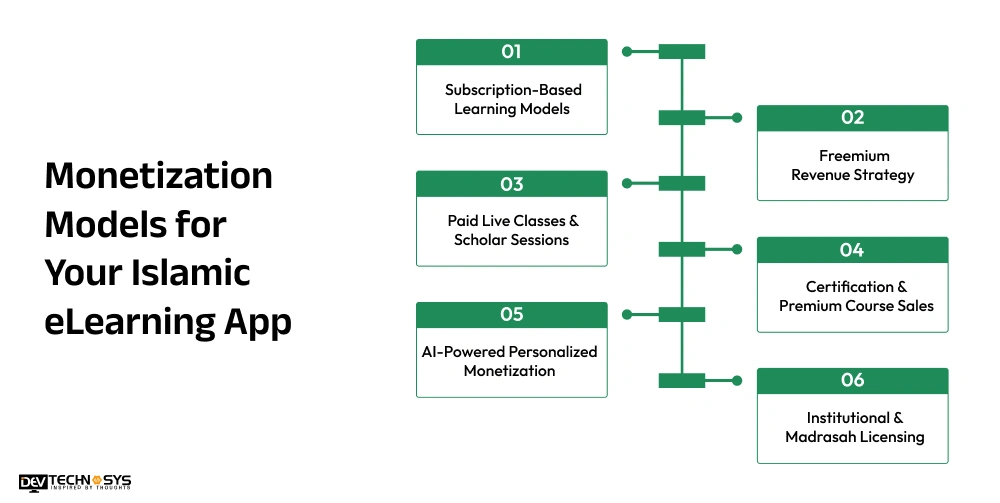
A strong monetization strategy helps businesses generate recurring revenue while improving user retention and long-term platform scalability. Companies investing in Islamic education app development should choose revenue models that balance accessibility, premium learning experiences, and sustainable business growth.
1. Subscription-Based Learning Models
Subscription plans are among the most profitable monetization methods because they generate predictable recurring revenue while encouraging businesses to continuously improve educational content and user engagement features.
2. Freemium Revenue Strategy
Freemium models help platforms attract large audiences by offering free learning resources initially. Advanced features, certifications, and exclusive courses can later convert free users into paying subscribers.
3. Paid Live Classes & Scholar Sessions
Many users prefer personalized Islamic learning experiences through live classes and direct scholar interaction. Premium live sessions create additional revenue streams while increasing user engagement and platform credibility.
4. Certification & Premium Course Sales
Verified Islamic course certifications add professional value for learners and encourage users to purchase advanced educational programs, especially in structured Islamic course management system platforms.It gives learners full control over spending while allowing platforms to price premium content at higher margins.
5. AI-Powered Personalized Monetization
Modern platforms increasingly use AI-driven recommendations and behavioral analysis to promote relevant premium courses, improving conversion rates and maximizing revenue opportunities for scalable Islamic learning ecosystems.
6. Institutional & Madrasah Licensing
Partner directly with Islamic schools, Masjids, universities, and organizations by offering white-label or licensed versions of your platform. Institutions pay a flat annual licensing fee for bulk student access. This B2B model generates high-value contracts and positions your platform as a trusted Islamic eLearning app development infrastructure partner across the Middle East and beyond.
How AI Is Transforming Islamic eLearning Apps in 2026?
Artificial intelligence is reshaping how businesses use Islamic eLearning apps by making digital learning more personalized, interactive, and scalable. Modern AI systems can analyze user behavior to recommend relevant Quran lessons, automate assessments, and improve student engagement through personalized learning journeys.
Businesses creating an Islamic eLearning software in Dubai are also adding AI-powered Quran pronunciation correction, multilingual translations, and intelligent chatbots for fast learning support. Analytics powered by AI also assists platforms in spotting idle learners and boosting retention techniques.
As competition in Islamic eLearning App development continues to increase, AI is becoming essential for delivering smarter learning experiences, improving user satisfaction, and building scalable Islamic EdTech ecosystems for global audiences.

Conclusion
There is a growing demand for digital Islamic education as people are looking for flexible and mobile-first learning experiences. Today, businesses looking to build an Islamic eLearning app are now considering personalized learning via AI, live learning elements, and scalable cloud infrastructure.
With the rise of adoption in the Middle East, particularly in UAE and the bordering regions, the possibility for Islamic EdTech platforms is now more than ever. Understanding the Islamic eLearning App development cost, monetization strategies, and feature planning is essential for long-term success.
For businesses aiming to enter this space with a scalable and reliable product, partnering with Dev Technosys, an Islamic app development company, ensures proper execution, technical expertise, and faster time-to-market. With 15+ years of experience, we provide the right strategy to help Islamic learning platforms achieve both educational impact and strong revenue potential.
FAQs
Q1. How Can Businesses Validate an Idea Before They Develop an Islamic eLearning App?
Businesses can validate their idea through competitor analysis, user surveys, MVP testing, and market demand research. This helps reduce risk before you develop an Islamic eLearning app and ensures the platform aligns with real user needs and monetization potential.
Q2. What Technologies Are Best for Scalable Islamic eLearning App Development?
Modern Islamic eLearning App development relies on Flutter or React Native for the frontend, Node.js or Laravel for the backend, and cloud platforms like AWS or Google Cloud. AI APIs and streaming tools like Agora are also essential for scalability and engagement.
Q3. How Do Islamic Learning Apps Ensure Content Authenticity and Quality?
Islamic platforms work with verified scholars, certified educators, and structured review systems to ensure accuracy. This is a critical part of Islamic learning app development, especially when delivering Quranic, Hadith, and educational content globally.
Q4. How Can Islamic Elearning Apps Scale Globally After Launch?
Scalability is achieved through cloud infrastructure, multilingual support, AI-driven personalization, and region-based content delivery. Businesses that are developing an Islamic eLearning app with a scalable architecture can expand into GCC, Southeast Asia, and global Muslim markets efficiently.
Q5. Why is Middle East a Strong Market for Islamic eLearning Apps?
The Middle East offers high smartphone penetration, strong digital education adoption, and growing demand for online Islamic learning. This makes it a highly profitable region for Islamic eLearning App development and scalable EdTech investments.