





Key Takeaways:
-
- Healthcare app development trends are shifting the industry from treatment-focused systems to predictive and preventive care models.
- AI-powered features and automation are streamlining workflows, enabling faster diagnoses and improving operational efficiency at scale.
- Interoperability is becoming essential, allowing healthcare apps to connect seamlessly with multiple systems and eliminate data silos.
- Scalable, cloud-based architectures are helping businesses build flexible and future-ready healthcare platforms.
- Personalized patient experiences are emerging as a key differentiator, driving higher engagement and long-term user retention.
- Security, compliance, and data privacy are no longer optional; they are core requirements for building trust and ensuring adoption.
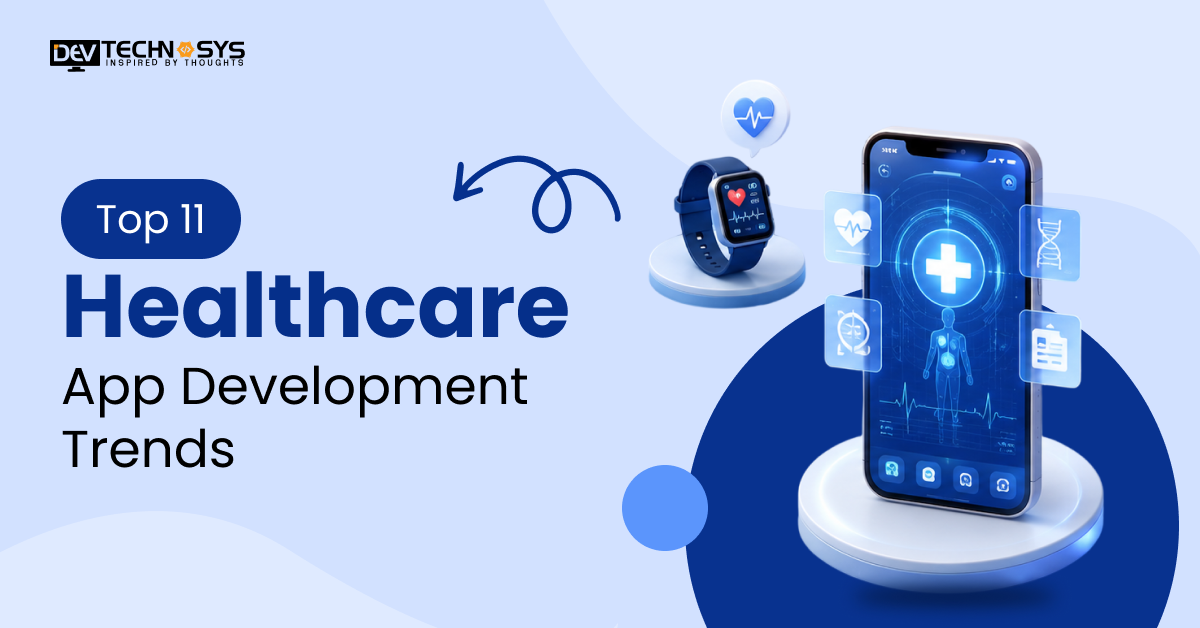
Healthcare is no longer confined to hospitals; it’s shifting rapidly into a mobile-first, data-driven ecosystem. From virtual consultations to AI-powered diagnostics, the way care is delivered and experienced is being completely redefined. This shift is exactly why understanding the latest healthcare app development trends is no longer optional for businesses; it’s a strategic necessity.
The numbers make this transformation impossible to ignore. The global digital health market is projected to surpass $660 billion by 2028, driven by rising demand for remote care, wearable integrations, and personalized treatment experiences. What’s changing now isn’t just technology; it’s user expectations. Patients want faster access, smarter insights, and seamless digital interactions.
For businesses building or scaling healthcare platforms, this creates both an opportunity and a challenge: adapt to these evolving top healthcare app development trends or risk falling behind in an increasingly competitive digital health app trends.
Top Healthcare App Development Trends: Trends in 2026
The latest trends in healthcare app development are reshaping how digital care is delivered, blending advanced technologies with user-first experiences. These digital health app trends highlight a shift toward smarter, connected, and more personalized healthcare solutions in 2026.
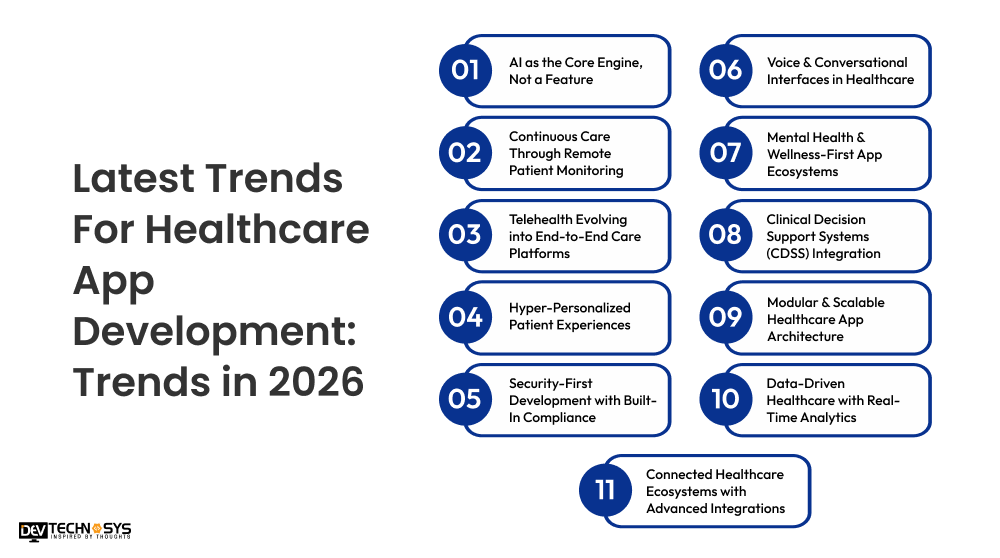
1. AI as the Core Engine, Not a Feature
AI is no longer an add-on in modern healthcare platforms; it’s becoming the decision-making backbone of digital care. What’s changing now is how deeply AI is embedded across the app lifecycle, from symptom analysis to treatment recommendations.
Instead of reacting to patient inputs, apps are beginning to anticipate risks, flag anomalies, and guide both patients and clinicians toward faster, data-driven decisions. This shift is redefining what users expect from mobile health app innovations, not just access to care, but intelligent assistance at every step.
For businesses, this isn’t just about innovation; it’s about staying relevant. Partnering with a reliable healthcare app development company ensures AI is integrated in a way that’s scalable, compliant, and actually improves outcomes, rather than adding unnecessary complexity.
Technologies Powering AI-Driven Healthcare
- Machine Learning & Predictive Analytics
- Natural Language Processing (NLP)
- Computer Vision for Diagnostics
- Clinical Decision Support Systems (CDSS)
2. Continuous Care Through Remote Patient Monitoring
Healthcare is shifting from occasional check-ups to continuous, real-time care, and remote patient monitoring (RPM) is at the center of this transformation. Instead of waiting for symptoms to escalate, healthcare apps now track vitals like heart rate, glucose levels, and activity patterns around the clock.
This creates a constant feedback loop where both patients and doctors can act early, not late. The real shift here isn’t just monitoring, it’s turning everyday health data into actionable insights that reduce hospital visits and improve long-term outcomes.
Technologies Enabling Real-Time Monitoring
- Wearables & IoT-connected medical devices
- Cloud-based data synchronization
- Real-time alerts & notification systems
- Secure health data storage and analytics
What most businesses underestimate is the complexity behind this “always-on” care model. Handling continuous data streams, ensuring accuracy, and maintaining compliance requires a well-planned backend, something that needs to be done when you build a healthcare app like Sehhaty.
3. Telehealth Evolving into End-to-End Care Platforms
Telehealth is no longer just a video consultation feature; it’s rapidly transforming into a complete digital care environment. What started as a convenience during necessity is now becoming the default care model. Users expect everything in one place: appointment booking, virtual visits, prescriptions, medical records, and follow-ups.
The real shift is that healthcare apps are moving from single-purpose tools to integrated care platforms that replicate the entire patient journey digitally.
This evolution is also changing how providers operate. Instead of fragmented systems, clinics and hospitals are adopting unified platforms that streamline workflows, reduce administrative load, and improve patient engagement.
For businesses building an app like Practo, the focus is no longer just on enabling consultations; it’s about delivering a seamless, end-to-end personalized healthcare app experience that keeps users within one ecosystem.
Key Components of Modern Telehealth Platforms
- Video & audio consultation (SDK integration)
- E-prescriptions & digital health records
- Appointment scheduling & reminders
- In-app payments and billing systems
Industry Insights
According to Emorphis Health, over 65% of newly launched healthcare apps now include AI-driven features, making AI a standard component rather than a differentiator in modern healthcare solutions.
4. Hyper-Personalized Patient Experiences
Healthcare apps are moving away from one-size-fits-all experiences toward deeply personalized user journeys. What’s changing now is how apps use real-time data behavior patterns, medical history, and lifestyle inputs to tailor everything from health recommendations to notifications.
Instead of generic reminders, users receive insights that feel relevant to their condition, habits, and goals, making engagement far more meaningful.
This level of personalization is also reshaping user expectations. Patients now compare healthcare apps to fitness and lifestyle platforms that already deliver curated experiences. As a result, businesses must rethink how they design healthcare mobile apps, focusing not just on functionality but on delivering context-aware interactions that adapt over time and keep users consistently engaged.
How Personalization is Delivered
- AI-driven recommendation engines
- Behavior-based alerts & reminders
- Adaptive UI/UX based on user data
- Integration with fitness and lifestyle data sources

5. Security-First Development with Built-In Compliance
Security in healthcare apps is no longer a backend concern; it’s a core product requirement. With sensitive patient data flowing across platforms, even a minor vulnerability can lead to serious legal and financial consequences. What’s changing now is the shift toward privacy-by-design, where security and compliance are embedded from the very first line of code rather than added later.
At the same time, regulations are becoming stricter, pushing businesses to prioritize HIPAA-compliant app features and global data protection standards. This isn’t just about avoiding penalties; it’s about building user trust in an environment where data privacy directly impacts adoption and retention. Ignoring this layer can break even the most innovative healthcare solution.
Key Security & Compliance Measures
- End-to-end data encryption
- Role-based access control (RBAC)
- Multi-factor authentication (MFA)
- Secure cloud infrastructure & audit logs
Visit: How to Build an App Like Altibbi?
6. Voice & Conversational Interfaces in Healthcare
Typing symptoms into an app is quickly being replaced by something far more natural: speaking and interacting conversationally. Voice-enabled healthcare apps are making it easier for users to book appointments, describe symptoms, or get guidance without navigating complex interfaces. This shift is especially impactful for elderly users and patients who struggle with traditional app interactions.
What’s interesting is that conversational UI isn’t just about convenience, about reducing friction in critical moments. When users need quick answers or assistance, voice and chat interfaces remove barriers and speed up access to care. For businesses, this means rethinking interaction design and working with forward-thinking mobile health app innovations that understand how to build intuitive, voice-first healthcare experiences.
Technologies Behind Conversational Healthcare
- Natural Language Processing (NLP)
- AI-powered chatbots
- Voice recognition systems
- Speech-to-text and text-to-speech engines
7. Mental Health & Wellness-First App Ecosystems
Mental health is no longer a secondary feature; it’s becoming a core pillar of digital healthcare platforms. What’s changing is the shift from reactive support to continuous wellness management in mental health app development trends. Modern healthcare apps now integrate mood tracking, guided therapy, meditation, and behavioral insights to support users beyond clinical treatment.
This trend is also being driven by user behavior. People are more open to seeking mental health support through digital platforms, especially when they offer privacy and accessibility. As a result, businesses are expanding their scope from treatment-focused solutions to holistic wellness ecosystems.
For teams planning long-term scalability, this directly influences the healthcare app development cost, as integrating such features requires advanced data handling and personalization capabilities.
Core Features in Mental Health Apps
- Mood & behavior tracking
- AI-based therapy chatbots
- Meditation and mindfulness modules
- Progress analytics and insights
8. Clinical Decision Support Systems (CDSS) Integration
Healthcare apps are increasingly stepping into the role of clinical assistants, not just patient-facing tools. By integrating clinical decision support systems (CDSS), apps can analyze patient data, flag potential risks, and provide evidence-based recommendations to doctors in real time.
The real shift here is speed; what once required manual review can now be surfaced instantly, improving both accuracy and response time in critical situations.
This also changes how healthcare providers rely on digital tools. Instead of using apps only for record-keeping, they now depend on them for data-backed clinical guidance, especially in complex or high-risk cases.
For businesses building advanced solutions, working with the right healthcare app development solution becomes essential to ensure CDSS integration is reliable, compliant, and aligned with real-world clinical workflows.
Capabilities Enabled by CDSS
- Risk prediction and early warning alerts
- Evidence-based treatment suggestions
- Integration with the patient’s medical history
- Real-time clinical insights and reporting
9. Modular & Scalable Healthcare App Architecture
Healthcare apps are no longer built as single, monolithic systems; they’re evolving into modular platforms powered by microservices. The reason is simple: healthcare requirements change fast, and rigid architectures can’t keep up. A modular approach allows different components, like appointments, billing, analytics, or patient records, to scale and evolve independently without breaking the entire system.
What’s changing now is how businesses think about long-term growth. Instead of building for current needs, they’re designing systems that can adapt to new features, integrations, and user loads over time. This is especially critical for platforms expecting high traffic or multi-region expansion.
Choosing the right mobile app development company plays a key role here, as architecture decisions made early directly impact performance, scalability, and future development flexibility.
Key Elements of Scalable Architecture
- Microservices-based backend
- Cloud-native infrastructure
- API-first development approach
- Independent service deployment and scaling
10. Data-Driven Healthcare with Real-Time Analytics
Healthcare apps are no longer just collecting data; they’re actively interpreting it in real time. From patient vitals to app interactions, every data point is now used to generate insights that improve care delivery and operational efficiency. The real shift is from static reports to live analytics dashboards that help both patients and providers make faster, informed decisions.
This trend is also reshaping how healthcare businesses operate. Instead of relying on historical data, teams can now track patient engagement, treatment effectiveness, and system performance as it happens. For platforms scaling rapidly, this directly impacts mobile app maintenance cost, as real-time analytics requires continuous monitoring, optimization, and infrastructure support to ensure accuracy and performance.
What Real-Time Analytics Enables
- Live patient health tracking
- Predictive health insights
- Operational performance monitoring
- Data-driven decision-making
11. Connected Healthcare Ecosystems with Advanced Integrations
Healthcare apps are no longer standalone products; they’re becoming part of larger, interconnected ecosystems. The real shift is toward platforms that can communicate with multiple services simultaneously, from pharmacies and labs to insurance providers and wearable devices. This level of connectivity creates a more seamless and efficient care experience for both patients and providers.
What’s driving this trend is the growing need for unified healthcare journeys. Users expect their data to flow effortlessly across systems without manual input or delays. For businesses, this means focusing heavily on third-party API integration in healthcare apps, ensuring secure, real-time data exchange across platforms. As ecosystems grow more complex, many teams also choose to hire dedicated developer resources to manage integrations and maintain system stability at scale.
Key Integration Areas
- Lab & diagnostic APIs
- Pharmacy & e-prescription systems
- Insurance & billing integrations
- Telehealth API integration (video/audio SDKs)
Industry Insight
According to McKinsey & Company, AI-powered healthcare apps improve diagnostics, automate workflows, and personalize patient care experiences across hospitals and digital health platforms globally.
AI-Driven Transformation in Healthcare Apps
AI in healthcare apps is moving beyond feature-level implementation into system-wide transformation. The real shift isn’t just automation, it’s how AI is redefining decision-making across the entire care journey. From predicting disease risks before symptoms appear to optimizing treatment plans based on real-time patient data, AI is enabling a more proactive and precise healthcare model.
What makes this evolution significant is its impact on both clinical and operational efficiency. Advanced clinical decision support systems (CDSS) are now capable of assisting doctors with data-backed recommendations, while automation reduces manual workload in areas like diagnostics, triage, and patient management. This not only improves accuracy but also speeds up response times in critical scenarios.
As AI adoption accelerates, businesses are increasingly investing in scalable solutions backed by custom Android app development, ensuring these intelligent systems are seamlessly integrated, compliant, and aligned with real-world healthcare workflows.
Futuristic Healthcare Technologies Shaping the Next Decade
Healthcare innovation isn’t slowing down; it’s accelerating into areas that were once considered experimental. The next wave of healthcare technology trends is being shaped by technologies that go beyond apps and into immersive, predictive, and highly automated care environments.
What’s important here is not immediate adoption, but strategic readiness. Businesses that prepare early will define the next generation of digital healthcare experiences.
These emerging technologies are focused on solving deeper challenges like data security, surgical precision, and personalized simulations. As they mature, they will push healthcare apps from being support tools to becoming intelligent healthcare ecosystems that can simulate, predict, and even assist in complex medical procedures.
Emerging Technologies to Watch
- Blockchain for secure and transparent medical records
- AR/VR for medical training and remote surgeries
- Digital Twins for patient-specific health simulations
- Robotics & Automation for precision-driven procedures
Adopting these innovations requires long-term planning, which is why businesses often collaborate with an experienced iOS app development company to build scalable, future-ready healthcare platforms that can evolve with these technologies.
How Dev Technosys is Driving Innovation in Telehealth
As telehealth evolves into a core healthcare delivery model, the real challenge lies in building platforms that are not just functional but scalable, secure, and experience-driven. This is where Dev Technosys is actively shaping next-gen telehealth solutions, focusing on performance, compliance, and seamless user journeys rather than just feature delivery. They are aligned with the latest trends in healthcare app development to provide you with the best solution.
Custom Telehealth App Solutions
Dev Technosys builds tailored platforms that go beyond basic consultations, covering appointment systems, real-time communication, patient records, and integrated care workflows. Their approach aligns closely with modern healthcare app development services, ensuring each solution is built around specific business and user needs.
Advanced Technology Integration
From AI-powered insights to secure telehealth API integration (video/audio SDKs), the focus is on creating connected and intelligent platforms. By combining scalable infrastructure with deep domain expertise, they help businesses deliver telehealth experiences that are reliable, compliant, and future-ready.

Conclusion
The rapid evolution of healthcare app development trends is reshaping how care is delivered, experienced, and scaled in a digital-first world. From AI-driven intelligence to connected ecosystems and real-time analytics, the focus is clearly shifting toward smarter, more integrated healthcare solutions. For businesses, the opportunity lies in building platforms that are not just functional but adaptable to continuous innovation.
Whether you’re planning to launch or scale, partnering with the right healthcare app development company can make the difference between a standard app and a future-ready solution. The key is to stay aligned with these healthcare app development trends and build with long-term impact in mind.
FAQs
Q1. How Do Healthcare App Development Trends Impact Overall Development Costs?
Modern trends like AI, real-time analytics, and interoperability increase the initial healthcare app development cost due to complex architecture and integrations. However, they also improve efficiency, scalability, and user engagement, helping businesses achieve better long-term returns and reduced operational expenses over time.
Q2. What Technologies Are Essential for Modern Healthcare App Development?
Today’s healthcare apps depend on AI/ML, cloud infrastructure, IoT, and secure APIs. Technologies like telehealth API integration (video/audio SDKs) and interoperability standards ensure seamless communication, while analytics tools enable smarter decision-making and real-time health monitoring across connected systems.
Q3. Why is Compliance Important in Healthcare Mobile Apps?
Compliance ensures patient data is protected and handled responsibly. Features aligned with HIPAA-compliant app features help prevent data breaches, maintain confidentiality, and build trust among users. It also safeguards businesses from legal penalties and strengthens credibility in a highly regulated healthcare environment.
Q4. How Does AI Improve Healthcare App Performance and Outcomes?
AI improves healthcare apps by enabling predictive insights, automating repetitive tasks, and enhancing diagnostics. Through tools like clinical decision support systems (CDSS), it assists healthcare professionals in making faster, data-driven decisions, ultimately improving patient outcomes and reducing manual workload across operations.
Q5. What Factors Should Businesses Consider Before Developing a Healthcare App?
Businesses should evaluate target users, required features, compliance needs, and scalability. Choosing the right tech stack, integration capabilities, and long-term maintenance planning is essential. Partnering with experts in custom healthcare app development services also ensures the solution aligns with business goals and evolving industry demands.