






Key Takeaways
The cost to build a cryptocurrency exchange app in 2026 typically ranges from $8,000 to $26,000, depending on platform type, features, security architecture, and scalability requirements. A basic MVP starts from $8,000, mid-level exchanges range between $12,000–$18,000, while advanced enterprise-grade platforms can go up to $26,000+.
Cost Breakdown by Development Complexity
- Basic / MVP ($8,000 – $12,000): Simple trading engine, wallet integration, user login, basic UI, and limited features for market validation.
- Mid-Level ($12,000 – $18,000): Includes KYC/AML, crypto wallet integration, trading charts, notifications, payment gateways, and cross-platform support.
- Advanced ($18,000 – $26,000+): High-frequency trading engine, liquidity integration, AI-based analytics, multi-currency wallets, strong security layers, and scalable cloud infrastructure.
Key Factors That Affect the Cost
- App Complexity: Advanced trading features and real-time systems increase the crypto exchange app development pricing in 2026.
- Platform Choice: Web, iOS, and Android support increases development scope.
- Blockchain Architecture: Complex smart contracts and decentralized systems raise costs.
- Security & Compliance: Strong encryption, audits, and risk systems increase investment.
- Third-Party Integrations: APIs for liquidity, wallets, and payments add to the overall cost to make a cryptocurrency exchange app.
Development Timeline
- Basic MVP: 1–2 months
- Mid-Level App: 3–4 months
- Advanced Platform: 4–6 months
Hidden Costs
-
- Maintenance: 15%–20% of annual development cost for updates and scaling.
- Cloud Infrastructure: Increases with user traffic and trading volume.
- Security Audits: Regular penetration testing and compliance checks.
- API & Licensing Fees: Third-party integrations add recurring operational costs.
A startup founder in Dubai staring at a trading dashboard that refreshes in milliseconds, watching global crypto prices shift faster than decisions can be made. At the same time, another entrepreneur in Riyadh is frustrated because existing platforms feel slow, complex, and not built for regional users who want speed and trust in one place.
That gap is exactly where new crypto exchange apps are born.
The global cryptocurrency market is already valued at over $2 trillion, and crypto exchange platforms are at the center of this growth. What starts as a simple idea quickly turns into a much bigger question: what is the real cost to build a cryptocurrency exchange app in 2026, and what does it take to compete in a market moving at lightning speed?
Behind every successful exchange lies a complex system of trading engines, wallet architecture, compliance layers, and real-time data processing working together seamlessly. In this blog, we’ll break down how these systems come together and what it actually takes to build one from the ground up.
Let’s get started!
What is a Cryptocurrency Exchange Platform?
A cryptocurrency exchange platform is a digital system that allows users to buy, sell, and trade cryptocurrencies like Bitcoin, Ethereum, and other digital assets in real time. It works as a bridge between buyers and sellers, ensuring secure transactions through advanced trading engines and liquidity systems. These platforms can be centralized, decentralized, or hybrid, depending on how control and transactions are managed.
In 2026, such platforms are no longer basic trading tools; they are full-scale financial ecosystems powered by blockchain technology, smart contracts, and automated order matching systems designed for speed, transparency, and global accessibility.
Cryptocurrency Exchange App Development Cost in 2026: Complete Breakdown
The cost to build a cryptocurrency exchange app in 2026 depends heavily on the level of features, security architecture, scalability requirements, and compliance systems included in the platform. A basic MVP designed for market validation will require significantly lower investment, while a full-scale trading ecosystem with advanced security, liquidity management, and real-time trading engines demands a much higher budget.
| App Complexity | Features Included | Estimated Cost |
| Basic MVP | Core trading engine, user registration, basic wallet, simple UI, limited crypto pairs | $8,000 – $12,000 |
| Mid-Level App | MVP features + multi-currency wallet, KYC integration, notifications, payment gateway integration, improved UI/UX | $12,000 – $18,000 |
| Full-Featured App | Advanced trading engine, high liquidity integration, AI-based insights, analytics dashboard, admin panel, enhanced security layers | $18,000 – $26,000 |
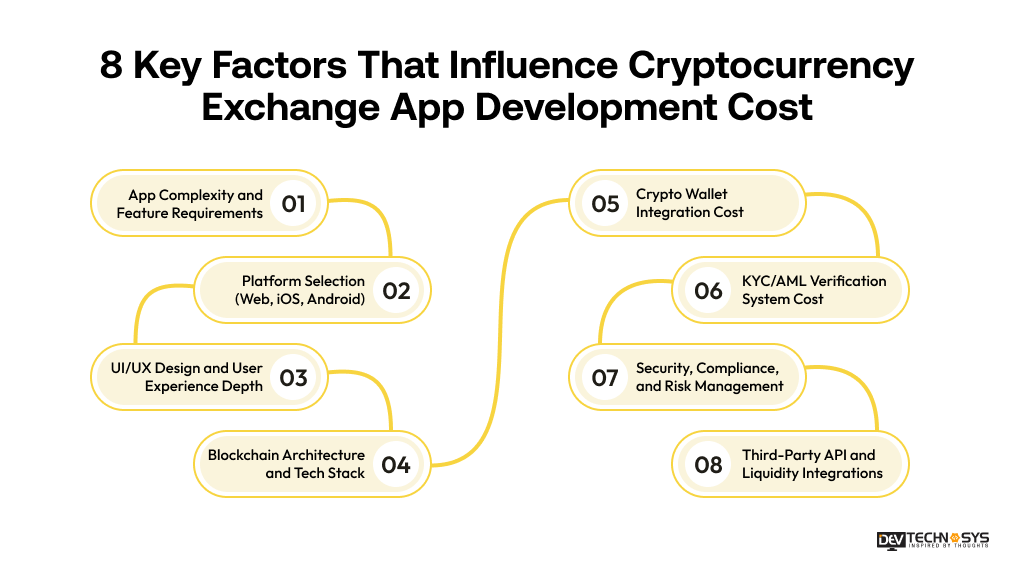
8 Key Factors That Influence Cryptocurrency Exchange App Development Cost
The cost to build a cryptocurrency exchange app depends on multiple technical and business-driven factors. Each component adds complexity to the system, increases development effort, and directly impacts the final budget required to build a secure and scalable trading platform in 2026.
1. App Complexity and Feature Requirements
The overall cost increases as the number and sophistication of features grow. A simple trading app with basic buy and sell functions is quicker to build, while advanced features like real-time trading engines, margin trading, liquidity management, and AI in cryptocurrency exchange apps require deeper backend logic and longer development cycles.
Feature Type |
Features |
Cost Contribution |
| Basic MVP | User login, basic trading, wallet | $3,000 – $4,000 |
| Core Features | Charts, order book, notifications | $4,000 – $5,000 |
| Advanced Features | AI trading, margin trading, analytics | $5,000 – $6,000 |
2. Platform Selection (Web, iOS, Android)
Choosing platforms directly affects development cost and time. A single web or mobile platform reduces effort, while making for on iOS, Android app development, and web simultaneously increases coding, testing, and optimization work. Cross-platform development can reduce cost slightly, but still requires careful performance tuning for real-time trading systems.
Platform Type |
Features |
Cost Contribution |
| Single Platform | Web or mobile only | $1,000 – $2,000 |
| Cross Platform | Shared codebase apps | $3,000 – $4,000 |
| Multi Platform | iOS + Android + Web | $3,000 – $5,000 |
3. UI/UX Design and User Experience Depth
UI/UX plays a major role in user retention and trust in trading platforms. Simple dashboards reduce cost, while advanced trading interfaces with real-time charts, animations, and interactive dashboards increase design complexity and development hours. A smooth user experience is essential for high-frequency trading environments.
Design Level |
Features |
Cost Contribution |
| Basic UI | Simple dashboards, minimal design | $1,000 – $1,800 |
| Custom UI/UX | Branded trading interface | $1,800 – $2,500 |
| Advanced UI | Real-time charts, animations | $2,500 – $3,200 |
4. Blockchain Architecture and Tech Stack
The blockchain architecture determines the scalability, speed, and security of transactions. Simple setups using standard APIs are cost-effective, while custom blockchain integration, smart contracts, and microservices architecture significantly increase development complexity and infrastructure cost.
Architecture Level |
Features |
Cost Contribution |
| Basic Setup | Standard APIs, simple backend | $2,000 – $4,000 |
| Scalable Architecture | Cloud + API-driven system | $4,000 – $6,000 |
| Advanced Blockchain | Smart contracts, microservices | $6,000 – $8,000 |
5. Crypto Wallet Integration Cost
Wallet integration is critical for storing and transferring digital assets securely. Basic wallets handle limited crypto storage, while advanced wallets support multi-currency, cold storage, and real-time transaction tracking. Security level and scalability directly influence integration cost.
Wallet Type |
Features |
Cost Contribution |
| Basic Wallet | Single currency storage | $1,000 – $2,000 |
| Multi-Currency Wallet | Multiple crypto assets | $2,000 – $3,000 |
| Advanced Wallet | Cold storage, high security | $3,000 – $5,000 |
6. KYC/AML Verification System Cost
KYC and AML systems ensure compliance with global financial regulations. Basic verification systems are cost-efficient, while advanced automated identity checks, document scanning, and fraud detection systems require integration with third-party verification APIs, increasing cost and complexity.
Verification Level |
Features |
Cost Contribution |
| Basic KYC | Manual verification | $400 – $1,000 |
| Automated KYC | Document scanning, API-based | $1,000 – $1,600 |
| Advanced Compliance | AML + fraud detection system | $1,600 – $2,200 |
7. Security, Compliance, and Risk Management
Security is one of the highest cost drivers in crypto exchange development. Basic encryption ensures minimal protection, while advanced systems include multi-layer security, 2FA, DDoS protection, penetration testing, and real-time fraud monitoring to protect digital assets and user data.
| Security Level | Features | Cost Contribution |
| Basic Security | SSL, login protection | $500 – $1,000 |
| Standard Security | 2FA, encryption layers | $1,000 – $1,700 |
| Advanced Security | Audit systems, fraud detection | $1,700 – $2,500 |
8. Third-Party API and Liquidity Integrations
Crypto exchanges rely heavily on third-party APIs for liquidity, trading data, payment processing, and market integration. Basic APIs are inexpensive, but advanced liquidity aggregation, real-time trading feeds, and multiple exchange integrations significantly increase both development and operational costs.
Integration Type |
Features |
Cost Contribution |
| Basic APIs | Market data, notifications | $1,000 – $2,000 |
| Standard Integration | Payment gateway, trading APIs | $2,000 – $3,000 |
| Advanced Liquidity APIs | Multi-exchange liquidity systems | $3,000 – $4,000 |
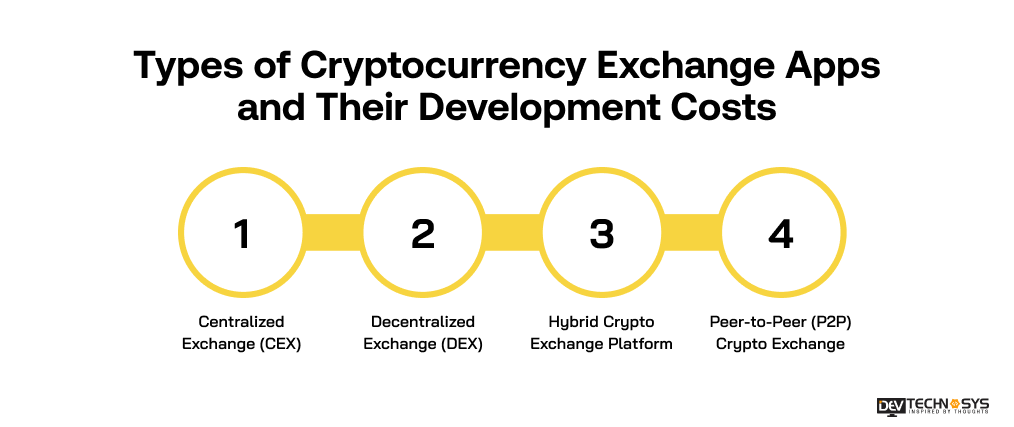
Types of Cryptocurrency Exchange Apps and Their Development Costs
Cryptocurrency exchange apps are built in different models depending on control, architecture, liquidity handling, and user experience. Each type requires a different technical stack and directly affects the overall cost to build a cryptocurrency exchange app, depending on scalability and security needs.
1. Centralized Exchange (CEX)
A centralized exchange is controlled by a single authority that manages trading, liquidity, and user data in one system. It offers fast transactions, high liquidity, and an easier user experience but requires strong backend security and compliance systems. Many businesses consult a mobile app development company to design a scalable, centralized exchange architecture for global users. The cost to create a cryptocurrency exchange app as a CEX is given below.
| Level | Features | Cost Contribution |
| Basic CEX | Simple trading, admin panel, wallet | $4,000 – $6,000 |
| Standard CEX | Order book, KYC, analytics | $6,000 – $10,000 |
| Advanced CEX | High liquidity, margin trading, scaling system | $10,000 – $14,000 |
2. Decentralized Exchange (DEX)
A decentralized exchange operates without a central authority and uses smart contracts to execute trades directly between users. It ensures transparency and user control over assets but requires advanced blockchain engineering and security architecture. Developers often rely on cryptocurrency exchange app development services to implement secure smart contract-based trading systems.
Level |
Features |
Cost Contribution |
| Basic DEX | Simple swap system, wallet connect | $5,000 – $7,000 |
| Standard DEX | Liquidity pools, smart contracts | $7,000 – $11,000 |
| Advanced DEX | Cross-chain swaps, advanced DeFi features | $11,000 – $15,000 |
3. Hybrid Crypto Exchange Platform
A hybrid crypto exchange combines centralized speed with decentralized transparency, offering a balanced trading experience. It requires dual architecture handling both on-chain and off-chain transactions, making development more complex. Many startups choose a cryptocurrency exchange app development solution to properly integrate hybrid systems with scalable infrastructure
Level |
Features |
Cost Contribution |
| Basic Hybrid | Basic trading + partial decentralization | $6,000 – $9,000 |
| Standard Hybrid | Dual system integration, wallets | $9,000 – $13,000 |
| Advanced Hybrid | Full hybrid architecture, high scalability | $13,000 – $18,000 |
4. Peer-to-Peer (P2P) Crypto Exchange
A peer-to-peer crypto exchange costs allow users to trade directly without intermediaries,s using escrow systems for security. It reduces dependency on centralized control but requires strong dispute management and fraud prevention systems. To scale such platforms efficiently, businesses often explore on-demand app development for faster deployment and flexible architecture.
Level |
Features |
Cost Contribution |
| Basic P2P | Direct user trading, basic escrow | $3,000 – $5,000 |
| Standard P2P | Ratings, dispute system, chat | $5,000 – $8,000 |
| Advanced P2P | AI fraud detection, global scaling | $8,000 – $11,000 |
Cost Comparison of Popular Cryptocurrency Exchange Platforms
Understanding real-world platforms helps estimate the cost to develop a cryptocurrency exchange app and the overall crypto trading platform development cost more accurately. Top cryptocurrency exchange apps in Middle East require different levels of scalability, compliance, and infrastructure, which directly affects the cost to develop a cryptocurrency exchange app in 2026.
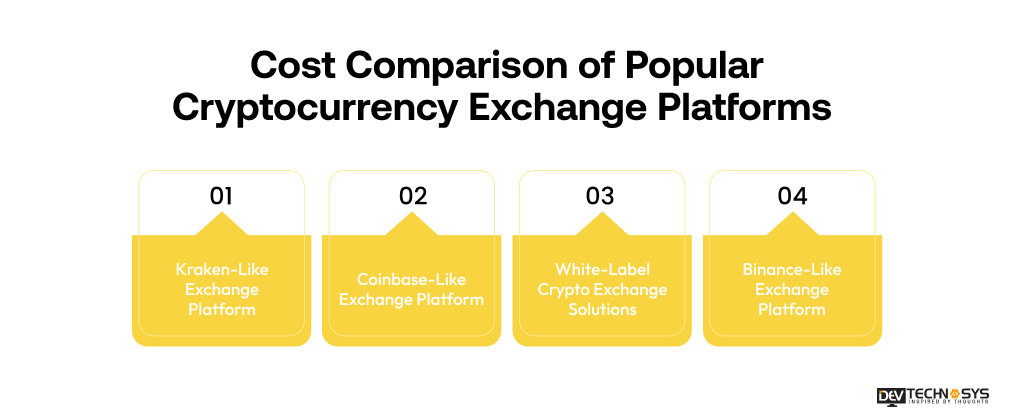
1. Kraken-Like Exchange Platform
Kraken-like platforms are known for strong security systems, advanced trading tools, and institutional-grade performance. They require robust backend architecture, encryption layers, and real-time risk management systems. This complexity increases the overall cost to build a cryptocurrency exchange app, especially when scaling for global users.
Level |
Features |
Cost Contribution |
| Basic Version | Trading engine, wallet | $7,000 – $9,000 |
| Standard Version | Margin trading, charts, APIs | $9,000 – $13,000 |
| Advanced Version | Institutional trading, high security | $13,000 – $18,000 |
2. Coinbase-Like Exchange Platform
A Coinbase-like exchange focuses on simplicity, regulatory compliance, and a beginner-friendly trading experience. It supports easy crypto buying and selling with strong identity verification systems. This model reduces the cost to develop a cryptocurrency exchange app compared to high-frequency trading platforms while maintaining a secure and scalable architecture.
| Level | Features | Cost Contribution |
| Basic Version | Simple buy/sell, wallet | $6,000 – $8,000 |
| Standard Version | KYC, charts, payment integration | $8,000 – $12,000 |
| Advanced Version | Institutional features, analytics | $12,000 – $16,000 |
3. White-Label Crypto Exchange Solutions
White-label crypto exchange solutions allow startups to launch faster using pre-built frameworks with customization layers. This reduces development time and lowers the cost to create a cryptocurrency exchange app, making it a preferred choice for early-stage businesses entering the crypto market quickly and efficiently.
| Level | Features | Cost Contribution |
| Basic Setup | Pre-built platform, branding | $5,000 – $7,000 |
| Standard Setup | Custom UI, basic integrations | $7,000 – $10,000 |
| Advanced Setup | Scalable white-label system | $10,000 – $14,000 |
4. Binance-Like Exchange Platform
A Binance-like exchange is built for high-frequency global trading with massive liquidity, advanced order matching, and enterprise-grade infrastructure. It requires complex backend systems, real-time data processing, and strong security layers. It significantly increases crypto exchange cost in 2026, and businesses usually consult a cryptocurrency exchange app development company to handle such large-scale architecture and performance demands.
| Level | Features | Cost Contribution |
| Basic Clone | Simple trading, basic UI | $8,000 – $10,000 |
| Standard Clone | Order book, wallets, KYC | $10,000 – $15,000 |
| Advanced Clone | High liquidity, futures, scaling engine | $15,000 – $20,000 |
Why Investing in a Crypto Exchange App is a High-Growth Opportunity in 2026
The demand for digital asset trading is accelerating as global crypto adoption continues to rise, making the cost to build a cryptocurrency exchange app a strategic investment rather than just a development expense. Businesses are entering this space due to strong revenue potential from trading fees, listings, and transaction-based models. In regions like the UAE and MENA, crypto adoption is increasing rapidly, driven by fintech innovation and regulatory openness.
Companies that work with a blockchain development company can accelerate their go-to-market strategy while ensuring secure and scalable architecture. This makes it easier to build a cryptocurrency exchange app platform that are future-ready and profitable in the long term.
Why Proper Budget Planning is Critical for Crypto Exchange App Success
Proper budgeting is essential when estimating the cost to make a cryptocurrency exchange app, because even small changes in features, security layers, or integrations can significantly impact the final development expense. Without clear financial planning, projects often face delays, scope changes, and unexpected technical costs during scaling.
Startups that define an MVP-first approach can better control the MVP cost for a crypto exchange app while validating market demand before full-scale investment. In competitive markets like the UAE and MENA, structured budgeting ensures efficient use of resources and helps businesses avoid overspending while still achieving secure and scalable platform development aligned with long-term growth goals.
Hidden Costs in Crypto Exchange App Development You Should Not Ignore
Hidden costs often increase the cost to build a cryptocurrency exchange app beyond initial estimates, especially when scaling, securing, and maintaining a full trading ecosystem in real-world conditions.
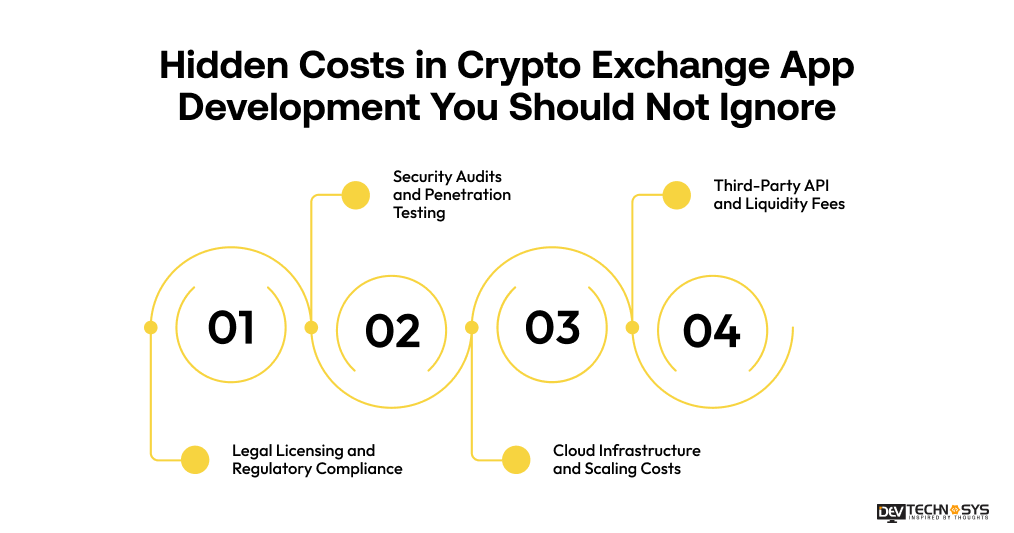
1. Legal Licensing and Regulatory Compliance
Crypto exchanges must comply with regional financial regulations, licensing requirements, and government policies. These legal procedures vary across countries and often require expert consultation, documentation, and approvals. Compliance delays and legal consultations can significantly increase the overall development budget and time-to-market for exchange platforms.
2. Security Audits and Penetration Testing
Security audits ensure the platform is protected against hacking, fraud, and data breaches. Penetration testing, vulnerability assessments, and continuous monitoring are required for safe trading operations. These advanced security layers add additional cost but are essential for protecting user funds and maintaining platform trust and reliability.
Read more: How to Build a Cryptocurrency Exchange App in Middle East?
3. Cloud Infrastructure and Scaling Costs
Crypto exchanges require powerful cloud infrastructure to handle high trading volumes and real-time transactions. As user traffic grows, server scaling, storage expansion, and load balancing increase operational expenses. Poor infrastructure planning can lead to downtime, affecting both performance and long-term platform profitability.
4. Third-Party API and Liquidity Fees
Most exchanges depend on third-party APIs for market data, payment gateways, and liquidity providers. These integrations come with recurring fees and usage-based charges. Over time, these costs increase as transaction volume grows, making them a significant hidden expense in long-term platform operations. This costs are included in cost to maintain an app, which takes about 15% to 20% of the total development cost.

How Long Does It Take to Build a Cryptocurrency Exchange App?
The development timeline of a crypto exchange depends on its complexity, feature depth, and security requirements. In 2026, most platforms follow a structured build approach where timelines increase as functionality, compliance, and scalability needs grow, directly impacting the cost to build a cryptocurrency exchange app.
| Development Level | Description | Estimated Time |
| Basic Exchange | Simple trading system with core features like wallet, login, and basic UI. Ideal for MVP launch and market validation. | 1 – 2 months |
| Mid-Level Exchange | Includes advanced features like KYC/AML, liquidity integration, improved UI/UX, and trading analytics for better user experience and scalability. | 3 – 4 months |
| Advanced Exchange | Enterprise-grade platform with high-frequency trading engine, multi-layer security, advanced APIs, and global scalability infrastructure. | 4 – 6 months |
How to Reduce Cryptocurrency Exchange App Development Cost Without Losing Quality
Reducing the cost to build a cryptocurrency exchange app is possible when development is planned strategically from the beginning. The goal is not to cut essential features but to optimize resources, avoid unnecessary complexity, and focus on scalable architecture that supports long-term growth.
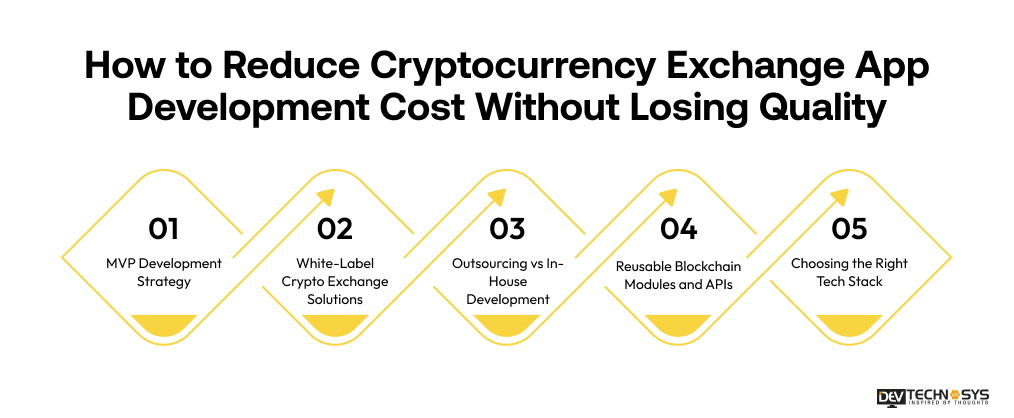
1. MVP Development Strategy
Starting with an MVP helps control initial investment by focusing only on core trading features like user registration, wallet integration, and basic buy/sell functions. This approach reduces the MVP cost for a crypto exchange app while allowing businesses to validate demand before investing in advanced features like margin trading or analytics.
2. White-Label Crypto Exchange Solutions
Using pre-built frameworks significantly reduces development time and cost. White-label systems already include trading engines, wallets, and basic security layers. This reduces the cost of white-label crypto exchange solutions compared to building from scratch, making it ideal for startups entering the market quickly.
3. Outsourcing vs In-House Development
Choosing experienced external teams can reduce hiring, infrastructure, and operational expenses. Many businesses prefer outsourcing to reduce the cryptocurrency exchange app development cost in 2026, while still gaining access to skilled blockchain developers and faster delivery cycles without long-term staffing commitments.
4. Reusable Blockchain Modules and APIs
Using reusable components for wallets, trading engines, and authentication systems avoids rebuilding core functionality from scratch. API-driven development also reduces engineering time and ensures faster deployment while maintaining scalability and security across the platform.
5. Choosing the Right Tech Stack
Selecting the right technology stack directly impacts performance and cost efficiency. Lightweight frameworks, scalable cloud infrastructure, and optimized backend architecture reduce long-term maintenance costs while ensuring high-speed trading performance and system stability under heavy loads.
Monetization Strategies for Cryptocurrency Exchange Apps
Cryptocurrency exchange platforms generate multiple revenue streams that make the cost to build a cryptocurrency exchange app a highly profitable long-term investment. With the rapid adoption of digital assets globally, especially in the UAE and MENA regions, exchanges are becoming full-scale financial ecosystems rather than just trading platforms.
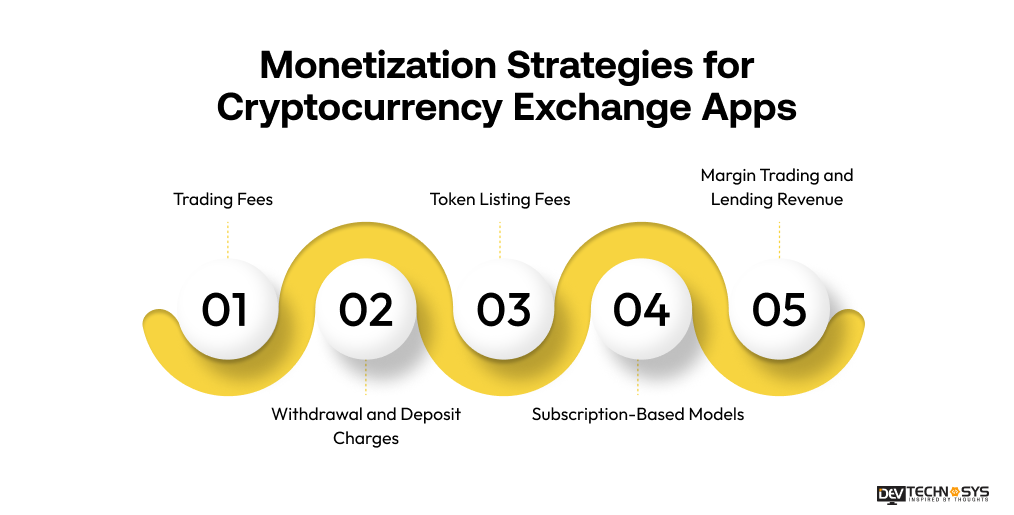
1. Trading Fees
Trading fees are the core revenue model for most cryptocurrency exchanges. Every transaction executed on the platform generates a small percentage-based commission. As trading volume increases, even low fee structures can produce significant revenue. This model scales naturally with user growth and is one of the most reliable income sources for sustaining exchange operations.
2. Withdrawal and Deposit Charges
Withdrawal and deposit fees help exchanges recover blockchain network costs while also generating additional revenue. These charges vary depending on network congestion and asset type. During high-volume trading periods, this becomes a consistent income stream that supports platform maintenance and infrastructure scaling costs.
3. Token Listing Fees
Token listing fees are charged to blockchain projects that want their cryptocurrency listed on the exchange. Established platforms charge higher fees due to credibility and user reach. This revenue stream is especially strong for popular exchanges with high liquidity and global user bases.
4. Subscription-Based Models
Subscription models offer premium access to advanced trading tools, lower fees, analytics dashboards, and priority execution. This creates predictable recurring revenue while improving user retention. Many exchanges use tier-based subscriptions to cater to both retail and professional traders.
5. Margin Trading and Lending Revenue
Margin trading and lending generate income through interest charges on borrowed funds. Users leverage capital to increase trading positions, while exchanges earn from lending fees. This high-margin model significantly boosts profitability for advanced crypto trading platforms with strong liquidity systems.

Final Insights
Building a crypto exchange platform in 2026 is a high-potential opportunity driven by rising global adoption and strong fintech innovation. The cost to build a cryptocurrency exchange app varies based on features, security, and scalability, but strategic planning ensures long-term profitability.
From MVP to enterprise-level systems, businesses can optimize development using modern blockchain frameworks and secure architecture. Partnering with experienced full-stack development services like Dev Technosys, with 15+ years of expertise, helps ensure reliable delivery, compliance, and scalability. With the right approach, crypto exchanges can become powerful revenue-generating digital ecosystems in the evolving financial landscape
FAQs
Q1. What is the MVP Cost for a Cryptocurrency Exchange App?
The MVP cost for a crypto exchange app depends on basic features like wallet integration, user login, and simple trading functions. Typically, the MVP cost for a crypto exchange app ranges from $8,000 to $12,000, allowing startups to validate ideas before investing in full-scale development.
Q2. How Much Does Crypto Wallet Integration Cost?
Crypto wallet integration cost varies based on support for multiple currencies, security layers, and blockchain networks. On average, crypto wallet integration costs range between $1,500 and $4,000, depending on complexity, cold storage features, and whether custodial or non-custodial wallet systems are implemented.
Q3. What is the Cost of KYC/AML Implementation in Crypto Apps?
KYC/AML implementation cost depends on verification depth, third-party APIs, and compliance requirements. The KYC/AML verification system cost usually ranges from $1,000 to $3,500, including identity checks, document verification, and fraud detection systems to ensure regulatory compliance and platform security.
Q4. Can I Build a Crypto Exchange App Using White-label Solutions?
Yes, white-label solutions allow faster deployment with pre-built trading engines and wallets. The cost of white-label crypto exchange solutions is lower than custom development, typically ranging from $5,000 to $14,000, making it ideal for startups aiming for quick market entry with reduced development time.
Q5. What is the Monthly Maintenance Cost of a Crypto Exchange Platform?
Monthly maintenance includes server costs, updates, security patches, and performance optimization. The cost to maintain an app for a crypto exchange usually ranges from $500 to $2,000 per month, depending on traffic, infrastructure scale, and ongoing feature enhancements.