





Key Takeaways:
-
- The market for smart parking systems in the Middle East and Africa is estimated to bring in US$2,412.4 million by 2030.
- The cost to develop a parking app ranges from $8,000 to $25,000, depending on the unique or specific requirements and demands.
- App development requires planning, designing a user-friendly interface, and using real-time GPS and payment integration features.
Have you ever been stuck trying to find parking in an incredibly busy city?
If you’re in the Middle East, and particularly places like Dubai, Riyadh, or Doha, the traffic can be ridiculous, and parking is a huge headache!
That’s why a parking app in 2025 can work so well! With so many people using smartphones and apps, online parking apps have a clear purpose to help drivers search and find empty parking spaces, pay conveniently and save time!
In this blog, we want to guide you through the development of a smart parking app one step at a time. We will talk about app development aspects, tools, design, how parking can make cities smarter, and what will be important to understand if you are passionate about cars and technology or want to simply help other people out!
Let’s take this adventure together!
Market Stats of Parking Apps in Middle East
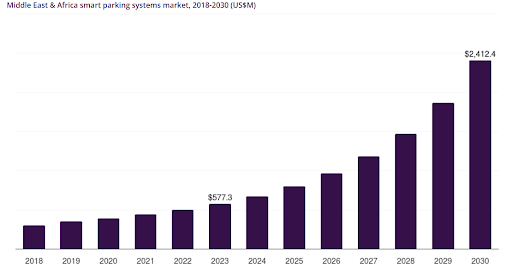
- In 2023, the MEA smart parking systems market brought in USD 577.3 million.
- Between 2024 and 2030, the market is likely to grow at a rate of 22.7% per year.
- According to a study, the hardware segment is one of the most revenue-generating segments in parking applications in 2024.
- The smart parking applications in Middle East are projected to reach around $2,412.4 million by the end of 2030.
- According to the research, the services segment is a fast-growing area in parking applications during the forecast period.
What is Parking App?
A parking app is a mobile application that enables you to find, reserve, and pay for parking spaces in real time. Parking apps offer a variety of features, including location-based searches, availability, prices, electric payment options etc. Some apps like Mawgif, even allow you to navigate to the open parking space and remind you when you have to leave. They are meant to help you save time and minimize your stress when searching for parking spots and are especially useful in crowded urban areas and near activities and venues.
Types of Parking Applications
There are various types of parking applications that provide different features and services as per the specific requirements and needs. So, let’s explore the wide variety of parking applications:
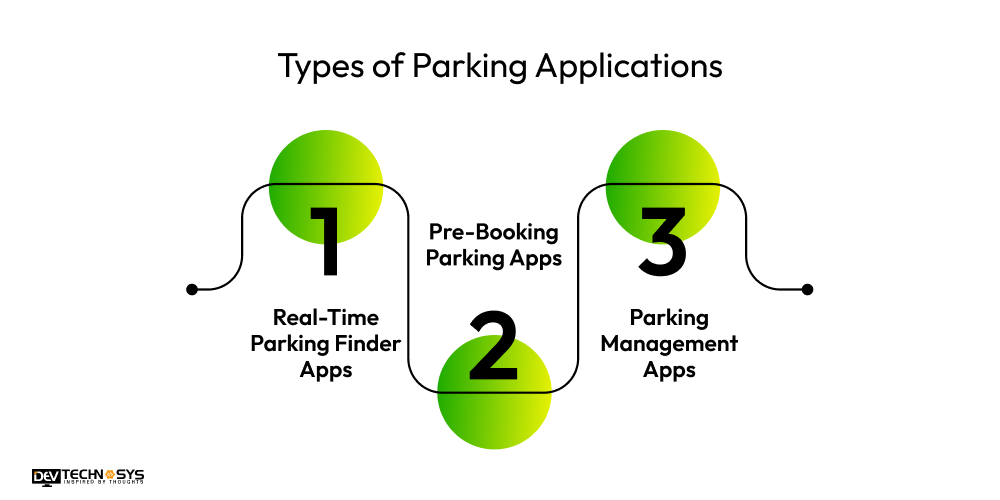
1. Real-Time Parking Finder Apps
These apps help users locate available parking spots instantly using GPS and live data. They display nearby options, pricing, and availability, allowing users to choose and navigate to the best spot without wasting time.
2. Pre-Booking Parking Apps
Pre-booking apps let users reserve parking spaces in advance for specific dates and times. Ideal for airports, events, or busy city areas, these apps ensure availability and convenience, often offering discounted rates and secure, guaranteed parking options.
3. Parking Management Apps
Designed for parking lot owners and administrators, these apps manage space availability, payments, and user access. They streamline operations through automation, generate reports, and improve efficiency, helping businesses optimize revenue and provide a better customer experience.
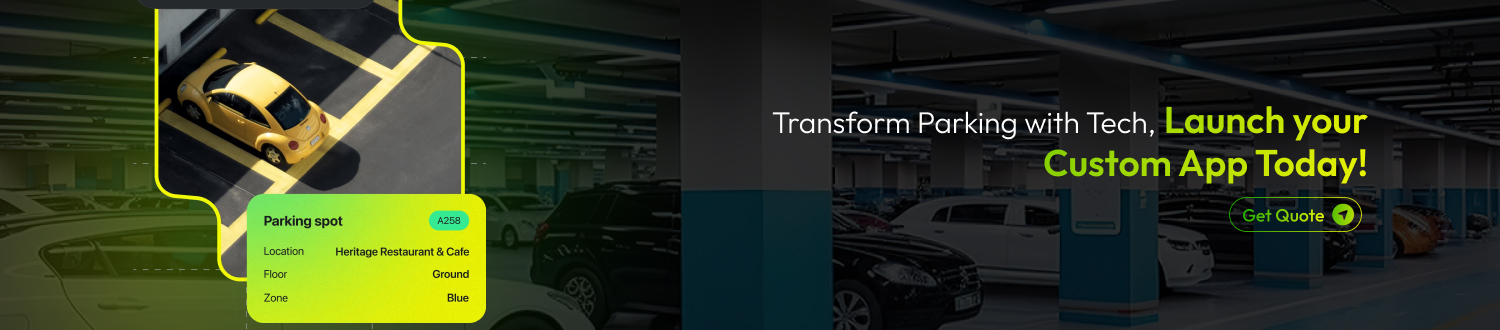
10 Best Parking Apps in Middle East
Do you want to build a parking app with customized features? Then you first observe the top parking apps in Middle East that already have higher success rates and popularity.
App Name |
Launched |
Platforms |
Approx. Downloads |
Ratings |
| Parkopedia | 2007 | iOS, Android | 5M+ | 4.6 |
| JustPark | 2006 | iOS, Android | 1M+ | 4.4 |
| EasyPark | 2001 | iOS, Android | 1M+ | 4.5 |
| ParkMe | 2009 | iOS, Android | 500K+ | 4.2 |
| RTA Smart Parking | 2014 | iOS, Android | 100K+ | 4.6 |
| Waze | 2006 | iOS, Android | 100M+ | 4.4 |
| PayByPhone | 2001 | iOS, Android | 5M+ | 4.1 |
| The Parking Spot | 1998 | iOS, Android | 1M+ | 4.8 |
| Jeeran | 2000 | iOS, Android | 500K+ | 4.3 |
| ZParking | 2017 | iOS, Android | 30K+ | 4.0 |
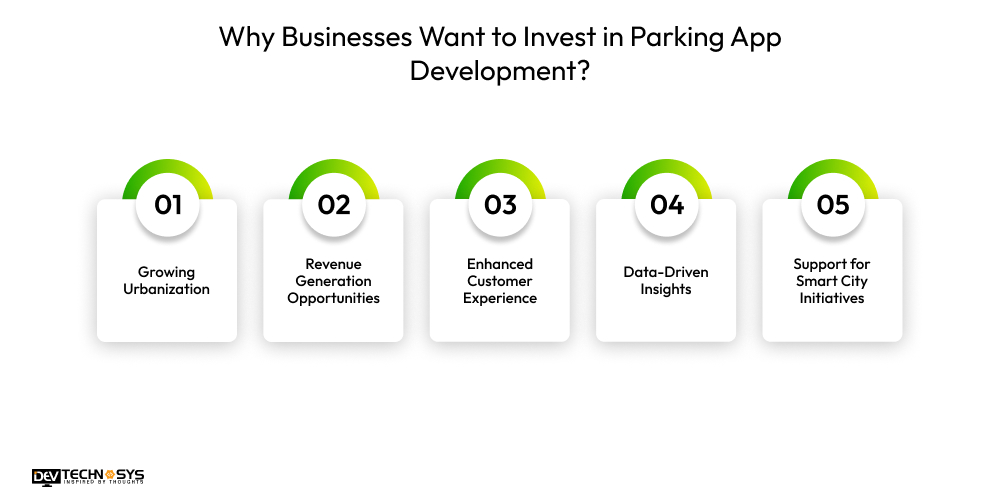
Why Businesses Want to Invest in Parking App Development?
With rising urban traffic and parking challenges, smart parking apps offer a lucrative opportunity. They enhance user convenience, generate steady revenue, provide valuable data insights, and align with smart city goals, making them a smart investment for forward-thinking businesses.
- Growing Urbanization
- Revenue Generation Opportunities
- Enhanced Customer Experience
- Data-Driven Insights
- Support for Smart City Initiatives
1. Growing Urbanization
As cities expand and car ownership rises, parking demand increases. A parking app meets this growing need by offering convenient solutions, helping businesses tap into a profitable, underserved market and provide value to urban commuters searching for efficient parking options.
2. Revenue Generation Opportunities
Parking apps can generate income through subscription models, in-app advertisements, booking fees, and partnerships with parking lot owners. These multiple revenue streams make parking app development a financially attractive investment for businesses looking to diversify and scale.
3. Enhanced Customer Experience
By simplifying the parking process, apps reduce user frustration and save time. Features like real-time availability, digital payments, and navigation improve the overall experience, increasing customer satisfaction and loyalty, key drivers of long-term business growth.
4. Data-Driven Insights
Parking apps collect valuable data on user behavior, location trends, and peak times. According to the Android app development services provider, businesses can analyze this information to improve services, optimize pricing, and make informed decisions.
5. Support for Smart City Initiatives
Investing in a parking app aligns businesses with smart city goals by reducing traffic congestion, lowering emissions, and promoting efficient urban mobility. These contributions can enhance brand image and attract partnerships with municipalities and environmentally conscious organizations.
The Role of AI in Parking Applications
- AI in parking app development helps to optimize parking availability by analyzing real-time data from sensors, cameras, and user inputs to predict open parking spots.
- Machine learning algorithms forecast parking demand patterns, enabling cities and apps to manage space allocation and dynamic pricing effectively.
- AI-powered image recognition identifies license plates automatically, facilitating seamless entry, exit, and automated payments without human interaction.
- Smart routing algorithms guide drivers directly to nearby available parking, reducing congestion, fuel consumption, and time spent searching.
- AI integrates with IoT sensors to monitor parking space occupancy in real-time and relay data instantly to user apps.
- Predictive analytics in AI helps forecast peak parking times, improving city planning and optimizing resource distribution for enforcement.
7 Advanced Steps to Develop a Parking App in Middle East
To create a parking app, you need to observe each development process in depth. From the initial development stage to the final post-maintenance services. So, let’s explore the parking app development process:
- Gather Project Requirements
- Features and Functions
- Tech Stacks
- Design UI/UX
- App Development
- Testing and Security
- Launch and Maintenance
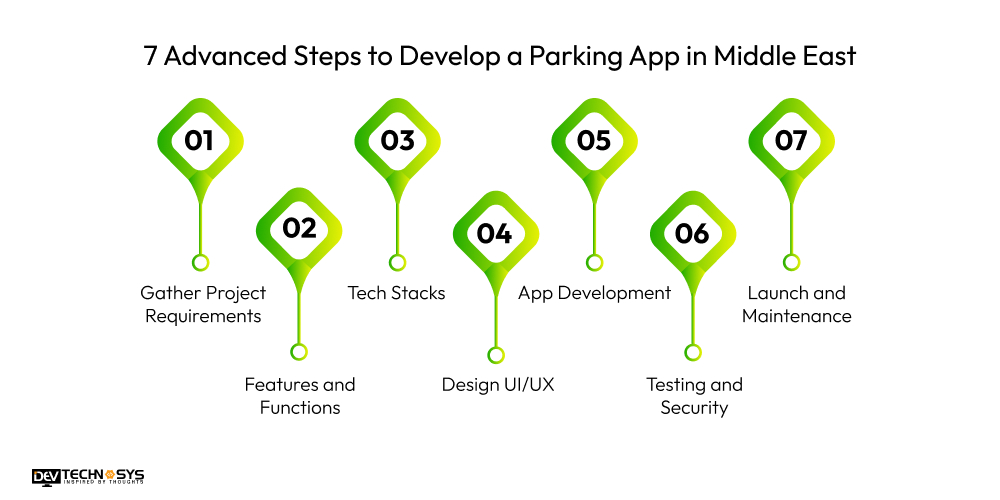
1. Gather Project Requirements
In the first stage to create a parking app, identify the basic and advanced requirements of your project and make a clear and structured sheet. After that, research in this competitive market about existing parking applications to find out their services and working processes. Businesses can make strategies and plans to compete with existing applications and create a future-proof plan for long-term investment.
2. Features and Functions
Let’s start the second step to make a parking app. There are various types of features and functions, but you need to choose specific functionalities. It involves real-time parking availability, a reservation system, dynamic pricing, parking history, wallet management, and smart meter integration. Hire developers from an artificial intelligence development company to identify the primary and secondary users of your project.
3. Tech Stacks
After identifying the project requirements and features, it’s time to select the optimal tech stack for a successful and reliable smart parking software development. There is a wide variety of tech stacks, such as APIs, cloud storage, databases, programming languages, infrastructure, and more. So, choose the best tech stacks as the project requirements and preferences.
4. Design UI/UX
In the fourth stage, to create a parking app, design a user-friendly interface that enables users to easily access all the features and services of the app. There are many paid design tools such as Figma, Sketch, InVision, Marvel, Proto.io, Adobe XD, and many more. You need to make sure that users can navigate all the specifications with just one tap. It includes many design elements such as layouts, templates, themes, navigation bars, and more.
5. App Development
Moving to the fifth stage of parking app development, hire talented mobile app developers from an automobile app development company to begin the real coding. It includes various implementation phases such as third-party tools and applications, modules, functions, and more. Integrate the database to store a huge amount of data for users and admins.
6. Testing and Security
Do you want to publish the app on the live phase directly? No, it’s not the right way. You need to test your application to ensure it works perfectly as you want. Use various types of testing techniques, such as block-box testing, unit testing, functional testing, security testing, and integration testing, and fix bugs if found. Integrate the security measurements to avoid threats, malware, and unauthorized accessibility, which includes firewalls, encryption, authentication, and more.
7. Launch and Maintenance
Finally, launch the parking app on the selected platforms such as Android, iOS, and cross-platforms. You need to hire an expert developer from a parking app development services provider who makes sure all integration phases are successfully deployed. After that, begin the post-maintenance services such as fixing errors and security issues, regular updates, performance optimization, upgrading to the latest OS versions, and adding new services or features.
10 Must-Have Features of Parking Applications
Are you looking to build a unique parking app from others to gain popularity? Then, you need to integrate advanced or specialized features that make it easy for users to navigate within the application. So, let’s explore a wide variety of features:
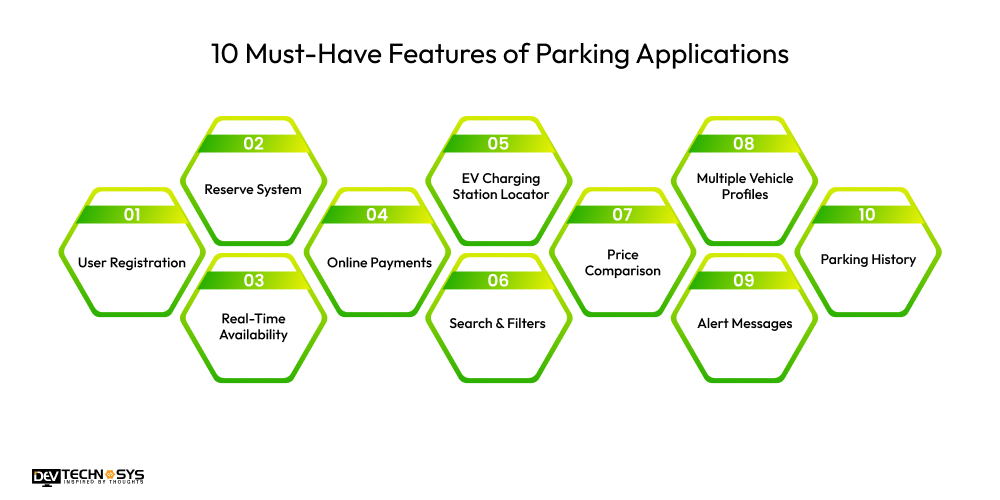
1. User Registration
The parking application enables users to create their own account using phone numbers, official email addresses, social media logins, and other methods.
2. Reserve System
It allows users to book their parking spot in advance for a specific time and duration, which can reduce the stress of parking availability.
3. Real-Time Availability
Users can show the live parking spot availability to instantly book their parking and reduce the searching time.
4. Online Payments
The smart parking apps provide digital payment methods such as debit or credit cards, digital wallets, net banking, and many more.
5. EV Charging Station Locator
With the help of the EV charging station locator feature, users can search nearby stations to charge their vehicle.
6. Search & Filters
An app like Mawgif lets users quickly search for a specific parking spot with the help of filters. It includes location, price, distance, type, and more.
7. Price Comparison
The digital parking system helps users to compare parking prices across different locations and choose the cost-effective parking spot.
8. Multiple Vehicle Profiles
Users can access their multiple vehicle profiles in one account, and different vehicles include bikes and cars.
9. Alert Messages
It sends push notifications to users for real-time parking availability, traffic updates, reservation status, and promotional offers.
10. Parking History
With the help of parking history, users can view their past parking spots and download digital parking receipts for record-keeping.
What is the Average Cost to Build a Parking App in Middle East?
The cost to develop a parking app ranges from $8,000 to $25,000, or approximately 29,000 AED to 91,000 AED. The development cost can be up or down due to major factors such as features, project complexity, infrastructure, development team, deployment platforms, and size. Businesses need to consider these factors to maintain their overall project budget. It also includes extra factors like technologies, designing tools, maintenance, security measurements, testing, and more.
For the detailed explanation, you can look at the cost table:
App Complexity/Type |
Estimated Cost (USD) |
Key Features Included |
| Basic MVP | $8,000 – $10,000 | Spot locator, static map, user login/registration |
| Essential Features | $10,000 – $12,000 | Real-time availability, search filters, improved UI |
| Payment Ready | $12,000 – $15,000 | In-app payments, basic booking, push notifications |
| Reservation System | $15,000 – $18,000 | Pre-booking, parking history, multi-vehicle support |
| Business Dashboard | $18,000 – $20,000 | Admin panel, dynamic pricing, rewards, user reviews |
| Navigation Enabled | $20,000 – $23,000 | GPS navigation, EV charging locator, accessibility info |
| Advanced App | $23,000 – $25,000 | LPR integration, offline access, multilingual support, analytics |
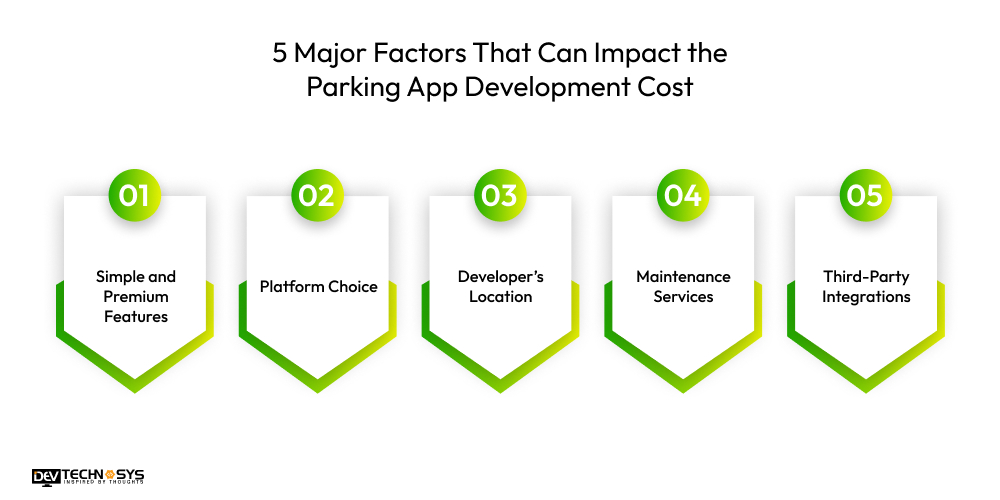
5 Major Factors That Can Impact the Parking App Development Cost
Do you want to develop a parking app within a fixed budget? Then you must observe these cost-affecting factors and make a plan to avoid these factors. Let’s take a look at the crucial factors that highly impact the cost to build a smart parking app:
- Simple and Premium Features
- Platform Choice
- Developer’s Location
- Maintenance Services
- Third-Party Integrations
1. Simple and Premium Features
Businesses integrate simple and premium features, and these features can raise the cost to build a parking app. It includes various types of advanced features such as real-time parking availability, digital payments, a reservation system, price comparison, and parking history. So, these premium features can increase the cost because some features are highly paid for.
Feature Type |
Cost Range (USD) |
Example Inclusions |
| Simple Features | $2,000 – $6,000 | Spot finder, login, static maps, basic UI |
| Moderate Features | $6,000 – $10,000 | Payments, reservations, notifications |
| Premium Features | $10,000 – $15,000 | LPR, dynamic pricing, offline access, analytics |
2. Platform Choice
In the second cost-affecting factor, platform choice is one of the common factors; there are various deployment platforms, but all these costs are different from each other. It includes Android and iOS; developers need to build separate applications for both platforms, which can influence the cost to develop an app for smart parking.
Platform |
Cost Range (USD) |
Notes |
| Android Only | $4,000 – $8,000 | Lower cost, larger user base in Middle East |
| iOS Only | $4,500 – $9,000 | Slightly higher due to App Store requirements |
| Cross-Platform | $8,000 – $12,000 | Built using Flutter/React Native, more efficient |
| Both Native | $12,000 – $18,000 | Best performance, highest cost |
3. Developer’s Location
Moving to the third factor, development team location can be another major cost-affecting factor. There are various regions or locations that have higher living standards as compared to other regions, such as Europe and the USA. Due to higher living costs, developers demand higher salaries. In Asia-specific regions, developers are ready to work at an average cost, because living costs are low compared to high-tech countries or regions.
Developer Region |
Cost Range (USD) |
Hourly Rate (Est.) |
| South Asia (India) | $3,000 – $8,000 | $15 – $30/hr |
| Middle East (UAE, Egypt) | $6,000 – $12,000 | $30 – $50/hr |
| Eastern Europe | $8,000 – $14,000 | $40 – $60/hr |
| Western Europe/North America | $12,000 – $25,000 | $60 – $80/hr |
4. Maintenance Services
In the post-launch maintenance services, these are very important for maintaining the app’s scalability and performance. It includes various types of maintenance services such as upgrading OS versions, fixing bugs or glitches, performance optimization, adding new enhancements, regular updates, and more. So, these advanced maintenance services can increase the cost to maintain an app.
Maintenance Scope |
Annual Cost Estimate (USD) |
Coverage |
| Basic Bug Fixes | $1,000 – $2,000 | Minor fixes, crash resolution |
| Moderate Maintenance | $2,000 – $4,000 | Feature updates, OS support |
| Full Support Plan | $4,000 – $6,000 | 24/7 support, major updates, server costs |
5. Third-Party Integrations
There are many third-party tools and applications that are necessary to integrate into the application. It includes payment gateways, social media logins, analytics, CRM system, maps & navigation, geofencing, EV charging networks, and authentication. These third-party platforms have higher licensing fees and take more time to implement into the application, so they can influence the overall project budget.
Integration Level |
Cost Range (USD) |
Example Tools |
| Basic | $500 – $1,500 | Google Maps, Firebase Auth |
| Moderate | $1,500 – $3,000 | Payment gateways, notifications |
| Advanced | $3,000 – $5,000+ | LPR, IoT sensors, EV locators |
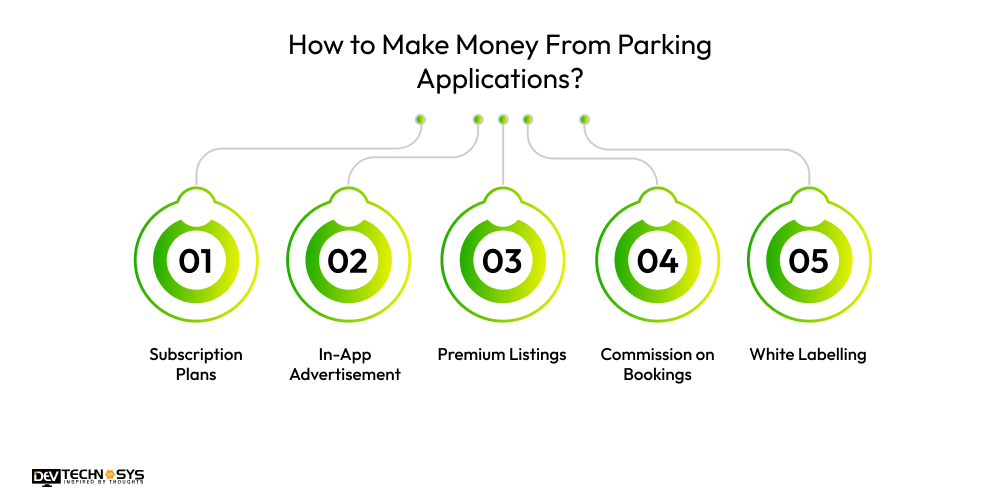
How to Make Money From Parking Applications?
There are various types of money-making strategies that help businesses generate higher profits, thereby increasing their overall business valuation. So, let’s explore the best monetization models:
- Subscription Plans
- In-App Advertisement
- Premium Listings
- Commission on Bookings
- White Labelling
1. Subscription Plans
The parking applications offer paid subscription plans such as basic, premium, and enterprise to access the unlimited features and services of the app. Users need to purchase the paid subscription plan to access rich functionality like real-time parking availability, a reservation system, digital payments, and more.
2. In-App Advertisement
Businesses can allow third-party organizations or agencies to display their product and services within their platform. There are various advertisement formats available, such as banner, native, image, display, and pop-up window ads. So, businesses can charge a fee of around 7% to 10% of each advertisement.
3. Premium Listings
In the third money-making technique, parking apps offer premium listings for parking owners to list their parking spaces, allowing them to attract more users. These listings are viewed as a featured list and top of the search list; businesses can charge an extra fee of around 10% to 12%.
4. Commission on Bookings
Moving to the fourth money-earning strategy, commission on booking is one of the most common and used ways to generate higher revenue streams. Allow related businesses or agencies to offer parking spots to users through your platform. According to the iOS app development company in UAE, you can charge a commission on each booking.
5. White Labelling
Connect to the last profit-generating technique, you can sell your existing or pre-made parking solution to other companies and they can also sell under their own name. So, you can charge a higher cost to them, it can be a major revenue-generating stream, and this can boost the overall valuation of the business.

Conclusion
We are standing at the last stage of this blog. We discussed in detail how to develop a parking app in the Middle East and how it can present a significant opportunity for change. It includes various types of advanced features like online parking booking, real-time parking availability, and more, it can attract more users. As per the market analysis, it is rapidly growing and expanding to a global audience.
Are you looking to develop a parking app? Then just share your project requirements with the leading mobile app development company in UAE at a lower cost.
Frequently Asked Questions
1. How Much Does it Cost to Develop a Parking App in Middle East?
The cost to build a parking app is around $8,000 to $25,000, depending on the features, functions, complexity, size, developers’ location, deployment platforms, tech stacks, designing tools, and more.
2. How Long Does it Take to Create a Parking App in Middle East?
To create a parking app, it basically takes around 5 to 10 weeks. There are various reasons that can increase the development timeline, such as project complexity, the number of features, and developers’ working hours.
3. What Technologies Are Used to Make a Parking App in Middle East?
There are various technologies used to make a parking app in Middle East:
- Java
- Python
- C++
- C#
- PHP
4. How Much Does it Cost to Hire Developers to Build a Parking App?
The professional parking app developers for hire are around $15 to $25 per hour. The hiring cost can be influenced due to various factors such as experience level, project complexity, rich skill set, and the developer’s location.
5. What Are the Challenges Faced During Parking App Development in UAE?
Here, we provide the list of challenges:
- Higher Operational Cost
- Multilingual User Base
- Local Law Regulations
- Payment Gateway Compliance
- Real-Time Accuracy