




Key takeaways:
- Building an OTT app typically costs $30,000 to $90,000+, depending on platform complexity, features, streaming infrastructure, DRM, integrations, and supported devices.
- The UAE video streaming market generated $2.20 billion in revenue in 2024 and is projected to reach $7.17 billion by 2030, growing at a 21.8% CAGR from 2025 to 2030.
- Successful OTT development requires a structured process covering discovery, strategy and architecture, UI/UX design, platform development, streaming integrations, testing, and deployment.
- Features such as DRM, adaptive streaming, CDN integration, multilingual support, analytics, and scalable cloud infrastructure are essential for delivering secure and reliable experiences across mobile, web, and Smart TV platforms.
Streaming is no longer limited to watching content on third-party platforms. Businesses across entertainment, media, sports, and other industries are building their own digital ecosystems to control content, strengthen audience relationships, and create recurring revenue.
But launching a successful streaming platform takes far more than adding videos to an app. You need the right OTT architecture, seamless playback, engaging features, strong content protection, scalable infrastructure, and a monetization strategy that fits your audience.
This OTT app development guide walks you through everything that matters, from the development process and must-have features to technology, streaming architecture, security, development costs, and revenue models. Whether you are planning a new OTT product or upgrading an existing platform, this guide will help you understand what it takes to build one that can scale.
What Is OTT App Development and How Does It Work?
OTT platform development involves building a platform that delivers video content directly to users over the internet. Unlike traditional television distribution, OTT platforms give businesses greater control over their content, audience, branding, and monetization.
How Does an OTT App Work?
The basic OTT delivery process follows these steps:
- Content Upload
Businesses upload movies, shows, live programs, or other video content through a content management system. - Video Encoding and Transcoding
The uploaded content is converted into multiple formats and quality levels so it can play smoothly across different devices and networks. - Cloud Storage
Processed video files are stored securely in cloud infrastructure, allowing the platform to manage and scale large content libraries. - CDN Distribution
A content delivery network distributes video content from optimized locations, helping users across the UAE and other markets access streams with lower latency. - User Request
When a viewer selects content, the OTT application communicates with the backend to verify access, subscription status, and content permissions. - Video Streaming
The platform delivers the requested content using streaming technologies such as HLS or MPEG-DASH. Adaptive bitrate streaming adjusts video quality based on the user’s connection. - Playback and Analytics
The viewer watches the content while the platform collects performance and engagement data to improve playback, recommendations, and content strategy.
This workflow makes a video streaming app development solution a combination of content management, streaming infrastructure, user experience, security, and scalable backend systems.
What Are the Different Types of OTT Apps?
OTT platforms can serve different content formats and business models. Choosing the right type depends on your audience, content strategy, and revenue goals.
- Video-on-demand OTT apps: Let users watch movies, shows, documentaries, or other content whenever they choose. This model is common for subscription and transaction-based platforms.
- Live TV streaming apps: Deliver scheduled television channels, news, sports, and live entertainment over the internet. They are suitable for broadcasters and media businesses moving toward digital distribution.
- Live streaming platforms: Focus on real-time events, including sports, concerts, webinars, and interactive broadcasts. These platforms require reliable streaming infrastructure and low-latency delivery.
- Hybrid OTT platforms: Combine live and on-demand content with subscription, advertising, or pay-per-view options, giving businesses greater flexibility in monetization.
- Enterprise video streaming platforms: Enable organizations to securely distribute training, corporate communications, events, and internal video content to employees or selected audiences.
OTT Streaming Market Statistics in UAE and Globally
The UAE streaming market is expanding across video, live streaming, infrastructure, and software. According to Grand View Research, the latest 2025 market data highlights the growing scale of the streaming ecosystem in the UAE and worldwide.
- The UAE live streaming market is projected to grow from $2.69 billion in 2025 to $15.16 billion by 2033, at a CAGR of 24.96%, highlighting the growing demand for digital video experiences.
- Video streaming accounted for 83.89% of UAE live streaming market revenue in 2025, making it the dominant segment for businesses developing consumer-focused streaming platforms.
- The UAE live streaming infrastructure market is expected to grow from $173.8 million in 2025 to $440.2 million by 2033, reflecting rising demand for scalable streaming infrastructure and reliable content delivery.
- The UAE free ad-supported streaming TV market is projected to increase from $209.4 million in 2025 to $647.8 million by 2033, creating more opportunities for advertising-based OTT monetization.
- The UAE live streaming market represented 2.3% of the global live streaming market in 2025, demonstrating the country’s growing position within the wider digital streaming ecosystem.
Answer a few quick questions and our experts will share a tailored project estimate.
7 Steps For OTT App Development In UAE
Building an OTT platform requires more than developing a mobile or web application. This OTT app development guide follows a practical seven-step approach. Here is a practical seven-step approach for businesses planning to build a video streaming app for UAE and international audiences.

1. Discovery & Requirement Analysis
The process starts by defining your target audience, content strategy, business goals, supported platforms, and core user journeys. The development team evaluates whether you need a live streaming app, video-on-demand platform, or hybrid OTT solution. Functional requirements, integrations, security needs, and scalability expectations are also documented.
2. OTT Strategy & Architecture Planning
Next, the team defines the technical and business architecture of the platform. This includes selecting the monetization model, cloud infrastructure, database, CDN, streaming protocols, and security framework. Businesses can also study established regional platforms when planning to build an OTT app like STC TV, while creating a distinct content and user experience strategy.
3. UI/UX Design
Designers create wireframes and interactive prototypes for the app, website, smart TV interface, and other supported platforms. Navigation, content discovery, video playback, personalization, multilingual experiences, and accessibility are optimized to make streaming simple and engaging.
4. OTT Platform Development
Developers then build the frontend, backend, APIs, content management system, user accounts, subscription features, admin dashboard, and analytics modules. A scalable architecture helps the platform support growing content libraries and audiences.
5. Streaming & Third-Party Integrations
The platform is connected with CDN services, payment gateways, DRM providers, cloud storage, video encoding tools, authentication systems, analytics platforms, and notification services. These integrations create a complete streaming ecosystem.
6. Testing & Performance Optimization
The application is tested across devices, operating systems, browsers, screen sizes, and network conditions. Teams validate playback quality, loading speed, security, API performance, and scalability while identifying issues before launch.
7. Deployment & Launch
Finally, the OTT platform is deployed to production environments and submitted to relevant app stores. Monitoring, analytics, crash reporting, performance tracking, and post-launch improvements help maintain reliable streaming as the user base grows.
What Features Should An OTT App Have?
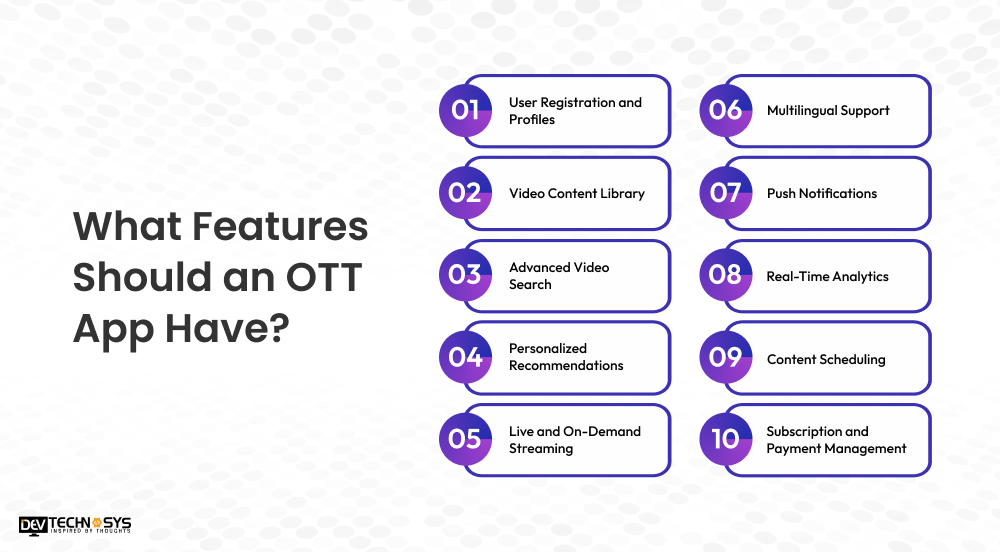
A well-planned feature set is at the heart of any OTT app development guide, helping UAE businesses create engaging streaming experiences across smartphones, web browsers, smart TVs, and connected devices. Businesses looking to build a video streaming app like Watch IT can combine these capabilities with personalized experiences, strong content discovery, and scalable streaming infrastructure to create a more engaging platform.
1. User Registration And Profiles
Allow users to create accounts, manage preferences, and maintain individual profiles for personalized viewing experiences. Multiple profiles can also help families or shared accounts maintain separate recommendations and watch histories.
2. Video Content Library
Organize movies, shows, documentaries, sports, and other content with categories, metadata, thumbnails, and availability controls. A structured library makes content easier to manage while helping viewers discover relevant titles quickly.
3. Advanced Video Search
Help users quickly find specific titles, genres, actors, languages, or categories through intelligent search and filtering. Suggestions, filters, and keyword-based results can reduce the time users spend looking for content.
4. Personalized Recommendations
Use viewing behavior and preferences to suggest relevant content and increase engagement. Recommendation engines can highlight similar titles, new releases, and content that matches individual viewing patterns.
5. Live And On-Demand Streaming
Support scheduled live content and on-demand video streaming so businesses can serve different viewing preferences. Users can watch live sports and events while also accessing movies, series, and recorded programs whenever they choose.
6. Multilingual Support
Offer Arabic and English interfaces, subtitles, and localized content to serve diverse audiences in the UAE and wider MENA region. Language preferences can also be linked to user profiles for a more personalized experience.
7. Push Notifications
Notify users about new releases, live events, subscription updates, and personalized content recommendations. Timely notifications can bring viewers back to the platform without disrupting their overall experience.

8. Real-Time Analytics
Track viewing time, engagement, retention, content performance, and user behavior to support data-driven decisions. These insights can help businesses understand audience preferences and identify opportunities to improve content and engagement.
9. Content Scheduling
Allow administrators to schedule upcoming videos, live broadcasts, premieres, and regional content releases. Scheduling tools also help content teams manage publishing workflows and maintain a consistent release calendar.
10. Subscription And Payment Management
Support subscription plans, free trials, secure payments, renewals, and account management through a centralized system. Flexible billing options can help businesses serve different customer segments and create recurring revenue streams.
What Technology Stack Is Used for OTT App Development?
The technology stack determines how well an OTT platform performs, scales, and handles growing video libraries and audiences. A practical OTT app development guide should consider every technical layer, from the user interface and backend to video processing, cloud infrastructure, and secure content delivery.
For UAE businesses, a scalable video streaming infrastructure is particularly important when serving audiences across multiple locations and devices.
A microservices architecture can separate core services for easier scaling, while serverless components can reduce infrastructure management for selected workloads.
The stack should also support CDN integration, video encryption, analytics, and third-party APIs. The final technology choices should depend on the platform’s expected audience, content volume, supported devices, performance requirements, and long-term growth strategy.
Technology layer | Recommended technologies | Purpose | OTT application |
| Frontend | Flutter, React Native, React.js | Builds responsive interfaces across devices | Mobile apps, web platforms, smart TV interfaces |
| Backend | Node.js, Python, Java | Handles business logic, APIs, and user requests | Profiles, subscriptions, content management |
| Database | PostgreSQL, MongoDB | Stores structured and unstructured data | User data, content metadata, viewing history |
| Cloud infrastructure | AWS, Google Cloud, Azure | Provides scalable computing and storage | Cloud-based OTT platform and content hosting |
| Video processing | FFmpeg, cloud transcoding | Encodes and converts video into multiple formats | Multi-quality playback and adaptive streaming |
| Streaming protocols | HLS, MPEG-DASH | Delivers video efficiently to supported devices | Live and on-demand streaming |
| CDN | CloudFront, Cloudflare, Akamai | Distributes content closer to viewers | Faster playback and reduced buffering |
| Authentication | JWT, OAuth 2.0 | Secures user access and sessions | Login, authorization, and protected content |
| Storage | Amazon S3, Google Cloud Storage | Stores large media files securely | Video libraries, thumbnails, subtitles, and assets |
How To Secure an OTT App and Protect Video Content?
Security should be planned from the first stage of OTT development rather than added after launch. Hiring experienced mobile app development services can help UAE businesses address authentication, encryption, content protection, secure APIs, and platform-specific security requirements before vulnerabilities become costly problems.
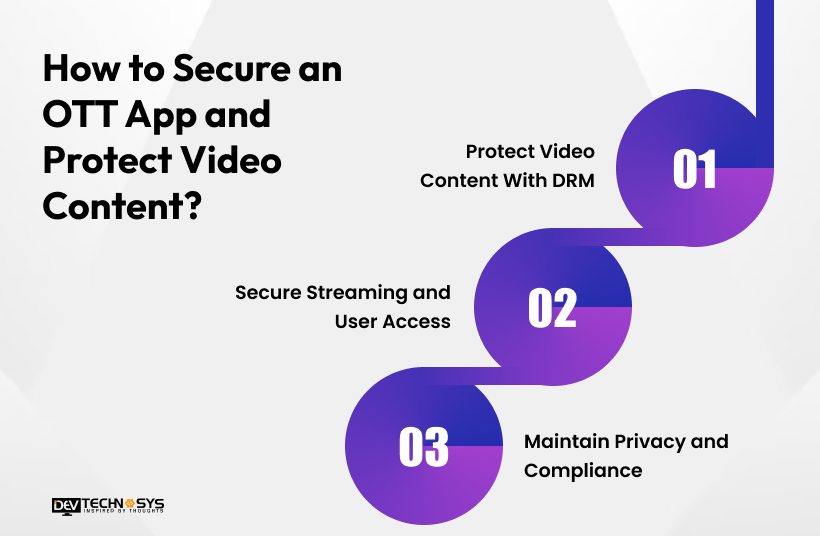
1. Protect Video Content With DRM
Digital Rights Management (DRM) helps control who can access and play premium video content. Multi-DRM integration can combine Widevine DRM, Apple FairPlay Streaming, and Microsoft PlayReady to support different devices and operating systems. It can also help reduce unauthorized access, screen capture risks, and content redistribution.
2. Secure Streaming And User Access
A secure OTT platform should use video encryption and AES encryption to protect content during delivery and storage. JWT authentication and OAuth 2.0 can secure user sessions and API access, while token-based authorization can restrict protected streams to eligible users. Rate limiting, secure payment processing, and regular vulnerability testing further strengthen OTT app security.
3. Maintain Privacy And Compliance
OTT platforms collect account details, viewing activity, payment information, and other user data, making data privacy compliance essential. UAE businesses should consider applicable requirements under the UAE Personal Data Protection Law, which establishes protections around personal data processing and confidentiality. Platforms serving users covered by GDPR should also address lawful processing, purpose limitation, data minimization, security, and user consent management.
How Much Does OTT App Development Cost?
The OTT app development cost typically ranges from $30,000 to $90,000+. The final investment depends on the platform’s complexity, supported devices, streaming infrastructure, content protection, integrations, and monetization requirements. Businesses in the UAE should also consider post-launch infrastructure and maintenance expenses when planning their overall OTT budget. OTT App Development Cost Breakdown

The overall investment varies based on platform complexity, features, integrations, and scalability requirements. Here is a practical cost breakdown:
OTT app type | Estimated development cost | Typical inclusions |
| Basic OTT app | $30,000–$45,000 | VOD, user accounts, CMS, basic search, and essential monetization |
| Mid-level OTT platform | $45,000–$70,000 | Multi-platform support, subscriptions, analytics, personalization, and advanced content management |
| Advanced OTT platform | $70,000–$90,000+ | DRM, AI-powered recommendations, scalable streaming infrastructure, Smart TV support, and complex integrations |
What Factors Affect OTT App Development Cost?
Several factors can influence the final development budget:
- Number of platforms: Building for iOS, Android, web, Smart TVs, and connected devices requires additional development and testing.
- Feature complexity: Personalization, advanced search, analytics, subscription management, live streaming, and content scheduling increase development effort.
- Streaming infrastructure: Cloud hosting, video encoding, transcoding, CDN usage, and storage requirements affect both development and operational expenses.
- Content protection: DRM, encryption, secure playback, and anti-piracy measures add technical and licensing costs.
- Third-party integrations: Payment gateways, analytics tools, authentication services, advertising platforms, and external APIs can increase implementation complexity.
- UI/UX requirements: Custom interfaces, multilingual experiences, accessibility, and device-specific designs require additional design and development work.
- Development team: Team size, technical expertise, project complexity, and development location can significantly influence the overall budget.
Maintenance And Ongoing OTT App Costs
Launching the platform is only the beginning. Regular maintenance helps keep the application secure, compatible, and reliable as devices, operating systems, streaming technologies, and user expectations evolve.
Typical ongoing expenses can include bug fixing, security updates, cloud infrastructure, CDN and storage usage, video processing, DRM licensing, performance monitoring, and feature enhancements. Businesses can also review mobile app development costs to understand how broader mobile development and ongoing technical requirements can contribute to their overall digital product budget.
What Are The Hidden Costs Of OTT App Development?
The initial development budget does not always represent the complete investment required to operate an OTT platform. Businesses should account for recurring technical, infrastructure, and service-related expenses that can influence the total cost of ownership. Comparing it with broader video streaming app development costs can also help businesses understand where ongoing expenses may arise.

1. Cloud Hosting And Video Storage
OTT platforms require substantial storage for movies, shows, live recordings, thumbnails, subtitles, and other media assets. Cloud hosting costs can increase as the content library and number of users grow.
2. CDN, Bandwidth, and Video Processing
Every stream consumes bandwidth, while video encoding and transcoding may be required to create different quality levels and formats. CDN usage can therefore become a significant recurring expense as viewing hours increase.
3. DRM and Third-Party Services
Premium content may require DRM licensing, while payment gateways, authentication providers, analytics tools, advertising services, and other APIs can involve subscription or transaction-based charges.
4. Maintenance, Security And Updates
Ongoing maintenance is essential for fixing bugs, improving performance, updating dependencies, maintaining device compatibility, and addressing security vulnerabilities. Businesses should also budget for new features, compliance updates, and infrastructure optimization as the platform evolves.
How To Reduce OTT App Development Costs?
Building an OTT platform does not always require a large upfront investment. A focused development strategy can help businesses control expenses while creating a foundation that can scale as the audience and content library grow.

1. Start With an MVP
Begin with essential features such as user accounts, content management, video playback, search, and basic monetization. Once the platform gains traction, advanced features can be introduced based on actual user demand.
2. Prioritize High-Value Features
Not every requested feature needs to be included at launch. Prioritize capabilities that directly support viewing, engagement, monetization, and content management, while postponing lower-priority functionality.
3. Use Cross-Platform Development
For suitable OTT projects, technologies such as Flutter or React Native can reduce the effort required to build separate mobile applications. This can help streamline development while maintaining a consistent user experience.

4. Leverage Managed Cloud Services
Managed cloud infrastructure, storage, transcoding, CDN, and analytics services can reduce the need to build and maintain complex systems internally. Businesses can also scale resources based on actual traffic and content consumption.
5. Choose Proven Third-Party Integrations
Payment gateways, authentication providers, DRM solutions, analytics tools, and communication services can often be integrated instead of developed from scratch. This reduces development effort and can shorten the launch timeline.
6. Plan For Scalability From The Start
A scalable architecture may require more planning initially, but it can prevent expensive redevelopment when user numbers increase. Cloud-ready infrastructure, modular services, and efficient streaming architecture make future expansion easier and more predictable.
How Do OTT Apps Make Money?
Choosing the right monetization model is essential for turning an OTT platform into a sustainable digital business. Businesses investing in live video streaming app development can combine subscription, advertising, transaction, and premium content models based on their audience, content catalog, and viewing behavior.

1. Subscription Video On Demand (SVOD)
SVOD allows users to pay a recurring fee for access to a broader content library. Businesses can offer monthly, quarterly, or annual plans with different content tiers, quality options, or device limits. This model creates predictable recurring revenue and works well for platforms with regularly updated content.
2. Advertising Video On Demand (AVOD)
AVOD gives users free or low-cost access to content while generating revenue through advertisements. Businesses can place ads before, during, or after videos and use audience data to deliver more relevant advertising. This model can help platforms grow their user base while monetizing high viewing volumes.
3. Transactional Video On Demand (TVOD)
TVOD charges users for individual movies, shows, live events, or premium releases instead of requiring a recurring subscription. It can work well for exclusive premieres, sporting events, concerts, and other content with strong one-time demand.
4. Hybrid Monetization
A hybrid model combines subscriptions, advertising, pay-per-view, or premium purchases within one platform. For example, a business can offer an ad-supported free tier alongside paid plans that provide an enhanced viewing experience.
Conclusion
Building an OTT platform requires a careful balance of user experience, streaming performance, security, scalability, and monetization. From choosing the right features and technology stack to protecting premium content and managing infrastructure costs, every decision can influence long-term platform success.
For UAE businesses, starting with a focused MVP can provide a practical way to validate the market before expanding into advanced streaming capabilities, Smart TV support, personalization, and large-scale content delivery. Partnering with an experienced OTT app development company can also help turn your concept into a secure, scalable, and commercially viable streaming platform.
This OTT app development guide gives businesses a practical foundation for planning the right technology, features, budget, and development strategy before entering the competitive streaming market.
FAQs
1. How Much Does It Cost to Develop an OTT App?
The cost to develop an OTT app generally ranges from $30,000 to $90,000+. The final investment depends on features, supported platforms, streaming infrastructure, DRM, integrations, UI/UX complexity, and scalability requirements. Ongoing cloud, CDN, storage, and maintenance expenses should also be included in the overall budget.
2. How Long Does It Take to Develop an OTT App?
An OTT app can take around 4 to 9 months to develop, depending on its complexity and number of platforms. A basic VOD application may require less time, while advanced platforms with live streaming, Smart TV support, DRM, personalization, analytics, and complex integrations require a longer development cycle.
3. How Can an OTT App Protect Video Content?
OTT platforms can protect premium content through Digital Rights Management (DRM), encryption, secure authentication, token-based access, and protected APIs. Multi-DRM solutions such as Widevine, FairPlay, and PlayReady help support secure playback across different devices while reducing unauthorized content access and redistribution.
4. What Monetization Models Can an OTT App Use?
OTT applications can generate revenue through SVOD, AVOD, TVOD, and hybrid monetization models. Businesses can also introduce free trials, premium subscriptions, pay-per-view events, advertising tiers, or exclusive content packages. The best approach depends on audience behavior, content type, competitive positioning, and long-term revenue objectives.
5. What Should Businesses Consider Before Starting OTT Platform Development?
A strong OTT app development guide can help businesses evaluate their target audience, content strategy, supported platforms, streaming infrastructure, security requirements, and monetization model before development begins. Planning these elements early can reduce unnecessary development costs and create a more scalable platform.