




 Tarun Nagar
 Key takeaways:
-
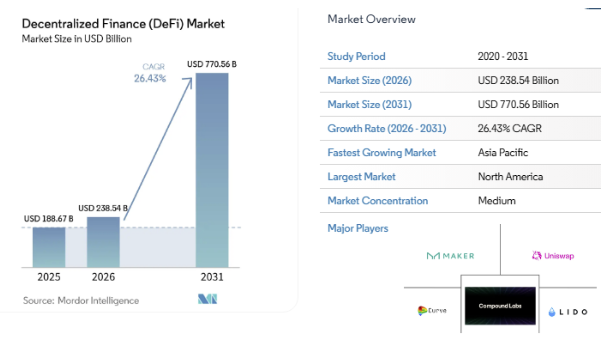
- The Decentralized Finance Market size is projected to reach USD 238.54 billion in 2026 and USD 770.56 billion by 2031.
- The cost to build a Defi app is around $30,000 to $1,50,000+, depending on features and functionalities.
- Startups must comply with data protection laws like GDPR and similar frameworks to safeguard user information, ensure secure storage, limit data collection, and provide financial data transparency.
- DeFi platforms generate revenue through transaction-based models, premium services, and protocol-level fees.
Decentralized Finance (DeFi) is transforming the global financial landscape by eliminating intermediaries and enabling users to access lending, borrowing, trading, and investment services directly through blockchain networks. As DeFi adoption continues to grow, startups are increasingly investing in DeFi app development to capitalize on new revenue opportunities and build innovative financial ecosystems.
However, creating a successful DeFi application requires careful planning, robust blockchain security services, smart contract auditing, regulatory awareness, and the right technology stack. Today, we will explore the essential features, development process, technology requirements, and cost considerations involved in DeFi app development for startups in 2026.
What is DeFi?
DeFi (Decentralized Finance) is a financial system built on blockchain technology that eliminates traditional intermediaries such as banks, brokers, and payment processors. Instead of relying on centralized institutions to manage transactions, users interact directly with decentralized applications (dApps) through smart contracts, self-executing programs that automatically enforce agreements and transactions.
Built on blockchain networks like Ethereum, DeFi enables users to access financial services such as lending, borrowing, trading, staking, and yield farming without requiring approval from a bank or financial institution. All transactions are recorded on a transparent and immutable blockchain, ensuring greater security, accessibility, and user control over assets.
Why Startups are Investing in DeFi Apps?
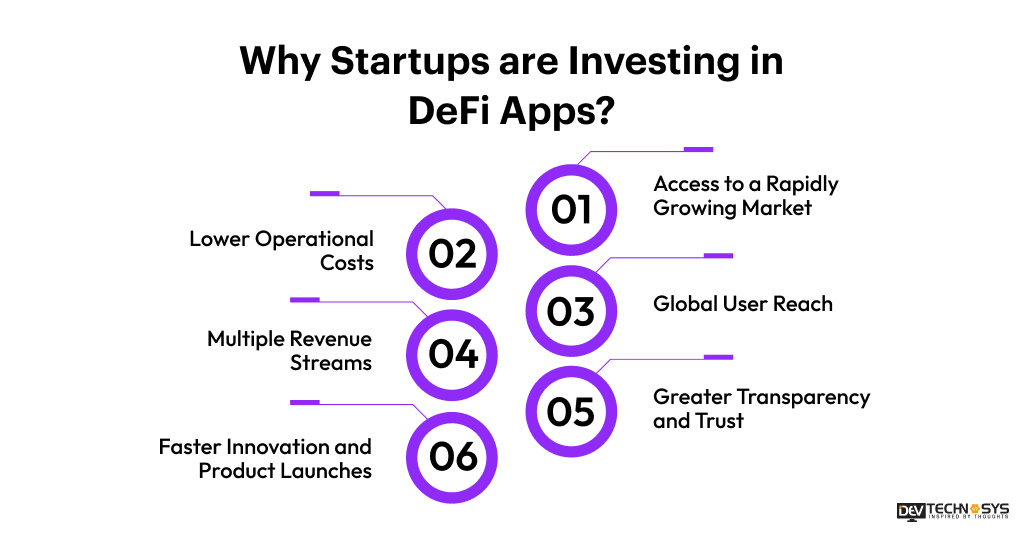
Startups Invest In blockchain app development because they offer innovative ways to deliver financial services without relying on traditional intermediaries. By leveraging blockchain technology and smart contracts, DeFi platforms enable startups to reduce operational costs, improve transparency, and create new revenue opportunities in the rapidly growing digital finance ecosystem.
1. Access to a Rapidly Growing Market
The DeFi sector has experienced significant growth over the past few years, attracting billions of dollars in digital assets and institutional interest. This expanding market creates opportunities for startups to launch innovative financial products and capture early market share.
2. Lower Operational Costs
Unlike traditional financial institutions, DeFi platforms automate processes through smart contracts. This reduces administrative overhead, minimizes manual intervention, and lowers the cost of delivering financial services.
3. Global User Reach
DeFi applications are accessible to anyone with an internet connection and a crypto wallet. This allows startups to serve users worldwide without geographical restrictions or the need for physical branches.
4. Multiple Revenue Streams
Startups can generate revenue through transaction fees, staking services, lending interest, liquidity pool fees, token launches, premium subscriptions, and governance mechanisms, creating diversified monetization opportunities.
5. Greater Transparency and Trust
All transactions are recorded on public blockchains, providing transparency and auditability. This helps build user trust and reduces concerns related to hidden fees or opaque financial operations.
6. Faster Innovation and Product Launches
Blockchain infrastructure, open-source protocols, and existing DeFi frameworks enable startups to develop and launch financial products more quickly than traditional fintech solutions.
Key Market Statistics and Growth Projections
- The Decentralized Finance Market size is projected to reach USD 238.54 billion in 2026 and USD 770.56 billion by 2031, registering a CAGR of 26.43% between 2026 and 2031.
- By protocol type, tokenized RWA platforms are forecasted to expand at a 39.72% CAGR through 2031.
- By end-use application, payments, remittances & cross-border treasury are projected to grow at a 34.67% CAGR to 2031.
- By end user, institutional investors & asset managers are expected to grow at a 32.55% CAGR through 2031.
- By geography, North America retained 42.78% of the decentralized finance market share last year, and Asia-Pacific is set to advance at a 31.89% CAGR through 2031.
How DeFi Apps Work?
DeFi (Decentralized Finance) apps use blockchain technology and smart contracts to provide financial services without banks or intermediaries.
How it works:
- Users connect a crypto wallet.
- Smart contracts process transactions automatically.
- The blockchain verifies and records transactions.
- Liquidity pools supply funds for lending, borrowing, and trading.
- Users retain full control of their assets.
In simple terms, blockchain in financial industry enables secure, transparent, and peer-to-peer financial transactions through automated smart contracts and decentralized networks.
Core Components of a DeFi Ecosystem
DeFi ecosystems are built on blockchain technology to replace traditional financial intermediaries with decentralized protocols. They enable transparent, permissionless, and automated financial services worldwide.
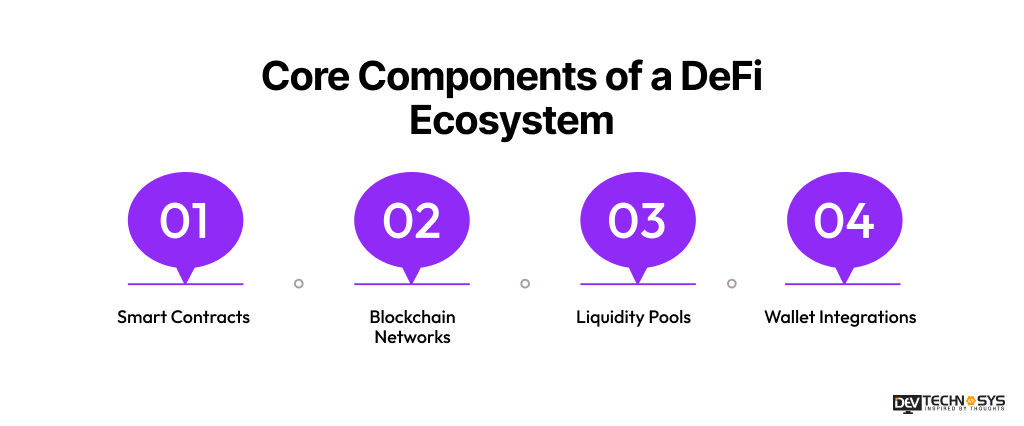
1. Smart Contracts: Self-executing blockchain programs that automate lending, trading, staking, and other financial operations without intermediaries. It is one of the great benefits of DeFi app development.
2. Blockchain Networks: Decentralized ledgers like Ethereum and Solana that securely record, validate, and store all DeFi transactions.
3. Liquidity Pools: Crowdsourced crypto funds locked in protocols, enabling decentralized trading, lending, and earning yield rewards.
4. Wallet Integrations: Crypto wallets like MetaMask allow users to connect, store assets, and interact with DeFi applications securely.
Difference Between DeFi Apps and Traditional Financial Apps
DeFi apps operate on decentralized blockchain networks where users interact directly through smart contracts, eliminating the need for banks or intermediaries. In contrast, traditional financial apps are centralized systems controlled by financial institutions that verify, approve, and manage all transactions. While DeFi focuses on transparency, automation, and global accessibility, traditional apps prioritize regulation, trust in authorities, and controlled financial operations.
Feature |
DeFi Apps |
Traditional Financial Apps |
| Control | Decentralized, user-controlled | Centralized, institution-controlled |
| Intermediaries | No intermediaries | Banks and financial institutions required |
| Technology | Blockchain & smart contracts | Central servers and databases |
| Transparency | Fully transparent on-chain records | Limited visibility for users |
| Access | Global, permissionless | Restricted by geography & regulations |
| Transaction Speed | Fast (depends on network) | Slower due to approvals & processing |
| Operating Time | 24/7 availability | Limited banking hours in some cases |
| Security Model | Cryptographic security | Institution-based security systems |
| Costs | Lower fees (generally) | Higher fees due to intermediaries |
| Trust Model | Trustless system | Trust in centralized authority |
Industry Insights
‘According to the World Economic Forum, there is increasing collaboration among regulators, banks, and blockchain innovators to support responsible DeFi adoption.’
DeFi App Architecture Explained
DeFi applications are built using a layered architecture where each layer performs a specific role, from user interaction to blockchain execution and data verification. This structure ensures decentralization, transparency, and security.
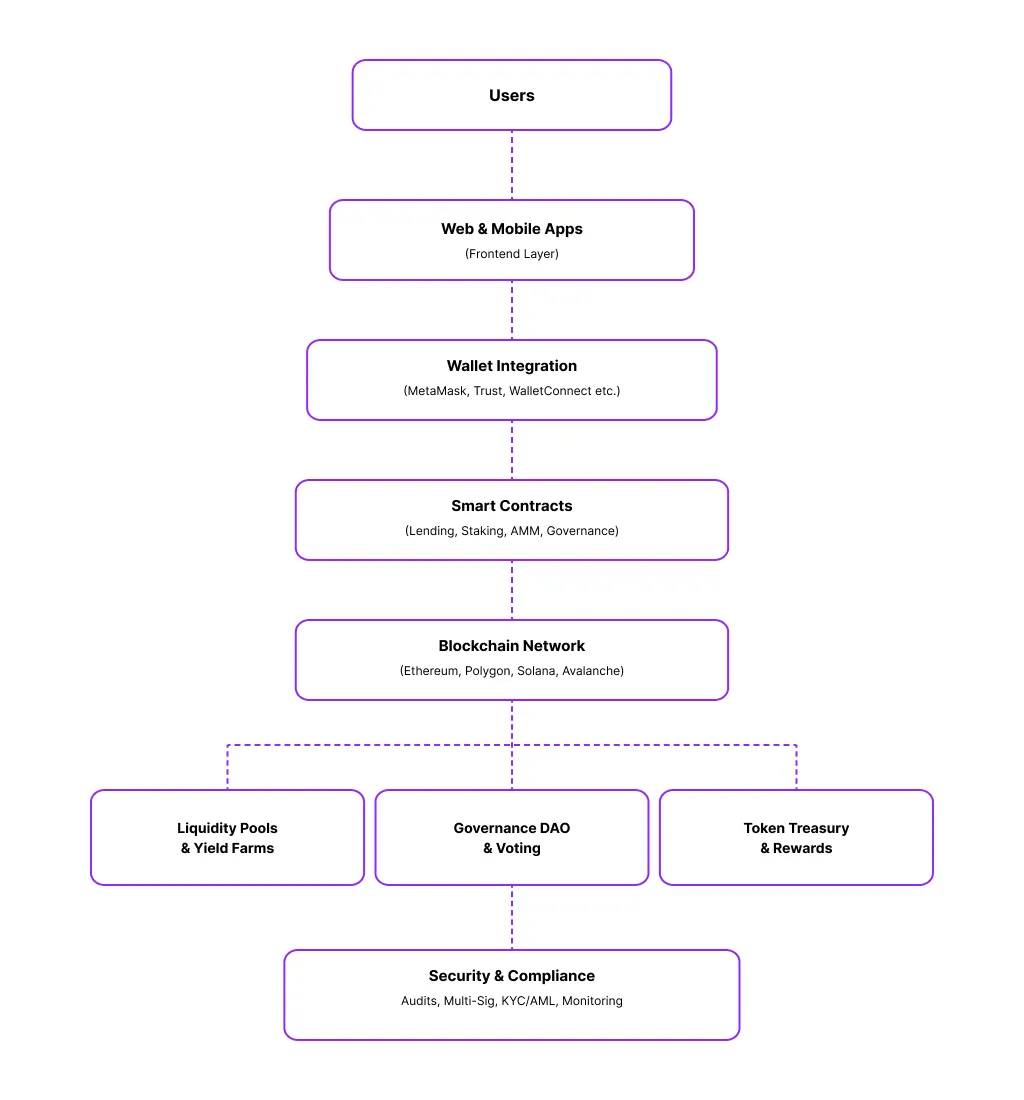
1. Frontend Layer
frontend is the user interface of a DeFi app built using frameworks like React or Next.js. It connects users to wallets such as MetaMask, displays balances, dashboards, charts, and allows interaction with smart contracts through Web3 libraries.
2. Application Layer
This layer acts as a middleware between the UI and the blockchain. It handles API requests, transaction formatting, wallet authentication, gas fee estimation, caching, and routing of user actions to smart contracts.
3. Smart Contract Layer
This is the core logic layer of DeFi systems. Smart contracts manage lending, borrowing, staking, swaps, liquidity pools, and yield farming. Once deployed, they execute automatically without human intervention.
Key functions:
- Token swaps (AMMs)
- Lending & borrowing rules
- Reward distribution
- Governance voting logic
4. Blockchain Layer
The blockchain acts as the decentralized execution and storage engine. It validates transactions, maintains consensus, and stores immutable records.
Includes:
- Validator nodes/miners
- Consensus mechanisms (PoS, PoW)
- Gas fee computation
- Transaction finality
Popular networks include Ethereum, Solana, and BNB Chain.
5. Security Layer
According to a top mobile app development company, security is critical in DeFi because systems are immutable once deployed.
Includes:
- Smart contract audits
- Bug bounty programs
- Reentrancy & exploit protection
- Multi-signature wallets
- Fraud detection monitoring
- Rate limiting & circuit breakers
6. Additional Important Layers (Often Missed)
- Indexing Layer: Tools like The Graph index blockchain data to make it searchable and usable for dashboards, analytics, and DeFi apps.
- Node / RPC Layer: RPC providers (like Infura or Alchemy) connect frontend apps to blockchain networks.
- MEV Protection Layer: Protects users from front-running and transaction manipulation by miners/validators.
- Governance Layer: Enables token holders to vote on protocol upgrades, fee changes, and treasury management.
Step-by-Step DeFi App Development Process
There are structured steps for making a DeFi app, from planning to releasing it. Each step makes sure that the platform is safe, scalable, and in line with what users want. Here is a full outline of the whole development lifecycle.
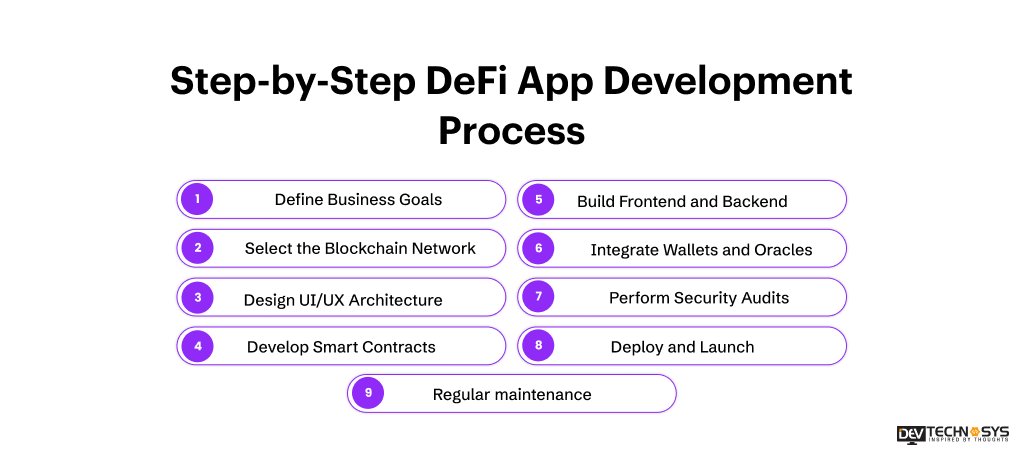
Step 1: Define Business Goals and Use Case
Figure out what the primary goal of the DeFi app is, like lending, staking, swapping, or yield farming. Identify your target users, your revenue plan, and your competitive edge. This step helps blockchain development services providers in making sure the product is going in the right direction, that its features are in line with what the market wants, and that it can be scaled up to solve problems.
Industry Insights
According to Deloitte’s Global Blockchain Survey, more than 75% of financial executives believe digital assets will become a strong alternative to traditional financial systems within the next decade.
Step 2: Select the Blockchain Network
The next step in decentralized finance app development involves selecting the right blockchain based on how well it supports ecosystems, how quickly transactions can be completed, and how scalable it is. Ethereum has strong security, Solana has fast speed, and BNB Chain lowers the cost of transactions. The choice has an effect on the decentralized finance app development, including speed, gas costs, developer tools, and the ability to grow in the future.
Step 3: Design UI/UX Architecture
Cryptocurrency exchange app development experts create an easy-to-use interface that makes complicated DeFi tasks easier to do. Pay attention to how wallets link, dashboards, transaction flows, and how to see data in real time. A clean UI/UX makes it easier for new users to get started, builds trust, and makes sure that users and decentralized financial protocols can talk to each other easily on both web and mobile platforms.
Step 4: Develop Smart Contracts
Smart contracts are what make DeFi apps work. To handle loans, borrowing, staking, swaps, and liquidity pools, developers who provide DeFi application development write code that is safe and works well. These contracts run automatically on the blockchain, so there are no middlemen. This makes sure that all financial deals in the ecosystem are clear, safe, and quick.
Step 5: Build Frontend and Backend
Custom DeFi app development involves using frameworks like React or Next.js to build the front end, which lets users connect with the DeFi protocol. The backend is in charge of APIs, tracking, caching, and talking to the blockchain. Together, they make sure that data flows smoothly, that changes happen in real time, and that smart contracts and blockchain networks work with them without any problems.
Step 6: Integrate Wallets and Oracles
For DeFi application development, add crypto wallets like MetaMask to help with identification and signing transactions. Oracles are linked to get info from the real world, like market rates and token prices. This mix makes sure that users can access information safely and that smart contracts are carried out correctly using accurate information from outside sources.
Step 7: Perform Security Audits
Hackers and other bad people can’t get into smart contracts without security checks. Code reviews, penetration tests, and third-party checks are all things that smart contract development providers do. Bug bounty programs and tracking tools make the DeFi platform even safer, more reliable, and less likely to be attacked by hackers.
Step 8: Deploy and Launch
Smart contracts are put into use on the mainnet after they have been tested, and the view is made available to everyone. Deployment includes verifying contracts, configuring APIs, and ensuring wallet connectivity. A smooth launch makes sure that users can use the DeFi app without any problems or interruptions.
Step 9: Regular maintenance and attention
After start, the system is constantly checked to make sure it is stable, that it works at its best, and that bugs are fixed. Developers keep track of deals, update smart contracts when they need to, and make the system more scalable. DeFi development services involve regular patches, updates, and feature additions to make sure that the DeFi app will always work and be competitive in the ever-changing blockchain environment.
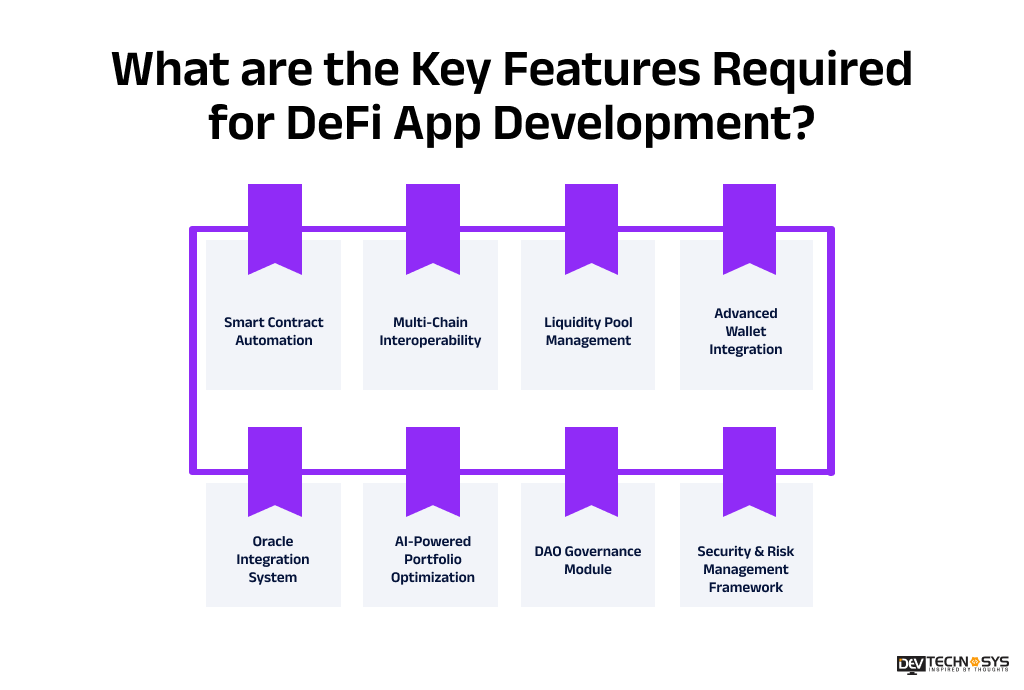
What are the Key Features Required for DeFi App Development?
Decentralized Finance (DeFi) applications require a combination of blockchain infrastructure, smart contract logic, and user-centric features to ensure secure, scalable, and trustless financial operations. Below are the most advanced and essential features needed for modern DeFi platforms.
User Features |
Admin Features |
Advanced Features |
| Wallet connection | User management | AI-powered portfolio recommendations |
| Portfolio dashboard | Liquidity monitoring | Automated yield optimization |
| Token swaps | Transaction analytics | DAO governance |
| Transaction history | Treasury management | Cross-chain bridges |
| Yield tracking | Risk management tools | Smart contract automation |
1. Smart Contract Automation
Enables self-executing code that automates lending, staking, swaps, and rewards distribution without intermediaries, ensuring transparency, trustlessness, efficiency, and reduced operational costs across decentralized finance applications.
2. Multi-Chain Interoperability
Allows DeFi apps to operate across multiple blockchain networks like Ethereum, Solana, and BNB Chain, improving liquidity access, scalability, asset mobility, and overall ecosystem connectivity for users.
3. Liquidity Pool Management
Manages pooled user funds used for trading, lending, and yield farming, enabling continuous liquidity, automated market-making, and efficient capital utilization within decentralized financial ecosystems.
4. Advanced Wallet Integration
Supports secure connection with wallets like MetaMask and WalletConnect, enabling user authentication, digital asset management, transaction signing, and seamless interaction with DeFi protocols across web and mobile platforms.
5. Oracle Integration System
Best DeFi app development company integrates this feature to bridge real-world data, such as token prices, exchange rates, and market feeds, into smart contracts, ensuring accurate execution of financial operations and reducing dependency on centralized data sources.
6. AI-Powered Portfolio Optimization
Uses artificial intelligence to analyze market trends, user behavior, and risk profiles, delivering optimized investment strategies, improved yield opportunities, and automated asset allocation for better returns.
7. DAO Governance Module
Enables decentralized governance where token holders vote on protocol upgrades, fee structures, and treasury decisions, ensuring community-driven development and transparent decision-making in DeFi ecosystems.
8. Security & Risk Management Framework
Includes smart contract audits, vulnerability detection, real-time monitoring, and fraud prevention systems to protect user funds, reduce exploits, and maintain platform reliability and trustworthiness.
What are the Types of DeFi Apps Startups Can Build?
Decentralized Finance (DeFi) startups can build a wide range of blockchain-based financial applications that remove intermediaries, increase transparency, and enable global access to financial services.
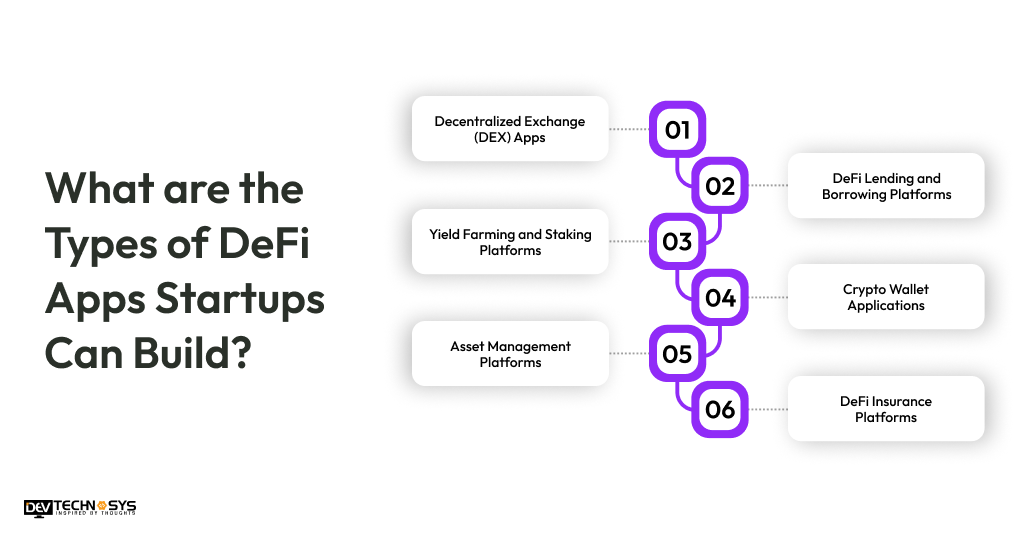
1. Decentralized Exchange (DEX) Apps
Platforms that enable users to trade cryptocurrencies directly using smart contracts without intermediaries, ensuring secure, permissionless, and transparent peer-to-peer token swapping through automated liquidity pools and decentralized order execution mechanisms across blockchain networks. To develop a DEX app, contact a top DeFi software development company.
2. DeFi Lending and Borrowing Platforms
Applications that allow users to lend crypto assets to earn interest or borrow funds by providing collateral, all managed through smart contracts that automate lending terms, interest rates, liquidation rules, and repayment processes without banks.
3. Yield Farming and Staking Platforms
Platforms where users lock crypto assets into liquidity pools or staking protocols to earn rewards, governance tokens, and passive income, while supporting network liquidity, security, and incentivized participation across decentralized finance ecosystems.
4. Crypto Wallet Applications
Secure digital wallets that store private keys, manage crypto assets, and enable users to connect with DeFi applications for trading, staking, transfers, and authentication, ensuring full control over funds with strong encryption and accessibility.
5. Asset Management Platforms
DeFi platforms that help users manage diversified crypto portfolios, track performance, rebalance assets, and optimize investment strategies across multiple protocols, providing analytics, automation, and real-time insights for improved financial decision-making and portfolio growth.
6. DeFi Insurance Platforms
Blockchain-based insurance systems that protect users against smart contract failures, hacks, and protocol risks using decentralized risk pooling, automated claim verification, and transparent payout mechanisms that enhance trust and financial security in DeFi ecosystems.
Industry Insights
McKinsey estimates that the market for tokenized financial and real-world assets could reach $2 trillion to $4 trillion by 2030, creating significant opportunities for DeFi startups focused on asset tokenization.
How Much Does DeFi App Development Cost?
The Defi app development cost is around $30,000 to $1,50,000, depending on various factors like features, third-party integration, blockchain selection, developers’ location, and more. The basic Defi mobile app development cost lies between $30,000 to $70.000, whereas the mid-level Defi app development cost ranges from $70,000 to $100,000. However, adding advanced features like smart contract automation, multi-chain interoperability, AI-Powered portfolio optimization, and multi-platform support can exceed the cost to $1,50,000+.
DeFi App Type |
Estimated Cost (USD) |
Development Timeline |
| Basic DeFi MVP | $30,000 – $60,000 | 2 – 4 months |
| Mid-Level DeFi App | $60,000 – $1,00,000 | 4 – 7 months |
| Advanced DeFi Platform | $1,00,000 – $1,50,000 | 7 – 12 months |
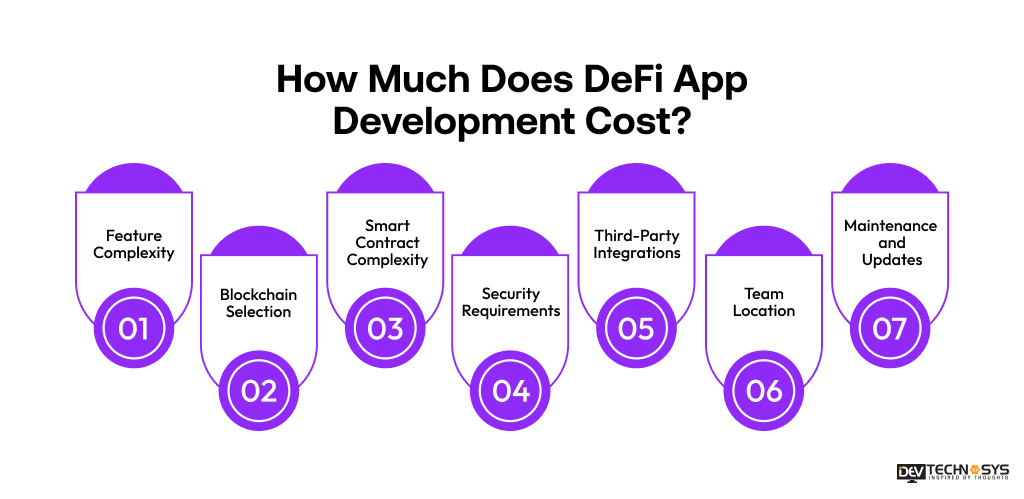
1. Feature Complexity
More complex features like staking, lending, yield farming, and cross-chain swaps significantly increase development effort, requiring advanced smart contracts, backend logic, UI design, and extensive testing, which directly raises overall Blockchain app development cost.
2. Blockchain Selection
The choice of blockchain, such as Ethereum, Solana, or BNB Chain, impacts cost due to differences in transaction fees, development tools, scalability, network speed, and ecosystem maturity, influencing overall integration complexity and performance optimization needs.
3. Smart Contract Complexity
Complex smart contracts involving automated market making, liquidity pools, governance systems, and liquidation mechanisms require more coding, testing, auditing, and optimization, increasing development time, security risks, and overall project implementation cost.
4. Security Requirements
Strong security needs like audits, penetration testing, bug bounty programs, and multi-signature wallets increase smart contract development cost significantly, as DeFi platforms must prevent hacks, vulnerabilities, and financial losses through highly secure architecture.
5. Third-Party Integrations
Integrations with wallets, oracles, APIs, analytics platforms, and cross-chain bridges add extra complexity, requiring additional development, testing, and maintenance efforts, which ultimately increase both initial build cost and long-term operational expenses.
6. Team Location
Cost to hire blockchain developers varies by region, with North America and Europe charging higher hourly rates compared to Asia or Eastern Europe, impacting the overall budget depending on the expertise level and location of the development team.
7. Maintenance and Updates
Hire DeFi developers to provide ongoing maintenance services like bug fixes, smart contract upgrades, performance optimization, and security patches, which are essential for long-term stability, scalability, and user trust, and entail ongoing operational costs after initial deployment. The mobile app maintenance cost is around 12% to 20% of the total cost.
Cost Factor |
Impact on Cost |
Estimated Cost Influence |
| Feature Complexity | High | +$8,000 – $35,000 |
| Blockchain Selection | High | +$5,000 – $20,000 |
| Smart Contract Complexity | Very High | +$10,000 – $40,000 |
| Security Requirements | Very High | +$8,000 – $30,000 |
| Third-Party Integrations | Medium–High | +$5,000 – $25,000 |
| Team Location | Medium | +$5,000 – $15,000 difference |
| Maintenance & Updates | Continuous | 15%–20% of the annual project cost |
Legal and Compliance Requirements for DeFi Startups
DeFi startups must follow evolving global regulations to ensure secure, lawful, and sustainable operations. Since DeFi operates without centralized intermediaries, compliance becomes critical for user protection, fraud prevention, and long-term platform trust.
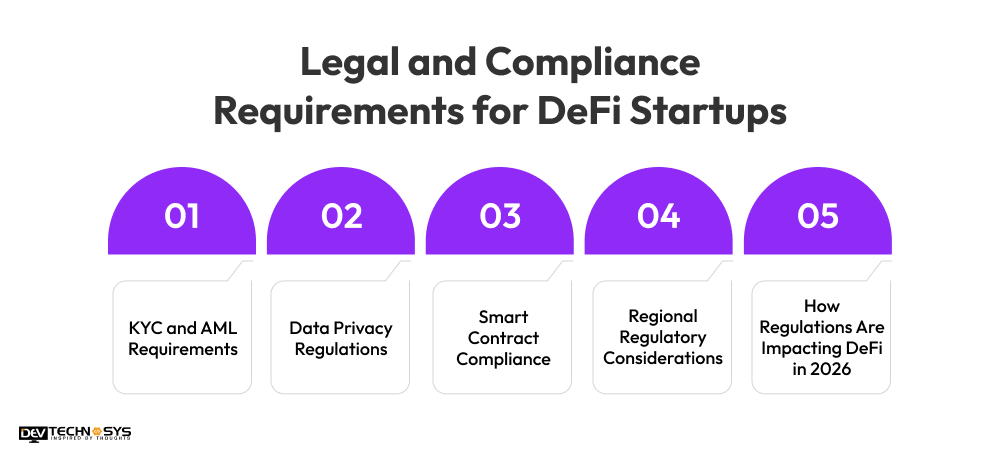
1. KYC and AML Requirements
DeFi platforms may need Know Your Customer (KYC) and Anti-Money Laundering (AML) processes to verify user identities and prevent illicit activities such as fraud, terrorism financing, and money laundering, especially when fiat on-ramps are involved.
2. Data Privacy Regulations
Startups must comply with data protection laws like GDPR and similar frameworks to safeguard user information, ensure secure storage, limit data collection, and provide transparency about how personal and financial data is used.
3. Smart Contract Compliance
Smart contracts must be designed with regulatory awareness, ensuring auditability, transparency, and security standards. Compliance also includes avoiding unauthorized financial activities and ensuring proper risk disclosures in decentralized financial operations.
4. Regional Regulatory Considerations
Different countries regulate DeFi differently, with some embracing innovation and others imposing restrictions. Startups must adapt to jurisdiction-specific rules related to crypto trading, taxation, licensing, and digital asset usage.
5. How Regulations Are Impacting DeFi in 2026
In 2026, regulations are pushing DeFi toward hybrid models combining decentralization with compliance layers, increasing KYC adoption, improving transparency standards, and encouraging institutional participation while reducing anonymity-based risks in ecosystems.
Monetization Strategies For DeFi Apps
DeFi platforms generate revenue through transaction-based models, premium services, and protocol-level fees. These monetization strategies ensure sustainable income while maintaining decentralized financial operations.
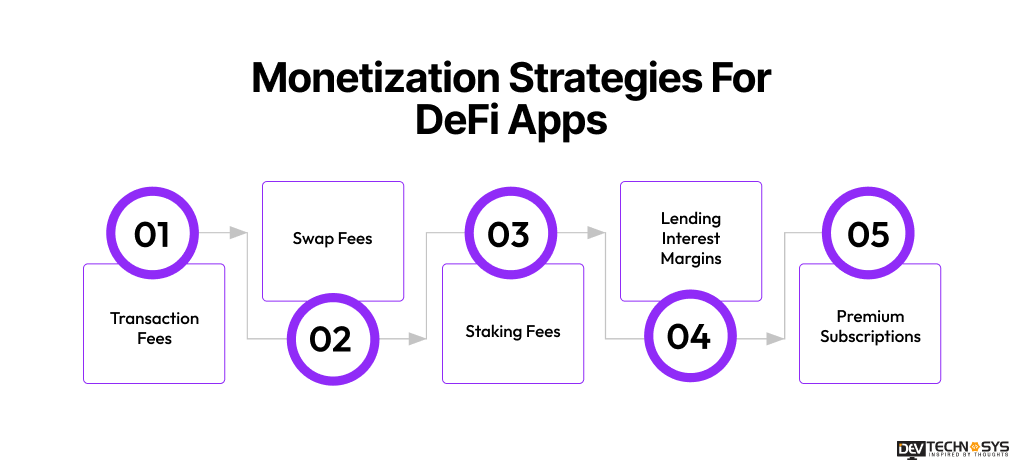
1. Transaction Fees
DeFi apps charge a small fee on every transaction executed on the platform, including swaps, transfers, and liquidity interactions, generating consistent revenue from overall network activity. These fees scale with platform usage, making them a primary long-term income source.
2. Swap Fees
Decentralized exchanges earn revenue by charging fees on token swaps, typically a percentage of trade value, which is distributed between liquidity providers and the protocol. Higher trading volume directly increases profitability for the platform ecosystem.
3. Staking Fees
Platforms charge fees for staking services where users lock tokens to earn rewards, helping secure the network while creating passive income opportunities for the protocol. These fees also incentivize long-term token holding and ecosystem stability.
4. Lending Interest Margins
DeFi lending platforms earn profit through interest rate spreads, where interest paid to lenders is lower than interest charged to borrowers within smart contract-based lending pools. This model ensures continuous liquidity flow and predictable platform revenue.
5. Premium Subscriptions
Advanced features such as analytics dashboards, AI-driven insights, and portfolio optimization are offered through subscription plans targeting institutional users and high-value traders. Subscriptions also provide recurring revenue and improve user retention across the platform.
Technology Stack Required for DeFi App Development
Building a DeFi application requires a combination of blockchain frameworks, smart contract languages, frontend tools, backend systems, and security infrastructure. Each layer of the stack plays a crucial role in ensuring scalability, transparency, and secure decentralized financial operations.
Layer |
Technologies |
| Blockchain Platforms | Ethereum, Solana, BNB Chain, Polygon |
| Smart Contract Languages | Solidity, Rust, Vyper |
| Frontend Development | React.js, Next.js, Vue.js |
| Backend Development | Node.js, Python, Go |
| Wallet Integration | MetaMask, WalletConnect, Coinbase Wallet |
| Smart Contract Frameworks | Hardhat, Truffle, Foundry |
| Oracles | Chainlink, Band Protocol |
| Databases | MongoDB, PostgreSQL, Redis |
| APIs & Indexing | The Graph, Infura, Alchemy |
| Security Tools | OpenZeppelin, Certik, Slither |
| Cloud & Hosting | AWS, Google Cloud, Azure |
| DevOps Tools | Docker, Kubernetes, CI/CD pipelines |
Common Mistakes Startups Make During DeFi Development
DeFi startups often fail not because of poor ideas, but due to weak execution in security, planning, and blockchain strategy. Avoiding these mistakes is essential for building a scalable and trusted DeFi platform.
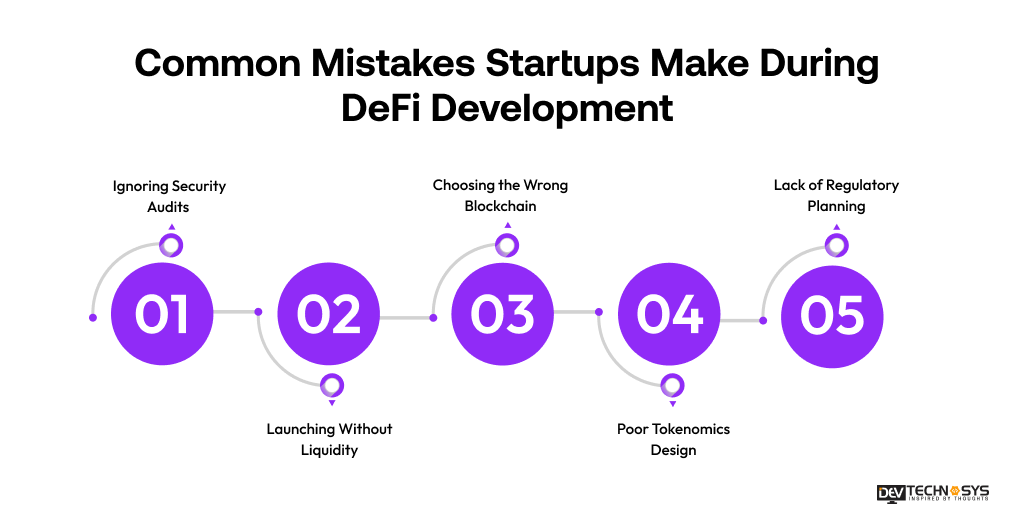
1. Ignoring Security Audits
Many startups skip professional smart contract audits, exposing platforms to hacks, exploits, and financial losses that can permanently damage user trust and project reputation.
2. Launching Without Liquidity
Without sufficient liquidity, users cannot trade or transact efficiently, leading to poor user experience, low adoption, and failure of decentralized exchange or lending mechanisms.
3. Choosing the Wrong Blockchain
Selecting an unsuitable blockchain can result in high gas fees, poor scalability, slow transactions, and limited ecosystem support, negatively affecting platform performance and growth.
4. Poor Tokenomics Design
Weak tokenomics leads to inflation, low utility, and poor investor confidence, reducing long-term sustainability and limiting user engagement within the DeFi ecosystem.
5. Lack of Regulatory Planning
Ignoring compliance requirements such as KYC, AML, and regional laws can lead to legal issues, restrictions, or shutdowns in multiple jurisdictions.
Emerging Trends Shaping the Future of DeFi
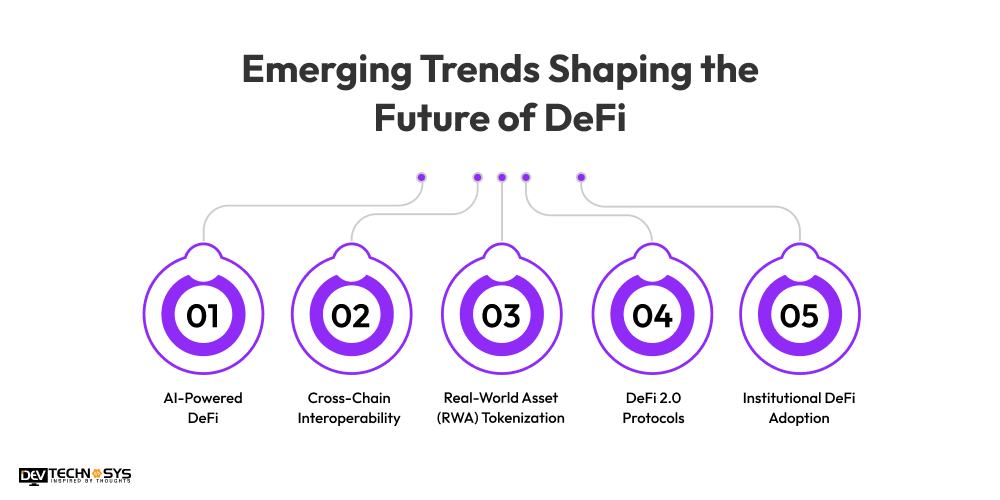
The DeFi ecosystem is rapidly evolving with new technologies and institutional adoption, making it more intelligent, interconnected, and real-world focused. Here are some of the top DeFi app development trends to consider:
1. AI-Powered DeFi
AI is transforming DeFi by optimizing trading strategies, automating yield farming, detecting risks, and improving portfolio management through intelligent predictive analytics and real-time decision-making systems.
2. Cross-Chain Interoperability
Cross-chain technology enables seamless asset transfers and communication between multiple blockchains, improving liquidity flow, ecosystem connectivity, and user accessibility across decentralized financial networks globally.
3. Real-World Asset (RWA) Tokenization
RWA tokenization converts physical assets like real estate, bonds, and commodities into blockchain tokens, enabling fractional ownership, global investment access, and improved asset liquidity.
4. DeFi 2.0 Protocols
DeFi 2.0 introduces improved liquidity models, protocol-owned liquidity, and more sustainable incentive structures, reducing dependency on external incentives while strengthening long-term ecosystem stability.
5. Institutional DeFi Adoption
Institutional adoption is increasing as banks and hedge funds enter DeFi, bringing large-scale capital, regulatory compliance, and credibility, accelerating mainstream integration of decentralized financial systems.
Build vs Buy vs Partner: Which Is Best for Startups?
Startups entering the DeFi space often face a strategic decision: whether to build a solution from scratch, buy existing infrastructure, or partner with established providers. Each approach has different implications for cost, speed, scalability, and control over the product ecosystem.
Factor |
Build |
Buy |
Partner |
| Cost | High initial investment | Low to medium upfront cost | Shared cost model |
| Time to Market | Slow (3–12 months) | Fast (immediate deployment) | Moderate |
| Customization | Fully customizable | Limited customization | Moderately customizable |
| Scalability | Highly scalable if built well | Limited by the vendor | Scalable with partner support |
| Security Control | Full control requires audits | Depends on vendor security | Shared responsibility |
| Technical Expertise Needed | Very high | Minimal | Medium |
| Flexibility | Maximum flexibility | Low flexibility | Medium flexibility |
| Maintenance | Fully in-house responsibility | Vendor-managed | Shared maintenance |
Conclusion
DeFi app development offers startups a powerful opportunity to build decentralized financial products that eliminate intermediaries, improve transparency, and unlock global access to financial services. However, success depends on choosing the right features, secure architecture, scalable blockchain infrastructure, and a well-planned development process.
Businesses seeking advanced DeFi app development can consult Dev Technosys, a leading blockchain development company. With 15+ years of expertise and 270+ developers, we create high-tech DeFi platforms for businesses of all sizes.
FAQs
Q1. What is a DeFi App?
A DeFi app is a blockchain-based financial application that enables users to trade, lend, borrow, and earn rewards without relying on traditional banks or centralized intermediaries, using smart contracts for automated and transparent financial operations.
Q2. How Much Does it Cost to Develop a DeFi App?
The cost of DeFi app development typically ranges from $30,000 to $1,50,000, depending on features like staking, lending, liquidity pools, cross-chain support, security measures, and overall platform complexity and scalability requirements.
Q3. How Long Does it Take to Build a DeFi Application?
A basic DeFi MVP takes around 2–4 months, while advanced platforms with complex smart contracts, integrations, and security audits may require 6–12 months or more, depending on development scope.
Q4. What are the Key Features Of a DeFi App?
Key features include wallet integration, token swaps, liquidity pools, yield farming, lending and borrowing systems, DAO governance, multi-chain support, and advanced analytics for seamless decentralized financial operations.
Q5. Is DeFi App Development Secure?
Yes, but only when strong security practices are applied, including smart contract audits, penetration testing, bug bounty programs, encryption, and continuous monitoring to prevent hacks, vulnerabilities, and financial risks.
Q6. Which Blockchain is Best For DeFi Apps?
Ethereum is most widely used due to its strong security and ecosystem support, while Solana and BNB Chain are preferred for faster transactions, lower fees, and better scalability in DeFi applications.