





Key Insights
Real estate app development costs in 2026 typically range from $30,000 to $150,000+, depending on the app’s complexity, features, platform, and technology stack. A basic property listing app starts at $30,000 to $60,000, while feature-rich marketplace platforms cost between $60,000 and $100,000. Advanced real estate applications with AI-powered recommendations, virtual tours, analytics, and enterprise-grade functionality generally range from $100,000 to $150,000+.
Cost Breakdown by Development Complexity
- Basic/MVP ($30,000 – $60,000): Includes essential features such as user registration, property listings, search filters, agent contact, basic maps, and an admin dashboard.
- Medium ($60,000 – $100,000): Adds advanced search filters, interactive maps, push notifications, property comparison, appointment scheduling, CRM integration, custom UI/UX, and payment gateway integration.
- Complex ($100,000 – $150,000+): Incorporates AI-powered property recommendations, virtual property tours, real-time chat, analytics dashboards, multi-role access, cloud infrastructure, multilingual support, and advanced security features.
Key Cost Drivers
- App Type: A simple property listing app costs significantly less than a real estate marketplace, rental platform, or property investment application.
- Platform: Developing native apps for both iOS and Android is more expensive than using cross-platform frameworks like Flutter or React Native.
- Feature Complexity: AI recommendations, virtual tours, real-time messaging, interactive maps, CRM integrations, and analytics dashboards substantially increase development costs.
- Maintenance: Ongoing maintenance, security updates, cloud hosting, and feature enhancements typically account for 15–20% of the initial development cost annually.
- Third-Party Integrations: Integrating services such as Google Maps, payment gateways, CRM systems, MLS/IDX databases, and analytics tools adds to the overall development budget.
Cost Variation by Country
- North America: $50 – $100/hr
- Western Europe: $45 – $80/hr
- Eastern Europe: $40 – $70/hr
- India & Southeast Asia: $20 – $40/hr
In 2026, a real estate app is not just about browsing property photos online. It is a complete real estate management app that connects buyers, sellers, agents, and investors in one place. People prefer real estate apps because they offer instant property search, transparent pricing, and faster decisions.
Are you also interested in building a proptech startup with a strong idea? Developing a real estate app that helps people buy, sell, or rent homes through smart technology is a solid business option. As we start planning, the first question is: how much does it cost to build a real estate app?
The real estate app development cost mainly depends on factors like the app’s features, complexity, design quality, platform choice, integrations, and more. Be it a simple property listing app or a complex AI valuation platform, each idea comes with a different real estate app cost estimation.
Understanding the real estate app development cost in UAE will help you plan smarter and avoid surprises later. Go through this guide and be ready to turn your vision into a successful digital property product.
What Is a Real Estate App?
A real estate app is an online platform where users can search, list, buy, sell, or rent properties with ease. These apps display verified property listings, pricing trends, and immersive virtual walkthroughs. Along with property search, a real estate management platform also offers mortgage calculators, agent connect tools, and secure document management, increasingly backed by AI algorithms. Whether you want to buy a home, rent an apartment, or invest in commercial property, these AI-powered real estate apps offer everything you need.
What Are the Reasons Real Estate Apps Are Booming in 2026?
AI personalization, virtual tours, growing UAE demand, and live agent consultations are driving the expansion of real estate apps in 2026. In this section, we will learn how these real estate app development trends contribute to modern property buying.
1. Targeting Younger and First-Time Investors
Every time you build a real estate app or a simple listing app, younger buyers are highly open to trying it. Millennials and Gen Z treat it as a digital tool for property discovery and long-term investment planning.
2. Virtual and Interactive Property Tours
Another reason real estate apps are increasingly preferred is the rise of real-time, immersive virtual tour experiences. Live video walkthroughs and instant valuations build buyer trust, though they can raise the virtual tour real estate app cost for new platforms.
3. Multi-Vendor and B2B Property Marketplaces
Better APIs have lowered the multi-vendor real estate platform cost, letting apps onboard agencies, builders, and individual sellers together. This trend supports B2B real estate platform development, where developers, brokers, and channel partners collaborate inside one scalable real estate marketplace app.
4. AI-Powered Personalization
With the integration of Artificial Intelligence, real estate apps are becoming more tailored and predictive for every user. AI in real estate analyzes browsing behavior and budget to recommend matching homes, driving real estate app growth.
What Do Market Predictions Say About Real Estate Apps?
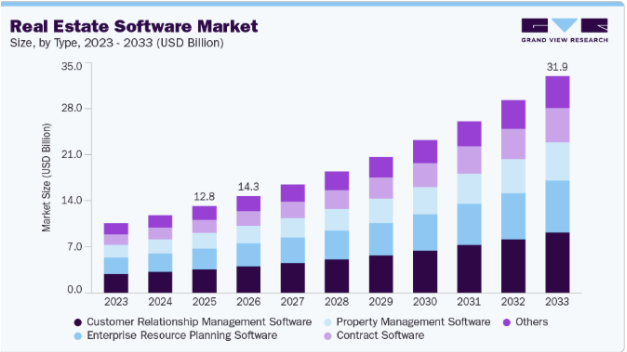
We know that the real estate app market is expanding fast, driven by smartphone adoption, AI integration, and rising digital property transactions. Here, we will look at a few market predictions by Grand View Research on real estate apps.
- The global real estate software market was valued at USD 12.8 billion in 2025.
- The market is expected to reach USD 14.3 billion in 2026, driven by increasing digital transformation across the real estate industry.
- It is projected to grow to USD 32.0 billion by 2033, reflecting strong long-term market potential.
- The industry is forecast to expand at a CAGR of 12.2% between 2026 and 2033.
- North America held the largest market share, accounting for 33.4% of global revenue in 2025. It is fueled by the widespread adoption of property management and sales automation solutions.
What Is the Cost to Build a Real Estate App?
The cost to build a real estate app typically ranges from $30,000 to $ 150,000. Generally, the cost of building a real estate app is determined by its complexity. A simple app with basic features, UI/UX, security, and integrations has lower complexity. It leads to a smaller real estate app development budget. In contrast, a mid-level real estate app comes with a balanced mix of essential and advanced integrations.
Due to this, the development cost becomes moderate. Whereas a futuristic platform with high-tech features, AI/ML algorithms, and deep personalization has high complexity. This can lead to a higher real estate app development cost. We will explain this clearly with a cost breakdown table below.
App Complexity |
Estimated Cost |
Ideal For |
Key Features |
| Basic / MVP Real Estate App | $30,000 – $60,000 | Startups, Small Agencies | User registration, property listings, basic search filters, property details, agent contact, favorites, simple admin panel |
| Mid-Level Real Estate App | $60,000 – $100,000 | Growing Businesses | Advanced search & filters, interactive maps, push notifications, appointment scheduling, property comparison, CRM integration, payment gateway, custom UI/UX |
| Advanced / Enterprise Real Estate App | $100,000 – $150,000+ | Enterprises, Large Real Estate Portals | AI-powered property recommendations, virtual property tours, real-time chat, analytics dashboard, multi-role access, multilingual support, cloud infrastructure, enterprise-grade security |
What Are the Types of Real Estate Apps and Their Cost Breakdown?
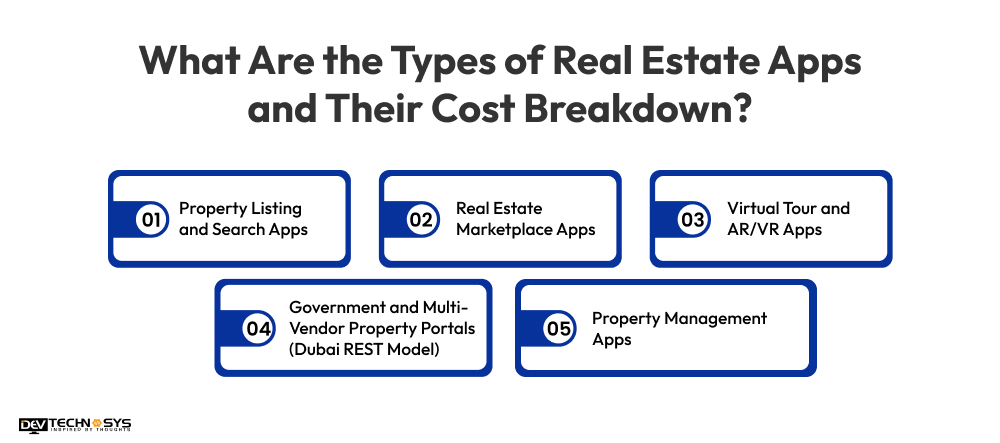
Property listing apps, real estate marketplaces, property management tools, virtual tour platforms, and B2B portals are the common types of real estate apps. Each app type has different features that influence the cost to build a real estate app in 2026. In this section, we will discuss the type and their cost breakdown:
1. Property Listing and Search Apps
One of the most common types of real estate apps is a property listing and search app. It lets users browse homes, apartments, and commercial spaces using filters like price, location, and amenities. Through this app, users can easily analyze pricing trends, nearby schools, and neighborhood safety scores.
2. Real Estate Marketplace Apps
A real estate marketplace app seamlessly connects buyers, sellers, agents, and renters under one digital roof. Analyzing this model, the app handles listings, negotiations, agent profiles, and secure communication between parties. It is a popular choice among startups that want to build an app like realtor.com.
3. Virtual Tour and AR/VR Apps
Virtual tour and AR/VR real estate apps usually let buyers walk through a property remotely through 3D scans or live video. This connection can be made through a normal video call, recorded walkthrough, or full augmented-reality overlay. It is a common feature among users who want real-time guidance before visiting in person.
4. Government and Multi-Vendor Property Portals (Dubai REST Model)
Government-backed and multi-vendor property portals are widely preferred in the UAE for transparent, regulated property transactions. These apps help in tracking title deeds, rental disputes, mortgage records, and verified broker listings in one place. It amazingly combines regulatory trust with modern, mobile-first technology.
5. Property Management Apps
Property management apps primarily help landlords and agencies track rent, maintenance, and tenant communication in one real estate management platform. This app helps in exploring lease tracking, automated rent reminders, and maintenance ticketing for property owners. It is widely used by independent landlords and large agencies alike.
Real Estate App Type |
Complexity Level |
Estimated Cost Range |
| Property Listing & Search App | Medium | $30,000 – $55,000 |
| Real Estate Marketplace App | High | $70,000 – $110,000 |
| Virtual Tour & AR/VR Real Estate App | Advanced | $90,000 – $130,000 |
| Property Management App | Medium–High | $55,000 – $90,000 |
| Government & Multi-Vendor Property Portal (Dubai REST Model) | Enterprise | $120,000 – $150,000+ |
Answer a few quick questions and our experts will share a tailored project estimate.
How Are Emerging Trends Affecting Real Estate App Development Cost in 2026?
Artificial Intelligence, machine learning, data integration, and personalization are some of the real estate app developments impacting overall pricing. These trends have transformed a simple listing app into a highly engaging real estate app development solution, which increases the build cost. It is time to understand these trends and the way they affect the property app development cost.
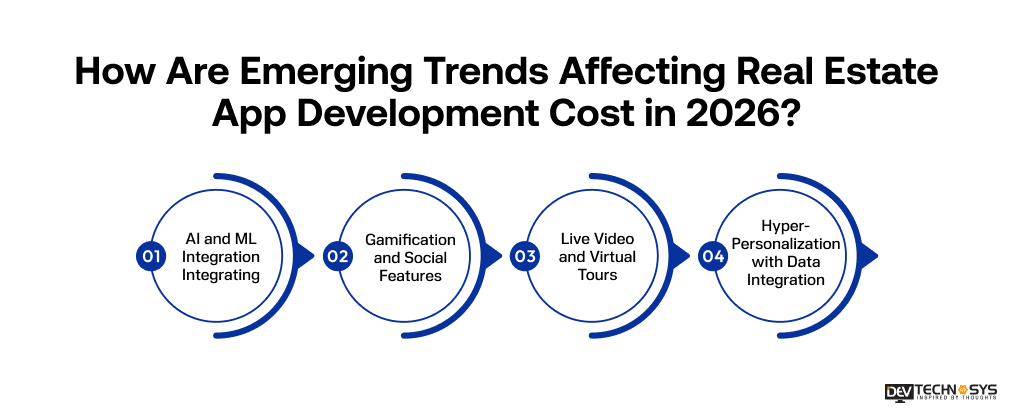
1. AI and ML Integration Integrating
AI and ML in a real estate app require advanced algorithms, data processing, model training, and skilled developers. All of this is necessary for delivering accurate valuations and automated recommendations that satisfy modern buyers. However, this integration raises the overall AI real estate app development cost noticeably.
2. Gamification and Social Features
To boost user engagement and retention, many real estate app development companies add gamification and social sharing features. Adding this trend to a real estate app demands premium UI/UX design and a stronger backend infrastructure. However, it pushes up the property app development services quote you receive from agencies.

3. Live Video and Virtual Tours
Live video and virtual property tours can noticeably increase the real estate app features and cost line items in your scope document. This trend for property management app development requires real-time streaming technology, secure communication, scheduling tools, and recording features. Additionally, it should also focus on data protection and regional compliance standards
4. Hyper-Personalization with Data Integration
As people demand hyper-personalization, the real estate app development agency price increases significantly across most quoted projects. It needs multiple data sources, public records APIs, user behavior tracking, and analytics systems. These are necessary to provide personalized listings while ensuring accuracy and data safety.
Here, we will explain these trends affecting the real estate software development cost estimate in a tabular way:
Emerging Trend |
Complexity |
Estimated Cost Range |
| AI & ML Integration | High | $45,000 – $60,000 |
| Gamification & Social Features | Medium | $30,000 – $45,000 |
| Live Video & Virtual Tours | High | $50,000 – $60,000 |
| Hyper-Personalization & Data Integration | High | $40,000 – $60,000 |
What Are the Best Real Estate Apps Available in the Market?
Some of the top real estate apps popular worldwide are Zillow, Trulia, Realtor.com, and Dubai REST. These apps are well-known for delivering a transparent, trustworthy property experience to users. Here, we will discuss these apps and real estate app development price.
1. Zillow
Zillow is one of the most popular real estate apps available, well-known for its property valuation tool called Zestimate. It blends listings, mortgage tools, and agent connections together, analyzing pricing trends and buyer affordability.
The cost to build property listing app like Zillow:
Development Component |
What It Includes |
Estimated Cost (USD) |
| UI/UX Design | Interactive property search, maps, and a user-friendly interface | $12,000 – $18,000 |
| Core Features | Property listings, search filters, favorites, agent profiles | $35,000 – $45,000 |
| AI & Third-Party Integrations | Zestimate, Google Maps, mortgage calculator, MLS APIs | $28,000 – $40,000 |
| Backend & Database | User management, cloud infrastructure, property database | $25,000 – $35,000 |
| Testing & Deployment | QA, security testing, App Store & Play Store deployment | $20,000 – $25,000 |
| Total Cost | $120,000 – $150,000+ |
2. Trulia
Trulia is a personalized real estate app known for its strong neighborhood insights and crime, school, and commute data. It analyzes neighborhood reviews against a buyer’s lifestyle needs, making it a great option for first-time buyers.
To create a real estate app like Trulia, the cost breakdown is as follows:
Development Component |
What It Includes |
Estimated Cost (USD) |
| UI/UX Design | Property browsing interface, neighborhood insights | $5,000 – $8,000 |
| Core Features | Listings, search filters, saved properties, map view | $20,000 – $28,000 |
| API Integrations | Google Maps, notifications, property APIs | $10,000 – $15,000 |
| Backend & Database | User accounts, property database, and admin panel | $15,000 – $22,000 |
| Testing & Deployment | Functional testing, optimization, deployment | $8,000 – $12,000 |
| Total Cost | $70,000 – $95,000 |
3. Realtor.com
Another widely used real estate app is Realtor.com, which provides verified MLS listings and professional agent connections. It combines direct MLS feeds and broker partnerships with modern search tools for serious home buyers.
The real estate app development cost in Dubai to build an app like Realtor:
Development Component |
What It Includes |
Estimated Cost (USD) |
| UI/UX Design | Modern interface, advanced search experience | $8,000 – $12,000 |
| Core Features | MLS listings, property search, agent directory | $28,000 – $38,000 |
| API Integrations | MLS/IDX, Google Maps, mortgage calculator | $18,000 – $25,000 |
| Backend & Database | Cloud backend, CRM, lead management | $22,000 – $30,000 |
| Testing & Deployment | Performance testing, security, deployment | $10,000 – $15,000 |
Total Cost |
$90,000 – $125,000 |
4. Dubai REST
Dubai REST is a government-backed real estate app used widely in the UAE for verified property transactions and dispute resolution. It tracks title deeds, mortgage records, and broker registrations inside one regulated real estate management app.
The price estimation to build a real estate app like Dubai REST:
Development Component |
What It Includes |
Estimated Cost (USD) |
| UI/UX Design | Government portal interface, multilingual UI | $10,000 – $15,000 |
| Core Features | Property registration, ownership verification, and digital services | $35,000 – $45,000 |
| Government & API Integrations | Dubai Land Department APIs, payment gateway, and authentication | $22,000 – $30,000 |
| Backend & Database | Enterprise cloud infrastructure, secure document management | $25,000 – $35,000 |
| Testing & Deployment | Compliance testing, security audits, and deployment | $12,000 – $15,000 |
Total Cost |
$100,000 – $140,000 |
What Are the Factors Affecting the Cost to Build a Real Estate App?
The cost to develop a property app highly depends on the platform choice, backend, security, third-party APIs, and other factors. Now, we are going to discuss these factors and understand how each one affects the real estate app development cost for an app like Zillow.
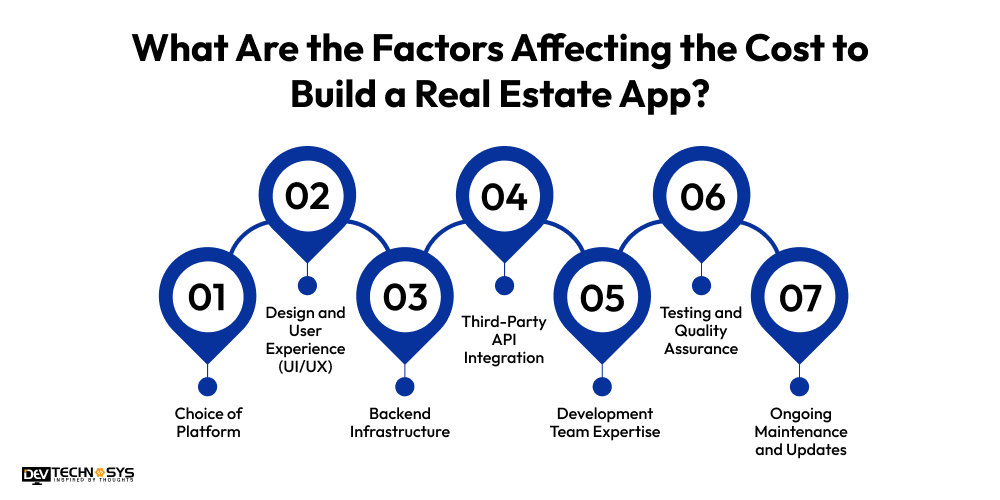
1. Choice of Platform
The selection of a platform to launch the real estate app, such as Android, iOS, or both, directly influences development cost. Android app development needs different tools than an iOS app development workflow, which raises the overall cost to build a real estate app.
Platform |
What It Includes |
Estimated Cost (USD) |
| Single Platform (Android or iOS) | Native development for one platform | $10,000 – $15,000 |
| Cross-Platform | Flutter or React Native development | $15,000 – $22,000 |
| Native for Both Platforms | Separate Android & iOS applications | $22,000 – $30,000 |
2. Design and User Experience (UI/UX)
UI/UX design shapes the way users interact with the real estate app every single day. Custom property cards and smooth navigation enhance the experience but raise the real estate mobile app development pricing.
Design Level |
What It Includes |
Estimated Cost (USD) |
| Basic UI Design | Standard layouts and user flows | $5,000 – $8,000 |
| Custom UI/UX Design | Custom branding, wireframes, and prototypes | $8,000 – $15,000 |
| Premium UI/UX Design | Animations, micro-interactions, responsive design | $15,000 – $20,000 |
3. Backend Infrastructure
The backend infrastructure supports listings, user accounts, transactions, and real-time features for every property record. Maintaining servers, databases, and security at scale raises the overall budget to make a real estate app.
Backend Component |
What It Includes |
Estimated Cost (USD) |
| Basic Backend | User authentication, property database | $10,000 – $15,000 |
| Scalable Backend | Cloud hosting, APIs, notifications | $15,000 – $20,000 |
| Enterprise Backend | Analytics, multi-role management, and high scalability | $20,000 – $25,000 |

4. Third-Party API Integration
Many real estate apps rely on third-party APIs, such as payment gateways, MLS data, maps, or virtual tour providers. Configuring and monitoring these integrations means the property listing app development cost climbs with every API added.
API Integration |
What It Includes |
Estimated Cost (USD) |
| Maps & Location APIs | Google Maps, Mapbox, geolocation | $4,000 – $6,000 |
| Payment & Communication APIs | Stripe, PayPal, Twilio, and email services | $6,000 – $9,000 |
| CRM & Property Data APIs | MLS/IDX, CRM systems, analytics tools | $9,000 – $12,000 |
5. Development Team Expertise
The real estate app development cost depends on the skill level, location, and experience of your developer’s team. A senior real estate app development firm with proven property-tech experience naturally charges higher rates. Either way, a reliable mobile app development company should offer clear post-launch support too.
Development Team |
What It Includes |
Estimated Cost (USD) |
| Freelancers / Small Team | Basic development with limited resources | $12,000 – $16,000 |
| Mid-Sized Development Agency | Dedicated designers, developers, and QA | $16,000 – $21,000 |
| Enterprise App Development Company | End-to-end development, consulting, support | $21,000 – $25,000 |
6. Testing and Quality Assurance
Thorough testing across devices and user scenarios ensures the app works smoothly without glitches. This covers functionality, payment security, and load testing, all requiring a real estate app development agency with dedicated QA staff.
Testing Type |
What It Includes |
Estimated Cost (USD) |
| Functional Testing | Feature validation and bug fixing | $4,000 – $7,000 |
| Performance & Compatibility Testing | Device, browser, and load testing | $7,000 – $11,000 |
| Security & User Acceptance Testing | Security audits, penetration testing, final QA | $11,000 – $15,000 |
7. Ongoing Maintenance and Updates
Regularly maintaining the app keeps it trusted and scalable as your user base grows over time. Bug fixes, API updates, and OS compatibility all raise the mobile app maintenance cost gradually.
Maintenance Service |
What It Includes |
Estimated Annual Cost (USD) |
| Basic Maintenance | Bug fixes and security patches | $2,500 – $3,500 |
| Regular Updates | Performance optimization and OS compatibility | $3,500 – $5,000 |
| Continuous Enhancement | Feature updates, monitoring, cloud maintenance | $5,000 – $6,000 |
Which Measures To Implement To Reduce the Real Estate App Development Cost?
Building a real estate app requires strategic planning, smart choices, and the right technology approach from the start. This balance is mandatory not only to reduce mobile app development expenses but also for long-term scalability. MVP features, hybrid app development, and agile methodology are measures we will discuss further.
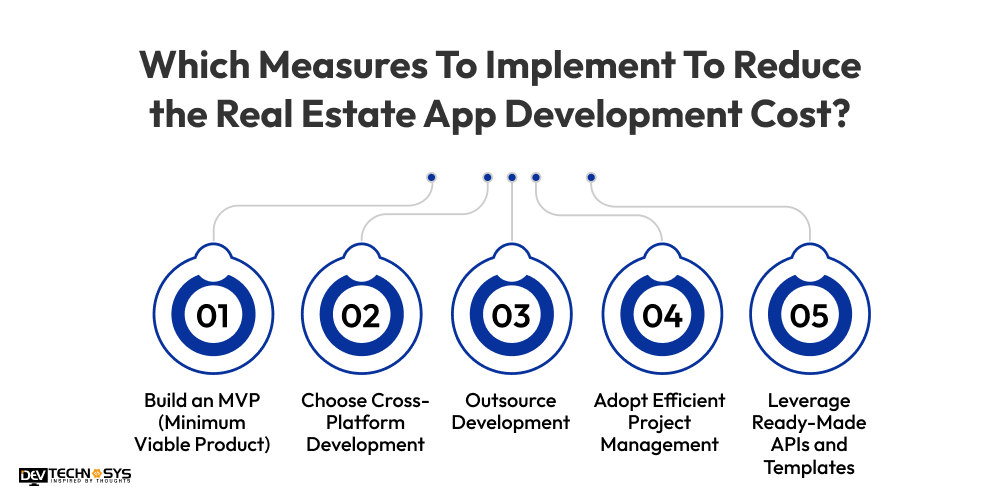
1. Build an MVP (Minimum Viable Product)
A real estate app development company often focuses on building an MVP first to reduce overall development cost. It helps lower the cost to build a Real Estate App by 20-30% by integrating only essential features initially.
2. Choose Cross-Platform Development
Picking up cross-platform app development services lowers the budget to make a real estate app by nearly 10-25%. A single codebase covers app development and iOS together, cutting down the testing and the mobile app maintenance budget.
3. Outsource Development
Outsourcing cost drops considerably when you hire developer teams from lower labor-cost regions worldwide. This cuts overall mobile app development costs by 10-20%, especially across India and Eastern Europe, or when outsourcing to Middle East hubs.
4. Adopt Efficient Project Management
To build a custom real estate app, efficient project management mandates clear goals and a defined real estate app development process. Agile sprints decrease rework, lowering the cost to develop a real estate app by nearly 20-30%.
5. Leverage Ready-Made APIs and Templates
Integrating third-party APIs while developing a real estate app can reduce overall development cost by 15-25%. Pre-built MLS, payment, and virtual tour solutions speed up development for apps like Dubai REST with fewer custom builds.
How To Effectively Monetize Your Real Estate App?
Monetizing your app means choosing the right ways to generate recurring revenue from buyers, agents, and partners. By implementing listing fees, subscriptions, and lead generation, you can earn a continuous income from your platform. We are here to discuss these monetization models in detail.
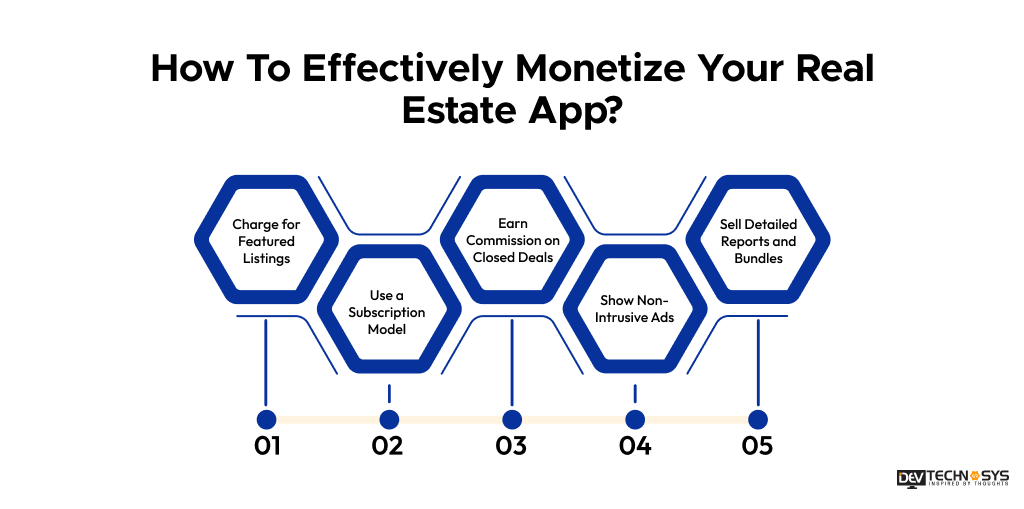
1. Charge for Featured Listings
Let agents and sellers pay to feature their property listings higher in search results and recommendations. This feels flexible and fair because they only pay extra for the visibility they actually want.
2. Use a Subscription Model
Provide agents and brokers with premium analytics, lead access, or CRM tools through monthly or yearly plans. After the property management software development, businesses can implement a subscription model to generate a steady income while giving professionals continuous, exclusive access to serious buyer leads.
3. Earn Commission on Closed Deals
Allowing brokers or agencies to close deals through your real estate marketplace app cost model works well in the long term. Commission-based pricing works because partners only pay once a transaction actually closes successfully.
4. Show Non-Intrusive Ads
Display limited but relevant ads to free users without interrupting their property search experience. This works best when users can remove ads entirely by upgrading to a premium agent plan.
5. Sell Detailed Reports and Bundles
Offer detailed valuation reports, neighborhood insights, or investment analysis as one-time purchases for serious buyers. Bundling services increases perceived value and encourages users to spend more in a single transaction.

Security & Compliance for UAE Real Estate Apps
UAE businesses must focus on implementing security measures and regulations for real estate marketplaces to earn customers’ trust and avoid legal issues. Since these applications are used by multiple users who handle financial and sensitive information, security practices must be followed.
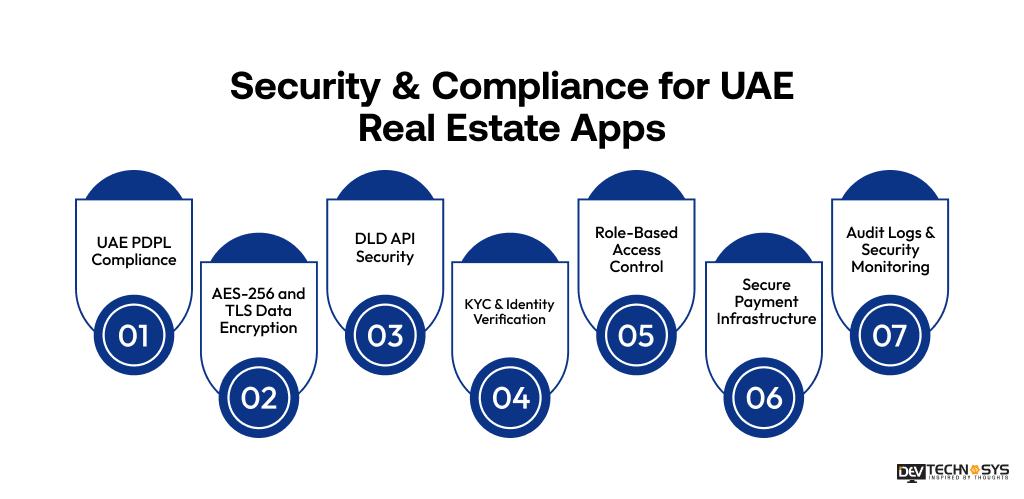
1. UAE PDPL Compliance
The UAE Personal Data Protection Law (PDPL) requires data protection and consent management for data deletion when required. This law protects data from cross-border data transfer using data minimization, privacy controls, purpose limitation, and secure data processing.
Estimated Cost: AED 15,000–40,000
2. AES-256 and TLS Data Encryption
In real estate apps, data is transferred between APIs, apps, and servers that is protected through data encryption. This security practice might add to real estate app development cost in Dubai
Estimated Cost: AED 8,000–20,000
3. DLD API Security
When integrating Dubai Land Department services into the real estate app, businesses must invest additional funds in property data security. This includes logging, integration testing, and API authentication to secure the transmitted data.
Estimated Cost: AED 20,000–60,000+
4. KYC & Identity Verification
The digital verification process involves transmitting sensitive data such as Emirates ID, passport, and OTP, which needs to be protected. The cost impact is medium to high for such a security protocol. UAE businesses must always collaborate with a CMMI Level 3-certified company to ensure this protocol is included in app development.
Estimated Cost: AED 15,000–40,000
5. Role-Based Access Control
To secure the real estate marketplace, developers implement RBAC to define access permissions for a limited set of users. This security practice often increases costs because developers must implement RBAC separately for each user.
Estimated Cost: AED 10,000–25,000
6. Secure Payment Infrastructure
PCI DSS-aligned processing, secure payment gateway integration, tokenization, and fraud controls are designed into the infrastructure to protect cardholder data. This limits data visibility to authorized users or service providers only.
Estimated Cost: AED 15,000–40,000
7. Audit Logs & Security Monitoring
UAE businesses often partner with an experienced real estate app development company that provides continuous monitoring services. The engineers test the features & functionalities by running audit logs, making administrative changes, performing KYC actions, and more to ensure the app is secure.
Estimated Cost: AED 10,000–30,000

Final Words
For a successful property listing platform development, there should be a proper balance of user experience, technology, and the overall real estate app development budget. Trends such as AI personalization and virtual tours can significantly improve user engagement. However, it raises the cost to build a real estate app across most project scopes.
By starting with an MVP and choosing the right property app development company, founders can control costs. With the right vision and the right real estate app development services partner, a real estate app can become a trusted one.
Are you ready to develop a profitable platform for property buyers and agents alike?
FAQs
Q1. Can I Build a Real Estate App Similar to Zillow or Dubai REST?
Yes, you can build a real estate app similar to Zillow or Dubai REST with features like property listings, interactive maps, AI recommendations, virtual tours, and agent dashboards. Depending on complexity, the development cost typically ranges from $70,000 to $150,000+, with custom integrations influencing the final budget.
Q2. How Can I Reduce the Cost of Real Estate App Development Without Compromising Quality?
The best way to reduce development costs is by starting with an MVP, prioritizing essential features, using cross-platform frameworks like Flutter or React Native, and partnering with an experienced development company. This approach minimizes initial investment while allowing you to scale your app as your business grows.
Q3. How Can Real Estate Apps Improve Lead Generation in the UAE?
AI real estate app development automates follow-ups, provides personalized recommendations, AI lead scoring, instant inquiry routing, and CRM integration to help businesses improve sales. Accurate data allows business leaders to convert quality leads into long-term customers.
Q4. Which Features Should I Prioritize in a Real Estate App to Maximize ROI?
To maximize return on investment, prioritize features such as advanced property search, interactive maps, user profiles, agent communication, saved listings, push notifications, and appointment scheduling. Once your platform gains traction, you can introduce AI recommendations, virtual tours, analytics, and multilingual support to enhance user engagement.
Q5. Is It Better to Build a Custom Real Estate App or Use a White-Label Solution?
A custom real estate app offers greater flexibility, scalability, branding, and long-term business value than a white-label solution. While custom development requires a higher initial investment, it enables unique features, seamless integrations, and complete ownership, making it the preferred choice for growing real estate businesses.
Q6. What Technologies Are Used to Build Real Estate Apps in the UAE?
A typical technology stack can include Flutter or React Native for cross-platform mobile development; React.js or Next.js for web development; Node.js, Python, or Java for backend services; PostgreSQL or MongoDB for data management; cloud infrastructure; AI/ML services; mapping APIs; payment gateways; and secure government APIs
Q7. Why Should I Hire a Professional Real Estate App Development Firm?
An experienced real estate app development firm helps you choose the right technology stack, build scalable architecture, ensure security compliance, and integrate advanced features efficiently. Their expertise reduces development risks, shortens time to market, and delivers a high-quality application that supports long-term business growth and profitability.